Looking for a structured learning path?
Explore our age-wise monthly curriculum with 4 subjects per month
Free Printable Worksheets
Browse Worksheets
Download free educational worksheets for children ages 1-8. Perfect for preschool, kindergarten, and early elementary learning activities.
Filters
Age Range
Curriculum
Tags

Soap & Pepper Science Experiment Worksheet for Preschoolers
This simple experiment introduces children ages 3-5 to the basic science of surface tension and how soap breaks it, using pepper flakes sprinkled on water as a visual demonstration. Watching the pepper scatter away the instant soap touches the water gives children a concrete, memorable example of cause and effect, an early building block for scientific thinking.
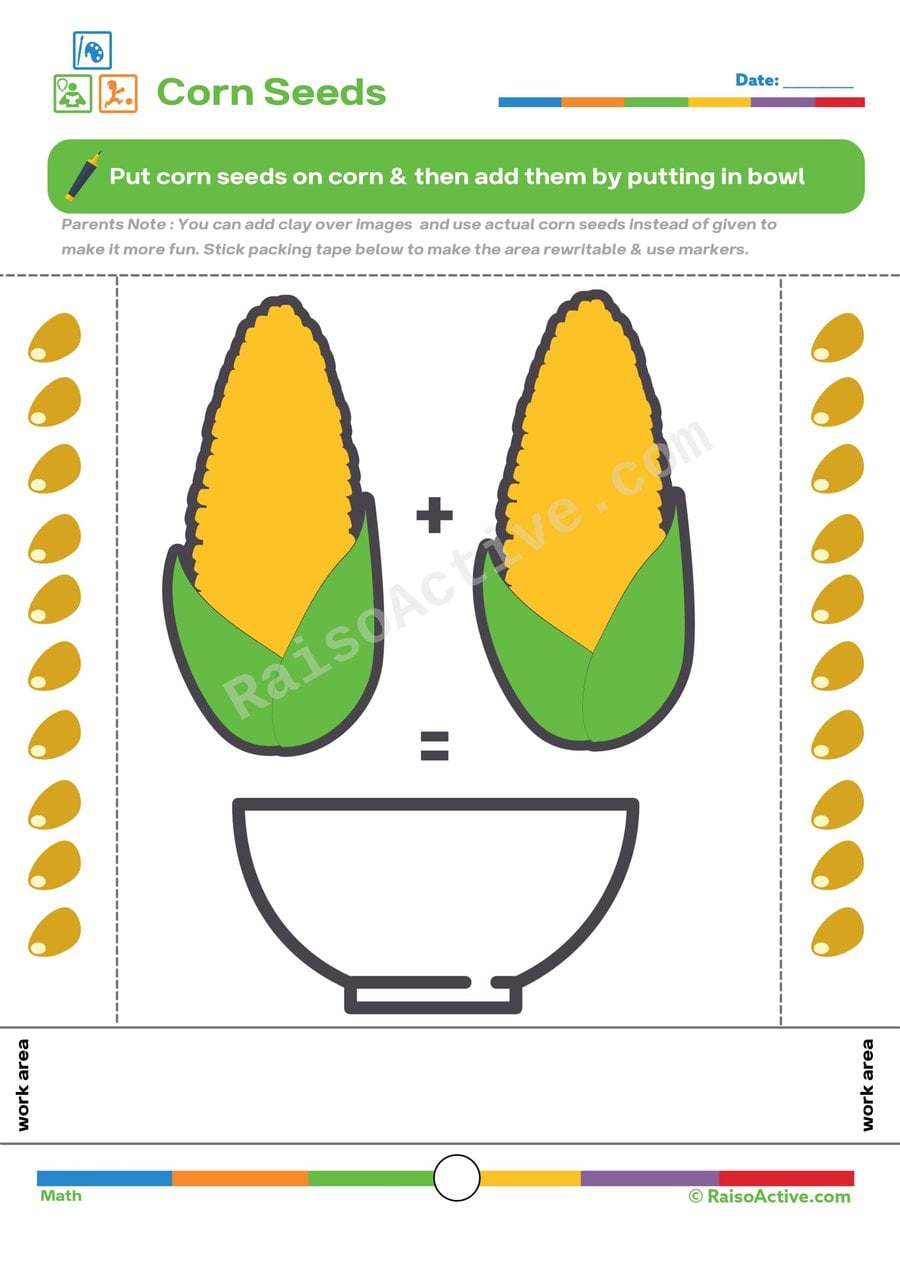
Corn Seed Addition Worksheet for Preschoolers
Counting corn seeds on two ears of corn and combining them into one total teaches children ages 3-5 the core concept of addition as joining groups together, using a concrete, countable image rather than abstract numerals alone. This worksheet also builds one-to-one correspondence, since accurate addition depends on touching or pointing to each seed exactly once while counting.

3D Shapes Worksheet: Explore and Learn with Playdough!
This worksheet teaches children ages 4-6 the basic components of 3D shapes — vertices, edges, and faces — by having them count each feature on shapes like cubes and cones, then build matching shapes out of playdough. Physically constructing a shape and counting its parts by hand builds a far deeper understanding of geometry than looking at flat pictures alone, since children can touch and rotate what they've made.

Soap & Pepper Science Experiment Worksheet for Preschoolers
This hands-on demonstration shows children ages 3-5 how soap disrupts water's surface tension, using floating pepper as a simple, visible indicator of the change. Because the reaction happens instantly and dramatically, it gives young children a strong, memorable first experience with predicting an outcome and then observing whether their prediction was right.

Color Mixing Fun: Primary and Secondary Colors Worksheet
This hands-on painting activity teaches children ages 3-5 the basics of color theory by having them paint the three primary colors first, then physically mix pairs of them to discover the secondary colors that result. Watching red and yellow blend into orange, or blue and yellow become green, right in front of them makes color mixing feel like a small science experiment rather than an abstract fact to memorize.

Head, Shoulders, Knees & Toes Rhyme Worksheet for Preschoolers
This rhyme-based worksheet has children ages 3-5 sing along to 'Head, Shoulders, Knees and Toes' while pointing to and naming each body part, combining music, movement, and vocabulary building in one activity. Rhythmic repetition is one of the most effective ways young children memorize new vocabulary, and pairing each word with a physical touch reinforces the connection between the spoken word and the actual body part. This kind of full-body engagement also supports gross motor coordination alongside language learning.
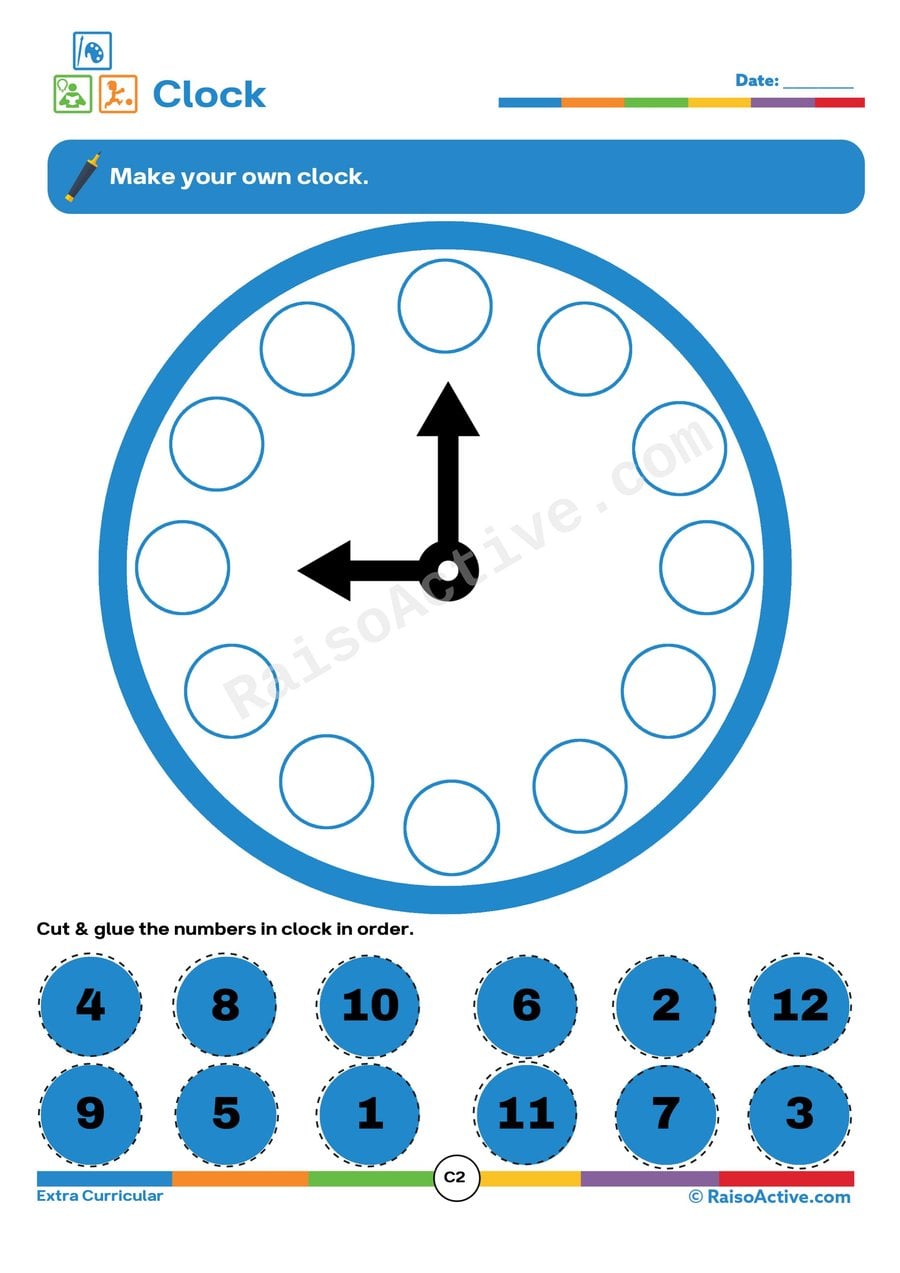
Make Your Own Clock Worksheet: Time Telling Fun!
This hands-on craft has children ages 4-6 cut out and glue numbers in order around a clock face, then draw hands to show different times, combining number sequencing with an introduction to how an analog clock is structured. Physically placing each number themselves, rather than reading a pre-printed clock, helps children internalize why the numbers 1 through 12 are arranged in that specific circular order. Drawing the hands afterward extends the activity from static number placement into functional time-telling practice.

Fun Activities for Kids: DIY Clock, No-Fire Cooking, and More!
This multi-activity guide gives children ages 3-5 hands-on practice with several different skills in one sitting — building a DIY paper clock to learn about time, assembling a simple no-fire recipe to build sequencing and following-directions skills, and exploring color mixing with tissue paper. Rotating through several short, varied activities keeps engagement high for young children whose attention spans are still developing. Each activity also builds language skills as children describe what they are doing.

Pikachu Pulses Worksheet: Following Instructions and Coloring Fun!
This activity helps children ages 3-5 practice following multi-step color instructions and strengthens pincer grip and fine motor precision as they place small dried lentils onto specific sections of a Pikachu outline. Working with tiny materials like lentils demands more finger control than crayons or markers, making this a genuinely challenging and rewarding fine motor exercise.

Healthy Habits Game: Roll the Dice and Practice Good Manners!
This dice-based board game teaches children ages 3-5 healthy habits and polite social language by combining movement, counting, and speaking practice in one activity. Rolling the dice and counting spaces builds number recognition and one-to-one counting, while landing on speaker icons gives structured practice saying polite phrases like 'please' and 'thank you' out loud. Coloring a smiley or sad face based on the habit shown also reinforces the idea that choices have positive or negative consequences.
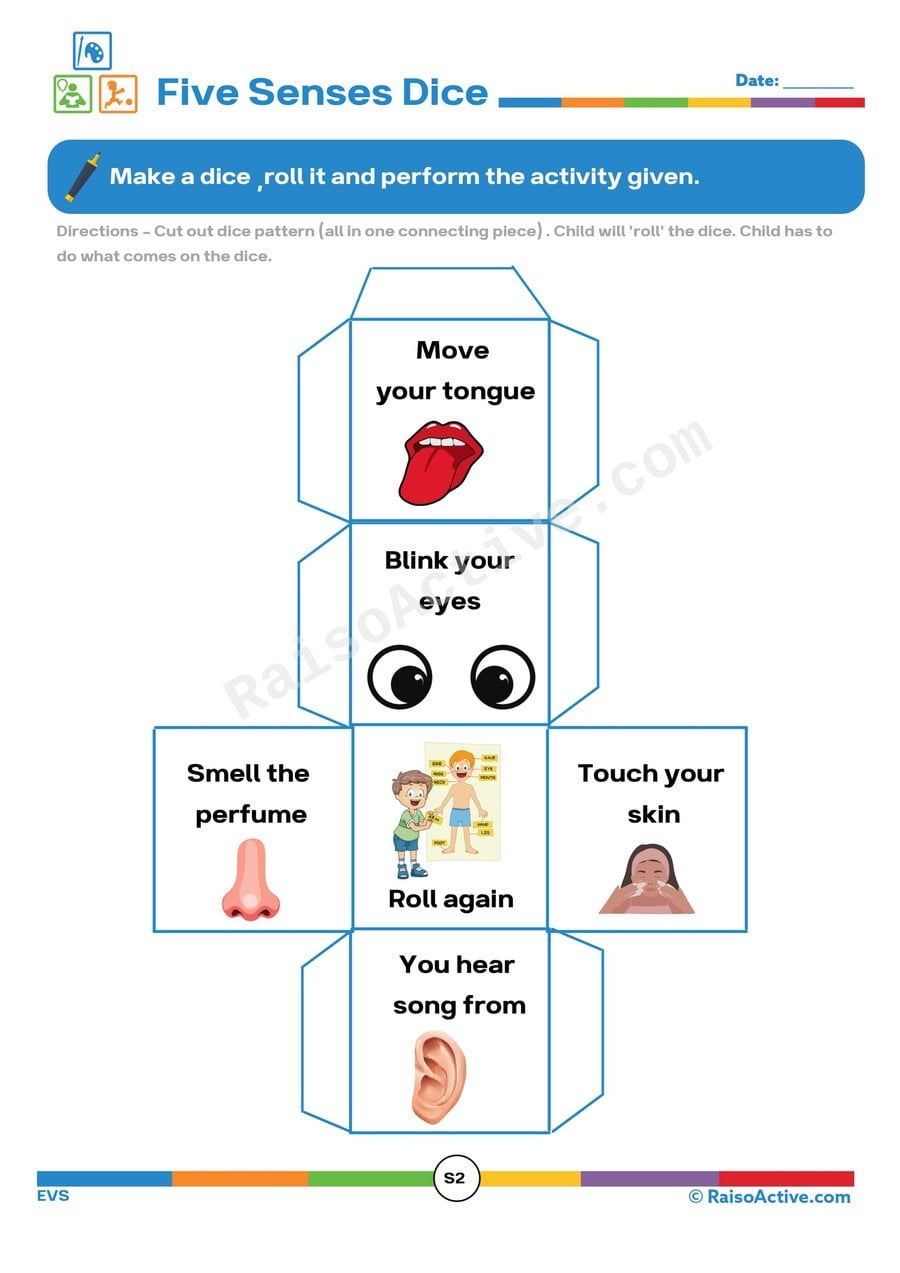
Five Senses Dice Activity: Roll and Explore!
Rolling a homemade dice to trigger sensory activities teaches children ages 3-5 to identify and use each of the five senses — sight, hearing, touch, taste, and smell — through direct hands-on exploration rather than only reading or discussing them. Building and assembling the dice itself also adds a light fine motor and spatial task before the sensory learning even begins.

Spin the Wheel Activity: Follow Instructions and Perform Actions!
Spinning a homemade wheel and performing whatever action it lands on teaches children ages 3-5 to listen carefully and follow a one-step instruction, a foundational social and self-regulation skill for classroom and group settings. Because the action changes with every spin, children also practice quick physical responses, like jumping, hopping, or spinning, which supports gross motor development. The randomness of the spinner keeps the activity unpredictable and exciting, which helps sustain engagement through repeated rounds.
Want Unlimited Downloads?
Subscribe to get unlimited access to all worksheets without watermarks
View Subscription Plans