Empowering Your Child's Success: How to Advocate for Your Child's Learning Needs
Author
RaisoActive - Kids Activities and Fun Learning
Published
Updated
Reading Time
15 min read

- Your child's rights in Indian schools — what the RTE Act and RPWD Act actually guarantee
- How to communicate with teachers effectively without putting anyone on the defensive
- Requesting accommodations without stigma — and what to say when schools push back
- Building a support team at home and school, plus how to keep useful records
- Teaching older children to speak up for themselves — the gift of self-advocacy
Why Advocacy Is the Most Important Skill You Can Have as a Parent
In many Indian homes, there is still an unspoken rule: the teacher knows best, and parents should not interfere. Schools are respected institutions, and questioning them can feel presumptuous — or even rude. But here is the truth that every parent of a child with different learning needs comes to understand: nobody will advocate for your child as fiercely or as consistently as you will.
Advocacy does not mean confrontation. It does not mean demanding, complaining, or making enemies of teachers. It means understanding your child's needs, communicating them clearly, and working persistently alongside educators to create the conditions your child needs to learn. It means showing up, asking questions, and not taking 'we'll see' for an answer.
Whether your child has a formal diagnosis of ADHD, dyslexia, autism, or a developmental delay — or whether you simply sense that something is not quite right and school is harder for them than it should be — this guide will walk you through everything you need to know to advocate effectively in the Indian school context and beyond.
Get practical parenting tools delivered to your inbox
Free worksheets, expert tips, and inclusive activity ideas for children ages 1–8. Join thousands of Indian parents who learn with RaisoActive.
Know Your Child's Rights: The Legal Framework in India
One of the most empowering things you can do as a parent is understand the legal protections that exist for your child. In India, two major laws are especially relevant for children with learning differences:
The Right to Education (RTE) Act, 2009 guarantees free and compulsory education to all children aged 6 to 14. For children with disabilities, the Act mandates that schools provide appropriate facilities and ensure inclusion. Private unaided schools must reserve 25% of seats at entry level for children from disadvantaged groups, which includes children with disabilities.
The Rights of Persons with Disabilities (RPWD) Act, 2016 is even more comprehensive. It covers 21 categories of disabilities — including specific learning disabilities such as dyslexia, dysgraphia, and dyscalculia — and mandates that government-funded educational institutions make reasonable accommodations. It also requires that children with disabilities receive appropriate support to access education on an equal basis with other children.
In practice, implementation varies enormously between states, cities, and school types. But knowing these laws exist gives you standing. When you walk into a school meeting and mention the RPWD Act, you signal that you are an informed parent — and that changes the conversation.
Recognising the Signs That Your Child Needs More Support
Advocacy begins with observation. Many parents feel something is off long before teachers or doctors confirm it. Trust your instincts — and know what to look for. While every child develops at their own pace, certain patterns across multiple settings (home, school, playground) deserve attention.
Common signs that your child may benefit from additional support include: persistent difficulty with reading or writing despite effort, extreme frustration during homework or learning tasks, difficulty following multi-step instructions, significant struggles with attention or sitting still in structured settings, frequent meltdowns around school work, reluctance to attend school, or a gap between what your child can do verbally and what they can produce on paper.
It is important to note that these signs do not automatically mean a diagnosis is needed. But they are signals worth exploring — with the school, with a developmental paediatrician, or with a child psychologist. The earlier you seek support, the better the outcomes. Brain plasticity is greatest in the early years, which means intervention during ages 1–8 has the most lasting impact.
Early identification is not about labelling your child. It is about giving them access to the right support at the right time — when it makes the biggest difference.
If you have concerns, request a formal assessment through your school or a private specialist. In India, educational psychologists at major hospitals and private clinics can conduct assessments that document learning differences and recommend accommodations.
How to Talk to Your Child's Teacher: Practical Communication Strategies
Your child's teacher is one of your most important allies — or one of your biggest obstacles, depending on how the relationship is managed. The good news is that most teachers genuinely want to help children succeed. They are often stretched thin, managing classrooms of 30–45 children with varying needs. Approaching them as partners, not adversaries, nearly always yields better results.
Start with appreciation. Before raising concerns, acknowledge what is working. 'Arya has been enjoying your stories in class — she mentions them at home' is a warmer opening than launching straight into problems. Teachers respond well to parents who recognise their efforts.
Lead with observation, not diagnosis. Even if you suspect ADHD, do not open the conversation by saying 'I think my son has ADHD.' Instead, describe what you observe: 'At home, Rohan struggles to finish tasks that take longer than 10 minutes. He does better with short bursts. Have you noticed something similar in class?' This invites collaboration rather than defensiveness.
Ask for regular communication. Request a short weekly update — even a two-line WhatsApp message or a quick note in the diary. Consistency matters. When home and school are aligned, children do significantly better. A simple system like a home-school diary, where both you and the teacher can write observations, can be transformative.
- Use collaborative language: 'I would love your insight on how Priya is doing — I want to make sure we are supporting her the same way at home and at school.'
- Avoid blame: instead of 'She is not getting enough support,' try 'I am wondering if there are strategies that might help her access the work more easily.'
- Come prepared with specific examples: bring a worksheet she struggled with, or describe a specific incident rather than making general statements.
- End with a shared next step: 'Could we try this for two weeks and then check in again?' gives the teacher a manageable commitment.
Requesting Accommodations Without Stigma
One of the biggest fears Indian parents face is stigma. 'What will people think?' is a genuine concern — not a shallow one. In many communities, a child receiving extra support is seen as 'slow' or 'different' in ways that feel shaming. But here is what experienced parents and educators know: accommodations are not special treatment. They are equal access.
If your child has poor eyesight, no one questions glasses. Glasses do not give the child an unfair advantage — they level the playing field. Accommodations work the same way. Extra time on a test for a child with dyslexia does not make the test easier; it removes the barrier created by slow decoding so that the child can demonstrate what they actually know.
Common and effective accommodations to request in Indian schools include: extra time during exams, oral exams as an alternative to written ones, reduced quantity of written work (same concepts, fewer problems), preferential seating near the front or away from distractions, use of a scribe for children with dysgraphia, access to enlarged print worksheets, and permission to use fidget tools during seated work.
For board examinations (CBSE, ICSE, state boards), formal accommodations are available to children with documented disabilities. These include extra time, the use of a writer, and question paper modifications. Applications must be made through the school to the relevant board well in advance — typically by November for March exams. Ensure you begin this process early, as it requires documentation from a certified specialist.
- Stay calm and ask for the school's reasoning in writing — this is your right.
- Reference the RPWD Act 2016: schools receiving government funding are legally required to provide reasonable accommodations.
- Request a meeting with the principal or special educator (if the school has one) rather than only the class teacher.
- Seek support from a parent advocacy group or disability rights organisation if the school continues to refuse.
- Document every conversation — keep notes with dates, names, and what was said or agreed.
Children in India are estimated to have some form of learning difficulty, yet the majority go unidentified and unsupported throughout their school years due to lack of awareness and stigma.
Source: Dyslexia Association of India, 2022
Building Your Child's Support Team
Effective advocacy is rarely a solo effort. The most successful parents build a small, informed team around their child — people who understand the child's needs and are working towards the same goals. This team might include the class teacher, a special educator or resource room teacher (if available), a developmental paediatrician or child psychologist, an occupational therapist (particularly for fine motor or sensory needs), a speech-language therapist (for language and communication), and — perhaps most importantly — you and your partner or co-parent.
In India, access to specialists varies enormously depending on where you live. If you are in a major city like Mumbai, Delhi, or Bengaluru, you likely have access to private practitioners and NGO-run resource centres. In smaller cities and towns, options may be more limited — but government hospitals often have paediatric rehabilitation units, and some states have district-level special educators through the Sarva Shiksha Abhiyan programme.
Keep records of everything. This is not about building a legal case — it is about having a clear picture of your child's journey so that every new teacher, specialist, or school understands where your child started and how far they have come. Create a simple folder (physical or digital) with assessment reports, school letters, communication records, and samples of your child's work over time.
A well-kept record is your child's story. When they move to a new class or school, those records mean the next teacher does not have to start from scratch — and your child does not have to struggle through a settling-in period that could have been avoided.
How to Navigate the IEP or Learning Plan Process
Request a formal assessment
Ask the school in writing for a learning needs assessment, or arrange one privately through an educational psychologist. A formal report is the foundation of any support plan and documents what accommodations are appropriate.
Request an Individual Education Plan (IEP) meeting
Once you have assessment results, request a meeting with the school to develop a support plan. In India, IEPs are not yet universally mandated in private schools, but you can still request one — call it a 'learning support plan' if IEP terminology meets resistance.
Come prepared with your priorities
Before the meeting, list the three to five outcomes that matter most to you for your child this year. Be specific: 'I want Arjun to be able to read a simple paragraph independently by March' is more useful than 'I want him to improve in reading.'
Review and understand every goal
Do not leave the meeting without understanding every goal in the plan. Ask how each goal will be measured and how often you will receive progress updates. If a goal seems vague, ask for it to be made more specific.
Get the plan in writing
Ensure the agreed support plan is documented and signed by both you and the school. You should receive a copy. If the school is reluctant to put things in writing, this is a red flag worth noting.
Monitor progress and schedule reviews
A learning plan is not a one-time document — it should be a living record that is reviewed at least every term. If strategies are not working, they need to be revised. Advocate for regular reviews, not just annual ones.
Celebrate progress, however small
Progress for children with learning differences often happens in smaller increments than expected. Acknowledge and celebrate every step forward — with your child, with their teachers, and within yourself. This keeps motivation high for everyone.
- +Request meetings in advance and come with written questions
- +Share what works at home so teachers can try similar strategies
- +Follow up in writing after verbal conversations to confirm what was agreed
- +Acknowledge the teacher's challenges and large class sizes
- +Frame concerns around your child's needs, not the school's failures
- +Bring assessment reports and professional recommendations to support requests
- -Arriving unannounced and expecting immediate answers
- -Comparing your child unfavourably to classmates in front of teachers
- -Making threats or invoking legal action as a first response
- -Speaking negatively about teachers in front of your child
- -Focusing on what the school is doing wrong rather than what could help
- -Dismissing the teacher's classroom observations as uninformed
Teaching Your Child to Advocate for Themselves
Parental advocacy is essential — but it cannot last forever. One of the most valuable gifts you can give your child is the ability to understand their own learning needs and communicate them to others. This is called self-advocacy, and it is a skill that begins to develop as early as age 5 or 6 and deepens significantly during the primary school years.
Start by giving your child language for their experience. Instead of 'You have a problem with reading,' try: 'Your brain learns reading in a different way. Lots of very clever people have brains like yours — and they found strategies that helped.' Help them understand that their difference is not a deficiency. It is just a difference.
Role-play conversations with your child so they know what to say when they need help. Practise phrases like: 'I am having trouble understanding this. Can you explain it differently?' or 'I do better when I can see the instructions written down — could I have a written copy?' For older children (7 and above), involve them in their own school meetings so they can hear the discussion about their needs and start to participate in it.
- Ages 3–5: Teach your child to say 'I need help' and 'I do not understand' — basic help-seeking is the foundation of self-advocacy.
- Ages 5–7: Help children identify what makes learning easier for them: 'Do you learn better when there is quiet, or when there is soft music?' Give them language for their preferences.
- Ages 7–8 and above: Practise 'self-advocacy scripts' through role play. Have your child practise explaining their learning needs to an imaginary teacher — then try it with the real one in a low-stakes situation.
- Read books together that feature characters with learning differences succeeding on their own terms — representation builds confidence and vocabulary around difference.
Children who develop self-advocacy skills during primary school show significantly better outcomes in secondary school and beyond, including higher rates of completing education and entering employment.
Source: National Center for Learning Disabilities, Self-Advocacy and Learning Disabilities Research, 2020
Support your child with the right tools, every week
Join thousands of Indian parents and teachers who receive free worksheets, inclusive activity ideas, and expert learning tips from RaisoActive. No spam — just resources that actually help.
Frequently Asked Questions
Does my child need a formal diagnosis before I can request accommodations?
My child's teacher says she is 'just lazy' or 'not paying attention.' What do I do?
What rights do children with disabilities have under Indian law?
How do I handle a school that is resistant to accommodations or dismisses my concerns?
My child does not want anyone at school to know they have extra support. How do I handle this?
Is there support available for parents who are navigating this for the first time?
Free worksheets for this topic
Browse all worksheets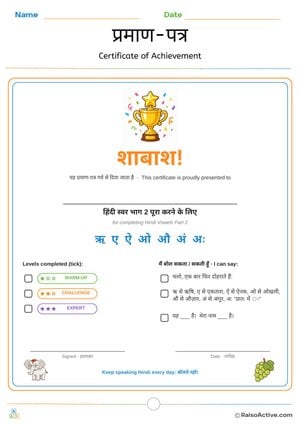
Hindi Vowels Part 2 Certificate of Achievement | प्रमाण-पत्र
Ages 3-7 · Preschool–Grade 1Ages 3-7 · Nursery–Year 2Ages 3-7 · Nursery–Class 1Ages 3-7
A certificate that celebrates finishing the pack, with a place for the child's name, tick boxes for the levels completed, sentences the child can say and space for a signature and date.
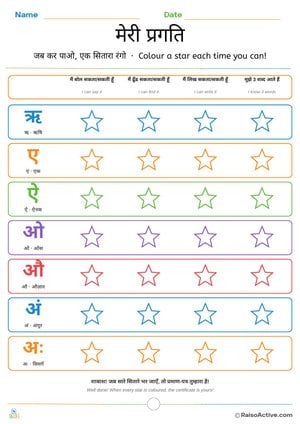
Hindi Vowels Part 2 Progress Tracker | मेरी प्रगति
Ages 3-7 · Preschool–Grade 1Ages 3-7 · Nursery–Year 2Ages 3-7 · Nursery–Class 1Ages 3-7
A progress chart with one row for each letter or sign (ऋ, ए, ऐ, ओ, औ, अं, अः) and four stars to colour: I can say it, I can find it, I can write it and I know 3 words.
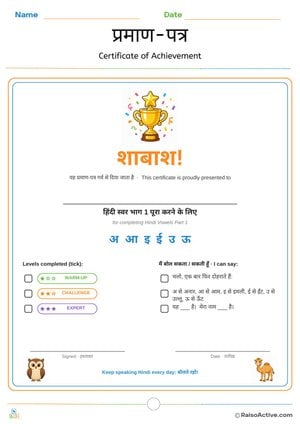
Hindi Vowels Part 1 Certificate of Achievement | प्रमाण-पत्र
Ages 3-7 · Preschool–Grade 1Ages 3-7 · Nursery–Year 2Ages 3-7 · Nursery–Class 1Ages 3-7
A certificate to celebrate finishing Hindi Vowels Part 1. It has a space for the child's name, tick-boxes for the three levels and the lines the child can now say (अ से अनार, आ से आम and so on).
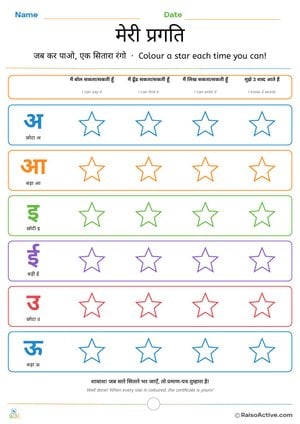
My Progress Chart: Colour a Star for Each Hindi Vowel Skill | मेरी प्रगति
Ages 3-7 · Preschool–Grade 1Ages 3-7 · Nursery–Year 2Ages 3-7 · Nursery–Class 1Ages 3-7
A star chart with the six vowels in rows and four skills in columns: I can say it, I can find it, I can write it and I know three words. Each time a skill is ready the child colours a star.

Written by
Hemsweta Jain · Teacher Cheena
MBA and Early Childhood Educator, teaching since 2014 · Founder of RaisoActive, Mumbai
Published · Last reviewed
Related posts
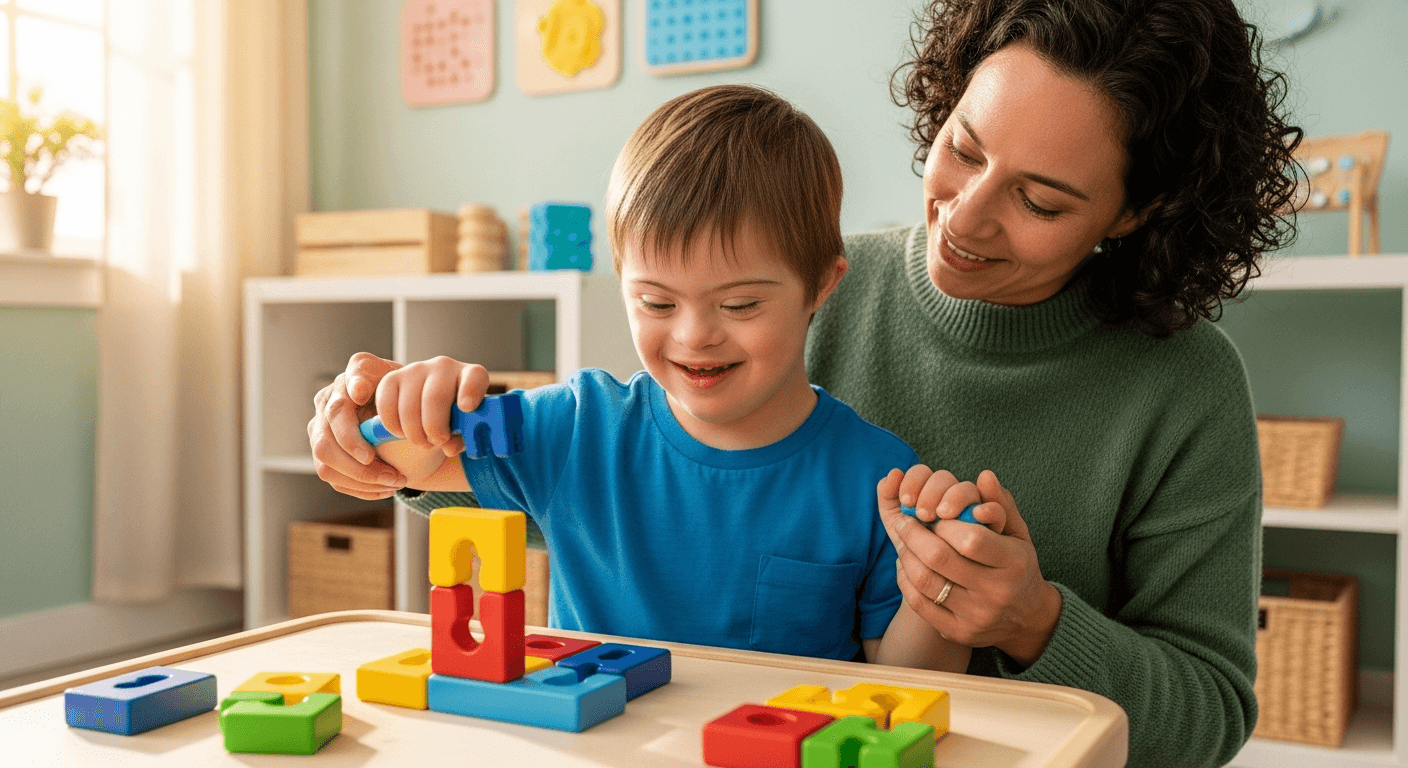
Supporting Your Child Who Learns Differently: A Comprehensive Guide for Parents
Practical strategies to support children with dyslexia, ADHD, dysgraphia & auditory processing differences at home and school. Indian context included.
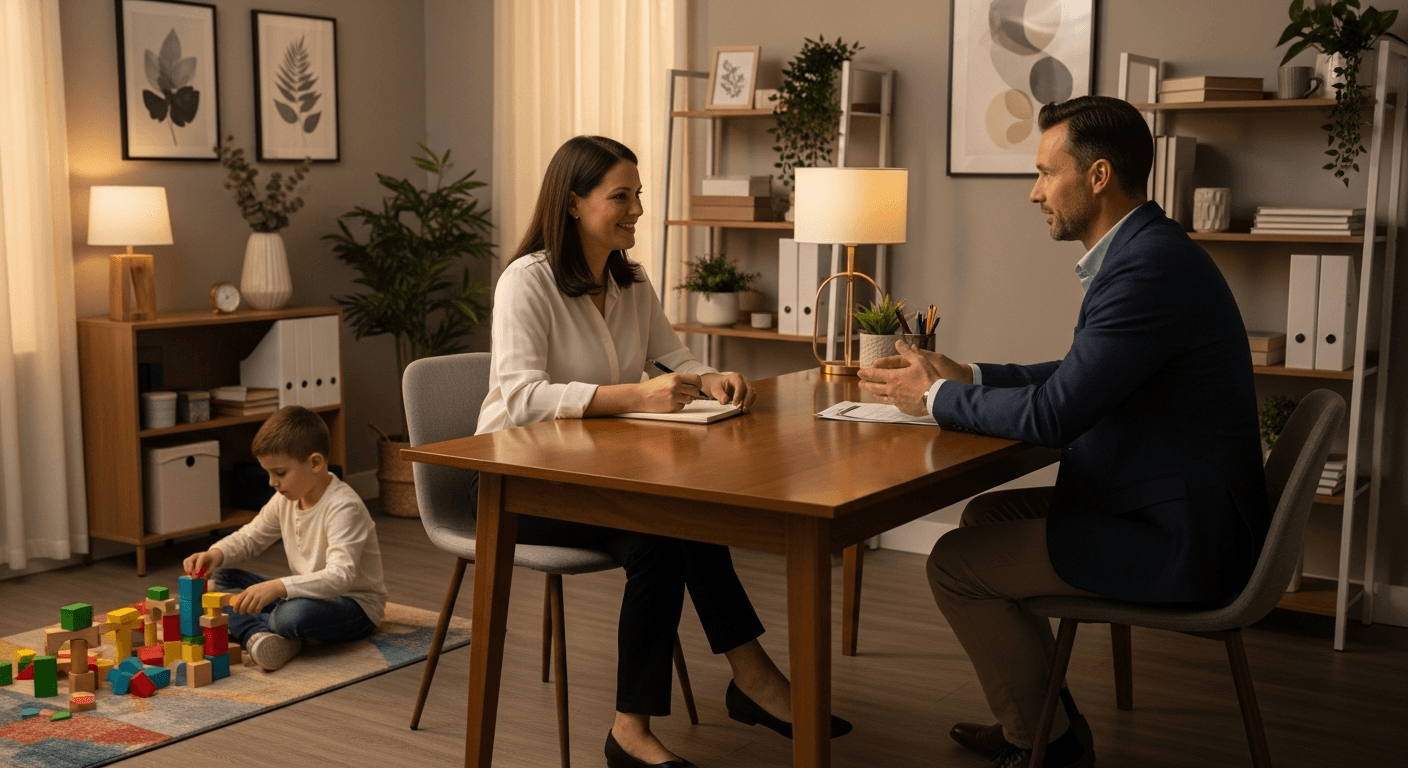
Navigating the Path to Support: Where Can I Find Professional Help for Learning Concerns?
Find out which professionals to consult for child learning concerns, red flags to watch for, and how to access evaluations in India — government, private, and online options.

What Red Flags Indicate Learning Difficulties? A Comprehensive Guide for Early Identification
Learn the age-by-age red flags for reading, writing, maths, and attention difficulties in children ages 1-8. Know when to seek help and where to find support in India.