How to Teach Your 3-Year-Old to Recognise Numbers: A Parent's Complete Guide
Author
RaisoActive - Kids Activities and Fun Learning
Published
Updated
Reading Time
7 min read

- Number recognition (naming a symbol) is a **different skill** from counting and quantity understanding — all three need to be built together, not drilled in isolation.
- By age 3, most children can recognise numbers **1 through 3** by sight; a typical 4-year-old can manage **1 through 5 or 6**. There is wide natural variation — this is a guide, not a rulebook.
- **Multi-sensory activities** — playdough, number hunts, sand tracing, songs — are far more effective than flashcards alone for this age group.
- Everyday moments (counting steps on the staircase, dosas on the plate, fingers on a hand) build number sense more powerfully than any worksheet.
- Number songs in Hindi and regional Indian languages give bilingual children a meaningful, joyful route into early numeracy.
Why Number Recognition Matters — and What It Really Means
Your 3-year-old holds up three fingers and announces "Three!" with enormous pride. You write the numeral 3 on a piece of paper — and they look at it blankly. Sound familiar? This is one of the most common early maths moments parents notice, and it reveals something important: counting, number recognition, and quantity understanding are three separate skills that develop at different rates and need different kinds of practice.
Number recognition means seeing the written symbol — the numeral 3 — and knowing its name. Counting means reciting numbers in the correct order. Quantity understanding (what mathematicians call cardinality) means knowing that the word 'three' corresponds to three actual objects. A child can be brilliant at reciting "one, two, three, four, five" like a song and still have no idea that 'four' means four things. This guide will help you build all three skills together — joyfully, gently, and in a way that fits real Indian family life.
Get Free Number & Counting Worksheets for Ages 2-4
Join thousands of parents across India who use RaisoActive printables to make early maths fun at home. New worksheets every week, completely free.
What to Expect: Number Milestones at Age 2, 3, and 4
Before diving into activities, it helps to have a realistic picture of what most children can do at each age. These are typical ranges — not performance targets. If your child is ahead in some areas and behind in others, that is completely normal.
- Age 2: Begins rote counting to 3 or 5 (often with gaps or repetitions). May recognise the numeral 1 in familiar contexts (e.g., on a clock or a birthday badge). Understands more versus less in a general, visual way.
- Age 3: Can usually count reliably to 5-10 out loud, though may skip numbers. Begins recognising numerals 1, 2, and 3 by sight. Understands that counting objects requires touching each one — though they still lose track easily. Grasps the concept of one and two as quantities.
- Age 4: Most children can recognise numerals 1 through 5 on sight; many can manage up to 10. Counts objects correctly up to 5-7 with one-to-one correspondence. Beginning to understand that the last number counted tells how many (cardinality principle). Can often write some numerals, though reversals (writing 3 backwards) are entirely normal at this age.
Number recognition is a symbol-sound link, not a measure of intelligence.
Learning to connect the symbol '3' to the word 'three' is similar to learning that the letter 'A' says /a/. It requires repetition, context, and — most importantly — a meaningful connection to real quantities. Children who seem 'behind' often simply haven't had enough varied exposure to numerals in meaningful contexts.
Numbers vs Numerals: A Distinction That Changes How You Teach
Here is a distinction that most parenting articles skip — and it matters. A number is an abstract mathematical idea: the concept of threeness, the idea that a quantity of three is one more than two and one less than four. A numeral is the written symbol we use to represent that idea: 3. When we talk about 'number recognition', we are technically talking about numeral recognition — the ability to look at a printed symbol and name it correctly.
Why does this matter? Because if you only teach a child to recognise the numeral without building the underlying number concept, you get rote learning without understanding. A child might recognise '4' perfectly and have no idea that it represents four actual mangoes. The activities in this guide are designed to build both together — always linking the symbol to the real quantity it stands for.
Multi-Sensory Activities That Actually Work for Toddlers
Three-year-olds learn through their bodies, not through sitting still and looking at things. The most effective number activities involve touching, moving, hearing, and doing. Here are the approaches that research and early childhood educators consistently recommend.
- Roll playdough into long snakes and shape them into numerals together. Say the number name as you form it.
- Press the correct number of small objects (beads, raisins, small stones) into the playdough next to the numeral to link symbol and quantity.
- Let your child squish and remake — the repetition of forming the shape builds muscle memory alongside recognition.
- Start with 1, 2, and 3 before moving on. A child who *knows* three numbers deeply is further ahead than one who vaguely recognises ten.
- Print or write large numerals on sticky notes and hide them around a room. Ask your child to find all the "3s" today, all the "2s" tomorrow.
- Go on a number hunt outside — look for numerals on doors, buses, auto-rickshaws, shop signs, and milk packets.
- Point out numbers on the TV remote, the washing machine dial, and the clock. Ask: *"Can you find the number 2 on the remote?"*
- The excitement of *searching* makes numbers feel like treasure — and memorable things are learned faster.
- Fill a shallow tray with fine sand, semolina (sooji), or salt. Show your child how to trace a numeral with their finger.
- Say the number name clearly as they trace: *"This is 4. Can you trace the 4?"* Then hold up 4 objects beside the tray.
- The tactile sensation of tracing reinforces the numeral shape through muscle memory — the same pathway that helps children learn to write later.
- Shake the tray to "reset" — children find this enormously satisfying and will happily repeat the activity many times.
Number Songs and Rhymes: The Indian Advantage
Songs are one of the most powerful tools for early number learning — and Indian families have a rich tradition to draw on. The rhythmic, repetitive structure of number songs helps children internalise counting sequences far faster than direct instruction. Crucially, songs in your home language are often the most effective starting point, because children's deepest emotional and conceptual understanding is anchored in the language they hear most.
- Hindi: "Ek do teen, ek do teen, haath mila le meri jaan" and traditional counting songs like "Machli jal ki rani hai" (which involves counting movements) are joyful entry points. Simply counting in Hindi during daily routines — ek, do, teen steps on the stairs — builds number sequence naturally.
- Tamil: "Onnu rendu moonu naalu" counting rhymes and the classic "Kannamma Kannamma" are beloved across Tamil-speaking families.
- Telugu: "Okati rendu moodu naalu" — straightforward number counting in Telugu works beautifully as a chant during play.
- Marathi: "Ek, don, teen, char" counting during games like Antakshari-style number chains keeps it playful.
- English: Five Little Ducks, Ten in the Bed, One Two Three Four Five, Once I Caught a Fish Alive, and Jack Hartmann's number recognition songs on YouTube are all excellent. Many Indian children respond enthusiastically to these because they see them as "English-world" learning — exciting and a little exotic.
- Mixing languages intentionally: Count to five in English, then immediately count to five in your home language. This cross-linguistic repetition strengthens both number concept and bilingual fluency simultaneously.
Children who learn number concepts through songs and movement consolidate them approximately three times faster than those exposed to numerals through flashcards alone, according to early childhood numeracy research. Rhythm and physical action create stronger memory traces in young children.
Source: Journal of Experimental Child Psychology, 2019
Everyday Maths Moments: Your Home Is Already a Number Classroom
You do not need to set up a formal lesson to build number recognition and number sense. The richest maths learning for 3-year-olds happens in the flow of daily life. Here are the kinds of moments that make a real difference — most of them take less than thirty seconds.
- Meal times: "I am putting 3 rotis on your plate. One... two... three. How many rotis do you have?" Then point to the numeral 3 on the date on the newspaper nearby.
- Staircase: Count steps every time you go up or down together. After a few weeks, ask your child to lead the count.
- Vegetables and fruit: Counting the number of guavas in the bag, idlis on the plate, or grapes in the bowl makes quantity feel real and immediate.
- Lift and floor buttons: Press the button for your floor together and say: "We are going to floor 4. Can you see the 4?" Point to the numeral.
- Clocks and timers: "The timer says 3 minutes. When the beep goes, your time is up." Children absorb numerals from clocks and timers effortlessly with repeated exposure.
- Bedtime: "I will read you 2 stories tonight. One story... now the second story." Ordinal language (first, second, third) quietly builds alongside cardinal number understanding.
Quantity before symbol — always.
When introducing a new number, always show the quantity first (three actual objects), then the word ('three'), then the numeral ('3'). The symbol should feel like the shortcut for something real, not an abstract squiggle to be memorised.
Common Mistakes Parents Make (And How to Avoid Them)
Most parents approach number learning with the best intentions — but some common habits can actually slow things down or create anxiety around maths. Here are the ones worth knowing about.
- **Drilling before understanding:** Showing flashcards of numerals before your child has any sense of what those numbers *mean* as quantities leads to empty recitation. A child who can say "one, two, three, four, five" in perfect order may still have no idea that "four" means four things. Build quantity understanding first.
- **Expecting too much too soon:** Recognising all numerals 1-10 is typically a 4-year-old milestone, not a 3-year-old one. If your 3-year-old reliably knows 1, 2, and 3 — that is genuinely good progress. Celebrate it.
- **Treating it like a test:** "What number is this? Are you sure? What about this one?" — rapid-fire questioning feels evaluative, not exploratory. Ask with genuine curiosity: *"Hmm, what do you think this number could be?"*
- **Skipping the physical:** Worksheets alone are not enough for this age group. A 3-year-old needs to touch, move, and manipulate to truly understand. Think of written activities as the *consolidation* phase, not the primary learning method.
- **Correcting every error immediately:** Give your child 5-10 seconds to self-correct before stepping in. Immediate correction erodes confidence and teaches children to wait for the adult's answer rather than thinking it through.
develops some degree of maths anxiety by the time they reach primary school — and research consistently links this to early experiences of pressure, correction, and timed testing around numbers. A warm, unhurried approach in the toddler years is genuine prevention.
Source: British Journal of Educational Psychology, 2020
A Step-by-Step Approach: Introducing Numbers 1 to 10
Here is a simple, sequenced approach you can follow at home. There is no rush — spend as long as your child needs on each number before moving on. Depth beats breadth at this age.
How to Introduce Each New Number (Repeat for 1 Through 10)
Step 1: Experience the quantity (Days 1-3)
Gather that many real objects. If introducing 4, gather 4 blocks, 4 raisins, 4 toy cars. Count them together slowly, touching each one. Say the number name clearly. Make it physical — put the 4 objects into a bowl, take them out, group them differently. The goal is for the child to *feel* what fourness is before ever seeing the numeral.
Step 2: Introduce the numeral (Day 3-4)
Write the numeral large on paper, or show it on a number card. Say: *"This special symbol means four — the same four we counted!"* Trace it together with a finger. Place the four objects next to the numeral so the connection is visible. Let your child trace it with their finger, then in sand or on your back (finger-writing on someone's back is a favourite with toddlers).
Step 3: Find it in the environment (Days 4-7)
Go on a numeral hunt specifically for that number. Look on doors, clocks, remotes, buses, books. Each time you find it, say the number name and hold up the correct number of fingers. This phase builds the crucial connection between the abstract symbol and the real world.
Step 4: Play with it (Days 5-10)
Integrate the number into play. Play a simple matching game: cards with the numeral on one side and dots on the other, placed face down. Sing songs that feature that number. Draw it in different colours, make it from sticks, stamp it with a sponge. The more varied the exposure, the stronger the memory trace.
Step 5: Review and mix (Ongoing)
Once your child knows 2-3 numbers, start mixing them in short review games. Lay out three number cards and ask your child to point to a specific one. Go slowly — accuracy matters more than speed. Only introduce the next number when the previous ones are solid across several days.
How Do Worksheets Fit In? Getting the Balance Right
Worksheets have an important but limited role in early number learning. For a 3-year-old, they are best thought of as consolidation activities — a way to practise and celebrate what has already been understood through hands-on exploration, not the primary teaching tool.
- +Your child already understands the concept and wants to show what they know
- +The activity involves tracing, colouring, or counting rather than abstract symbol recognition alone
- +Sessions are short (5-10 minutes), child-led, and pressure-free
- +The worksheet connects the numeral to a picture of the corresponding quantity
- +You use them as a springboard — "You coloured 3 apples! Let's find 3 things in the kitchen now"
- -Your child doesn't yet have a feel for what the numbers mean as quantities
- -The worksheet is the first or only exposure to a number concept
- -It becomes a daily obligation that creates resistance or tears
- -The child is expected to complete it independently without discussion
- -It replaces hands-on, playful exploration rather than complementing it
The best number worksheets for this age group involve tracing numerals, matching numerals to quantities (drawing the right number of dots or circling the right number of objects), and colouring by number. These activities combine visual recognition with a physical action, which makes them developmentally appropriate.
Ten minutes of play beats fifty minutes of worksheets at age 3.
This is not a criticism of worksheets — it is a statement about brain development. A 3-year-old's working memory, attention span, and abstract reasoning are still very early in development. Play-based, physical, and conversational activities are simply more effective learning vehicles at this stage. Use worksheets to consolidate and celebrate — not to introduce.
Try These Free Number Worksheets
Get a New Maths Worksheet Every Week — Free
Subscribe to RaisoActive and receive freshly designed number recognition and counting worksheets straight to your inbox. Trusted by parents and early years teachers across India.
Frequently Asked Questions
At what age should my child be able to recognise numbers 1-10?
My child can count to 20 but cannot recognise the numerals. Is something wrong?
Should I teach numbers in order (1, 2, 3...) or in any order?
My child confuses 6 and 9, or 2 and 5. How do I help?
How much time should I spend on number activities each day?
Is it better to teach numbers in English or in our home language first?
Free worksheets for this topic
Browse all worksheets
Trace the Numbers 1-9 Worksheet for Preschoolers
Tracing the numerals 1 through 9 gives children ages 3-5 repeated, guided practice with the specific pencil strokes each number requires, building the fine motor control and muscle memory needed for independent number writing. Because tracing follows a fixed, correct path, it also reinforces accurate numeral recognition, helping children tell visually similar digits apart.
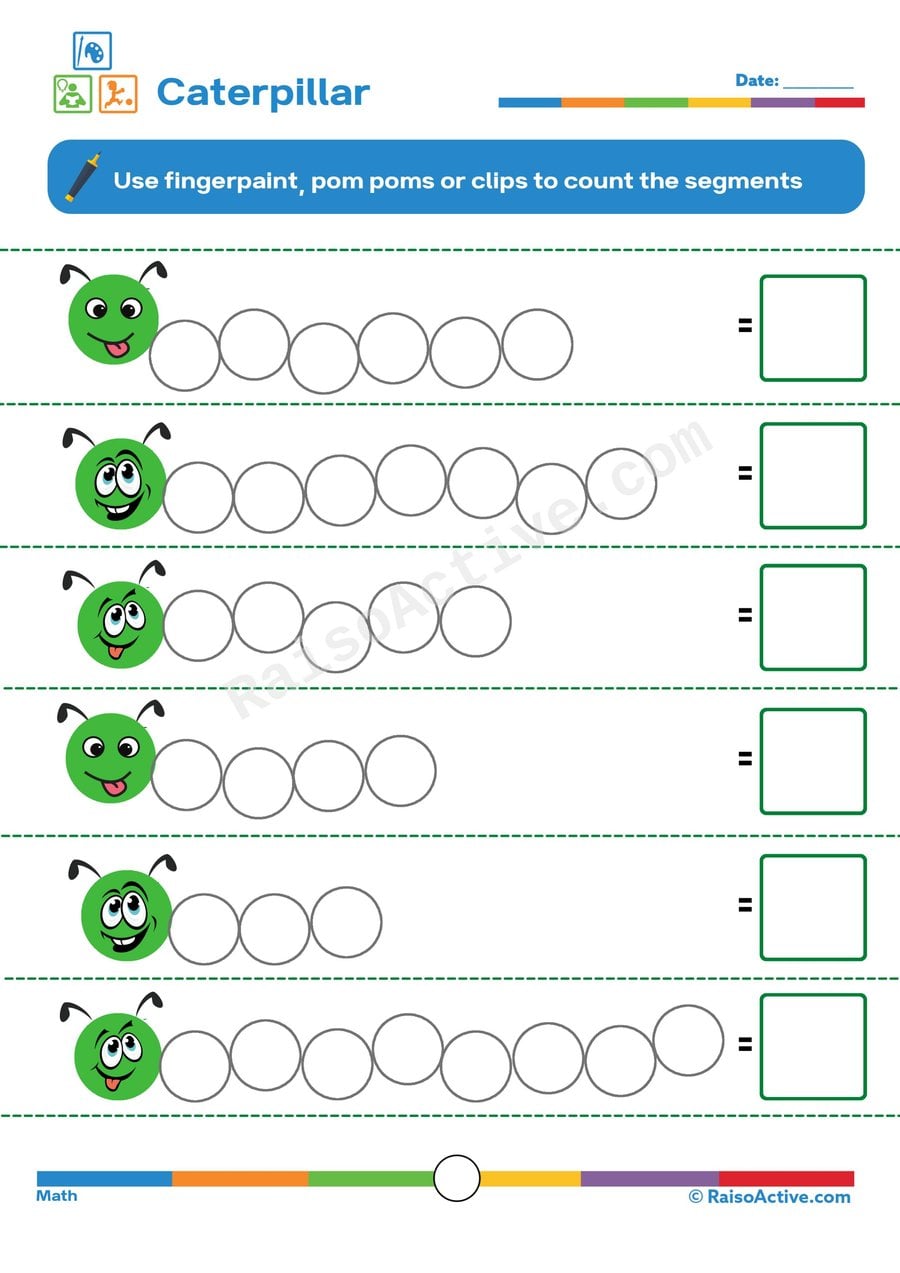
Caterpillar Counting Worksheet for Preschoolers
Counting the segments of each caterpillar teaches children ages 3-5 one-to-one correspondence — touching or marking each segment exactly once while saying a number — which is the core skill underlying accurate counting. Writing the final total in a box also connects the physical act of counting to its written numeral, reinforcing early number-writing practice.
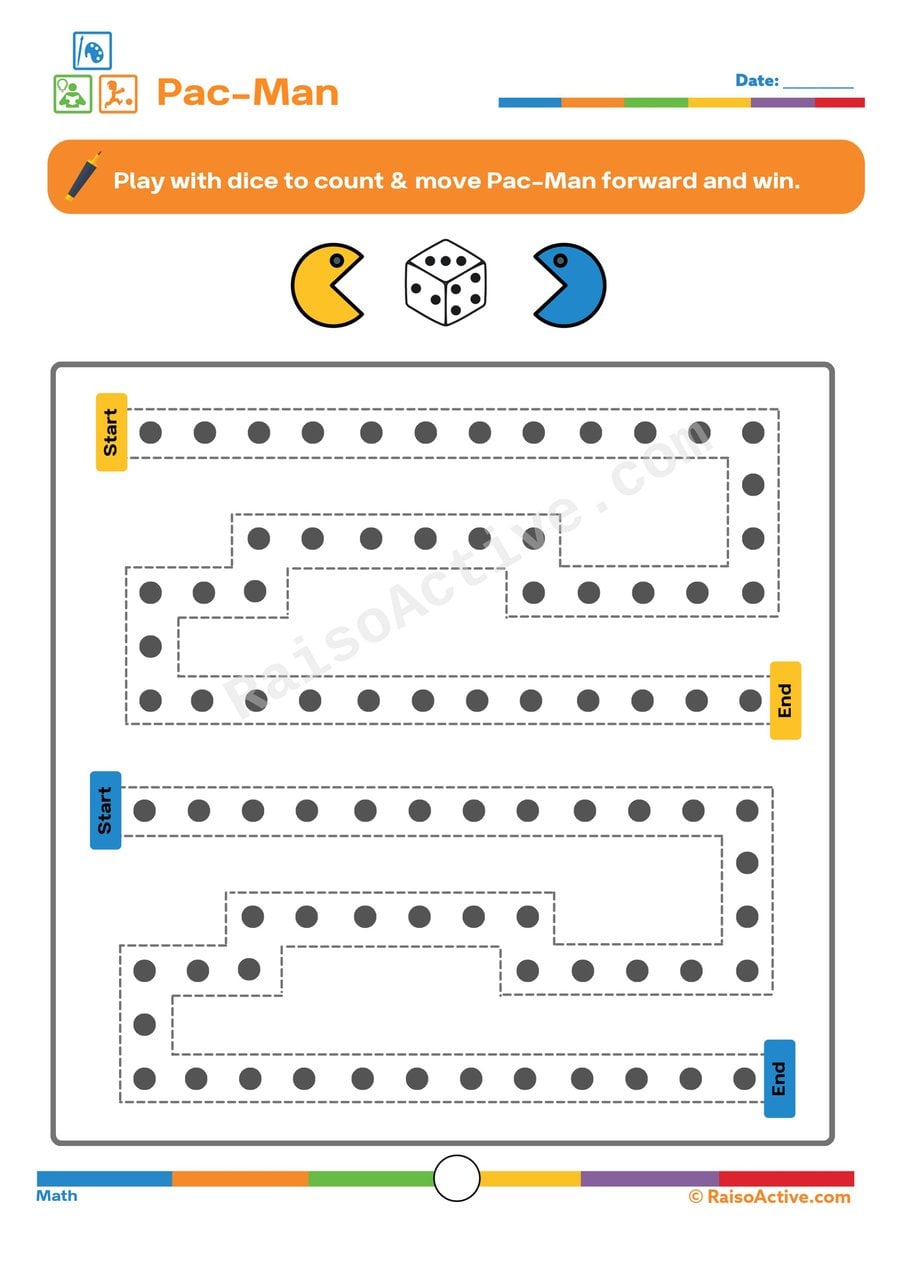
Pac-Man Maze Worksheet: Count and Move!
This dice-counting maze gives children ages 3-5 repeated practice matching a rolled number to the correct number of moves, reinforcing accurate counting under a bit of playful pressure. Tracking Pac-Man's current position after each roll also builds short-term spatial memory, since children must remember where they left off before moving again.
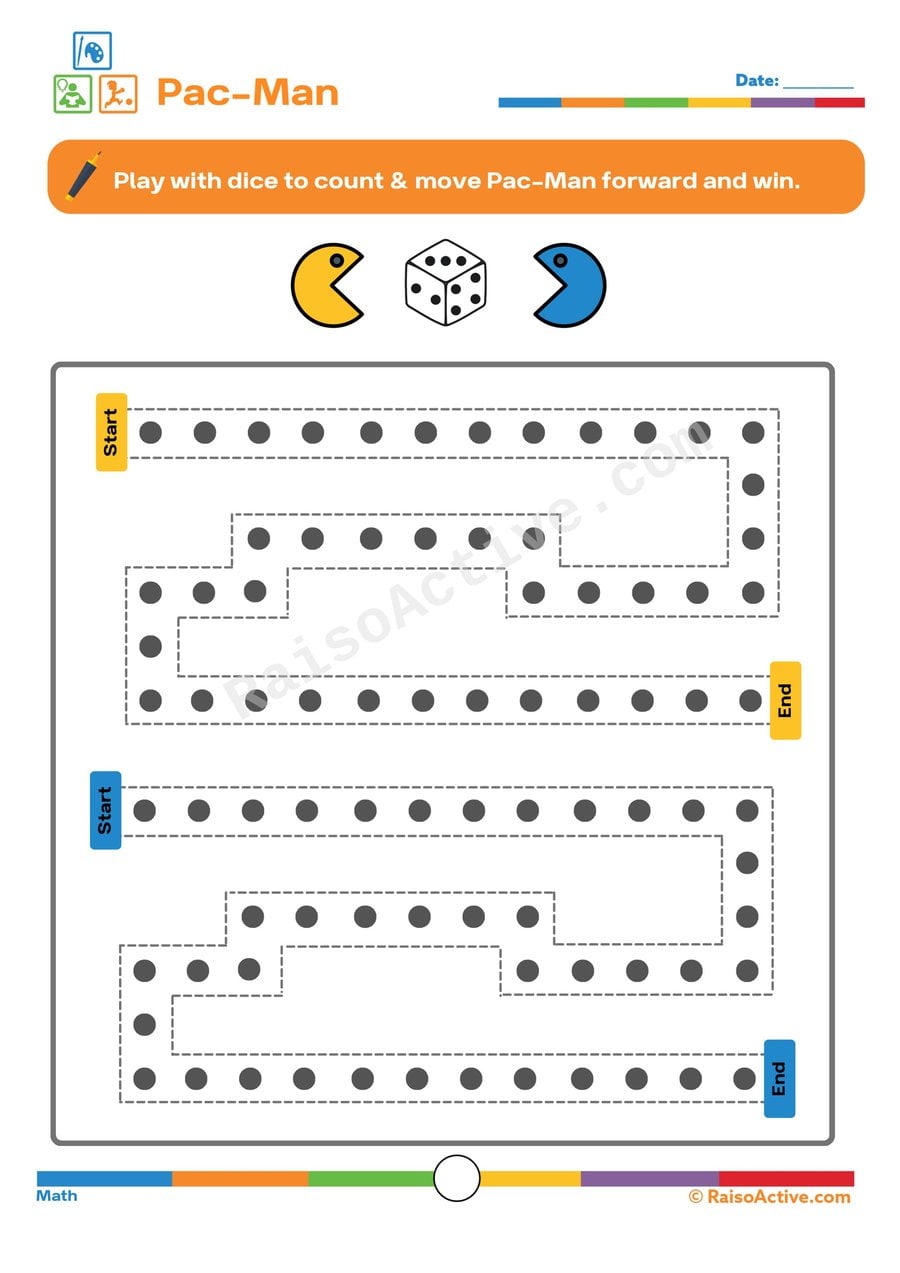
Pac-Man Maze Worksheet: Count and Move!
This dice-driven maze combines counting practice with path-following for children ages 3-5, since they must accurately count dots on a die before moving Pac-Man the matching number of spaces forward. Deciding how far to move and staying on the correct path also builds early strategic thinking, as children track their current position within the maze after each turn.

Written by
Hemsweta Jain · Teacher Cheena
MBA and Early Childhood Educator, teaching since 2014 · Founder of RaisoActive, Mumbai
Published · Last reviewed