Literacy, Early Learning
How to Teach Letter Sounds vs. Letter Names: A Complete Guide for Parents and Teachers
Author
RaisoActive - Kids Activities and Fun Learning
Date Published
Reading Time
8 min read

In This Article5 min read
- Research strongly supports **teaching letter sounds before letter names** — children who learn sounds first begin decoding words faster and with greater confidence.
- Knowing a letter's name but not its sound creates a frustrating gap: a child can sing the alphabet song perfectly yet still be unable to read the word *cat*.
- Letter names can and should be introduced alongside sounds — but sounds must be the **primary focus** from the very beginning of literacy instruction.
- In the Indian context, where English is often a second or third language, **explicit phonics instruction** is especially important because children cannot rely on ambient language exposure the way native English speakers can.
- A practical teaching sequence, multisensory activities, and simple daily routines can make this whole process joyful and effective for children aged 3-8.
The Question Every Parent Asks at Some Point
Your child can sing the alphabet song from start to finish. They point at letters confidently. They know A is for Apple, B is for Ball. And then you sit down to help them read a simple word like sit — and everything falls apart. They stare at the page, confused, unable to connect what they know about letters to the actual business of reading.
This scenario plays out in homes and classrooms across India every single day. The reason, more often than not, is a subtle but critical gap: the child has learned letter names without truly internalising letter sounds. These two things feel similar. They are not. Understanding the difference — and knowing which to teach first and how — is one of the most important things a parent or teacher of young children can do. This guide will walk you through everything you need to know, clearly and practically.
Get Free Phonics and Alphabet Worksheets
Join thousands of parents and teachers across India who use RaisoActive printables to make letter sounds and phonics practice fun. New worksheets every week, completely free.
Letter Names vs. Letter Sounds: What Is the Actual Difference?
A letter name is what we call the letter. The letter B is called "bee". The letter C is called "see". The letter H is called "aitch". These names are what children learn when they sing the alphabet song, and they are useful for spelling aloud, talking about language, and eventually learning dictionary skills.
A letter sound — also called a phoneme — is the actual sound that letter represents in spoken words. The letter B makes the sound /b/ as in ball, bat, bed. The letter C most commonly makes the sound /k/ as in cat, cup, clock (and sometimes /s/ as in city, but that comes later). The letter H makes the sound /h/ as in hat, hill, hot.
Here is where the confusion lives: the name of many letters tells you very little about the sound they make. "Bee" does not sound like /b/. "Aitch" does not sound like /h/. "Why" does not sound like /w/. When a child tries to decode the word dog and thinks "dee, oh, gee" instead of /d/, /o/, /g/, they are using names where they should be using sounds — and the result is confusion, not reading.
What the Research Tells Us: Sounds First, Names Second
The evidence from decades of reading research is remarkably consistent on this point: letter-sound knowledge is a stronger predictor of early reading success than letter-name knowledge. Studies by researchers including Treiman, Tincoff, and Adams have shown repeatedly that children who learn letter sounds alongside or before letter names begin to decode words earlier, make fewer errors, and develop phonological awareness more rapidly.
The landmark 1997 U.S. National Reading Panel and subsequent reviews all concluded that systematic, explicit phonics instruction — the formal teaching of letter-sound relationships in a structured sequence — is the most effective foundation for early reading. The Simple View of Reading, now widely accepted in reading science, shows that decoding (which depends on letter-sound knowledge) is one of the two pillars of reading comprehension. Without it, children cannot become independent readers, regardless of how rich their vocabulary or listening comprehension is.
None of this means letter names are unimportant. Children who know letter names do have an advantage — particularly for letters whose name contains the sound (such as B = "bee" which starts with /b/, or F = "eff" which ends with /f/). But the advantage of names without sounds is severely limited. The practical takeaway is: prioritise sounds, then layer in names alongside them.
Key Takeaway
Letter sounds unlock reading. Letter names unlock spelling aloud.
Both matter — but they serve different purposes. A child needs letter sounds to decode words on the page. They need letter names to say 'C-A-T spells cat' or look up a word in the dictionary. Teach sounds first and emphasise them more heavily in early literacy. Introduce names alongside sounds, but never at the expense of sound practice.
Why the Alphabet Song Is Not Enough (and What to Do Instead)
The alphabet song is a marvel of memorability — most children can learn it before they turn three. But here is the honest truth: singing the alphabet song is not literacy instruction. It teaches the sequence of letter names set to a catchy tune. It does not teach what any of those letters sound like, what they look like individually (the song famously blurs LMNOP into a single syllable), or how they connect to printed text.
This does not mean you should stop singing the alphabet song. It is a wonderful introduction to the idea that language is made up of distinct units called letters, and it gives children a mental map of the alphabet's sequence. But it should be treated as one small piece of the literacy puzzle, not the centrepiece of early reading instruction.
Phonics songs are a far more powerful companion to the alphabet song for early literacy. Songs like "A says /a/, A says /a/, every letter makes a sound, A says /a/" directly reinforce sound-to-letter connections. Resources like the Jolly Phonics songs, the Letter Sounds songs on the BBC Teach channel, or even the popular Alphablocks series on YouTube do what the alphabet song cannot: they make the sounds of letters memorable and fun. In Indian homes and classrooms, these resources are easily accessible and genuinely effective.
💡Replace One Alphabet Song Session with a Phonics Song
- You do not have to choose between the alphabet song and phonics songs — but be intentional about the ratio.
- Aim to sing or chant a letter *sound* at least as often as you practise a letter *name*. For every "B is for Ball, B says Bee", add a "B makes the sound /b/ — listen: /b/, /b/, ball, bat, bus."
- Jolly Phonics songs (available free on YouTube) are especially popular with children aged 3-5 and introduce all 42 phoneme-grapheme correspondences in a systematic, musical way.
- Alphablocks (BBC) is freely available on YouTube and is one of the most research-aligned children's phonics shows available. Many Indian families use it to great effect alongside classroom instruction.
How Phonics Programmes Handle This: A Structured Sequence
Structured phonics programmes — such as Jolly Phonics, Read Write Inc., and the various programmes endorsed by CBSE and ICSE curricula — teach letter sounds in a carefully designed sequence rather than simply following alphabetical order. The sequencing logic is deliberate: teach the most frequently occurring sounds first, so children can begin blending real words as early as possible.
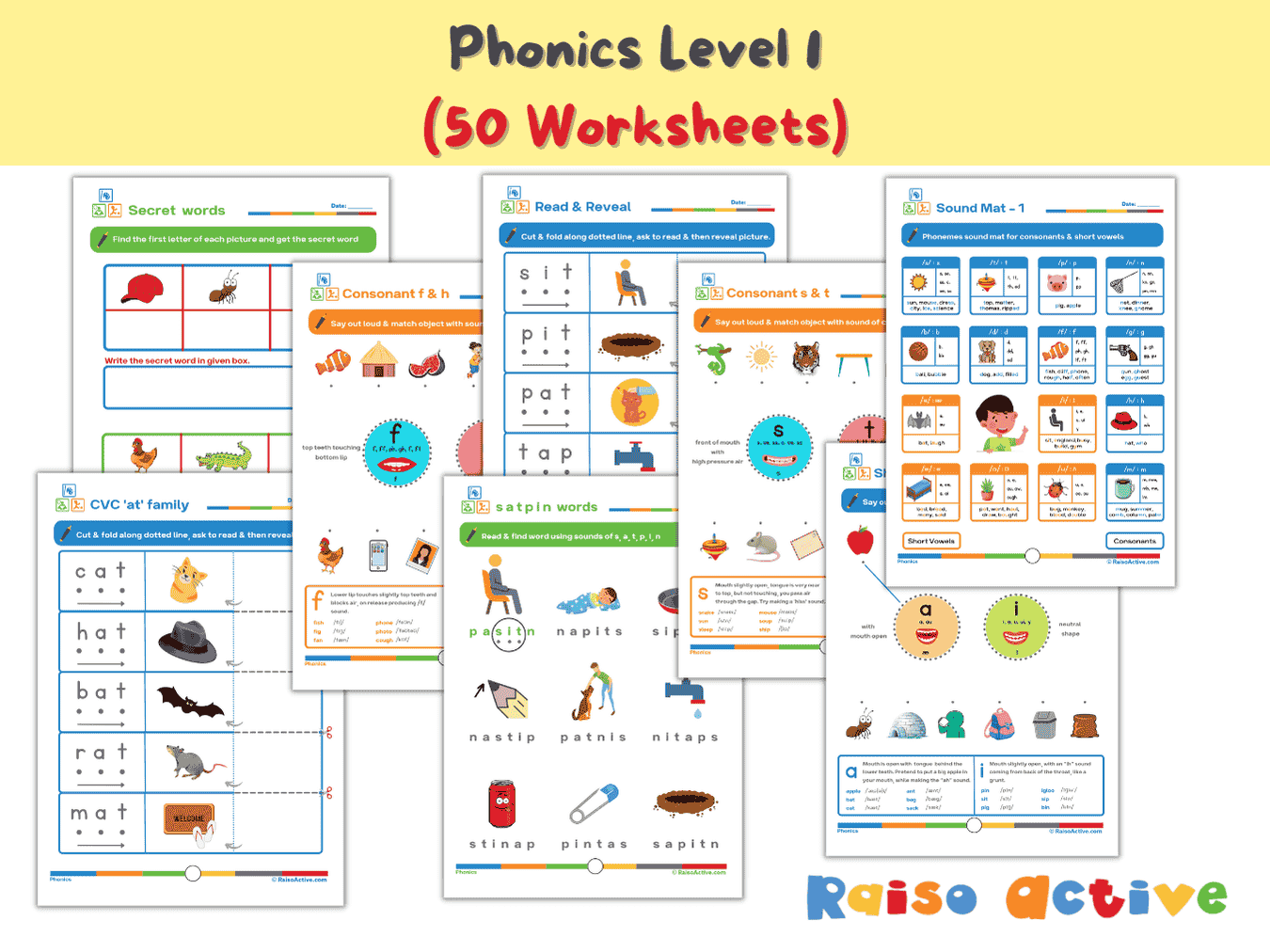
The Jolly Phonics sequence, for instance, begins with the seven letter sounds s, a, t, p, i, n — not because they are the first letters of the alphabet, but because these six sounds alone allow a child to blend more than two dozen simple words: sat, pin, nap, tin, pit, ant, tan, sip, nit. Within the first two weeks of learning, a child using Jolly Phonics is actually reading real words — not just reciting letters. That sense of early success is enormously motivating.
Many Indian schools, particularly those following CBSE, use phonics-integrated English textbooks from publishers like Oxford University Press, Macmillan, and Orient BlackSwan, which introduce letter sounds systematically alongside letter names. ICSE schools often follow a similar integrated approach. State board schools vary considerably, with some following older whole-language approaches that de-emphasise phonics. If your child's school does not have a strong phonics programme, home supplementation is extremely valuable and the responsibility naturally falls to parents and caregivers.
44 sounds
English has 44 distinct phonemes (sounds) but only 26 letters, which is why letter-sound instruction must go beyond a simple one-letter-one-sound model. Children need to learn that the same letter can make different sounds, and that some sounds are represented by combinations of letters — this is the foundation of a complete phonics education.
Source: Linguistic research on English phonology; foundational to all systematic phonics programmes
The Indian Context: English as a Second (or Third) Language
For most children in India, English is not the language of the home. Whether a family speaks Hindi, Marathi, Tamil, Telugu, Bengali, Kannada, Malayalam, or any of India's other rich languages, children arrive at school with limited exposure to English as a spoken language compared to their peers in English-speaking countries. This has a profound implication for literacy instruction: Indian children cannot rely on ambient English exposure to support their phonics learning the way children in the UK or USA can.
When a child in London learns that the letter S says /s/, they immediately connect it to dozens of words they already know and use: snake, sun, sister, school, shirt. When a child in Nagpur or Mysuru learns the same thing, they may know only a handful of these words in English — the connection between sound and meaningful word is thinner and more fragile. This is why explicit, multisensory, and highly contextualised phonics instruction is even more critical in the Indian context than it is in native English-speaking environments.
There is also a significant advantage that bilingual and multilingual learners bring to this table: strong phonological awareness in one language transfers to other languages. A child who has learned to hear and segment sounds in Hindi (m-aa-m-aa) brings a trained ear to English phonics. A Tamil-speaking child who can identify rhymes and beginning sounds in Tamil has already built the cognitive scaffolding that letter-sound learning in English will click onto. Honour this linguistic richness rather than treating multilingualism as a complication.
👋A Note for Parents of Bilingual and Multilingual Learners
- Never worry that strong home language literacy will confuse your child's English reading. Research consistently shows the opposite — well-developed literacy in any language supports literacy development in additional languages.
- When teaching English letter sounds at home, connect them explicitly to words your child already knows in English. Use real objects, pictures, and actions rather than relying on words they may not have in their vocabulary yet.
- If your child is learning to read Hindi or Marathi at school simultaneously, celebrate this! The phonological awareness they are developing in that script is directly transferable to English phonics.
- Be patient with the fact that your child may learn English letter sounds more slowly than a child in an English-medium home environment. This is normal and not a cause for concern. Consistent daily practice is the answer.
- Use bilingual alphabet books and phonics resources where available. Several Indian publishers produce materials that bridge the home language and English, making letter-sound learning more contextually meaningful.
Common Mistakes Parents and Teachers Make
Even the most dedicated parents and teachers can inadvertently create confusion when teaching letter sounds. Knowing what to avoid is just as important as knowing what to do.
Teaching letter names exclusively through the alphabet song is perhaps the single most common issue. The song is so deeply embedded in our culture — and children learn it so readily — that many parents assume it is doing more literacy work than it actually is. Use it as a warm-up or a fun ending to a phonics session, not as the main event.
Adding a vowel sound to consonant sounds is another very common error. When teaching the sound of B, many adults unconsciously say /buh/ rather than the pure consonant sound /b/. This matters enormously when children try to blend: /buh/-/a/-/t/ produces something that sounds like buh-a-t, not bat. Teach consonant sounds as cleanly and purely as possible — a short, clipped /b/, /t/, /s/, /m/ rather than buh, tuh, suh, muh.
⚠️Watch Out: The 'Schwa' Problem in Consonant Teaching
- The schwa is the unstressed vowel sound (like the 'uh' at the end of 'butter') that creeps into consonant teaching when we say 'buh' for /b/ or 'duh' for /d/.
- When children try to blend using schwas — /buh/-/a/-/t/ — they produce 'buh-at', not 'bat'. This makes blending genuinely harder and is a very common source of frustration.
- Practice saying consonant sounds in front of a mirror. Hold a piece of tissue paper in front of your mouth: a pure /b/ barely moves it; a 'buh' with a schwa will puff it outward. Aim for the pure sound.
- If you are unsure how to produce clean consonant sounds, watch a Jolly Phonics teacher demonstration video on YouTube — these consistently demonstrate correct sound production and are free to access.
Key Takeaway
The alphabet order is convenient, not instructionally optimal.
Teaching letters in alphabetical order (A, B, C, D...) is intuitive but not the most effective sequence for early reading. Phonics programmes sequence letters to maximise early blending opportunities. If you are supplementing at home, consider following a phonics programme's sequence rather than alphabetical order — your child will be able to read real words much sooner.
🎨Multisensory Letter Sound Activities to Try Today
- **Sand Tray Tracing:** Fill a shallow tray or thali with fine sand or semolina (rava). Say a letter sound together, then have your child trace the letter shape in the sand while repeating the sound. The tactile experience reinforces both the sound and the letter form simultaneously.
- **Sound Sorting Baskets:** Collect 8-10 small objects from around the home. Sort them into baskets by beginning sound. For /s/: a spoon, a small stone, a sock. For /b/: a button, a ball, a book. Children love the treasure-hunt element and the physical sorting action.
- **Action Phonics:** Give each letter sound a physical action. /s/ = make a slithering snake movement with your arm. /m/ = rub your tummy and say mmm as if tasting something delicious. /t/ = tap the table with one finger. Physical actions create body-memory (kinaesthetic encoding) that is remarkably durable.
- **Letter Sound Snap:** Make two sets of simple picture cards (pictures only, no letters). Play snap. When a match lands, the first player to say the beginning sound of the picture wins the pile. This trains phonological awareness (hearing sounds) which underpins letter-sound learning.
- **Mystery Bag:** Put 5-6 objects in a cloth bag. Your child reaches in, feels one object, guesses what it is, pulls it out, and then tells you the beginning sound. Multi-sensory, playful, and deeply effective for maintaining attention.
80%
of English words are phonetically regular — meaning they can be decoded using letter-sound knowledge. This is why teaching phonics gives children a powerful generalised tool for reading, not just a way to read words they have memorised individually.
Source: Hanna, Hanna, Hodges & Rudorf (1966); referenced in systematic phonics research literature
Key Takeaway
When to introduce letter names: alongside sounds, not before or instead of them.
There is no need to delay letter names — just do not prioritise them over sounds. A simple, consistent format works beautifully: 'This letter is called B. It makes the sound /b/. Listen: /b/, /b/, ball.' This ensures children learn both without one obscuring the other. Within a few weeks, most children aged 4-5 can hold both pieces of information with ease.
A Practical Sequence for Teaching Letter Sounds at Home
1
Start with 6-8 high-value letter sounds
Rather than beginning with A and working through the alphabet, start with the sounds that give you the most blending power earliest. A classic starting set is: s, a, t, p, i, n, m, d. With just these eight sounds, children can blend and read dozens of simple words. If you are following a school programme, follow their sequence instead — consistency between home and school is more important than any particular sequence.
2
Introduce one or two new sounds per week
Introduce sounds slowly enough that each one is genuinely consolidated before the next arrives. For children aged 3-4, one new sound per week is appropriate. For children aged 5-6, two sounds per week is manageable. Always review previous sounds at the start of each session before introducing anything new — spend at least two thirds of your session on revision and only one third on new material.
3
Use a consistent introduction format every time
Consistency reduces cognitive load and allows children to focus on the content rather than the format. A simple, reliable format: show the letter card, say the letter name, say the sound, give two or three example words, do a physical action if you use action phonics. Repeat this same sequence every single session. Within a week, children begin to lead the format themselves — a reliable sign that learning is happening.
4
Practice blending as soon as you have 3+ sounds
As soon as your child knows three sounds that can be combined — for example /s/, /a/, /t/ — begin blending simple consonant-vowel-consonant (CVC) words: *sat*, *at*, *tan*. Blending is a skill in itself and requires practice. Use a 'stretchy snake' technique: say each sound while slowly stretching a rubber band or a piece of playdough, then release it as you say the whole blended word. This physical metaphor helps children understand the relationship between individual sounds and the complete word.
5
Layer in letter names once sounds are secure
Once a child can reliably identify the sound of a letter when shown the written symbol, begin consistently naming the letter as well in your introduction format. This is typically appropriate after two to three weeks of sound-focused practice. Children who have secure sound knowledge find letter names easy to add — the reverse (learning names first, then sounds) is considerably harder.
6
Introduce digraphs and vowel teams as individual sounds, not combinations
Once the basic single-letter sounds are established (typically after 6-8 weeks of systematic teaching), begin introducing digraphs: *sh*, *ch*, *th*, *ck*. Teach each digraph as a single sound with its own card, just as you would a single letter. Children do not need to analyse why *sh* makes the sound /sh/ — they just need to know it reliably. This prevents the common confusion of children trying to blend /s/ + /h/ when they see *sh*.
7
Apply sounds in reading and writing every session
Every letter sounds session should end with reading or writing real words using the sounds learned so far. Write a simple word on a whiteboard or scrap paper, point to each letter, and blend together. Or ask your child to write a word you say aloud by segmenting each sound and choosing the right letter. This application step is non-negotiable — isolated sound knowledge that is never applied to actual reading and writing does not become useful literacy.
Teaching Letter Names First
- +Child can sing the alphabet song but cannot blend words
- +Decoding is slow because names do not directly map to reading
- +Confusion: "bee, ay, tee" does not produce "bat"
- +Works well for alphabetical order, spelling aloud, dictionary use
- +Common in older teaching approaches and some state board curricula
Teaching Letter Sounds First
- -Child begins blending real words within weeks of starting
- -Decoding is more direct: /b/-/a/-/t/ blends naturally to "bat"
- -Less confusion between the name of a letter and its reading function
- -Stronger early reading outcomes supported by decades of research
- -Used in all structured literacy and explicit phonics programmes
Unlimited Access
Get Free Phonics Worksheets Every Week
Subscribe to RaisoActive and receive beautifully designed letter sounds, phonics, and alphabet worksheets straight to your inbox — trusted by parents and teachers across India.
All worksheets & activitiesNew content weeklyDownload unlimited times
Subscribe NowFrequently Asked Questions
At what age should I start teaching letter sounds?
Most children are developmentally ready for **explicit letter sound instruction between ages 3.5 and 5**, though there is significant variation. A useful indicator is phonological awareness: if your child can clap syllables in words, identify simple rhymes (cat/bat), or hear the beginning sound in a spoken word, they are ready to begin connecting those sounds to written letters. Formal phonics instruction is standard from Nursery or LKG in most Indian English-medium schools. If your child is in UKG or Class 1 and letter sounds have not yet been formally introduced, starting immediately at home is the right move.
My child knows letter names but struggles to blend words. What should I do?
This is one of the most common phonics challenges, and the cause is almost always that **letter sounds have not been sufficiently consolidated**. Go back to basics: spend two to three weeks doing intensive, daily letter sound practice with no blending pressure. Use multisensory activities — sand trays, action phonics, sorting games — rather than worksheets. Once your child can respond to a letter card with its sound (not its name) within one to two seconds, begin blending practice with the simplest possible CVC words using sounds they know well. The blending skill itself also requires direct teaching: the 'stretchy snake' blending technique, where sounds are said slowly and then merged, is particularly effective for children who have previously learned names-only.
Does it matter that my child's school follows the CBSE curriculum — does CBSE teach phonics?
CBSE-affiliated schools vary considerably in their phonics approach. The CBSE curriculum framework supports literacy development from Class 1, and many CBSE textbooks (particularly those from publishers like Oxford University Press and Macmillan) include phonics components. However, the quality and depth of phonics instruction depends heavily on the individual school and teacher. Many CBSE schools use an integrated approach that includes some phonics alongside whole-language reading. If you are unsure how much phonics your child is receiving, speak to their class teacher. Regardless of what happens in school, **home supplementation with explicit letter sound practice is always beneficial** and will not conflict with any standard CBSE approach.
Should I be worried if my child confuses the name and sound of a letter?
Not at all — this confusion is **completely normal in the early stages** of phonics learning, typically between ages 3 and 5. The concepts of 'name' and 'sound' are abstract, and it takes time for children to hold both and deploy the right one in the right context. The most effective solution is consistent language on your part: always be explicit about which you are asking for. Say *"What sound does this letter make?"* rather than *"What is this?"* when you want the sound. Say *"What is the name of this letter?"* when you want the name. Within a few months of consistent, explicit instruction, the distinction becomes clear to most children without any drama.
We speak a mix of Hindi and English at home. Will this confuse my child when learning letter sounds?
No — and it is important to say this clearly, because many Indian parents carry unnecessary anxiety about this. **Code-switching (mixing languages) at home does not cause reading difficulties in either language.** In fact, children who grow up in multilingual environments consistently demonstrate strong phonological awareness because they have more experience paying close attention to sound differences between languages. The Devanagari script used for Hindi is highly phonetically regular, which means a child learning to read Hindi is simultaneously developing strong phonological processing skills that will support English phonics learning. What matters most is that letter sound instruction — in English — is explicit, consistent, and regular, regardless of what other languages are used at home.
How long should a letter sounds session be for a young child?
For children aged 3-4, **5-10 minutes per session** is the appropriate range. At this age, sustained focus on formal learning tasks is limited, and the greatest risk is turning phonics into something the child dreads. Two or three short sessions spread across the day (morning, after nap, before bed) are more effective than a single long session. For children aged 5-6, **10-15 minutes** is appropriate, and by age 7-8 children can typically sustain focused phonics work for 15-20 minutes. Always end a session on a positive note — on something the child can do successfully — so that the emotional association with phonics practice remains warm and encouraging.