How to Track Your Child's Reading Progress: A Parent's Complete Guide
Author
RaisoActive - Kids Activities and Fun Learning
Published
Updated
Reading Time
26 min read

- Reading progress has **four key dimensions** to track at home: decoding (sounding out words), fluency (reading smoothly at a good pace), comprehension (understanding what was read), and sight word bank (words recognised instantly).
- Simple **home assessments** — like the one-minute reading test, story retelling, and picture walk — give you meaningful data without requiring any specialist training or expensive tools.
- **Reading logs and journals** are powerful tracking tools that help you spot patterns over weeks and months, identify which books your child gravitates towards, and celebrate visible growth.
- Understanding **levelled reading systems** (PM Levels, Lexile bands) helps you choose books that are just right — not too easy (boring) and not too hard (discouraging).
- Knowing the **red flags** in reading development helps you seek support early, when intervention is most effective — before a child falls too far behind their peers.
Why Tracking Matters More Than You Might Think
Most parents have a vague sense of how their child is doing with reading — they can tell when things are going well and when something feels off. But vague sensing is very different from informed tracking, and the difference can mean the gap between catching a difficulty early and discovering it a year later when remediation is much harder.
When you track your child's reading progress deliberately — even in small, informal ways — you gain something invaluable: a baseline and a trajectory. You stop asking 'is my child doing okay?' in the abstract and start answering 'compared to last month, here is what has changed.' That shift from anxiety to evidence is one of the most calming things a parent can experience. It also gives you something concrete and useful to share with your child's class teacher during parent-teacher meetings, rather than a general worry that is difficult to act on.
This guide walks you through everything you need to track your child's reading progress at home: the stages of reading development, the four areas worth monitoring, simple assessments you can do in ten minutes, how to maintain a reading log, how levelled reading works, the red flags to watch for, and how to communicate what you are finding to your child's teacher — all in a way that is realistic for busy Indian families.
Get Free Reading Progress Worksheets
Join thousands of parents and teachers across India who use RaisoActive printables to support early reading. Get tracking sheets, phonics worksheets, and reading logs delivered free to your inbox.
The Stages of Reading Development: Where Is Your Child Now?
Before you can track progress, you need a map of where progress leads. Reading development is not a switch that flips from 'cannot read' to 'can read' — it is a gradual journey through distinct stages, each with its own characteristics and milestones. Knowing these stages helps you understand what is developmentally expected at your child's age and what the next step looks like.
Pre-readers (typically ages 2-4) are building the foundations of literacy without yet reading words. At this stage, children develop print awareness (understanding that text carries meaning, that we read left to right, that letters are distinct from pictures), phonological awareness (the ability to hear rhymes, syllables, and individual sounds in spoken words), and a love of books through shared reading. A pre-reader who cannot yet read a single word but eagerly handles books, enjoys rhymes, and can tell you that 'cat' and 'hat' rhyme is building exactly the right foundations.
Emergent readers (typically ages 4-5, Nursery to LKG) begin to connect letters to sounds, recognise their own name and a handful of high-frequency words, and understand basic concepts of print — like where a sentence begins and ends. They may 'read' familiar books from memory, which looks like reading but is actually an important bridge stage. Encouraging this approximation warmly is important; correcting it harshly can damage early reading confidence.
Early readers (typically ages 5-7, UKG to Grade 2) are actively decoding text — using phonics knowledge to sound out unfamiliar words, building a growing sight word bank, and beginning to read simple sentences and short books with support. Accuracy is the priority at this stage; fluency comes later. A child who reads slowly but accurately is on track; a child who reads quickly but guesses wildly at unfamiliar words needs more support with decoding strategies.
Developing readers (typically ages 7-8, Grades 2-3) are transitioning from 'learning to read' to 'reading to learn.' Fluency is developing — they read at a more natural pace with appropriate expression — and comprehension becomes the central focus. They can read independently for sustained periods, retell stories with reasonable accuracy, and begin to infer meaning beyond the literal text. This is the stage where reading stamina and a love of books becomes critically important.
Age ranges are guides, not verdicts.
Every child follows this sequence of stages, but the pace varies considerably. A child who reaches the early reader stage at age 6.5 instead of 5.5 is not behind in any catastrophic sense — they may simply have a different developmental timeline. What matters is that progress is visible over time, not that it arrives on a predetermined schedule.
The Four Areas to Track: What Actually Matters
Reading is not a single skill but a constellation of interconnected abilities. Tracking all four of the following areas gives you a much more useful picture than focusing on just one.
1. Decoding is the ability to convert written symbols into sounds and words — the foundational mechanics of reading. You can observe decoding by watching what your child does when they encounter an unfamiliar word. Do they attempt to sound it out, even imperfectly? Do they use the first letter as a clue? Do they skip the word entirely or substitute a visually similar but wrong word? A child who is developing well will attempt decoding actively and improve in accuracy over months. A child who consistently guesses wildly, skips unknown words, or insists on being told every unfamiliar word may need more phonics support.
2. Fluency is the ability to read aloud with appropriate speed, accuracy, and expression — what reading researchers call 'prosody.' Fluency is important because it is the bridge between decoding and comprehension. A child who reads so slowly that each sentence takes enormous effort cannot simultaneously hold the meaning of the text in working memory. You can track fluency by noting whether your child reads in a stilted, word-by-word manner or whether they are beginning to group words naturally into phrases and use expression to reflect meaning.
3. Comprehension is ultimately the whole point of reading — understanding what has been read. Comprehension can be tracked through simple conversations after reading: 'What happened in that story?' 'Who was your favourite character and why?' 'What do you think will happen next?' A child who can read every word accurately but cannot tell you what the passage was about has a comprehension gap that needs attention. Conversely, a child whose decoding is still developing but who demonstrates good understanding of what they have heard read aloud has strong comprehension foundations that will serve them well as decoding catches up.
4. Sight word bank refers to the growing collection of words your child can recognise instantly, without the need to decode. A larger sight word bank directly supports fluency, because common words like the, said, because, would, and could no longer require conscious effort and can be processed automatically. You can track this by maintaining a simple list of words your child knows instantly versus words that still require sounding out or prompting.
Simple Home Assessments That Give Real Insights
You do not need to be a reading specialist to gather meaningful information about your child's reading. These three informal assessments can be done at home in ten minutes, require no special training, and give you genuinely useful data across all four areas described above.
The One-Minute Reading Assessment is perhaps the most informative simple tool available to parents. Choose a book your child has not read before, at roughly the level they are currently working at. Ask them to read aloud for exactly one minute while you listen carefully. Count the total number of words they read and subtract any errors (mispronunciations, substitutions, skipped words, or words you had to supply). The result is their Words Read Correctly Per Minute (WCPM). As a broad reference: children finishing Grade 1 typically read 40-60 WCPM; Grade 2 children 80-100 WCPM. But the number matters less than the trend over time — if your child read 30 WCPM in January and 48 WCPM in April, that is meaningful, measurable progress.
Story Retelling is the most natural comprehension check and requires nothing more than a conversation. After your child finishes reading (or listening to) a story, ask them to tell you what happened — 'Can you tell me the whole story in your own words?' Listen for whether they can identify the main characters, sequence the key events, and recall the ending. More advanced retelling includes identifying the problem and solution, and making a simple inference about why a character acted as they did. A simple star rating (1-5 stars) for each retelling attempt, noted in your reading log, builds a picture of comprehension progress over weeks.
The Picture Walk is a pre-reading assessment most useful for emergent and early readers. Before reading a new book, flip through the pages together and look only at the pictures. Ask your child: 'What do you think is happening here? What might this book be about?' A child with strong print awareness and vocabulary will make elaborate, logical predictions; a child who is still developing these foundations will offer minimal responses. Over months, you will notice predictions becoming richer, more detailed, and more accurate — a clear sign of developing literacy thinking.
- Always frame home assessments casually — 'Let's do your reading together' rather than 'I'm going to test you now.' The moment it feels like a test, anxiety can skew the result and damage reading motivation.
- Choose books your child finds appealing for assessments. A child who is mildly interested in the text will always perform better than one who finds the book boring or intimidating.
- Note the date and title of the book alongside any observations in your reading log. Context matters — a tired child after a full school day will read differently from the same child on a Saturday morning.
- Celebrate what you notice going well before noting areas for growth. 'You read that whole page without stopping to ask me for help — brilliant!' sets a positive tone for the session.
Reading Logs and Journals: Making Progress Visible
A reading log is simply a record of what your child reads and any observations you make while reading together. It does not need to be elaborate — a simple notebook kept near the reading spot is perfectly sufficient. What matters is that it is maintained consistently over weeks and months, because the value of a reading log lies entirely in the pattern it reveals over time.
At minimum, your reading log should record: the date, the book title, the level or approximate difficulty, whether the reading was independent or shared, and a one-line observation — something like 'blended all CVC words without help today' or 'confused the words "where" and "were" again — needs more practice.' Over three months, these one-line observations add up to a remarkably detailed narrative of your child's reading development.
You can add more richness to your reading log by including your child's own responses. Ask them to draw a picture of their favourite part of the story, write (or dictate) one sentence about what they read, or rate the book with a simple happy/neutral/sad face. Children who participate in documenting their own reading develop metacognitive awareness — the ability to think about their own learning — which is strongly associated with better comprehension outcomes.
For tracking sight words specifically, maintain a separate 'word wall' or word list — either on paper or as sticky notes on a designated board — where each mastered sight word is added and visible. This is different from the reading log and serves a different purpose: it is a cumulative, visible celebration of vocabulary growth. Children as young as four find it genuinely motivating to see a growing collection of words they own.
- Create a simple 'Reading Passport' by folding four sheets of A4 paper and stapling them together to make a small booklet. Decorate the cover together.
- Each time your child finishes a book, they add a 'stamp' — a small sticker, a hand-drawn symbol, or their own name-signature — in their passport. The title and date go alongside.
- Add milestone pages: 'First book I read all by myself,' 'First chapter book,' 'My 25th book.' When your child reaches a milestone, make a small celebration of it.
- The passport becomes a cherished record that children often keep for years. More importantly, it makes the abstract idea of 'progress' completely concrete and visible.
- For children in Grade 1 upwards, you can add a simple self-rating: 'Was this book easy, just right, or hard?' — teaching children to assess their own reading level is a powerful comprehension strategy.
Understanding Levelled Reading: PM Levels, Lexile, and Choosing the Right Book
If you have ever bought a children's book labelled 'Level 1' or 'Stage 2' and wondered exactly what that means — or whether it is right for your child — you are not alone. Book levelling systems can feel opaque, and different publishers use completely different systems. Understanding the two most widely used systems will help you make sense of the labels and choose books that are appropriately challenging.
PM Levels (also called Reading Recovery Levels) are used widely in Indian English-medium schools and by reading specialists. The scale runs from PM Level 1 (simplest — two or three words per page, high picture support) to PM Level 30 (chapter books for confident readers). Most children in UKG begin around PM Levels 1-3 and progress to Levels 8-12 by the end of Grade 1, though there is considerable individual variation. If your child's school uses PM readers or Rigby readers, the level is usually printed on the back cover. You can ask your child's teacher which PM level your child is currently assessed at — this single number gives you a very clear, objective anchor for tracking progress.
Lexile Measures use a numerical scale (typically 200L to 1600L for school-age readers) based on text complexity — sentence length, vocabulary difficulty, and concept density. A Lexile score can be found on many book publishers' websites and on platforms like Reading A-Z. The advantage of the Lexile system is that it applies to virtually any English book, not just levelled readers. Most standardised reading assessments in India and internationally also report results in Lexile equivalent scores, making comparison easy.
The most important concept in levelled reading is the 'just right' zone — sometimes called the instructional level. A book is 'just right' if your child can read it with about 90-95% accuracy: they can handle most of the text independently but encounter enough challenge to practise new skills. A book below that threshold is too easy (comfortable for enjoyment and confidence, but offering limited growth). A book above that threshold is too hard (likely to cause frustration and guessing). Aim for a diet of roughly 70% 'just right' books, 20% easy books (for pleasure and fluency), and 10% books that are slightly stretching.
accuracy is the benchmark for a book being at your child's 'instructional level' — the sweet spot where learning happens most efficiently. Below 90% accuracy, the text is likely too difficult for productive independent reading, and reading aloud together with support becomes more appropriate.
Source: Fountas & Pinnell, Guided Reading: Responsive Teaching Across the Grades
Red Flags in Reading Development: When to Seek Support
Most reading difficulties, when identified early and addressed with consistent support, respond well to intervention. The key phrase is early — the earlier a reading difficulty is identified, the more effective and less disruptive support tends to be. Knowing which signs to watch for is therefore one of the most valuable things a parent can do.
It is important to distinguish between normal developmental variation — which is broad — and genuine red flags that warrant a conversation with your child's teacher or a reading specialist. Missing a milestone by a few months in an otherwise progressing child is usually not a concern. A cluster of the following signs, persisting over several months, warrants attention.
- **By end of UKG (age 5-6):** Cannot identify any letter sounds despite regular exposure; shows no interest in print or books; cannot hear rhymes or syllables in spoken words.
- **By mid-Grade 1 (age 6-7):** Cannot decode simple CVC words (cat, sit, hop) despite phonics instruction; reverses letters or numbers persistently beyond occasional errors; cannot remember sight words after many exposures; avoids reading entirely.
- **By end of Grade 1 (age 6-7):** Reads below 30 words per minute with high error rates; cannot retell even the simplest story with any accuracy; loses their place constantly and frequently re-reads the same line.
- **At any age:** Significant reading anxiety — tears, physical complaints (headaches, stomach aches) specifically around reading time; a child who was progressing and then plateaus for more than two months without apparent external cause.
- **Specific patterns:** Consistent confusion of visually similar words (was/saw, on/no, dog/bog); reading correctly in isolation but consistently failing in connected text; significantly better verbal comprehension than reading comprehension of the same content.
If you observe a cluster of these signs, the right first step is a calm, factual conversation with your child's class teacher — not an immediate referral for specialist assessment. Share what you have observed at home, including the data from your reading log, and ask the teacher what they are observing at school. Often, the school has already identified the same pattern and has strategies in place. If the teacher's observations align with yours and progress remains slow over the following six to eight weeks despite additional support, a referral for a more formal reading assessment may be appropriate.
Indian English Reading: Unique Challenges Worth Knowing
Reading instruction in India takes place in a rich and complex linguistic context that is not fully reflected in most mainstream reading resources, which are developed in the UK, USA, or Australia. Being aware of some India-specific factors will help you interpret your observations more accurately and support your child more effectively.
Pronunciation differences are perhaps the most common source of apparent 'errors' that are not actually errors. Indian English has distinct phonological patterns — the /w/ and /v/ distinction is often neutralised ('vater' for 'water'), the /th/ sounds (/θ/ and /ð/) are frequently realised as /t/, /d/, /s/, or /z/ ('dat' for 'that', 'tink' for 'think'), and vowel sounds in words like bath, dance, and castle differ markedly from British received pronunciation. A child who reads these words in their natural Indian English pronunciation is not making a reading error — they are simply applying the phonology of their spoken dialect to print. Correcting this as a reading mistake would be both inaccurate and potentially damaging to confidence.
Multilingual learners — which describes the vast majority of Indian children — bring enormous cognitive assets to reading in English. Research consistently shows that strong literacy in any language supports literacy development in additional languages. A child who is also learning to read Hindi, Marathi, or Tamil is building phonological awareness, print concepts, and reading stamina that directly transfer to English reading. Rather than worrying that multilingualism is slowing English reading development, recognise it as a long-term asset.
Vocabulary gaps are a real consideration for children whose primary language at home is not English. Comprehension depends not just on decoding but on knowing what the words mean. A child who can decode the word blizzard perfectly may have no idea what it refers to if they have never encountered the concept. Building English vocabulary through read-alouds, conversations about books, and exposure to English-medium television and audio books is a powerful supplement to formal reading instruction — and is especially important for comprehension development.
Observe the pattern, not individual data points.
A single bad reading session means nothing. A single good session is encouraging but not conclusive. What tells you about your child's true reading development is the pattern across four to six weeks of observations — the general direction of travel. Keeping a reading log makes this pattern visible and prevents both unnecessary panic and complacent missing of real difficulties.
of reading difficulties go unidentified until Grade 3 or later in many Indian schools, by which point the gap between struggling readers and their peers has significantly widened. Simple, consistent home tracking by parents is one of the most effective tools for early identification.
Source: Annual Status of Education Report (ASER), National context on reading outcomes
How to Share Progress With Your Child's Teacher Effectively
The parent-teacher relationship around reading is most effective when both parties are sharing observations rather than one party simply receiving information from the other. Your observations at home — in relaxed, low-stakes conditions — are genuinely valuable to a teacher who sees your child in a busy classroom. Coming to parent-teacher meetings with specific, dated observations rather than vague impressions makes the conversation far more productive.
When sharing your reading log observations, focus on patterns and specifics rather than overall judgements. Instead of 'I think she is struggling with reading,' try 'I noticed that over the last three weeks, she consistently loses her place when moving from one line to the next, and she often substitutes visually similar words — reading "horse" for "house", for example.' This kind of specific observation is immediately actionable for a teacher.
Ask the teacher to share their own observations in return and to explain how they are assessing reading in the classroom. Most teachers welcome an engaged parent and will happily share the PM level or other assessment data they have for your child, as well as strategies they are using at school that you can reinforce at home. The goal is a joined-up approach where home and school are supporting the same skills in consistent ways.
- Celebrate reading milestones genuinely and specifically — not with grand rewards, but with warm, sincere recognition. 'You read that whole book by yourself — I am so proud of how hard you have worked' is far more meaningful than a sticker chart or a prize.
- Avoid comparing your child's reading level to siblings, cousins, or classmates, even casually. Children are acutely aware of these comparisons and they can create deeply unhelpful competitive anxiety around reading.
- When you track progress, keep the data for your own reference — do not read out 'your score' to your child or make the numbers the focus. The message your child should receive is 'I love reading with you' not 'I am measuring you.'
- Allow your child to choose some of their own reading material, even if it is below their level or is something like a comic or a joke book. Autonomous reading choices are strongly associated with greater reading motivation and stamina over time.
- Recognise that some days will be better than others. A child who is tired, unwell, or emotionally unsettled will read below their usual level. This is normal and tells you nothing about their underlying ability.
How to Set Up a Simple Reading Progress System at Home
Choose your tracking tools
You need only two things to start: a small dedicated notebook (your reading log) and a designated space — a section of a cupboard door, a small noticeboard, or a rope with pegs — for your child's word wall. Keep both near the spot where you read together. Elaborate systems with apps and spreadsheets are appealing in theory but are rarely maintained; simplicity is the most important feature of any tracking system.
Establish a regular reading routine
Consistent daily reading — even fifteen minutes — is the engine that makes all tracking meaningful. Choose a time that is reliably low-pressure for your family: after school once the child has had a snack and some downtime, or at bedtime before lights out are common choices in Indian households. The routine matters more than the duration.
Do a baseline one-minute reading assessment
In the first week, do a simple one-minute reading assessment using a book your child has not read before. Count words read correctly per minute and note the PM level or approximate difficulty of the book. Write this in your reading log with the date. This is your starting point — your baseline. Everything you observe from here will be measured against it.
Record observations after each reading session
After each reading session, take thirty seconds to write one or two observations in your reading log: the book, the level, and something you noticed — a word type they struggled with, a comprehension question they answered beautifully, an expression they used that showed they understood the mood of the story. These brief notes accumulate into a rich developmental narrative over months.
Repeat the one-minute assessment monthly
Once a month, repeat the one-minute reading assessment with a new, unseen text at the same level as the previous assessment. Record the new WCPM score alongside the previous one. You are looking for an upward trend over three to four months. A plateau lasting more than six to eight weeks on the same level book is worth discussing with the teacher.
Review your reading log quarterly
Every three months, spend ten minutes re-reading your reading log entries. Look for patterns: are there specific word types that keep causing difficulty? Has comprehension improved? Are there genres or topics the child consistently engages with more deeply? Write a brief summary at the end of the quarter — 'Q1 summary: Good decoding progress, CVC words now solid, comprehension of non-fiction still needs support.' These summaries become invaluable at parent-teacher meetings.
Share and adjust with the teacher
Bring your reading log summary to each parent-teacher meeting. Share what you have observed and ask what the teacher is seeing at school. Use their feedback to adjust your home reading focus — if the teacher says comprehension is the current priority, spend more time on post-reading conversations and less on isolated word practice. A tracking system that informs action is valuable; one that only produces data without response is not.
- +Attempts to decode unfamiliar words using phonics knowledge
- +Sight word bank growing noticeably over each term
- +Can retell a story with main characters and key events
- +Reading speed gradually increasing over months
- +Chooses books independently for pleasure sometimes
- +Reads with some expression and natural phrasing
- -Consistently guesses or skips unfamiliar words without attempting to decode
- -Same sight words causing difficulty after weeks of practice
- -Cannot retell even a simple story immediately after reading it
- -Reading speed unchanged or declining over a full term
- -Actively avoids or resists reading at every opportunity
- -Word-by-word reading with no expression or phrasing after Grade 1
Tracking is an act of love, not surveillance.
The most important thing to remember about tracking your child's reading progress is that you are doing it because you care — not because you are managing a performance outcome. Keep the atmosphere around reading warm, relaxed, and positive. The data you gather is for your own clarity and for better conversations with teachers. Your child's experience of reading — whether they find it joyful, manageable, and connected to real meaning — matters far more than any number on a tracking sheet.
Get Free Reading Worksheets and Progress Trackers
Subscribe to RaisoActive and receive beautifully designed reading logs, phonics worksheets, and comprehension activities straight to your inbox. Trusted by parents and teachers across India.
Frequently Asked Questions
How often should I do a reading assessment with my child at home?
My child reads perfectly to me at home but the teacher says they struggle at school. Why?
What is the difference between PM Levels and Lexile scores, and which should I use?
Is it okay if my child reads slightly below grade level? Should I be worried?
My child can read the words perfectly but has no idea what they just read. What is going on?
How do I keep my child motivated to read when they find it hard and are getting frustrated?
Free worksheets for this topic
Browse all worksheets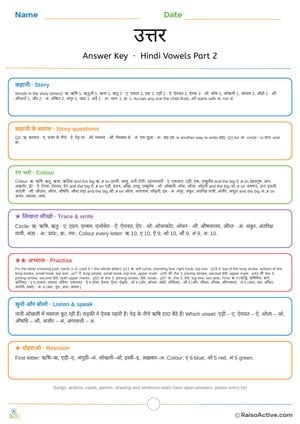
Hindi Vowels Part 2 Answer Key for Grown-ups | उत्तर
Ages 3-7 · Preschool–Grade 1Ages 3-7 · Nursery–Year 2Ages 3-7 · Nursery–Class 1Ages 3-7
The answers for each part of the pack: story word counts and questions, colouring answers, circle and colour-every-letter counts, the fix-the-letter pages, the find answers, listen-and-speak and revision. Songs, actions, cards, games, drawings and sentence tasks have open answers.
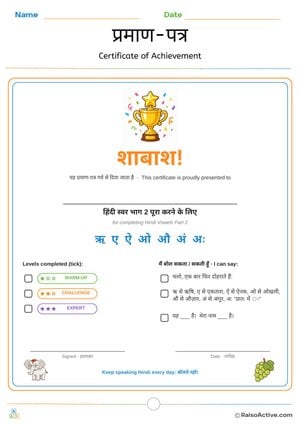
Hindi Vowels Part 2 Certificate of Achievement | प्रमाण-पत्र
Ages 3-7 · Preschool–Grade 1Ages 3-7 · Nursery–Year 2Ages 3-7 · Nursery–Class 1Ages 3-7
A certificate that celebrates finishing the pack, with a place for the child's name, tick boxes for the levels completed, sentences the child can say and space for a signature and date.
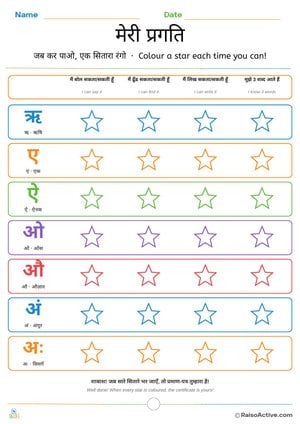
Hindi Vowels Part 2 Progress Tracker | मेरी प्रगति
Ages 3-7 · Preschool–Grade 1Ages 3-7 · Nursery–Year 2Ages 3-7 · Nursery–Class 1Ages 3-7
A progress chart with one row for each letter or sign (ऋ, ए, ऐ, ओ, औ, अं, अः) and four stars to colour: I can say it, I can find it, I can write it and I know 3 words.
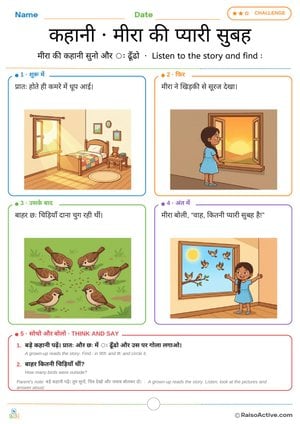
Hindi Story: Meera ki Pyari Subah (Meera's Lovely Morning) – Sign अः (ah) | कहानी मीरा की प्यारी सुबह
Ages 3-7 · Preschool–Grade 1Ages 3-7 · Nursery–Year 2Ages 3-7 · Nursery–Class 1Ages 3-7
A four-scene picture story: sunlight comes into Meera's room in the morning, she looks out of the window, six sparrows peck grains outside, and she says what a lovely morning it is. Children find ः in प्रातः and छः and count the birds.

Written by
Hemsweta Jain · Teacher Cheena
MBA and Early Childhood Educator, teaching since 2014 · Founder of RaisoActive, Mumbai
Published · Last reviewed
Related posts

Sight Words by Age: The First 50 Words and How to Teach Them Without Flashcard Fatigue
Which sight words to teach first and why, the heart-word method, a read-trace-write-find routine, games, and a by-age table of typical sight-word progress.
Where to Find Free Worksheets for Kindergarten Reading: A Complete Resource Guide
Find the best free kindergarten reading worksheets — phonics decoding, sight words, letter-sound matching, and comprehension. Aligned to CBSE and ICSE expectations.
Helping Your First Grader Overcome Reading Struggles: A Comprehensive Parent's Guide
Is your Grade 1 child struggling to read? Learn to identify the exact gap — phonics, fluency, or comprehension — and use proven home strategies to help them thrive.
Related Resources
Printable Resources(10)
View all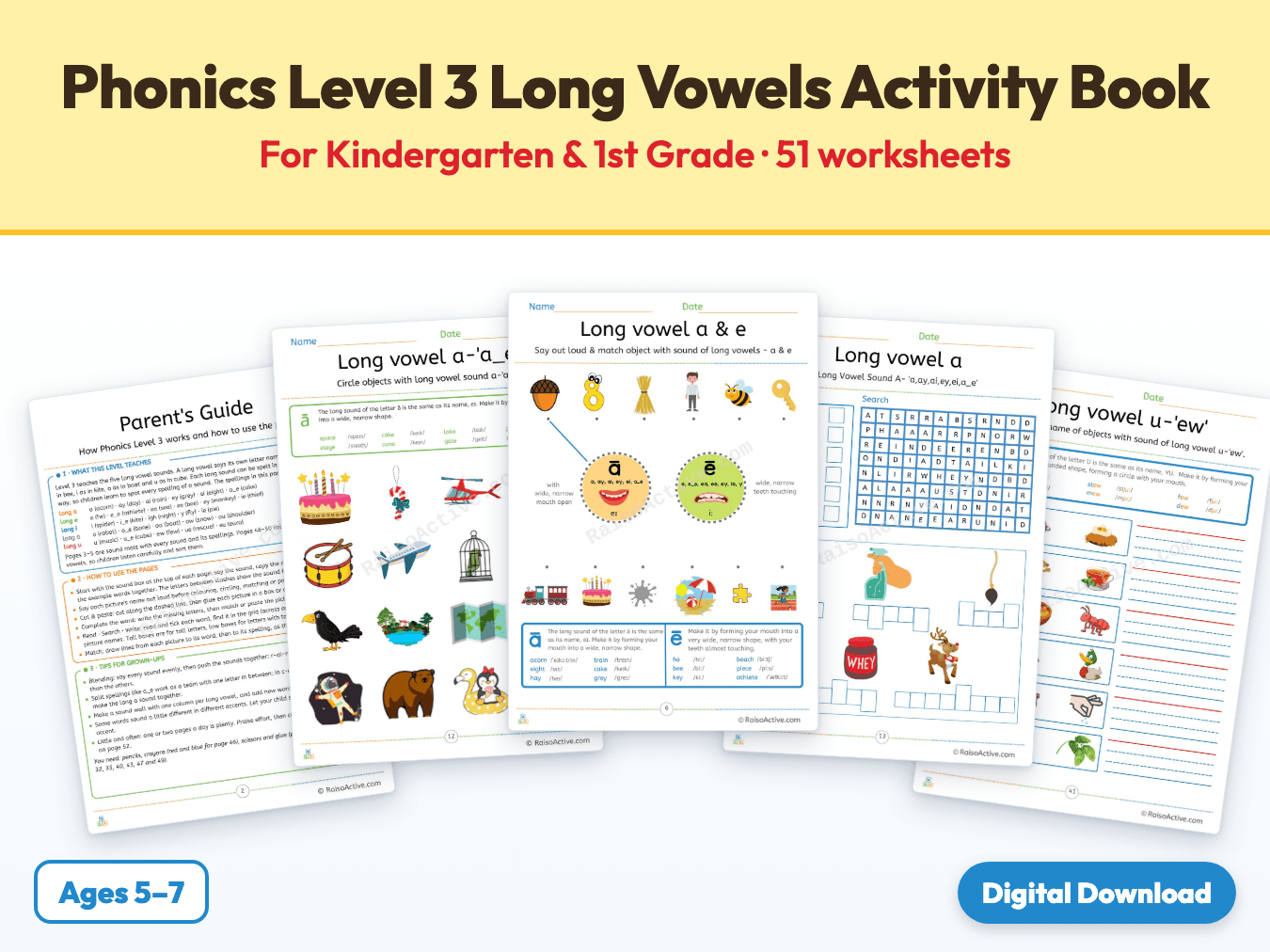

Phonics Level 3 Long Vowels Activity Book for Kindergarten & 1st Grade
Ages 5-7 · Kindergarten–Grade 1Ages 5-7 · Year 1–Year 2Ages 5-7 · UKG–Class 1Ages 5-7 · 52 pages
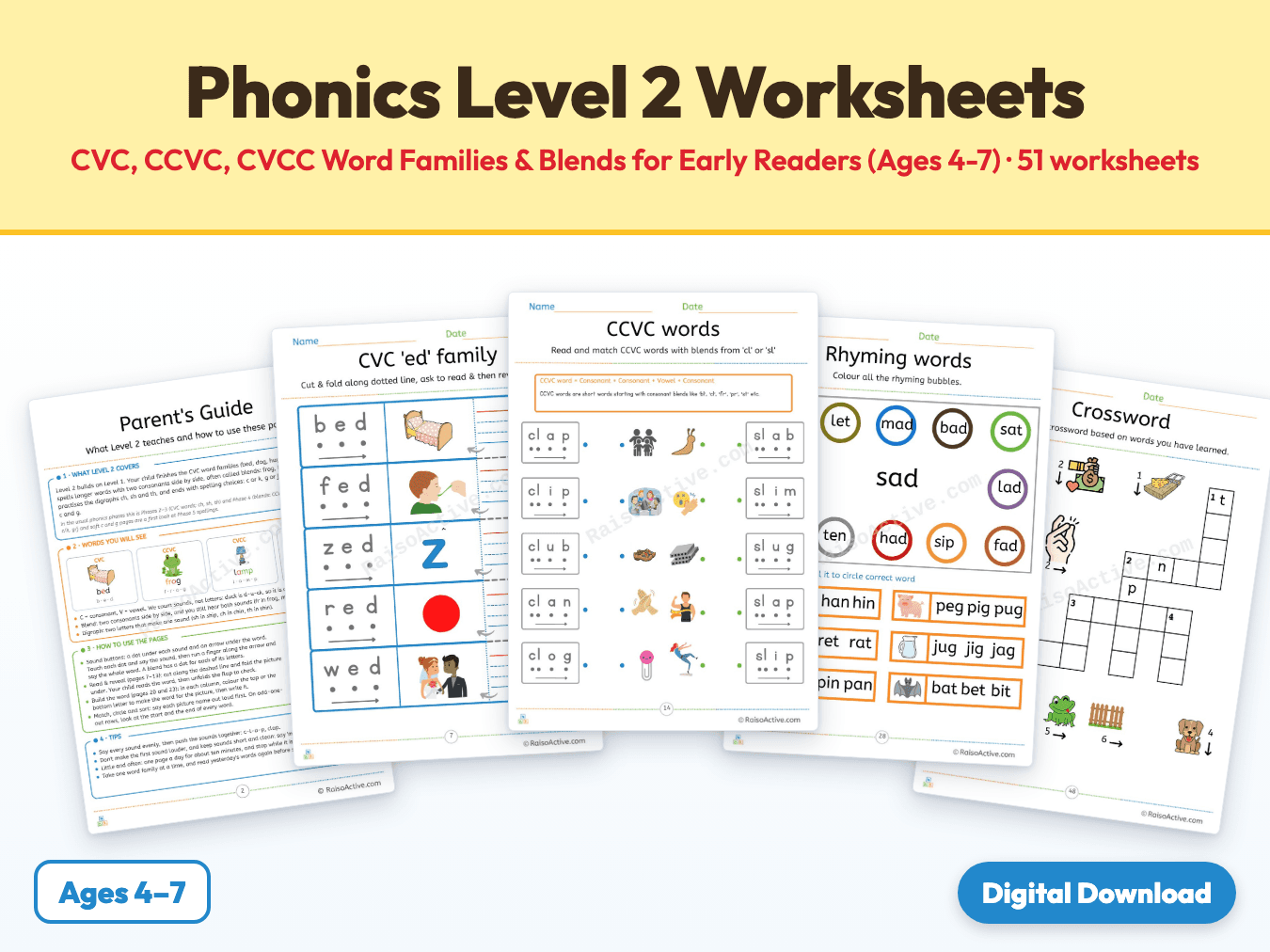
Phonics Level 2 Worksheets: CVC, CCVC, CVCC Word Families & Blends for Early Readers (Ages 4-7)
Ages 4-7 · Pre-K–Grade 1Ages 4-7 · Reception–Year 2Ages 4-7 · LKG–Class 1Ages 4-7 · 52 pages
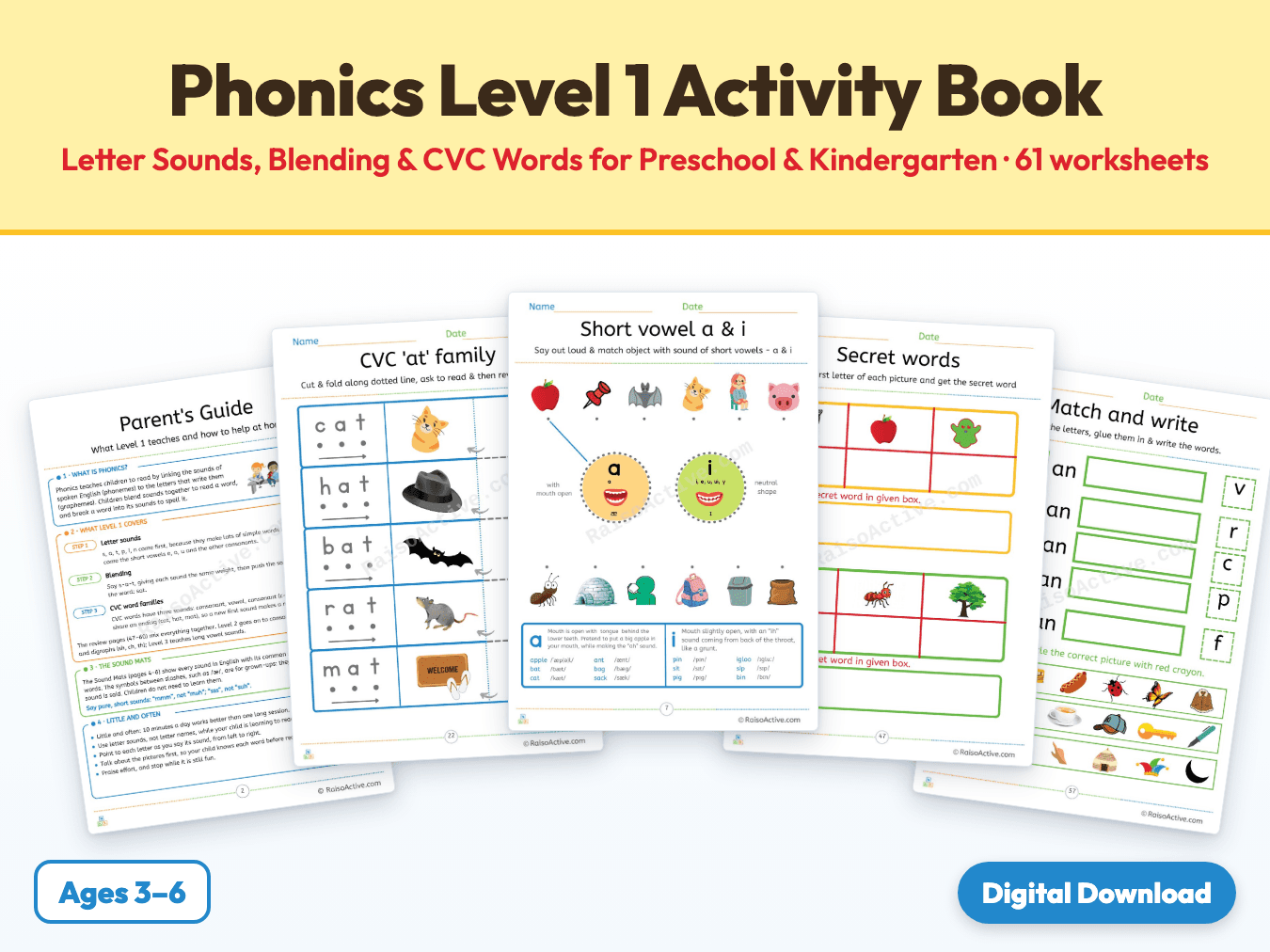
Phonics Level 1 Activity Book: Letter Sounds, Blending & CVC Words for Preschool & Kindergarten
Ages 3-6 · Preschool–KindergartenAges 3-6 · Nursery–Year 1Ages 3-6 · Nursery–UKGAges 3-6 · 62 pages
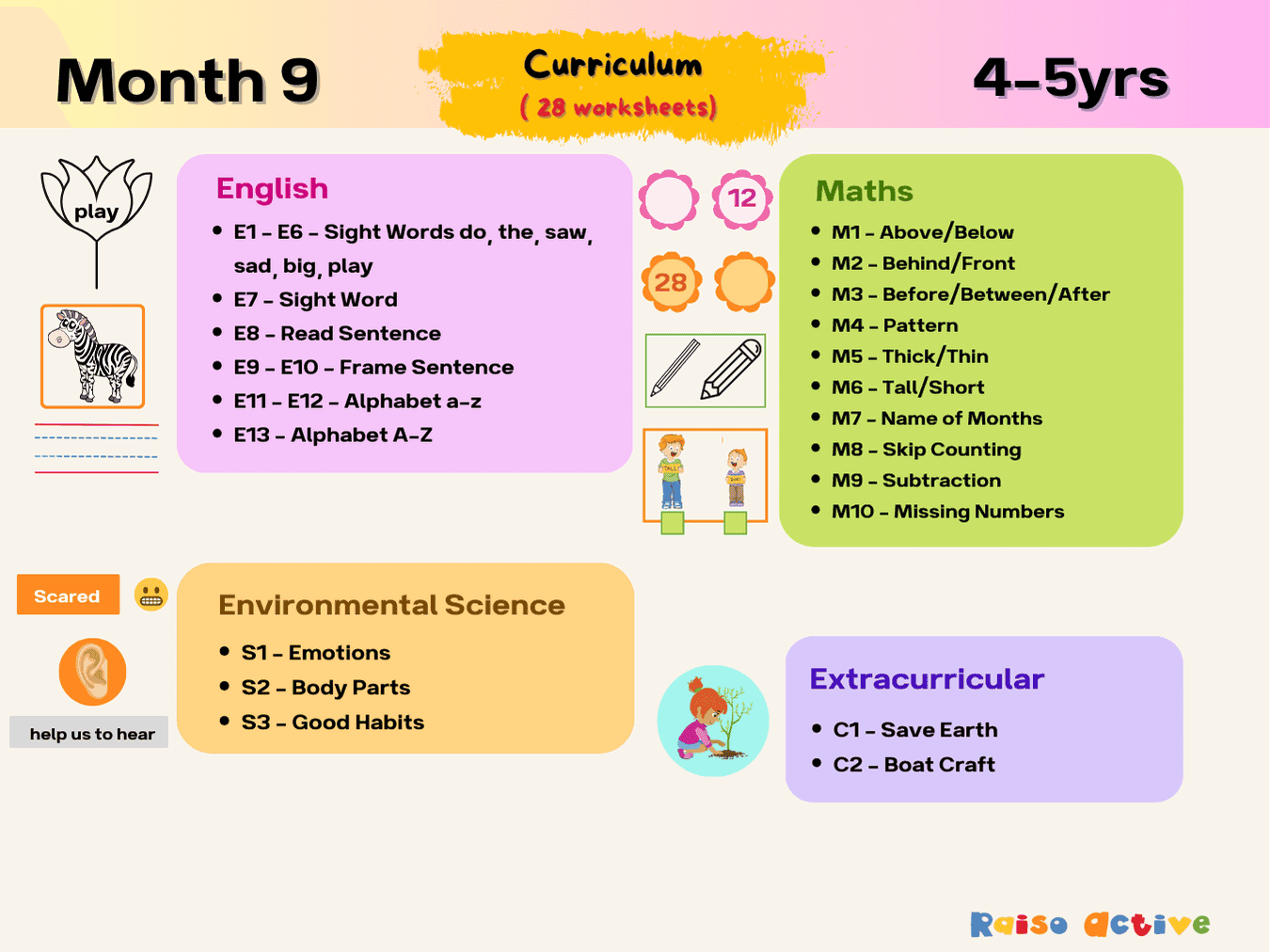

Month 9: Play-Based Preschool Foundational Skills | Ages 4-5
Ages 4-5 · Pre-KAges 4-5 · ReceptionAges 4-5 · LKGAges 4-5 · 31 pages
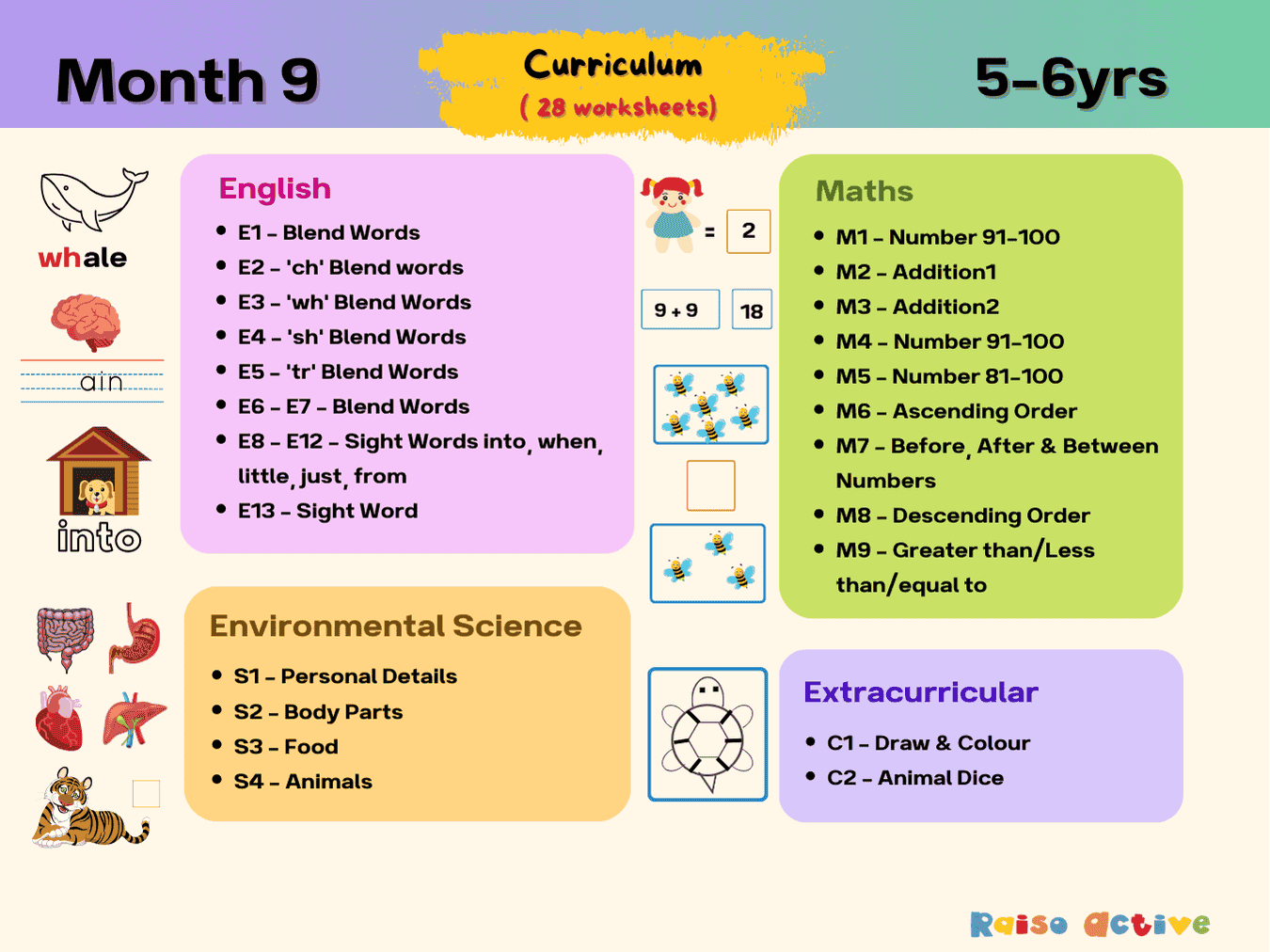
Month 9: Early Learning English Math Science | Ages 5-6
Ages 5-6 · KindergartenAges 5-6 · Year 1Ages 5-6 · UKGAges 5-6 · 31 pages
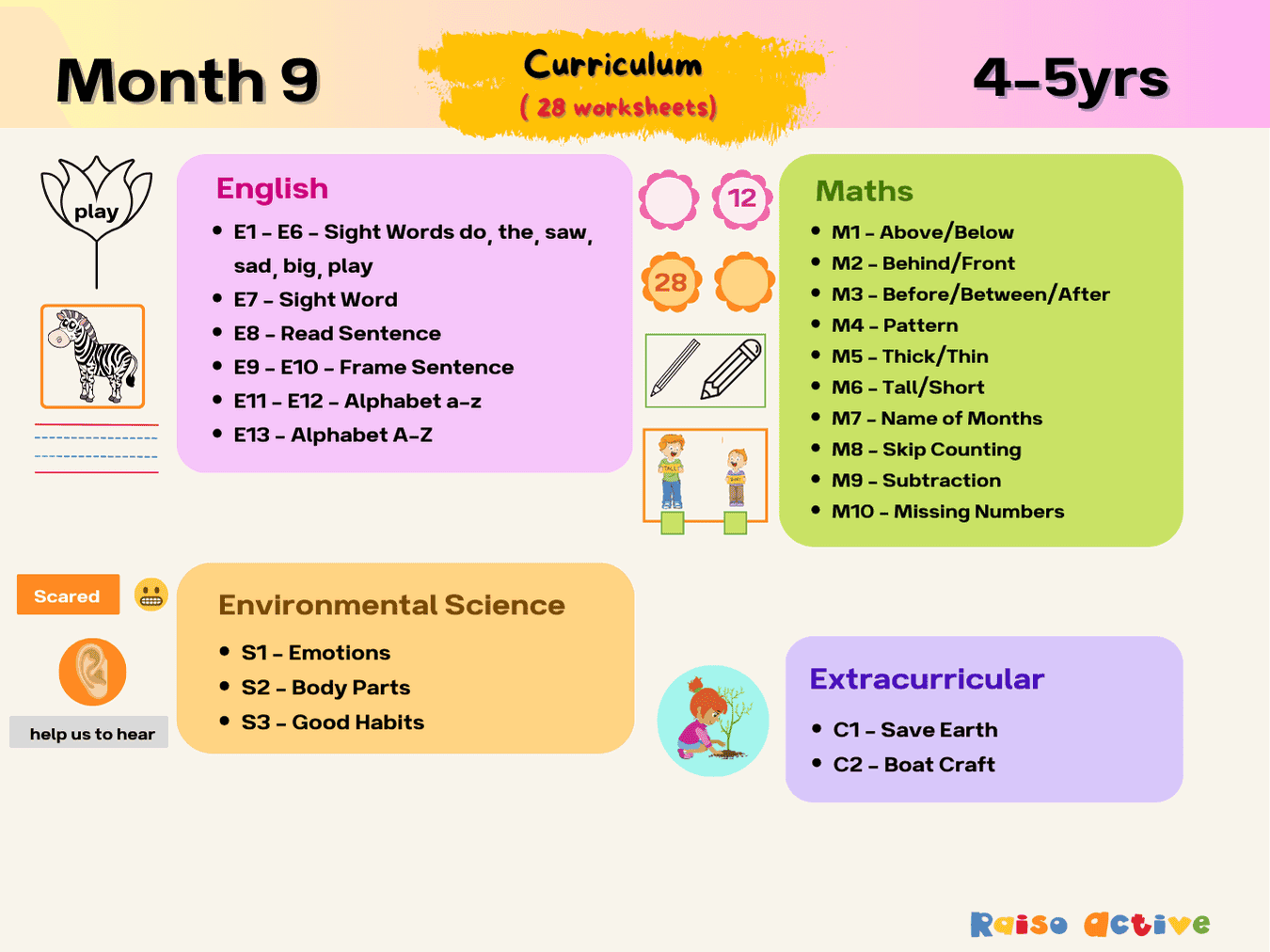
Month 9: Preschool Early Learning Activities | Ages 4-5
Ages 4-5 · Pre-KAges 4-5 · ReceptionAges 4-5 · LKGAges 4-5 · 31 pages
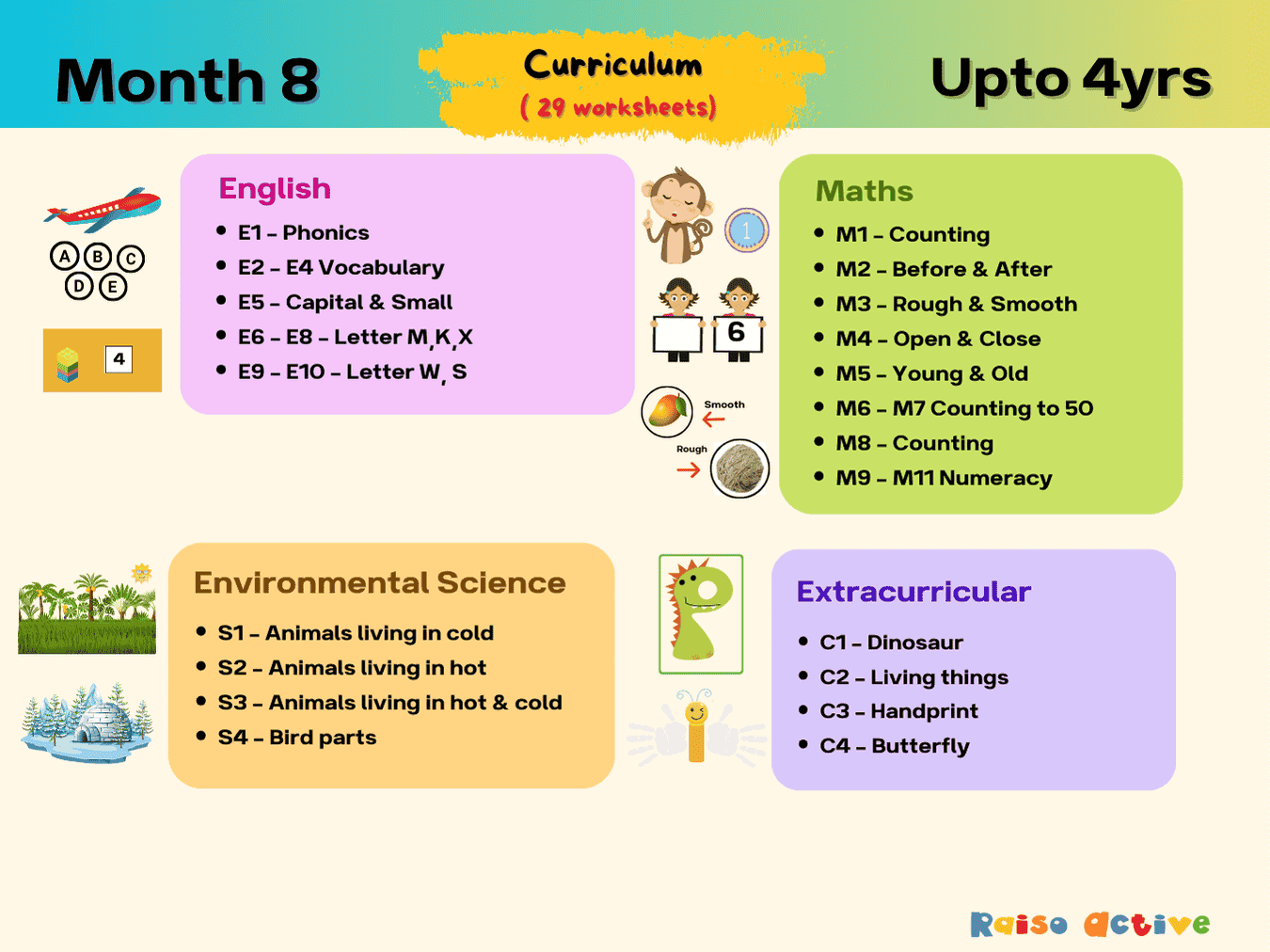
Month 8: Phonics, Math, Science, Creativity | Ages Up to 4
Ages 3-5 · Preschool–Pre-KAges 3-5 · Nursery–ReceptionAges 3-5 · Nursery–LKGAges 3-5 · 32 pages
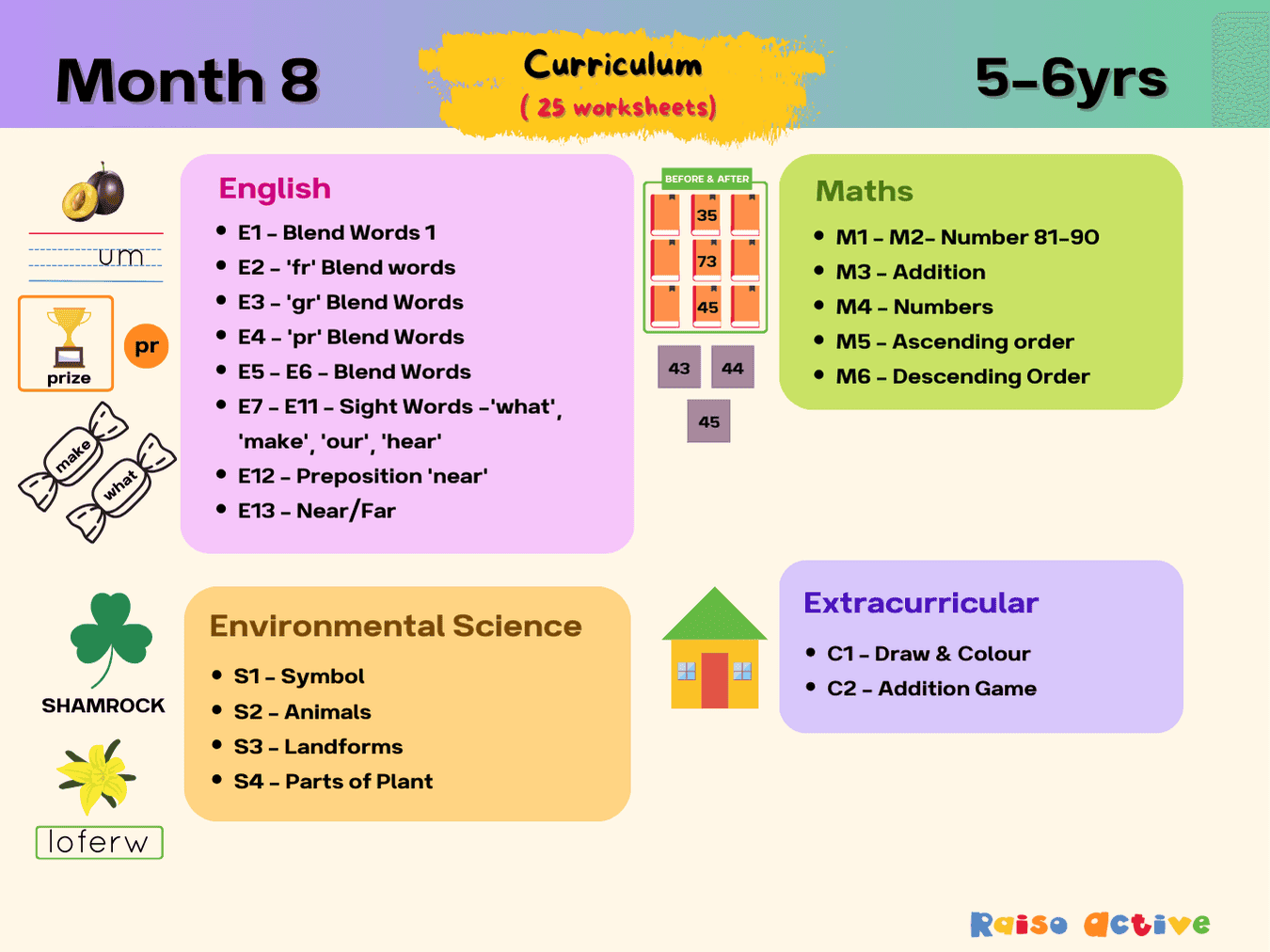
Month 8: Literacy, Math, Science Foundations | Ages 5-6
Ages 5-6 · KindergartenAges 5-6 · Year 1Ages 5-6 · UKGAges 5-6 · 28 pages
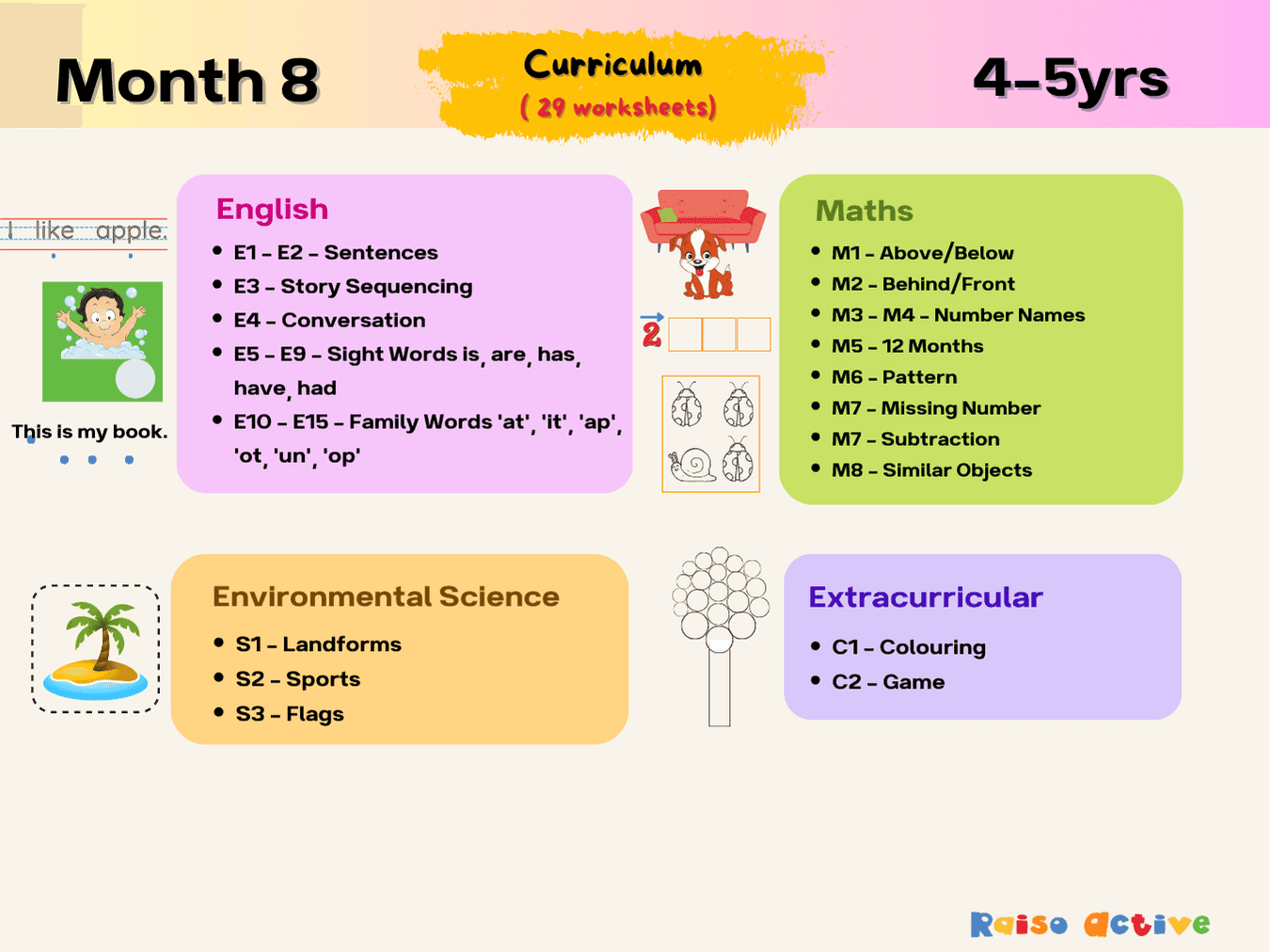
Month 8: English, Math, Science Foundations | Ages 4-5
Ages 4-5 · Pre-KAges 4-5 · ReceptionAges 4-5 · LKGAges 4-5 · 32 pages
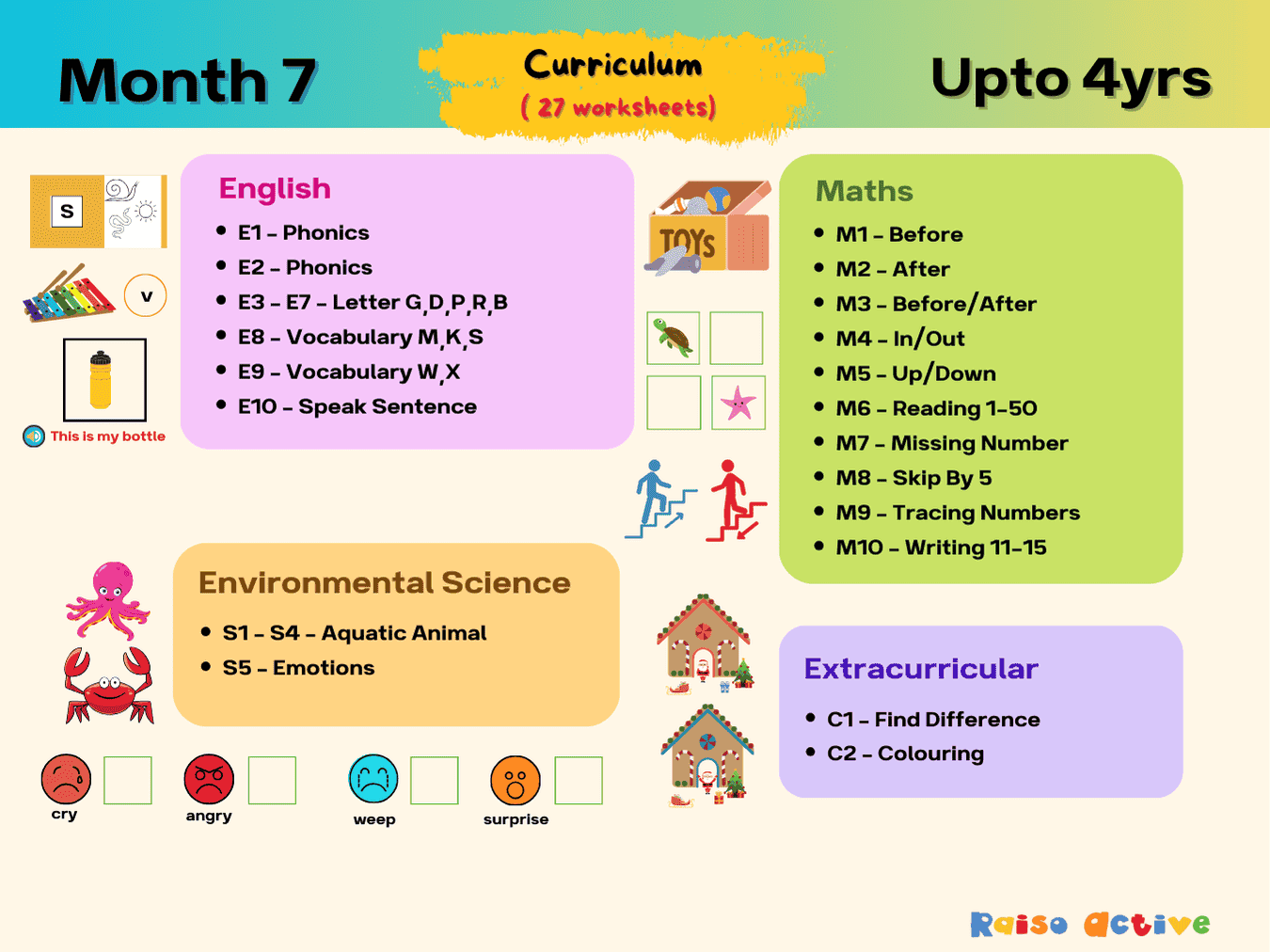
Month 7: Comprehensive preschool learning | Ages Up to 4
Ages 2-4 · PreschoolAges 2-4 · NurseryAges 2-4 · 30 pages