What's the Best Way to Teach Number Formation to Young Children? A Complete Guide
Author
RaisoActive - Kids Activities and Fun Learning
Published
Updated
Reading Time
13 min read

- Number recognition and number formation are two completely separate skills — children should be confident recognising a numeral before being asked to write it
- Each digit 0-9 has a specific correct stroke sequence; teaching it from the start prevents deeply ingrained bad habits
- Multi-sensory techniques — sand trays, sky writing, and the wet-dry-try method — build muscle memory far faster than pencil-and-paper drills alone
- Number reversals (especially 3, 5, and 7) are developmentally normal up to age 7-8 and do not indicate a learning difficulty
- The ideal time to introduce number writing is after a child can reliably recognise all ten digits and has solid pre-writing stroke control
Why Number Formation Is Harder Than It Looks
Watch a young child try to write the number 5 for the first time. The pencil goes left, then down, then curves right — and most of the time the result comes out mirrored, upside-down, or with the strokes in entirely the wrong order. The child looks confused. You look confused. And yet they can count to 20 perfectly well and point to every number on a chart without hesitation.
This is one of the most common surprises for parents beginning early maths education at home: knowing what a number is and being able to physically write that number are completely different skills, governed by completely different parts of the brain. Counting is a language and memory skill. Recognising numerals is a visual skill. Writing numerals is a fine motor and spatial skill. Rushing from the first two to the third — before a child's hands and eyes are ready — is the single biggest cause of frustration in early number writing.
This guide will walk you through everything you need: when to start, the correct stroke sequence for each digit from 0 to 9 with easy verbal cues, proven multi-sensory techniques, the most common formation errors for each number and how to fix them, and a clear, practical approach to the number reversals that worry so many parents. Whether you are a parent in Mumbai teaching after school, or a preschool teacher in Bengaluru managing a class of twenty, this is the guide you need.
Number Recognition vs Number Formation: Two Skills, Two Timelines
Before we talk about how to teach writing, it is worth being very clear about this distinction — because confusing the two leads most parents to push number writing too early.
Number recognition means the child looks at a printed "7" and knows it represents the quantity seven. This develops through exposure, songs, counting games, and picture books. Most children can recognise numerals 1 through 10 reliably by age 4 to 4.5, often earlier if they have been read to and played number games regularly.
Number formation means the child can pick up a pencil and produce a recognisable "7" on paper — starting from the correct point, moving in the correct direction, lifting the pencil in the right places. This requires working memory (to hold the stroke sequence), hand strength and coordination (to control the pencil), and spatial awareness (to understand where the numeral sits on the page). These abilities typically come together between ages 4.5 and 6.
A child can recognise all ten digits perfectly and still not be ready to write them. Solid number recognition is a prerequisite for number formation — not a sign that writing should begin immediately.
Research in early childhood mathematics consistently shows that children who are given time to develop recognition thoroughly before writing is introduced form numerals more accurately and retain correct formation longer.
When Is the Right Time to Start Teaching Number Writing?
There is no single magic age — but there are clear readiness signals. Look for this cluster of abilities before beginning formal number formation practice:
- Reliably recognises all ten digits (0-9) without prompting, in any order, including when shown in different fonts and sizes
- Holds a pencil or crayon with a functional grip — not necessarily a perfect tripod, but at least with some finger control rather than a full fist
- Can copy basic pre-writing strokes — a confident vertical line, a horizontal line, and a smooth curve or partial circle
- Understands "top", "bottom", "left", "right" in relation to a page — spatial vocabulary is essential for following stroke-direction instructions
- Can maintain focus for 5 to 8 minutes on a single structured activity
In most Indian preschools (Nursery and LKG), number writing begins formally around age 4 to 4.5. In international and play-based programmes, it may start as late as 5.5 to 6. Neither timeline is wrong — what matters is matching the introduction to the individual child's readiness, not to a calendar or a neighbour's child's progress.
- Strengthen hand muscles with playdough squeezing, bead threading, tearing paper, and using tweezers to pick up small objects like chickpeas
- Practise pre-writing strokes: vertical lines ("rain"), horizontal lines ("roads"), curves ("rainbows"), and circles ("suns") — these are the building blocks of every numeral
- Play quantity and recognition games: match numeral cards to dot cards, arrange number tiles in order, point to numbers on a lift page in daily life (lift buttons, page numbers, the number plate of the autorickshaw)
- Use finger tracing on large printed numerals before any pencil is introduced — the tactile experience builds spatial memory without requiring fine motor control
The Correct Stroke Sequence for Each Digit 0-9
This is the heart of this guide, and it is the section most parents and teachers skip — reaching straight for a workbook and hoping children will pick up the correct formation through tracing alone. Tracing helps, but without knowing the correct starting point and stroke direction, children often develop their own idiosyncratic ways of forming numerals that become deeply ingrained and very hard to undo later. Teaching the correct sequence from the beginning is always easier than correcting a bad habit later.
Each description below includes a simple verbal cue — a short phrase you say aloud as the child forms the numeral. These cues are the single most powerful tool for locking in correct formation, because they give the child's brain an auditory pathway alongside the motor pathway. Use the same cue every single time.
- 0 — "Around and close" Start at the top (roughly where 2 o'clock would be on a clock face), curve left and down, swing around the bottom, and close back at the top. A smooth, oval shape. No corners. The most common error is starting at the bottom — always start at the top right.
- 1 — "Slant down, then slide" Start at the top left, make a small diagonal slant down-right (the "rooftop"), then draw a straight vertical line down. In many school curricula, the simple version skips the rooftop: just a straight line from top to bottom. If your school uses the simpler version, stay consistent with it.
- 2 — "Curve around, slide left, go right" Start at the top right. Curve up and around to the left (like the top of a circle), then sweep down and to the right, ending with a short horizontal line along the baseline going right. The middle sweep is where most children go wrong — it should be a smooth curve, not a sharp angle.
- 3 — "Curve right, curve right again" Start at the top, curve right and inward to a middle point (like making the top bump of the 3), then without lifting the pencil curve right and inward again to form the bottom bump. Both bumps should face right. This is one of the most frequently reversed numerals — the bumps must face right, not left.
- 4 — "Down, across, then down again" Start at the top right. Draw a diagonal line down-left to mid-height. Then draw a horizontal line to the right. Lift the pencil and draw a vertical line from the top down through the crossing point to the baseline. The horizontal and vertical lines should cross cleanly.
- 5 — "Down, curve right, top goes left" Start at the top. Draw a short vertical line downward. Curve right and around to form the belly of the 5, closing at about mid-height. Lift the pencil, go back to the top, and draw a short horizontal line to the right (the hat). 5 is notoriously prone to reversal — the belly always faces right.
- 6 — "Curve left and around" Start at the top right (similar to 0), curve left and all the way down, then curve right and close into a small circle at the bottom — like a snail closing its shell. Do not lift the pencil. The circle at the bottom distinguishes 6 from 0.
- 7 — "Across the top, slant down" Start at the top left. Draw a horizontal line to the right along the top. Without lifting the pencil, slant diagonally down to the lower left. Optionally add a small horizontal cross-stroke in the middle (common in European writing and some Indian school curricula). 7 is frequently reversed — the top line goes left to right, and the slant always goes down-left.
- 8 — "S up, then close" Start at the middle. Draw an S-shape going upward (a curve to the right and up, then a curve to the left and up to close the top circle). Continue without lifting, curving right and down to close the bottom circle. Alternatively: draw a figure-8 starting at the top centre, curving right-down-left-up to cross the midpoint, then right-down-left-up to close. Both methods work; choose the one that feels more natural and stay consistent.
- 9 — "Circle at top, tail drops down" Start at the top right, draw a complete circle (like the number 0) closing at roughly the 5 o'clock position, then continue the line downward to the baseline. The circle sits at the top; the tail hangs below. This is often confused with 6 — remember: 6 has its circle at the bottom, 9 has its circle at the top.
Always teach the verbal cue alongside the physical stroke. Within two to three weeks of consistent, short daily practice with both the movement and the verbal cue together, most children will silently self-narrate the steps as they write — which is exactly what you want.
Multi-Sensory Techniques That Make Number Formation Stick
The brain learns motor patterns most efficiently when multiple sensory pathways are activated at once. When a child sees a number, says the verbal cue aloud, feels the texture of a sand tray, and moves their whole arm through the shape — four neural pathways are building the same memory simultaneously. This is why multi-sensory approaches outperform traditional pencil-and-paper repetition in virtually every study on handwriting and number formation instruction.
1. Sand Tray (or Sooji Tray) Writing
Fill a shallow tray or plate with a thin, even layer of fine sand, salt, or semolina (sooji or rava — available in every Indian kitchen and perfect for the purpose). The child uses their index finger to draw the numeral in the tray while saying the verbal cue aloud. The tactile feedback from the granules powerfully reinforces the motor pattern, and mistakes simply get smoothed away — creating a forgiving, low-anxiety learning environment. Sooji trays are especially effective for children who become distressed by the permanence of pencil marks.
2. Sky Writing
The child extends their dominant arm fully and uses their whole arm — shoulder, elbow, and wrist — to "write" large numerals in the air, looking at their fingertip as they go. The parent or teacher stands behind and mirrors the movement, guiding the elbow gently if needed. The gross motor movement uses the large shoulder and arm muscles to establish the neural pathway that the small finger muscles will later refine. Sky writing is also excellent for children who resist sitting at a table — it can be done standing up, in the garden, in a corridor, or even in the back seat of the car. Always say the verbal cue together as you go.
3. Wet-Dry-Try on a Slate
This technique — associated with the Handwriting Without Tears programme but widely adaptable — works beautifully with the small slates (patties) that are still commonly used in many Indian homes and classrooms. Wet: The adult writes a large numeral in chalk on the slate. The child erases it with a damp sponge, feeling and tracing the numeral's shape as they erase. Dry: The child uses a dry cloth or sponge to dry the slate, again following the numeral's path. Try: The child picks up the chalk and writes the numeral independently. The three-step repetition through different physical sensations locks in both the shape and the stroke direction.
4. Playdough Number Sculpting
Roll playdough into thin "snakes" and shape them into numerals together, always following the correct stroke sequence and starting point. This is slower and more deliberate than writing, which is precisely its advantage — the child must think about the shape spatially in a way that fast pencil work does not require. Sculpting is particularly effective for children who struggle with 3, 5, and 9, where the correct direction of the curve is the key issue.
5. Rainbow Writing
Write a large numeral lightly in pencil on paper. Give the child four or five different coloured crayons and ask them to trace over the numeral in each colour, always starting from the correct point. The layering of colours makes the stroke sequence physical and visible — children can see how each trace builds on the one before. The rainbow effect is also motivating for most young children and makes a visually striking result they are proud to display.
Studies consistently show that children who learn numeral formation through touch, movement, and verbal narration alongside pencil work develop more accurate, more automatic, and more legible number writing — and retain the correct formations significantly longer.
Source: Journal of Educational Psychology; Early Childhood Education Journal
Common Formation Errors for Each Digit — and How to Fix Them
Every numeral has a characteristic error pattern — a specific mistake that most children make. Knowing these in advance means you can watch for them and address them with a targeted technique rather than generic correction.
- **0** — Starting at the bottom rather than the top, making it a circle instead of an oval. Fix: Draw clock positions on a practice card; the child says start at two o'clock before every attempt.
- **1** — Drawing it as a simple vertical stroke with no slant, or drawing it from bottom to top. Fix: Remind the child we always come down, never go up for straight strokes.
- **2** — Making a sharp corner instead of a smooth sweep in the middle. Fix: Use sky writing with the full arm — large movements expose the curve that short pencil movements hide.
- **3** — Bumps facing left instead of right (mirror reversal). Fix: Playdough snakes shaped into 3; the child physically feels the bumps facing right. Pair with a verbal anchor pointing to the right side of the room.
- **4** — Closing the top into a triangle or making the cross-stroke too short. Fix: Trace a large pre-drawn 4 with the finger, feeling the open space inside the top section.
- **5** — Belly facing left (reversed), or forgetting the hat at the top. Fix: Teach 5 in two distinct steps: hat first, then belly. A visual card showing the hat and belly story helps enormously.
Tracing Numbers: How to Use It Well and When to Move On
Tracing is an excellent first scaffold for number formation. When a child traces a numeral, they are freed from the cognitive burden of remembering the stroke sequence and can focus entirely on the physical movement. But tracing has a shelf life — it is a bridge, not a destination. Staying on tracing too long can actually delay independent writing because the child's brain never has to fully internalise the formation pattern.
- +The child cannot recall where to start the numeral without looking at a model
- +Formation is inconsistent — very different in shape each attempt
- +The child lifts the pencil at random points mid-numeral
- +Introducing a new or particularly tricky numeral for the first time
- +Confidence is low and the child refuses to try independently
- -The child can trace the numeral correctly without pressing unusually hard or drifting
- -They can describe the stroke steps in order verbally before writing
- -The numeral is recognisable and consistent across at least three attempts
- -The child spontaneously tries to copy without the model or asks to "do it myself"
- -Previously learned numerals are being reviewed and consolidated
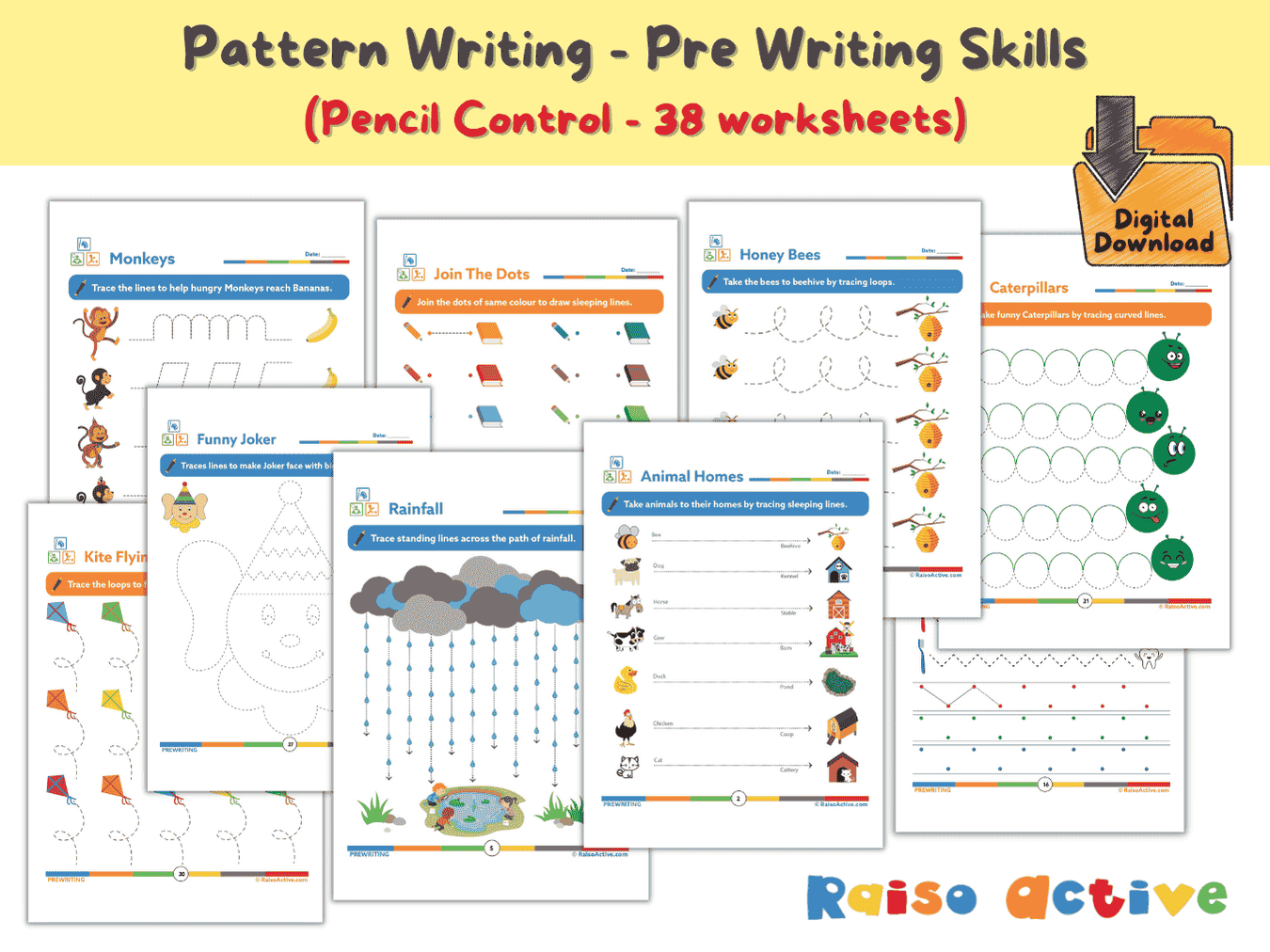
A useful bridge between guided tracing and independent writing is dotted numeral tracing — dotted outlines that the child connects rather than a solid line they follow. Begin with closely spaced dots, then gradually space them wider apart until the child is producing the numeral shape with only a few guide dots, and then with none at all. This gradual fading of support builds independence without the sudden leap from fully guided to fully independent that often trips children up.
Number Reversals — When They Are Normal and When to Take Action
Number reversals worry parents enormously — and almost always unnecessarily. If your child is writing 3 as a backwards ε, 5 as a mirrored shape, or 7 facing the wrong way, the most important thing to know first is this: reversals are a completely normal part of number writing development and are expected up to approximately age 7 to 8 for most children.
The young brain has not yet fully established left-right directionality in its visual processing system. For most of human history, the brain evolved to treat mirror images of objects as the same thing — a cup facing left and a cup facing right are both cups. Reading and writing require the brain to specifically unlearn this mirror generalisation for a particular set of symbols. This unlearning takes time and is fully consolidating between ages 6 and 8.
- **3** — The bumps face left instead of right. Very common, especially if the child is also learning Devanagari where some similar shapes have different orientations.
- **5** — The belly faces left; the hat may be omitted. Often confused with 2 as well as being mirrored.
- **7** — The slant goes right instead of left, or the top horizontal stroke is missing entirely.
- **2** — Less commonly, the bottom curve sweeps the wrong way, producing something that looks like a reversed Z.
- **9** — Confused with 6, or the tail extends upward rather than downward.
For children in India learning both English numerals and the Devanagari numeral system (used for Hindi, Marathi, and other languages), reversal frequency can be somewhat higher, and the resolution timeline slightly longer — simply because the brain is building directional memory for two separate numeral systems at once. This is not a cause for concern; it is a sign that a great deal of complex learning is happening simultaneously.
Respond to number reversals with calm, consistent modelling — not alarm, repetitive correction, or erasing. Say "let's check which way that one faces" rather than "you did it backwards again." The emotional tone you set around number writing matters as much as the technique.
The Indian School Context: What to Expect and How to Align
Number formation is introduced formally in most Indian preschools at the Nursery level (age 3 to 3.5) for recognition activities, and writing typically begins in LKG (age 4 to 4.5). Many schools follow a 1-to-10 or 1-to-20 sequence in the first term, covering numerals in numerical order rather than grouped by stroke similarity. This means children are often asked to write 3, 4, and 5 in quick succession — three of the most technically demanding and reversal-prone numerals — before their hands are fully ready.
If your child's school uses this sequence, do not attempt to override it at home — consistency between home and school is more valuable than any alternative sequence. Instead, use the multi-sensory and verbal cue techniques described in this guide as a supplement to the school's work, not as a replacement. A 10-minute multi-sensory practice session at home, aligned with whichever numeral the school introduced that week, will dramatically reinforce what was taught in the classroom.
- Ask the class teacher at the beginning of each term which numerals will be covered and in what order — plan your home practice to match
- Check whether the school uses a specific verbal cue or formation guide and mirror it exactly at home — different cues for the same numeral create confusion
- If the school uses a four-line exercise book (common in Indian preschools), practise at home using the same format so the spatial reference point is consistent
- For children attending English-medium schools that also teach Hindi, note that Devanagari numerals (०, १, २... ९) follow different stroke patterns — introduce these in a separate practice session, not mixed with English numeral practice
Research comparing explicit verbal cue instruction with observation-only and tracing-only approaches consistently finds that naming stroke steps aloud — "curve right, bump right, curve right again" for 3 — produces significantly better formation accuracy and faster automaticity than either passive observation or tracing alone.
Source: Early Childhood Education Journal; Educational Psychology Review
A 10-Minute Daily Number Formation Routine
Minutes 1-2: Hand Warm-Up
Before any pencil work, warm up the small muscles. Roll a ball of playdough for 60 seconds, or do finger taps — each finger touching the thumb one at a time, both hands, 10 repetitions. This is genuinely useful preparation, not just a ritual. Cold, stiff hand muscles produce less controlled, more effortful writing.
Minutes 3-4: Multi-Sensory Introduction
Focus on one numeral. Use a sand tray or sky writing to practise it two or three times, saying the verbal cue aloud each time. Keep this stage away from paper — the different surface reduces the anxiety of "messing up" and engages the tactile memory system alongside the motor system.
Minutes 5-7: Guided Tracing on Paper
Move to a worksheet or exercise book. The child traces the target numeral two or three times, using the correct starting point and saying the verbal cue quietly as they go. Offer calm, specific verbal guidance if needed — "the bump goes to the right" is more useful than "no, that's wrong." Avoid holding their hand and guiding physically; verbal guidance and demonstration are both more effective and less anxiety-inducing.
Minutes 8-9: Independent Attempt
Cover the traced numerals or move to a clean space on the page. Ask the child to write the numeral independently once or twice. Celebrate the attempt before commenting on accuracy. If the result is significantly off, demonstrate once more and ask for one more try — then move on. Never extend this stage into repeated correction; it creates frustration and diminishing returns.
Minute 10: Positive Close and Review
End with a specific, genuine compliment about one thing the child did well — "you remembered to start at the top", "the curve was really smooth this time", "you kept going even when it was tricky." Then transition to free play or a preferred activity. Never extend the session because it is going well — consistent short sessions build more robust habits than occasional long ones.
Three focused, high-quality attempts at a numeral with full attention will always produce better results than ten tired, inattentive repetitions. Short is not lazy — short is effective.
- Cannot draw a controlled vertical or horizontal line — the pencil wobbles or drifts significantly off course
- Cannot produce a smooth oval or circular shape — circles are angular, spiky, or open at random points
- Uses a fist grip for the pencil even after repeated, gentle guidance toward a finger grip
- Shows no interest in mark-making at all — does not draw, scribble, or colour spontaneously
- Becomes significantly distressed or tearful at any pencil-and-paper task, suggesting the motor demand is beyond current capacity
Frequently Asked Questions About Teaching Number Formation
My child can count to 100 but cannot write even simple numbers correctly. Is something wrong?
In which order should I teach the numerals?
My child's 3 always faces the wrong way. How do I fix the reversal?
Should I correct my child every time they reverse a number, or ignore it?
My child's preschool in India uses a four-line book for number writing. How should I use this at home?
How much number writing practice is appropriate for a 4-year-old each day?
Free worksheets for this topic
Browse all worksheets
Trace the Numbers 1-9 Worksheet for Preschoolers
Tracing the numerals 1 through 9 gives children ages 3-5 repeated, guided practice with the specific pencil strokes each number requires, building the fine motor control and muscle memory needed for independent number writing. Because tracing follows a fixed, correct path, it also reinforces accurate numeral recognition, helping children tell visually similar digits apart.
Caterpillar Counting Worksheet for Preschoolers
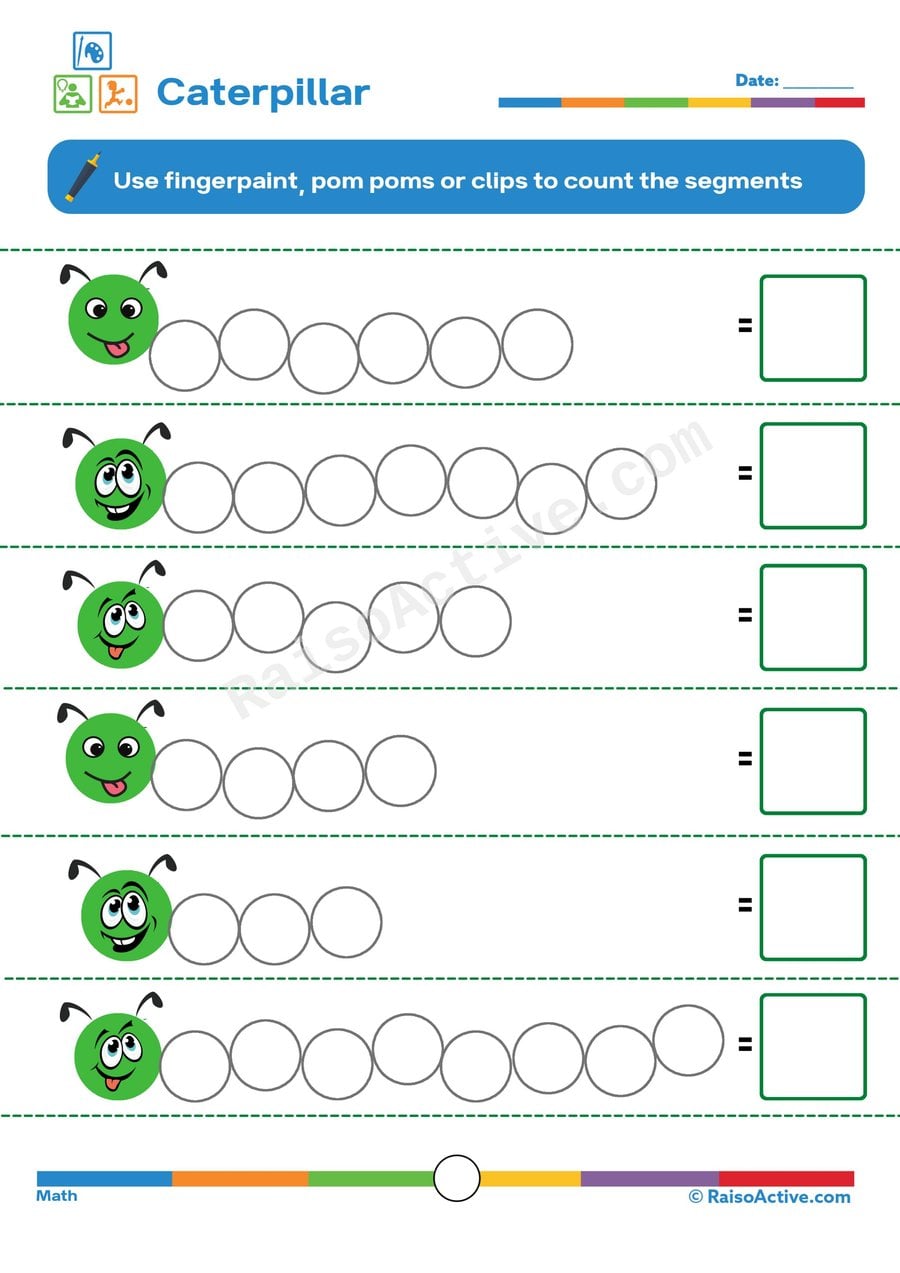
Counting the segments of each caterpillar teaches children ages 3-5 one-to-one correspondence — touching or marking each segment exactly once while saying a number — which is the core skill underlying accurate counting. Writing the final total in a box also connects the physical act of counting to its written numeral, reinforcing early number-writing practice.
Pac-Man Maze Worksheet: Count and Move!
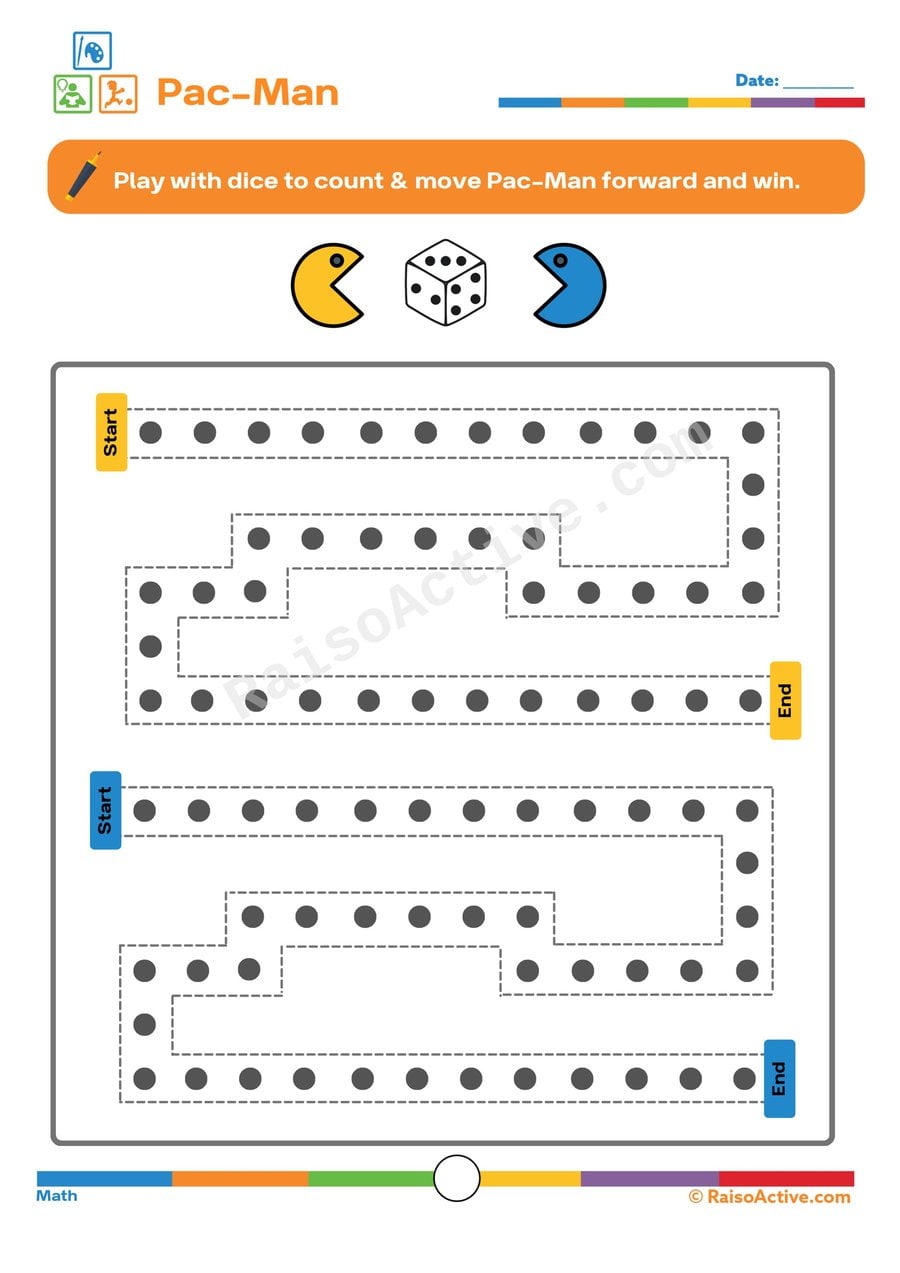
This dice-driven maze combines counting practice with path-following for children ages 3-5, since they must accurately count dots on a die before moving Pac-Man the matching number of spaces forward. Deciding how far to move and staying on the correct path also builds early strategic thinking, as children track their current position within the maze after each turn.
Corn Seed Addition Worksheet for Preschoolers
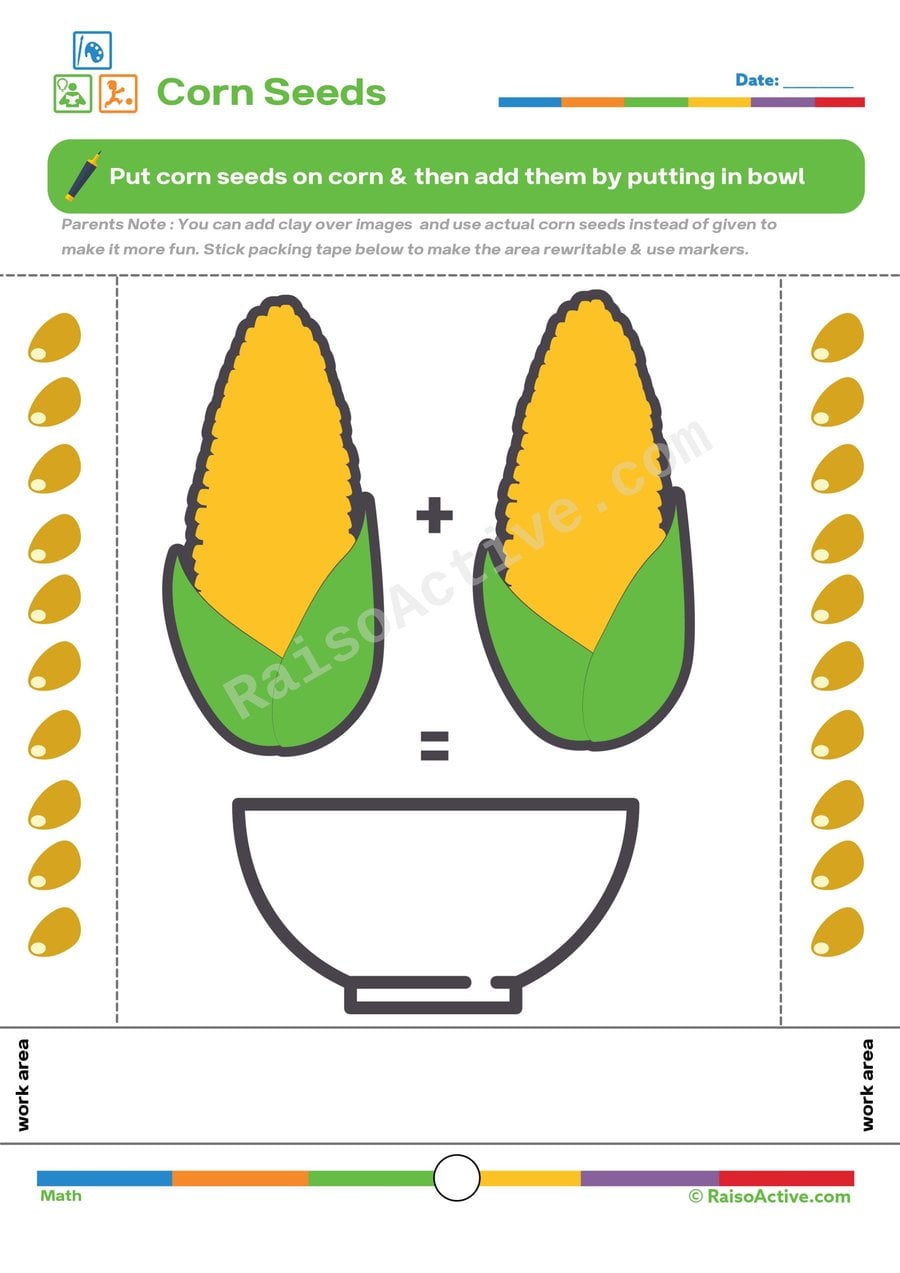
Counting corn seeds on two ears of corn and combining them into one total teaches children ages 3-5 the core concept of addition as joining groups together, using a concrete, countable image rather than abstract numerals alone. This worksheet also builds one-to-one correspondence, since accurate addition depends on touching or pointing to each seed exactly once while counting.

Written by
Hemsweta Jain · Teacher Cheena
MBA and Early Childhood Educator, teaching since 2014 · Founder of RaisoActive, Mumbai
Published · Last reviewed