Literacy, Parenting & Homeschool
What's the Right Age for My Child to Start Writing? A Developmental Guide for Parents
Author
RaisoActive - Kids Activities and Fun Learning
Date Published
Reading Time
9 min read

In This Article11 min read
- There is no single "right age" — writing readiness is determined by developmental milestones, not a birthday
- The natural progression moves from scribbling (age 2) → controlled shapes (age 3-4) → recognisable letters (age 4.5-6)
- Forcing early writing before muscles and coordination are ready can create lasting frustration and resistance
- Indian school pressure (LKG/UKG expectations) often pushes children into formal writing 1-2 years too early for their developmental stage
- Play-based activities — playdough, drawing, sand trays — build genuine writing readiness more effectively than pencil drills
The Question Behind the Question
Every week, parents across India ask some version of the same question: "My child is 3 and a half — should they be writing by now?" Or the reverse: "My child's school is already asking for neat letter writing in LKG and he just turns 4 — is this normal?" The anxiety underneath both questions is the same. Am I doing enough? Is my child on track? Are we falling behind?
The honest, evidence-based answer to "what is the right age to start writing?" is: it depends on the child — but for most children, formal letter writing is a skill for ages 4.5 to 6, not 2 or 3. The good news is that everything your child does before that window — the scribbling, the drawing, the finger painting, the playdough — is not wasted time. It is, in fact, the most important writing preparation there is. This guide will walk you through every stage of that journey, help you spot genuine readiness, and give you concrete, playful activities that build writing ability without a pencil in sight.
Writing Development by Age: What to Realistically Expect
Children do not go directly from holding a crayon to writing letters. There is a beautifully ordered developmental progression, and each stage is meaningful. Knowing what to look for at each age will help you stop worrying about what your child is not doing — and start noticing and celebrating what they are.
Around Age 2: The Scribbling Stage
At this stage, mark-making is the goal — not meaning. A 2-year-old who scribbles enthusiastically is doing exactly what they should be doing. Scribbling builds wrist strength, develops the pincer grip, and trains the hand-eye coordination that later makes letter formation possible. The scribbles will begin as large, sweeping arcs using the whole arm. Over the coming months, they become smaller and more controlled as the small muscles of the hand begin to develop.
What parents can do at this stage: provide large sheets of paper, chunky crayons and markers, finger paints, and chalk on pavements. The more mark-making, the better — surface, tool, and colour variety all keep engagement high and build a wider range of motor skills.
Around Age 3: Intentional Scribbling and First Shapes
Something shifts around age 3 — scribbles start to become intentional. A 3-year-old will often announce what they are drawing as they draw it, even if the finished product looks nothing like the named object. This is a significant cognitive leap. They are now connecting the idea of representing something to the act of making marks. They also begin to produce their first recognisable shapes — crude circles, horizontal lines, and vertical lines — though these will be inconsistent and wobbly.
Many Indian parents become concerned at this age when they see other children seemingly "writing letters" in their toddler groups. What those children are almost always producing are letter-like shapes — symbols that look a bit like letters but are not yet intentionally formed. This is completely normal and absolutely not a reason to start drilling letter formation.
Ages 3.5 to 4.5: Pre-Writing Strokes and Symbol Making
This is the golden window for pre-writing development. Children in this range begin to produce the basic strokes that underlie all letter formation: vertical lines, horizontal lines, circles, crosses, and diagonal lines. They also start to include letter-like forms and simple symbols in their drawings. Some children spontaneously produce the first letters of their name during this stage, particularly if they have seen it written frequently.
This is not yet the time for formal letter writing instruction. But it is absolutely the time to consolidate those pre-writing strokes through play — tracing in sand, drawing large shapes with chalk, playing with playdough — and to introduce the child's name as a first meaningful written word.
Ages 4.5 to 6: Emergent and Early Conventional Writing
This is when most children are genuinely ready to begin learning letter formation. Hand strength, finger coordination, and cognitive readiness converge during this window. Children can now hold a standard pencil (though chunky pencils are still preferable), follow stroke sequence instructions, and copy letters with increasing accuracy. By the end of this stage, most children can write their full name, recognise all capital letters, and produce many letters independently.
Children who begin formal letter writing at the earlier end of this range (4.5) will generally need more time, smaller targets, and more multi-sensory support. Children who begin at 5.5 or 6 will often pick it up remarkably quickly, simply because their brains and hands are more mature.
Ages 6 to 7: Consolidation and Fluency
By this stage, letter formation should feel increasingly automatic. The child is no longer thinking consciously about which stroke comes next — attention can shift to what they are writing rather than how they are forming each letter. Handwriting speed and legibility both improve significantly during this period, and most children in India will be transitioning from capital letters to a joined or partially joined script at school.
Key Takeaway
The progression from scribbling to fluent letter writing takes approximately 4-5 years and happens in stages that cannot be significantly accelerated. What can be accelerated is the quality of those stages — by giving children the right experiences at each point in the journey.
Children who receive rich pre-writing experiences (drawing, play, fine motor activities) in the early years typically find formal letter writing easier and more enjoyable when the time comes — not harder.
Signs Your Child Is Ready for Formal Writing — What to Look For
Writing readiness is not simply a matter of age. It is a cluster of physical and cognitive signs that tell you the necessary foundations are in place. Rushing formal writing before these signs appear is one of the most common — and most well-intentioned — mistakes parents make.
- Pincer grip is established — the child can pick up small objects (a pea, a button, a small bead) using only the thumb and index finger without using the other fingers for support
- Wrist rotation is present — they can turn a doorknob, unscrew a jar lid, or twist and roll playdough with a single hand
- Can copy basic strokes on request — when you draw a vertical line, horizontal line, circle, and cross and ask them to copy each one, they can produce recognisable versions of all four
- Shows pencil or crayon control — scribbles and drawings show intentionality; the child attempts to stay inside areas when colouring and can draw a face with eyes, nose, and mouth in roughly the right positions
- Shows interest in letters — spontaneously points to letters in the environment, asks what signs or labels say, notices letters in their own name
- Can sustain focused sitting for 8-10 minutes — attention span is long enough to complete a short, structured activity without constant redirection
- Follows two-step instructions — can process and act on a two-part direction such as "Pick up the red crayon and draw a circle at the top of the page"
If your child shows five or more of these signs, they are likely ready to begin gentle, structured letter work. If fewer than four apply, the most productive investment is not letter practice — it is building the physical foundations through the activities described later in this article.
Key Takeaway
Readiness signs matter more than age. A child who shows all the readiness markers at 4.5 will learn letter formation faster and with far less frustration than a child who begins formal practice at 4 without those foundations in place.
Why Forcing Early Writing Backfires
The instinct to start early is completely understandable — especially in a culture that places enormous value on academic achievement and visible progress. But the research on early writing instruction is surprisingly clear: starting formal writing too early does not produce better writers. It produces children who find writing frustrating, painful, and stressful.
When a child is asked to form letters before their small muscles are strong enough, several things happen. They grip the pencil too tightly, creating tension and fatigue in the hand. They compensate for lack of finger control by using their whole arm, producing large, uncontrolled strokes. They cannot maintain correct posture because core stability is also still developing. And perhaps most significantly, they experience repeated failure at a task that adults clearly consider important — which builds a story about themselves as "not good at writing" that can persist for years.
Hand and finger muscles in young children are genuinely immature. The fine motor system is one of the last to fully develop, with the small muscles of the hand not reaching full strength and coordination until around age 6 to 7. Attempting fine motor tasks before those muscles are ready is the equivalent of asking a child who cannot yet walk to run. The capacity simply is not there yet — and no amount of practice will create it faster than biological development allows.
⚠️Signs That Writing Has Been Introduced Too Early
- The child grips the pencil with the whole fist or presses so hard the paper tears
- Writing sessions end in tears, tantrums, or complete refusal after only a minute or two
- The child says they cannot write or that they are bad at this repeatedly, even with gentle encouragement
- Letters look significantly worse at the end of a practice session than at the beginning — a sign of muscle fatigue
- The child avoids any drawing or mark-making activity, not just formal writing — which suggests the association with writing has become negative
The Indian School Context: LKG, UKG, and the Pressure to Write Early
For parents in India, the conversation about writing readiness cannot happen without acknowledging the very real pressure that the school system creates. Most LKG (Lower Kindergarten) programmes in Indian private schools — attended by children aged 3.5 to 4.5 — include formal letter writing in their curriculum. By UKG (Upper Kindergarten), with children aged 4.5 to 5.5, many schools expect children to write full words and short sentences with reasonable legibility.
These expectations sit significantly below the developmental norms recommended by international early childhood bodies including UNICEF, the American Academy of Paediatrics, and the UK's Early Years Foundation Stage, all of which place the beginning of formal writing instruction at age 5 to 6. The gap between Indian school expectations and developmental science is real, and it creates genuine anxiety for families.
What can parents do? The most effective approach is to support the school's requirements without amplifying the pressure at home. Work with the teacher on realistic targets for your specific child. And invest heavily in the pre-writing and fine motor activities below — because children who have strong physical foundations genuinely do catch up quickly, often overtaking peers who were pushed to write early but developed poor habits as a result.
Children who begin formal writing at age 5-6 show equal or better handwriting outcomes by age 8 compared to children who began at 3-4
Multiple longitudinal studies from the UK, US, and Scandinavia show that early formal writing instruction does not produce better long-term handwriting. Children who spend their early years in play-based environments with rich fine motor experience typically catch up quickly to earlier writers — and show fewer persistent bad habits in grip and letter formation.
Source: Early Childhood Education Research, Cambridge University Press
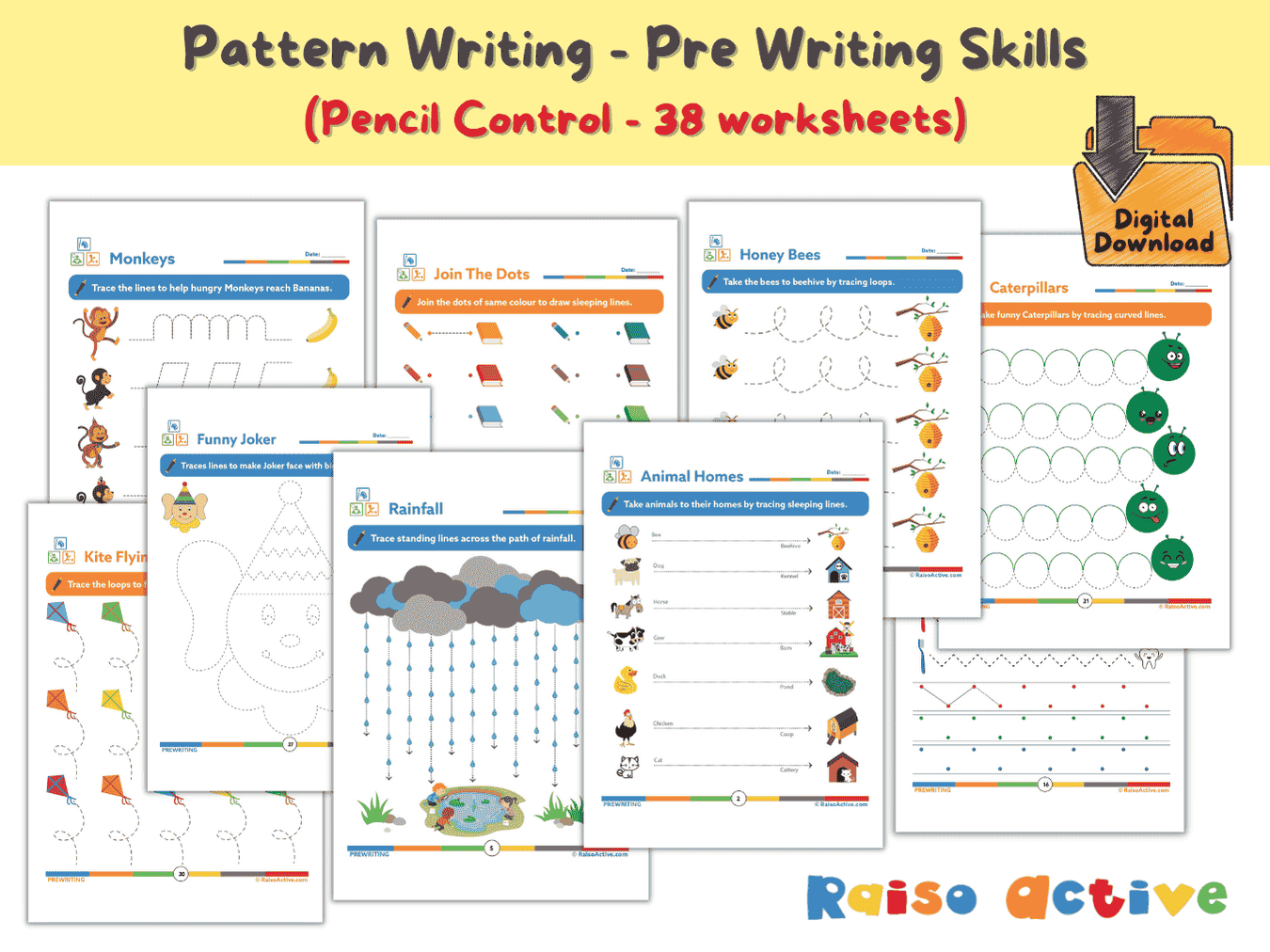
Building Writing Readiness Without a Pencil: Activities That Work
The most powerful writing preparation for children under 5 has nothing to do with pencils, worksheets, or letters. It involves building the hand strength, coordination, and spatial awareness that letter formation will later require. These activities are fun, easy to set up at home, and compatible with the play-based learning that young children need.
Building Writing Readiness Through Play
1
Step 1: Playdough and Clay Work (All Ages)
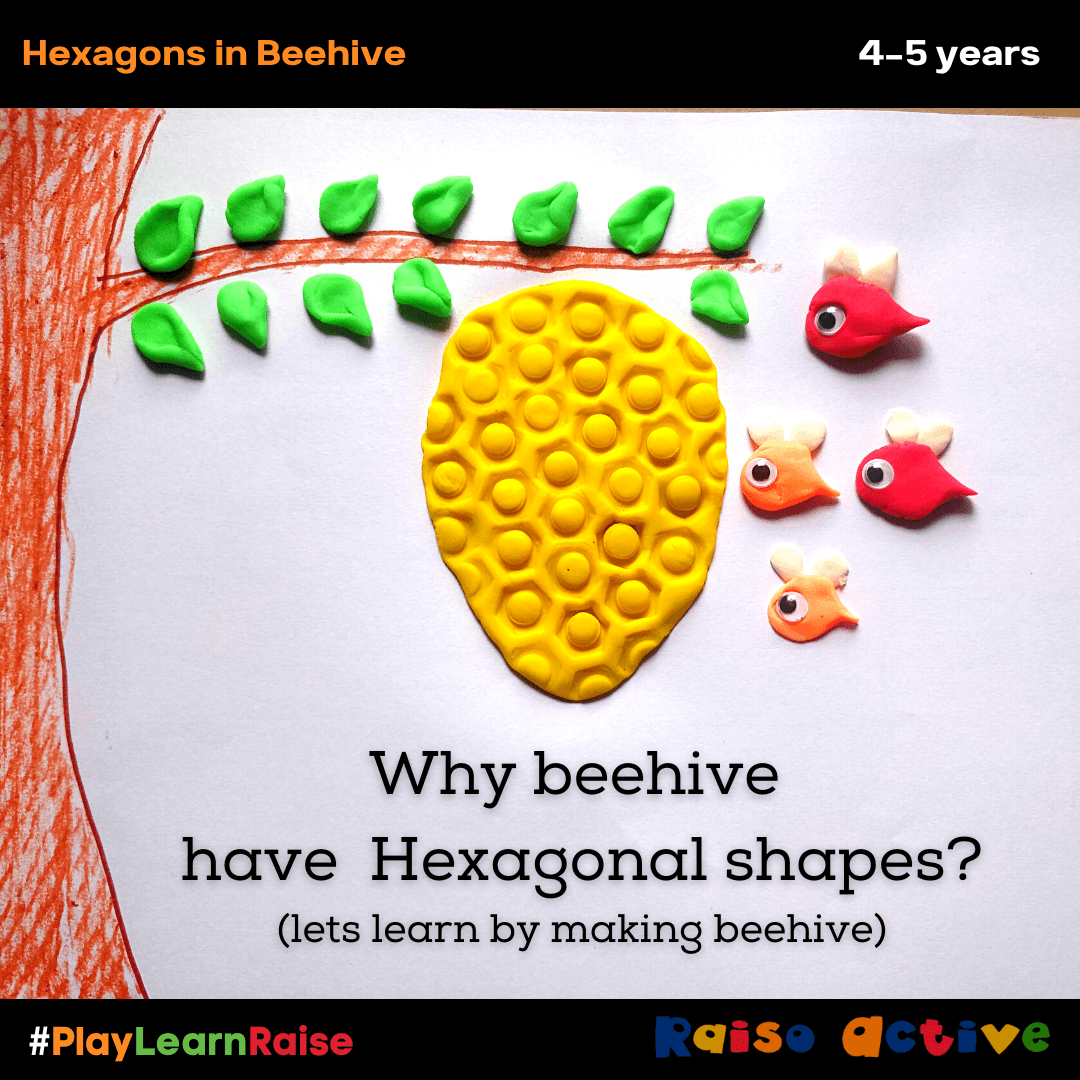
Rolling, squeezing, pinching, poking, and flattening playdough exercises every small muscle in the hand simultaneously. Make snakes (rolling between palms), balls (circular palming), and flat slabs (pressing and smoothing). For older children (4+), use playdough to make letter shapes — rolling thin snakes and shaping them into letters is far more effective than writing practice at this age. Indian kitchen staples like atta dough (wheat flour dough) work just as well as commercial playdough.
2
Step 2: Cutting Practice (Ages 3+)
Using child-safe scissors builds the same hand muscles used in writing — and more specifically, it builds the important distinction between the dominant "writing fingers" (thumb and index) and the supporting fingers. Start with cutting along wide straight lines on thick paper, then progress to wavy lines, zigzags, and simple shapes. Many Indian craft stores carry safe, rounded scissors sized for small hands.
3
Step 3: Sand and Salt Tray Writing (Ages 2.5+)
Fill a shallow tray (a baking tray or thali works perfectly) with a thin layer of fine sand, salt, or semolina (rava or sooji — found in every Indian kitchen). Children draw shapes, lines, and eventually letters with their index finger. The tactile resistance of the granules provides sensory feedback that pencil-on-paper cannot, and mistakes simply get smoothed away — no failure, just fresh starts. This is genuinely one of the best pre-writing activities in existence.
4
Step 4: Threading and Lacing (Ages 3+)
Threading large wooden or plastic beads onto a lace, or lacing through holes in a cardboard shape, builds the precise thumb-and-finger coordination and hand-eye tracking that writing requires. Start with large beads and thick laces, gradually progressing to smaller beads. This activity also naturally teaches left-to-right directionality when you thread a sequence of coloured beads in a pattern.
5
Step 5: Tearing, Crumpling, and Folding (Ages 2+)
Tearing strips of paper, crumpling newspaper into balls, and folding paper along a crease all strengthen the intrinsic hand muscles in ways that benefit writing. Tearing in particular requires the fine motor coordination of both thumbs working in opposite directions — a complex movement that builds essential hand strength.
6
Step 6: Large-Scale Drawing and Painting (Ages 2+)
Before children can write small, they need to be able to make large, controlled marks. Drawing on large sheets of paper on the floor, painting on a wall-mounted sheet, or chalking on a paved surface all use the shoulder and arm muscles that form the foundation for later smaller hand movements. The hierarchy is: shoulder → elbow → wrist → fingers. Gross motor comes before fine motor, always.
🎨Everyday Indian Home Opportunities for Fine Motor Development
- **Chapati rolling:** Let children help roll small balls of atta dough — this builds palm and wrist strength while feeling like a cooking contribution
- **Flower rangoli:** Picking up small flower petals and arranging them into patterns develops the same pincer grip used for pencil holding
- **Button and hook practice:** Dressing and undressing — managing buttons, hooks, and snaps — is direct fine motor training that many families underestimate
- **Rice and lentil sorting:** Sorting different types of dal or rice by hand, or picking small stones out of rice before washing it, builds the pincer grip and tactile discrimination that writing needs
- **Bead jewellery:** Threading beads to make simple jewellery, as done in many Indian craft traditions, is excellent fine motor work that children typically find highly motivating
When to Introduce Formal Letter Writing — and How to Start
Once the readiness signs are in place — and most children show them between ages 4.5 and 5.5 — formal letter writing can begin. The key is to start with the right tools, the right targets, and a realistic understanding of what progress looks like at this stage.
Not Ready for Formal Writing
- +Under 4 years old with no interest in mark-making
- +Cannot copy a circle, cross, or straight line on request
- +Grips crayon with full fist or whole palm
- +Writing sessions end in resistance after 1-2 minutes
- +Cannot sit for a focused activity for 5+ minutes
- +Shows no interest in letters or what print means
Ready for Formal Writing
- -Aged 4.5+ and shows curiosity about their own name in writing
- -Can copy all basic pre-writing strokes with reasonable accuracy
- -Uses fingers (not full palm) for most drawing and colouring
- -Engages willingly with drawing and mark-making for 8-10 minutes
- -Can follow two-step instructions and sit for focused tasks
- -Points out letters in the environment and asks what words say
When you begin, start with the letters of your child's own name. These are the most meaningful and motivating letters in the world to a young child — their identity written in symbols. Teach one letter at a time, using multi-sensory methods (sand tray, sky writing, finger tracing on large cards) before moving to pencil and paper. Keep sessions short — 5 to 10 minutes maximum — and always end before the child shows signs of fatigue.
Key Takeaway
The best starting point for formal letter writing is always the child's own name. It carries meaning, it is personally motivating, and it gives you exactly the right number of letters to start with — usually 4 to 6, which is enough to learn without overwhelming.
After the child's name, follow a stroke-based sequence rather than alphabetical order: straight-line letters first (L, I, T, H, E, F), then circular letters (O, C), then diagonal letters (A, V), then combination letters. This ensures each new letter builds on motor patterns already practised.
👋Setting Up for Writing Success at Home
- **Use the right tools:** Chunky triangular pencils or short broken crayons naturally encourage a correct tripod grip; avoid standard adult-length pencils for children under 5
- **Paper matters:** Wide-lined paper (at least 1.5 cm between lines) is appropriate for beginners; standard narrow-lined exercise books are too small for developing hand muscles
- **Posture first:** Feet flat on the floor, table at elbow height, non-dominant hand holding the paper — these three posture elements are prerequisites for good writing control
- **Write with them, not at them:** Children who watch adults write regularly develop stronger motivation and a clearer model to imitate; make writing visible in your daily life
- **Celebrate process, not product:** "I can see you worked really hard on that starting point" beats "That looks messy" every time — process praise builds resilience; outcome criticism builds avoidance
Children with 15+ minutes of daily fine motor play in the 2-4 year range show significantly stronger pencil control at age 5-6
Research tracking children from toddlerhood through early primary school consistently shows that the quantity and quality of fine motor play before formal schooling is one of the strongest predictors of early writing ability. The play does not need to be writing-related — any activity that exercises the small hand muscles contributes to the developmental account.
Source: Journal of Early Childhood Research; Fine Motor Development Longitudinal Study
Frequently Asked Questions: Writing Readiness and When to Start
My child's LKG school is already teaching letter writing and my child is only 3.5. What should I do?
This is a genuinely difficult situation that many Indian families navigate. The honest answer is: do not amplify the school pressure at home. Follow the school's homework expectations without adding extra writing practice on top — and focus your energy at home on building the physical foundations through play (playdough, drawing, sand trays, cutting). Talk to the class teacher about your child's specific needs and ask what a realistic target looks like for their age. Most experienced early years teachers understand that children this age vary enormously in readiness. If your child is visibly distressed by writing sessions, that is worth raising directly with the school.
My 2-year-old has no interest in holding a crayon. Should I be worried?
Not at all. Two is very young, and interest in mark-making develops at different times. Rather than offering a crayon specifically, try a variety of mark-making tools — fat chunky chalk on a pavement is often a hit because the marks are big and immediate; finger painting offers a very different sensory experience that some children prefer; and large brushes with water on a chalkboard or dark paper can feel exciting and new. The goal at 2 is simply to make mark-making pleasurable and familiar. There is no developmental concern about crayon disinterest at this age.
How do I know the difference between "not ready yet" and a potential developmental delay?
Developmental variation in writing readiness is enormous and normal — but there are some signals worth taking seriously. If your child is 5.5 or older and cannot copy a simple circle or straight line, shows no interest in any mark-making or drawing, has significant difficulty with fine motor tasks in general (buttons, feeding themselves, stacking blocks), or shows very low hand strength and coordination compared to peers, a conversation with your paediatrician is worthwhile. An occupational therapist can assess fine motor development and provide targeted support if needed. These assessments are widely available in Indian cities and can be genuinely reassuring — often confirming that the child is simply on a different timeline, not that anything is wrong.
Should I use workbooks with my child before they start school?
It depends on the age and the type of workbook. Before age 4, workbooks are generally not the most effective tool — the child's hands are not yet ready for the small, controlled movements most workbooks require, and the structured format can feel frustrating rather than engaging. A better investment is in the play-based activities described in this article. From age 4 onwards, high-quality pre-writing workbooks that focus on strokes, patterns, and tracing (rather than letter formation specifically) can be a useful supplement to play — particularly worksheets that use dotted tracing guides and allow large, confident movements. Look for worksheets with wide lines and minimal clutter on the page.
My daughter writes her name beautifully but my son (same age, 4.5) can barely hold a pencil. Is this a boy/girl difference?
Yes — and it is completely real. Research consistently shows that girls tend to develop fine motor skills earlier than boys, with a typical gap of 6 to 12 months in writing readiness. This is a biological reality related to the different rates of neurological maturation between male and female brains in early childhood, not a reflection of intelligence or potential. A 4.5-year-old boy who struggles to hold a pencil while his female classmate writes neatly is almost certainly within the completely normal range for boys. The solution is not more writing practice — it is more of the fine motor play activities that build the underlying foundations at whatever pace his development allows.
At what age should children be writing full sentences?
Most children begin writing short, simple sentences — typically 3 to 5 words — between ages 5.5 and 7, once they have consolidated letter formation and begun to understand basic phonics well enough to attempt spelling. In the Indian school context, many UKG and Class 1 programmes introduce sentence writing by age 5 to 6, which is on the earlier end of the developmental range. If your child is in this range and struggling with sentence writing, focus on the component skills: Are individual letters formed correctly and automatically? Can they hear the sounds in simple words? Is handwriting speed keeping up with their ideas? Sentence writing fluency follows naturally once these foundations are secure — rushing it tends to produce children who write as little as possible to avoid the effort, rather than confident, willing writers.