Sensory Processing Issues: Creative Alternatives to Traditional Worksheets
Author
RaisoActive - Kids Activities and Fun Learning
Published
Updated
Reading Time
21 min read

- What sensory processing differences look like in young children — tactile defensiveness, proprioceptive seeking, and auditory sensitivity — and why these patterns make traditional worksheets genuinely difficult
- Why worksheets can be a poor match for sensory learners: pencil pressure demands, visual clutter, fine motor fatigue, and the stillness they require
- Rich, hands-on alternatives including sand writing, playdough maths, textured letter cards, and heavy work activities that support focused learning
- Auditory and visual modifications — oral responses, recorded answers, coloured overlays, and decluttered layouts — that honour different sensory profiles
- How to create a sensory-friendly learning corner at home and when to involve a paediatric occupational therapist
When Worksheets Become the Enemy: Understanding Sensory Learners
Imagine handing your four-year-old a worksheet and watching what should be a simple colouring-and-matching activity dissolve into tears within two minutes. The pencil is gripped so tightly the paper tears — or refused entirely. The child rocks in their seat, covering their ears if anyone speaks. They shove the page away the moment the tip of the crayon touches the paper. You wonder: is this defiance? Is this laziness? Is something wrong?
For children with sensory processing differences, that scene is not defiance or laziness — it is a nervous system doing exactly what it is designed to do. The brain is receiving sensory signals that feel overwhelming, uncomfortable, or confusing, and the child is responding the only way available to them. Traditional worksheets, designed for a narrow sensory profile, can be genuinely painful or disorienting experiences for these children.
The good news is that sensory processing differences do not prevent learning — they simply require different pathways. When we replace the worksheet with an activity that works with a child's sensory system rather than against it, something remarkable happens: engagement, focus, and retention all improve, often dramatically. This guide explores what sensory processing differences look like in young children, why worksheets specifically are so challenging, and which hands-on alternatives work brilliantly in an Indian home or classroom setting.
Get sensory-friendly activity ideas in your inbox
Free hands-on learning activities, printable resources, and practical strategies for supporting sensory learners — delivered straight to your inbox every week.
What Sensory Processing Differences Actually Look Like
Sensory processing refers to the way the brain receives, organises, and responds to sensory information from the environment and the body. Most of us do this automatically and without effort — background noise is filtered out, the feeling of fabric on skin fades from awareness, and our muscles provide reliable information about where our bodies are in space. For some children, however, this filtering and organising process works differently.
Tactile defensiveness is one of the most common presentations. A child with tactile defensiveness experiences ordinary touch sensations — the texture of a worksheet's paper, the feeling of a pencil in the hand, chalk dust on fingers, or even a classmate brushing past their arm — as intensely unpleasant or threatening. They may refuse finger painting, hate having their hands messy, or recoil from certain craft materials. In a classroom setting, this can look like avoidance behaviour or emotional outbursts that seem disproportionate to what happened.
Proprioceptive seeking looks quite different. Proprioception is the sense that tells us where our body parts are and how much force we are using — it comes from muscles, joints, and tendons. Children who crave proprioceptive input are constantly seeking heavy, deep-pressure sensations: they push, pull, crash, carry heavy objects, press their pencil so hard it tears the paper, chew on clothing or stationery, and struggle to sit still unless they are moving. These children are often labelled as rough or hyperactive, when in reality their nervous system is seeking the organising, calming input that proprioception provides.
Auditory sensitivity means that sounds other children filter out — the hum of a fan, a conversation in the next room, the scrape of a chair — register as loud, distracting, or even painful. A child with auditory sensitivity may cover their ears frequently, become distressed in busy environments, struggle to follow verbal instructions in a noisy setting, or shut down entirely when asked to work in a room where others are talking. Standard classroom and home settings are rarely quiet enough for these children to do their best thinking.
Why Traditional Worksheets Are a Poor Match for Sensory Learners
Worksheets make a set of implicit assumptions about the child sitting in front of them: that they can tolerate the texture of paper, hold a pencil comfortably, sit still for ten or more minutes, process visual information from a busy page, and write with controlled, measured force. For a child with sensory processing differences, several of these assumptions fail simultaneously.
Fine motor demands are a significant barrier. Writing requires the child to calibrate pencil pressure precisely — not too light, not too heavy. For a child with proprioceptive differences, this calibration is effortful or impossible. They either press so hard they are uncomfortable and the pencil breaks, or so lightly nothing shows on the page. Either way, the cognitive energy that should go towards learning the maths concept or practising the letter shape is entirely consumed by the physical struggle.
Visual clutter on a typical worksheet — decorative borders, multiple font sizes, clip art, dense rows of problems — can overwhelm a child with sensory sensitivities to visual input. The page becomes a wall of stimulation with no clear entry point. The child either freezes, refuses, or moves through the worksheet randomly rather than systematically.
The requirement to sit still is perhaps the largest mismatch of all. A proprioceptive-seeking child regulates their nervous system through movement. Asking them to sit quietly and write for fifteen minutes without physical input is physiologically difficult — their body is telling them they need to move in order to think clearly. When we insist on stillness before learning, we remove the very tool the child needs to focus.
Tactile Alternatives: Learning Through Touch
Tactile alternatives replace pencil-on-paper with activities that engage the sense of touch in purposeful, learning-rich ways. The key is to go slowly with children who have tactile defensiveness — offer choices, never force touch, and start with tools that create distance between the hand and the material (a stick to write in sand, for example, rather than fingers).
Sand writing trays are one of the most effective and low-cost alternatives available. Fill a shallow tray or thali with fine sand, rice, or semolina (rawa). The child uses a finger, a small stick, or a paintbrush to write letters, numbers, or shapes. The deep tactile feedback of drawing through a textured medium is satisfying for most children and is particularly effective for letter formation — the child can simply smooth the surface and start again, removing the fear of making permanent mistakes that a worksheet creates.
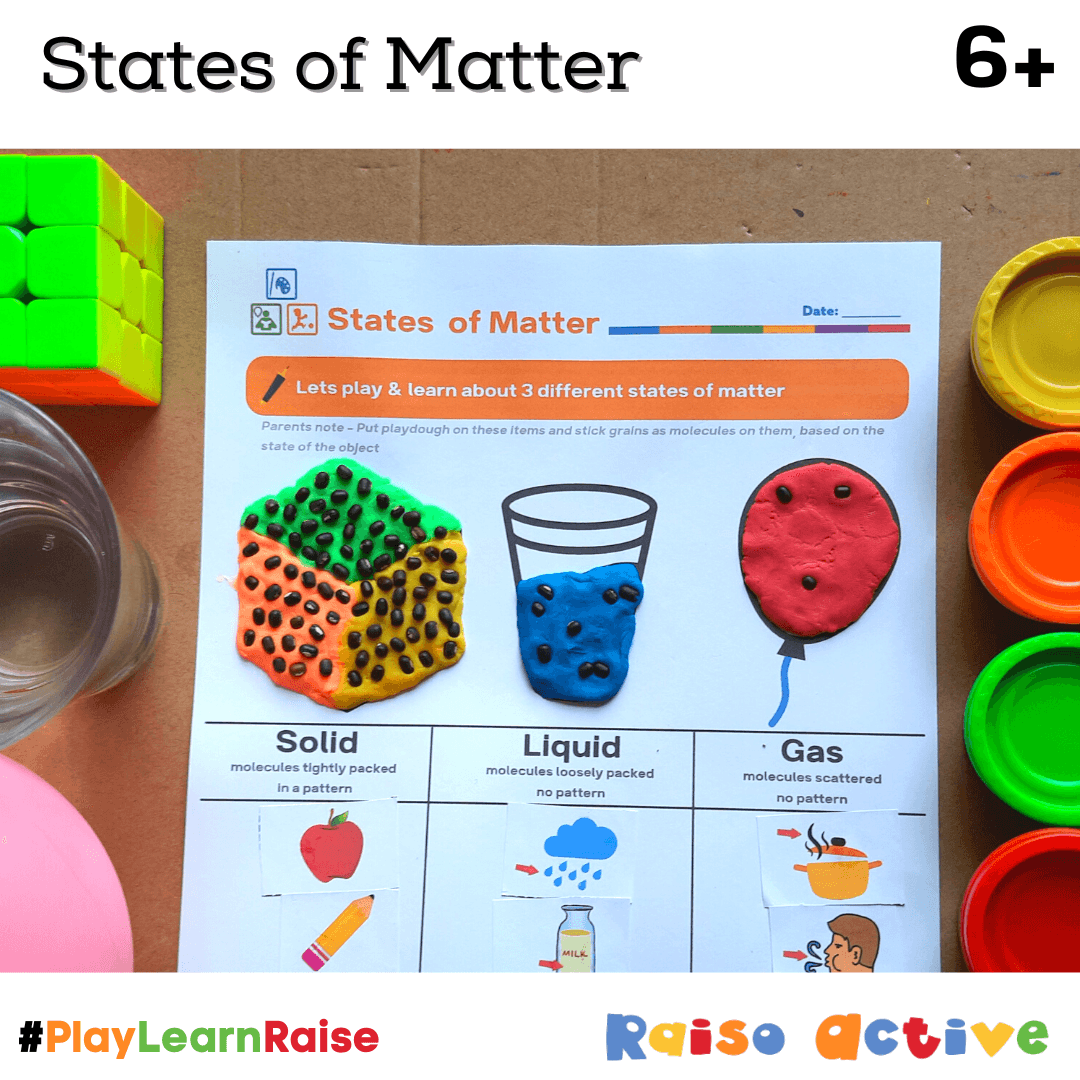
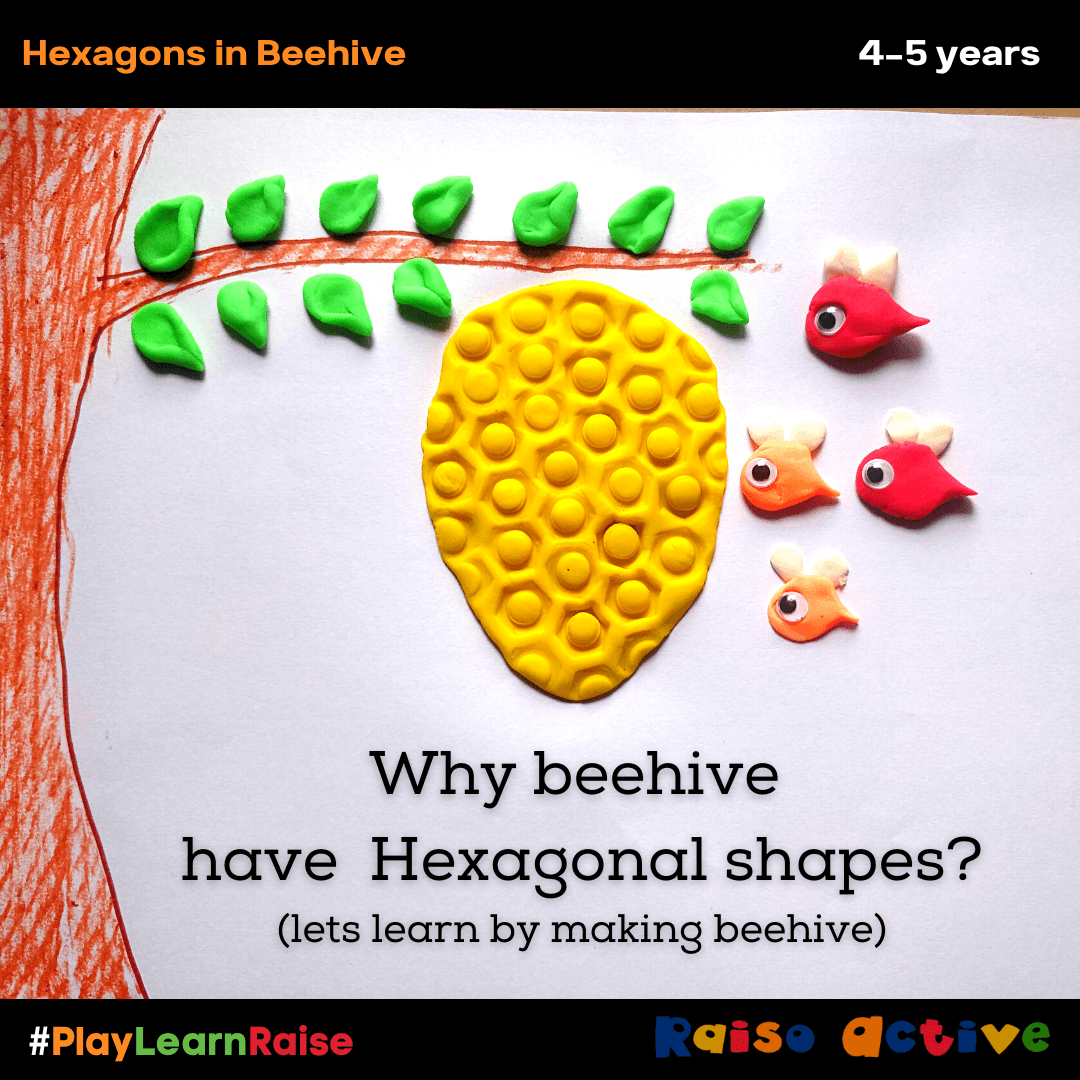
Playdough maths replaces number worksheets with three-dimensional, tactile manipulation. A child who struggles to write the number three can instead roll three balls of playdough, press them into a mat, or use a rolling pin to stamp the numeral into the dough. The heavy, resistive input of kneading and rolling is deeply organising for the nervous system — many children with sensory differences become noticeably calmer and more focused after two or three minutes of playdough work.
Textured letter cards and alphabet manipulatives support children who struggle with pencil writing but benefit from tracing raised or textured surfaces. These can be made at home by drawing letters in white glue on card and sprinkling sand, rice, or salt over them before the glue dries. Commercial versions are also widely available online. Tracing a textured letter while saying its sound engages tactile, auditory, and proprioceptive channels simultaneously — a powerful combination for memory consolidation.
Tactile learning is not a consolation prize for children who cannot manage worksheets — it is a richer, multi-sensory learning experience that benefits all children, particularly in the early years. The goal is the same; only the medium changes.
When introducing sand trays or playdough to a child with tactile defensiveness, place the material in front of them without any pressure to touch it. Let them observe, use a tool first, and gradually progress to direct contact on their own timeline.
Proprioceptive Activities: Heavy Work Before Learning Tasks
The single most effective strategy for children who seek proprioceptive input is not to find a worksheet alternative — it is to provide heavy work before sitting down to any focused task, worksheet-based or otherwise. Heavy work refers to activities that provide strong proprioceptive input to muscles and joints, creating a calming, organising effect on the nervous system that can last for thirty minutes to two hours.
Effective heavy work activities accessible in most Indian homes include: carrying a bag of books from room to room, pushing a laundry basket across the floor, doing wall push-ups, carrying a small bucket of water to the garden, kneading chapati dough, doing animal walks (bear walk, crab walk, frog jumps) across the room, and climbing (supervised) on outdoor play equipment. These are not time-wasters before learning — they are neurological preparation that makes learning possible.
During a learning session, movement breaks built into the activity work better than asking the child to push through until they are done. Every five to ten minutes, invite the child to do five wall push-ups, carry a book to another room and back, or squeeze a stress ball ten times before returning to the task. These micro-breaks deliver proprioceptive input without ending the learning session.
Alternatives to worksheet tasks can also be designed to incorporate proprioceptive input directly. Chalk writing on a vertical surface (a wall, a chalkboard, or even pavement outside) provides significantly more proprioceptive feedback than writing on a horizontal page — the shoulder and arm must work against gravity, which is organising and satisfying for proprioceptive seekers. Large-motor letter formation — writing enormous letters with a wet sponge on the outside wall, or walking the shape of a letter on the floor — combines movement with literacy in a way that worksheets simply cannot.
Heavy work is neurological preparation, not a reward. Provide it before a focused learning task, not after it is completed. A child who has had adequate proprioceptive input before sitting down will sustain attention significantly longer than one who has not.
Auditory-Friendly Alternatives: Learning Without the Noise Barrier
For children with auditory sensitivity, the challenge is not the worksheet itself — it is everything happening around the worksheet. Background noise that most people barely register can completely prevent a sensitive child from accessing their working memory and sustaining attention. Creating a quieter environment and replacing some written-response tasks with oral or recorded alternatives makes an enormous difference.
Oral responses are the simplest, most immediate alternative to writing answers on a worksheet. Instead of writing the answer to a maths problem, the child says it aloud. Instead of filling in the blanks of a sentence, they narrate the answer while the parent writes it, or the child dictates into a voice memo on a phone. This is not a shortcut — it genuinely assesses understanding of the concept while removing the writing and visual-processing barriers simultaneously.
Recorded answers work particularly well for children who feel self-conscious about speaking while others listen. Give the child a simple device — a phone, a tablet, or even a small toy voice recorder — and let them record their answers privately. Playing the recording back together becomes a natural review activity. For literacy tasks, the child can narrate a story or describe an image rather than writing a response.
For the learning environment itself, noise-cancelling headphones or simple foam earplugs (available from any pharmacy across India) can transform a noisy household into a manageable workspace. Some children do better with low, consistent background sound — a fan, soft instrumental music, or a white noise app — than with silence that is punctuated by unpredictable sounds. Experiment to find what works for your child.
Visual Modifications: Reducing the Overwhelm on the Page
When worksheets are appropriate and well-suited to the learning goal, simple visual modifications can make them far more accessible for children with sensory sensitivities. These changes cost very little and can be implemented by any parent or teacher.
Coloured overlays — a sheet of transparent coloured acetate placed over the page — reduce the contrast of black print on white paper, which many children with visual sensitivity find glaring and uncomfortable. Different colours work for different children; yellow, blue, and green are the most commonly helpful. A simple trial using a few sheets of coloured cellophane (available at any gift wrapping shop) is enough to discover whether this helps your child.
Reduced visual clutter means removing everything from the page that does not directly serve the learning objective. Print worksheets yourself and remove decorative borders in the PDF settings, or cover distracting elements with strips of blank paper before photocopying. Present only two or three problems at a time rather than a full page of twenty — for many sensory-sensitive children, this single change transforms the experience from overwhelming to manageable.
Printing on cream or pastel paper rather than bright white reduces visual stress for many children. Cream, soft yellow, or light blue paper is less reflective and softer on the eyes. Most print shops can accommodate this request for a small additional cost, or you can purchase pastel-coloured paper at any good stationery shop.
Visual modification does not mean dumbing down the content — it means removing the sensory barriers that prevent the child from accessing the content in the first place. A clean, uncluttered page with generous spacing is simply better design for all learners.
- **Choose a quieter area** away from the kitchen, television, and main traffic areas of the home. Even a small corner of a bedroom with a low table or floor mat can work beautifully.
- **Control the lighting.** Harsh fluorescent lighting is a common sensory trigger. A lamp with a warm bulb, or positioning the learning area near a window with natural light, is often calming.
- **Create a visual boundary.** A simple bookshelf, a low curtain, or even a large cardboard box open on one side can define the child's learning space and reduce visual distractions from the rest of the room.
- **Include sensory tools within reach.** A small tray of sand or rice, a pot of playdough, a fidget tool, a stress ball, or a small balance cushion to sit on — keep these accessible so the child can self-regulate without interrupting the session.
- **Keep the space consistent.** A predictable environment reduces the cognitive load of starting a learning session. When the child knows exactly where things are and what to expect, their nervous system spends less energy on vigilance and more on learning.
- **Limit what is on the walls near the learning space.** Visual clutter around the workspace is as distracting as visual clutter on the worksheet. A calm, neutral backdrop helps the child's brain stay focused on the task in front of them.
- **You will need:** A shallow tray or thali (a 30 cm baking tin works perfectly), fine sand from a hardware store or beach, or alternatives such as semolina (rawa), table salt, or even coloured powders.
- **Pour the material** to a depth of about one centimetre — deep enough to write clearly but not so deep that it is hard to smooth.
- **Introduce it without pressure.** Place the tray in front of your child and demonstrate by drawing a simple shape or their name. Let them explore freely first before making it a learning task.
- **Progress gradually.** Start with large, simple shapes (circles, lines, crosses), move to letters and numbers, then to short words or number sequences. Follow the child's interest and comfort level.
- **Make it multisensory.** Say the letter sound aloud as you trace it, feel the texture, watch the line appear. This combination of auditory, tactile, and visual input is far more powerful for memory consolidation than writing on a flat, silent worksheet.
- **Use a small stick or paintbrush** for children with tactile defensiveness — direct finger contact is not required for the activity to be effective.
- **Do not force sensory exposure.** Insisting a child who is tactile defensive touch a material they find aversive does not build tolerance — it builds anxiety and erodes trust. Gradual, self-directed exposure is always safer and more effective.
- **Do not assume movement is defiance.** A child who gets up, fidgets, and cannot sit still during a worksheet activity may be seeking essential proprioceptive input. Forcing them to stay seated may make attention worse, not better.
- **Do not switch between strategies too quickly.** Sensory interventions take time to show their full effect. Give a new approach at least one to two weeks of consistent use before concluding whether it helps.
- **Avoid sensory overload in the learning environment.** Playing loud music, working in a crowded room, or starting a task during a busy and noisy time of day sets sensory-sensitive children up to fail before they even begin.
children experiences sensory processing difficulties significant enough to affect their everyday functioning, including participation in academic tasks. These differences are common, neurologically based, and highly responsive to the right environmental supports.
Source: American Occupational Therapy Association, 2023
of children diagnosed with ADHD also have co-occurring sensory processing differences — meaning that strategies designed for sensory learners often help children with attention difficulties as well.
Source: Sensory Processing Disorder Foundation Research Review, 2022
Setting Up Sensory-Friendly Learning: A Step-by-Step Guide
Observe your child carefully for one week
Before introducing any alternative, spend a week observing. Note which sensory inputs seem to trigger distress (certain textures, sounds, light levels, or the requirement to be still) and which seem calming or sought out (heavy objects, rhythmic movement, deep pressure). These observations are your roadmap.
Provide heavy work before every learning session
Build five to ten minutes of heavy work into your daily routine before any seated learning activity. This is non-negotiable for proprioceptive-seeking children. Over time you will notice that sessions started with heavy work are significantly longer and more productive than those started cold.
Set up a sensory-friendly learning space
Choose a quieter corner of your home, control the lighting, create visual boundaries, and stock the space with sensory tools. This environment preparation is just as important as the activities themselves — the nervous system needs a calm context to focus.
Replace or modify the most challenging worksheets first
You do not need to abandon all worksheets immediately. Start by identifying the two or three worksheet activities that most consistently trigger distress and replace those specifically with sensory alternatives. The sand tray for letter formation and playdough for number work are excellent starting points for most children.
Introduce sensory alternatives gradually and with choice
Offer the alternative alongside, not instead of, the original activity whenever possible. "Would you like to write this in the sand tray or on the paper today?" gives the child agency, which is deeply regulating for a nervous system that often feels out of control in its environment.
Build in movement breaks every five to ten minutes
Set a gentle timer. When it sounds, invite the child to do five wall push-ups, carry a book to the shelf and back, or do ten frog jumps before returning to the task. These micro-breaks are not interruptions to learning — they are fuel for it.
Consult an occupational therapist for individualised guidance
If you have implemented environmental modifications and sensory alternatives consistently for four to six weeks and are still seeing significant distress or avoidance, a referral to a paediatric occupational therapist (OT) is the next step. An OT can conduct a formal sensory assessment and create an individualised sensory diet — a personalised schedule of sensory activities tailored to your child's specific profile.
- +Writing letters and numbers with a pencil on paper
- +Answering comprehension questions in a lined answer box
- +Sitting still at a desk for the full duration of the task
- +Working in a noisy, shared family space with the television on
- +Completing a full page of 20 problems before getting up
- +Touching glue, paint, and craft materials without preparation
- +Receiving verbal instructions in a busy, loud environment
- -Tracing in a sand tray, forming letters in playdough, or using textured letter cards
- -Narrating answers aloud, recording on a voice memo, or dictating to the parent
- -Working on a balance cushion, with a fidget tool, or with movement breaks every five minutes
- -Creating a quiet learning corner with a noise boundary and warm lighting
- -Completing two or three problems, doing five wall push-ups, then returning for the next chunk
- -Introducing materials gradually, offering tools like sticks or brushes before direct touch
- -Giving one instruction at a time in a quiet moment, with a visual support card alongside
When to Involve an Occupational Therapist
The strategies in this guide are things any parent or teacher can implement independently. However, some children's sensory processing differences are significant enough to warrant a formal assessment and an individualised programme designed by a trained professional. A paediatric occupational therapist specialises in exactly this area.
Consider seeking an OT referral if: your child's sensory responses are causing significant distress on a daily basis; sensory avoidance or seeking behaviours are affecting social relationships, safety, or the ability to participate in family life; you have been using sensory-friendly strategies consistently for six weeks without meaningful improvement; or your child's school is reporting concerns about participation or behaviour that may have a sensory component.
In India, paediatric OTs are available at government hospitals in most major cities, private developmental paediatric clinics, and increasingly via telehealth for families in smaller towns and rural areas. Organisations such as the Indian Association of Occupational Therapists can help you locate a registered practitioner in your region. Your child's paediatrician can provide a referral letter.
Free Sensory-Friendly Activities, Every Week
Join thousands of Indian parents and educators who are supporting children with sensory differences through hands-on, playful learning. Get free activities and practical strategies delivered to your inbox — no jargon, just ideas that work.
Frequently Asked Questions
Does my child need a diagnosis of sensory processing disorder before I try these alternatives?
My child refuses to touch the sand tray or playdough — what do I do?
How much heavy work does my child need before sitting down to learn?
Can sensory-friendly alternatives keep up with the Indian school curriculum?
My child's school insists on worksheets for homework. What can I do?
At what age should I involve an occupational therapist for sensory processing concerns?
Free worksheets for this topic
Browse all worksheets
Maze Worksheet for Kids: Bee Maze and Tangled Lines
Ages 4-7 · Pre-K–Grade 1Ages 4-7 · Reception–Year 2Ages 4-7 · LKG–Class 1Ages 4-7
Children plan a route through a maze to take the bee home, then trace three tangled lines with their eyes and finger to match each child to a toy. Both tasks build focus, planning and visual tracking.
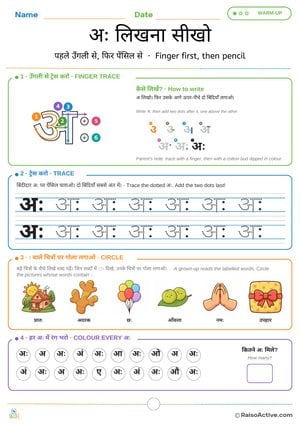
Learn to Write Hindi Visarga अः (ah) – Tracing Worksheet | अः लिखना सीखो
Ages 3-7 · Preschool–Grade 1Ages 3-7 · Nursery–Year 2Ages 3-7 · Nursery–Class 1Ages 3-7
Children learn to write अः step by step: write अ, then add two dots after it, one above the other. They trace with a finger, then a pencil, circle the pictures whose labelled words contain ः (प्रातः, छः, नमः) and colour every अः in a grid.
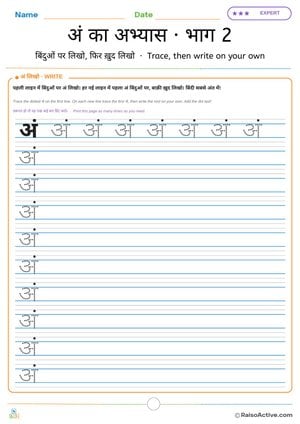
Hindi Letter अं (am) Practice 2: Trace, then Write on Your Own | अं का अभ्यास · भाग 2
Ages 5-7 · Kindergarten–Grade 1Ages 5-7 · Year 1–Year 2Ages 5-7 · UKG–Class 1Ages 5-7
An expert page for confident writers: trace the dotted अं on the first line, then on each new line trace the first अं and write the rest on your own, adding the dot last.
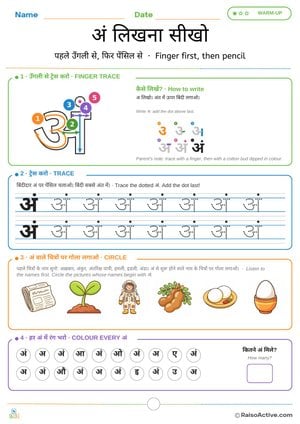
Learn to Write Hindi Letter अं (am) – Tracing Worksheet | अं लिखना सीखो
Ages 3-7 · Preschool–Grade 1Ages 3-7 · Nursery–Year 2Ages 3-7 · Nursery–Class 1Ages 3-7
Children learn to write अं step by step: write अ, then add the dot above it last. They trace with a finger first, then trace dotted rows with a pencil, circle the अं pictures and colour every अं in a grid.

Written by
Hemsweta Jain · Teacher Cheena
MBA and Early Childhood Educator, teaching since 2014 · Founder of RaisoActive, Mumbai
Published · Last reviewed
Related posts
Learning Activities That Work: A Comprehensive Guide for Children with ADHD
Discover hands-on, movement-based learning activities that genuinely work for children with ADHD. Practical tips for Indian parents and educators, ages 1-8.
Resources for Children with Multiple Disabilities: A Comprehensive Guide for Families
Discover essential resources for children with multiple disabilities. Therapies, inclusive learning, assistive technology, and printable activities for ages 1-8.
Supporting Your Child with Dyslexia: A Parent's Guide to Home-Based Learning Strategies
Practical home-based learning strategies for children with dyslexia in India. Covers signs, diagnosis, multisensory phonics, school accommodations under RPWD Act, and tech tools.
Related Resources
Printable Resources(10)
View all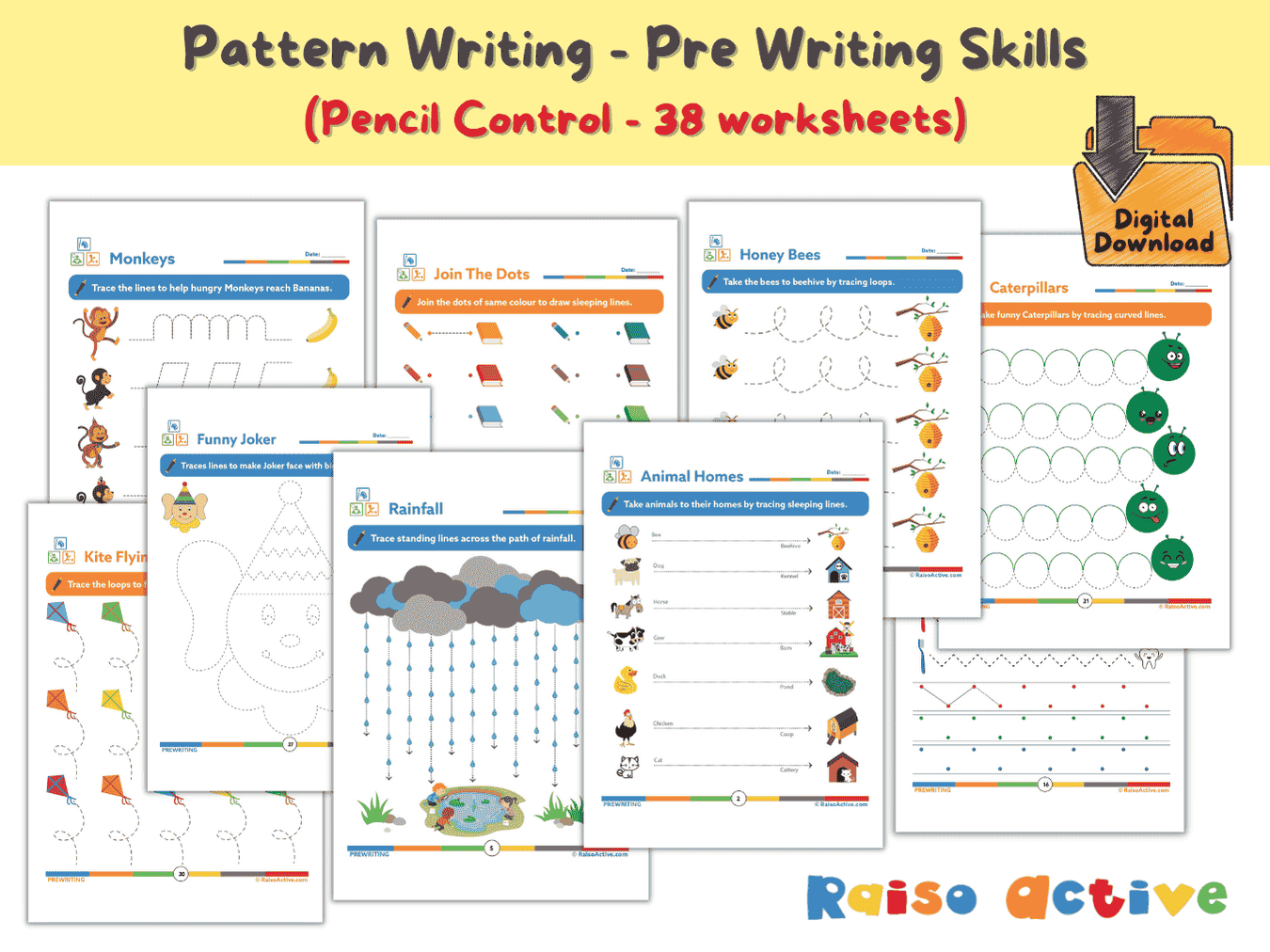

Pattern Writing Pre-writing Skills Activity Book for 3-4 Year Olds
Ages 3-4 · PreschoolAges 3-4 · NurseryAges 3-4 · 44 pages
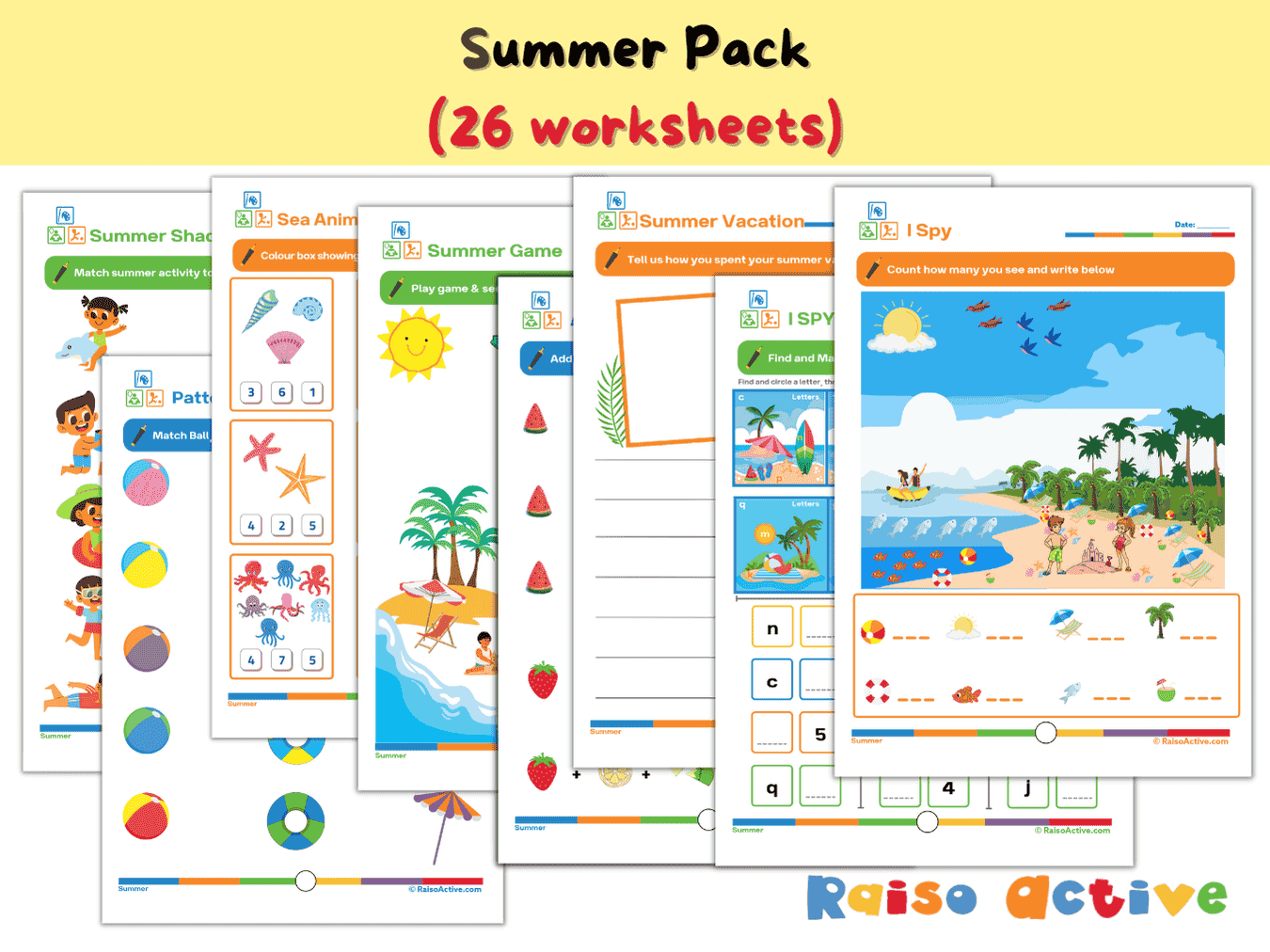

Summer Activity Pack: Math, Literacy, Puzzles & More for Preschool & Kindergarten
Ages 3-7 · Preschool–Grade 1Ages 3-7 · Nursery–Year 2Ages 3-7 · Nursery–Class 1Ages 3-7 · 26 pages
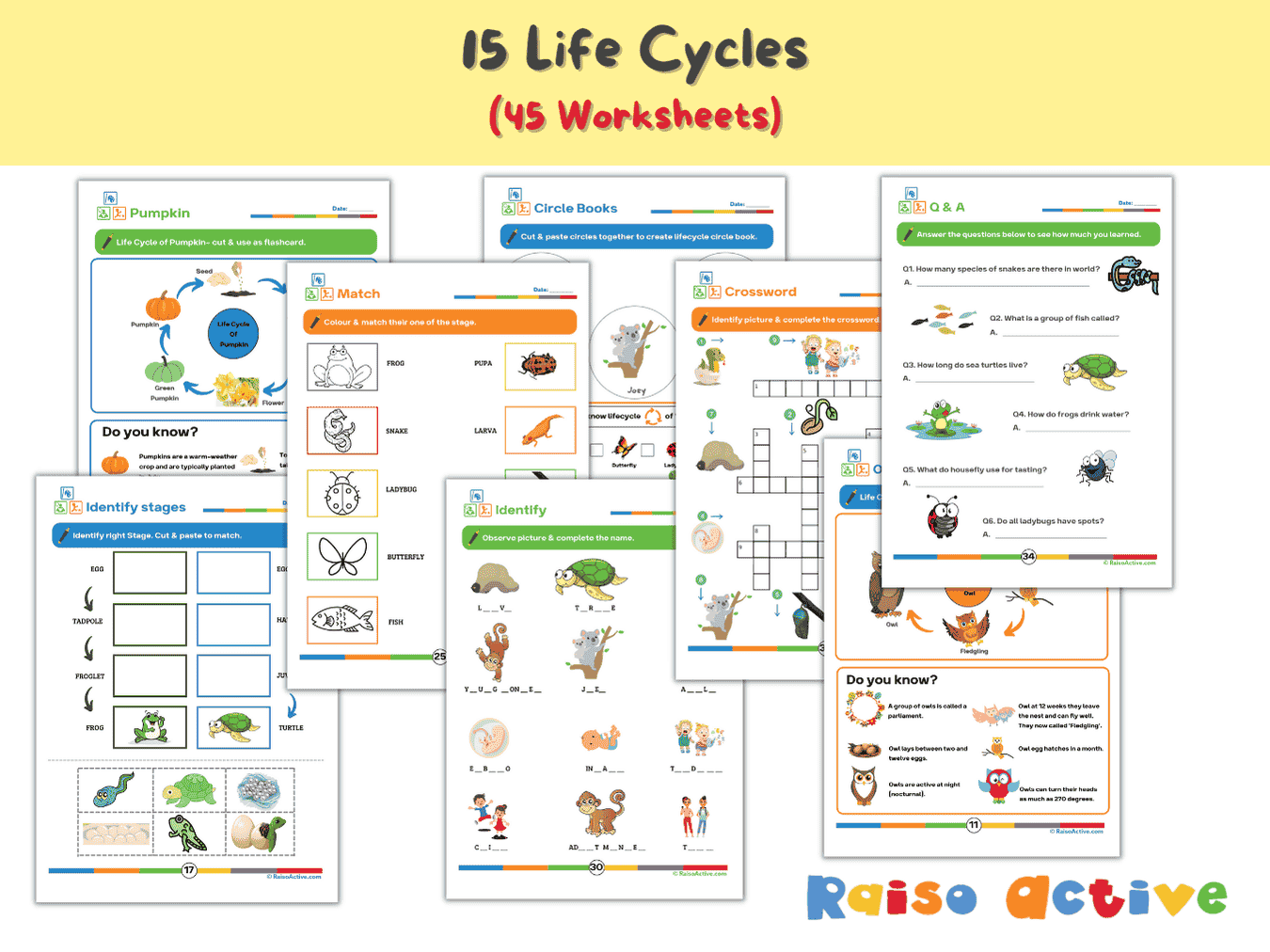

Lifecycles Activity Book & Flashcards for Preschool & Early Elementary
Ages 3-8 · Preschool–Grade 2Ages 3-8 · Nursery–Year 3Ages 3-8 · Nursery–Class 2Ages 3-8 · 46 pages
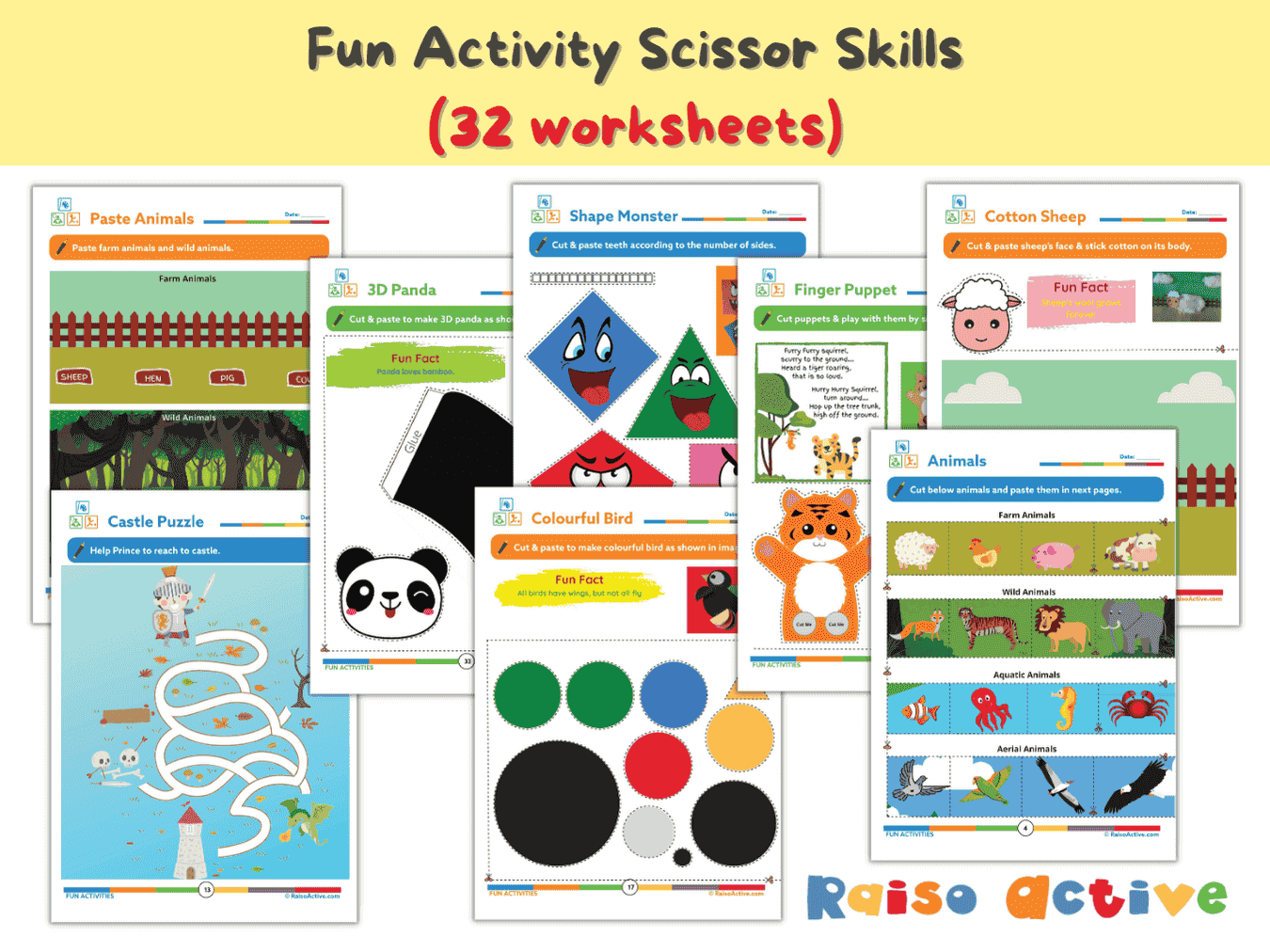
Preschool Scissor Skills Activity Book: Fine Motor & Craft Fun for Ages 3-6
Ages 3-6 · Preschool–KindergartenAges 3-6 · Nursery–Year 1Ages 3-6 · Nursery–UKGAges 3-6 · 35 pages
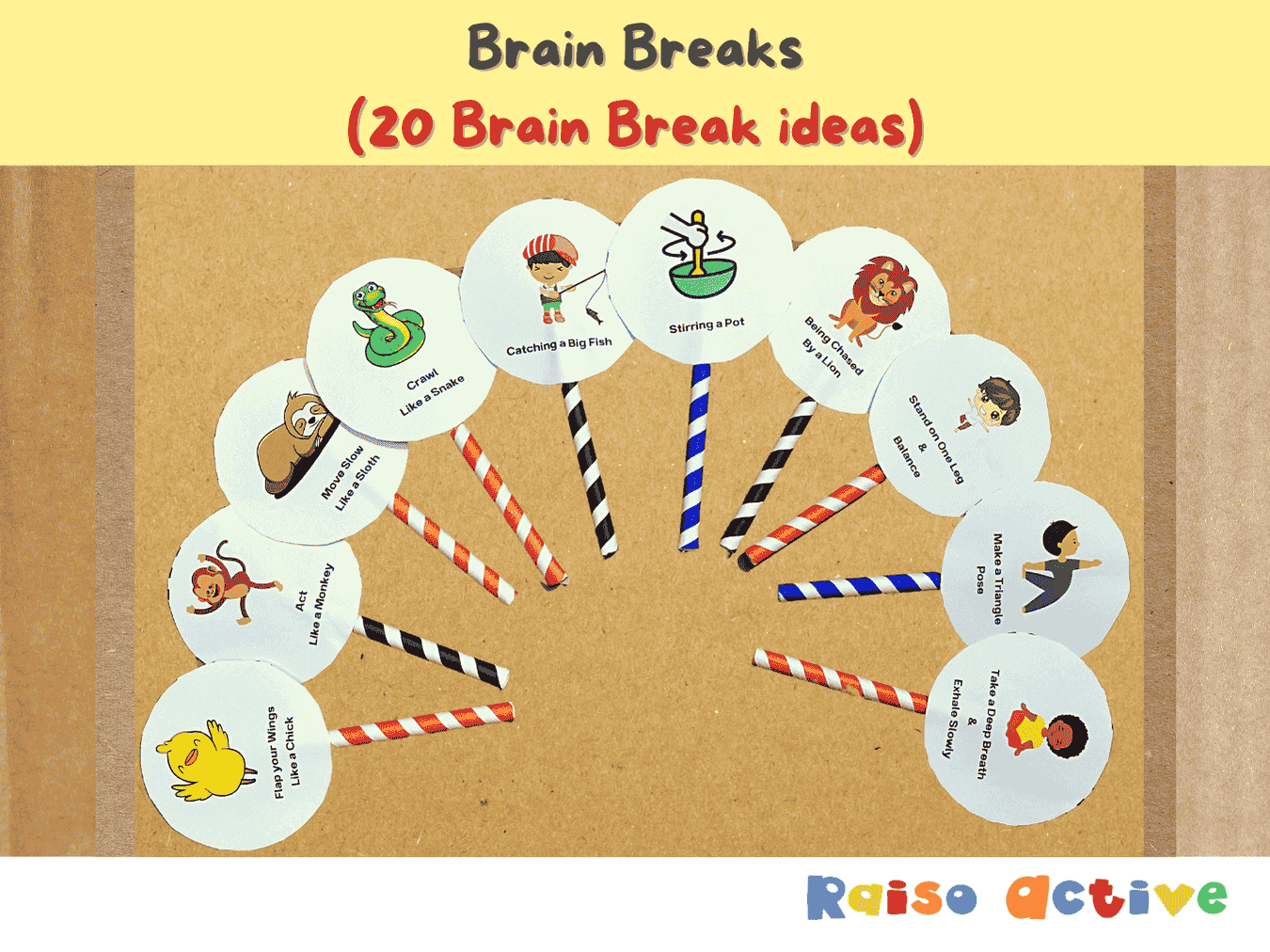
Gross Motor Movement & Imaginative Play Flashcards for Toddlers & Preschoolers
Ages 2-5 · Preschool–Pre-KAges 2-5 · Nursery–ReceptionAges 2-5 · Nursery–LKGAges 2-5 · 5 pages

India's Festivals & Cultural Diversity Activity Book for Kids 4-8
Ages 4-8 · Pre-K–Grade 2Ages 4-8 · Reception–Year 3Ages 4-8 · LKG–Class 2Ages 4-8 · 42 pages
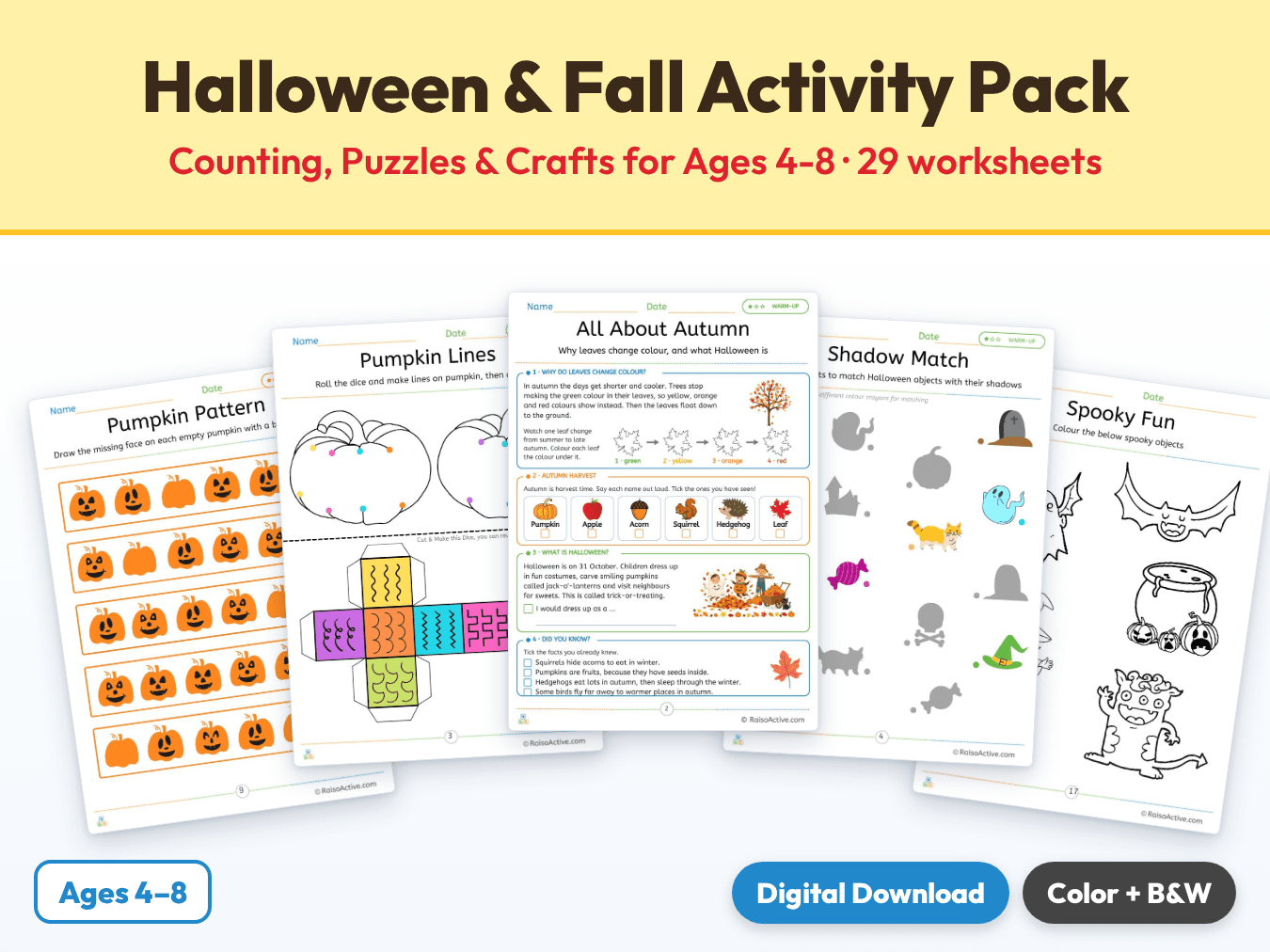
Halloween & Fall Activity Pack: Counting, Puzzles & Crafts for Ages 4-8
Ages 4-8 · Pre-K–Grade 2Ages 4-8 · Reception–Year 3Ages 4-8 · LKG–Class 2Ages 4-8 · 30 pages
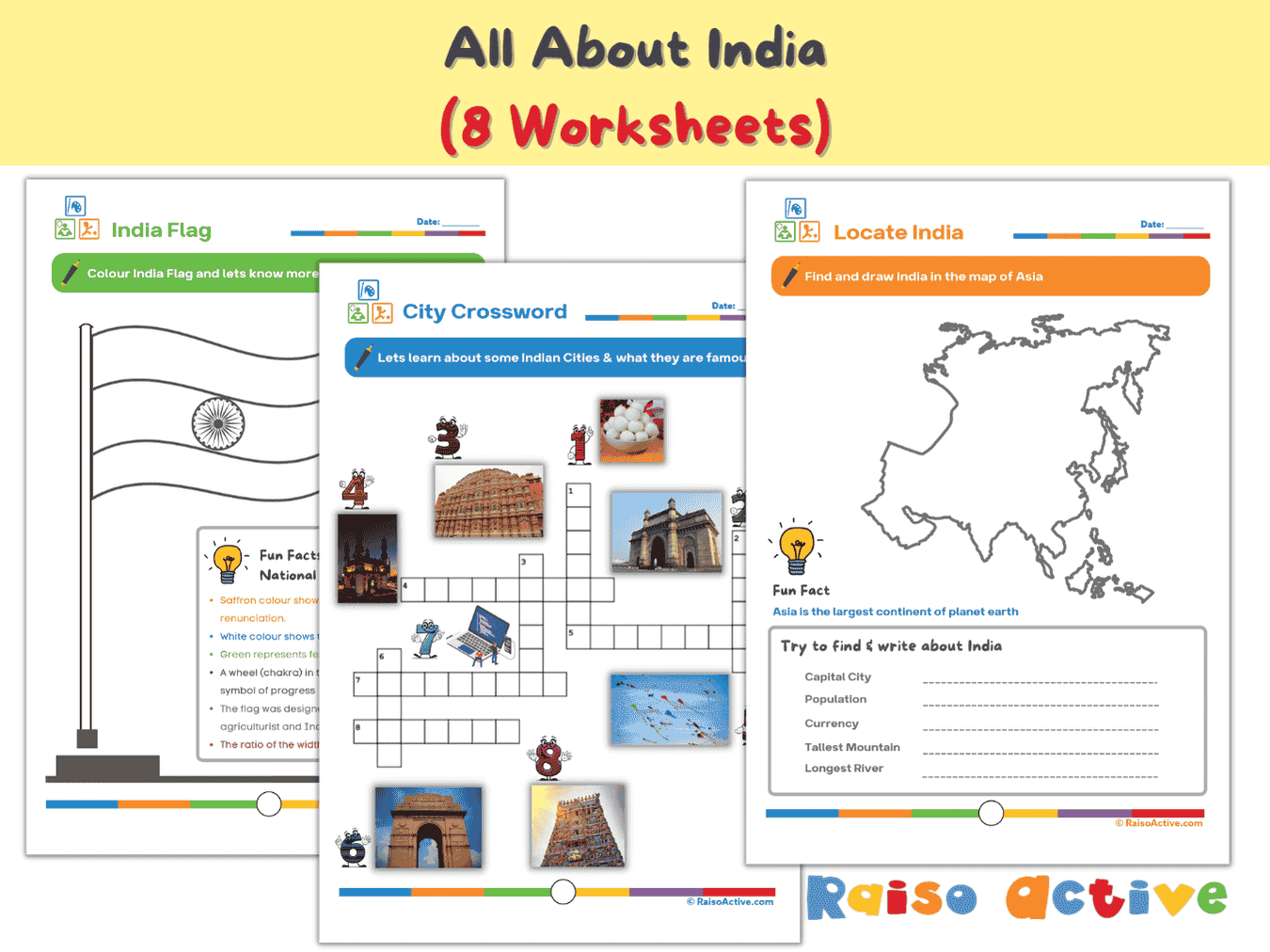
India Activity Book for Kids: Explore Geography, Culture & Symbols (Ages 5-8)
Ages 5-8 · Kindergarten–Grade 2Ages 5-8 · Year 1–Year 3Ages 5-8 · UKG–Class 2Ages 5-8 · 8 pages

Month 9: Holistic Preschool Play Learning | Ages Up to 4
Ages 3-4 · PreschoolAges 3-4 · NurseryAges 3-4 · 30 pages
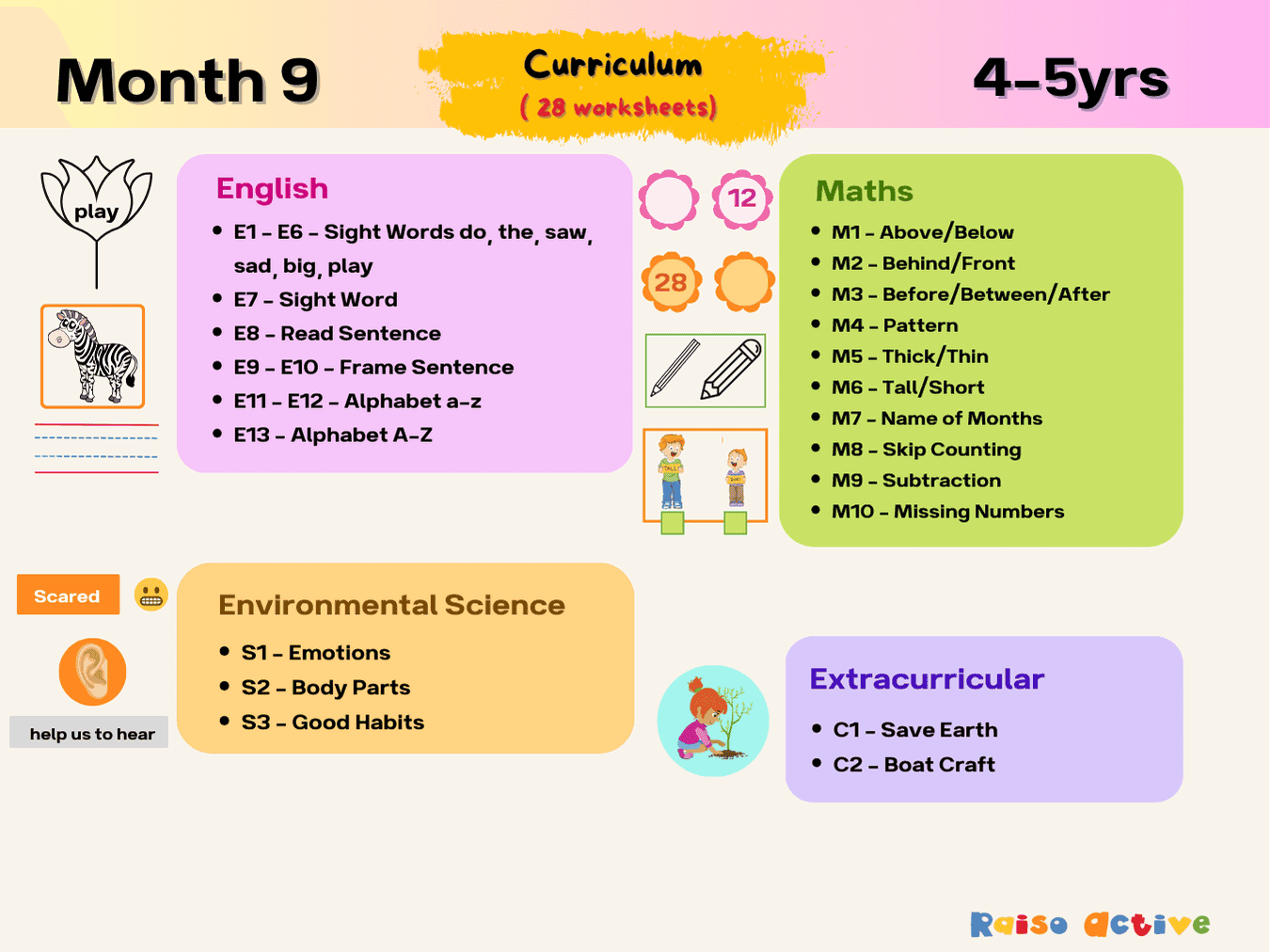
Month 9: Play-Based Preschool Foundational Skills | Ages 4-5
Ages 4-5 · Pre-KAges 4-5 · ReceptionAges 4-5 · LKGAges 4-5 · 31 pages