The Great Debate: Worksheets vs. Hands-On Activities for Young Learners
Author
RaisoActive - Kids Activities and Fun Learning
Published
Updated
Reading Time
8 min read

- The worksheets-vs-hands-on debate is a false choice — both have a place in a child's learning life
- Research firmly supports play-based, multi-sensory learning as the primary method for children under 6
- Structured practice (including worksheets) becomes increasingly valuable from age 6 onwards
- Indian schools lean heavily on worksheets; understanding when this helps and when it harms is every parent's superpower
- The best approach is a balanced week that uses age, interest, and developmental readiness as your guide
Why This Debate Matters More Than You Think
Walk into any Indian parent WhatsApp group and you will find it: photographs of three-year-olds completing pages of alphabet tracing, parents comparing how many worksheets their children finish daily, and the nagging anxiety that free play is somehow wasted time. On the other side, an increasing number of parents — inspired by Montessori videos and progressive parenting blogs — have swung to the opposite extreme, rejecting worksheets entirely as "anti-childhood."
Both camps are reacting to something real. The anxiety about worksheets comes from genuine love — parents want their children to be ready for the world. The rejection of worksheets comes from equally genuine love — parents want learning to feel joyful, not like drudgery. The problem is that both extremes miss the nuanced truth that decades of early childhood research has been telling us: it is not worksheets versus hands-on activities; it is knowing when and how to use each one.
In this post, we will walk through the best arguments on both sides, look at what the science actually says, and give you a practical framework for building a balanced learning week that serves your child — not the parenting trend of the moment.
Want balanced learning ideas every week?
Subscribe to the RaisoActive newsletter for age-appropriate worksheets, hands-on activity prompts, and expert guidance for parents of children ages 1-8.
The Case for Worksheets: Why They Have Earned Their Place
Worksheets have survived in classrooms across the world for a very long time, and not purely out of habit. When thoughtfully designed and used at the right developmental moment, they offer several genuine benefits that are difficult to replicate through play alone.
Structure and Focused Skill Practice
Play is beautifully open-ended, but some skills benefit from focused, repeated practice with clear parameters. Letter formation, number writing, and cutting along a line are fine motor tasks that improve with deliberate repetition. A well-designed worksheet provides exactly that — a contained, repeatable practice space. Think of it the way a musician practises scales: not exciting, but genuinely useful.
Assessment and Portfolio Evidence
Worksheets create a tangible record of learning. A child's tracing worksheet from January and one from April tell a powerful developmental story at a glance. For teachers managing 30 children, and for parents wanting to track progress at home, completed worksheets provide concrete evidence that is difficult to gather from play observations alone. This matters especially when communicating with schools about a child's readiness or identifying areas that need more support.
Accessibility and Ease of Use
Not every parent or teacher has the time, space, or resources to set up elaborate sensory bins and hands-on stations every day. A well-chosen worksheet can be pulled out in minutes, used on a crowded kitchen table, and completed without specialist materials. For Indian families managing small apartments, multiple children, and long working hours, this practicality is not a small thing. Worksheets that are educationally sound and logistically manageable serve real lives.
School Readiness and Transition Support
Whether we like it or not, most Indian primary schools are still structured around paper-based tasks — writing in notebooks, completing exercises, taking written tests. A child who has never sat down to complete a focused paper-based activity may struggle with the transition to Class 1, not because they are less intelligent, but simply because the format is unfamiliar. Gradual, gentle exposure to worksheets in the year before school entry can ease this transition meaningfully.
Worksheets are most valuable as practice tools, assessment aids, and school-readiness bridges — not as primary learning experiences.
A child learns what a butterfly is by observing one in the garden, touching a wing, and listening to a story. The worksheet that asks them to colour and label butterfly parts afterwards reinforces what they already understand. Worksheets consolidate learning; they rarely create it from scratch.
The Case for Hands-On Learning: What Play Does That Worksheets Cannot
The research here is unambiguous: for children under 6, hands-on, play-based, multi-sensory learning is not just preferable — it is how young brains are biologically designed to acquire knowledge. Understanding why helps parents move past the guilt of "just playing" and recognise it for the serious developmental work it actually is.
Deeper Engagement and Multi-Sensory Processing
When a child pushes dal into groups of five on the kitchen counter, they are not just learning to count — they are feeling the weight, hearing the sound, seeing the colour, and moving their hands in space. This multi-sensory experience creates a web of neural connections that paper-based counting simply cannot match. The brain encodes information more durably when multiple senses are involved. This is not an educational philosophy; it is neuroscience.
Intrinsic Motivation and the Joy of Discovery
Children are born curious. That curiosity is the engine of all learning, and hands-on exploration is what keeps the engine running. When a child discovers that mixing haldi and soap creates a reaction, or that a cardboard tube makes a perfect telescope, they experience the profound satisfaction of self-directed discovery. Worksheets, by their nature, have pre-determined correct answers. Hands-on activities can have endless, surprising outcomes — and that unpredictability is what keeps children deeply motivated.
Real-World Connection and Meaning-Making
Abstract symbols on a worksheet (the letter "A", the number "3") become meaningful only when they are connected to real-world experiences. A child who has sorted three types of leaves, cooked three rotis with their grandmother, and counted three stars in a story understands "threeness" in a deep, embodied way. The worksheet that comes afterwards simply maps a symbol onto an already-rich understanding. Without the real-world foundation, the symbol remains hollow.
Executive Function and Problem-Solving
Open-ended play builds executive function — the cluster of mental skills that includes planning, flexible thinking, impulse control, and working memory. When children build with blocks, negotiate pretend-play scenarios, or figure out why their clay structure keeps collapsing, they are exercising these skills intensively. Executive function, not alphabet knowledge, is one of the strongest predictors of academic success. Worksheets that require only one correct response do little to build this capacity.
Hands-on play builds the mental architecture that worksheets later fill in — skip the architecture and the filling has nowhere to stick.
Think of hands-on learning as laying the foundations of a house and worksheets as painting the walls. You can paint beautifully, but without strong foundations, the house will not stand. Children who have rich, play-based early years develop stronger cognitive foundations that make later structured learning — including worksheets — far more effective.
What the Research Actually Tells Us: Play Wins Under 6, Structure Matters After
The scientific literature on early childhood learning is remarkably consistent. Study after study, across different countries and cultures, arrives at the same conclusion: play-based learning is the optimal approach for children under 6, while structured practice becomes increasingly important from age 6 onwards.
The landmark Perry Preschool Project in the United States followed children from age 3 through to adulthood. Children in play-rich preschool programmes showed significantly better outcomes in academic achievement, employment, and social well-being compared to those in academically-pressured early environments. Similar findings have emerged from Scandinavian countries where formal schooling does not begin until age 7 — yet children consistently outperform their peers who began formal instruction at 4 or 5.
The shift happens around age 6-7. This is when children typically enter what Jean Piaget called the "concrete operational stage" — they can follow logical rules, understand abstract symbols, and benefit from structured, sequential instruction. From this point, a balance that includes meaningful structured practice (yes, including worksheets) alongside experiential learning produces the best results. Before this developmental shift, heavy structured instruction can actually suppress curiosity, increase anxiety, and reduce intrinsic motivation.
of a child's brain connections are formed in the first five years of life — primarily through sensory experience, movement, and play, not paper-based tasks.
Source: Harvard Center on the Developing Child
The Indian Education Reality: A Worksheet-Heavy Culture and How to Navigate It
In India, the pressure to begin formal academics early is intense and comes from multiple directions simultaneously. Preschools compete for admissions by demonstrating "academic outcomes" — often measured by how well three-year-olds can write the alphabet. Relatives compare grandchildren's worksheet completion rates. Social media amplifies anxiety with photographs of toddlers holding pencils and completing rows of letters.
This culture has real costs. Occupational therapists across India report increasing numbers of young children with hand pain and pencil-grip problems caused by premature writing pressure. School counsellors see children as young as five with test anxiety and a fear of making mistakes. These are not minor inconveniences — they are early signs of a relationship with learning that has been damaged before it had a chance to flourish.
It is worth noting that India's National Education Policy (NEP) 2020 explicitly and forcefully recommends a play-based, activity-centred approach for all children in the foundational stage (ages 3-8). The NEP discourages formal reading and writing instruction before age 6 and calls for joyful, multi-sensory, experiential learning as the default mode. This means that if your child's school is doing daily worksheets with three-year-olds, it is not just developmentally questionable — it is out of step with national educational policy.
This does not mean you should ignore or rebel against your child's school. It means you can make informed choices at home, supplement the school curriculum with rich play experiences, and approach school-sent worksheets with perspective rather than panic. A worksheet sent home by school is a suggestion, not a developmental mandate.
Children who attend play-based preschools are three times more likely to demonstrate strong problem-solving skills by age 8 compared to peers in academically-pressured programmes, even when the academically-pressured group had earlier reading and writing skills.
Source: Journal of Educational Psychology
When Worksheets Are Genuinely Useful — and When They Do Real Harm
Not all worksheet use is equal. Context, timing, design, and the child's emotional response all determine whether a given worksheet session is beneficial or harmful. Here is a practical guide to reading the situation clearly.
- Your child is 5 or older and showing readiness for more structured tasks
- The worksheet reinforces a concept the child has already explored hands-on
- The child approaches it willingly — even eagerly — without coaxing
- Completion takes 5-15 minutes with minimal frustration
- The design is age-appropriate: large spaces, simple instructions, engaging visuals
- It forms a small part of a varied learning day, not the majority of it
- Your child cries, refuses, or develops somatic complaints (headaches, tummy aches) before worksheet time
- They rush through carelessly just to be done — a sign the task feels meaningless
- They ask constantly whether the answer is right or erase obsessively — signs of anxiety, not learning
- Worksheet time exceeds 20-30 minutes per day for children under 6
- The child is under 4 and being pushed to write letters or numbers before their hands are ready
- Play, exploration, and joyful curiosity are being crowded out by paper-based tasks
The child's emotional response is your most reliable data point — more reliable than any developmental chart or school requirement.
A child who is consistently distressed during worksheets is telling you something important. Distress during learning is not character-building; it is the nervous system signalling that a demand is beyond its current capacity. Listen to that signal. Pull back, play more, and reintroduce structured tasks when the child's confidence and readiness have grown.
- **Monday**: Go on a nature walk and collect five different leaves. Sort them by size, shape, and colour.
- **Tuesday**: Use paint to make prints of your favourite leaf. Count the prints you make.
- **Wednesday** (optional worksheet day): Complete a simple worksheet where you circle the largest leaf in each row.
- This sequence means the worksheet is consolidating rich, real-world experience — not replacing it. Notice how much more engaged your child is with the worksheet when it follows genuine exploration.
Designing a Balanced Learning Week: A Step-by-Step Guide
Start with your child's age and stage
Under 4: Make hands-on play and sensory exploration 90% of learning time. Worksheets, if used at all, should be simple, short, and entirely child-led. Age 4-5: Shift to roughly 80% hands-on, 20% structured. One or two brief worksheet sessions per week is ample. Age 5-6: A 70/30 split works well — rich play and exploration as the foundation, with increasing structured practice as school entry approaches. Age 6+: A 60/40 or 50/50 balance becomes more appropriate as children enter the concrete operational stage.
Plan your hands-on anchor activities first
Before you think about worksheets, plan the week's experiential learning. What will your child explore, build, cook, garden, craft, or discover? These activities are non-negotiable — they are where the real learning happens. Write them down. Block the time. Treat them with the same seriousness you give homework.
Choose worksheets that extend what you are already exploring
Once your hands-on activities are planned, look for worksheets that naturally connect to those themes. Studying insects this week? A worksheet asking children to count insect legs or sort insects by size has meaning and context. A random letter-tracing sheet does not have the same richness. Thematic alignment dramatically increases a worksheet's educational value.
Set a time limit and stick to it
Decide in advance how long worksheet time will last. For children under 5, 10 minutes is a generous upper limit. For ages 5-6, 15-20 minutes total per day. Set a timer if it helps. When the time is up, stop — even if the worksheet is not finished. Respecting the limit protects your child's energy and keeps worksheet time associated with manageable effort rather than endless slog.
Let your child's mood guide the day
On days when your child is tired, upset, or overexcited, skip the worksheet entirely. Play instead. Chase bubbles. Build a fort. Read a story. Learning happens in those moments too, and a child who is emotionally dysregulated cannot learn from a worksheet anyway. Save structured tasks for calm, receptive moments.
Offer choice within structure
Whenever possible, give your child a choice between two or three worksheets rather than assigning one. "Would you like to do the butterfly matching activity or the number-tracing sheet today?" Both options achieve your learning goals; the child gains a sense of agency that research consistently links to better engagement and retention.
Review and adjust weekly
At the end of each week, honestly assess how learning time felt. Was your child enthusiastic or resistant? Curious or anxious? Energised or depleted? Your answers will tell you whether your balance is working. There is no single correct formula — the right balance is the one that keeps your individual child joyful, engaged, and eager to learn more.
- +Practising letter and number formation
- +Reinforcing skills already learned through play
- +Building focus and task-completion habits
- +Creating a portfolio of developmental progress
- +Easing the transition to formal school (age 5-6)
- +Families with limited time and space for elaborate setups
- -First introduction to any new concept
- -Building vocabulary and language in context
- -Developing problem-solving and critical thinking
- -Nurturing intrinsic curiosity and motivation
- -Fine motor development (play dough, cutting, threading)
- -Social-emotional learning (pretend play, collaboration)
Get the Balance Right — Every Week
Join the RaisoActive newsletter for curated worksheets, hands-on activity ideas, and research-backed learning tips tailored for Indian parents and teachers of children ages 1-8.
Frequently Asked Questions
My child is 3 and their preschool sends home worksheets daily. What should I do?
How do I explain to my in-laws that play is as valuable as worksheets?
At what age should I start using more worksheets?
My child loves doing worksheets. Should I be concerned?
Are there certain subjects where hands-on learning is especially important?
What does a genuinely balanced learning day look like for a 5-year-old?
Free worksheets for this topic
Browse all worksheets
Clothing Pattern Match Worksheet for Preschoolers
This worksheet has children ages 3-5 study repeating patterns on clothing items — stripes, polka dots, or checks — and match each item to its identical twin, building visual discrimination and early pattern-sequencing skills. Distinguishing between similar-looking patterns also sharpens attention to detail, a skill that later supports letter and word recognition.

Elephant Shapes: Fun Sorting Worksheet for Preschoolers!
This playful sorting worksheet has children ages 3-5 use an elephant's 'trunk' (their own hand reaching through a cut circle) to pick and sort shapes, building both shape recognition and simple classification skills. Physically selecting and grouping shapes by type, rather than just naming them on sight, helps solidify the concept that shapes can share a category even when their size or color differs.
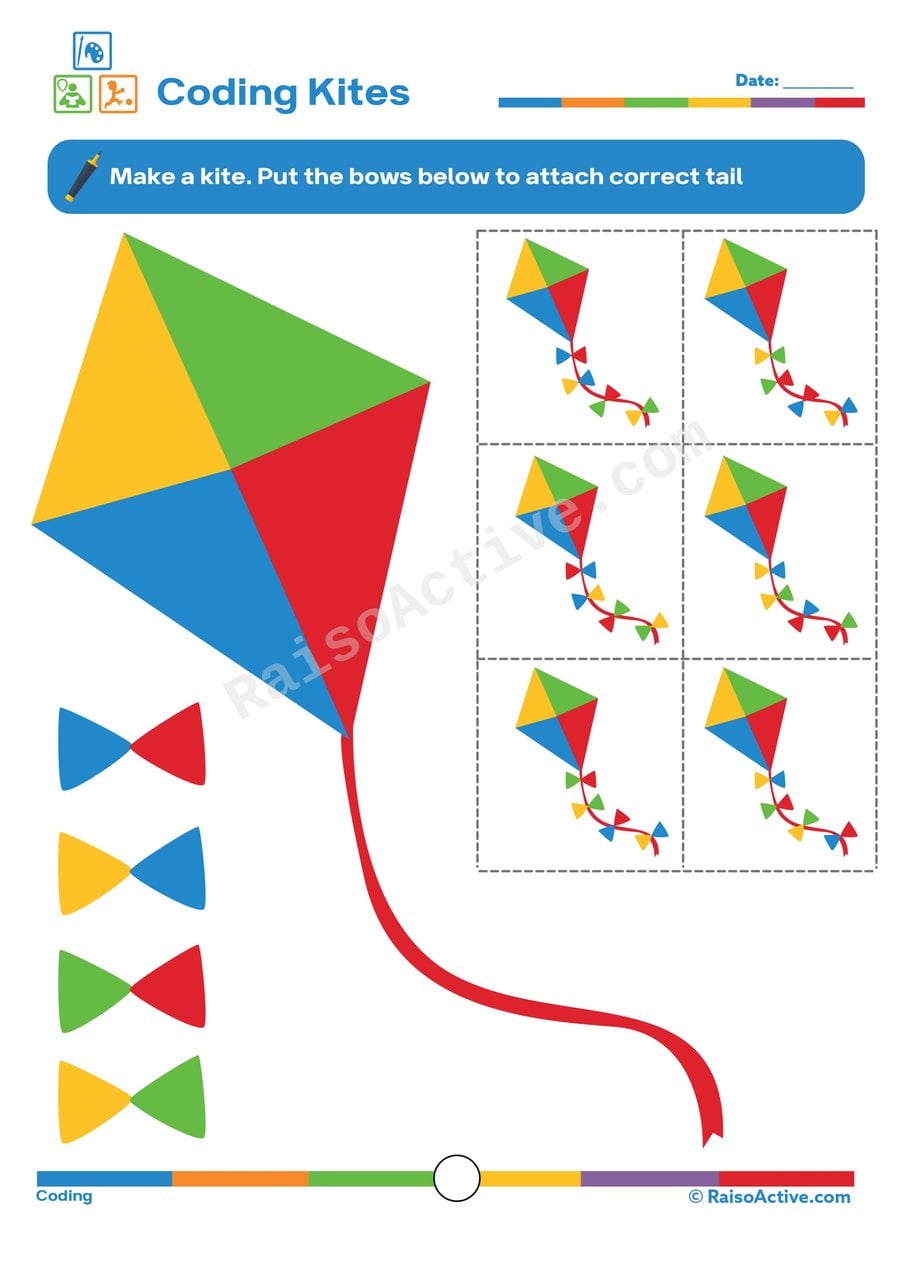
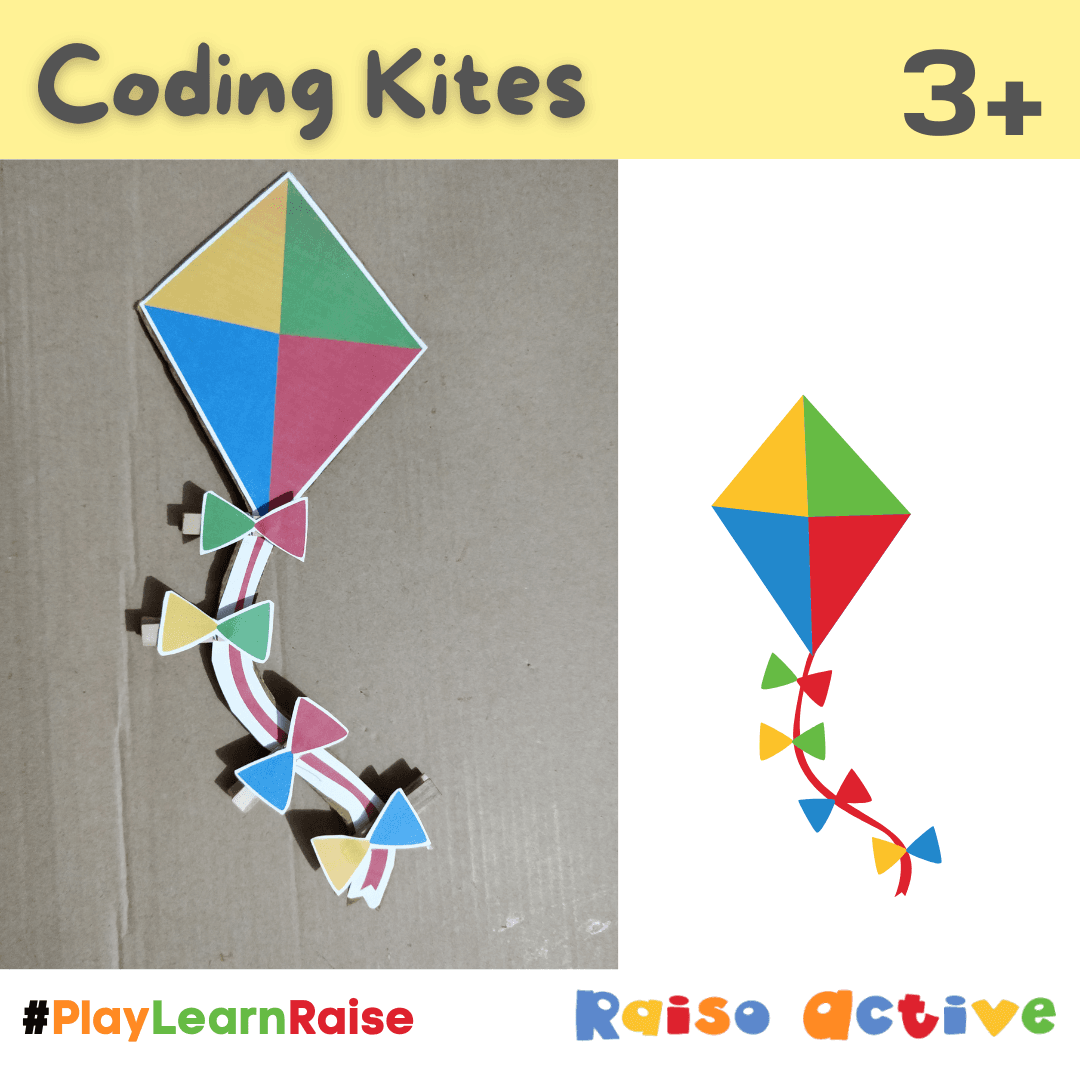
Coding Kites Worksheet: Match the Bows!
This activity sharpens visual observation in children ages 3-5 as they compare color sequences on each kite to a set of loose bows and find the exact match. Careful, systematic comparison — checking each color in order rather than glancing quickly — builds an attention-to-detail habit that transfers directly to early reading and number work.
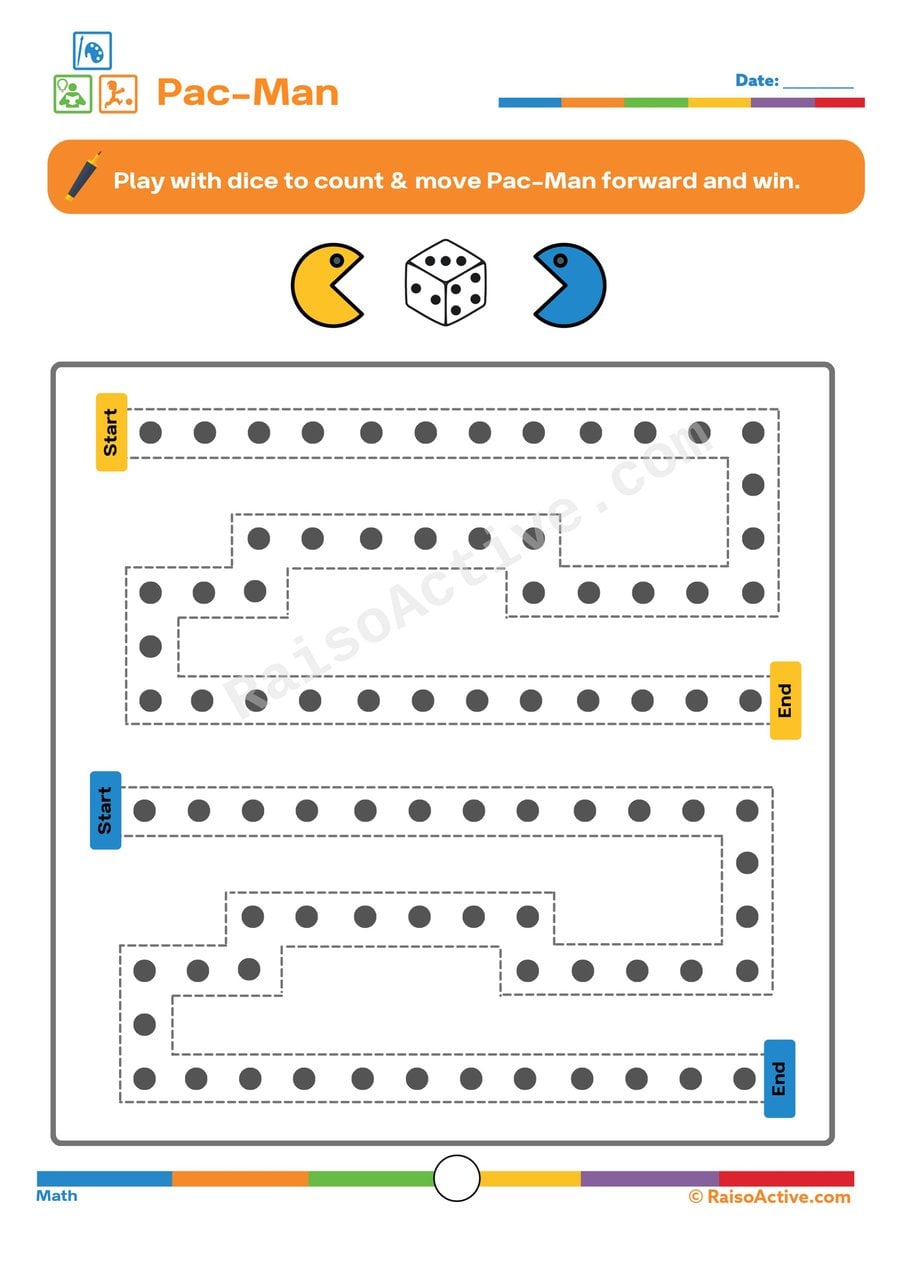
Pac-Man Maze Worksheet: Count and Move!
This dice-counting maze gives children ages 3-5 repeated practice matching a rolled number to the correct number of moves, reinforcing accurate counting under a bit of playful pressure. Tracking Pac-Man's current position after each roll also builds short-term spatial memory, since children must remember where they left off before moving again.

Written by
Hemsweta Jain · Teacher Cheena
MBA and Early Childhood Educator, teaching since 2014 · Founder of RaisoActive, Mumbai
Published · Last reviewed