Christmas Cutting Activities for Kids: 5 Cut-and-Paste Pages

Scissors out! Let's cut and stick some Christmas pictures together.
- 10-15 minutes a page
- Printer, scissors, glue stick
- A table with a grown-up
- Scissor control, planning
Christmas cutting activities for kids are a gentle way to practise scissor control, because the pictures are cheerful and the cutting has a purpose. Here are five Christmas cut-and-paste and colour-and-cut pages, from a tree to decorate to a Santa picture puzzle, with how to use each one.
Every page below is a real worksheet from our Christmas worksheets or one of our packs. If scissors are new to your child, our general guide on how to teach cutting skills to your preschooler is the place to start.
Why is cutting good for young children?
Cutting uses both hands, one to hold and turn the paper and one to open and close the scissors, and it builds the small muscles in the fingers that later hold a pencil. In the classroom, children who think they cannot cut often do better when the pieces are pictures they care about, because they want to see what the picture will become. The tasks below are short and low-pressure.
- Let your child cut, and the grown-up hold the page steady if needed
- Cut the curved shapes after the straight ones
- Stop when hands are tired; a hand cramp ends the fun
- Sit at a table with a tray or a box lid to catch the paper scraps
Which Christmas cutting pages can I try?
Five Christmas cutting pages, one at a time
Pick the page that matches your child today. The tree and the gingerbread man are the easiest cuts; the Santa puzzle is the hardest. Tick each one off as you finish it. You do not need to do all five in one week.
0 of 5 done
Cut out the ornaments, stars and lights from the right of the page and stick them onto the big green tree. Look at the sample picture first, then decide where each piece goes. Cutting small pieces out of a crowded page is good scissor practice, and there is no single right tree.

Cut out the green shapes, a diamond, square, circle, triangle, oval and rectangle, and the six elf faces, and stick them on ice-cream sticks to make little elf puppets, as the page says. Name each shape as you cut it. A short elf rhyme sits at the top, so read it together first.

Colour the gingerbread man in a plain outline, then cut out the two buttons and the blue bow and stick them on. Deciding where the buttons go on the body is a small spatial puzzle, and the circles on the outline give a clue.

Cut out the little moon in a Santa hat, the snowmen, the trees and the gifts, and use them to decorate. The turquoise circle in the middle looks like a space to arrange them in, so try a card, a window picture or a small collage. There is no right answer, which suits children who are nervous of getting it wrong.

Colour the pieces, cut them out and match them to the outline of Santa, then paste them in place. It asks for patience as well as scissors, so cut the pieces first and let your child choose the order. This page is from our Logical Reasoning pack and is a step up from the others.


You earned a sticker!
All five pages done. What a lot of careful cutting!
- Start with the big, easy pieces and save the small ones for the end, when your child is warmed up.
- A glue stick keeps the paper flat and is easier for small hands than liquid glue.
- Place the pieces on the page before gluing, so your child can change their mind.
- Say what you saw, such as "you went round the whole curve", and not only whether the result is neat.
Each page practises something slightly different. The tree and Merry X'mas pages are free arranging, the elf and gingerbread pages ask for matching shapes and positions, and the Santa puzzle adds patience, colouring and matching the pieces to the picture.
Christmas pictures make cutting practice feel like play
Choose a page, cut one piece at a time and let your child decide where it goes. Start with the tree or the gingerbread man, and come back to the Santa puzzle when cutting feels easy. Ten to fifteen minutes is plenty, and a paper-scrap tray makes the clear-up quick.
How can I make cutting easier or harder?
Change the activity to suit your child
Little ones
- Cut the pieces out for them and let them do the gluing and placing.
- Cut only the big shapes, and keep the small pieces for another day.
- Draw a thick line round a piece with a crayon to give a clear path to cut on.
Older kids
- Colour every piece before cutting, using only two colours of their choice.
- Make a card for a friend using the Merry X'mas pieces.
- Cut the Santa puzzle pieces and put the puzzle together, then swap with a friend.
Where can I find more Christmas cutting and craft pages?
For a folded paper craft, try our reindeer craft activity or the rocking Santa card craft. For more games for snowy days, see our winter activities for kids post. For a hands-on activity, see the snow globe craft. More pages sit on the Christmas worksheets hub.
The tree, elves, gingerbread man and Merry X'mas pages come from the Christmas Activity Book. The Santa picture puzzle comes from the Logical Reasoning Activity Book.
Questions parents ask about Christmas cutting activities
What age can children start cutting?
Which page should we try first?
My child gets frustrated cutting. What can I do?
Do I need special scissors?
Can I use these pages in a classroom or group?
Made for your child
Printables with your child's name on every page
7 packs for ages 2 to 14: pen control, phonics, spelling, maths, mazes and detective puzzles, each made from their name and the things they love.
See the personalised packsFree preview · free for members

Written by
Hemsweta Jain · Teacher Cheena
MBA and Early Childhood Educator, teaching since 2014 · Founder of RaisoActive, Mumbai
Published · Last reviewed
Related posts
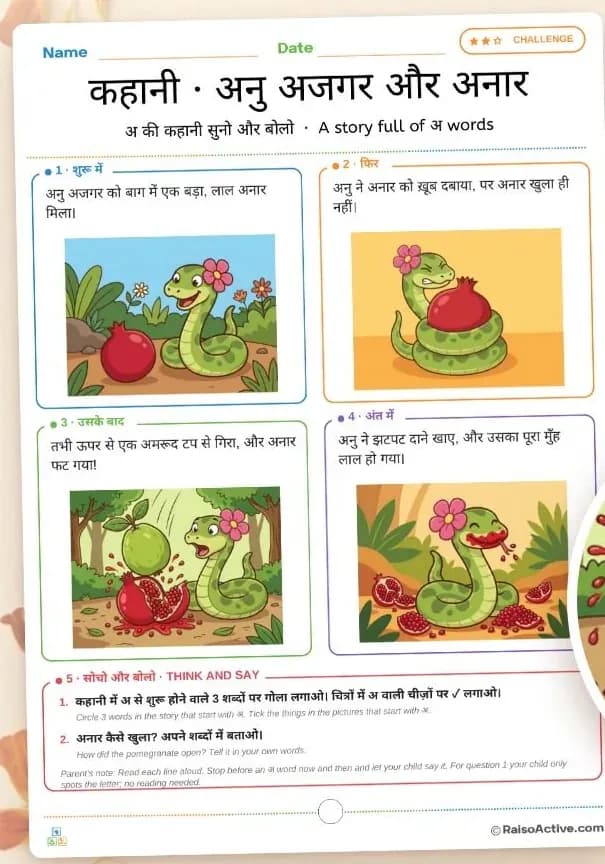
Hindi Letter Activities for Kids: 7 Ways to Play with अ
Hindi letter activities for kids at home: sing, read, fix, colour, make, play and say the letter अ. Seven easy ideas that need no reading.

Diwali Activities for Kids: 6 Calm Ideas to Do at Home
Diwali activities for kids that need little more than paint, paper and clay diyas: painting, lanterns, counting, sorting and a story. Easy to do at home.

My Child Writes Letters Backwards — Should I Be Worried? Understanding Letter Reversal in Young Children
Letter reversals like b/d are completely normal up to age 7-8. Learn why young brains mirror letters, the dyslexia distinction, and activities that actually help.