Free printable worksheets · US · UK · India
Worksheets for 5 Year Olds
Worksheets for 5 year olds are printable practice pages for children aged 5 to 6 in Kindergarten, Year 1 or UKG, the year most children begin to read and to add. They cover blending CVC words, reading sight words, writing sentences, counting and writing numbers to 50, addition and subtraction within 10, shapes and patterns.
Five is the year the code cracks. A child who knows letter sounds suddenly reads "cat", then "cats", then "the cat sat", and the same month discovers that 3 + 2 has an answer they can find. Attention now holds for twenty minutes and pencil grip is settled, so pages can carry a full decodable passage or ten sums. This hub gathers the worksheets that Kindergarten, Year 1 and UKG programs all rely on at this age: CVC blending by vowel family, sight words, sentence writing with capitals and periods, numbers to 50, addition and subtraction within 10 with pictures and then without, and shapes and patterns. Some fives are still consolidating letters; those children should start with the four-year-old hub and move up when blending begins.
1956+ worksheets · free PDF download · print on A4 or Letter
Worksheets for 5 Year Olds to print
Browse all worksheets for ages 5–6
Pronoun Power: Matching and Writing Practice Worksheet
Matching nouns to their correct pronouns and then rewriting sentences with a pronoun in place of an underlined word teaches children ages 4-6 how pronouns work as stand-ins for people, places, or things, a key grammar concept for writing smoother sentences. Practicing both matching and substitution gives two different angles on the same underlying skill.

Navaratri Dance Count: A Fun Counting Worksheet for Kids!
This worksheet builds counting accuracy in children ages 4-6 as they count dancers in Garba or Navaratri dance scenes and record the totals. Counting figures arranged in a lively, non-linear scene is slightly more challenging than counting objects in a row, which pushes children to track what they've already counted more carefully.

Family Words Cut and Paste Worksheet for Early Readers
Reading a simple CVC word and matching it to its picture teaches children ages 4-6 to blend individual sounds into a whole word and then connect that word to its meaning, a core decoding skill for early readers. Because CVC words follow a consistent consonant-vowel-consonant pattern, practicing them builds a reliable phonics foundation that transfers to reading many other simple words.
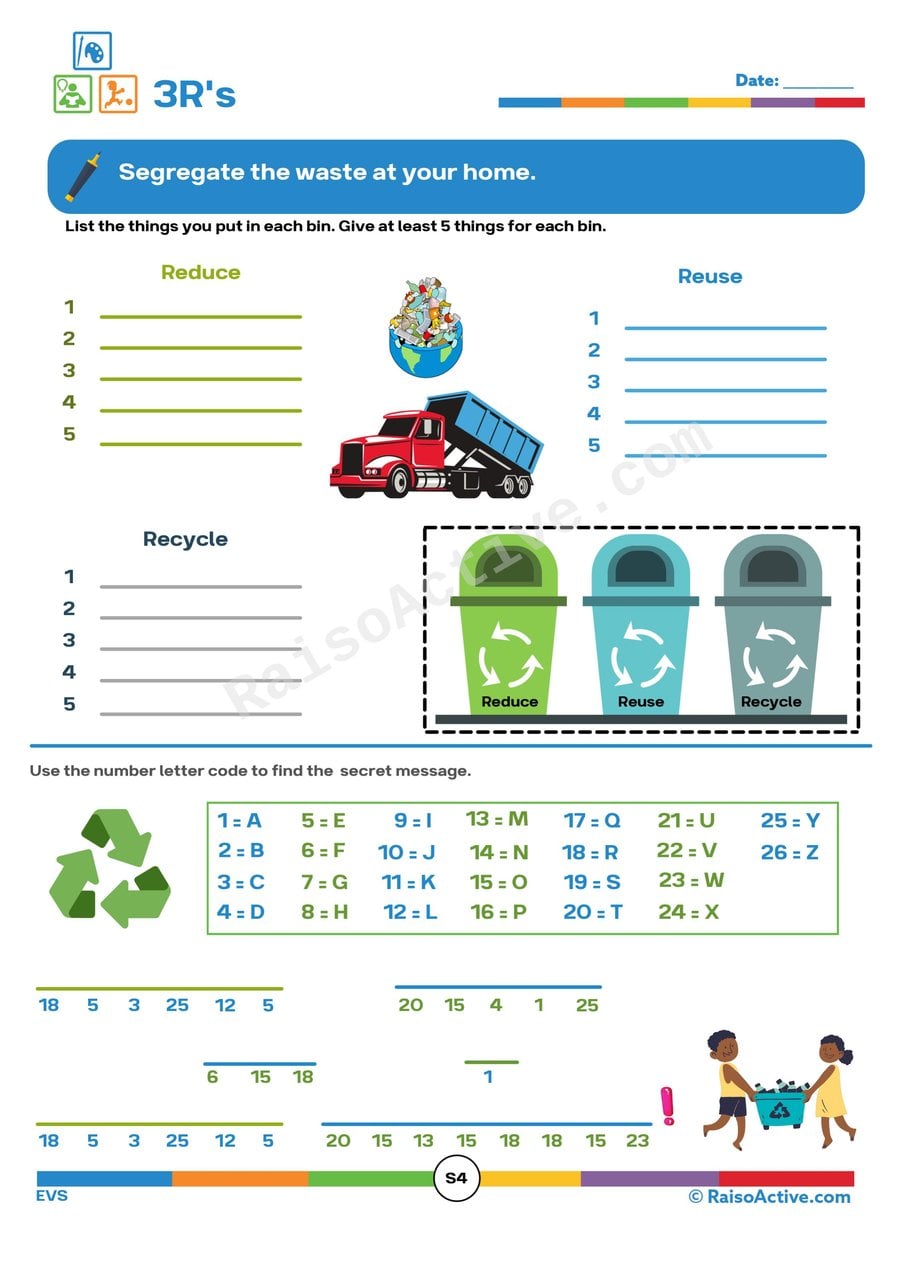
3 R's Worksheet: Reduce, Reuse, Recycle!
This worksheet introduces the three R's, reduce, reuse, and recycle, as concrete categories for sorting everyday actions, helping children ages 4-6 build environmental vocabulary and classification skills. Decoding a secret message using a number code adds a layer of early math and logic practice, linking numeral recognition to problem-solving.

My Favorite Animal: Lifecycle Writing Worksheet for Kids
This writing worksheet asks children ages 4-6 to describe their favorite animal's life cycle using sequencing words like 'first,' 'then,' 'next,' and 'last,' essential building blocks for narrative and informational writing. Choosing their own animal makes the task personally engaging while still requiring them to organize factual information in a logical order. This combination of choice and structure helps children practice both content knowledge and the mechanics of sequential writing.
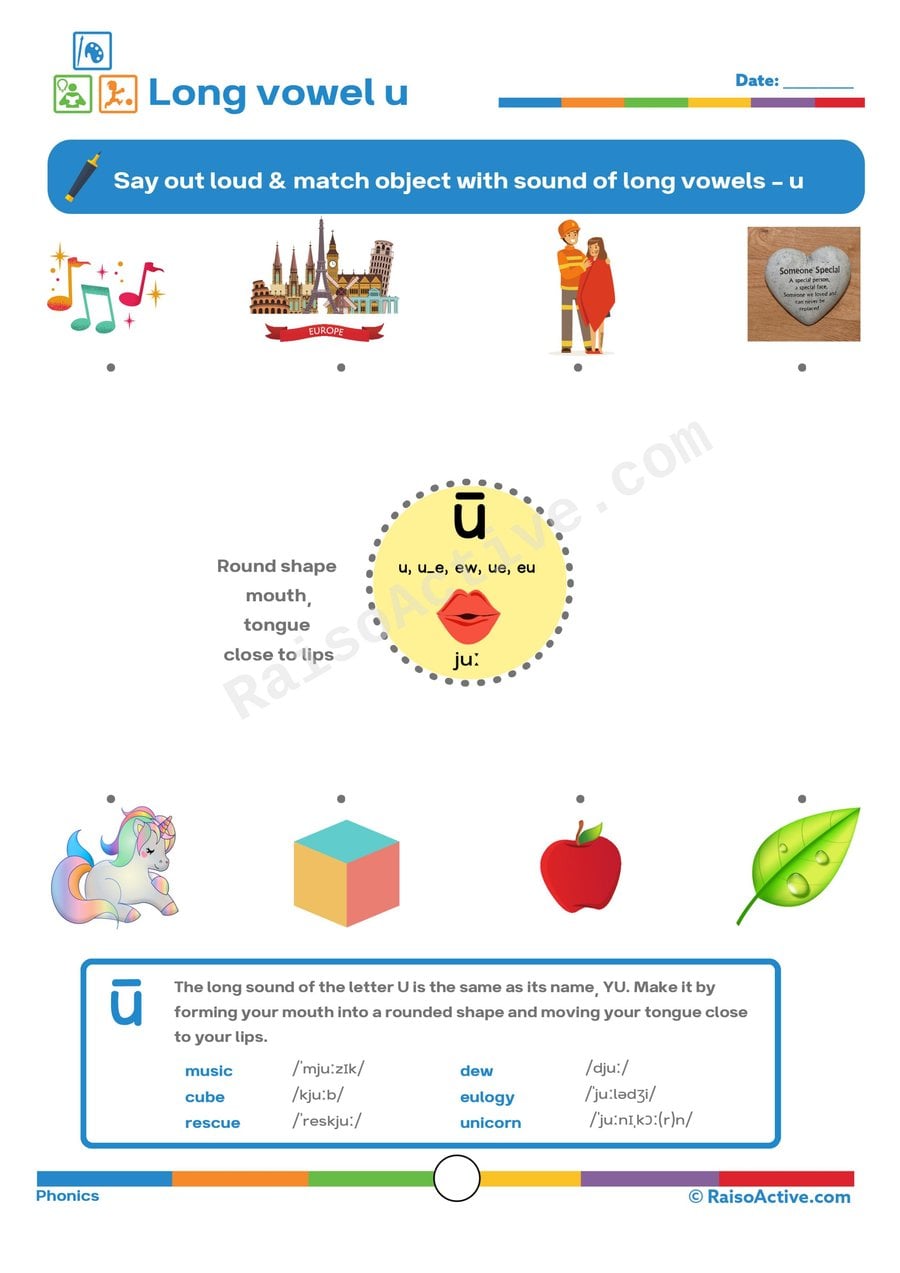
Long Vowel U Worksheet: Say the Sound and Match!
This matching worksheet gives children ages 4-6 focused practice hearing and identifying the long 'u' sound (as in 'cube' and 'mule') inside real words, then connecting that sound to its written form. Matching pictures to words strengthens the sound-symbol link that underlies fluent reading, while distinguishing long 'u' from other vowel sounds sharpens phonemic awareness — a strong predictor of later reading success.

Earth Day Sorting Worksheet: Good vs. Bad for the Environment!
Sorting pictures of everyday actions into 'good for the environment' and 'bad for the environment' introduces children ages 4-6 to cause-and-effect reasoning about human impact, an early building block for environmental awareness and responsible habits.
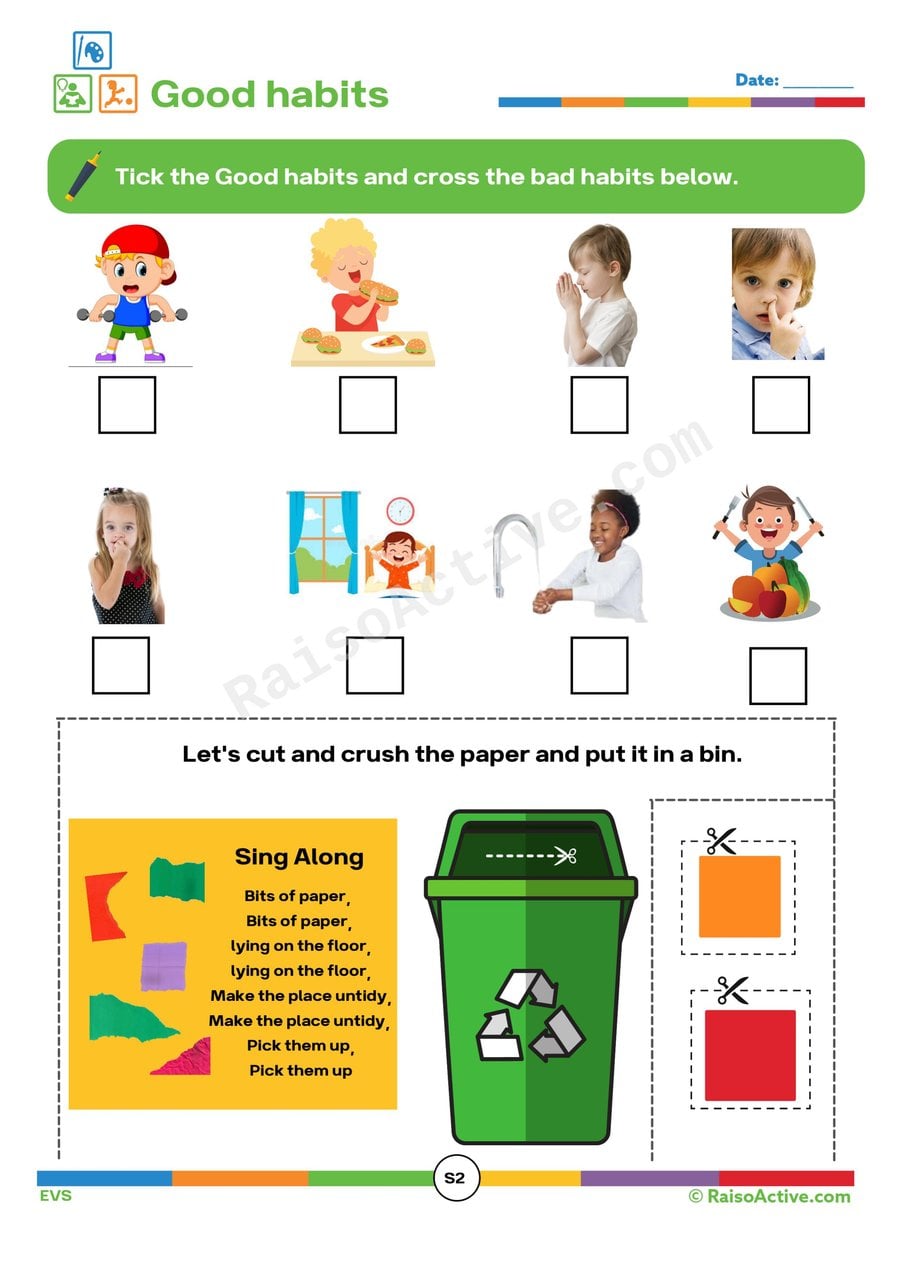
Good Habits Worksheet for Kids: Tick and Cross!
Marking each pictured behavior with a tick or a cross asks children ages 4-6 to reason about whether an action is a good habit or a bad one, an early exercise in moral and social reasoning that goes beyond simple right-or-wrong memorization. Using tick and cross symbols also introduces basic symbol literacy, since children need to understand what each mark conventionally represents before they can use it correctly.

Frame a Sentence Worksheet: Building Sentences with Cows!
Arranging a set of given words into a complete, correctly ordered sentence teaches children ages 4-6 basic sentence structure, helping them understand that word order changes meaning and that sentences follow predictable patterns like subject before action. Remembering to start with a capital letter and end with a period also reinforces early writing conventions alongside the sentence-building itself. This combination of grammar and mechanics gives children practice with the full process of forming a proper written sentence, not just choosing words.

Festival Fun Crossword Puzzle Worksheet for Kids
Children ages 4-6 practice letter recognition and early spelling by using picture clues to fill in the names of different festivals in a crossword format. This worksheet introduces the concept of a crossword grid itself — that words interlock and share letters — which builds spatial and phonics awareness beyond simple word writing.

Number Names Worksheet: Addition Practice for Kids
This worksheet combines addition practice with number-word writing for children ages 4-6, asking them to solve simple addition problems and then spell out the answer using its written name rather than a numeral. Requiring the answer in word form pushes children beyond calculation into applying number vocabulary correctly, reinforcing that 'seven' and '7' represent the same value. This dual task builds both math fluency and early spelling skills together.

Cut and Paste Body Parts Worksheet for Preschoolers
This worksheet helps children ages 4-6 learn to name and correctly place major body parts by cutting them out and pasting each one onto the right location on a body outline. Physically assembling a body diagram builds body awareness and vocabulary at the same time, while the cutting and gluing sharpens fine motor precision that supports later handwriting.
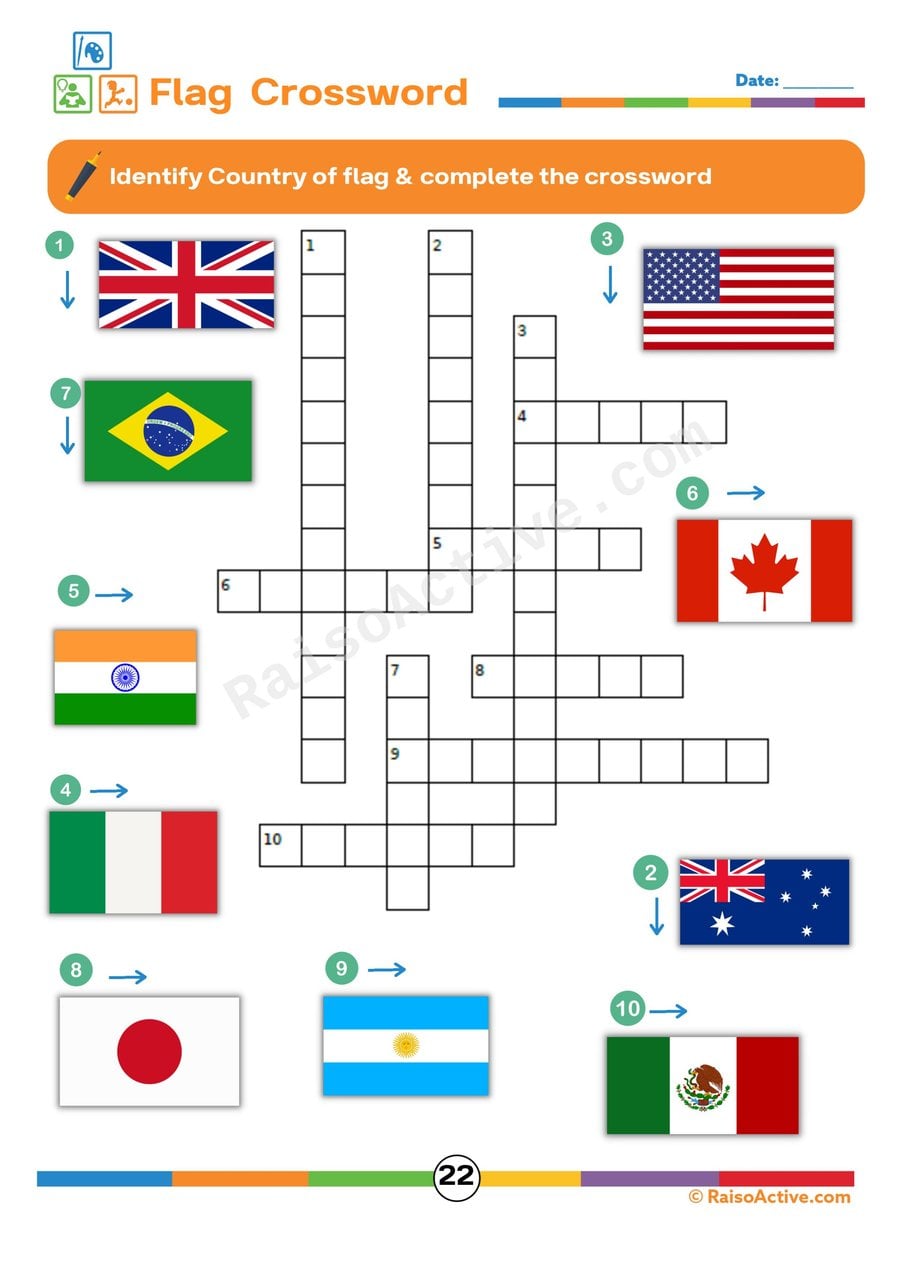
Flag Crossword Puzzle Worksheet for Kids
This flag crossword challenges children ages 4-6 to identify a country from its flag image and then spell out its name letter by letter in a crossword grid, linking visual recognition with early spelling and word-structure skills. Fitting each answer into the correct number of boxes also reinforces letter counting and attention to word length.

Simple Sentences Worksheet: Rewriting Sentences for Early Readers
Children ages 4-6 practice sentence construction by rearranging scrambled words into a grammatically correct, meaningful sentence, building an understanding of proper word order in English. This hands-on rearranging task teaches children to recognize where a sentence's subject, action, and details belong, a skill they'll use in all future writing.
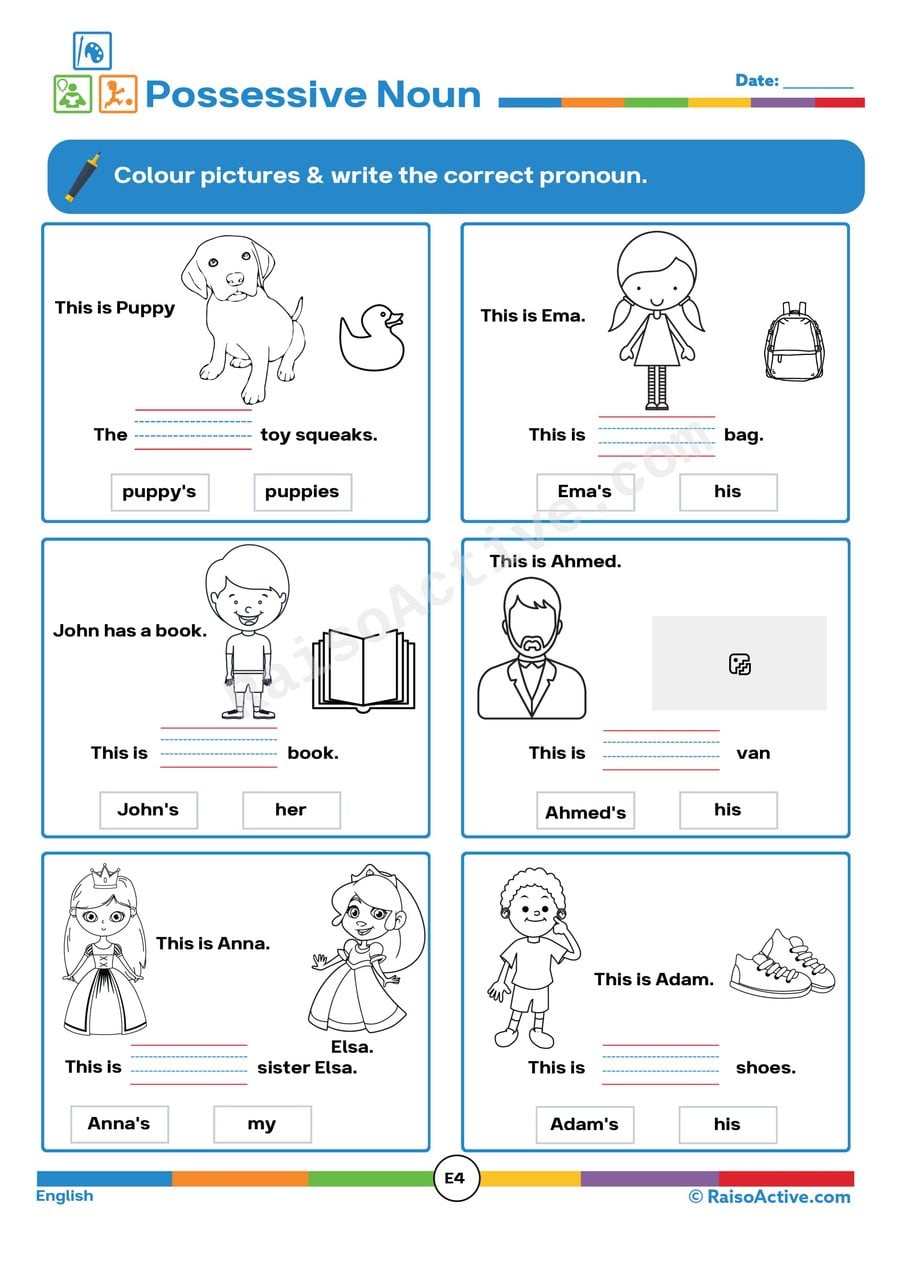
Possessive Nouns Worksheet: Color and Write!
Children ages 4-6 practice forming possessive nouns, learning to add an apostrophe and 's' to show that something belongs to someone, like 'the dog's bone.' This is a specific grammar rule that children will use constantly once they start writing about ownership in their own sentences.

Taste Bud Sorting Worksheet: Identify and Sort Foods by Taste!
This worksheet introduces children ages 4-6 to four basic taste categories — salty, sour, bitter, and sweet — by having them sort pictured foods into the correct group. Beyond taste vocabulary, sorting foods by an invisible property like flavor (rather than an obvious one like color or shape) pushes children to draw on memory and prior experience, building more advanced classification skills.

Alphabet Adventures: Write the First Letter - Small Alphabet Worksheet
This worksheet strengthens phonemic awareness by asking children ages 4-6 to isolate the very first sound in a spoken word and match it to its lowercase letter - a skill that sits at the heart of early decoding and spelling. Because it uses small (lowercase) letters specifically, it also reinforces letter-case recognition, since children encounter lowercase print far more often than capitals once they begin reading books.

Sight Word Search and Reading Comprehension Worksheet for Preschoolers
This worksheet combines three literacy skills for children ages 4-6 in one activity: reading a short story and spotting sight words within it, answering comprehension questions about what happened, and finding those same sight words hidden in a word search grid. Practicing the same words across reading, comprehension, and search formats gives children multiple angles of exposure that build genuine reading confidence rather than rote memorization.
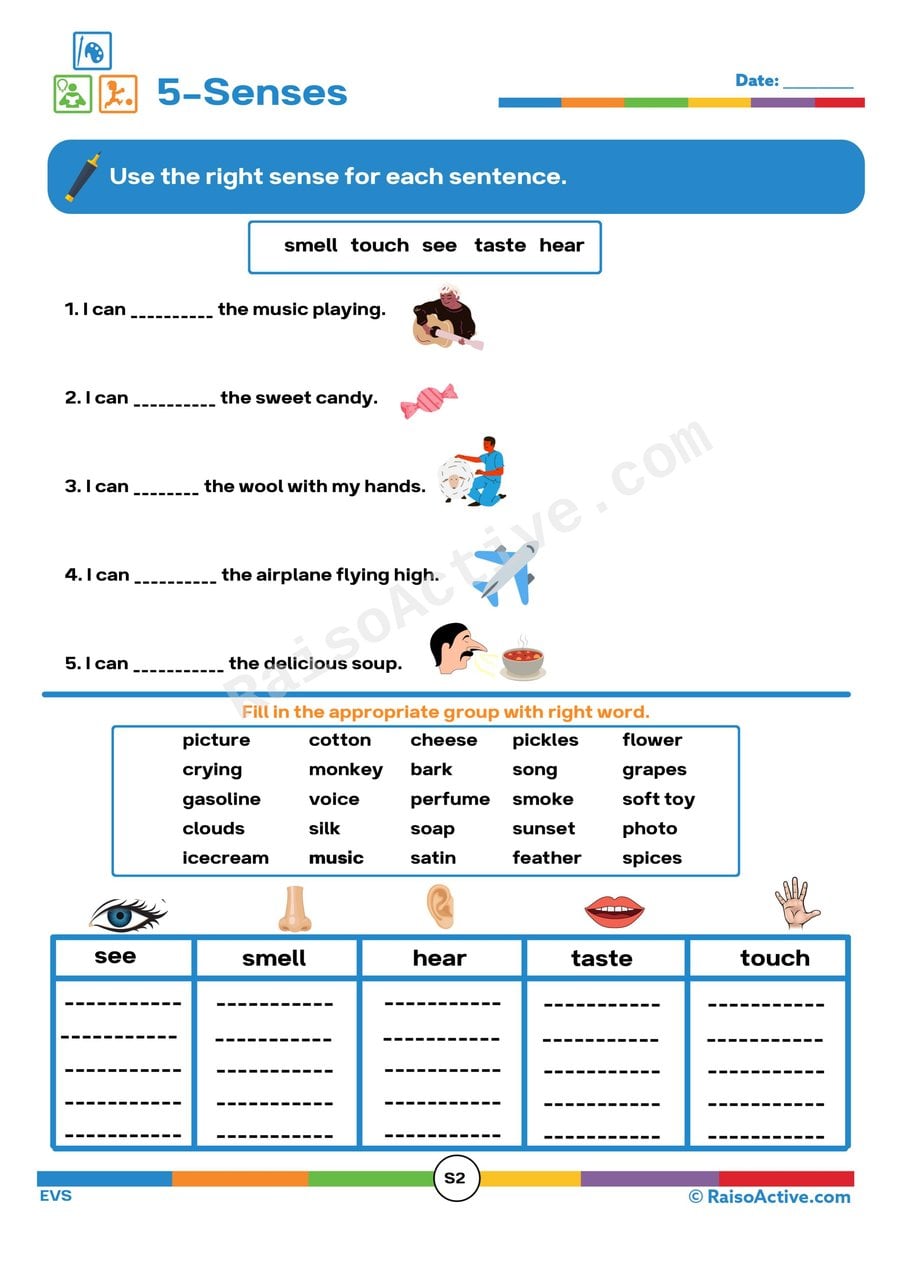
5 Senses Worksheet: Explore the World!
Identifying which of the five senses, sight, smell, hearing, taste, or touch, is being used in each picture or sentence helps children ages 4-6 build scientific observation vocabulary and connect abstract sense words to concrete everyday actions. Matching the words to senses in a table afterward reinforces the vocabulary in a second, different format.

Froggy Fun: Word Problems Worksheet for Early Learners
This worksheet introduces basic addition word problems using a frog theme, teaching children to translate a short story into a math equation they can solve. For four- to six-year-olds, this is a critical bridge skill — moving from simply adding numbers on a page to understanding what a real-world situation like '3 frogs on a lily pad, 2 more hop on' is actually asking them to find.
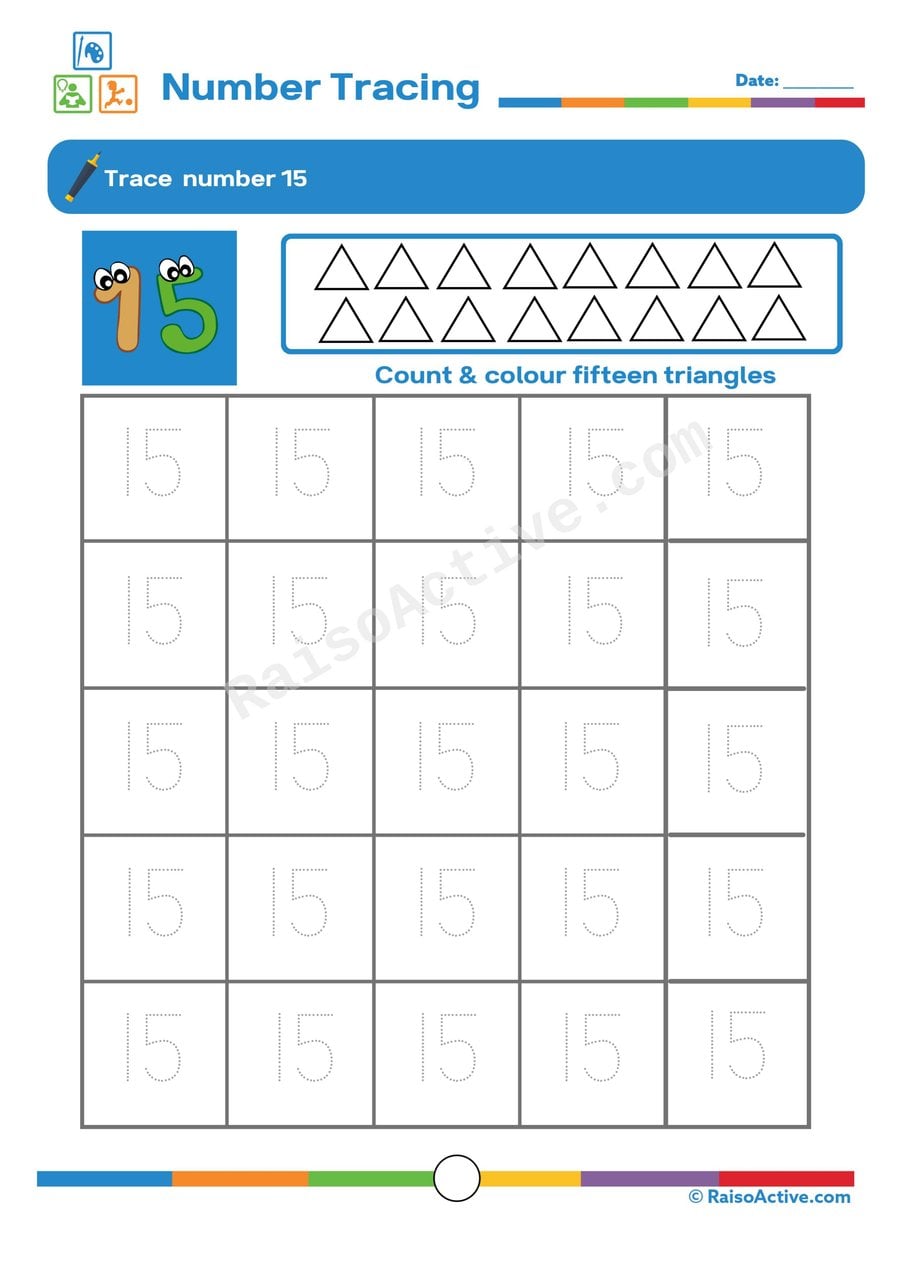
Number Tracing Worksheet: Trace and Count to 15!
This worksheet has children ages 4-6 trace the number 15 and then count and color a full set of fifteen triangles, extending their counting range further into the teens than many earlier worksheets. Counting all the way to fifteen requires children to keep track across a larger set without losing their place, building the working memory and sustained attention needed for extended counting. Introducing triangles instead of circles or balls also lets this worksheet quietly reinforce basic shape recognition alongside the counting task.
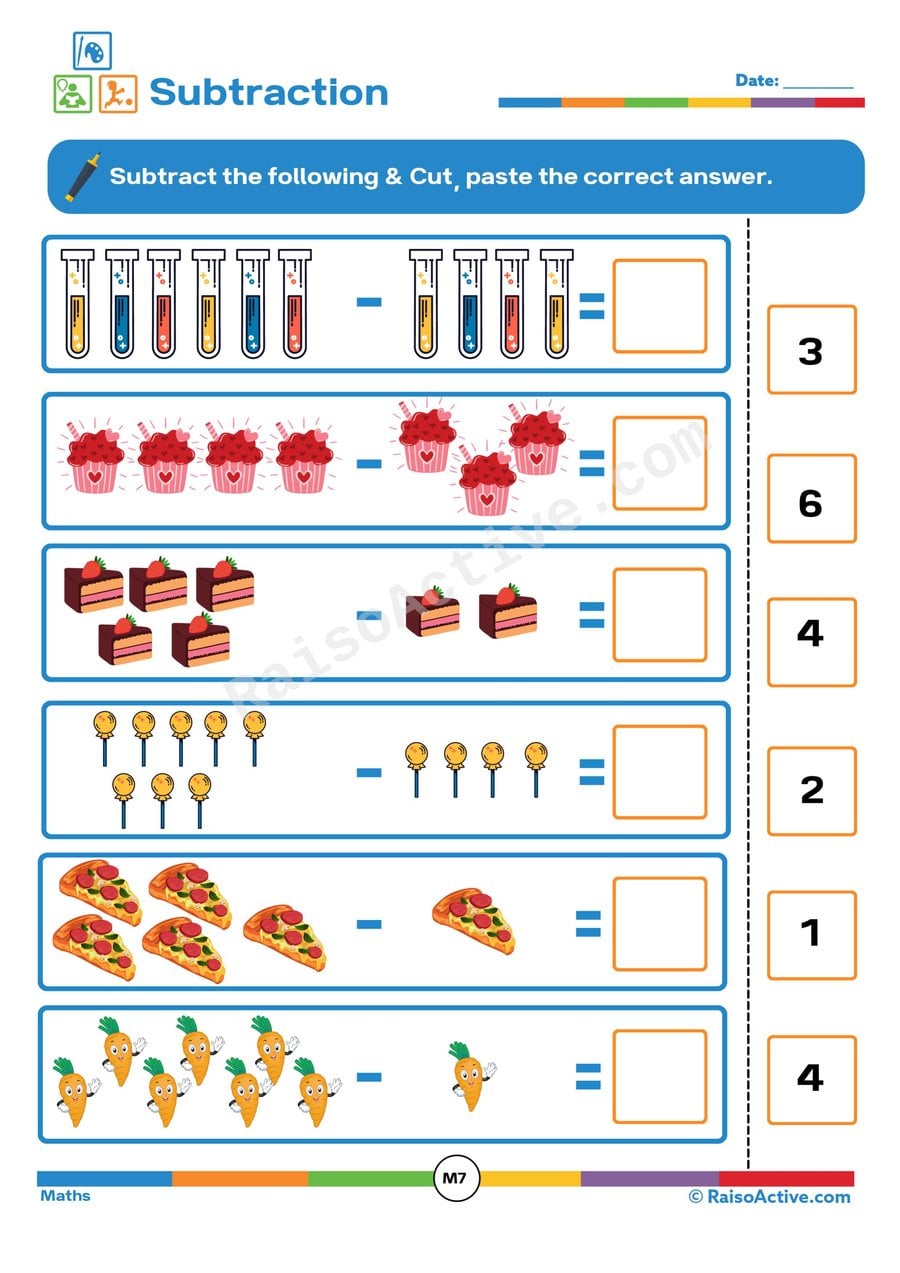
Subtraction Fun: Cut and Paste the Answers!
This worksheet grounds subtraction in something concrete for children ages 4-6 by having them count visual object groups, subtract, and then physically select and paste the correct numeral answer from a set of choices. Counting objects before subtracting keeps the math anchored in real quantities rather than abstract numerals alone, which is exactly the kind of support young learners need before they're ready for purely symbolic subtraction. The cut-and-paste answer selection also adds a layer of verification, since your child has to search through several numeral options to find the one that truly matches their calculated answer.
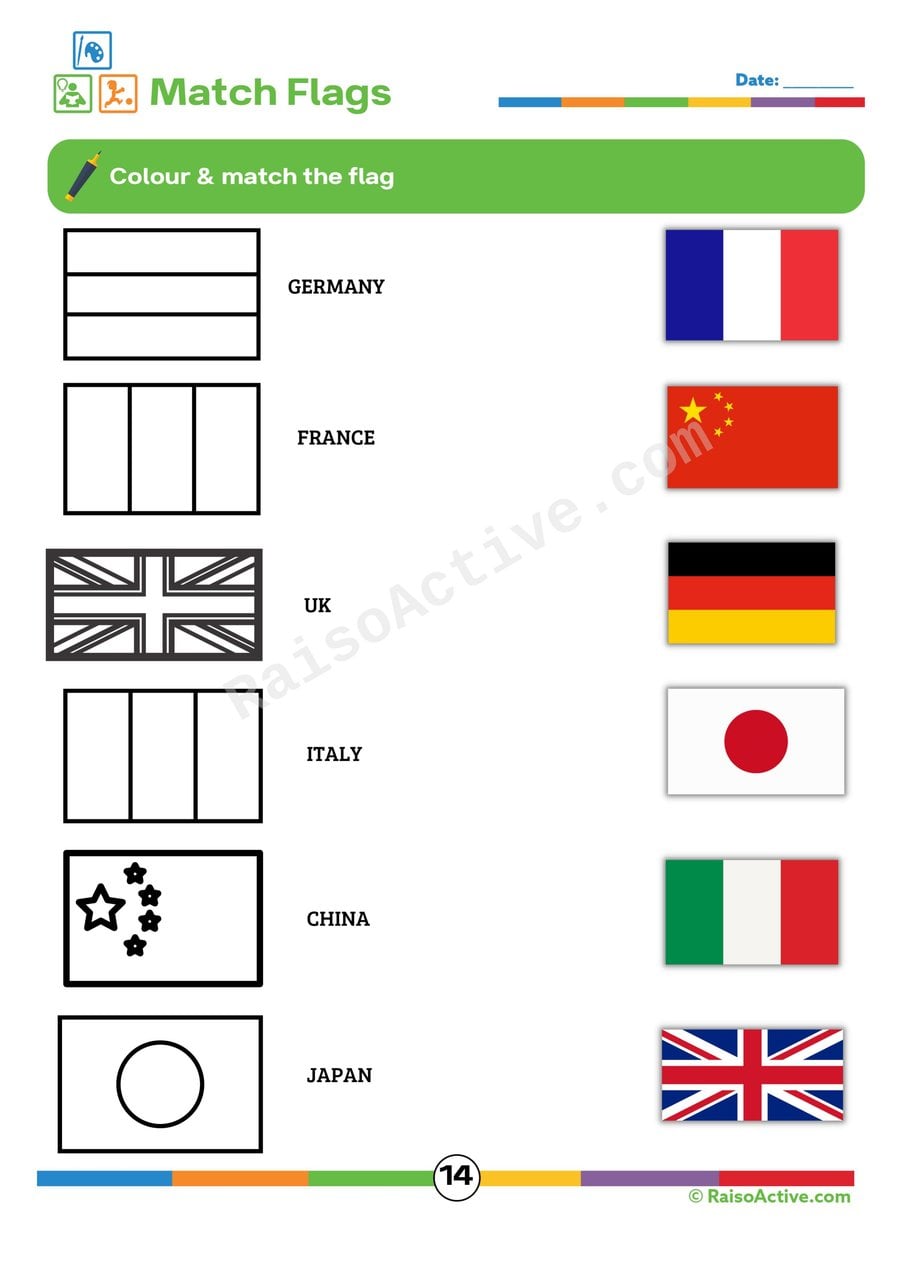
Match the Flags Worksheet: Color and Learn!
This worksheet helps children ages 4-6 recognize different country flags by coloring them accurately and matching each one to its correct country name. Coloring flags with real colors, rather than free choice, adds a layer of factual precision to the usual creative coloring task, reinforcing that flags carry specific, meaningful designs.

Clean Hands Worksheet: Germs and Handwashing Experiment
This worksheet teaches children ages 4-6 the science behind why handwashing matters through a simple, visual experiment demonstrating how germs (represented by something like glitter or oil) transfer between hands and spread easily, then how washing removes them. Seeing germs 'in action' makes an invisible concept concrete, helping children understand the real reason behind a daily hygiene habit rather than just following a rule.
What a 5 year old can typically do
A typical five-year-old can write all letters in upper and lower case with some reversals, blend and read CVC words, recognize a growing list of sight words, write a sentence with help, count to 50 and beyond, write numerals to 20 or more, add and subtract within 5 mentally and within 10 with objects, name 2D and some 3D shapes, continue patterns and draw a recognizable person.
- Reading: CVC words in all five vowel families, beginning blends, digraphs, 40–60 sight words, short decodable passages
- Writing: lowercase formation, copying and composing sentences, capital letter, spaces, period
- Number: counting and writing to 50, number before and after, missing numbers, comparing, teen numbers as ten and ones
- Operations: addition and subtraction within 10 with pictures, number lines and then numerals only
- Shapes, patterns and data: 2D and 3D shapes, ABB and ABC patterns, simple sorting and tally charts
How to use worksheets with a 5 year old
Alternate a reading day and a math day. On a reading day, one blending or sight-word sheet followed by writing a sentence about it; on a math day, one number sheet and one sums sheet with counters on the table. Twenty minutes total. Ask your child to read the instruction aloud first, which is reading practice in itself.
Check work together and ask for one explanation ("how did you know it was 7?"). Explaining is where understanding forms. Keep finished sheets in a folder; teachers in Kindergarten, Year 1 and UKG all use similar sheets for assessment, and a folder shows exactly which skills are secure and which need another week.
Common difficulties at five
The usual sticking points are blending that stays letter-by-letter, b/d and p/q reversals, subtraction that lags behind addition, and teen numbers written backwards. Daily short blending practice fixes the first; reversals fade with formation practice from a start dot and are not a concern until seven; crossing-out sheets fix subtraction; and saying "one ten and four ones" while writing 14 fixes teen reversals. None of these needs to be drilled to exhaustion.
Frequently asked questions
What should a 5 year old know by the end of kindergarten?
By the end of Kindergarten, Year 1 or UKG most children are expected to read CVC and simple blend words and a bank of sight words, write a simple sentence, know all letter names and sounds, count to 100 (to 50 in many UKG syllabi), write numbers to 20, add and subtract within 10, compare numbers, name 2D and 3D shapes and describe simple patterns. Common Core, the KS1 curriculum and NCF-FS 2022 describe outcomes close to these.
Are worksheets good for 5 year olds?
At five, worksheets are one of the most efficient ways to practice the skills that need repetition: blending, sight words, letter formation and math facts. The key is short, single-skill pages used daily for about twenty minutes, alongside reading real books and playing. Pages that mix many skills or run to several sides are less effective at this age than one focused sheet.
How do I help my 5 year old start reading?
Make sure letter sounds are automatic, then blend three-letter words with one vowel at a time, sliding a finger under the letters while saying the sounds and then the word. Practice five minutes daily, add sight words in small sets, and move to short decodable passages once single words are quick. Reading to your child every day builds vocabulary and the desire to read, which the sheets alone cannot.
What math should a 5 year old be doing?
At five, math means counting to 50 or 100, reading and writing numerals, understanding that a teen number is ten and some ones, comparing which of two numbers is bigger, adding and subtracting within 10 first with objects and pictures and later with numerals, naming shapes and continuing patterns. Word problems with pictures ("3 birds, 2 more come") are appropriate; column addition is not.
How long should a 5 year old spend on worksheets each day?
Fifteen to twenty minutes a day is right for most five-year-olds, which is one reading sheet and one math sheet, or two of one subject on alternate days. Kindergarten and UKG homework is usually about this amount. Longer sessions reduce attention and accuracy; if your child wants more, add a book or a game rather than a third sheet.
Are the worksheets for 5 year olds free?
Yes. Every sheet downloads free as a watermarked PDF after creating an account, up to five a day. An annual subscription (about $20 or ₹1000) removes the watermark and the daily limit for the entire library of worksheets and printable packs, the usual choice for teachers printing class sets on Letter or A4.

Written by
Hemsweta Jain · Teacher Cheena
MBA and Early Childhood Educator, teaching since 2014 · Founder of RaisoActive, Mumbai
Written and reviewed by Hemsweta Jain (Teacher Cheena), who designs every RaisoActive worksheet.
Last reviewed
Printable packs for ages 5–6
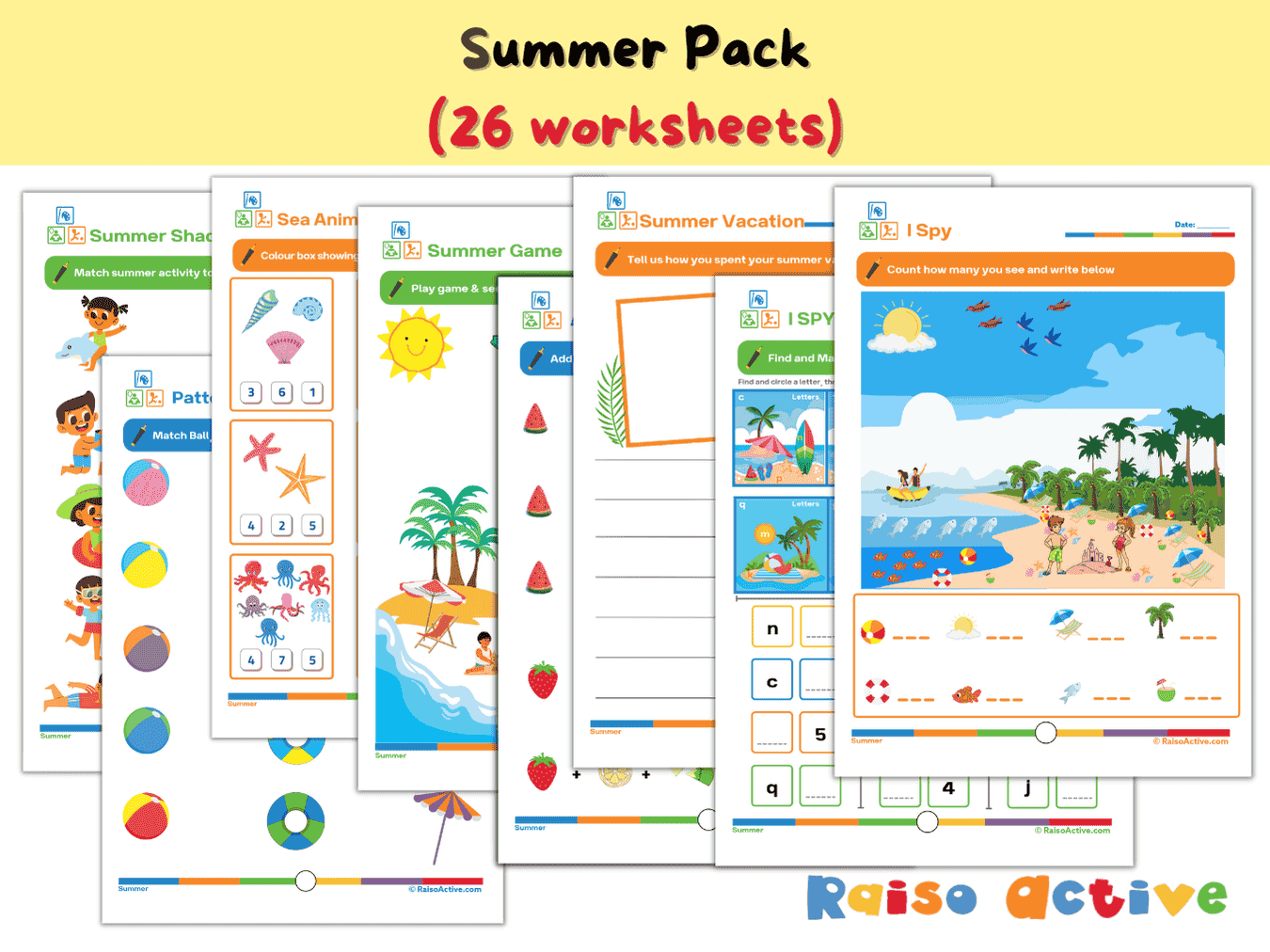
Summer Activity Pack: Math, Literacy, Puzzles & More for Preschool & Kindergarten
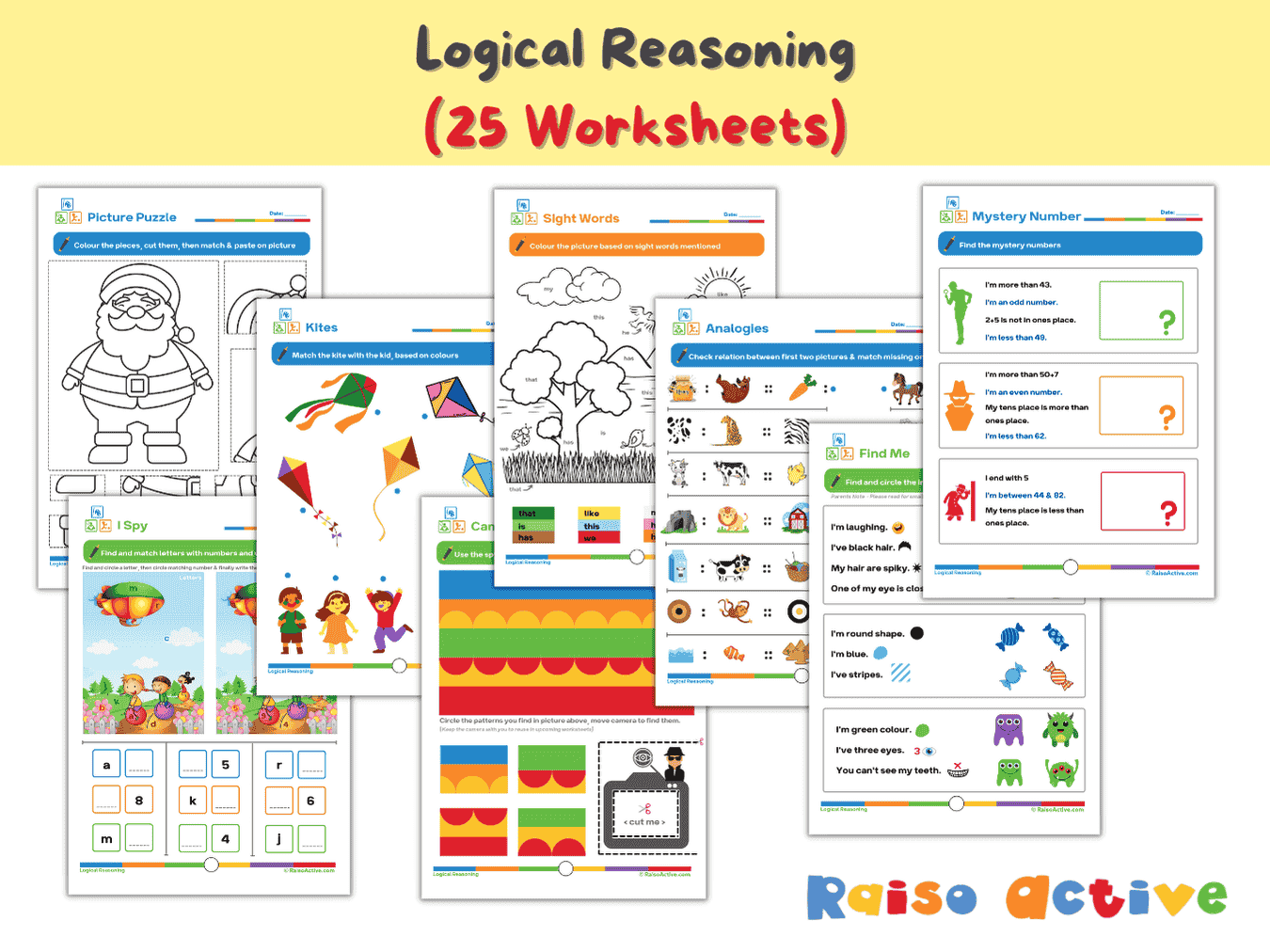
Logical Reasoning Activity Book for Preschool & Kindergarten | Patterns, Puzzles & Analogies
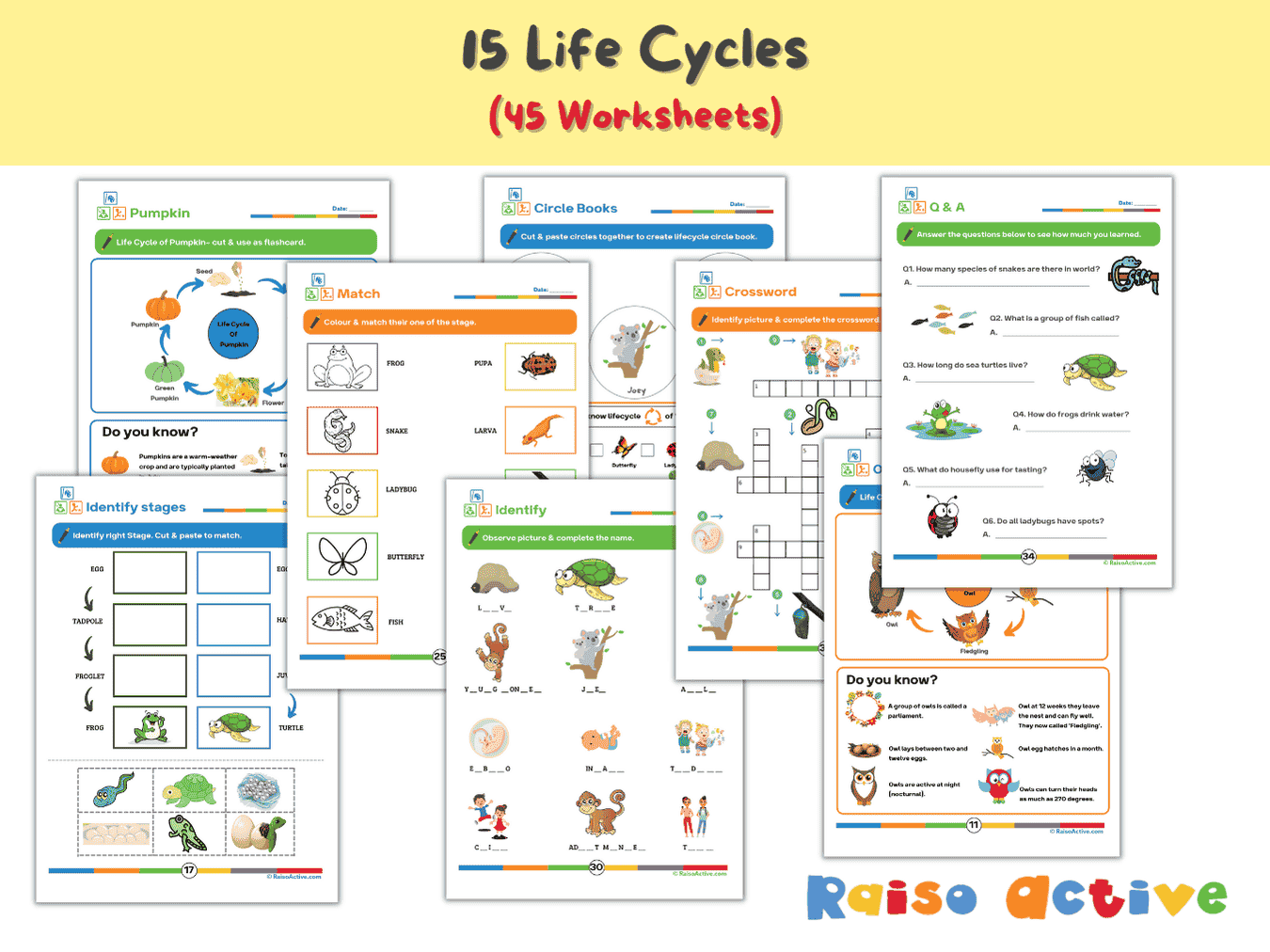
Lifecycles Activity Book & Flashcards for Preschool & Early Elementary
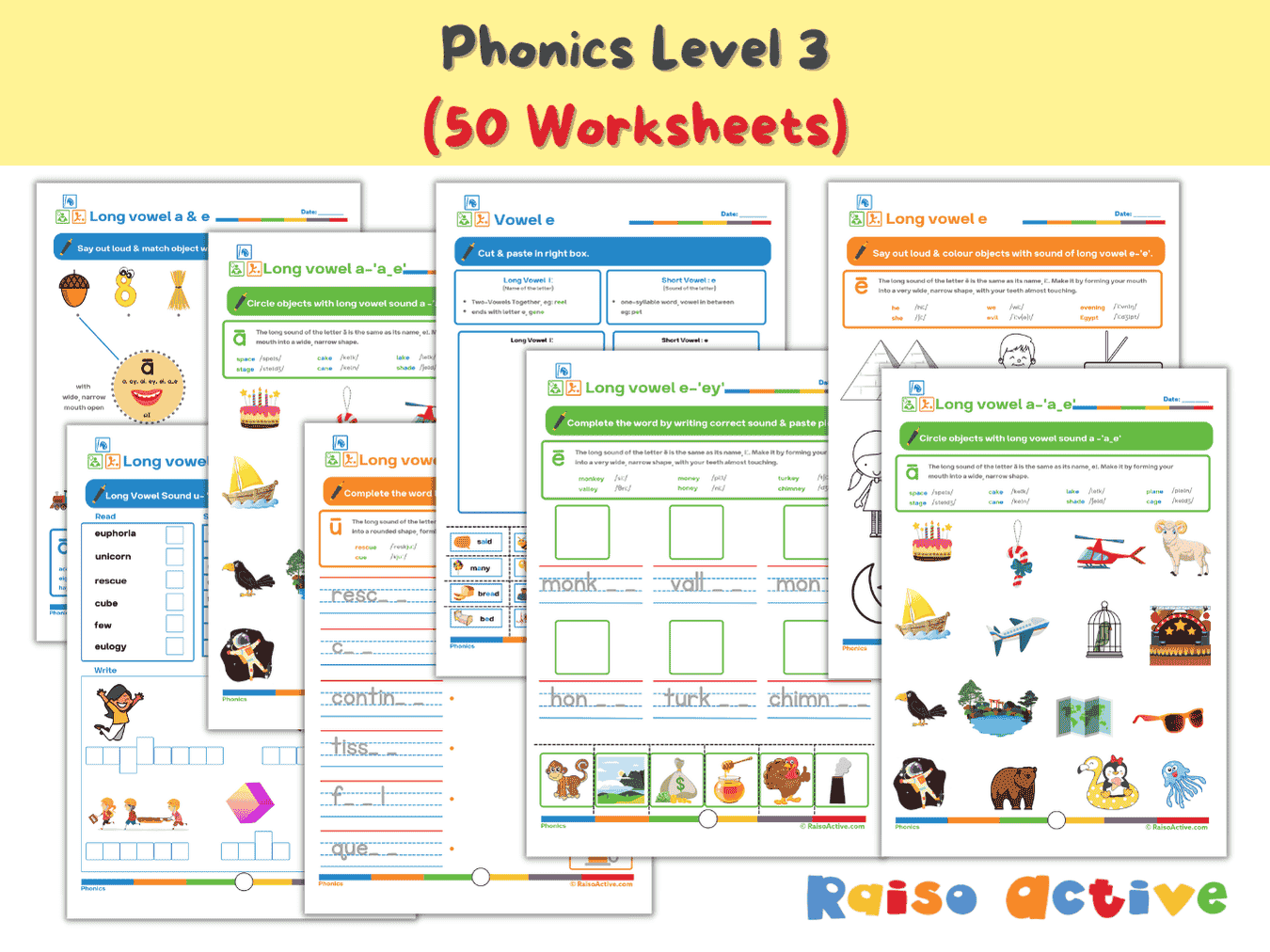
Phonics Level 3 Long Vowels Activity Book for Kindergarten & 1st Grade
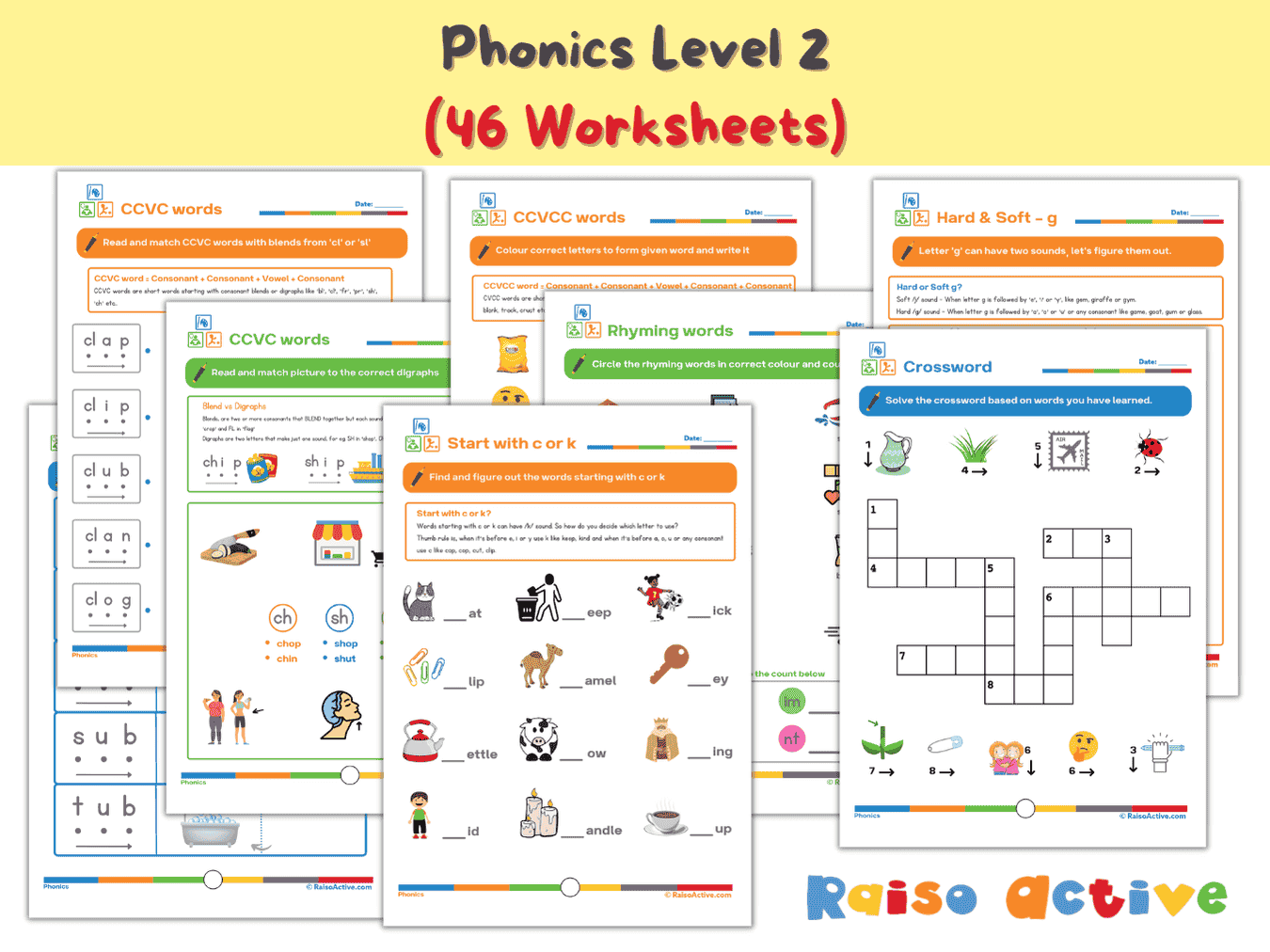
Phonics Level 2 Worksheets: CVC, CCVC, CVCC Word Families & Blends for Early Readers (Ages 4-7)
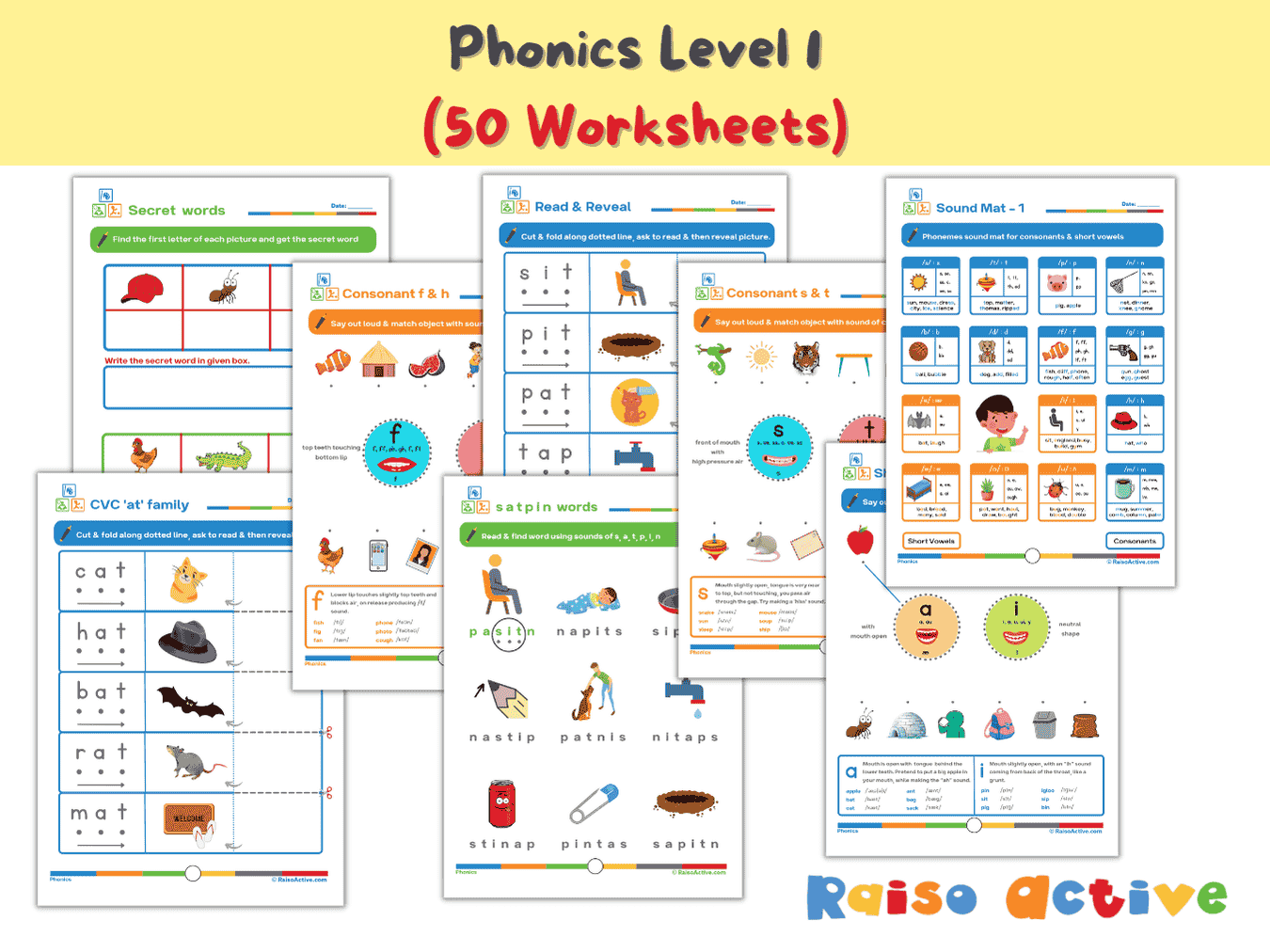
Phonics Level 1 Activity Book: Letter Sounds, Blending & CVC Words for Preschool & Kindergarten
Guides for parents and teachers
See all guides →Sight Words by Age: The First 50 Words and How to Teach Them Without Flashcard Fatigue
Which sight words to teach first and why, the heart-word method, a read-trace-write-find routine, games, and a by-age table of typical sight-word progress.
How to Teach CVC Blending: A Step-by-Step Method That Works in Two Weeks
A step-by-step method for teaching CVC blending, covering continuous sounds, word families, common errors, and a 14-day plan that most children finish reading CVC words.
Kindergarten Readiness Checklist: 25 Skills to Practice Before the First Day
A kindergarten readiness checklist of 25 literacy, math, motor, self-regulation and self-help skills, with an 8-week summer plan and notes on when not to worry.
Phase 2 Phonics at Home: Sound Order, Blending Games, Worksheets
Phase 2 phonics at home: the five sound sets in order, oral blending, tricky words, a two-week routine, common mistakes, and free worksheets.
Reception Year Explained: EYFS Learning and How to Help at Home
A teacher's plain-English guide to the Reception Year: the seven areas of learning, Early Learning Goals, Phase 2/3 phonics, the RBA and home routines.
UKG Syllabus Explained: English, Maths and EVS Month by Month
What UKG classes typically cover in English, maths and EVS, month by month, aligned to NEP 2020, with ways to support at home and signs your child is behind.
Canonical: https://raisoactive.com/worksheets/worksheets-for-5-year-olds