Number Names Worksheet: Addition Practice for Kids
This worksheet combines addition practice with number-word writing for children ages 4-6, asking them to solve simple addition problems and then spell out the answer using its written name rather than a numeral. Requiring the answer in word form pushes children beyond calculation into applying number vocabulary correctly, reinforcing that 'seven' and '7' represent the same value. This dual task builds both math fluency and early spelling skills together.
Part of the pack
Month 10: Learning & Development | Ages 5-6
This is page 13 of the pack. Ages 5-6 · KindergartenAges 5-6 · Year 1Ages 5-6 · UKGAges 5-6

Made for your child
Adding within 10, made for your child
A maths pack with your child's name in it: pictures that explain, practice at three levels, puzzles and story sums about them. Print a new set whenever they finish.
Make a maths packFree preview · free for members
Curriculum
- Number Recognition > Number Names
How to use this worksheet
Read the first addition problem aloud together and have your child solve it, using fingers, drawn dots, or mental math depending on their comfort level. Once they know the sum, ask them to write the number name for that answer, like 'six' instead of '6', in the space provided. Continue solving and writing out each remaining problem the same way, checking spelling together as you go. Finish by reading through all the completed number-name answers as a final check.
Materials needed
- Pencil
Extension activities
- 1Have the child create their own addition problems and write the answers in number names.
- 2Use manipulatives (like blocks or counters) to help visualize the addition problems.
- 3Make flashcards pairing simple sums with their number-name answers for quick review.
- 4Practice writing number names 1-10 in order from memory.
- 5Turn it into a game where you say a sum aloud and your child races to write the number-name answer.

Written by
Hemsweta Jain · Teacher Cheena
MBA and Early Childhood Educator, teaching since 2014 · Founder of RaisoActive, Mumbai
Every RaisoActive worksheet is designed and checked by the founder before publishing.
Published · Last reviewed
More from Month 10: Learning & Development | Ages 5-6
Time Telling Worksheet for Kids: Write the Time!
Ages 4-6 · Pre-K–KindergartenAges 4-6 · Reception–Year 1Ages 4-6 · LKG–UKGAges 4-6
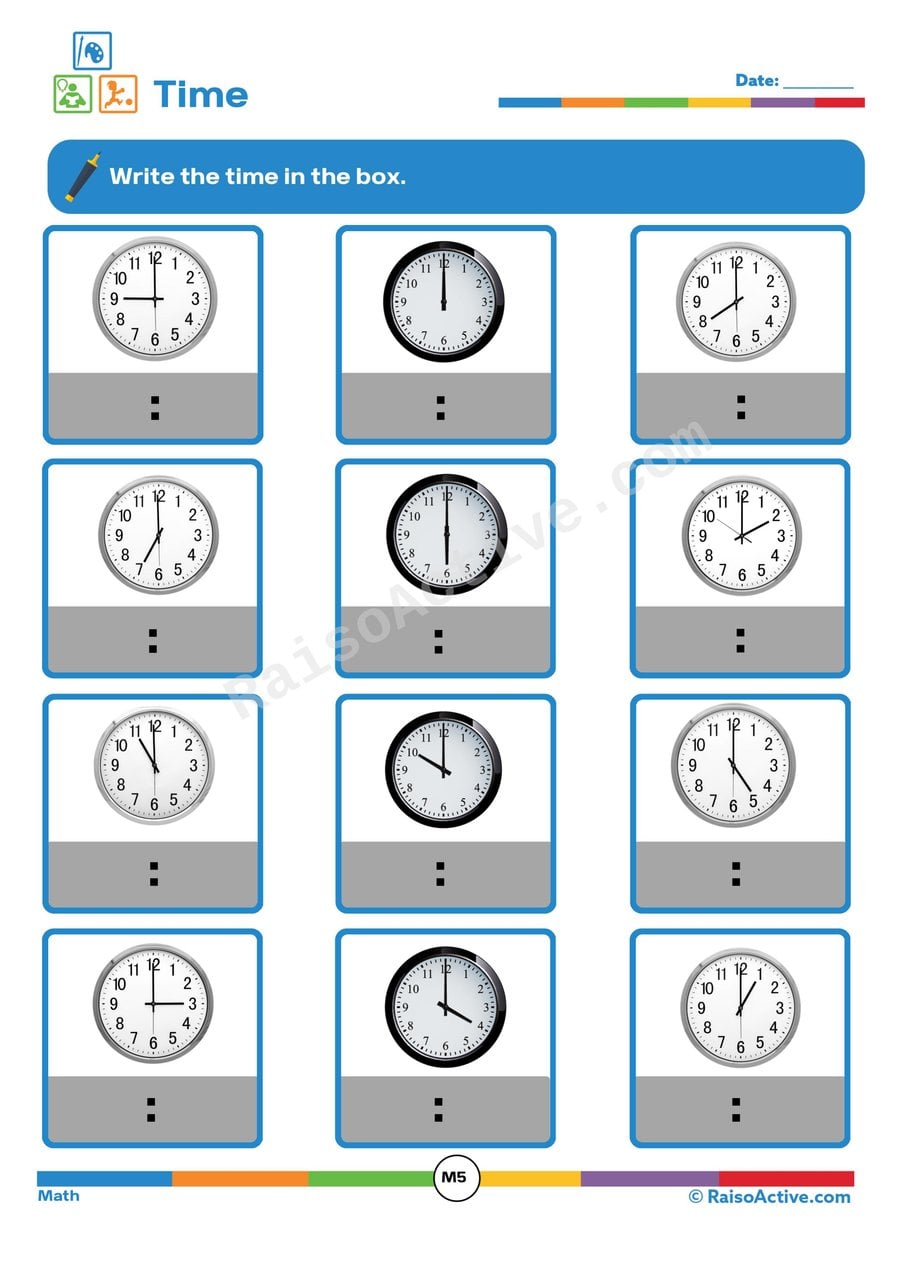
Reading the position of the hour and minute hands on an analog clock and writing the matching digital time teaches children ages 4-6 an important real-world math skill that connects visual, spatial reasoning with numeral writing. Because analog clocks require understanding both where the short hour hand and long minute hand point, this worksheet builds a more advanced skill than simple number recognition, introducing the idea that two hands work together to tell one time. Regular practice with clock reading also supports growing independence, as children begin to understand daily routines in terms of actual clock times.

Zoo Adventure: Reading Comprehension Worksheet for Preschoolers
Ages 4-5 · Pre-KAges 4-5 · ReceptionAges 4-5 · LKGAges 4-5
Reading a short passage about a zoo and then answering multiple-choice questions builds early reading comprehension in children ages 4-5, teaching them to hold information in mind after reading rather than just decoding words on a page. Choosing answers from provided options also introduces test-taking skills like eliminating wrong choices and rereading for clarification, both useful habits for later school assessments. Zoo animals as the subject matter keep the reading engaging enough to sustain focus through the full passage and question set.
Taxi Cut and Paste Worksheet for Preschoolers
Ages 3-5 · Preschool–Pre-KAges 3-5 · Nursery–ReceptionAges 3-5 · Nursery–LKGAges 3-5
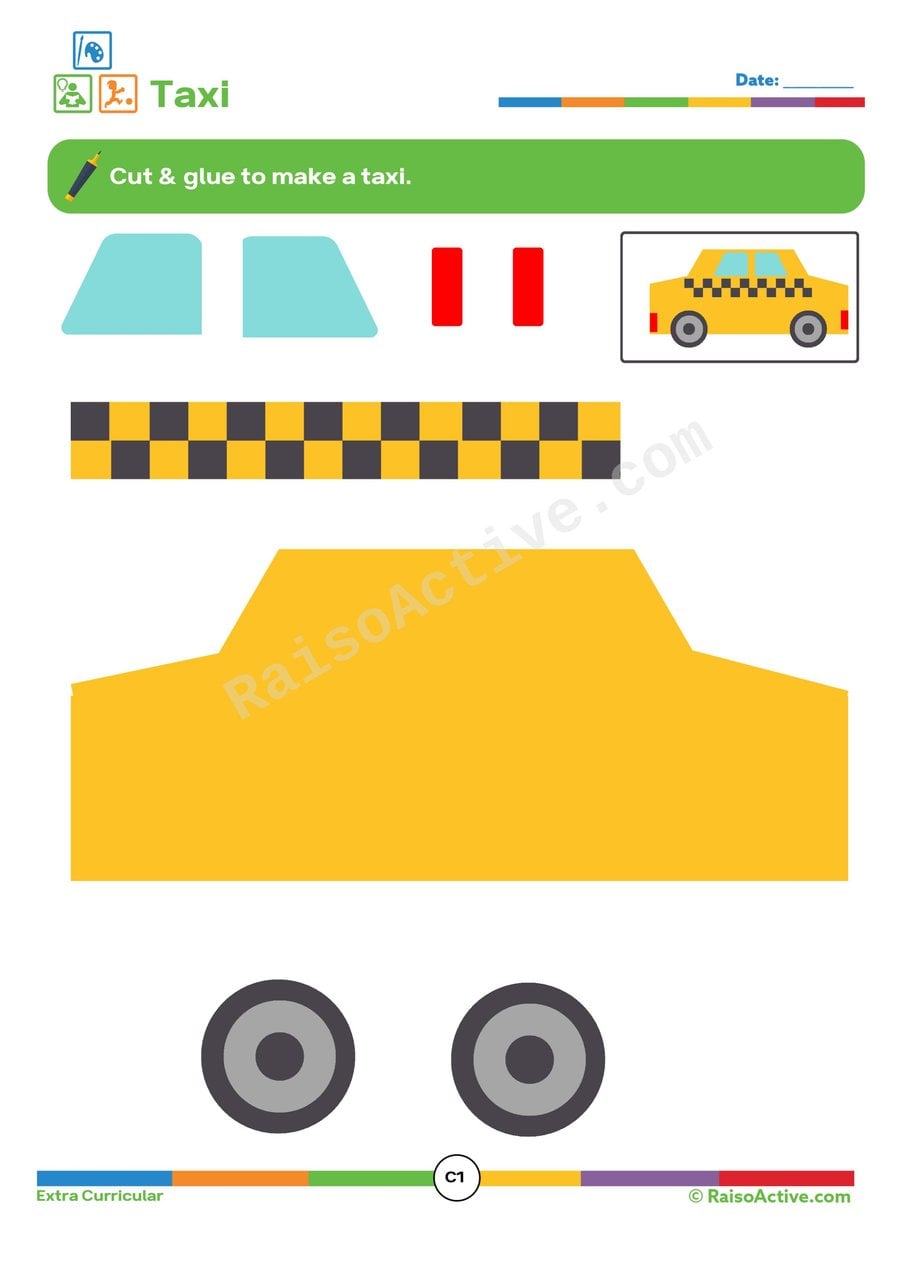
This craft-style worksheet gives children ages 3-5 focused practice with cutting along both straight and curved lines and assembling several separate pieces into one recognizable picture — a taxi. Building an image from multiple cut-out parts requires spatial planning, since children must figure out where each piece belongs relative to the others before gluing. The community-helper theme also introduces vocabulary around transportation and the people who drive it.

Ascending Order Cut and Paste Worksheet for Preschoolers
Ages 4-6 · Pre-K–KindergartenAges 4-6 · Reception–Year 1Ages 4-6 · LKG–UKGAges 4-6
This worksheet teaches children ages 4-6 to arrange numbered animal pictures from smallest to largest, reinforcing the concept of ascending order as a foundational number-sequencing skill. Physically cutting and repositioning each numbered piece, rather than simply writing numbers in order, makes the abstract idea of 'smallest to largest' into something children can manipulate and see. This hands-on approach also builds patience and careful visual comparison.

Blend Words Matching Worksheet: Read and Circle the Picture!
Ages 4-6 · Pre-K–KindergartenAges 4-6 · Reception–Year 1Ages 4-6 · LKG–UKGAges 4-6
This worksheet gives children ages 4-6 further practice reading consonant blend words and connecting them to their matching picture, this time by circling rather than cutting and pasting, which keeps the focus purely on reading and visual scanning. Repeated blend practice across different formats — matching, circling, and later independent writing — helps these two-consonant sounds become automatic rather than something a child has to sound out every time.

Frame a Sentence Worksheet: Building Sentences with Cows!
Ages 4-6 · Pre-K–KindergartenAges 4-6 · Reception–Year 1Ages 4-6 · LKG–UKGAges 4-6
Arranging a set of given words into a complete, correctly ordered sentence teaches children ages 4-6 basic sentence structure, helping them understand that word order changes meaning and that sentences follow predictable patterns like subject before action. Remembering to start with a capital letter and end with a period also reinforces early writing conventions alongside the sentence-building itself. This combination of grammar and mechanics gives children practice with the full process of forming a proper written sentence, not just choosing words.
Time Telling Worksheet: What Time Is It? (3-5)
Ages 3-5 · Preschool–Pre-KAges 3-5 · Nursery–ReceptionAges 3-5 · Nursery–LKGAges 3-5
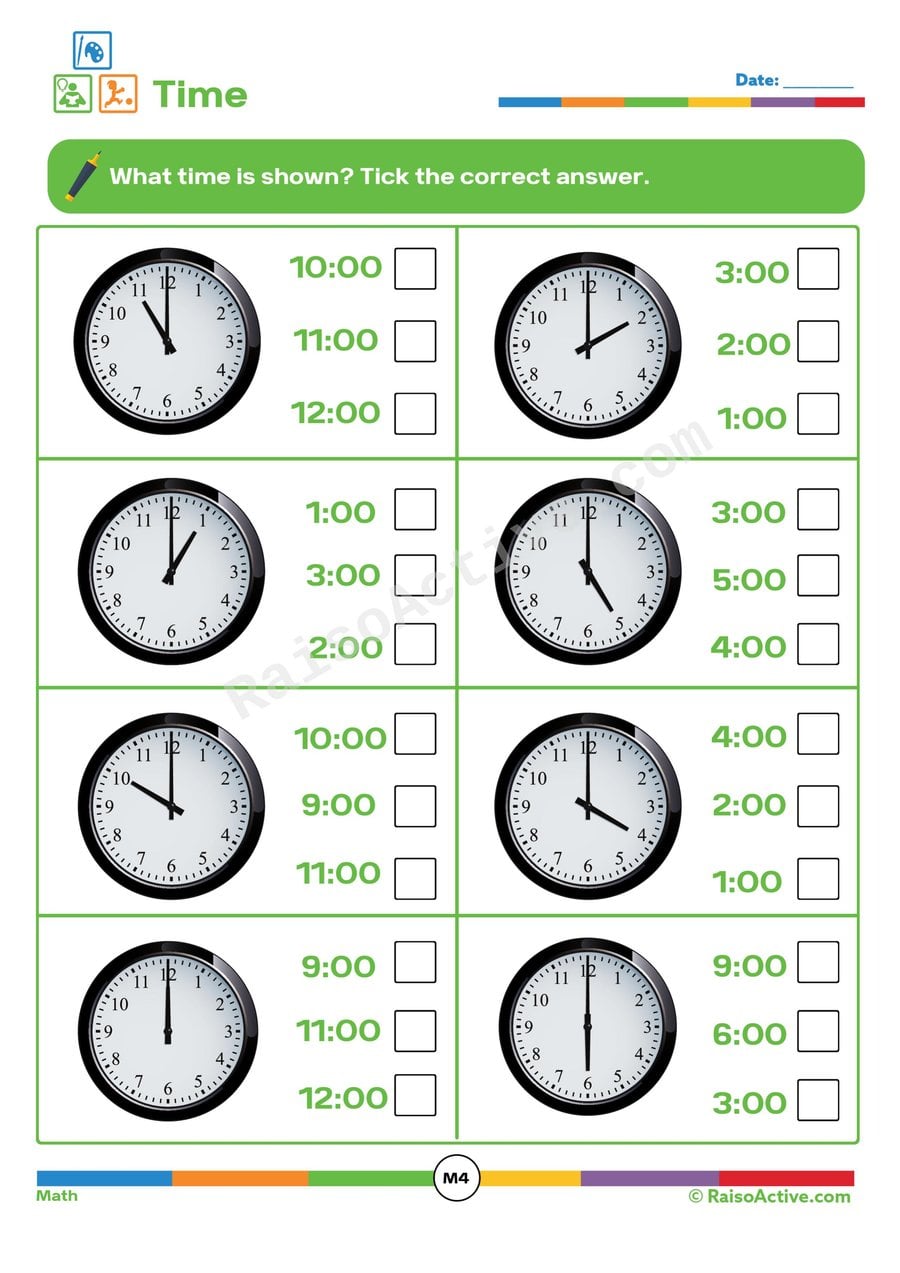
This worksheet introduces children ages 3-5 to analog clock reading at its simplest level, asking them to look at a clock face and choose the correct time from a set of answer options rather than writing it independently. Multiple-choice format lowers the barrier for this genuinely difficult skill, letting younger children build early clock familiarity before they're expected to read time unaided.

Plant Life Cycle Worksheet: Cut and Paste the Stages!
Ages 4-6 · Pre-K–KindergartenAges 4-6 · Reception–Year 1Ages 4-6 · LKG–UKGAges 4-6
Children ages 4-6 learn the sequential stages of a plant's life cycle — from seed to sprout to full-grown flower — by cutting out and correctly ordering picture cards. Understanding that living things grow through a fixed, predictable sequence is an early science concept that also reinforces sequencing and ordering skills useful well beyond biology.
Related worksheets

Number Names Worksheet: Unscramble, Match, and Write Numbers!
Ages 4-6 · Pre-K–KindergartenAges 4-6 · Reception–Year 1Ages 4-6 · LKG–UKGAges 4-6
This worksheet layers three literacy and numeracy skills together: unscrambling jumbled letters to spell out number names, writing the corresponding numeral, and matching numbers to their written names. For ages 4-6, connecting a numeral like '5' to its written word 'five' bridges math and reading skills, reinforcing that numbers can be represented in more than one way.

Number Names Matching Worksheet for Preschoolers
Ages 3-5 · Preschool–Pre-KAges 3-5 · Nursery–ReceptionAges 3-5 · Nursery–LKGAges 3-5
This worksheet helps children ages 3-5 connect written number names, like 'three' or 'seven,' to the numeral they represent, an important step beyond simply recognizing digits since it introduces reading actual number words. Decoding a color clue to figure out and write each number name first adds an extra layer of visual attention before the matching step even begins.
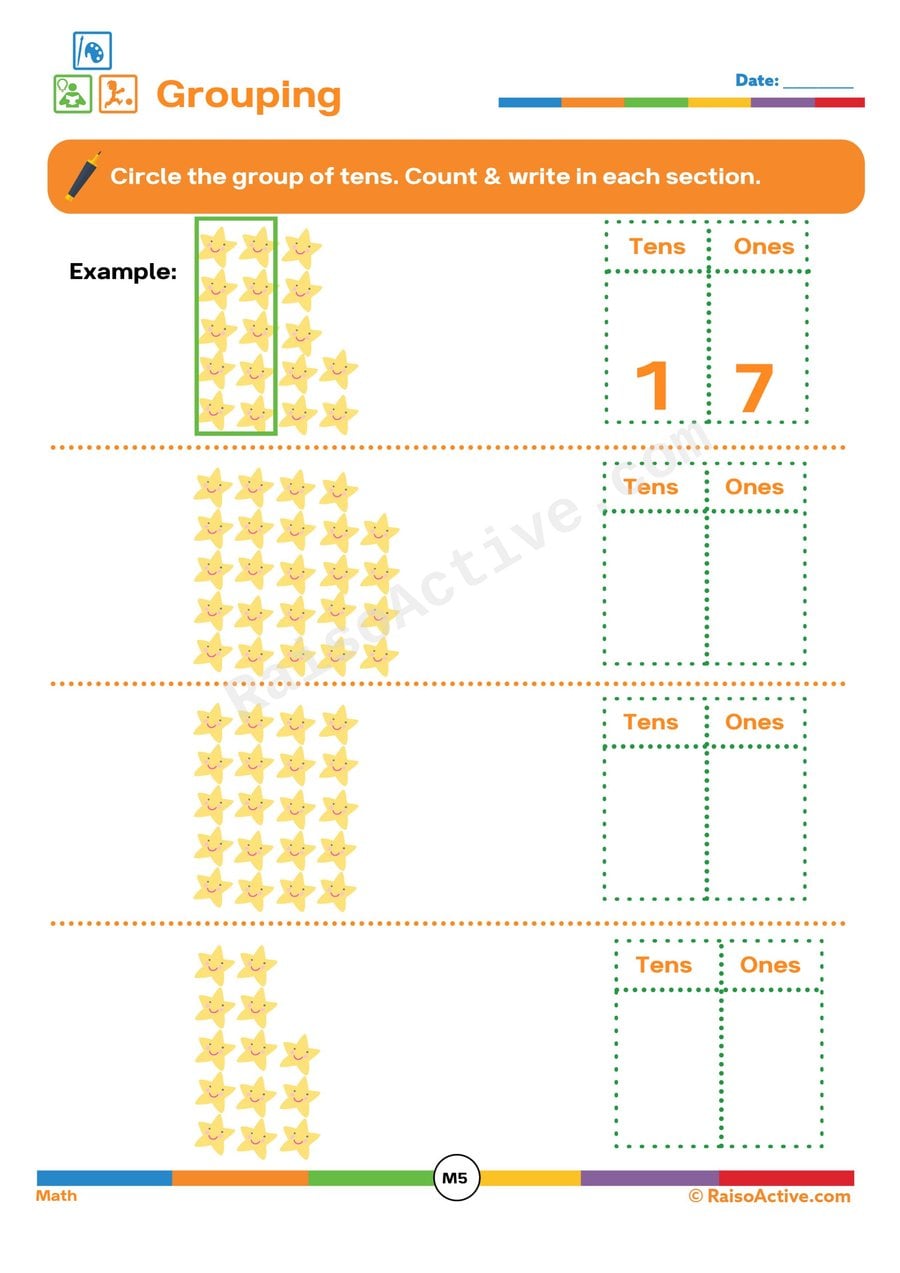
Grouping Stars: Tens and Ones Worksheet for Kids
Ages 4-6 · Pre-K–KindergartenAges 4-6 · Reception–Year 1Ages 4-6 · LKG–UKGAges 4-6
Circling groups of ten stars and counting the leftover ones teaches children ages 4-6 to see a two-digit number as tens plus ones, reinforcing place value in a visual, hands-on way. This grouping practice builds a stronger number sense than memorizing numerals alone, since children physically organize quantities before writing them down.

Number Path: Help the Boy Reach His House! (Numbers 41-50)
Ages 4-6 · Pre-K–KindergartenAges 4-6 · Reception–Year 1Ages 4-6 · LKG–UKGAges 4-6
This maze worksheet takes 4-6 year olds into two-digit number territory, asking them to recognize and sequence numbers 41 through 50 in order to trace a path — a step up in difficulty from single-digit counting since two-digit numbers are easy to reverse or confuse (41 versus 14). Tracing the connecting line also keeps pencil control and hand-eye coordination in play alongside the number work, and the payoff of guiding the boy home gives the counting task a clear, motivating goal.
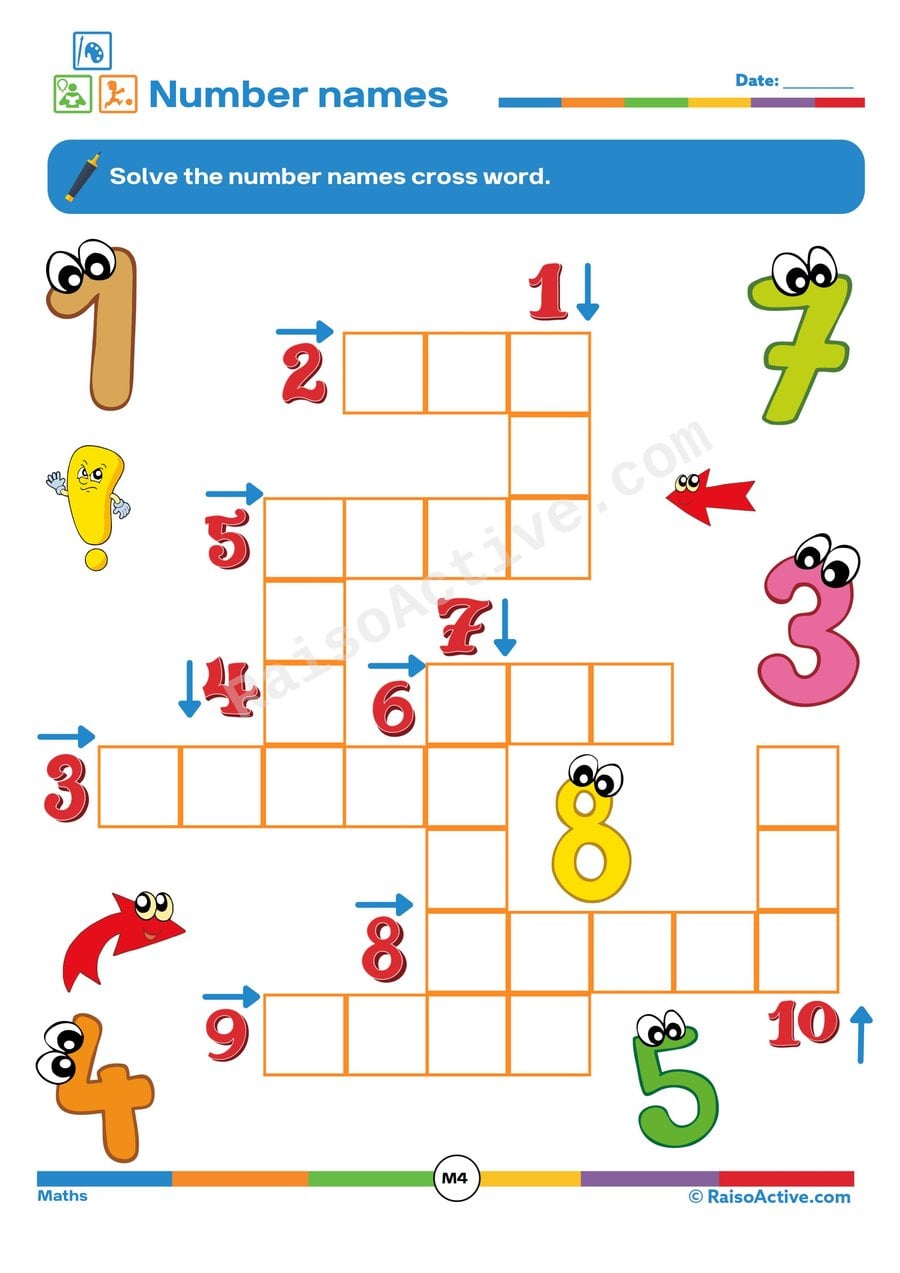
Number Names Crossword Worksheet for Kids
Ages 4-6 · Pre-K–KindergartenAges 4-6 · Reception–Year 1Ages 4-6 · LKG–UKGAges 4-6
Children ages 4-6 practice spelling number names — like 'five', 'twelve', or 'twenty' — by using numeral clues to fill in a crossword grid. This task bridges numeral recognition with word spelling, requiring children to think about both quantity and written vocabulary simultaneously. Fitting letters into the fixed crossword boxes also builds spatial planning and careful letter counting.

Number Names Matching Worksheet for Preschoolers
Ages 3-5 · Preschool–Pre-KAges 3-5 · Nursery–ReceptionAges 3-5 · Nursery–LKGAges 3-5
This worksheet helps children ages 3-5 connect written number words — like 'three' or 'seven' — to their matching numerals, an important step beyond simple numeral recognition toward full number literacy. Drawing a line from a number name to the numeral it stands for requires children to read or recall the word and hold it in mind while scanning for its match, which builds working memory alongside early reading and number skills.
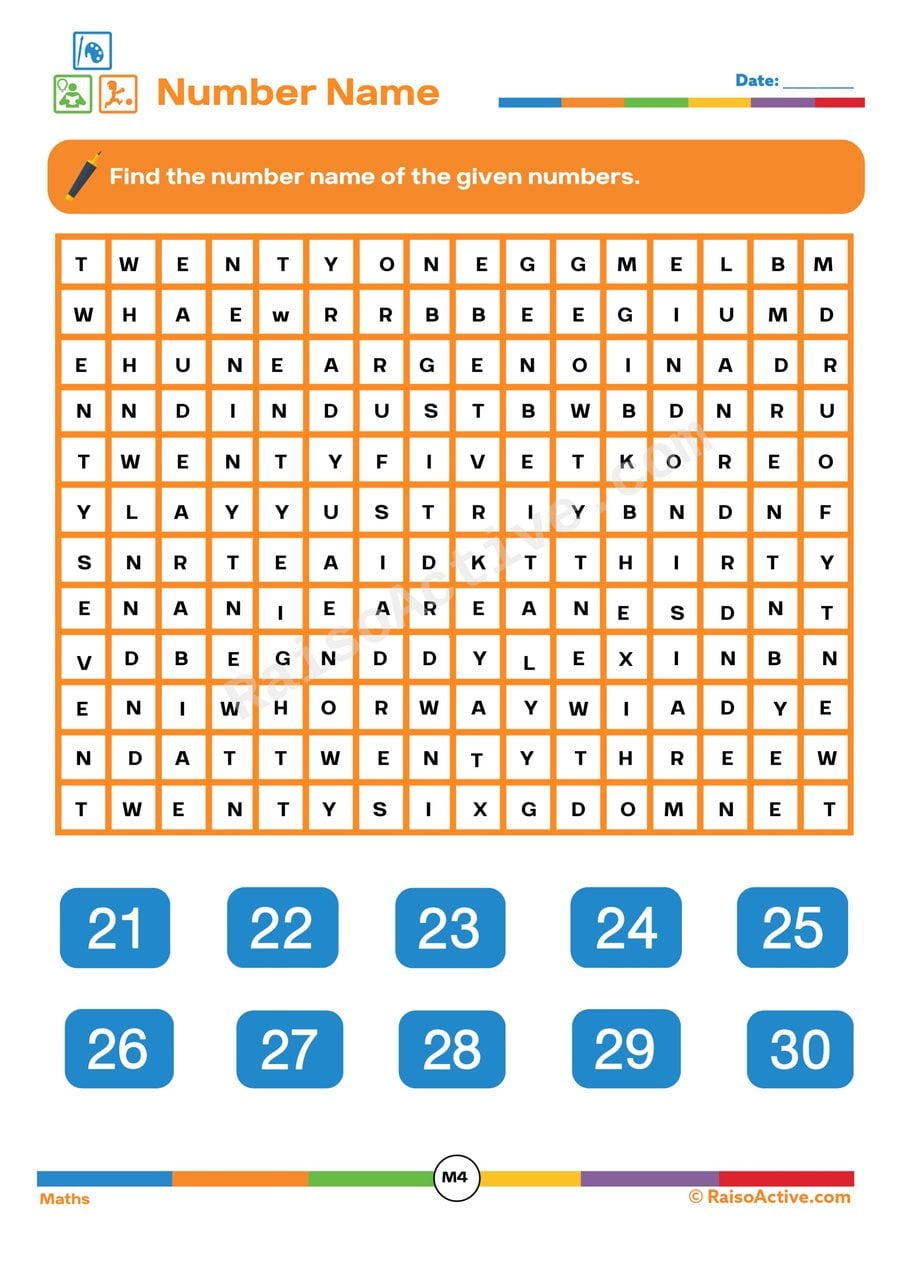
Number Name Word Search Worksheet for Kids
Ages 4-6 · Pre-K–KindergartenAges 4-6 · Reception–Year 1Ages 4-6 · LKG–UKGAges 4-6
This word search worksheet asks children ages 4-6 to visually scan a letter grid to find hidden number names, then match each found word to its numeral — combining spelling recognition, visual scanning, and number sense in one activity. Searching for whole words rather than single letters is a step up in difficulty that pushes early readers to recognize letter patterns quickly.
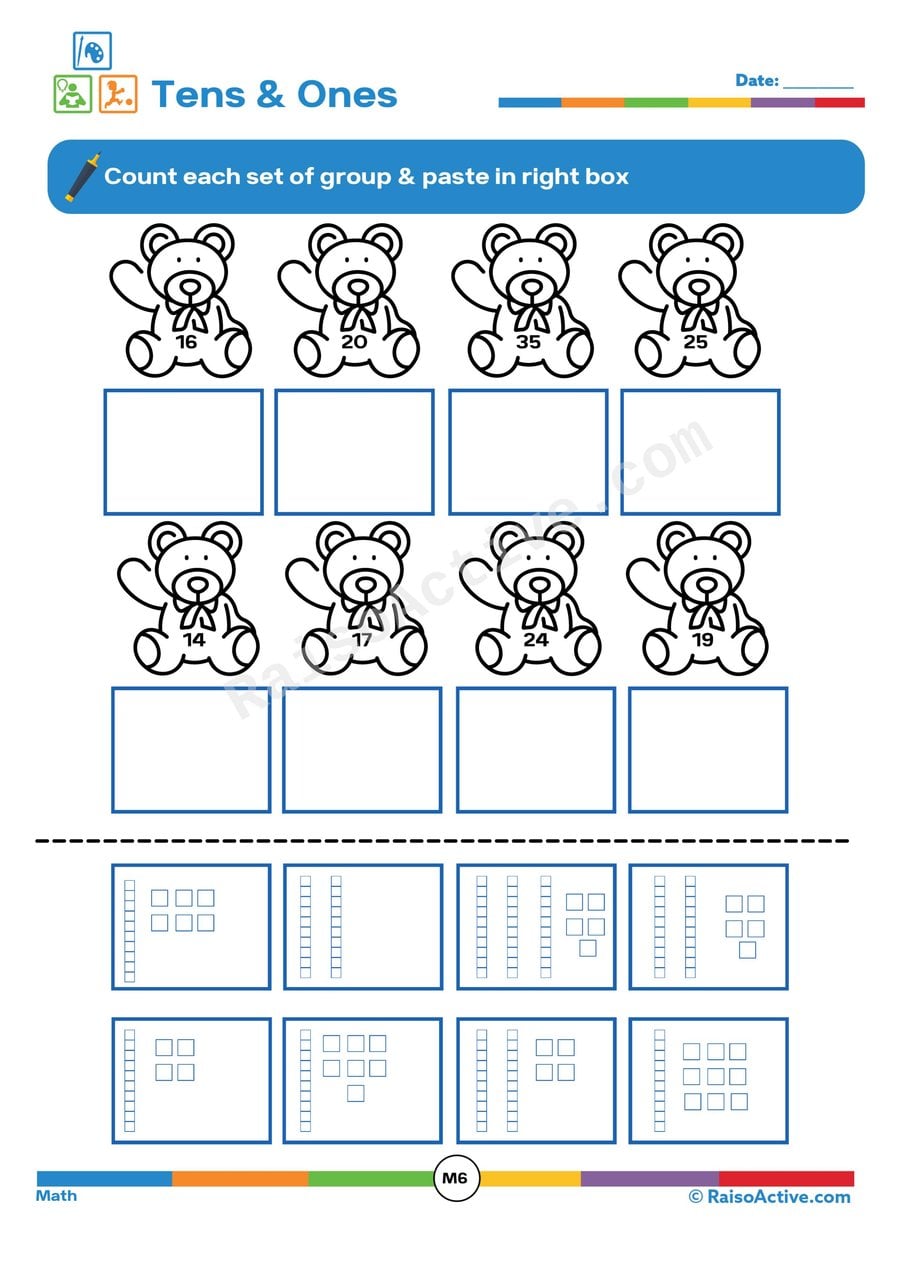
Count and Paste! Tens and Ones Worksheet
Ages 4-6 · Pre-K–KindergartenAges 4-6 · Reception–Year 1Ages 4-6 · LKG–UKGAges 4-6
Counting groups of teddy bears and then matching each total to its tens-and-ones representation teaches children ages 4-6 to connect a counted quantity with its place value breakdown, reinforcing that numbers can be represented in more than one way. Cutting and pasting the matching representation adds fine motor practice to the counting and place value work.
Guides for this topic

Number Formation Rhymes 0–9 and How to Fix Reversals
Original number formation rhymes for 0–9, the correct stroke order for each digit, why 3, 5 and 7 get reversed most often, and multisensory fixes that work.

Documenting Learning Without Drowning in Data: A Practical Guide for Parents and Teachers
Learn practical ways to document your child's learning without overwhelm. Simple portfolios, observation tips, and printable trackers for ages 1-8.

How to Help Your Child with Letter Reversals: A Complete Guide for Parents and Teachers
Letter reversals are normal until age 7-8. Learn the best multisensory strategies, anchor letter tricks, and activities to help children write b, d, p, and q correctly.
Reviews
Every worksheet for ages 4–6, no watermark
Members download the full library of 1,000+ worksheets and every activity pack without watermarks or daily limits. One year costs ₹999 in India or $20 elsewhere.
See membership plansOr download any worksheet free with a watermark (5 a day).