Free printable worksheets · US · UK · India
Shapes Worksheets (Ages 2–6)
Shapes worksheets are printable sheets for children aged 2 to 6 that teach names and properties of two- and three-dimensional shapes. They cover recognizing and matching circles, squares, triangles and rectangles, tracing them, sorting by sides and corners, identifying cubes, spheres, cones and cylinders, and finding shapes in everyday objects, from Preschool and Nursery to Kindergarten, Reception and UKG.
Shapes are the first math that a child can see rather than count, and they develop from recognition to reasoning. A two-year-old posts a circle through a circular hole and matches identical shapes by sight. A three- or four-year-old names a circle, square and triangle and can trace one. A five-year-old in Kindergarten, Reception or UKG says a triangle has three sides and three corners, sorts shapes by that rule regardless of size or orientation, tells a square from a cube, and points out that a clock is a circle and a door is a rectangle. That last step, from shapes on a page to shapes in the room, makes the topic useful. The shapes worksheets here go recognition, naming, tracing, sorting, 3D and environment, and Nursery, Preschool and LKG children should start with the matching and coloring sheets.
1058+ worksheets · free PDF download · print on A4 or Letter
Shapes Worksheets to print
Browse all worksheets for ages 2–6
Clothing Pattern Match Worksheet for Preschoolers
This worksheet has children ages 3-5 study repeating patterns on clothing items — stripes, polka dots, or checks — and match each item to its identical twin, building visual discrimination and early pattern-sequencing skills. Distinguishing between similar-looking patterns also sharpens attention to detail, a skill that later supports letter and word recognition.
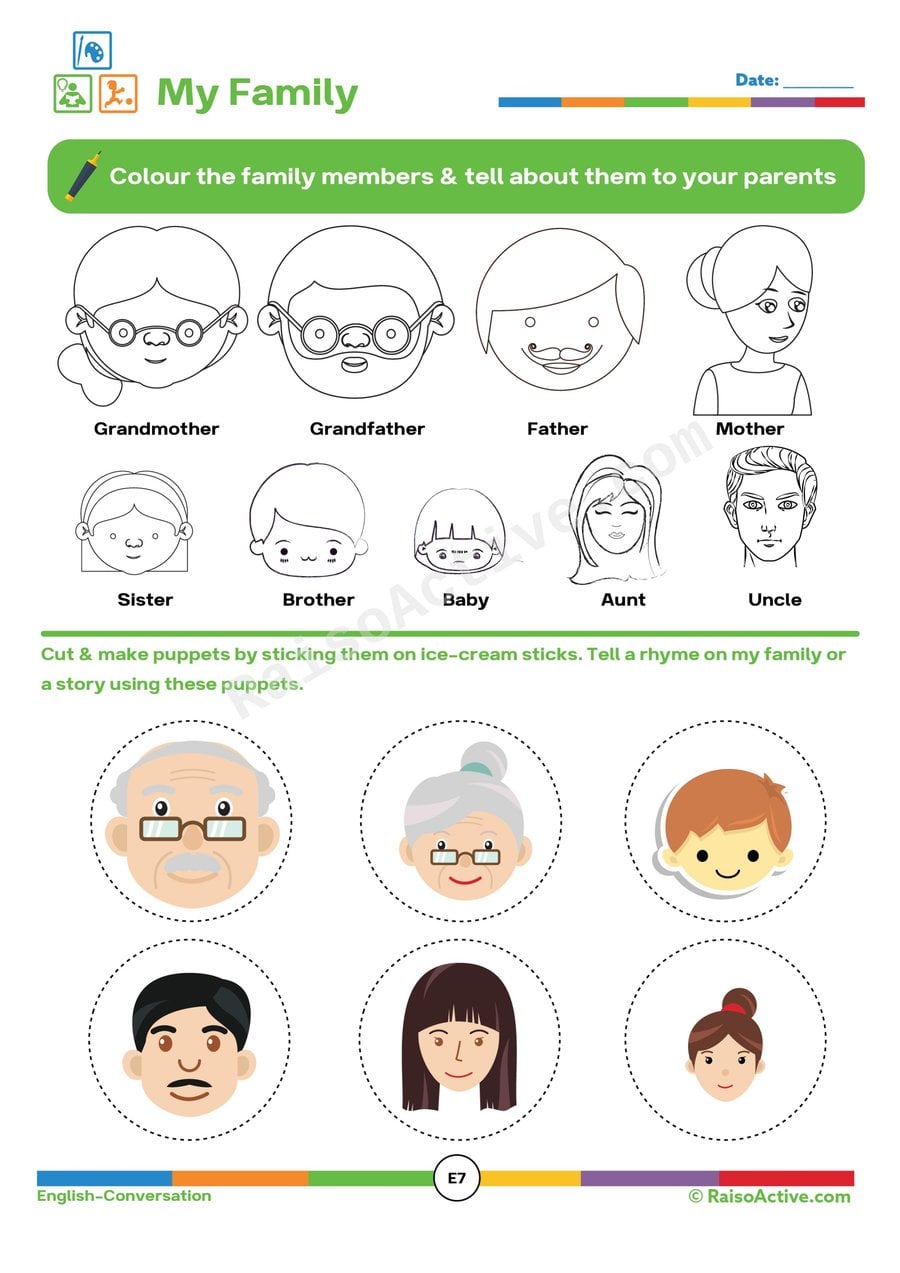
My Family: Color and Create Puppets Worksheet
This worksheet builds early social-emotional vocabulary around family roles while developing fine motor skills through coloring, cutting, and assembling finger puppets. For three- to five-year-olds, turning family members into puppets they can move and talk through gives them a hands-on way to describe relationships and practice storytelling about people who matter most to them.

High and Low Volume Sorting Worksheet for Preschoolers
This worksheet introduces children ages 3-5 to an early science concept — sound volume — by asking them to sort pictures of sound sources into 'high' (loud) and 'low' (quiet) volume columns. Making this judgment requires recalling real-world sound memories and applying that knowledge to a picture, which builds auditory reasoning and categorization skills beyond what's visible on the page. It's also a gentle introduction to the idea that sound is a form of energy with measurable properties.

Color Santa Claus for Christmas! A Fun Coloring Worksheet
This Santa Claus coloring page lets children ages 3-5 practice crayon control and color selection on a large, familiar holiday figure, building confidence with fine motor coloring skills before moving to smaller or more detailed pictures. Choosing colors for Santa's suit, hat, and beard also opens up conversation about the holiday season and familiar seasonal symbols.

Letter K Tracing Worksheet: Learn to Write the Letter K!
This tracing worksheet helps children ages 3-5 practice the angled strokes of the letter K, which are more challenging than curved letters because they require precise diagonal lines meeting at a point. Repeated tracing builds the pencil control and hand strength needed for confident handwriting later on. Coloring K-word pictures reinforces the connection between the letter's shape and its beginning sound.

Animal Babies Tracing Worksheet: Help the Babies Find Their Mothers!
This tracing worksheet sharpens fine motor skills and hand-eye coordination as children carefully follow the dotted lines. It helps them develop the controlled pencil movements essential for pre-writing while reinforcing visual discrimination to match baby animals with their mothers. Children also expand their vocabulary by identifying different animal families and their offspring.
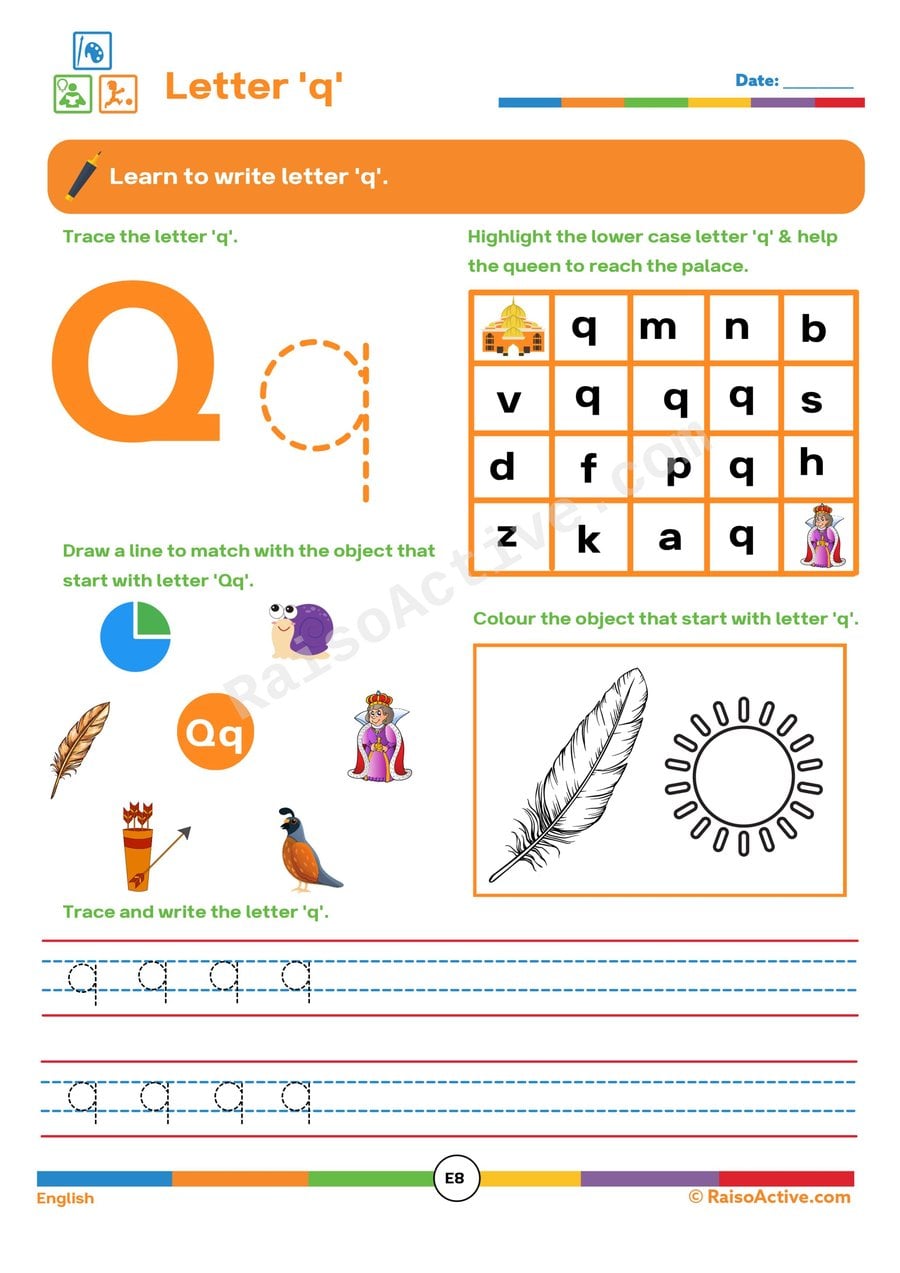
Letter 'q' Worksheet: Trace, Match, and Color!
This worksheet builds letter recognition for 'q' in both its uppercase and lowercase forms for children ages 3-5, a letter that's often trickier than most since it almost always pairs with 'u' and rarely appears alone in early vocabulary. Tracing the letter strengthens the fine motor control for its distinctive tail stroke, while matching and highlighting activities reinforce visual recognition across a busy grid. Helping the queen reach the palace through a simple letter-hunt maze adds a playful, motivating goal to an otherwise repetitive tracing task.

Letter O Tracing Worksheet for Preschoolers: Practice Uppercase and Lowercase!
O is a complete closed circle, distinct from the open curves of C and the single dip of U, giving 3-5 year olds practice with a stroke that must connect back to its own starting point. Tracing both uppercase O and lowercase o also reinforces that this is one of the few letters that looks essentially identical in both cases, just at different sizes.

Halloween Shadow Match Worksheet for Preschoolers
This shadow-matching worksheet sharpens visual discrimination in children ages 3-5 as they compare the outline of each Halloween object to its silhouette and identify the correct match. Because shadows strip away color and detail, children must focus purely on shape, which builds a skill that transfers directly to letter and shape recognition later on.

Letter P Tracing and Coloring Worksheet for Preschoolers
This worksheet builds the fine motor control needed to form the letter P while connecting it to its sound through pictures of objects that start with P, like a pig or a pumpkin. For three- to five-year-olds, repeated tracing combined with sound practice builds the muscle memory and letter-sound association that both come together in early reading and writing.

Trace and Write the Letter F Worksheet for Preschoolers
With just the uppercase F to focus on, children get concentrated practice on its vertical line and two separate horizontal strokes without the distraction of a second letter form, helping them build clean, confident stroke order. This focused repetition at ages 3-5 strengthens the fine motor control needed for the two distinct horizontal lines to land at the right heights.

Count the Sea Animals! A Fun Counting Worksheet for Kids
This worksheet has children ages 3-5 count different sea animals grouped in boxes and then identify the matching numeral for each group, strengthening one-to-one correspondence alongside early ocean and marine-life vocabulary. Because each box features a different sea creature, such as fish, crabs, or starfish, children also practice sorting attention between groups rather than counting one long continuous row. This variety keeps the counting task from becoming rote repetition.

Trace and Count: Number 7 Worksheet for Preschoolers
This worksheet has children ages 3-5 trace the number 7, formed from a straight horizontal line followed by a diagonal line down, and then count out seven cars from a larger group, an important step up from earlier worksheets that show only the exact quantity needed. Because the page includes more cars than the number seven, children must count carefully and stop at the right point rather than simply circling everything shown. This distinction between 'how many are here' and 'find exactly this many' builds a more precise counting skill.

Trace the Penguin: A Fun Pre-Writing Worksheet for Kids!
Tracing the rounded outline of a penguin gives children ages 3-5 practice with curved strokes that form a whole recognizable animal shape rather than an abstract line, which helps the tracing feel purposeful and connected to something familiar from books or videos. The cold-climate theme also introduces simple vocabulary about penguins and their environment, a small science connection layered onto the fine motor practice.
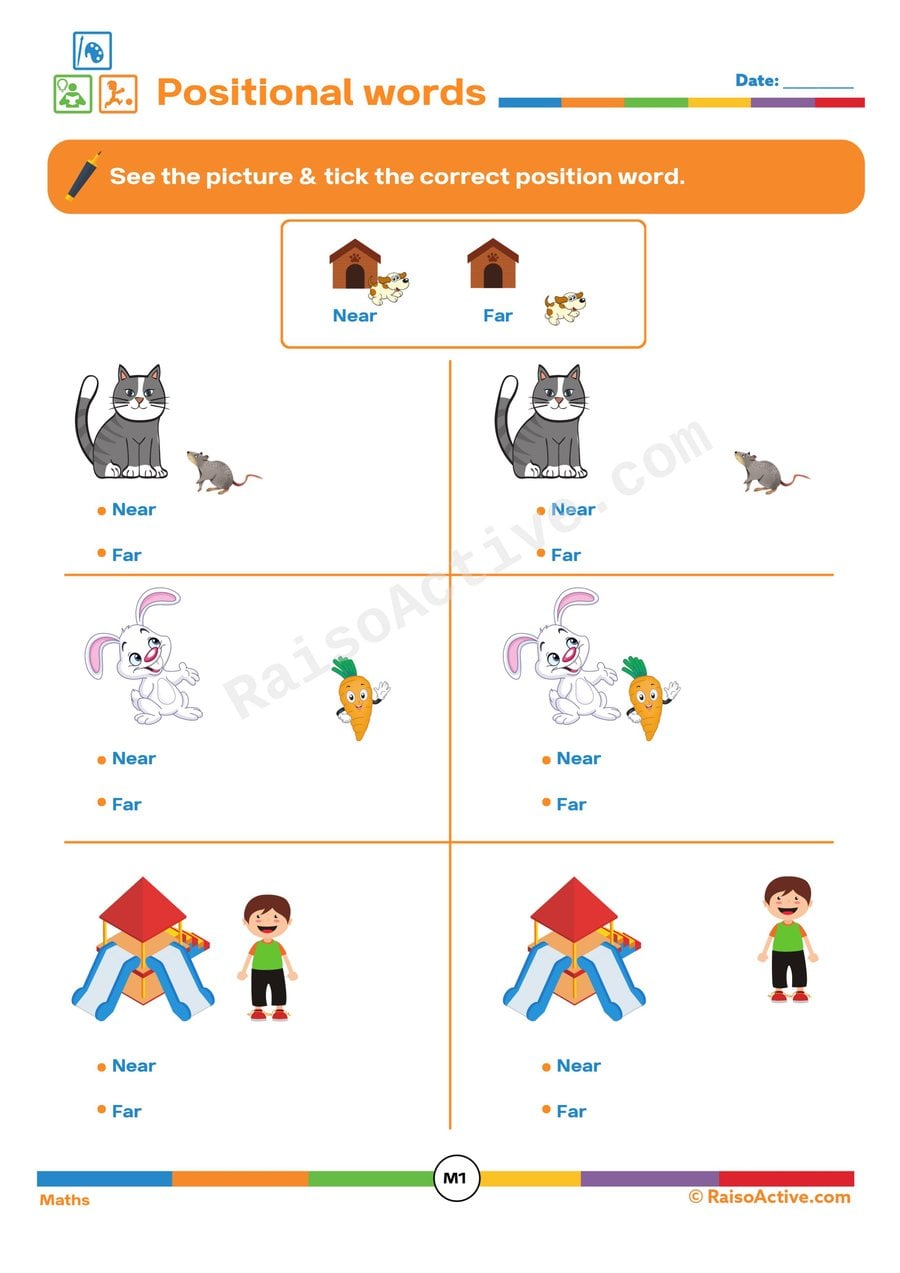
Positional Words Worksheet: Near and Far
This worksheet introduces children ages 3-5 to the positional concepts of 'near' and 'far,' asking them to look at a picture and tick the word that correctly describes an object's distance from a reference point. Positional vocabulary like this is an important building block for spatial reasoning and later geometry and direction-following skills. Because near and far are relative concepts rather than fixed labels, this practice also builds flexible thinking about how position depends on comparison.

Color Code Shorts: A Fun Summer Coloring Worksheet!
This worksheet has children ages 3-5 use a color-by-number code to color a pair of summer shorts, matching each numbered section to the correct color listed in a key at the bottom of the page. This activity strengthens number recognition, since children must match numerals to their position in a code, while also reinforcing color names and fine motor control as they color within smaller, numbered sections. Following a color code is also an early introduction to reading and applying a visual key, a skill used again in maps and charts later on.

In Family Words Worksheet: Read, Trace, and Identify the Pictures!
Reading, tracing, and matching words from the 'in' family — like pin, fin, and win — helps children ages 3-5 notice that changing just the first letter of a word while keeping the same ending creates a whole new word, a key phonics insight called word family recognition. Tracing each word alongside reading it builds handwriting muscle memory at the same time as reading fluency. Circling the picture that matches each traced word also checks true comprehension, not just the ability to sound out letters.

Sight Word 'Get' Worksheet: Trace, Color, and Practice!
This multi-step worksheet builds deep familiarity with the sight word 'get' for children ages 3-5 through six different formats — tracing, coloring, sentence completion, circling, writing, and cut-and-paste spelling — giving far more repetition than a single tracing task would. High-frequency sight words like 'get' don't sound out easily, so this kind of repeated exposure across formats is exactly how early readers learn to recognize them instantly.

Match the Baby Animals Worksheet for Preschoolers
Connecting adult animals to their babies builds specific vocabulary for children ages 3-5, like puppy, kitten, and fawn, while training visual comparison skills as they look for matching features between each pair. This activity also introduces the early biology concept that offspring, though smaller and sometimes differently colored, belong to the same animal family as their parent.

Letter M Tracing and Coloring Worksheet for Preschoolers
This worksheet helps children ages 3-5 practice tracing the letter M's up-down-up-down strokes, identifying words that start with M, and coloring both capital and lowercase versions of the letter. Comparing the capital and lowercase forms side by side helps children notice that the same letter can look different in size while representing the same sound.
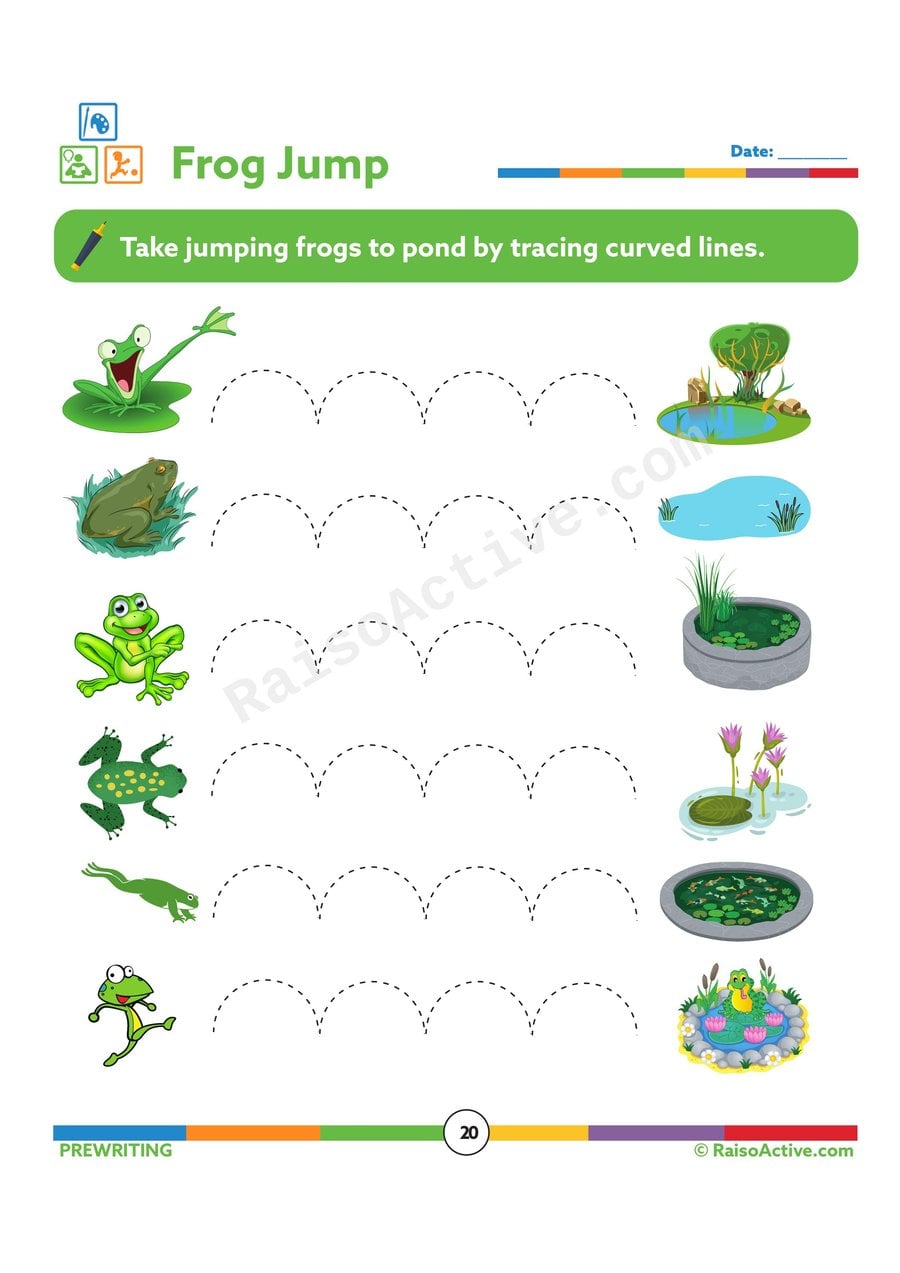
Frog Jump Tracing Worksheet for Preschoolers
Tracing the arc-shaped path of a frog's jump from one lily pad to the next gives children ages 3-5 practice with curved strokes tied to a real physical motion, a hop, which makes the abstract line feel grounded in something they've done themselves. Repeating this jump-shaped arc across several lily pads also builds consistency, helping a child produce similarly sized curves rather than arcs that vary widely from one to the next.

Letter E Tracing Worksheet for Preschoolers: Learn to Write!
Children ages 3-5 use this worksheet to build the specific motor pattern for capital E — three horizontal strokes branching off one vertical line — while reinforcing the /e/ sound through picture recognition. Repeated tracing in a dashed-box format also trains children to keep letters a consistent size, an important pre-writing skill before they move to unlined paper.
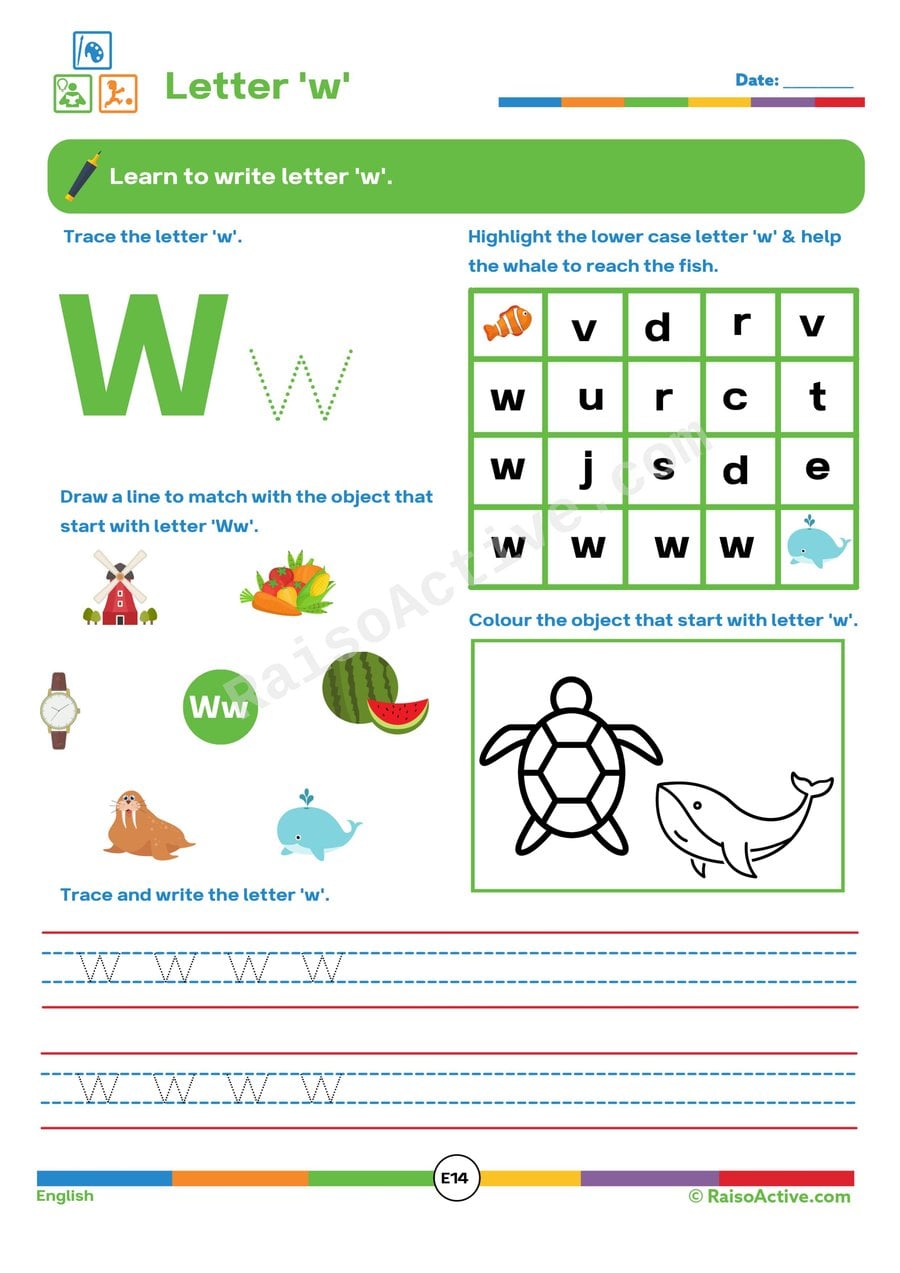
Letter 'w' Worksheet: Trace, Match, and Color!
Tracing, matching, and highlighting the letter 'w' gives children ages 3-5 practice with one of the more visually complex lowercase letters, made up of four connected diagonal strokes rather than a single simple shape. Matching pictures that start with 'w' to the letter reinforces the /w/ sound-to-symbol link, while scanning a letter grid to highlight every 'w' builds visual search skills alongside letter recognition. This combination of tracing, matching, searching, and coloring keeps the practice varied enough to hold a young child's attention across the full page.

Color the Shapes! A Fun Coloring Worksheet for Kids
This worksheet strengthens children ages 3-5 in both shape recognition and color matching by having them reproduce a colored key onto a black-and-white picture made of shapes. Matching a printed example rather than choosing colors freely also builds a new skill: following a visual reference precisely, which is different from — and complements — open-ended coloring.
From recognizing shapes to reasoning about them
Recognition means matching a shape to an identical one, which a two-year-old can do with cutouts. Naming attaches the word, usually circle first, then square and triangle, with rectangle and oval following because they resemble shapes already known. Tracing gives the hand the shape and shows that a triangle is three straight lines meeting at corners. Sorting asks the child to state the rule: everything with four sides goes here, everything round goes there.
Sorting by attribute is where shape becomes math. A child who sorts a tall thin triangle with the other triangles, rather than with the rectangles it resembles in size, is using the number of sides as the defining property. Three-dimensional shapes follow at 5 to 6, with the key idea that a cube has square faces but is not itself a square. Shape hunts in the home and street close the sequence.
- Age 2–3: matching identical shapes, coloring one shape, circle and square
- Age 3–4: naming circle, square, triangle, rectangle; tracing shapes; finding a named shape on a page
- Age 4–5: oval, star, heart, hexagon; counting sides and corners; sorting by shape
- Age 5–6: cube, sphere, cone, cylinder; 2D versus 3D; shapes in everyday objects; composing shapes
How to use shapes worksheets
Name the shape aloud each time it is colored, traced or circled, and ask the child to say what makes it that shape ("how many sides?") from 4 onward. Show shapes in different sizes and turned at odd angles, since children who have only seen a triangle on its base often reject one standing on a point. After a sheet, hunt for the same shape around the room; a coloring page followed by finding three rectangles in the kitchen is a complete lesson.
Common confusions
Square and rectangle are the most confused pair, and the honest answer is that a square is a special rectangle, which children accept easily if told. Circle and oval are confused by young children who see both as round. Diamond is often taught as a shape, but the sheets here use rhombus for older children and treat a diamond as a turned square, which is what it is. Ball and sphere, box and cube are usually learned together, with the formal name added in Kindergarten, Reception or UKG.
Frequently asked questions
What shapes should a child know by age 4?
By 4, the end of Nursery or Preschool, most children can name a circle, square and triangle when shown one in a standard orientation, match identical shapes, and often name a rectangle and a star. By 5, at the end of Pre-K, Reception or LKG, oval, heart and hexagon are added and the child can say how many sides a shape has. Naming 3D shapes and comparing them with 2D shapes is a Kindergarten and UKG goal under Common Core K.G.
What age do children start learning shapes?
Shape matching starts around 18 months to 2 years with shape sorters and puzzles. Naming shapes usually begins at 2 to 3 with circle, and square and triangle follow by 3 to 4. Worksheets become useful at about 3, when a child can color inside a large outline and point to a named shape. Before that, cut-out shapes and blocks teach the same thing better.
Which shapes should be taught first?
Circle, then square, then triangle, then rectangle. The circle is the easiest to recognize and draw, the square introduces sides and corners, the triangle contrasts with it by having three, and the rectangle is learned as a stretched square. Oval, star and heart follow because they appear on so many pages. Hexagon, pentagon and rhombus belong in Kindergarten, Reception or UKG, and 3D shapes after 2D shapes are secure.
What is the difference between 2D and 3D shapes for kids?
A 2D shape is flat and has only length and width, like a drawing of a square on paper. A 3D shape is solid and can be picked up, like a dice, which is a cube. The simplest way to explain it to a five-year-old is that 2D shapes can be drawn and 3D shapes can be held. The main 3D shapes for this age are cube, sphere, cone, cylinder and cuboid, each matched to a familiar object.
Why does my child say a turned square is a diamond?
Because a shape's name for a young child is tied to how it usually looks on the page, and a square is nearly always shown sitting flat. Rotating it changes the picture even though the sides and corners are unchanged. Show the same cutout square, turn it slowly and ask whether anything about it changed. Sheets that present shapes at different angles and sizes fix this quicker than explanation, and it is a normal stage at 3 to 5.
Are the shapes worksheets free to download?
Yes. Once you have an account, each shapes sheet can be downloaded as a watermarked PDF at no charge, up to five downloads a day. An annual subscription of ₹1000 or $20 removes the watermark and the daily limit across the whole library of more than 1,000 worksheets and every printable pack. Every sheet is sized for A4 and US Letter paper.

Written by
Hemsweta Jain · Teacher Cheena
MBA and Early Childhood Educator, teaching since 2014 · Founder of RaisoActive, Mumbai
Written and reviewed by Hemsweta Jain (Teacher Cheena), who designs every RaisoActive worksheet.
Last reviewed
Printable packs for ages 2–6
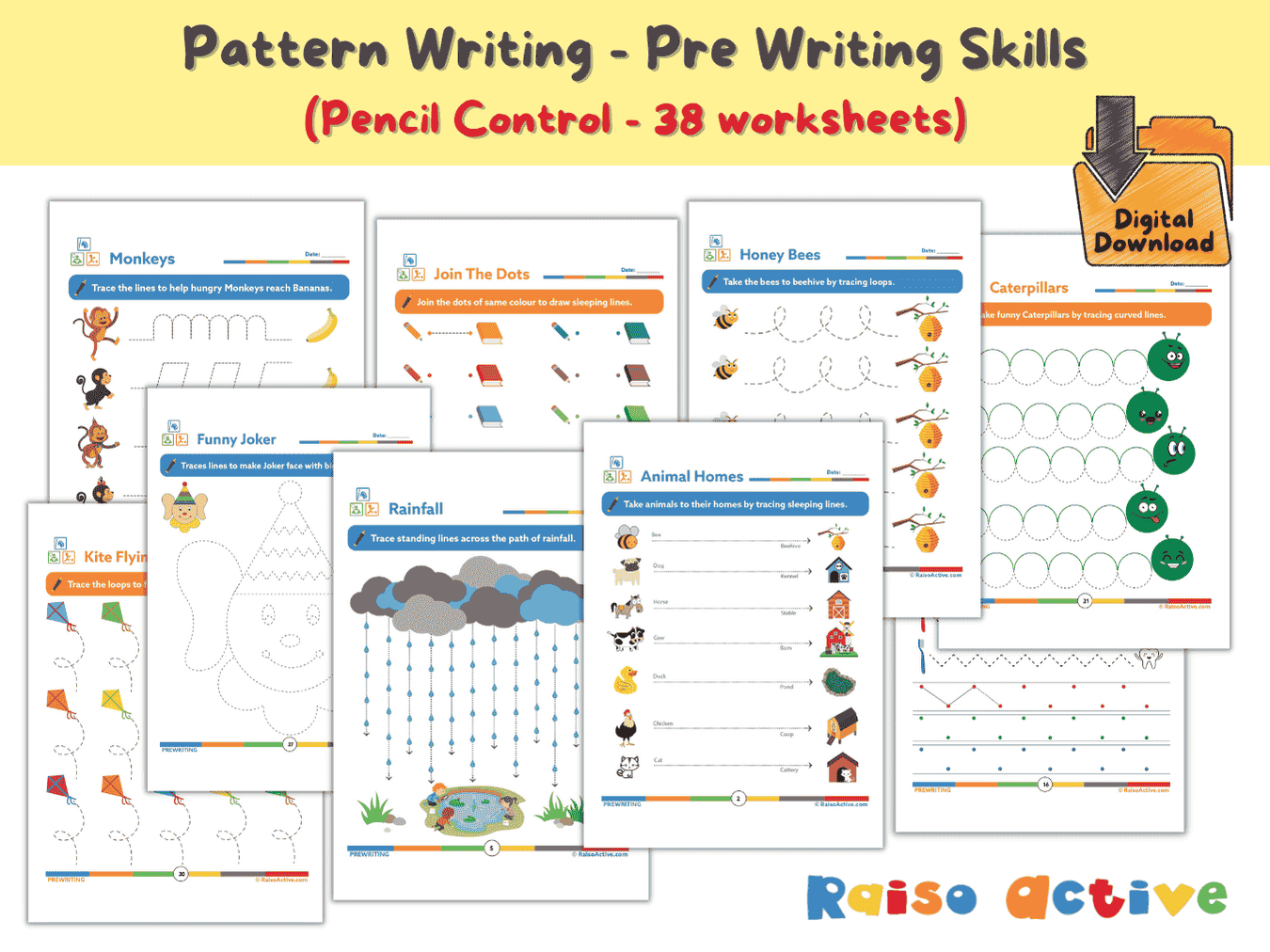
Pattern Writing Pre-writing Skills Activity Book for 3-4 Year Olds
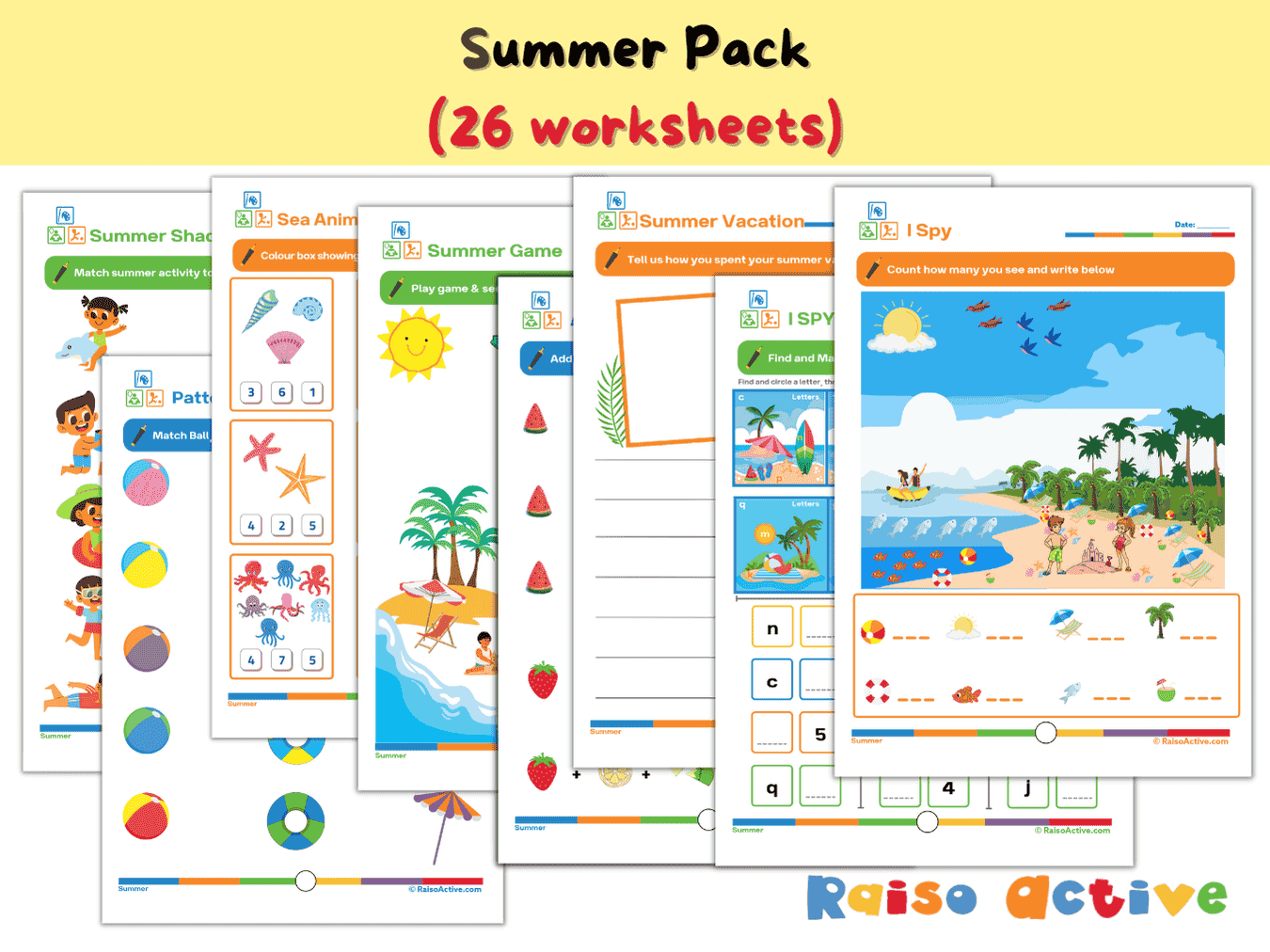
Summer Activity Pack: Math, Literacy, Puzzles & More for Preschool & Kindergarten
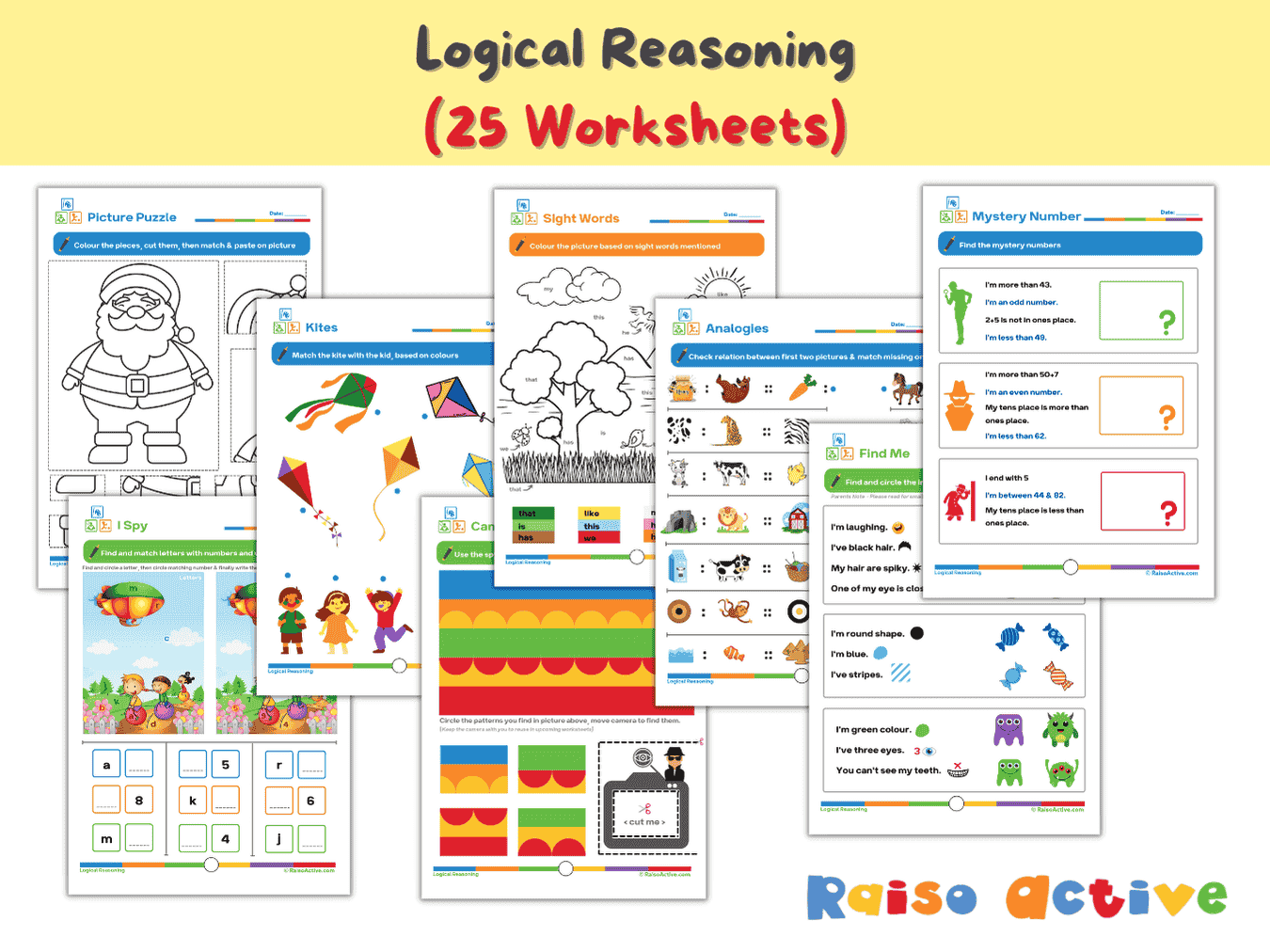
Logical Reasoning Activity Book for Preschool & Kindergarten | Patterns, Puzzles & Analogies
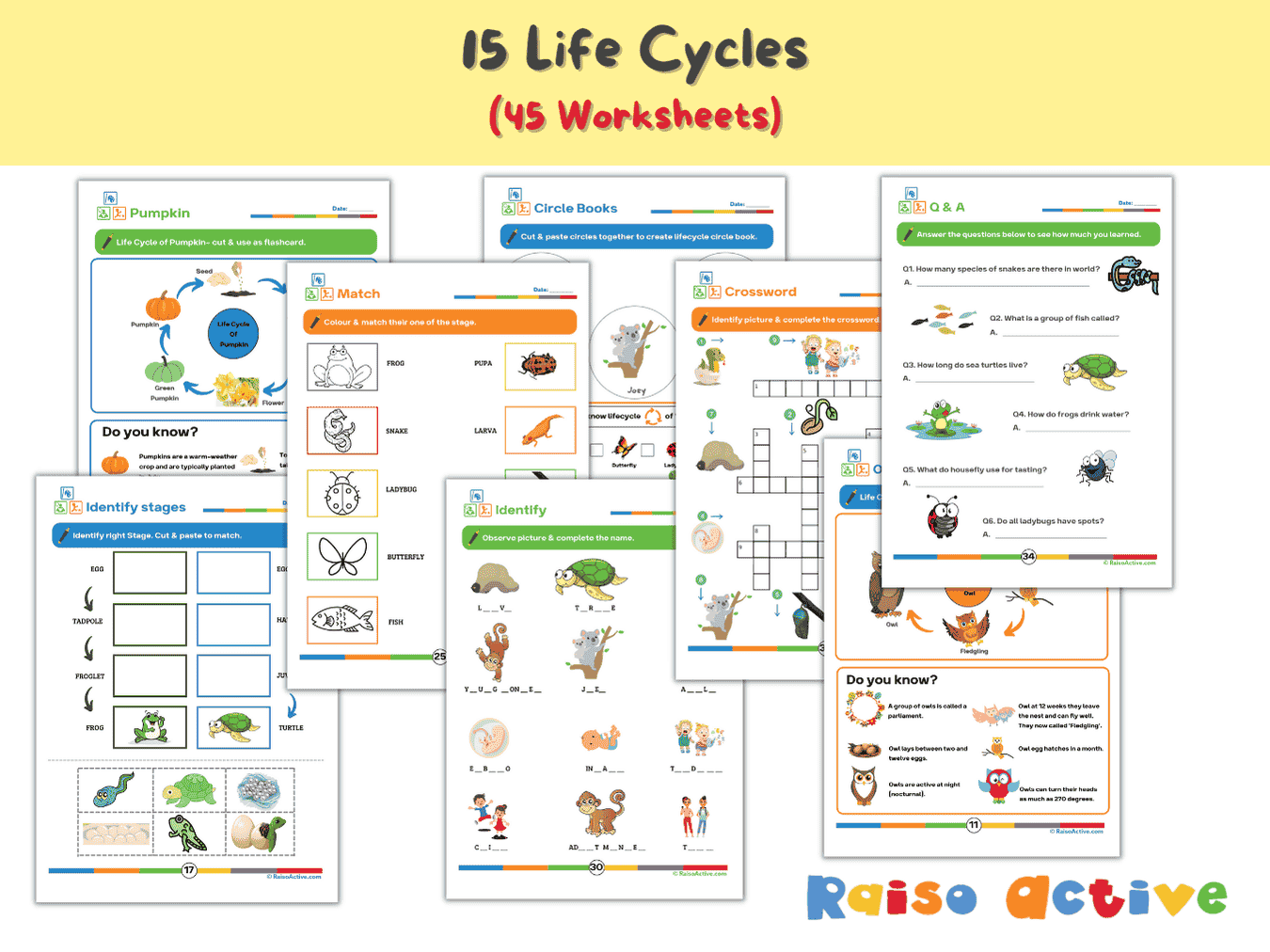
Lifecycles Activity Book & Flashcards for Preschool & Early Elementary
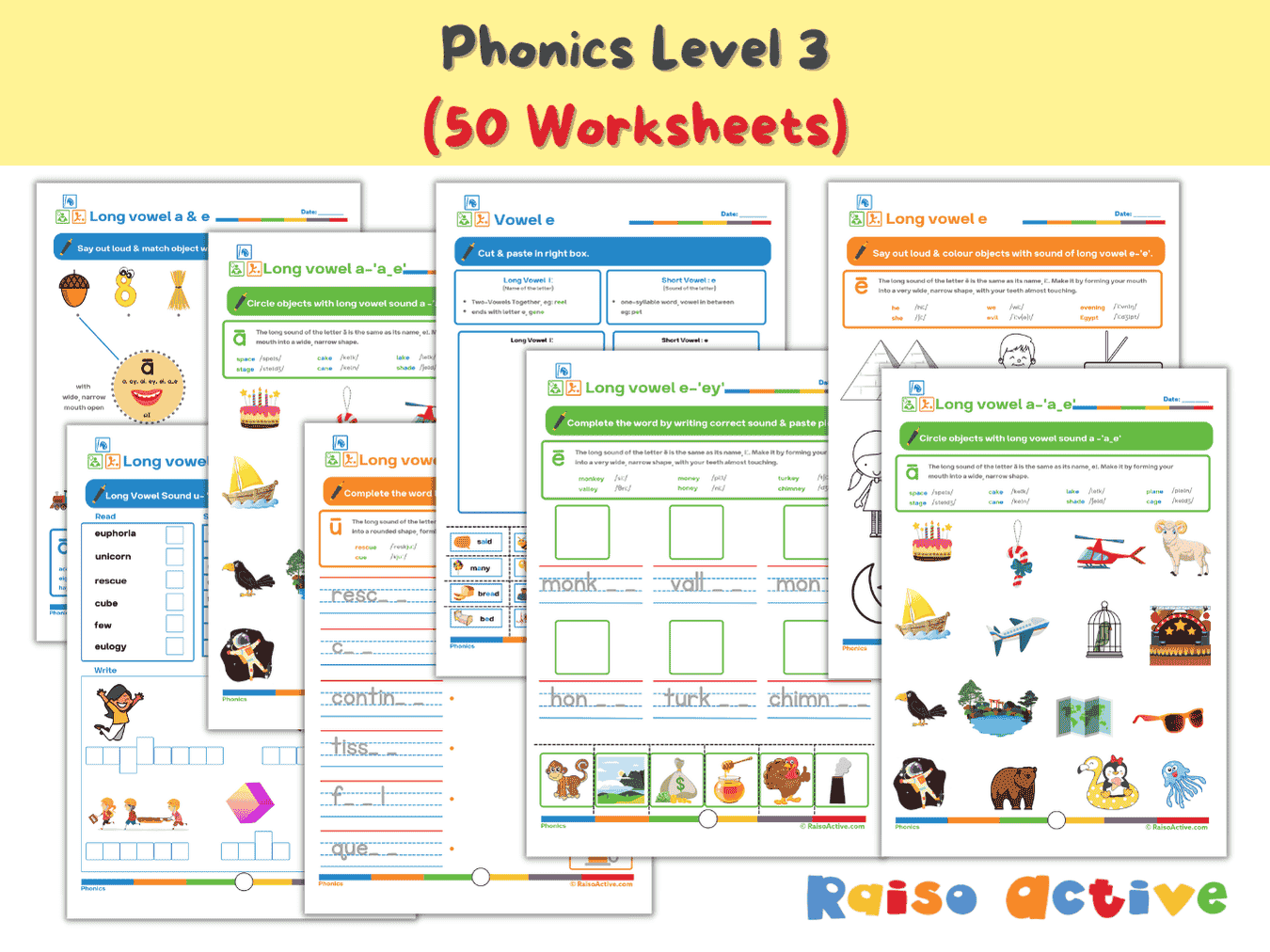
Phonics Level 3 Long Vowels Activity Book for Kindergarten & 1st Grade
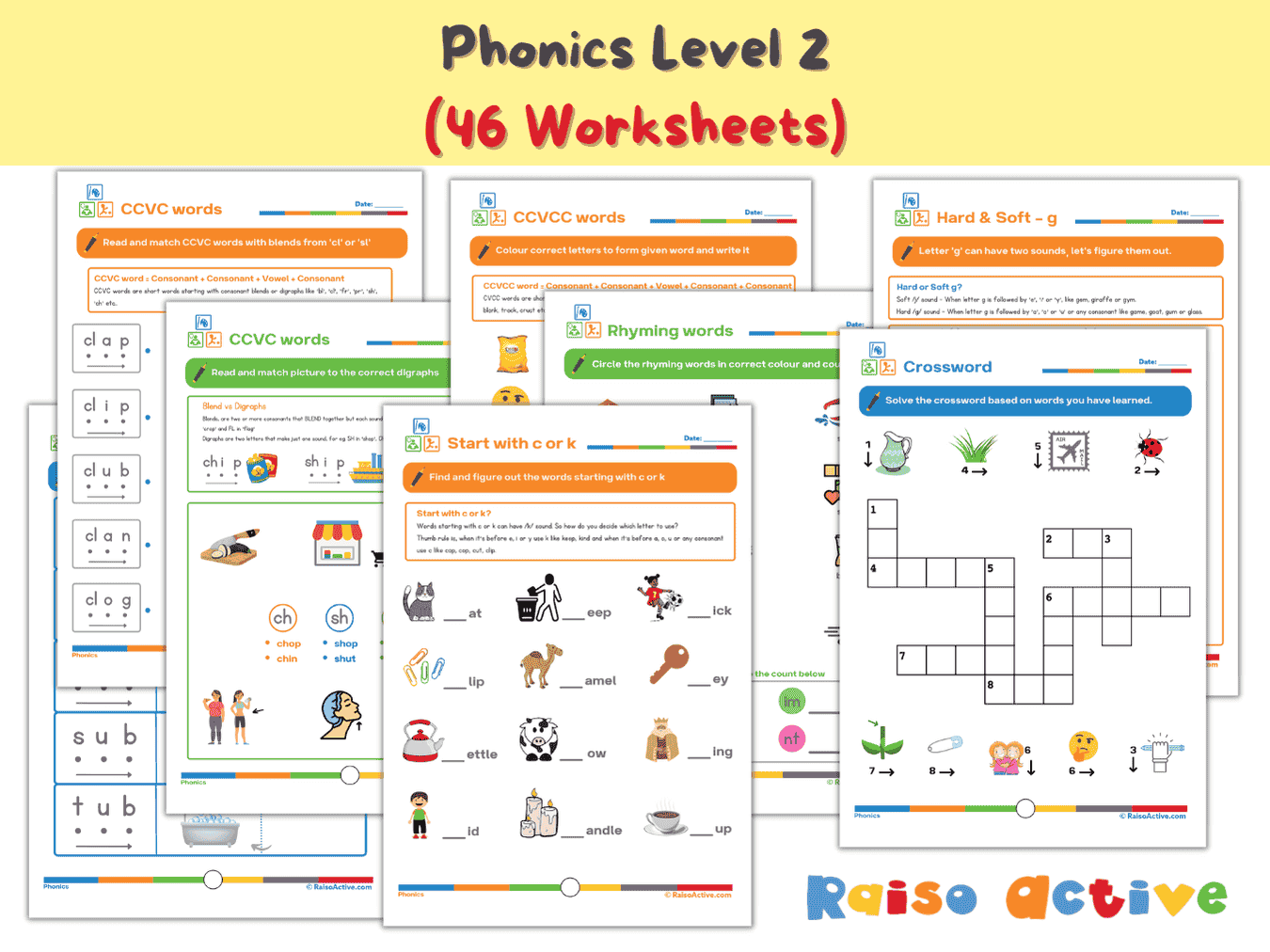
Phonics Level 2 Worksheets: CVC, CCVC, CVCC Word Families & Blends for Early Readers (Ages 4-7)
Guides for parents and teachers
See all guides →Pre-Writing Strokes in Order: From Standing Lines to Loops (With Printable Patterns)
The developmental order of pre-writing strokes, from vertical lines to loops, and why practicing them in sequence makes letter formation much easier to learn.
Age-Appropriate Problem-Solving Activities: Building Critical Thinkers from the Ground Up
Discover fun, age-appropriate problem-solving activities for children ages 1-8. Build critical thinking, logic, and reasoning skills through play-based learning.
Fostering Creativity in Structured Learning: The Perfect Balance for Young Minds
Learn how to blend creativity with structured learning for children ages 1-8. Practical strategies, activities, and printable worksheets for parents and teachers.
Coding Activities for Preschoolers: Building Tomorrow's Thinkers Today
Discover 15+ unplugged and screen-based coding activities for preschoolers that build sequencing, logic, and problem-solving skills through play. NEP 2020 aligned.
Montessori Activities for 3-4 Year Olds: A Complete Guide to Purposeful Learning
Discover practical Montessori activities for 3-4 year olds — practical life, sensorial, language, and maths — with Indian kitchen adaptations and budget shelf ideas.
Complete Guide to Jack Hartmann Worksheets: Enhancing Educational Videos with Hands-On Learning
Discover how to pair Jack Hartmann YouTube videos with printable worksheets for deeper learning. Counting, alphabet, sight words activities for preschool to Grade 1.
Canonical: https://raisoactive.com/worksheets/shapes