Free printable worksheets · US · UK · India
Coloring Worksheets & Educational Coloring Pages
Coloring worksheets are printable pages for children aged 2 to 6 that combine coloring with a learning task: color by number, color by letter, color by sight word, color by shape and mystery pictures. They build crayon and pencil grip, hand strength, staying within boundaries, color recognition, number and letter recognition, and sustained attention.
Coloring is the first task most children complete from start to finish, and educational coloring pages turn that motivation into practice. At two and three, the goal is grip and wide, confident strokes on a big simple picture. At four, color-by-number and color-by-shape pages add a key to read, so the child matches a symbol to a color before filling a region. At five and six, color-by-letter, color-by-sight-word and mystery-picture grids ask for careful reading and small, controlled movements inside tight boundaries. Toddler and Preschool classes in the US, Nursery and Reception in the UK, and Playgroup to UKG in India all use coloring daily for the same reason: it exercises the hand while rehearsing the day's lesson.
- 410 worksheets
- Free PDF download
- Print on A4 or Letter
Coloring Worksheets & Educational Coloring Pages to print
Browse all worksheets for ages 2–6
Color the Pictures! Kk, Ll, and Mm Letter Sounds Worksheet
Ages 4-5 · Pre-KAges 4-5 · ReceptionAges 4-5 · LKGAges 4-5
Coloring a circle beneath a picture only when its name starts with a target letter sound builds beginning-sound discrimination for children ages 4-5 across three letters — K, L, and M — sharpening their ability to isolate initial phonemes.

Blend Words: Color the Correct Picture Worksheet for Preschoolers
Ages 4-5 · Pre-KAges 4-5 · ReceptionAges 4-5 · LKGAges 4-5
This worksheet gives children ages 4-5 practice reading consonant blend words — words that start with two consonant sounds blended together, like 'bl' or 'sn' — and coloring the picture that matches each one. Consonant blends are trickier to decode than single-letter sounds, so this focused, low-pressure coloring format lets children practice blending without the added challenge of writing at the same time.
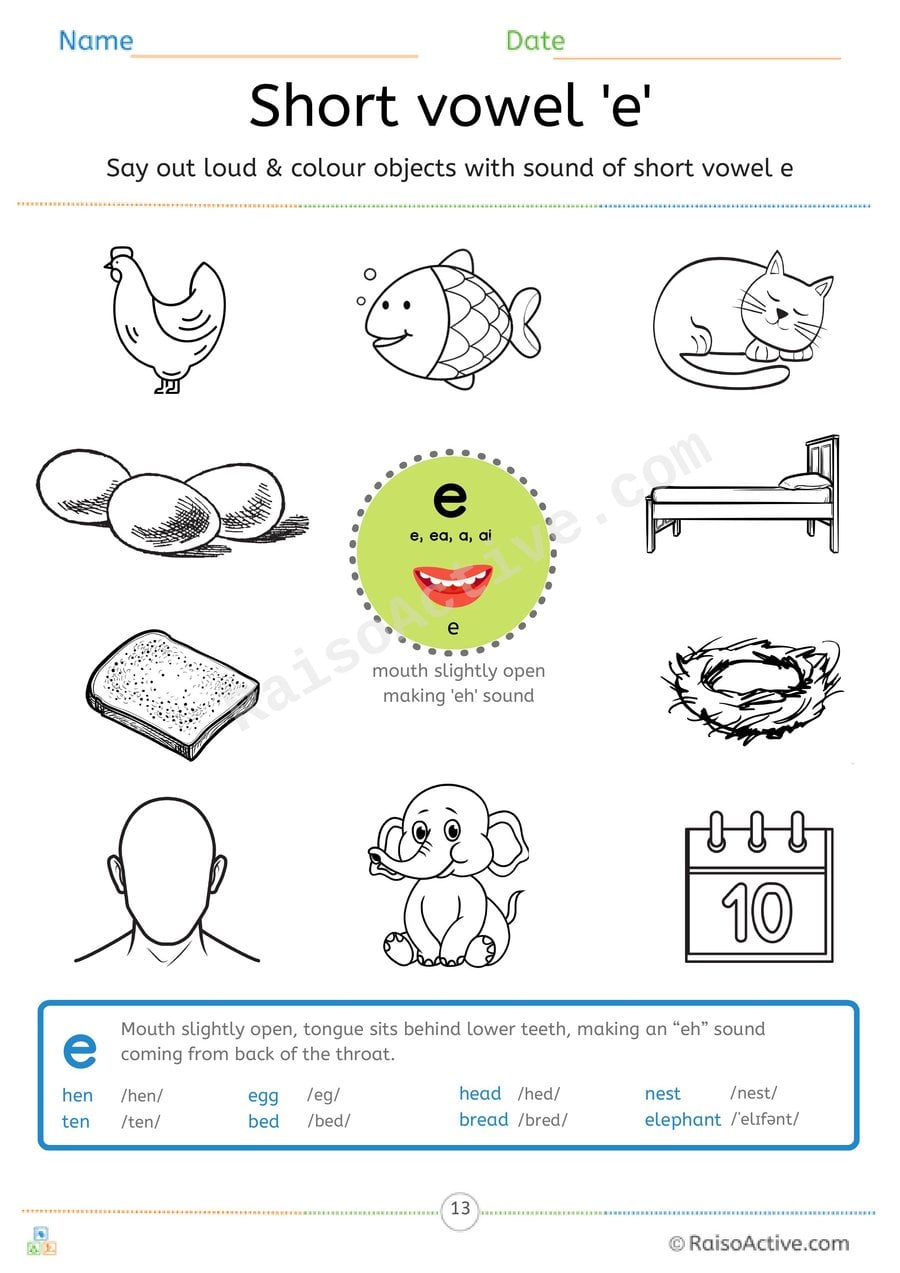
Short Vowel e Say and Colour Worksheet
Ages 3-6 · Preschool–KindergartenAges 3-6 · Nursery–Year 1Ages 3-6 · Nursery–UKGAges 3-6
Children hear the short e sound in the middle of words and pick it out: hen, eggs, bed, bread, nest, head, elephant and ten have it; fish and cat don't.

Letter Sounds Worksheet: Color the Letter That Begins the Word!
Ages 4-5 · Pre-KAges 4-5 · ReceptionAges 4-5 · LKGAges 4-5
This worksheet strengthens phonemic awareness in children ages 4-5 by asking them to isolate the very first sound of a picture's name and match it to its printed letter. Identifying beginning sounds is one of the strongest early predictors of reading success, since it teaches children that spoken words are made of individual sounds that map onto letters. The coloring component adds a motivating, low-pressure way to record each answer.

Christmas Blend Words Coloring Worksheet for Preschoolers
Ages 4-5 · Pre-KAges 4-5 · ReceptionAges 4-5 · LKGAges 4-5
Coloring words by their beginning blend sound on a Christmas tree turns phonics practice into a festive, motivating activity for children ages 4-5, reinforcing that blends like 'br,' 'cl,' or 'sn' keep their combined sound even though they're made of two consonants. Because each color represents a different blend, children must listen carefully to each word before choosing a crayon, strengthening auditory discrimination alongside seasonal fun.
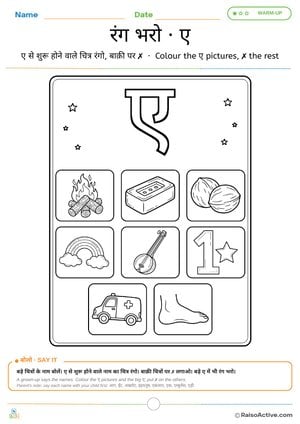
Colour the ए Words – Hindi Letter ए (e) Colouring Worksheet | ए वाली चीज़ों में रंग भरो
Ages 3-7 · Preschool–Grade 1Ages 3-7 · Nursery–Year 2Ages 3-7 · Nursery–Class 1Ages 3-7
Children say each picture name aloud, decide whether it starts with ए, colour the matching pictures (एकतारा, एक, एम्बुलेंस and एड़ी) and the big outline letter, and put a cross on the rest. Sorting by first sound trains the ear and colouring builds hand control.
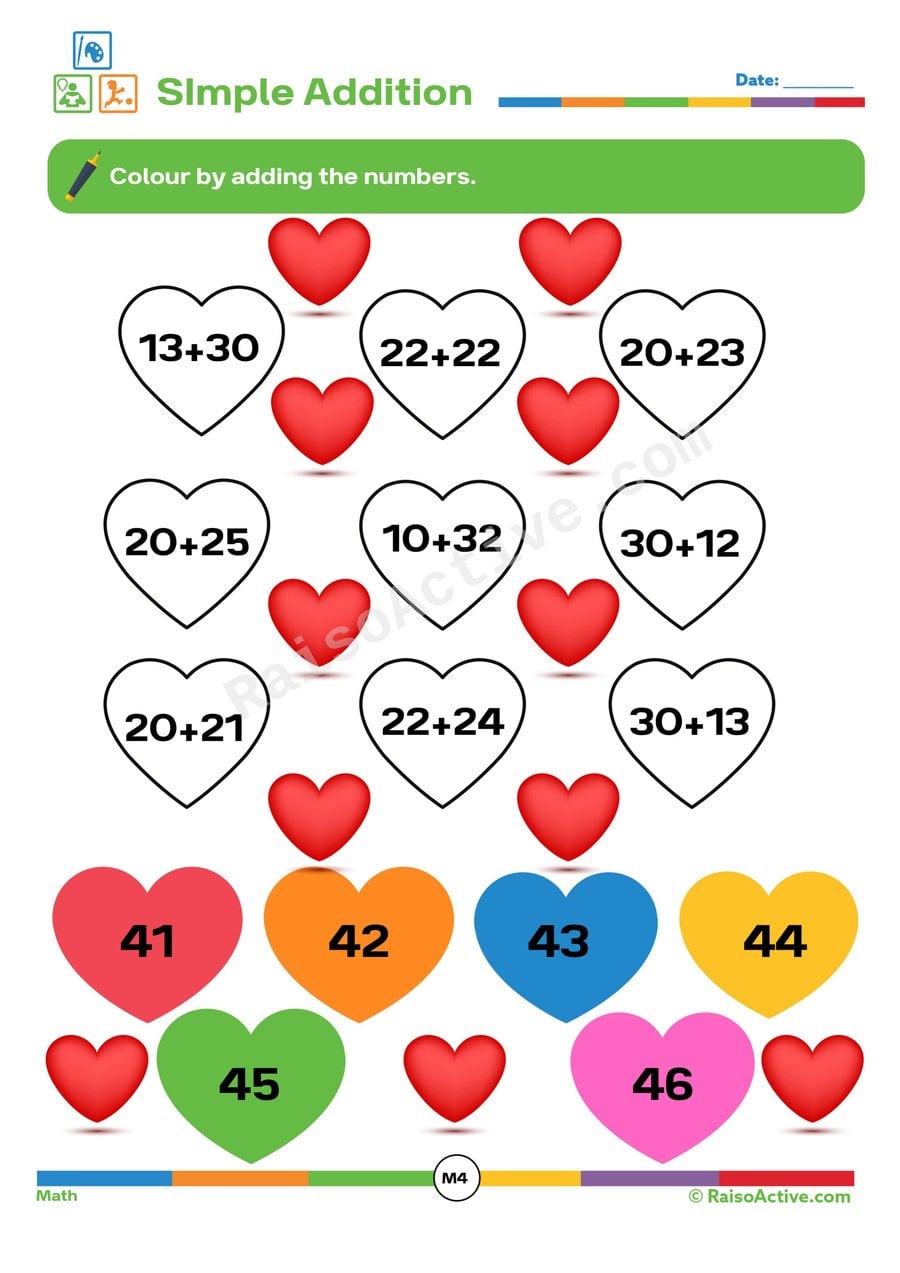
Simple Addition Worksheet: Color by Sums!
Ages 4-6 · Pre-K–KindergartenAges 4-6 · Reception–Year 1Ages 4-6 · LKG–UKGAges 4-6
Children ages 4-6 practice quick single-digit addition facts while also following a color key, combining early math fluency with visual attention to detail. Solving each problem before coloring gives an immediate, satisfying way to check their own accuracy as the picture comes together.

Many or Few Fish Bowl Worksheet for Preschoolers
Ages 3-5 · Preschool–Pre-KAges 3-5 · Nursery–ReceptionAges 3-5 · Nursery–LKGAges 3-5
This worksheet builds the comparative concepts of 'many' and 'few' — an early step toward understanding quantity that comes before formal counting comparisons like greater-than and less-than. By having your child actually draw bubbles and fish into the bowls following directions, it also reinforces following multi-step instructions and one-to-one correspondence, since each fish or bubble they add has to be drawn individually. Coloring the bowl with the most fish at the end ties the abstract idea of 'more' back to a concrete, visible outcome.
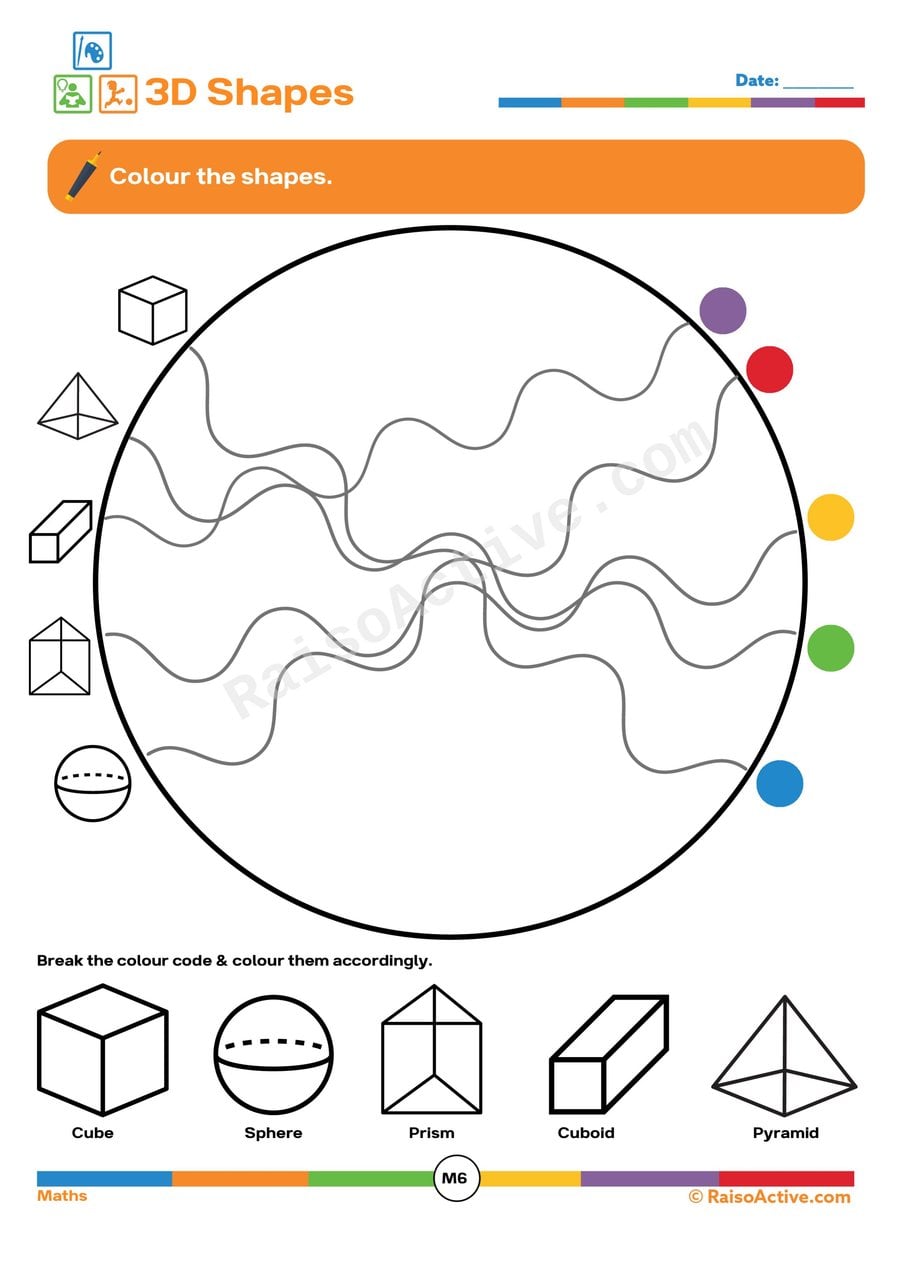
Color the 3D Shapes Worksheet for Kids
Ages 3-5 · Preschool–Pre-KAges 3-5 · Nursery–ReceptionAges 3-5 · Nursery–LKGAges 3-5
Children ages 3-5 build early geometry vocabulary by learning to name and visually recognize five 3D shapes — cube, sphere, prism, cuboid, and pyramid — a step beyond the flat 2D shapes most preschool worksheets cover. Following a color-code instruction while coloring also strengthens their ability to hold and apply a rule, and the repeated coloring motion builds hand strength and control useful for future writing.

Easter Egg Color by Hints Worksheet for Preschoolers
Ages 3-5 · Preschool–Pre-KAges 3-5 · Nursery–ReceptionAges 3-5 · Nursery–LKGAges 3-5
This worksheet has children ages 3-5 listen to or read simple written hints describing shapes and colors, then apply that information correctly while coloring each Easter egg, building early reading comprehension and the ability to follow multi-step verbal instructions. Because the hints must be followed precisely rather than colored freely, children also practice patience and careful attention to detail.

Spooky Fun Coloring Worksheet for Preschoolers
Ages 3-5 · Preschool–Pre-KAges 3-5 · Nursery–ReceptionAges 3-5 · Nursery–LKGAges 3-5
This Halloween-themed coloring page gives children ages 3-5 practice with crayon grip, color choice, and staying within outlines as they bring a collection of spooky objects to life. Naming each object as they color, like a ghost, a pumpkin, or a bat, also builds seasonal vocabulary tied directly to what they're seeing and creating.
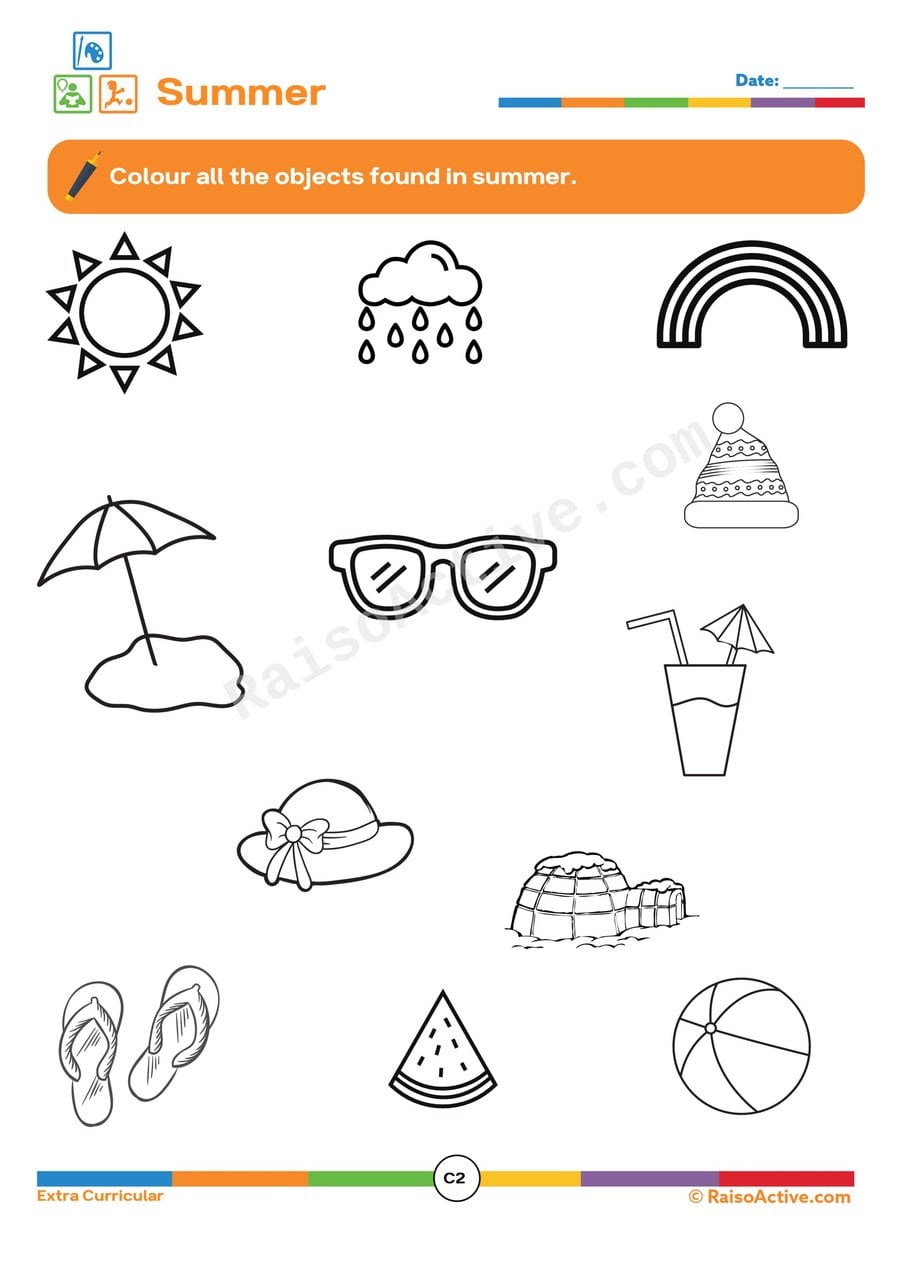
Summer Fun Coloring Worksheet for Preschoolers
Ages 3-5 · Preschool–Pre-KAges 3-5 · Nursery–ReceptionAges 3-5 · Nursery–LKGAges 3-5
Children ages 3-5 practice associating specific objects, like sunglasses, ice cream, or a swimsuit, with the summer season, building early seasonal awareness alongside fine motor coloring practice. Recognizing which objects belong to which season is a foundational step toward understanding weather, time, and the changing year.
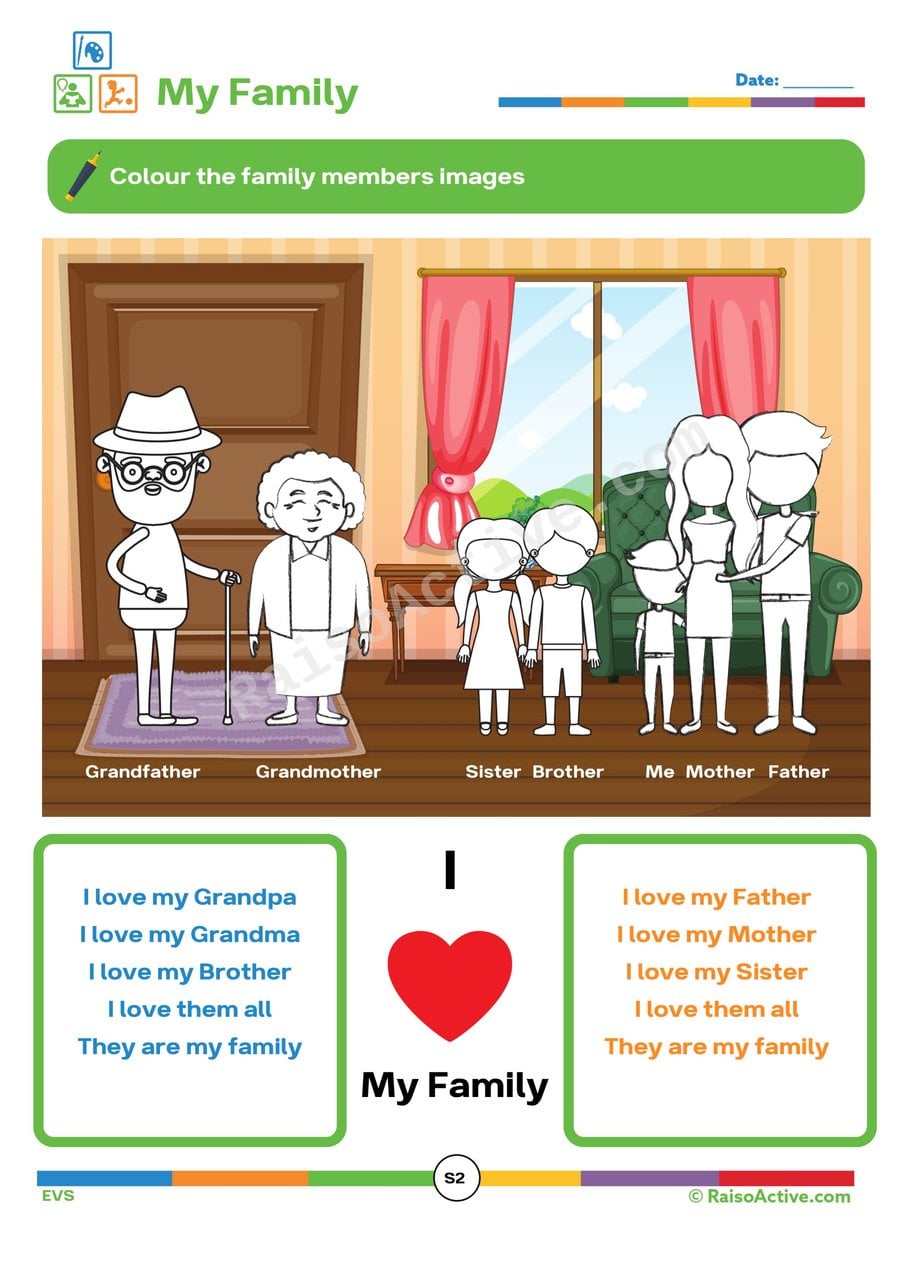
My Family Coloring Worksheet for Preschoolers
Ages 3-5 · Preschool–Pre-KAges 3-5 · Nursery–ReceptionAges 3-5 · Nursery–LKGAges 3-5
This worksheet helps children ages 3-5 practice fine motor control and color-staying-in-the-lines skills while coloring pictures of family members, giving them a personal, meaningful subject that keeps engagement high. Reading and coloring a heart after the family sentences also introduces the idea that words can express feelings, linking literacy with emotional expression.
Colour the ऋ Words – Hindi Letter ऋ (ri) Colouring Worksheet | ऋ वाली चीज़ों में रंग भरो
Ages 3-7 · Preschool–Grade 1Ages 3-7 · Nursery–Year 2Ages 3-7 · Nursery–Class 1Ages 3-7
Children say each picture name aloud, decide whether it starts with ऋ, colour the matching pictures (ऋषि, ऋतु, ऋचा and ऋतिक) and the big outline letter, and put a cross on the rest. Sorting by first sound trains the ear and colouring builds hand control.

Coloring Fun: Animals and Nature Worksheet for Preschoolers
Ages 3-5 · Preschool–Pre-KAges 3-5 · Nursery–ReceptionAges 3-5 · Nursery–LKGAges 3-5
Coloring within defined lines strengthens fine motor control and hand strength for children ages 3-5, building the pencil grip and precision they'll eventually need for handwriting. This nature-themed page also gives children a chance to practice sustained focus on a single task, since completing a full scene with multiple elements requires more attention than a single small image. Naming and talking about the animals and natural elements as they color adds a light vocabulary and observation component on top of the fine motor practice.

Summer Coloring Fun: Color the Summer-Related Objects!
Ages 3-5 · Preschool–Pre-KAges 3-5 · Nursery–ReceptionAges 3-5 · Nursery–LKGAges 3-5
This worksheet builds vocabulary and category recognition for children ages 3-5 as they color a collection of objects associated with summer, like sunglasses, ice cream, or a beach ball, reinforcing that certain items belong together under a seasonal theme. Coloring within outlined shapes also continues to build the fine motor control and hand strength children need for future writing.

Father's Day Coloring Card: A Fun Coloring Worksheet for Kids!
Ages 3-5 · Preschool–Pre-KAges 3-5 · Nursery–ReceptionAges 3-5 · Nursery–LKGAges 3-5
Coloring Father's Day themed images and folding the page into a card gives children ages 3-5 practice with crayon control and color choice, while the act of creating a gift adds a meaningful, purposeful goal to the fine motor task. Because the final product becomes something to give to a special person, this worksheet also introduces early ideas about celebration and appreciation. Folding the paper into a card shape adds a simple spatial task on top of the coloring itself.
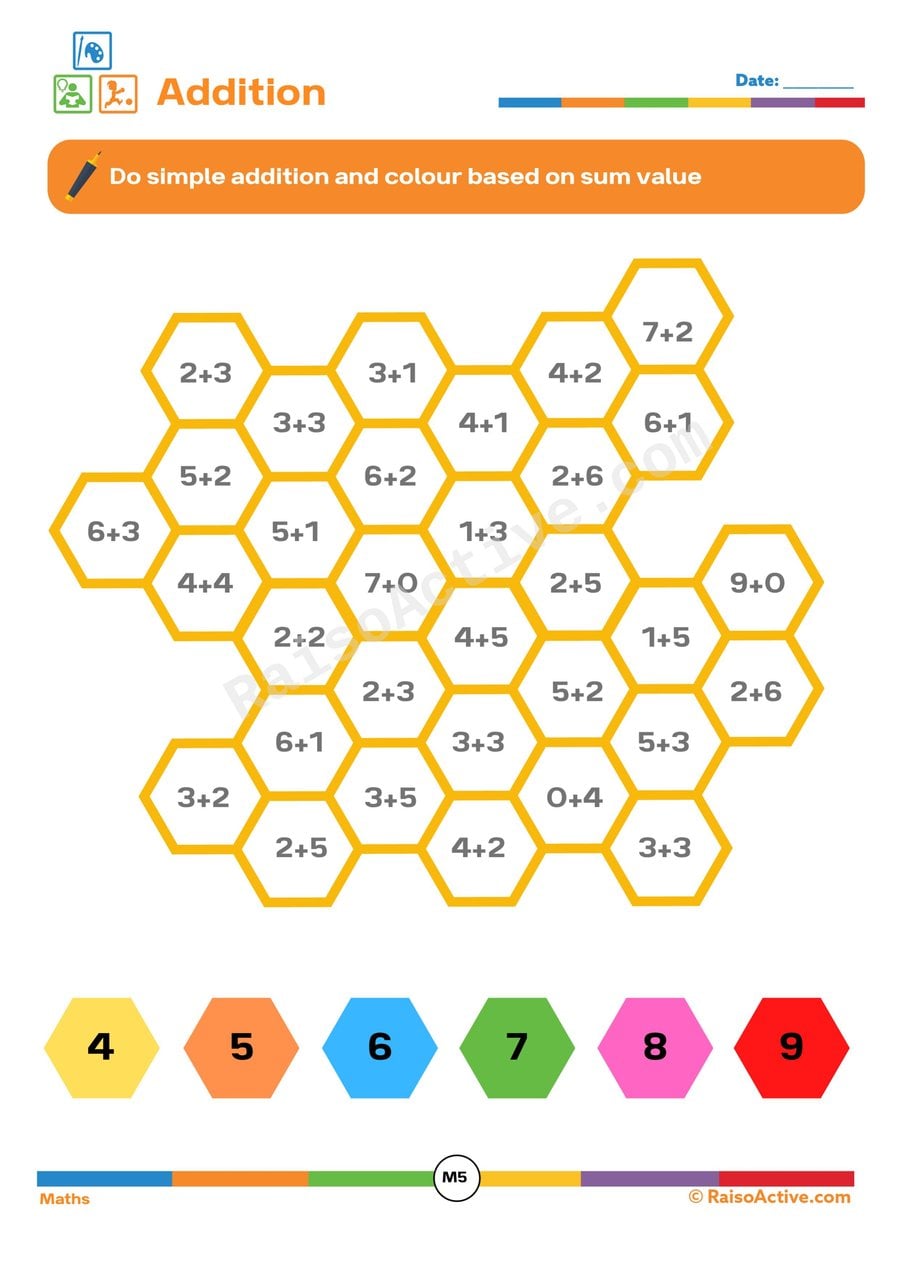
Addition Coloring Worksheet: Color by Sum!
Ages 4-6 · Pre-K–KindergartenAges 4-6 · Reception–Year 1Ages 4-6 · LKG–UKGAges 4-6
This worksheet combines addition practice with a color-by-number format, giving children ages 4-6 motivation to solve simple addition problems in each hexagon since the correct sum determines which color to use. Repeated, low-pressure practice adding small numbers builds fluency and speed, while the reveal of a colorful picture at the end rewards accurate calculation.

Shape Song Fun: Color & Learn Shapes Worksheet for Preschoolers
Ages 3-5 · Preschool–Pre-KAges 3-5 · Nursery–ReceptionAges 3-5 · Nursery–LKGAges 3-5
Coloring each shape according to its outline helps children ages 3-5 practice recognizing 2D shapes while staying within lines, and singing the accompanying shape song adds a rhythmic memory aid that makes shape names easier to recall. Combining a physical coloring task with an auditory song appeals to multiple ways young children learn best.
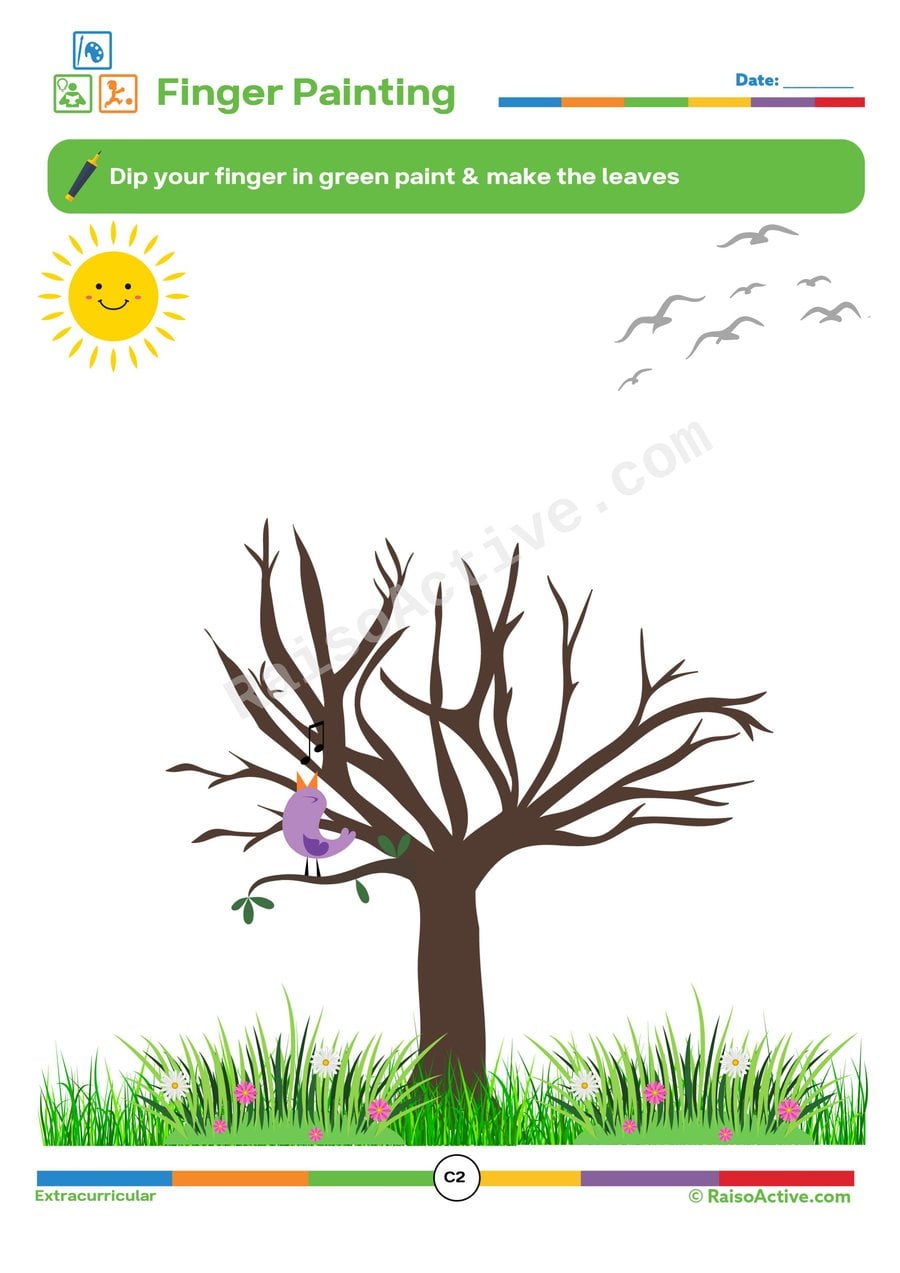
Finger Painting Fun: Make Leaves on the Tree!
Ages 3-5 · Preschool–Pre-KAges 3-5 · Nursery–ReceptionAges 3-5 · Nursery–LKGAges 3-5
This worksheet develops fine motor control and sensory creativity by having children use their fingertip, rather than a brush, to dab green paint onto tree branches to create leaves. For three- to five-year-olds, finger painting builds precise fingertip control in a low-pressure, playful way, and repeating the same dabbing motion across the page also reinforces the concept of filling a space with a repeated mark.

Summer Symmetry Worksheet for Preschoolers: Complete and Color!
Ages 3-5 · Preschool–Pre-KAges 3-5 · Nursery–ReceptionAges 3-5 · Nursery–LKGAges 3-5
This worksheet introduces children ages 3-5 to the concept of symmetry by having them draw the missing half of a summer object, such as completing one side of a picture to mirror the other. This exercise builds an early sense of balance and proportion, an important visual-spatial skill that supports later geometry and art. Coloring the completed picture afterward adds fine motor practice while reinforcing the finished, whole shape they just created.
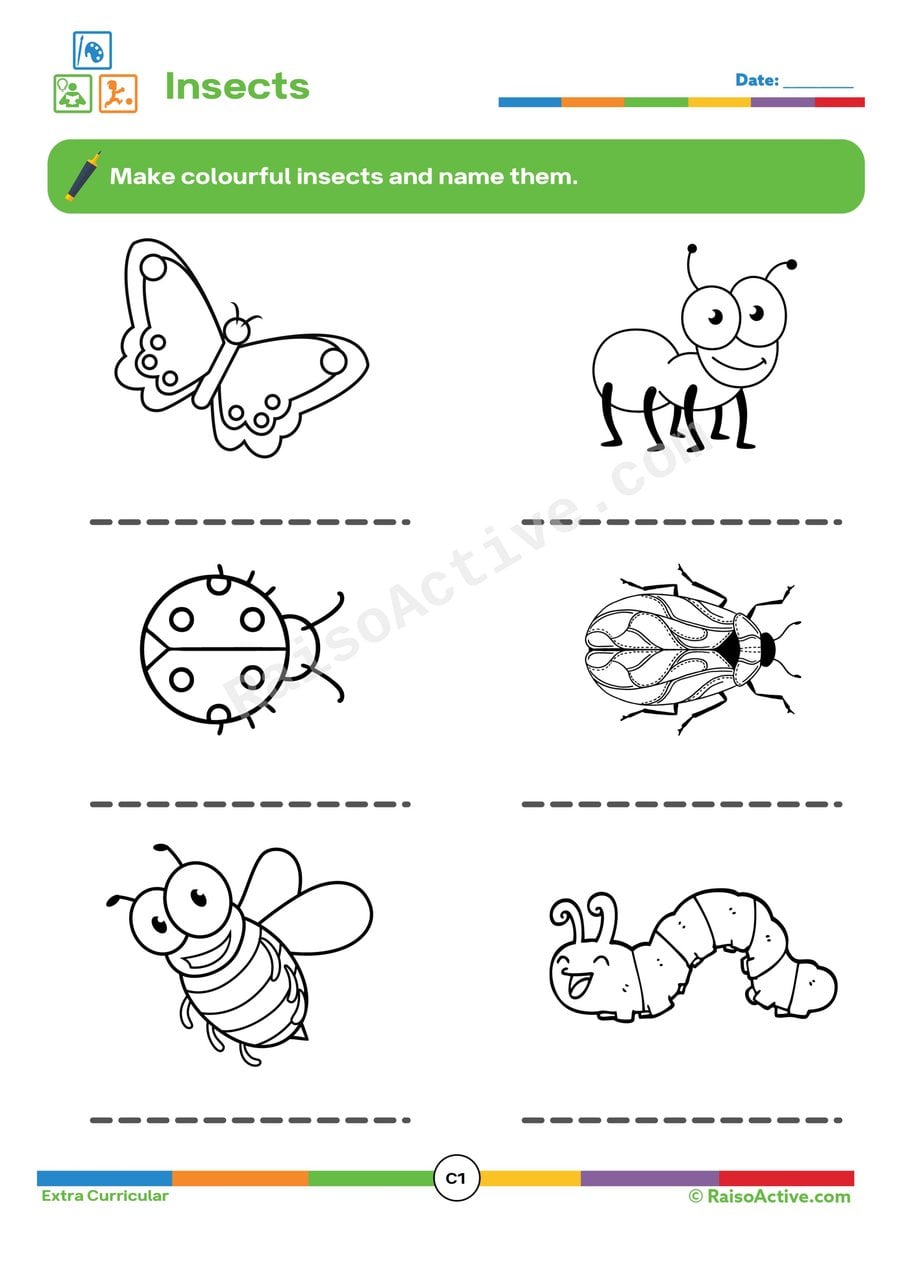
Color the Insects Worksheet for Preschoolers
Ages 3-5 · Preschool–Pre-KAges 3-5 · Nursery–ReceptionAges 3-5 · Nursery–LKGAges 3-5
Coloring a set of insects and writing their names afterward helps children ages 3-5 build insect vocabulary while practicing fine motor coloring control and connecting a picture to its written word. This combination of art and labeling reinforces new vocabulary more effectively than looking at pictures alone.

Seasons Worksheet: Identify and Color the Correct Season!
Ages 3-5 · Preschool–Pre-KAges 3-5 · Nursery–ReceptionAges 3-5 · Nursery–LKGAges 3-5
Identifying which season a picture represents and coloring the matching letter code builds children's ages 3-5 awareness of how weather, clothing, and activities change throughout the year, an early and very relatable science concept. This worksheet asks children to actively classify each picture rather than passively look at seasonal images, sharpening their observational and reasoning skills. Understanding seasons also gives children a framework for talking about holidays, weather, and the passage of time in daily conversation.
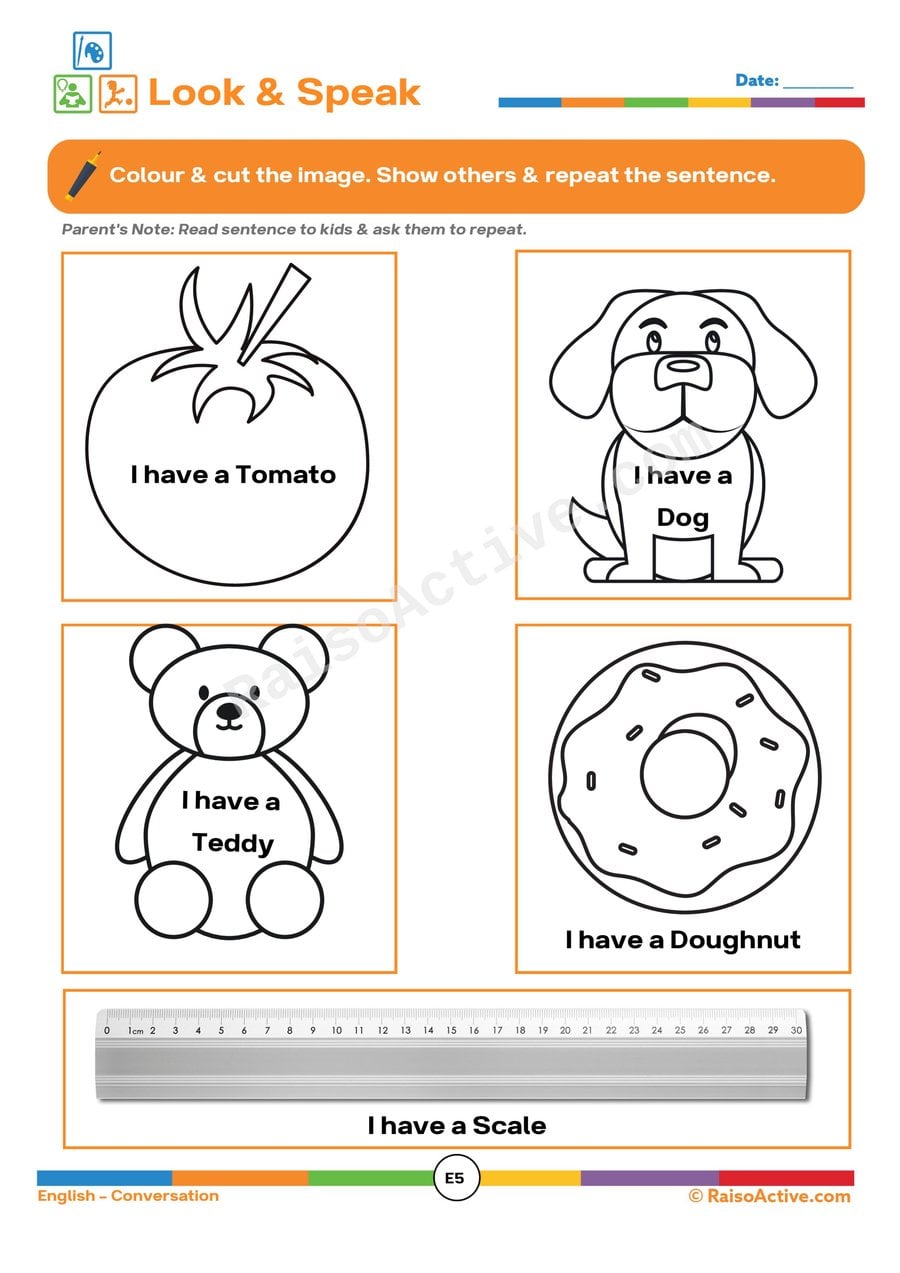
Look & Speak: Color and Repeat the Words Worksheet
Ages 3-5 · Preschool–Pre-KAges 3-5 · Nursery–ReceptionAges 3-5 · Nursery–LKGAges 3-5
This worksheet builds early vocabulary and oral language skills by having children color familiar images and then read and repeat a simple sentence describing each one aloud. For ages 3-5, the combination of coloring, reading, and speaking reinforces new words through multiple senses, helping vocabulary stick more effectively than reading alone.
Types of educational coloring pages
Plain coloring pages are useful, but pages with a code do more. Color by number rehearses numeral recognition and one-to-one matching. Color by letter rehearses capital and lowercase recognition, and color by sound links a picture to its beginning letter. Color by sight word makes children read a word before every stroke. Mystery pictures hide an image in a grid until the right squares are filled, which rewards accuracy and persistence.
- Color by number: numerals 1–5 for ages 3–4, 1–10 and simple sums for 5–6
- Color by letter or sound: capital letters first, then lowercase, then beginning sounds
- Color by sight word: 5–10 high-frequency words per page
- Mystery picture grids: 10×10 squares from age 5, with sums for 6–7
- Color by shape: circle, square, triangle and rectangle for ages 3–4
Crayons, pencils and markers by age
Two- and three-year-olds do best with chunky or egg-shaped crayons that fit a whole-hand grasp and reward pressure with strong color. Around four, triangular or short crayons and thick colored pencils encourage a finger grip. By five and six, standard colored pencils and fine markers let the child stay inside small regions. Watch the grip during coloring, because it is the same grip the child will use for handwriting.
How to use coloring worksheets for learning
Read the key aloud together the first time, then let the child work alone. For color-by-code pages, ask the child to name the number, letter or word before filling each region, and to say which color it maps to. Keep sessions short at two and three (five minutes), and allow ten to fifteen minutes for a mystery picture at six. Finished pages make a visible record of improving control when kept in a folder.
Frequently asked questions
What are the benefits of coloring for a child's development?
Coloring strengthens the small muscles of the hand and fingers, trains the wrist and finger movements later needed for writing, and builds hand-eye coordination as the child aims for boundaries. It also develops sustained attention, color vocabulary and, when a key is used, number, letter and word recognition. Occupational therapists commonly use coloring as a fine motor activity for children who find handwriting tiring.
At what age should a child color inside the lines?
Most children begin to keep roughly within a large outline around age 3 to 4, and color neatly within smaller regions by 5 to 6. Before three, scribbling across the page is typical and appropriate. Staying inside the lines depends on grip, wrist control and the ability to slow down, so it improves with practice rather than instruction. Large simple pictures with thick outlines help younger children succeed.
What should a 4 year old be able to do on a coloring page?
By age 4, in Preschool, Nursery or LKG, a child is usually expected to hold a crayon with fingers rather than a fist, choose colors deliberately, fill a large shape with strokes that mostly stay inside the outline, and follow a simple color-by-number key with numerals 1 to 5. Naming at least eight colors and matching a color word to the crayon are also common expectations at this age.
What is a color by number worksheet?
A color by number worksheet divides a picture into regions, each marked with a numeral, and provides a key that assigns a color to each numeral. The child reads the number, finds its color in the key and fills that region. Simple versions use numerals 1 to 5 and large regions; harder versions use numbers to 20, addition or subtraction sums, or small grid squares that reveal a mystery picture.
Is it "coloring" or "colouring"?
Both are correct. "Coloring" is the American spelling used in US Preschool and Kindergarten materials; "colouring" is the British spelling used in the UK and India. The worksheets themselves are identical, and the site's search finds either spelling. The same difference applies to "color" and "colour" on the color recognition pages, and to "gray" and "grey" in the color names.
Can I download coloring pages free?
Yes. Each coloring worksheet is available as a free watermarked PDF after signing up, with a limit of five downloads per day. A yearly subscription of ₹1000 or $20 removes the watermark and lifts the limit for all 1,000-plus worksheets and every printable pack. Pages print on A4 or US Letter paper.

Written by
Hemsweta Jain · Teacher Cheena
MBA and Early Childhood Educator, teaching since 2014 · Founder of RaisoActive, Mumbai
Written and reviewed by Hemsweta Jain (Teacher Cheena), who designs every RaisoActive worksheet.
Last reviewed
Printable packs for ages 2–6

Pattern Writing Pre-writing Skills Activity Book for 3-4 Year Olds
Ages 3-4 · PreschoolAges 3-4 · NurseryAges 3-4 · 44 pages
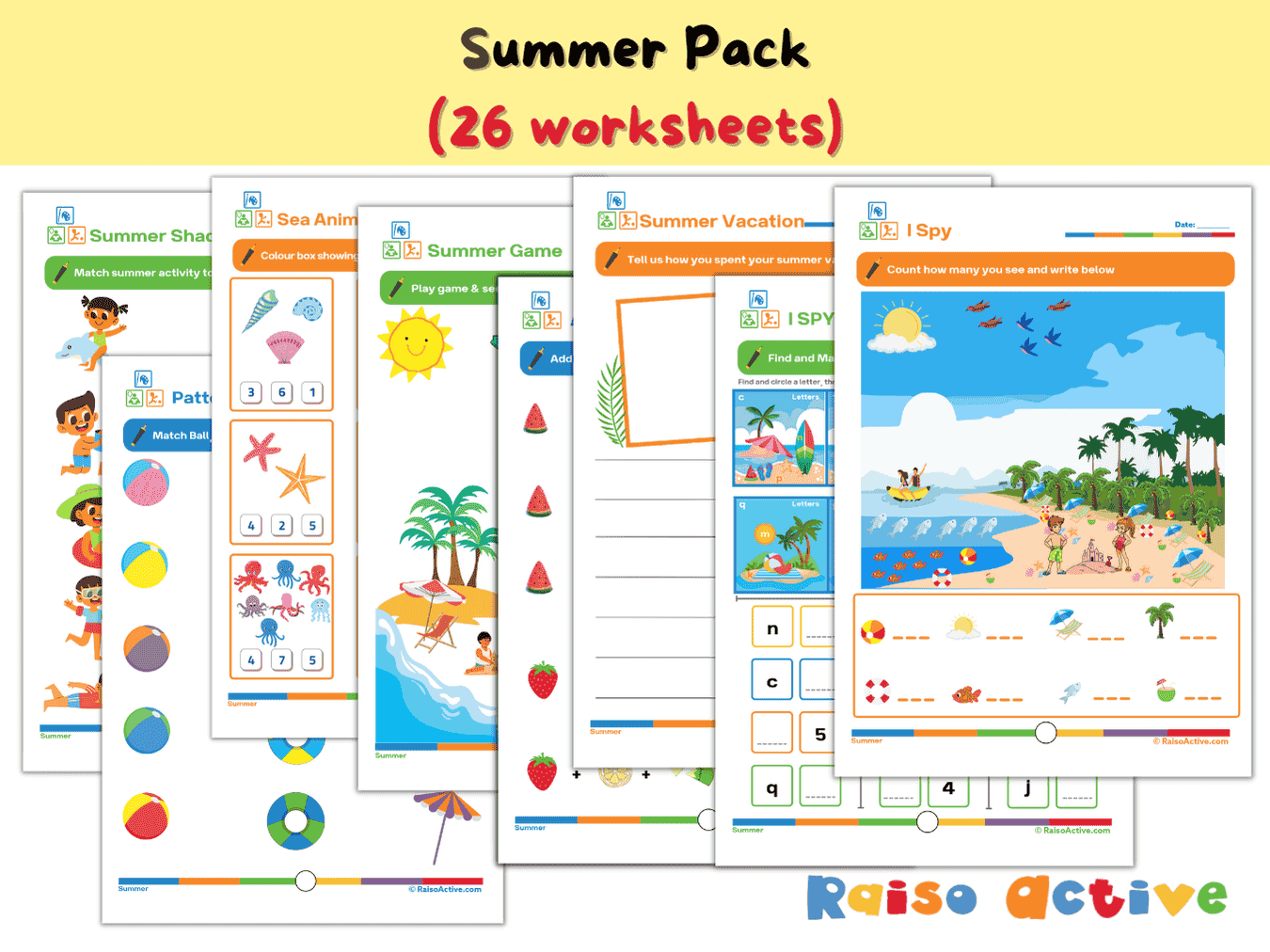

Summer Activity Pack: Math, Literacy, Puzzles & More for Preschool & Kindergarten
Ages 3-7 · Preschool–Grade 1Ages 3-7 · Nursery–Year 2Ages 3-7 · Nursery–Class 1Ages 3-7 · 26 pages
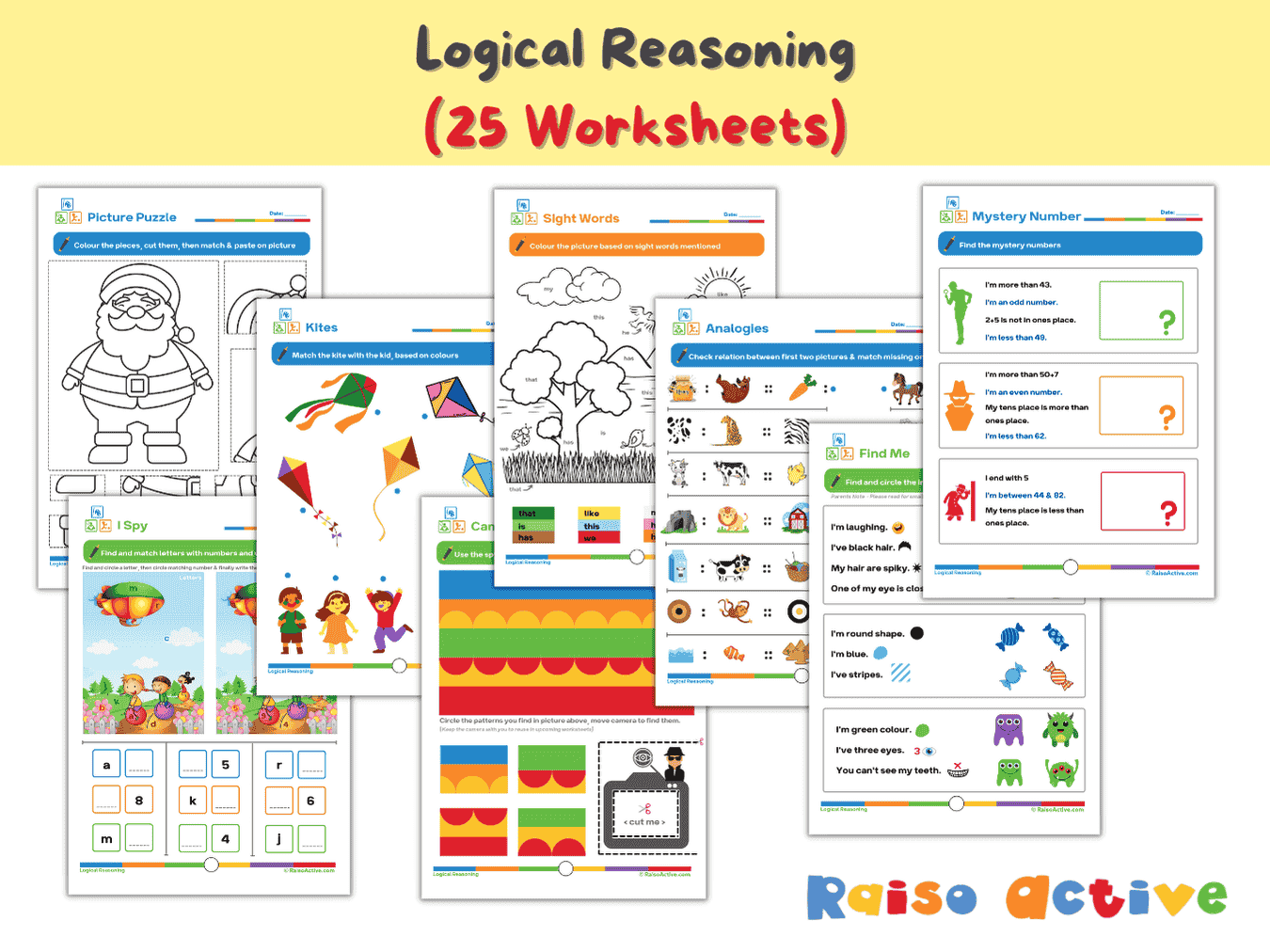

Logical Reasoning Activity Book for Preschool & Kindergarten | Patterns, Sudoku, Mazes & Coding
Ages 4-7 · Pre-K–Grade 1Ages 4-7 · Reception–Year 2Ages 4-7 · LKG–Class 1Ages 4-7 · 34 pages
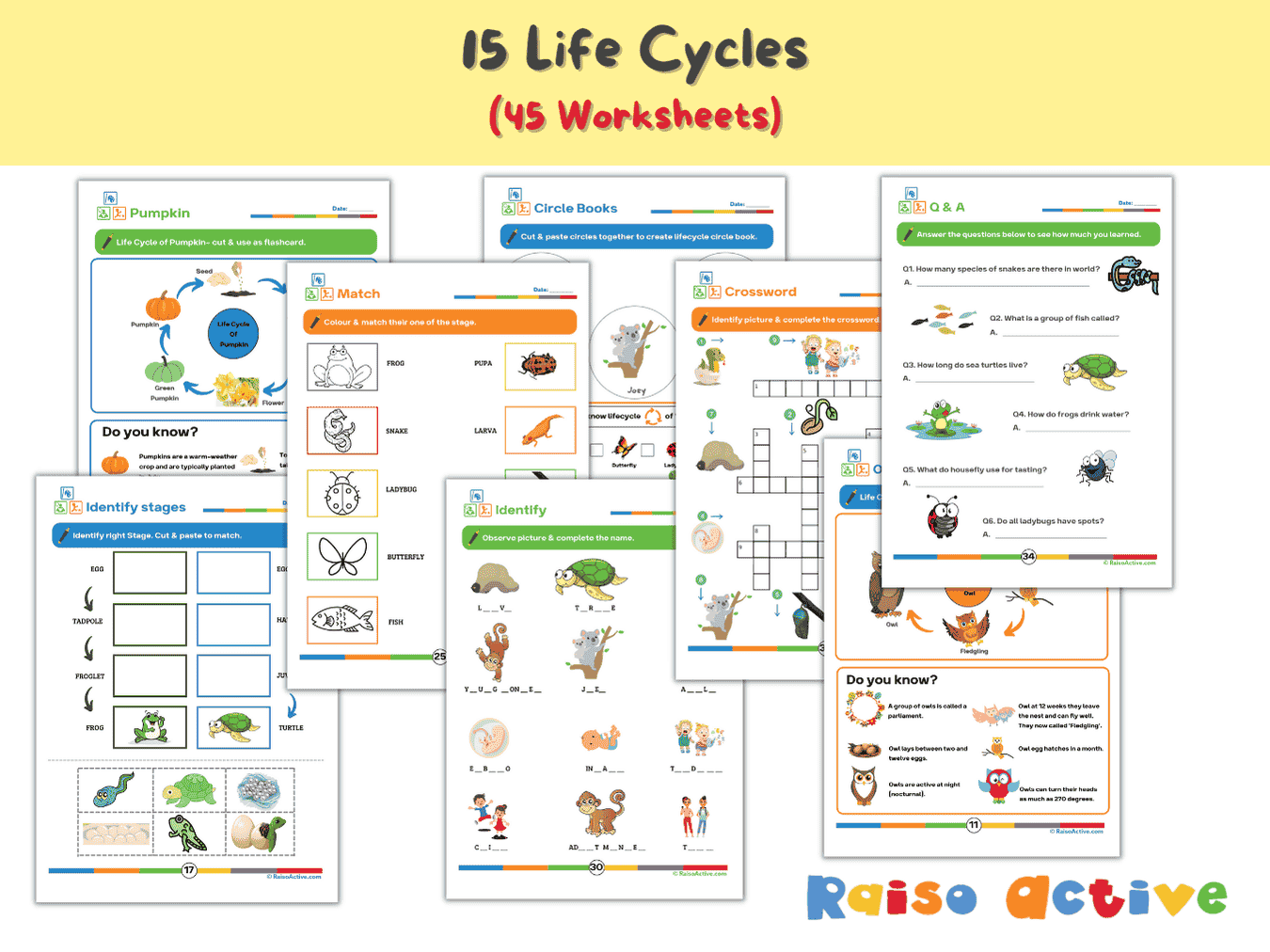

Lifecycles Activity Book & Flashcards for Preschool & Early Elementary
Ages 3-8 · Preschool–Grade 2Ages 3-8 · Nursery–Year 3Ages 3-8 · Nursery–Class 2Ages 3-8 · 46 pages
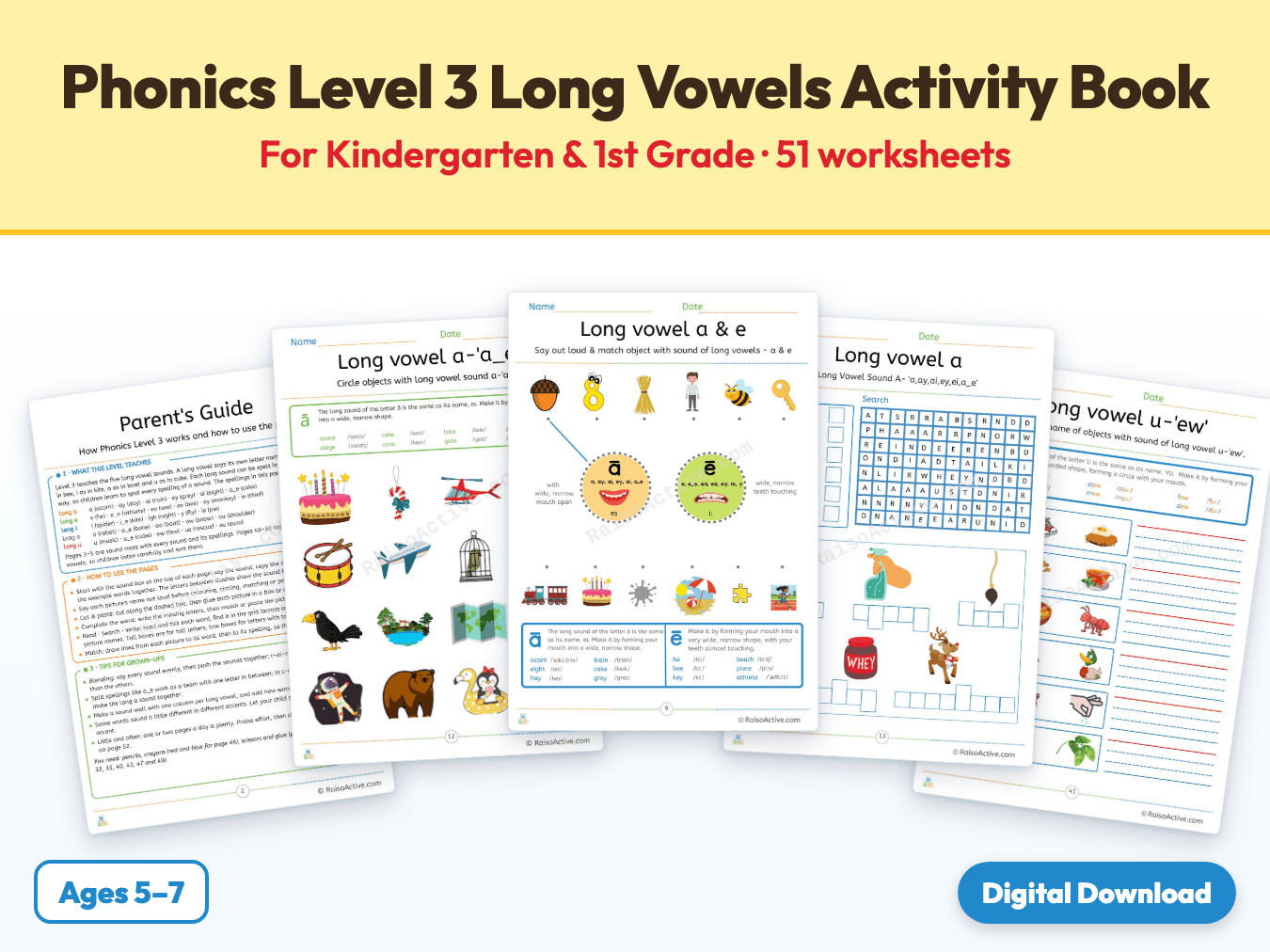

Phonics Level 3 Long Vowels Activity Book for Kindergarten & 1st Grade
Ages 5-7 · Kindergarten–Grade 1Ages 5-7 · Year 1–Year 2Ages 5-7 · UKG–Class 1Ages 5-7 · 52 pages
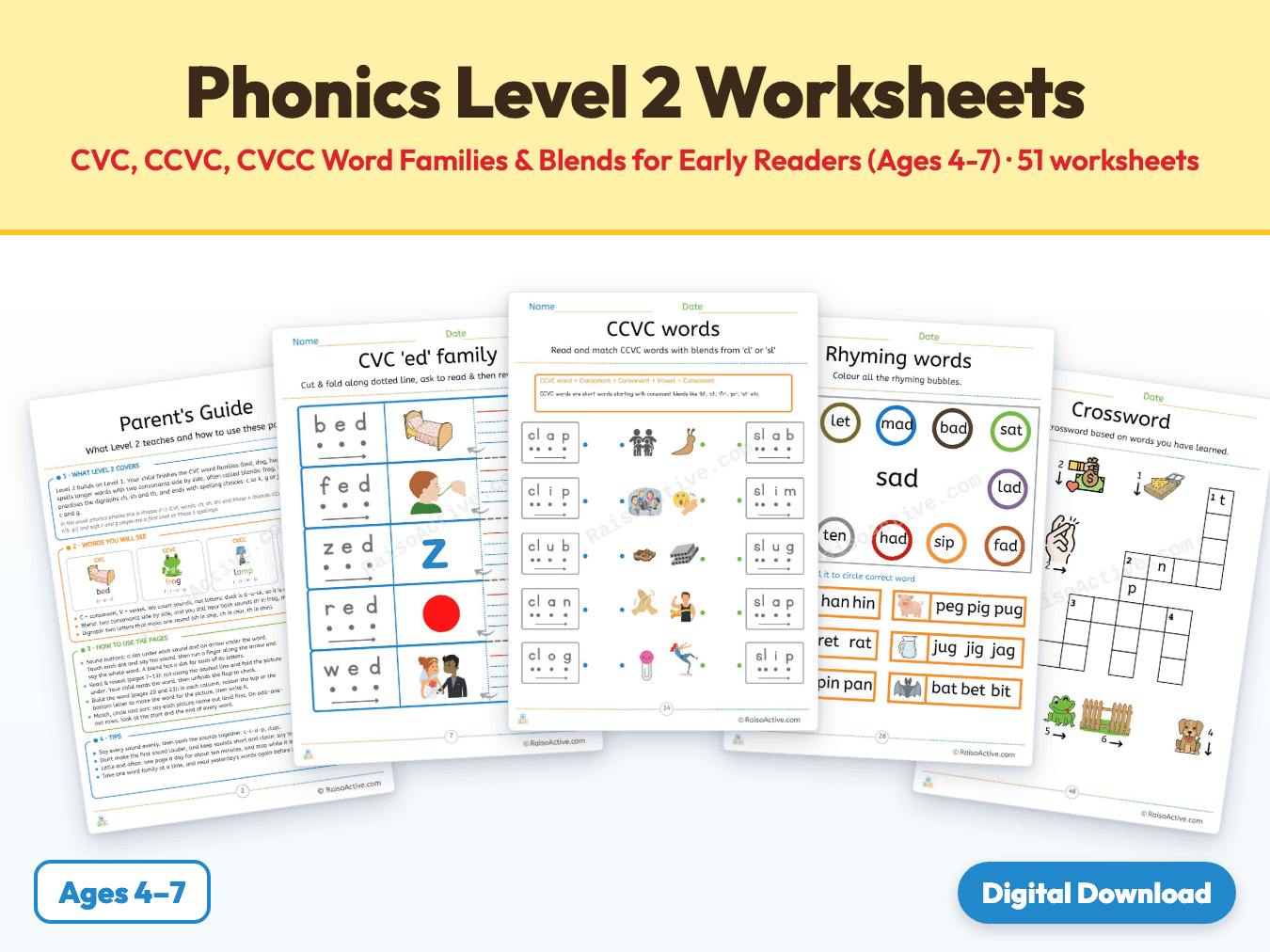
Phonics Level 2 Worksheets: CVC, CCVC, CVCC Word Families & Blends for Early Readers (Ages 4-7)
Ages 4-7 · Pre-K–Grade 1Ages 4-7 · Reception–Year 2Ages 4-7 · LKG–Class 1Ages 4-7 · 52 pages
Guides for parents and teachers
See all guides
Number Formation Rhymes 0–9 and How to Fix Reversals
Original number formation rhymes for 0–9, the correct stroke order for each digit, why 3, 5 and 7 get reversed most often, and multisensory fixes that work.

Pre-Writing Strokes in Order: From Standing Lines to Loops (With Printable Patterns)
The developmental order of pre-writing strokes, from vertical lines to loops, and why practicing them in sequence makes letter formation much easier to learn.

Kindergarten Readiness Checklist: 25 Skills to Practice Before the First Day
A kindergarten readiness checklist of 25 literacy, math, motor, self-regulation and self-help skills, with an 8-week summer plan and notes on when not to worry.
Best Worksheets for 3-Year-Olds: What Works and What to Avoid
What works on worksheets for 3-year-olds: short sessions, crayons, tracing lines, matching, cutting, a free weekly plan, and signs one is too advanced.
What Should a 4-Year-Old Know Before LKG? A Readiness Checklist
A calm, teacher-written LKG readiness checklist for 4-year-olds: language, pattern writing, numbers to 10, self-help and social skills, plus a 6-week plan.
Resources for Children with Multiple Disabilities: A Comprehensive Guide for Families
Discover essential resources for children with multiple disabilities. Therapies, inclusive learning, assistive technology, and printable activities for ages 1-8.