Coloring Fun: Animals and Nature Worksheet for Preschoolers
Coloring within defined lines strengthens fine motor control and hand strength for children ages 3-5, building the pencil grip and precision they'll eventually need for handwriting. This nature-themed page also gives children a chance to practice sustained focus on a single task, since completing a full scene with multiple elements requires more attention than a single small image. Naming and talking about the animals and natural elements as they color adds a light vocabulary and observation component on top of the fine motor practice.
Part of the pack
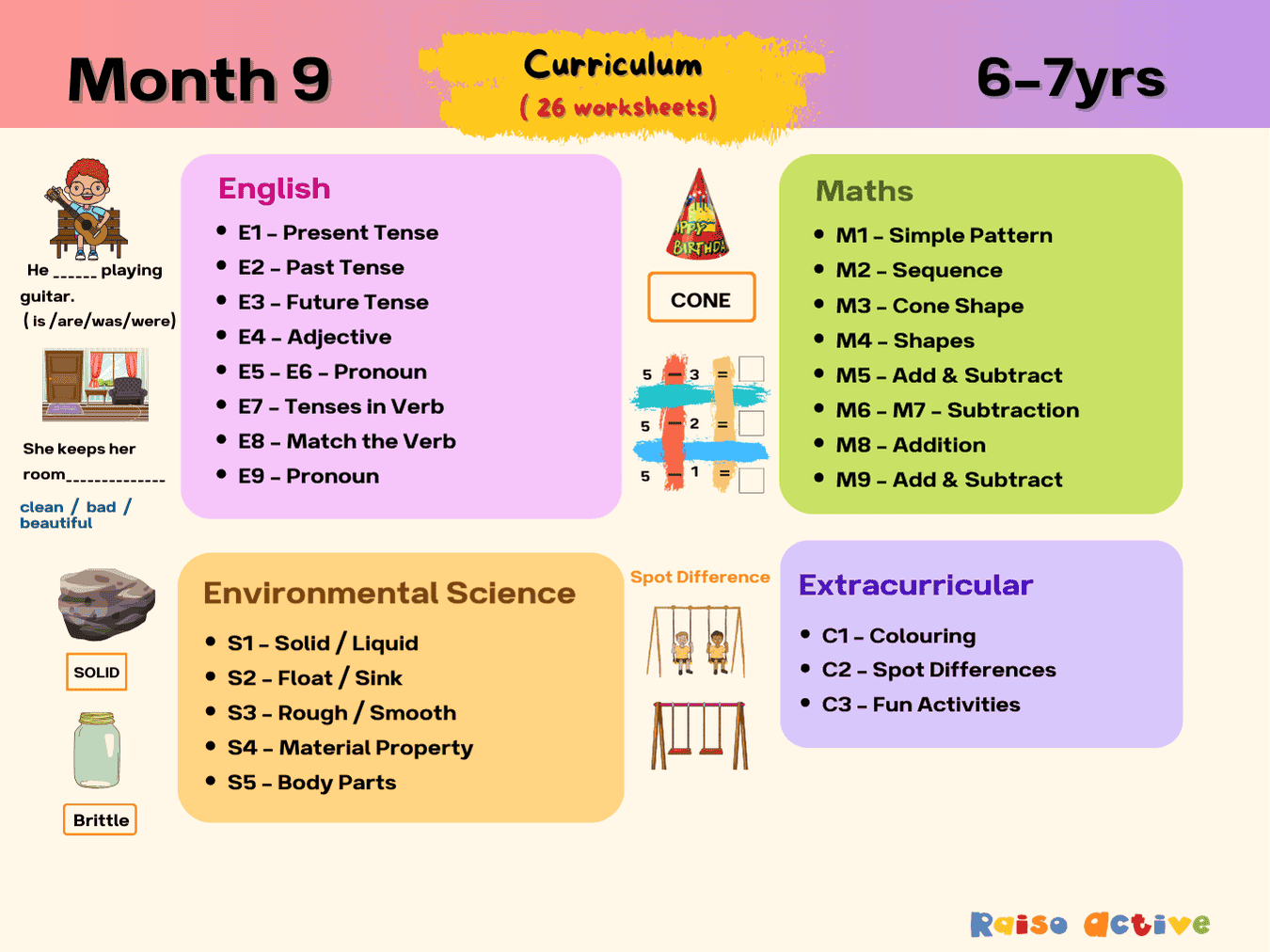
Month 9: Multi-Subject Early Learning | Ages 6-7
This is page 27 of the pack. Ages 6-7 · Grade 1Ages 6-7 · Year 2Ages 6-7 · Class 1Ages 6-7
Made for your child
A whole activity pack made with their name
60 pages to spot, build, trace and write their own name, plus pages about their favourites, feelings and family. See a free preview with their name.
Make an All About Me packFree preview · free for members
Or start free: a name tracing sheet with their nameCurriculum
- Living Things - Animals > Animals & Habitats
How to use this worksheet
Look at the picture together first and talk about what's in the scene — animals, houses, the sun, clouds. Let your child choose their own colors for each element rather than directing their choices. Encourage them to try to stay within the lines as they color, without insisting on perfection. Once finished, look at the completed picture together and ask your child to describe what they colored and why they chose those colors.
Materials needed
- Crayons
- Pencils
Extension activities
- 1Ask the child to describe the animals and objects they colored and what those animals might be doing.
- 2Encourage the child to create their own scene on a separate piece of paper, drawing their own animals and nature elements.
- 3Use the colored pictures to tell a story, making up what happens to the animals in the scene.
- 4Take a short nature walk afterward and try to spot real versions of anything from the coloring page.

Written by
Hemsweta Jain · Teacher Cheena
MBA and Early Childhood Educator, teaching since 2014 · Founder of RaisoActive, Mumbai
Every RaisoActive worksheet is designed and checked by the founder before publishing.
Published · Last reviewed
More from Month 9: Multi-Subject Early Learning | Ages 6-7

Rough vs. Smooth Worksheet: Sorting and Counting Objects
Ages 3-5 · Preschool–Pre-KAges 3-5 · Nursery–ReceptionAges 3-5 · Nursery–LKGAges 3-5
Rough and smooth are texture words a 3-5 year old usually understands through touch long before they can reliably identify them just by looking at a picture, so this worksheet bridges that gap by pairing the visual sorting task with counting practice. Counting how many rough versus smooth objects appear afterward layers basic data skills — 'which group has more?' — on top of the classification.

Adjective Worksheet: Circle and Fill in the Blanks!
Ages 4-6 · Pre-K–KindergartenAges 4-6 · Reception–Year 1Ages 4-6 · LKG–UKGAges 4-6
Working from a picture and a sentence together, children ages 4-6 practice choosing an adjective that accurately describes what they see and then writing it into the sentence - a skill that strengthens both vocabulary and the understanding that descriptive words add detail and meaning to a sentence. This bridges picture comprehension with written language, an important step as children move from purely oral vocabulary to using descriptive words in their own writing.

Cone Shape Worksheet for Preschoolers: Circle & Match!
Ages 3-5 · Preschool–Pre-KAges 3-5 · Nursery–ReceptionAges 3-5 · Nursery–LKGAges 3-5
This worksheet gives children ages 3-5 focused practice identifying the cone as a distinct 3D shape among a set of pictured objects, building the visual discrimination skills needed to tell shapes apart by their form rather than by color or size. Matching the shape to its printed word 'CONE' also introduces early print awareness, connecting a familiar geometric form to its written name.

Match the Verb: Action Verbs Worksheet for Preschoolers
Ages 3-5 · Preschool–Pre-KAges 3-5 · Nursery–ReceptionAges 3-5 · Nursery–LKGAges 3-5
Action verbs are some of the first 'doing words' children learn to recognize in print, and this worksheet asks children ages 3-5 to spot the verb within a simple sentence and connect it to a picture showing that action. Circling the verb first trains children to identify the part of a sentence that describes an action, an early grammar skill, while matching it to a picture reinforces comprehension of the word's meaning. This combination builds both reading and vocabulary skills using content — running, jumping, eating — that's naturally engaging to young children.

Float or Sink: Cut and Paste Worksheet for Preschoolers
Ages 3-5 · Preschool–Pre-KAges 3-5 · Nursery–ReceptionAges 3-5 · Nursery–LKGAges 3-5
This worksheet introduces children ages 3-5 to a basic science concept — that different materials and objects behave differently in water — by having them sort pictures into 'float' and 'sink' categories. Making a prediction and then physically sorting an object reinforces early scientific reasoning, since children must think about an object's properties, like weight or material, before deciding where it belongs. This kind of hands-on categorizing builds observation and classification skills that are foundational to all later science learning.

Spot the Differences! Fun Picture Puzzle Worksheet for Kids
Ages 3-5 · Preschool–Pre-KAges 3-5 · Nursery–ReceptionAges 3-5 · Nursery–LKGAges 3-5
This spot-the-differences puzzle sharpens visual discrimination in children ages 3-5 by requiring them to compare two nearly identical pictures and notice small changes in detail, color, or position. Scanning systematically for differences also builds sustained visual attention and patience, both important pre-academic skills that support later tasks like proofreading and careful reading.

Simple Pattern Worksheet for Preschoolers: Fill in the Sequence!
Ages 3-5 · Preschool–Pre-KAges 3-5 · Nursery–ReceptionAges 3-5 · Nursery–LKGAges 3-5
Recognizing and continuing a pattern is one of the earliest building blocks of mathematical and logical thinking for children ages 3-5, since it requires noticing a repeating rule and predicting what comes next based on that rule. This worksheet uses both shapes and numbers to build pattern awareness, asking children to fill in missing elements in a sequence and then match related number sequences together. Pattern recognition like this underpins later skills in math, reading, and even everyday problem-solving, since spotting repeating structures is a skill that transfers well beyond this one worksheet.

Future Tense Fun: Fill-in-the-Blanks Worksheet for Kids
Ages 4-6 · Pre-K–KindergartenAges 4-6 · Reception–Year 1Ages 4-6 · LKG–UKGAges 4-6
This worksheet introduces children ages 4-6 to the future tense, having them choose and write the correct verb form to complete sentences about things that 'will' happen. Understanding that verbs change to reflect when an action takes place — past, present, or future — is a foundational grammar concept that helps children communicate more precisely as their sentences grow longer and more complex.
Related worksheets
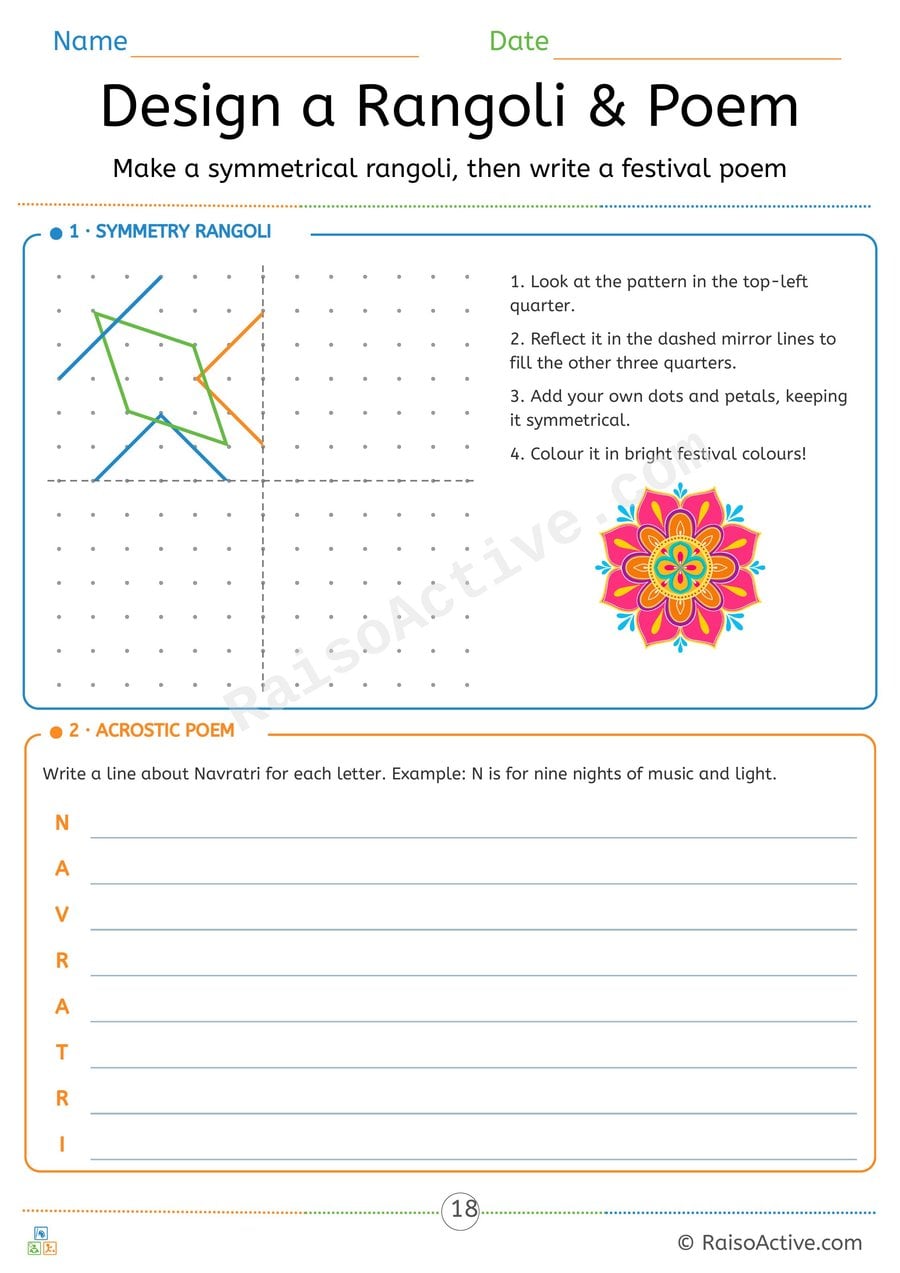
Navratri Symmetry Rangoli and Acrostic Poem
Ages 7-11 · Grade 2–Grade 3Ages 7-11 · Year 3–Year 4Ages 7-11 · Class 2–Class 3Ages 7-11
Children reflect a pattern in two mirror lines to complete a four-way symmetrical rangoli on a dot grid, add their own symmetrical details, and write an acrostic poem with one line for each letter of NAVRATRI.
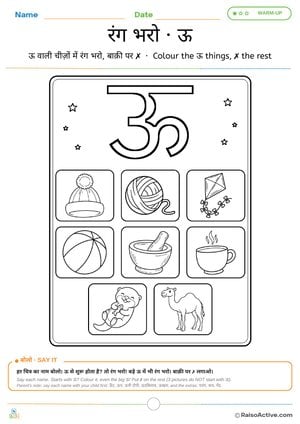
Colour the ऊ Things: Hindi Letter ऊ Colouring Page | रंग भरो · ऊ
Ages 3-7 · Preschool–Grade 1Ages 3-7 · Nursery–Year 2Ages 3-7 · Nursery–Class 1Ages 3-7
Children listen for the first sound of each picture name and decide whether it starts with ऊ. They colour the ऊ pictures, cross out the others and colour the big letter.

Symmetry Fun Worksheet for Kids: Complete and Color!
Ages 3-5 · Preschool–Pre-KAges 3-5 · Nursery–ReceptionAges 3-5 · Nursery–LKGAges 3-5
This symmetry worksheet challenges children ages 3-5 to study a half-drawn Christmas picture and draw the missing mirror-image half, introducing the early geometry concept that two sides of a shape can match exactly. Completing and then coloring the picture also builds visual comparison skills, since children must check their drawn half against the original before filling it in with color.

Spooky Fun: Complete the Halloween Sketches Worksheet
Ages 3-5 · Preschool–Pre-KAges 3-5 · Nursery–ReceptionAges 3-5 · Nursery–LKGAges 3-5
This worksheet has children ages 3-5 complete partially drawn Halloween sketches by tracing or extending existing lines, building visual perception and fine motor control as they figure out what shape a sketch is meant to become. Coloring the completed pictures afterward adds a creative finishing step that rewards the careful tracing work.
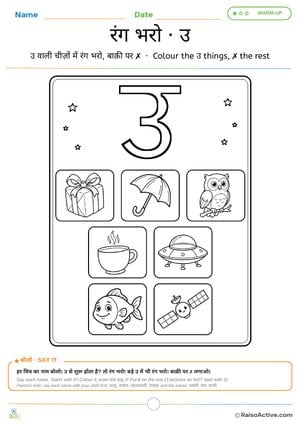
Colour the उ Things: Hindi Letter उ Colouring Page | रंग भरो · उ
Ages 3-7 · Preschool–Grade 1Ages 3-7 · Nursery–Year 2Ages 3-7 · Nursery–Class 1Ages 3-7
Children listen for the first sound of each picture name and decide whether it starts with उ. They colour the उ pictures, cross out the others and colour the big letter.

Spring Table Color by Number Worksheet for Preschoolers
Ages 3-5 · Preschool–Pre-KAges 3-5 · Nursery–ReceptionAges 3-5 · Nursery–LKGAges 3-5
This color-by-number worksheet has children ages 3-5 practice matching numerals to a specific color key and then applying that color accurately across a picture, reinforcing both number recognition and one-to-one correspondence between a symbol and an action. Rolling a dice to determine which color to use next also adds an element of chance that keeps the repetitive coloring task engaging.
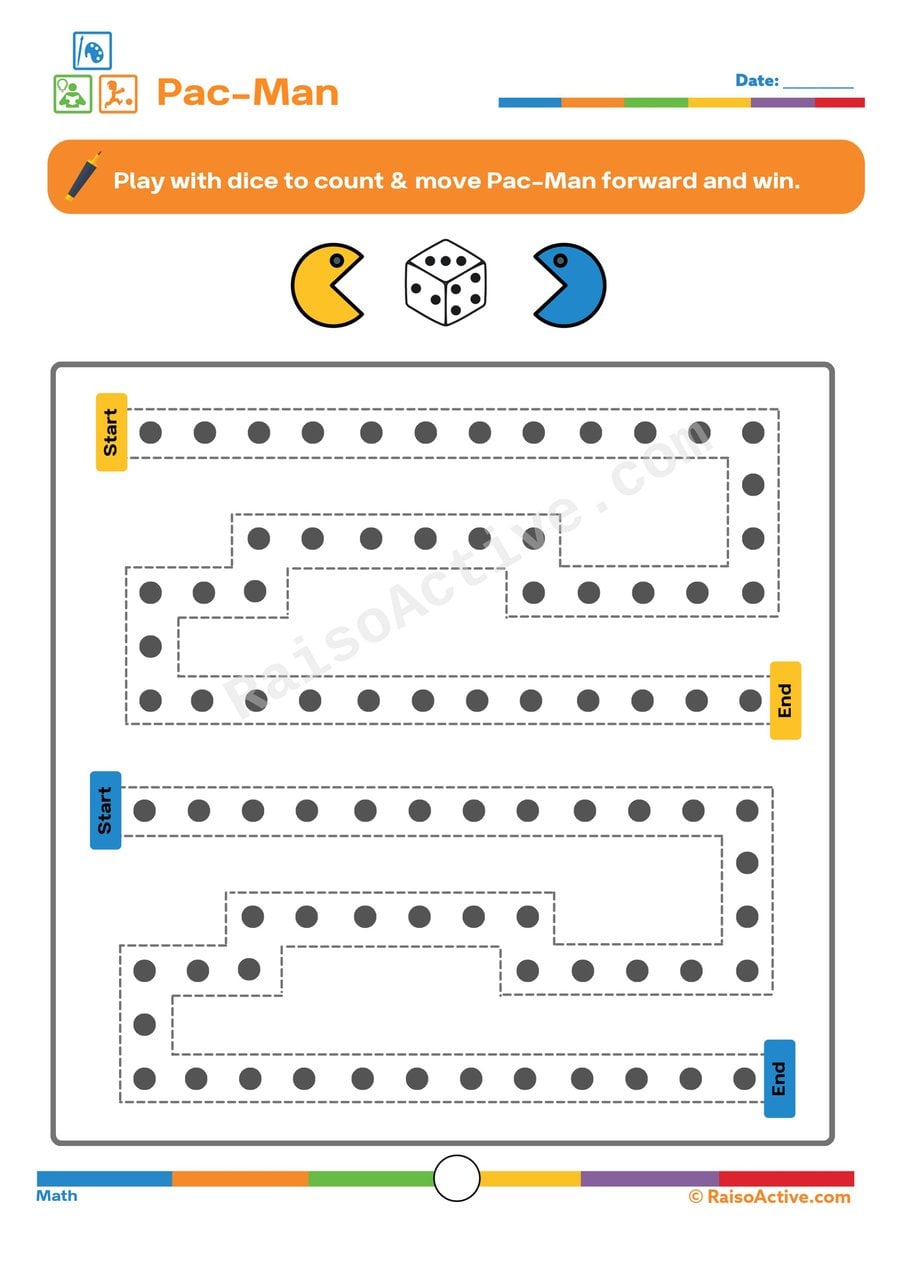
Pac-Man Maze Worksheet: Count and Move!
Ages 3-5 · Preschool–Pre-KAges 3-5 · Nursery–ReceptionAges 3-5 · Nursery–LKGAges 3-5
This dice-counting maze gives children ages 3-5 repeated practice matching a rolled number to the correct number of moves, reinforcing accurate counting under a bit of playful pressure. Tracking Pac-Man's current position after each roll also builds short-term spatial memory, since children must remember where they left off before moving again.

Spot the Spots! Spring Coloring Worksheet for Preschoolers
Ages 3-5 · Preschool–Pre-KAges 3-5 · Nursery–ReceptionAges 3-5 · Nursery–LKGAges 3-5
This worksheet pairs counting practice with coloring as children ages 3-5 look at a number written beside each picture and color exactly that many spots onto it, reinforcing one-to-one correspondence between a numeral and a matching quantity. Because the target number changes from picture to picture, children must check the number freshly each time rather than coloring on autopilot.
Guides for this topic

Best Worksheets for 3-Year-Olds: What Works and What to Avoid
What works on worksheets for 3-year-olds: short sessions, crayons, tracing lines, matching, cutting, a free weekly plan, and signs one is too advanced.
Fostering Creativity in Structured Learning: The Perfect Balance for Young Minds
Learn how to blend creativity with structured learning for children ages 1-8. Practical strategies, activities, and printable worksheets for parents and teachers.

Growing Green Hearts: A Comprehensive Guide to Teaching Environmental Awareness to Preschoolers
Practical guide to teaching preschoolers ages 2-6 about nature, recycling, water conservation, and Earth Day with Indian context and simple home activities.
Reviews
Every worksheet for ages 3–5, no watermark
Members download the full library of 1,000+ worksheets and every activity pack without watermarks or daily limits. One year costs ₹999 in India or $20 elsewhere.
See membership plansOr download any worksheet free with a watermark (5 a day).