Float or Sink: Cut and Paste Worksheet for Preschoolers
This worksheet introduces children ages 3-5 to a basic science concept — that different materials and objects behave differently in water — by having them sort pictures into 'float' and 'sink' categories. Making a prediction and then physically sorting an object reinforces early scientific reasoning, since children must think about an object's properties, like weight or material, before deciding where it belongs. This kind of hands-on categorizing builds observation and classification skills that are foundational to all later science learning.
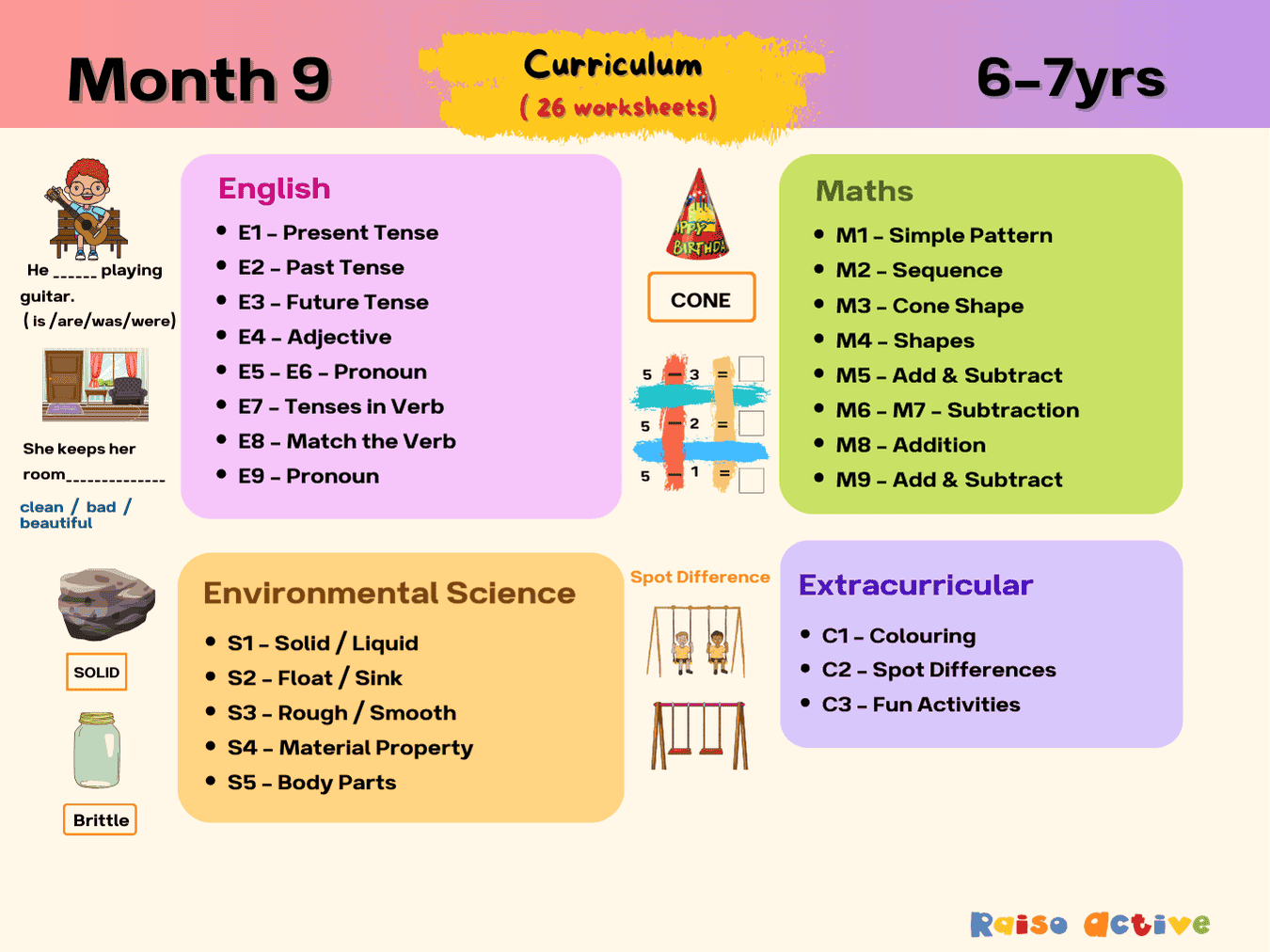
Part of the pack
Month 9: Multi-Subject Early Learning | Ages 6-7
This is page 23 of the pack. Ages 6-7 · Grade 1Ages 6-7 · Year 2Ages 6-7 · Class 1Ages 6-7
Curriculum
- Earth & Environment > Material Properties
How to use this worksheet
Look at the pictures at the bottom of the page together and name each object aloud. Talk about what the object is made of and how heavy it might be before deciding whether you think it will float or sink. Have your child cut out each picture and glue it into the correct section of the page. Once everything is sorted, review the choices together and, if possible, test a couple of the real objects in a sink or basin of water to check the predictions.
Materials needed
- Scissors
- Glue
- Pencil
Extension activities
- 1Test different objects around the house to see if they float or sink in a sink, bathtub, or basin of water.
- 2Draw pictures of objects that float and objects that sink, adding them to two separate lists.
- 3Experiment with the same object made from different materials, like a paper boat versus a metal spoon.
- 4Predict before testing each item, then check whether the prediction was right, to build the habit of hypothesizing.

Written by
Hemsweta Jain · Teacher Cheena
MBA and Early Childhood Educator, teaching since 2014 · Founder of RaisoActive, Mumbai
Every RaisoActive worksheet is designed and checked by the founder before publishing.
Published · Last reviewed
More from Month 9: Multi-Subject Early Learning | Ages 6-7
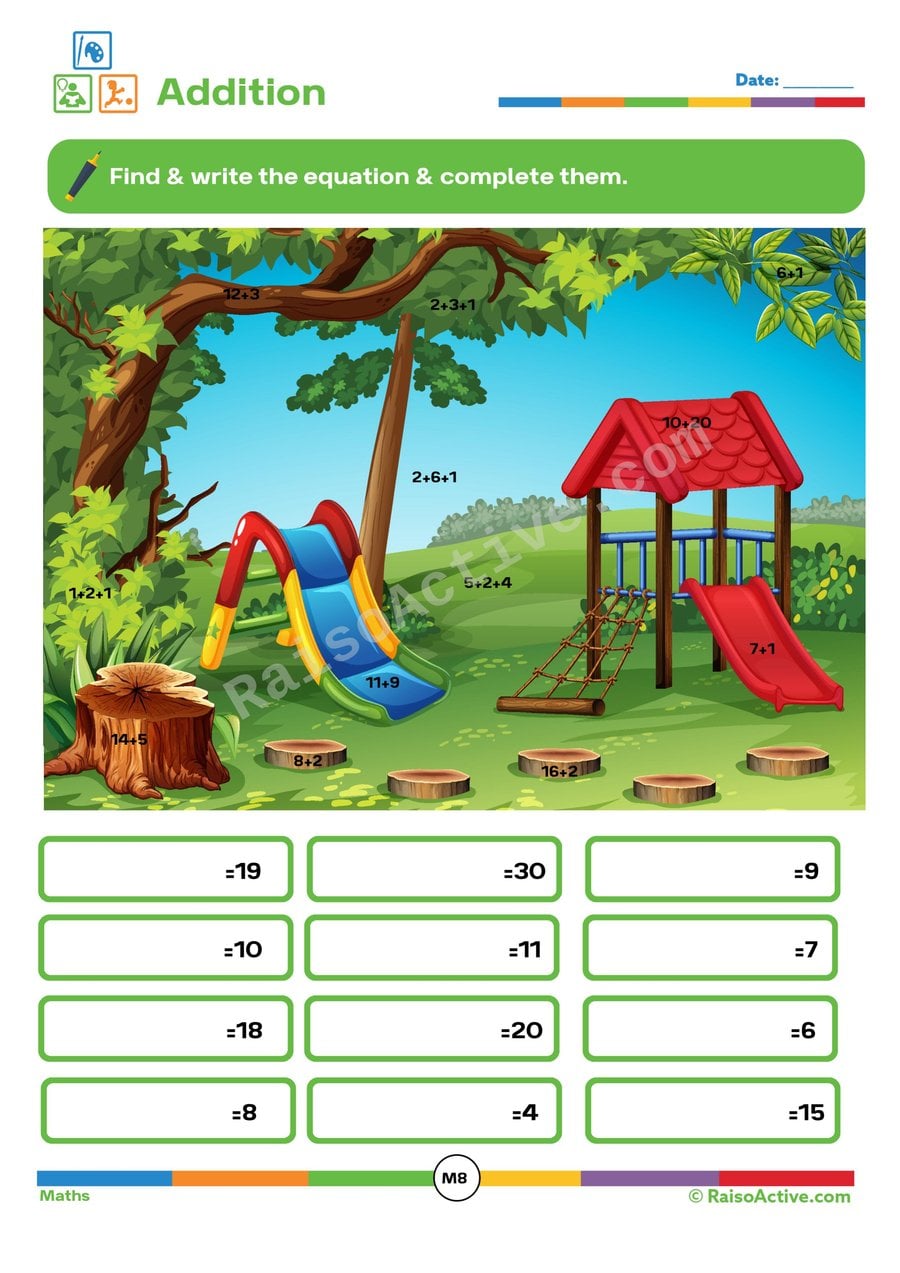
Addition Worksheet: Find and Write Equations!
Ages 4-6 · Pre-K–KindergartenAges 4-6 · Reception–Year 1Ages 4-6 · LKG–UKGAges 4-6
Writing an addition equation from a picture — rather than solving one that's already written — asks children ages 4-6 to translate a visual quantity into mathematical symbols, a more demanding skill than simply computing a given sum. This worksheet has children count grouped objects, represent what they see as a written equation, and then solve it, connecting concrete counting to abstract number sentences. Practicing this translation step is exactly what builds true number sense, rather than just memorized addition facts.

Subtraction Worksheet: Find the Row with Matching Answers!
Ages 4-6 · Pre-K–KindergartenAges 4-6 · Reception–Year 1Ages 4-6 · LKG–UKGAges 4-6
This worksheet pushes subtraction practice a step further for children ages 4-6 by having them solve several subtraction problems and then compare the answers across different rows to find matches, adding a layer of number-sense reasoning on top of basic calculation. Recognizing that two different subtraction problems can produce the same answer helps children understand that numbers can be reached in more than one way, which is an important early step toward flexible mathematical thinking. This kind of comparison task also builds attention to detail, since a child has to solve every problem accurately before the matching rows can be found.

Spot the Differences! Fun Picture Puzzle Worksheet for Kids
Ages 3-5 · Preschool–Pre-KAges 3-5 · Nursery–ReceptionAges 3-5 · Nursery–LKGAges 3-5
This spot-the-differences puzzle sharpens visual discrimination in children ages 3-5 by requiring them to compare two nearly identical pictures and notice small changes in detail, color, or position. Scanning systematically for differences also builds sustained visual attention and patience, both important pre-academic skills that support later tasks like proofreading and careful reading.

Material Properties Worksheet for Kids: Matching and Identifying
Ages 3-5 · Preschool–Pre-KAges 3-5 · Nursery–ReceptionAges 3-5 · Nursery–LKGAges 3-5
This early science worksheet introduces children ages 3-5 to the idea that materials have distinct physical properties — like hardness, brittleness, or elasticity — and that everyday objects can be grouped based on how they look, feel, or behave. Matching objects to their correct property builds observational and classification skills, which are foundational scientific thinking tools long before formal science instruction begins. Talking through why a rubber band stretches while a plate breaks helps children start noticing cause-and-effect patterns in the physical world around them.

Future Tense Fun: Fill-in-the-Blanks Worksheet for Kids
Ages 4-6 · Pre-K–KindergartenAges 4-6 · Reception–Year 1Ages 4-6 · LKG–UKGAges 4-6
This worksheet introduces children ages 4-6 to the future tense, having them choose and write the correct verb form to complete sentences about things that 'will' happen. Understanding that verbs change to reflect when an action takes place — past, present, or future — is a foundational grammar concept that helps children communicate more precisely as their sentences grow longer and more complex.

Simple Pattern Worksheet for Preschoolers: Fill in the Sequence!
Ages 3-5 · Preschool–Pre-KAges 3-5 · Nursery–ReceptionAges 3-5 · Nursery–LKGAges 3-5
Recognizing and continuing a pattern is one of the earliest building blocks of mathematical and logical thinking for children ages 3-5, since it requires noticing a repeating rule and predicting what comes next based on that rule. This worksheet uses both shapes and numbers to build pattern awareness, asking children to fill in missing elements in a sequence and then match related number sequences together. Pattern recognition like this underpins later skills in math, reading, and even everyday problem-solving, since spotting repeating structures is a skill that transfers well beyond this one worksheet.
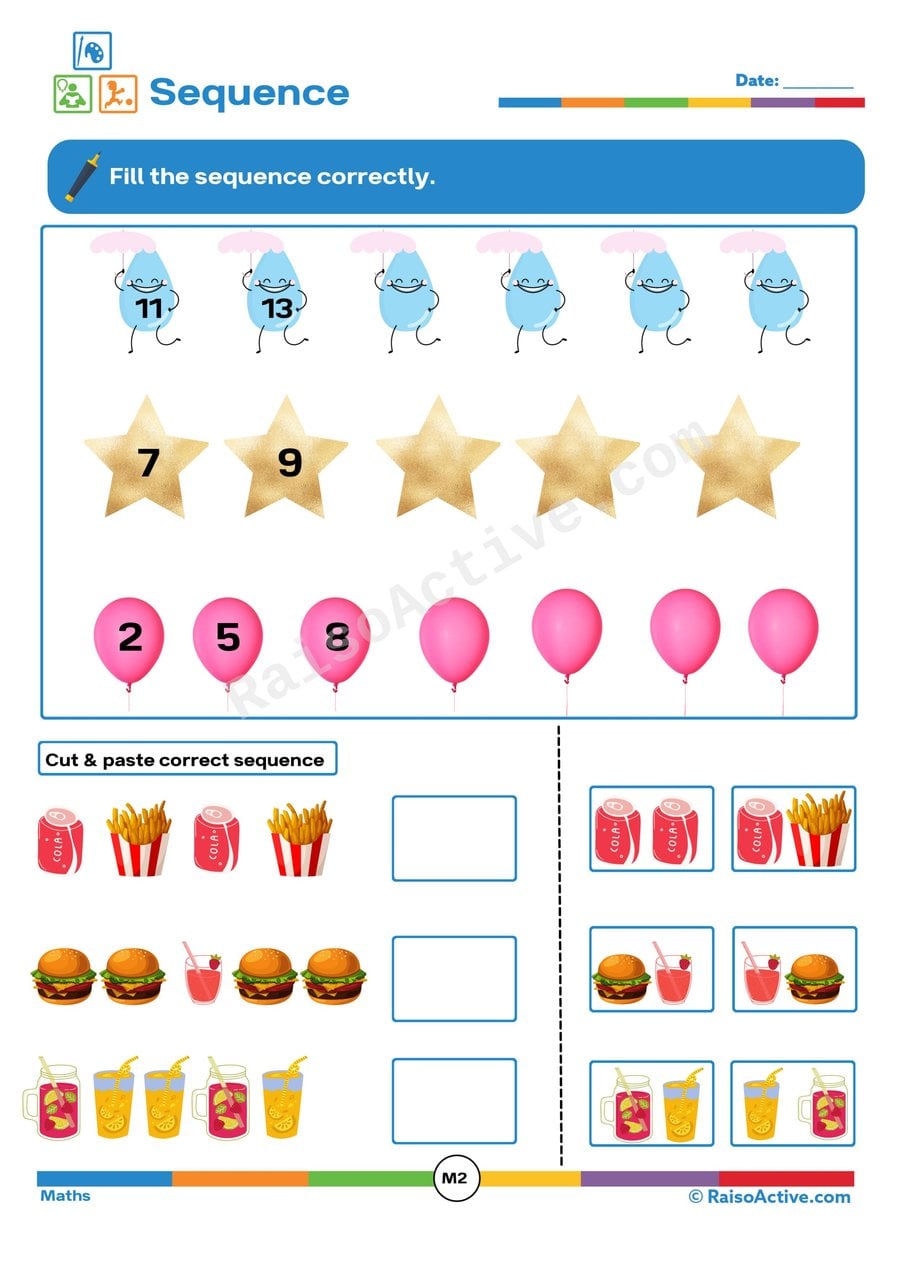
Fill the Sequence Worksheet for Preschoolers
Ages 3-5 · Preschool–Pre-KAges 3-5 · Nursery–ReceptionAges 3-5 · Nursery–LKGAges 3-5
This two-part worksheet has children ages 3-5 first fill in missing numbers within a counting sequence and then cut out and paste the correct completed sequence, combining number-order recognition with fine motor cutting and pasting practice. Understanding that numbers follow a fixed, unchanging order is a critical foundation for counting accurately and, later, for addition and subtraction.
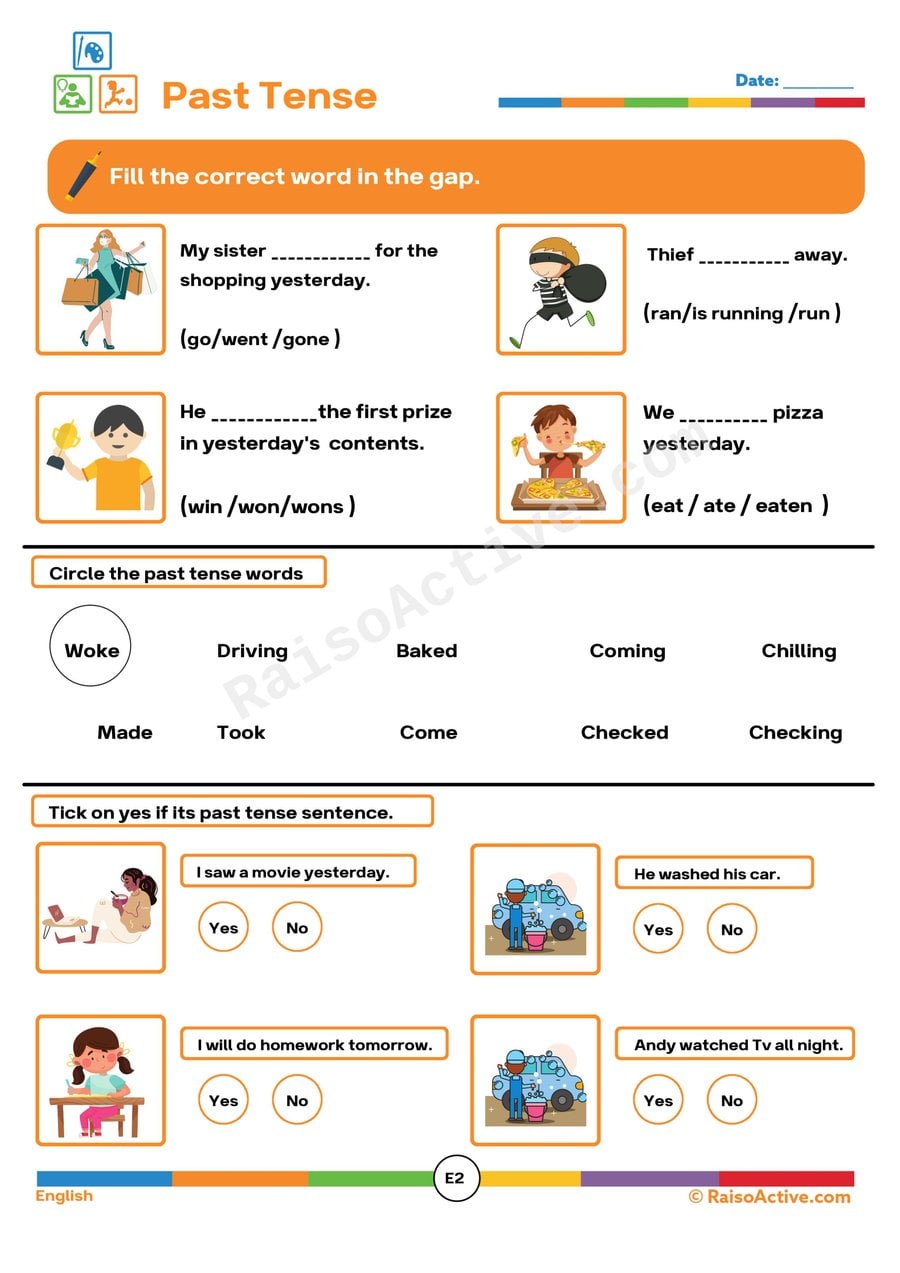
Past Tense Verbs Worksheet for Kids
Ages 4-6 · Pre-K–KindergartenAges 4-6 · Reception–Year 1Ages 4-6 · LKG–UKGAges 4-6
Understanding that verbs change form to show when an action happened is an important grammar concept for children ages 4-6, and this worksheet gives them focused practice recognizing and using past tense verbs in context. Filling in blanks with the correct past tense form, circling past tense words, and judging whether a sentence is already in the past tense all approach the same grammar skill from different angles, which helps solidify the pattern. This kind of grammar awareness supports both clearer spoken language and more accurate writing as children begin composing their own sentences.
Related worksheets

Energy Sources Worksheet for Kids: Identifying Light and Heat
Ages 3-5 · Preschool–Pre-KAges 3-5 · Nursery–ReceptionAges 3-5 · Nursery–LKGAges 3-5
Children ages 3-5 learn to identify sources of light and heat energy, like the sun, a lamp, or a fire, by ticking the correct option for each pictured scene. Distinguishing natural sources of heat, like the sun, from artificial ones, like a stove, introduces early scientific classification of energy in the world around them. This awareness lays groundwork for later science topics about energy, weather, and how everyday objects work.

Energy Sources Worksheet: Circle the Energy Sources!
Ages 4-6 · Pre-K–KindergartenAges 4-6 · Reception–Year 1Ages 4-6 · LKG–UKGAges 4-6
This worksheet introduces children ages 4-6 to the basic science concept that certain objects and phenomena — like the sun, batteries, or wind — are sources of energy, while other everyday objects are not. Asking children to circle only the true energy sources from a mixed set of pictures builds early categorization and critical thinking skills, since they must apply a definition rather than just recognize familiar objects. Writing numbers stepwise afterward adds a light sequencing task that keeps the page varied rather than focused on a single skill.

Material Properties Sorting Worksheet for Preschoolers
Ages 3-5 · Preschool–Pre-KAges 3-5 · Nursery–ReceptionAges 3-5 · Nursery–LKGAges 3-5
Children ages 3-5 practice identifying basic material properties, like hard, soft, rough, or smooth, and sorting everyday objects accordingly, an early science observation skill that builds the foundation for later lessons on states of matter and physical properties. Describing why an object belongs in a category also strengthens descriptive vocabulary.

States of Matter Worksheet: Exploring Solids, Liquids, and Gases!
Ages 4-6 · Pre-K–KindergartenAges 4-6 · Reception–Year 1Ages 4-6 · LKG–UKGAges 4-6
This worksheet introduces children ages 4-6 to the three states of matter — solid, liquid, and gas — by having them examine images and sort each one into its correct category. Learning to classify familiar objects (like ice, water, and steam) by their physical state builds early scientific reasoning, since children must look past an object's identity and focus on its underlying properties.
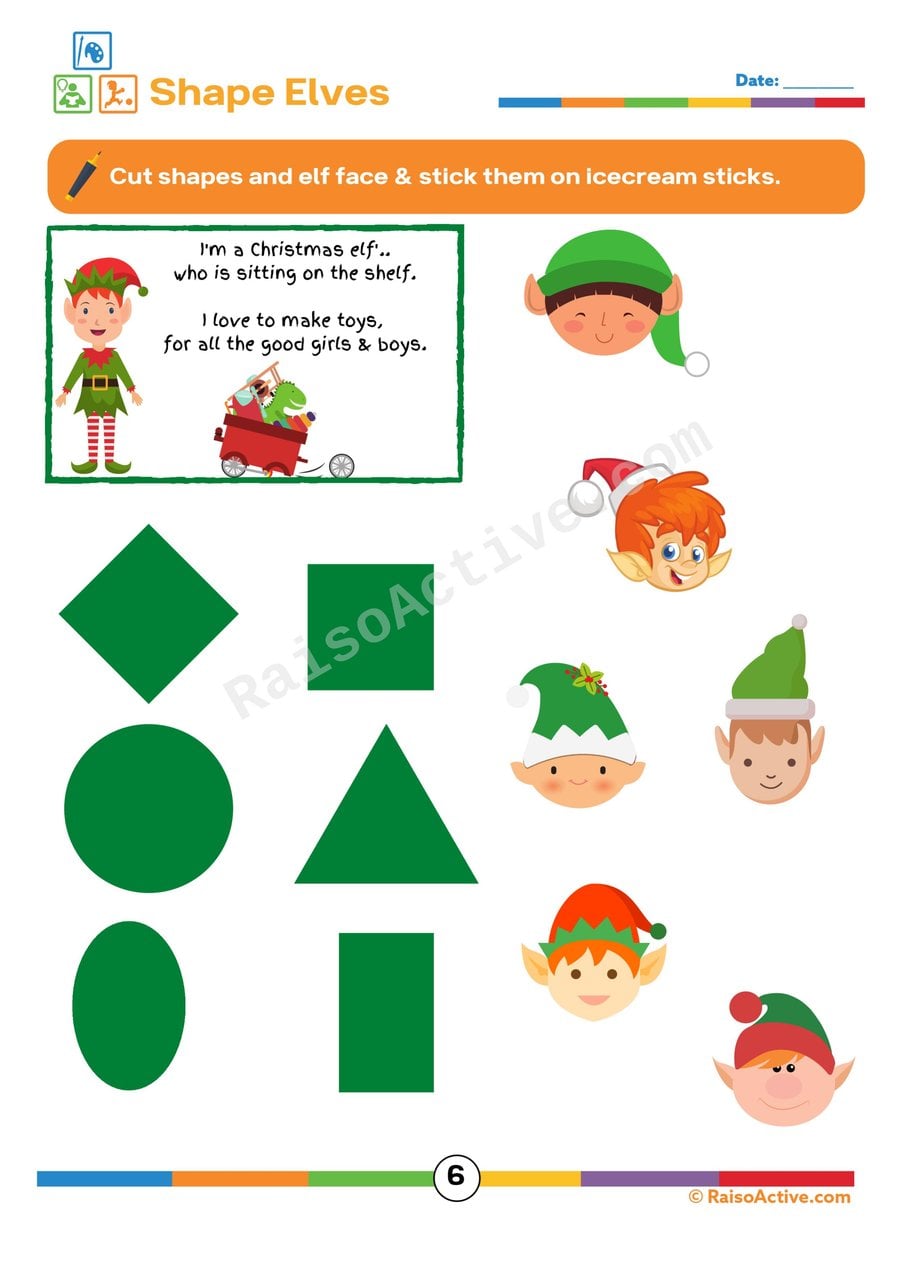
Shape Elves Worksheet: Cut, Paste, and Create!
Ages 3-5 · Preschool–Pre-KAges 3-5 · Nursery–ReceptionAges 3-5 · Nursery–LKGAges 3-5
Cutting out circles, triangles, and rectangles to assemble an elf face teaches children ages 3-5 to recognize and name basic 2D shapes while practicing scissor control along both straight and curved lines. Because each shape has to go in a specific spot to form a recognizable face, children also build spatial reasoning as they figure out which shape works as eyes, a nose, or a hat. Turning geometry into a craft project makes an abstract math concept feel like creative play.

Indian Cities Crossword Puzzle Worksheet for Kids
Ages 4-6 · Pre-K–KindergartenAges 4-6 · Reception–Year 1Ages 4-6 · LKG–UKGAges 4-6
This crossword challenges children ages 4-6 to identify famous Indian cities from picture clues of their landmarks and then spell out each city's name in the puzzle grid, combining observation skills with early geography knowledge. Counting the crossword boxes to match each city's letter count also reinforces attention to word length before writing.

Balloon Pattern Matching Worksheet for Preschoolers
Ages 3-5 · Preschool–Pre-KAges 3-5 · Nursery–ReceptionAges 3-5 · Nursery–LKGAges 3-5
This worksheet strengthens pattern recognition in children ages 3-5 by having them study a repeating sequence of colored balloons and locate the matching arrangement elsewhere on the page. Recognizing and reproducing a pattern is an early pre-algebra skill, laying groundwork for later number patterns and logical sequencing.
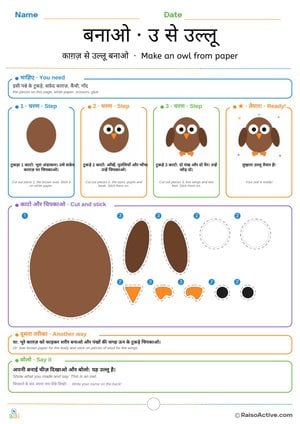
Make a Paper Owl: Hindi Letter उ Craft | बनाओ · उ से उल्लू
Ages 3-7 · Preschool–Grade 1Ages 3-7 · Nursery–Year 2Ages 3-7 · Nursery–Class 1Ages 3-7
Children cut out the pieces, put them together following three step pictures and make a paper owl. Saying the word उल्लू as they make it links the sound उ to something they built themselves.
Guides for this topic

Age-Appropriate Problem-Solving Activities: Building Critical Thinkers from the Ground Up
Discover fun, age-appropriate problem-solving activities for children ages 1-8. Build critical thinking, logic, and reasoning skills through play-based learning.
Critical Thinking Activities That Actually Work for Young Children: Building Tomorrow's Thinkers Today
Discover proven critical thinking activities for young children. Age-wise logic games, questioning techniques, and hands-on ideas to build thinking skills at home.

Preparing Your Child for a Rapidly Changing World: Essential Skills for Future Success
Discover the essential 21st century skills your child needs for future success. Practical tips on creativity, critical thinking, digital literacy & emotional intelligence for ages 1-8.
Reviews
Every worksheet for ages 3–5, no watermark
Members download the full library of 1,000+ worksheets and every activity pack without watermarks or daily limits. One year costs ₹999 in India or $20 elsewhere.
See membership plansOr download any worksheet free with a watermark (5 a day).