Free printable worksheets · US · UK · India
Cutting Practice Worksheets (Scissor Skills)
Cutting practice worksheets are printable sheets for children aged 3 to 6 that develop scissor skills in stages: snipping the edge of a strip, cutting along straight lines, cutting curves and zigzags, cutting out shapes, and cut-and-paste tasks such as sequencing or sorting. They build hand strength, bilateral coordination, hand-eye coordination and the open-close grasp used in writing.
Scissors are the first tool that asks both hands to do different jobs at once: one opens and closes the blades while the other turns the paper. That bilateral coordination is why cutting practice appears on Kindergarten readiness checklists in the US, in EYFS Physical Development goals for Nursery and Reception in the UK, and in Nursery, LKG and UKG fine motor routines in India. These worksheets follow the standard progression: snipping fringe into a strip at three, straight lines and gentle curves at four, zigzags, spirals and shapes at five, and cut-and-paste activities such as story sequencing and sorting at six. Every sheet prints on A4 or US Letter with lines thick enough for a beginner to follow.
- 373 worksheets
- Free PDF download
- Print on A4 or Letter
Cutting Practice Worksheets to print
Browse all worksheets for ages 3–6
Handprint Face Fun: A Creative Cut and Paste Worksheet for Kids!
Ages 3-5 · Preschool–Pre-KAges 3-5 · Nursery–ReceptionAges 3-5 · Nursery–LKGAges 3-5
Tracing or printing a handprint and then building a face on it with cut-out features combines fine motor practice, following multi-step instructions, and open-ended creativity in a single activity. For ages three to five, the sequencing required, print, then cut, then arrange, then paste, also strengthens working memory as children hold several steps in mind at once.

Colorful Bird Cut and Paste Worksheet for Preschoolers
Ages 3-5 · Preschool–Pre-KAges 3-5 · Nursery–ReceptionAges 3-5 · Nursery–LKGAges 3-5
Assembling a colorful bird from separate cut-out shapes teaches children to build a recognizable image from individual parts — body, wings, beak, tail — which strengthens both scissor control and the visual-spatial planning needed to see how pieces relate to a whole picture. The bright color theme also gives a natural opportunity to build color-naming vocabulary as each piece goes on.
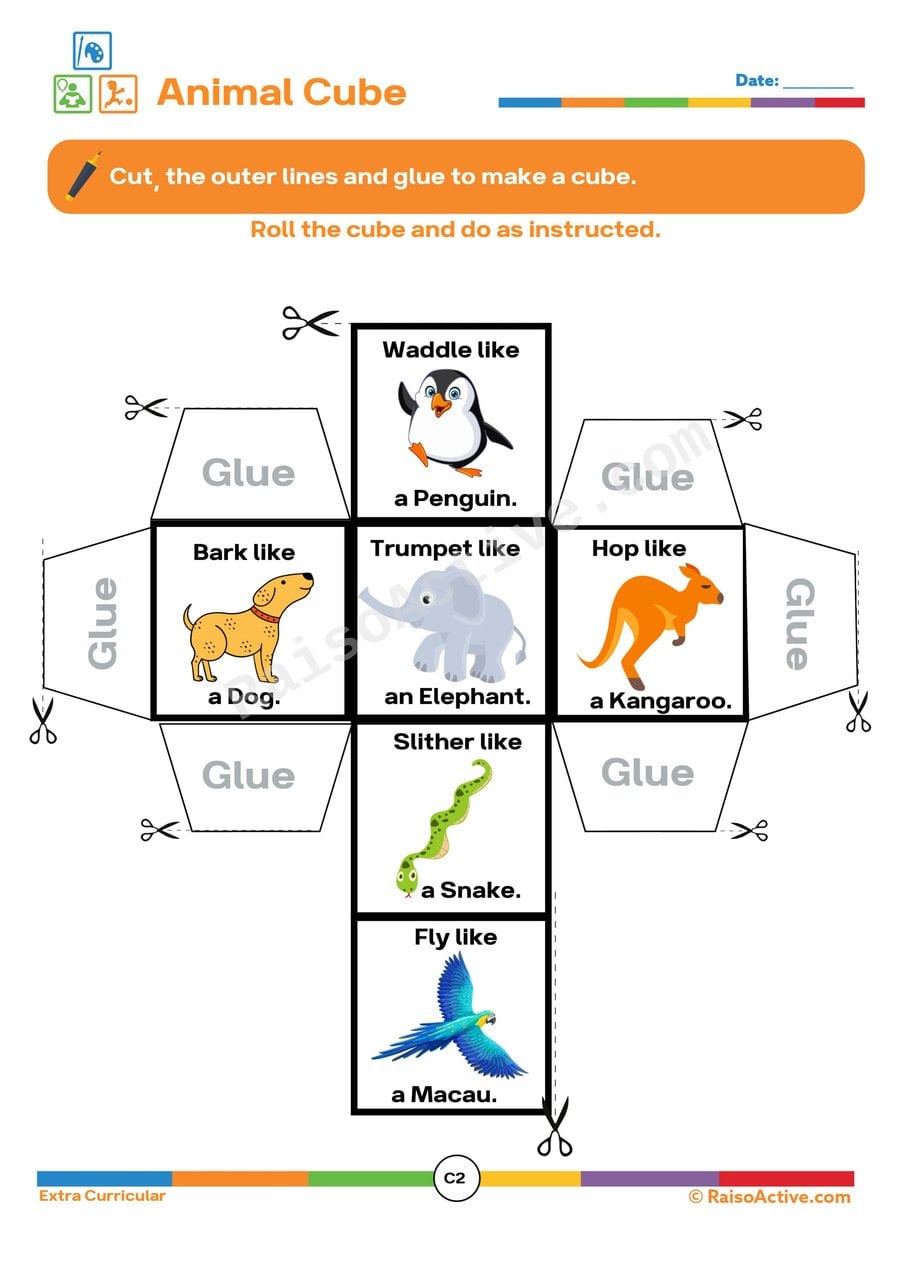
Animal Cube: Cut, Glue, and Learn!
Ages 3-5 · Preschool–Pre-KAges 3-5 · Nursery–ReceptionAges 3-5 · Nursery–LKGAges 3-5
Children ages 3-5 practice following a multi-step assembly sequence as they cut out a net, fold it, and glue the tabs to build a 3D cube featuring different animals, then use it as a game piece to review animal names and sounds. Assembling a flat shape into a 3D object also introduces early spatial reasoning about how 2D shapes fold into 3D forms.
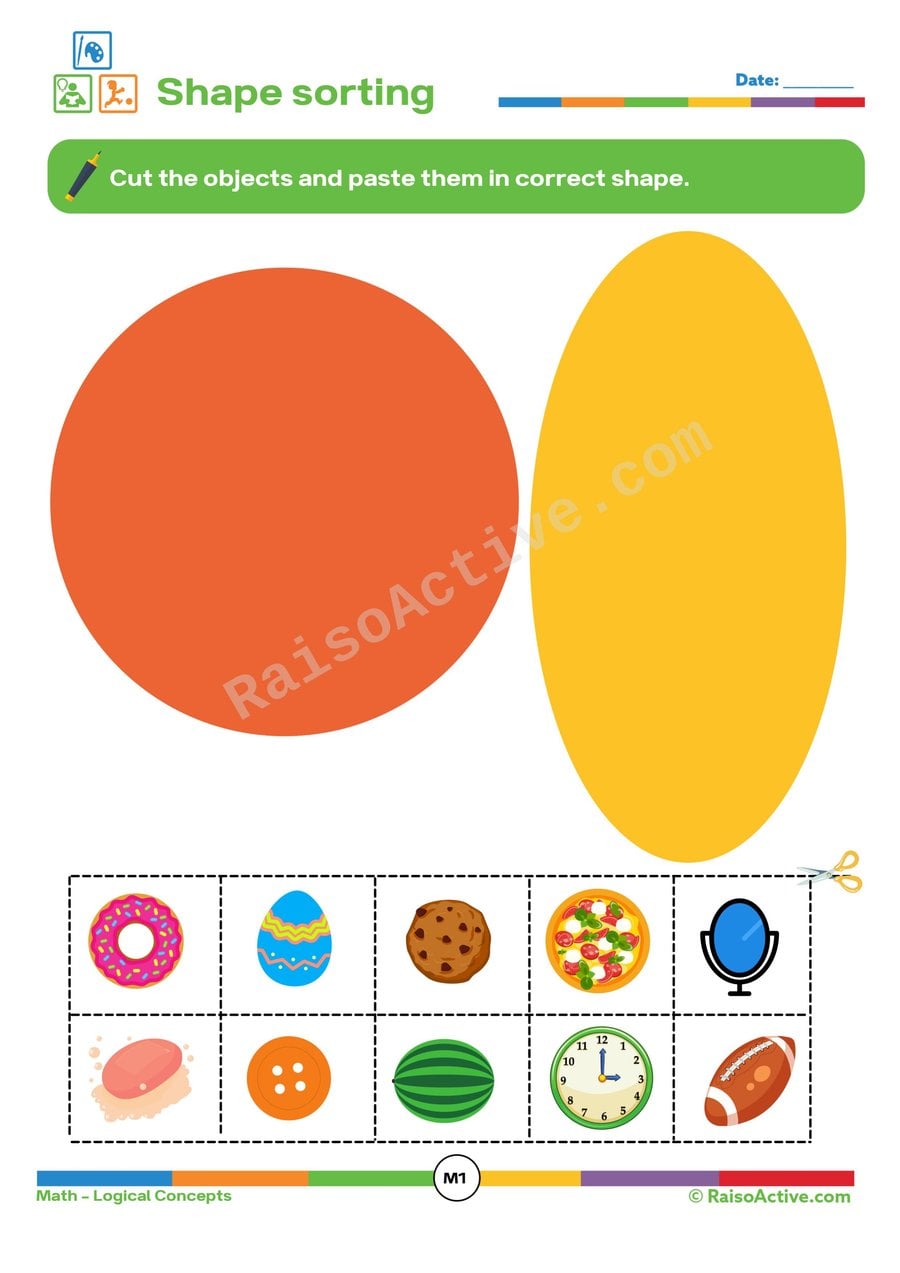
Shape Sorting Worksheet: Cut and Paste Fun!
Ages 3-5 · Preschool–Pre-KAges 3-5 · Nursery–ReceptionAges 3-5 · Nursery–LKGAges 3-5
Sorting everyday objects — a plate, an egg, a clock — into 'circle' or 'oval' bins asks a 3-5 year old to look past what an object is and notice its geometric shape instead, an early step toward abstract categorization. Cutting along the outline of each picture and gluing it into the right column also builds the scissor control and hand-eye coordination that later supports handwriting.
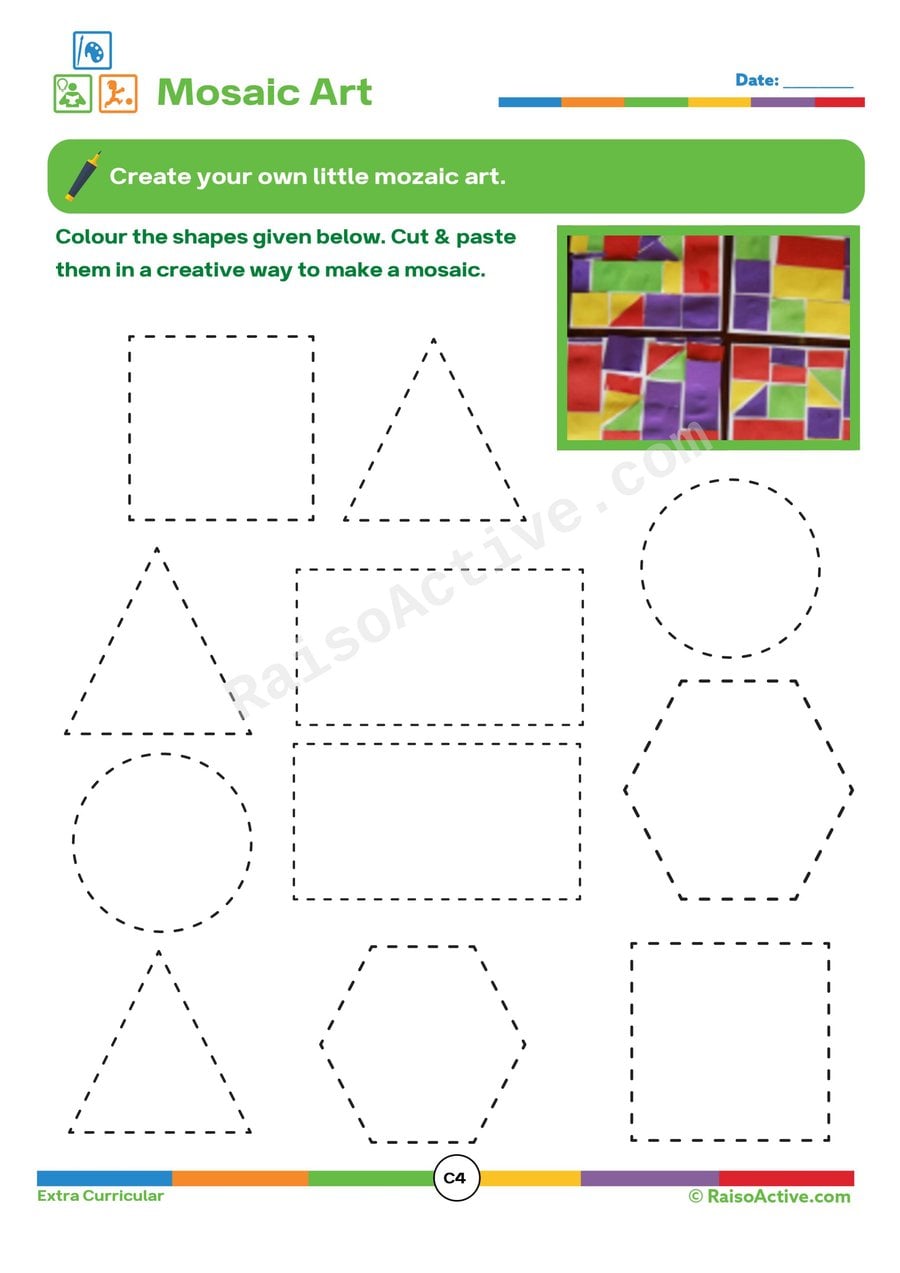
Mosaic Art Shapes Worksheet for Kids
Ages 3-5 · Preschool–Pre-KAges 3-5 · Nursery–ReceptionAges 3-5 · Nursery–LKGAges 3-5
This mosaic craft asks children ages 3-5 to color, cut, and arrange individual shape pieces into a larger picture, combining shape recognition with sustained fine motor practice in scissor use and precise placement. Working piece by piece toward a bigger image also builds early planning skills, as children must think about how small parts combine to form a whole.

Snowman Cut and Paste Worksheet for Preschoolers
Ages 3-5 · Preschool–Pre-KAges 3-5 · Nursery–ReceptionAges 3-5 · Nursery–LKGAges 3-5
This cut-and-paste craft builds fine motor precision as children cut out and arrange a snowman's body parts, while decorating with buttons, cotton, and googly eyes adds open-ended creative expression. For ages 3-5, the multi-step nature of cutting, arranging, and gluing several separate pieces in the right order and position strengthens both scissor control and sequencing skills.

Honey Bee Cut and Paste Worksheet for Preschoolers
Ages 3-5 · Preschool–Pre-KAges 3-5 · Nursery–ReceptionAges 3-5 · Nursery–LKGAges 3-5
Assembling a honey bee from separate paper pieces — body, wings, stripes — asks children to hold a finished picture in mind and build toward it piece by piece, an early form of the planning and sequencing skills used later in following multi-step instructions. The repeated cutting also strengthens the small hand muscles needed for a mature pencil grip, while the bee theme naturally opens the door to simple nature vocabulary.

Wild Animals Cut and Paste Worksheet for Preschoolers
Ages 3-5 · Preschool–Pre-KAges 3-5 · Nursery–ReceptionAges 3-5 · Nursery–LKGAges 3-5
Children ages 3-5 practice fine motor cutting and pasting skills while learning to recognize wild animals such as lions, tigers, or elephants that live in jungle habitats rather than around a home. This builds early classification knowledge about animal habitats alongside hands-on scissor practice.

Animals in Cold Climates Cut and Paste Worksheet for Kids
Ages 3-5 · Preschool–Pre-KAges 3-5 · Nursery–ReceptionAges 3-5 · Nursery–LKGAges 3-5
Sorting animals into the cold-climate habitats where they actually live introduces preschoolers to the idea that different animals are adapted to survive in different environments, an early building block for later lessons in ecosystems and animal science. The cutting and pasting also reinforces fine motor control while giving children a reason to look closely at each animal picture and recall what they know about it.
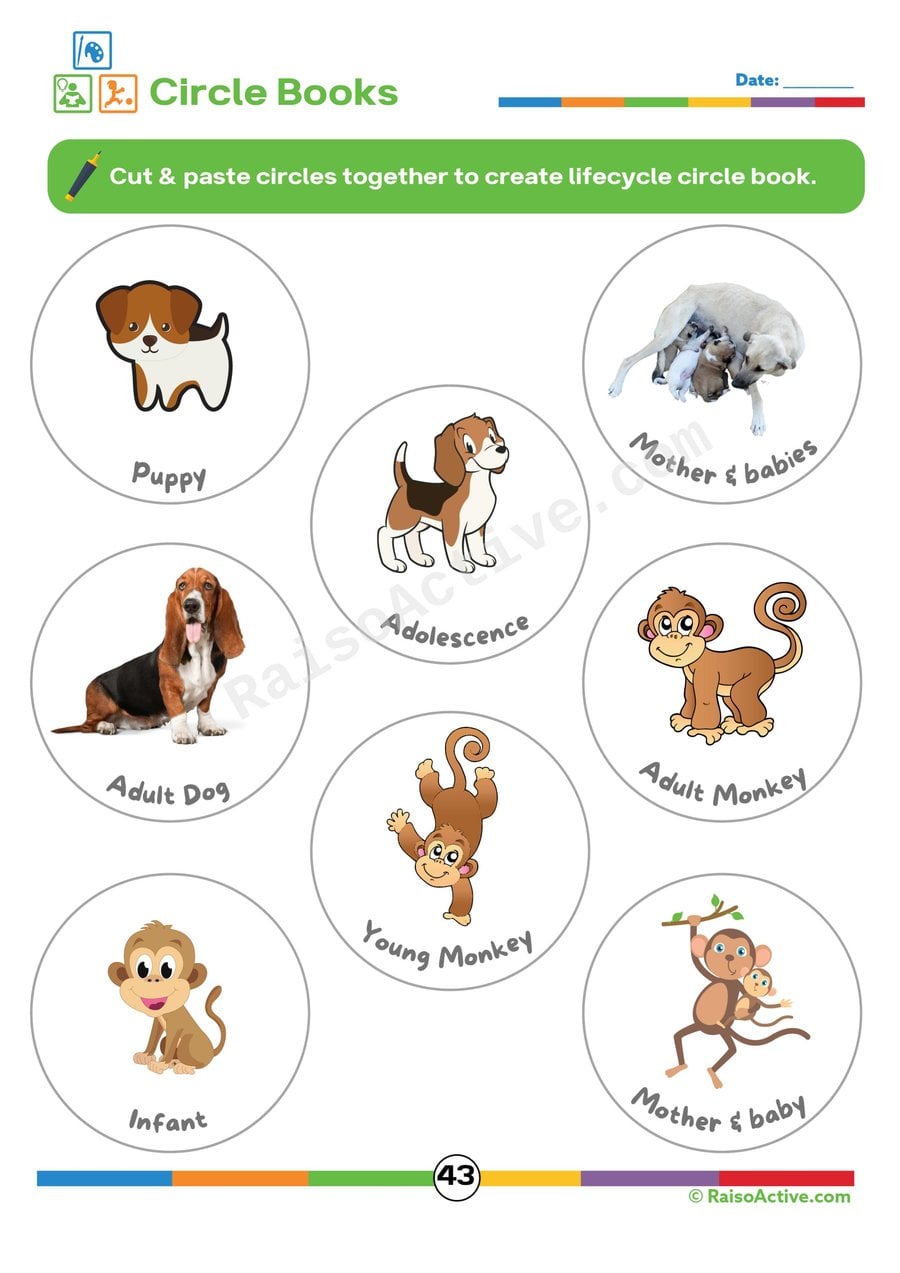
Lifecycle Circle Book: Cut and Paste Fun!
Ages 3-5 · Preschool–Pre-KAges 3-5 · Nursery–ReceptionAges 3-5 · Nursery–LKGAges 3-5
This worksheet gives children ages 3-5 more practice assembling a rotating lifecycle circle book, reinforcing the skills of sequencing, cutting, and gluing built in earlier lifecycle activities. Repeating this hands-on format with new content helps the process itself — cut, sequence, glue, review — become a familiar and confident routine.

Farm Animal Fun: Cut and Paste Worksheet for Preschoolers
Ages 3-5 · Preschool–Pre-KAges 3-5 · Nursery–ReceptionAges 3-5 · Nursery–LKGAges 3-5
Coloring, cutting, and pasting farm animals onto a scene teaches children ages 3-5 farm animal vocabulary while giving substantial fine motor practice through careful cutting along lines. Building the completed farm scene also lets children practice spatial placement, deciding where each animal fits within the picture.
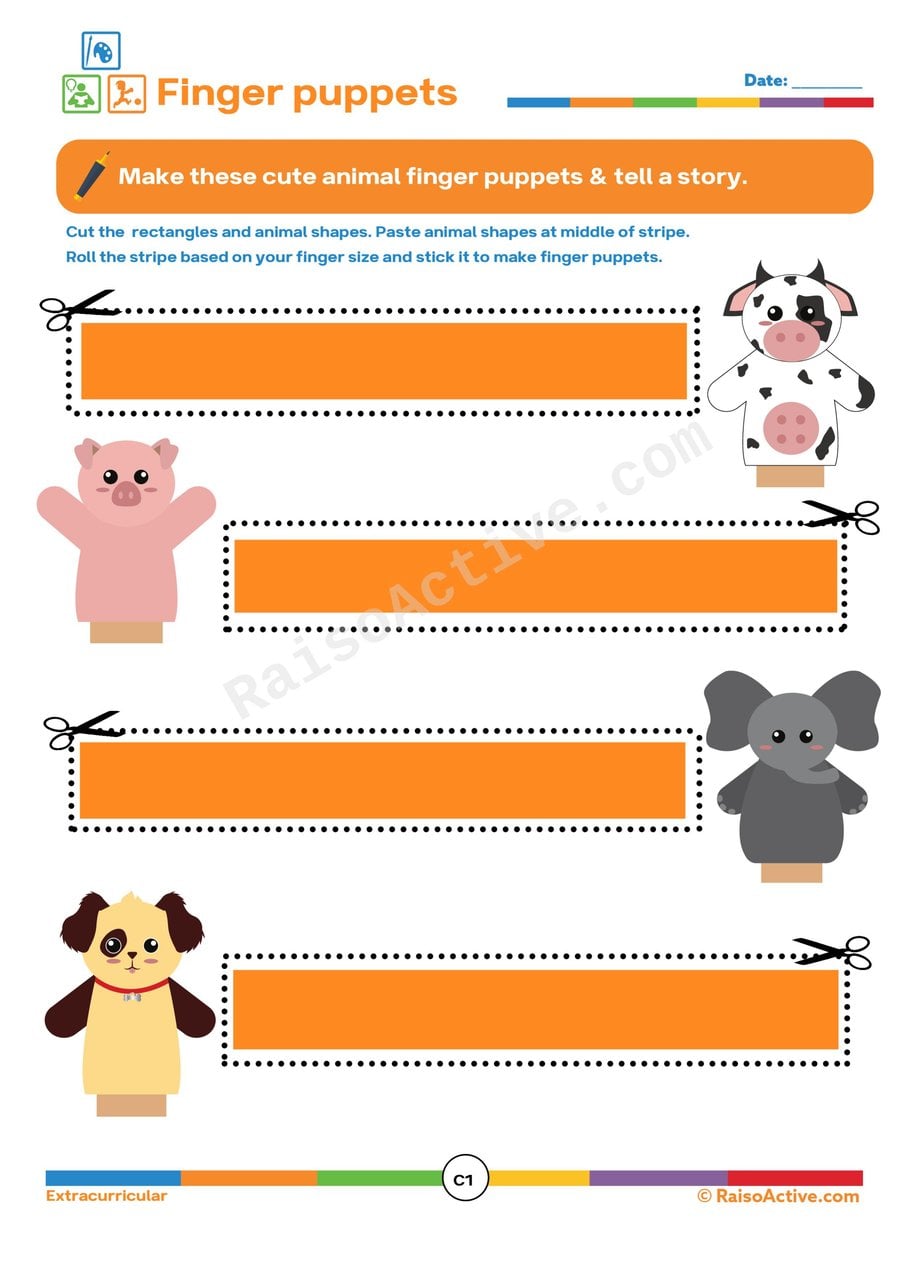
Make Finger Puppets! Fun Animal Craft Worksheet
Ages 3-5 · Preschool–Pre-KAges 3-5 · Nursery–ReceptionAges 3-5 · Nursery–LKGAges 3-5
This hands-on craft worksheet builds scissor control and fine motor precision in children ages 3-5 as they cut out animal shapes and rectangles, then roll and secure the rectangle into a puppet that fits their finger. The three-dimensional assembly step also introduces early spatial reasoning, since children must figure out how a flat shape becomes a wearable tube.

Decorate the Christmas Tree! Cut and Paste Worksheet
Ages 3-5 · Preschool–Pre-KAges 3-5 · Nursery–ReceptionAges 3-5 · Nursery–LKGAges 3-5
This cut-and-paste activity builds scissor control and hand strength in children ages 3-5 as they snip out ornaments, stars, and lights to decorate their own Christmas tree. Deciding where each decoration goes also develops spatial planning and following a visual guide, since children compare their tree to the sample image while placing pieces.

Scarecrow Cut and Paste Worksheet for Preschoolers
Ages 3-5 · Preschool–Pre-KAges 3-5 · Nursery–ReceptionAges 3-5 · Nursery–LKGAges 3-5
This scarecrow-building activity gives children ages 3-5 focused practice in cutting and gluing basic shapes — circles, triangles, rectangles — into place to assemble a recognizable figure. Matching each shape to its correct spot on the scarecrow outline also reinforces spatial reasoning, since children must judge size and orientation before pasting. Naming the shapes aloud as they work connects the craft to early geometry vocabulary rather than treating it as pure art time.

Cut and Match Worksheet: Fun Matching Activity for Kids
Ages 3-5 · Preschool–Pre-KAges 3-5 · Nursery–ReceptionAges 3-5 · Nursery–LKGAges 3-5
This general cut-and-match activity has children ages 3-5 cut out individual cards or pieces and then figure out which ones go together, combining scissor control with visual matching and comparison skills. Because the matching pairs aren't pre-arranged the way they are in a simple line-tracing matching worksheet, your child also has to search and compare across all the pieces, a slightly more demanding visual task.
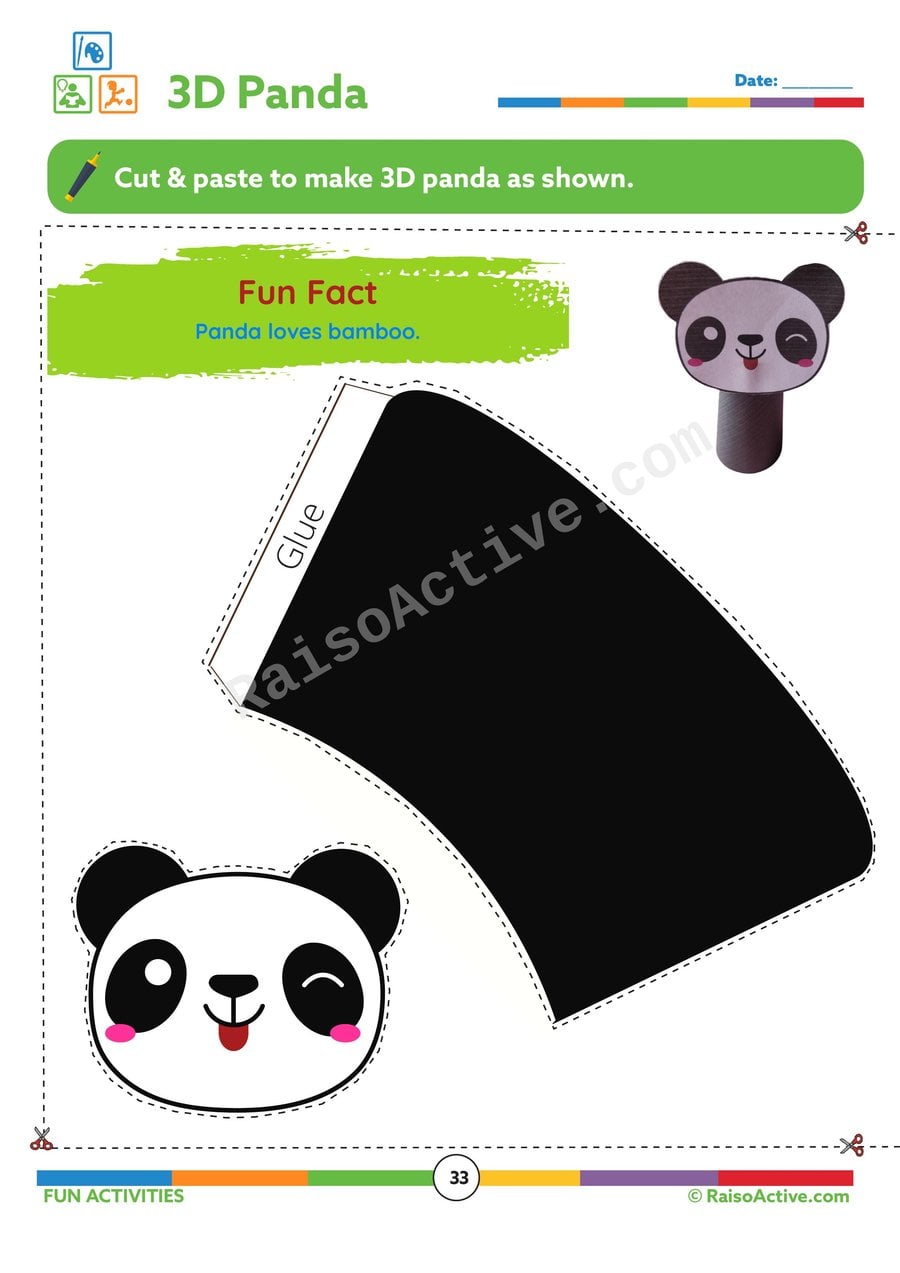
3D Panda Craft: Cut, Paste, and Create!
Ages 3-5 · Preschool–Pre-KAges 3-5 · Nursery–ReceptionAges 3-5 · Nursery–LKGAges 3-5
Folding and gluing flat paper pieces into a standing 3D panda asks children to understand that a flat shape can become a solid form — an early, hands-on introduction to the difference between 2D and 3D that most kids won't meet formally until later in school. The multi-step fold-and-glue sequence at ages 3-5 also builds patience and the ability to follow a picture-based set of instructions rather than verbal ones alone.

Cute Rabbit Cut and Paste Worksheet for Preschoolers
Ages 3-5 · Preschool–Pre-KAges 3-5 · Nursery–ReceptionAges 3-5 · Nursery–LKGAges 3-5
Children ages 3-5 practice precise scissor control and gluing as they cut apart separate body-shape pieces and assemble them into a complete rabbit picture, building the fine motor coordination needed for later handwriting. Piecing together separate parts to form a whole also strengthens early spatial reasoning about how shapes fit together.

Farm and Wild Animals Cut and Paste Worksheet for Preschoolers
Ages 3-5 · Preschool–Pre-KAges 3-5 · Nursery–ReceptionAges 3-5 · Nursery–LKGAges 3-5
Sorting each cut-out animal into 'Farm' or 'Wild' teaches an early classification skill — grouping items by a shared category rather than just by appearance — which is foundational to later science and math thinking. At ages 3-5, deciding where an animal belongs also builds vocabulary and general knowledge about where different animals actually live, alongside the scissor and gluing practice.

Paste the Animals: Aerial and Aquatic Animals Worksheet
Ages 3-5 · Preschool–Pre-KAges 3-5 · Nursery–ReceptionAges 3-5 · Nursery–LKGAges 3-5
Sorting animals into 'aerial' and 'aquatic' groups introduces slightly more advanced classification vocabulary than a simple farm-versus-wild sort, asking children to think about how an animal moves and where it lives — in the air or in water — rather than just what it looks like. This kind of habitat-based categorization at ages 3-5 builds early science thinking alongside the scissor and gluing practice.

Shape Dog Craft: Cut and Assemble a Fun Shapes Worksheet!
Ages 3-5 · Preschool–Pre-KAges 3-5 · Nursery–ReceptionAges 3-5 · Nursery–LKGAges 3-5
This worksheet helps children ages 3-5 recognize and assemble basic shapes, like circles, triangles, and squares, into a recognizable dog, reinforcing shape recognition while also building the fine motor precision needed to cut and place pieces accurately. Following a visual example to combine multiple shapes into one picture also strengthens early spatial reasoning.

Wild Animals Cut and Paste Worksheet for Preschoolers
Ages 3-5 · Preschool–Pre-KAges 3-5 · Nursery–ReceptionAges 3-5 · Nursery–LKGAges 3-5
Children ages 3-5 practice scissor control and glue placement while learning to identify wild animals and place them into a jungle habitat, connecting the idea that specific animals belong to specific environments. This activity builds fine motor precision — cutting along a line and centering an object with glue — while introducing early habitat vocabulary like jungle, forest floor, and trees.

Human Body Parts Cut and Paste Worksheet for Kids
Ages 3-5 · Preschool–Pre-KAges 3-5 · Nursery–ReceptionAges 3-5 · Nursery–LKGAges 3-5
This cut-and-paste activity teaches children ages 3-5 to identify and correctly place major body parts — like the head, arms, legs, and torso — onto a body outline, reinforcing body awareness alongside cutting and gluing fine motor skills. Understanding where each part belongs on the body supports early self-awareness and vocabulary that children use constantly, from getting dressed to describing how they feel. Physically assembling the body from separate pieces also helps children see how individual parts combine into a whole, functioning figure.

Months of the Year Cut and Paste Worksheet for Preschoolers
Ages 3-5 · Preschool–Pre-KAges 3-5 · Nursery–ReceptionAges 3-5 · Nursery–LKGAges 3-5
Learning the twelve months in order gives children ages 3-5 an early framework for understanding calendars, seasons, and the passage of time, concepts that are quite abstract at this age without a hands-on anchor. This cut-and-paste activity turns that memorization into a physical sorting task, requiring children to recall the correct sequence while also practicing scissor control and precise gluing. Arranging the months onto train cars adds a visual, story-like structure that makes the lengthy sequence easier to hold in memory than a plain list would be.

Train Engine Craft: Cut and Paste Worksheet for Preschoolers
Ages 3-5 · Preschool–Pre-KAges 3-5 · Nursery–ReceptionAges 3-5 · Nursery–LKGAges 3-5
Children ages 3-5 practice following a multi-step visual sequence and build fine motor precision as they cut out individual shapes and assemble them into a complete train engine picture. Beyond cutting and gluing practice, this craft introduces basic engineering thinking — understanding how separate parts combine to form one recognizable whole.
The scissor skills progression
Cutting develops in a predictable order. First a child learns to hold scissors thumb-up and make single snips into the edge of a strip of paper. Next come short straight lines, then longer lines that need the helper hand to feed the paper. Curves and circles require turning the paper rather than the scissors. Zigzags and spirals add direction changes, and cutting out a shape means combining all of these. Cut-and-paste sheets then use the cut pieces for a sorting, matching or sequencing task.
- Age 2½–3: snipping, fringe cutting, short straight lines on thick paper
- Age 4: longer straight lines, wide curves, simple zigzags
- Age 5: circles, spirals, cutting out shapes and pictures
- Age 6–7: cut-and-paste sequencing, sorting, multi-step paper crafts
Choosing scissors and setting up
Use blunt-tipped safety scissors sized for small hands, and check that they actually cut paper, since scissors that only fold paper cause frustration. Left-handed children need left-handed scissors, on which the blades are reversed so the child can see the cutting line; right-handed scissors held in the left hand hide the line and crush the paper. Teach "thumb on top" with elbows tucked in, and start with stiff paper or card, which is easier to control than thin copy paper.
How to use cutting worksheets at home
Sit beside the child rather than opposite, so your hands demonstrate the same orientation. Cut the sheet into strips first for a three-year-old so the task is short, and hold the paper for them the first few times. Keep sessions to five or ten minutes and finish with the pieces glued onto a base sheet so there is something to show. Save the cut-and-paste sheets for age five and up, when both cutting and the learning task are within reach.
Frequently asked questions
At what age should a child start using scissors?
Most children can begin supervised snipping with safety scissors between 2½ and 3, once they can open and close their hand on request. Cutting along a straight line is usually achievable by 3½ to 4, curves and simple shapes by 4½ to 5, and complex shapes by 6. Children who find scissors difficult at three benefit from tong, tweezer and squeezing activities that build the same open-close movement.
What should a 4 year old be able to cut?
By age 4, in Preschool, Nursery or LKG, a child is typically expected to hold scissors correctly with the thumb up, snip across a strip of paper, cut along a straight line about 15 cm long staying within roughly a centimeter of it, and begin cutting wide curves. Cutting out a circle or square is a 5-year-old milestone, and Kindergarten, Reception and UKG expect shapes and simple pictures to be cut out with reasonable accuracy.
How do I teach a child to hold scissors?
Have the child hold out a "thumbs up", then place the thumb in the small loop and the middle finger (with the index finger supporting) in the large loop. The thumb should stay on top and the elbow close to the body. If the wrist turns so the thumb faces down, reposition it before cutting. Practice opening and closing the blades in the air, then snip a strip of card, before attempting a line.
What are the benefits of cutting practice for children?
Cutting strengthens the small muscles of the hand, develops bilateral coordination because the two hands perform different actions, trains the eyes to guide the hand along a line, and builds the ability to follow directions in sequence. The open-close grasp also uses the same muscles as a tripod pencil grip, so children who cut regularly often show better pencil control and less hand fatigue when handwriting begins.
Are left-handed scissors necessary?
Yes, for a left-handed child. On left-handed scissors the blades are mounted the other way around, which lets a left-handed cutter see the cutting line and keeps the blades pressing together instead of apart. "Ambidextrous" scissors with symmetrical handles but right-handed blades are not the same thing. Because handedness is often still settling at three, watch which hand the child prefers before buying.

Written by
Hemsweta Jain · Teacher Cheena
MBA and Early Childhood Educator, teaching since 2014 · Founder of RaisoActive, Mumbai
Written and reviewed by Hemsweta Jain (Teacher Cheena), who designs every RaisoActive worksheet.
Last reviewed
Printable packs for ages 3–6
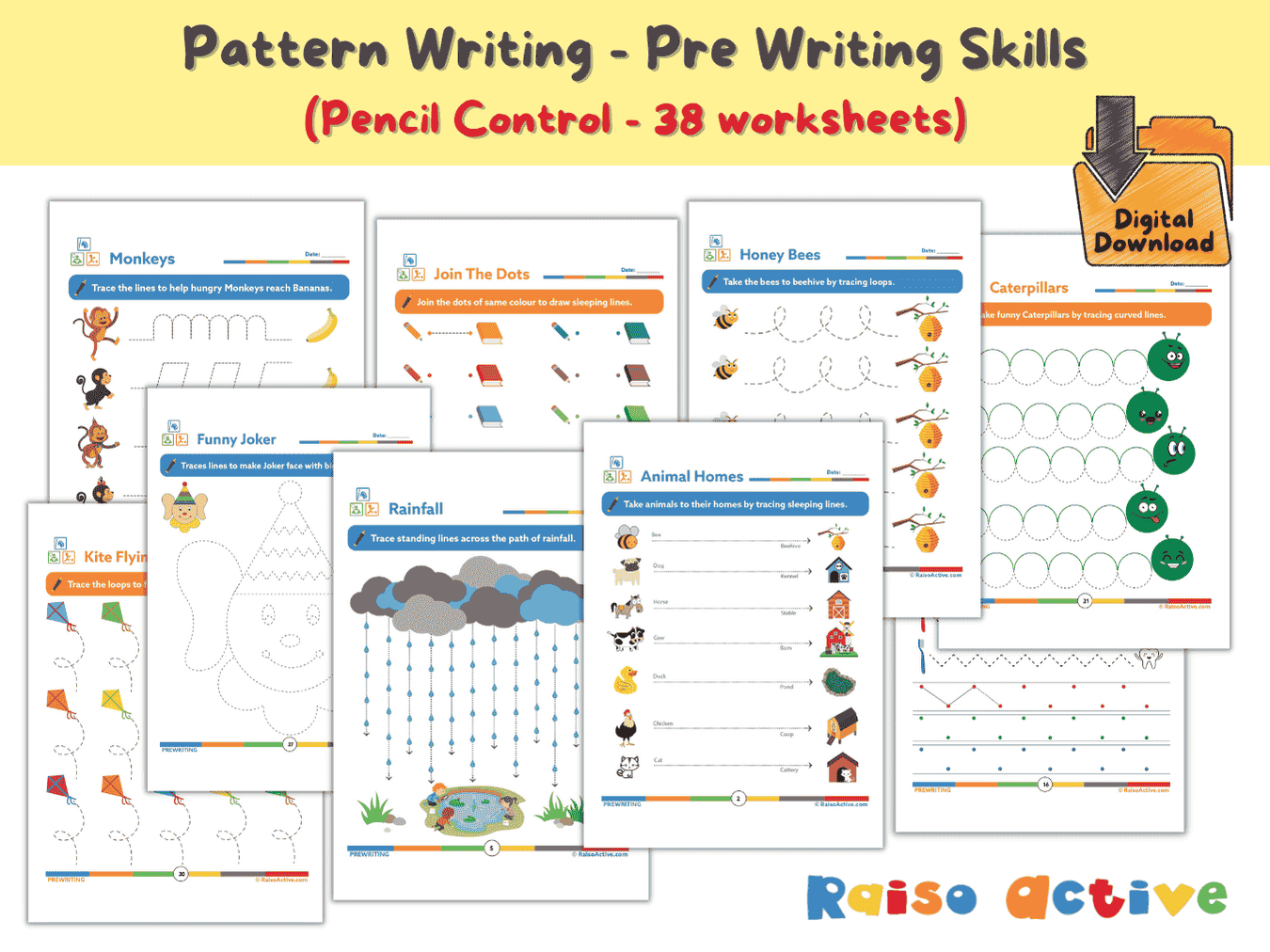

Pattern Writing Pre-writing Skills Activity Book for 3-4 Year Olds
Ages 3-4 · PreschoolAges 3-4 · NurseryAges 3-4 · 44 pages
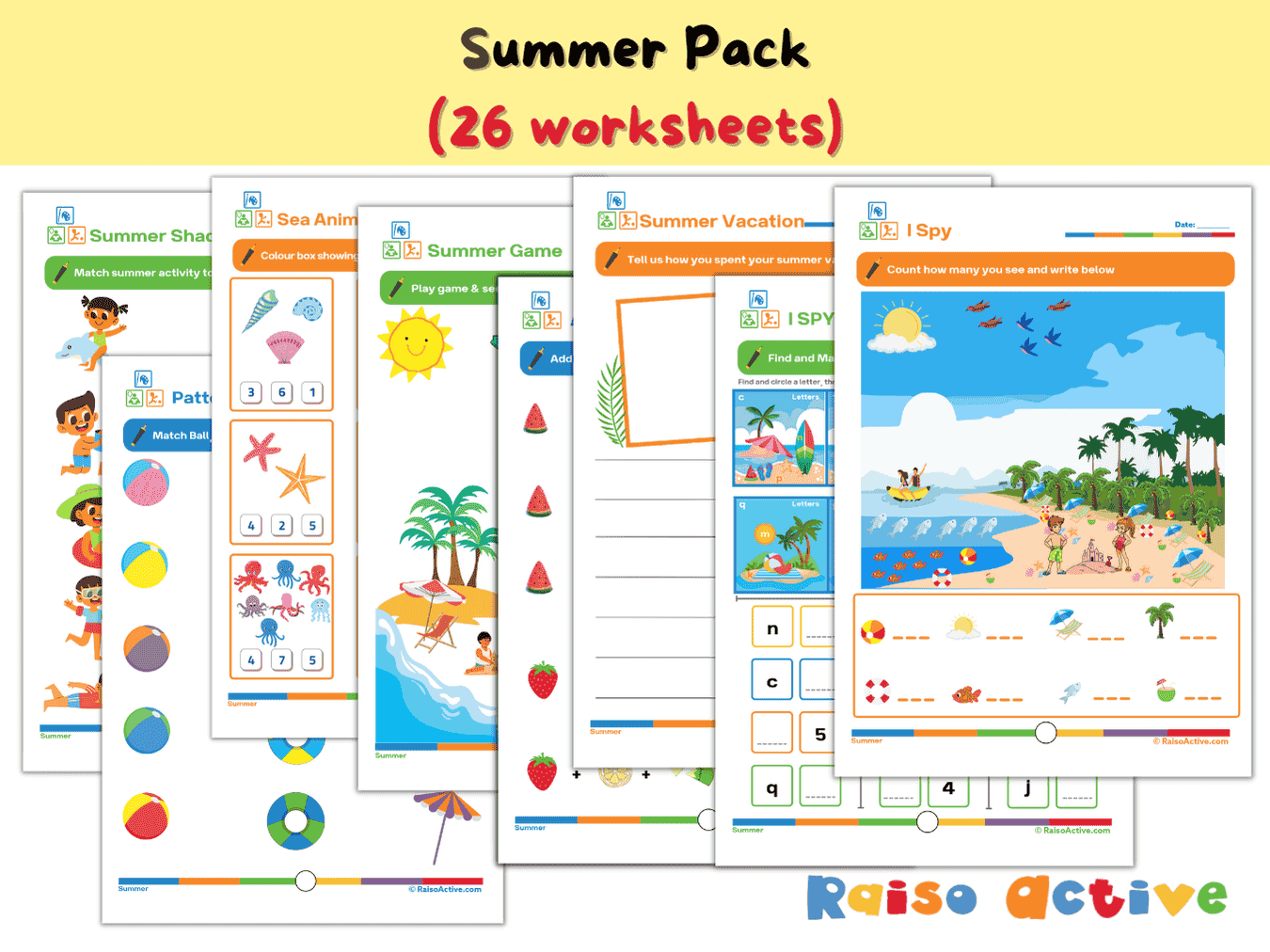

Summer Activity Pack: Math, Literacy, Puzzles & More for Preschool & Kindergarten
Ages 3-7 · Preschool–Grade 1Ages 3-7 · Nursery–Year 2Ages 3-7 · Nursery–Class 1Ages 3-7 · 26 pages
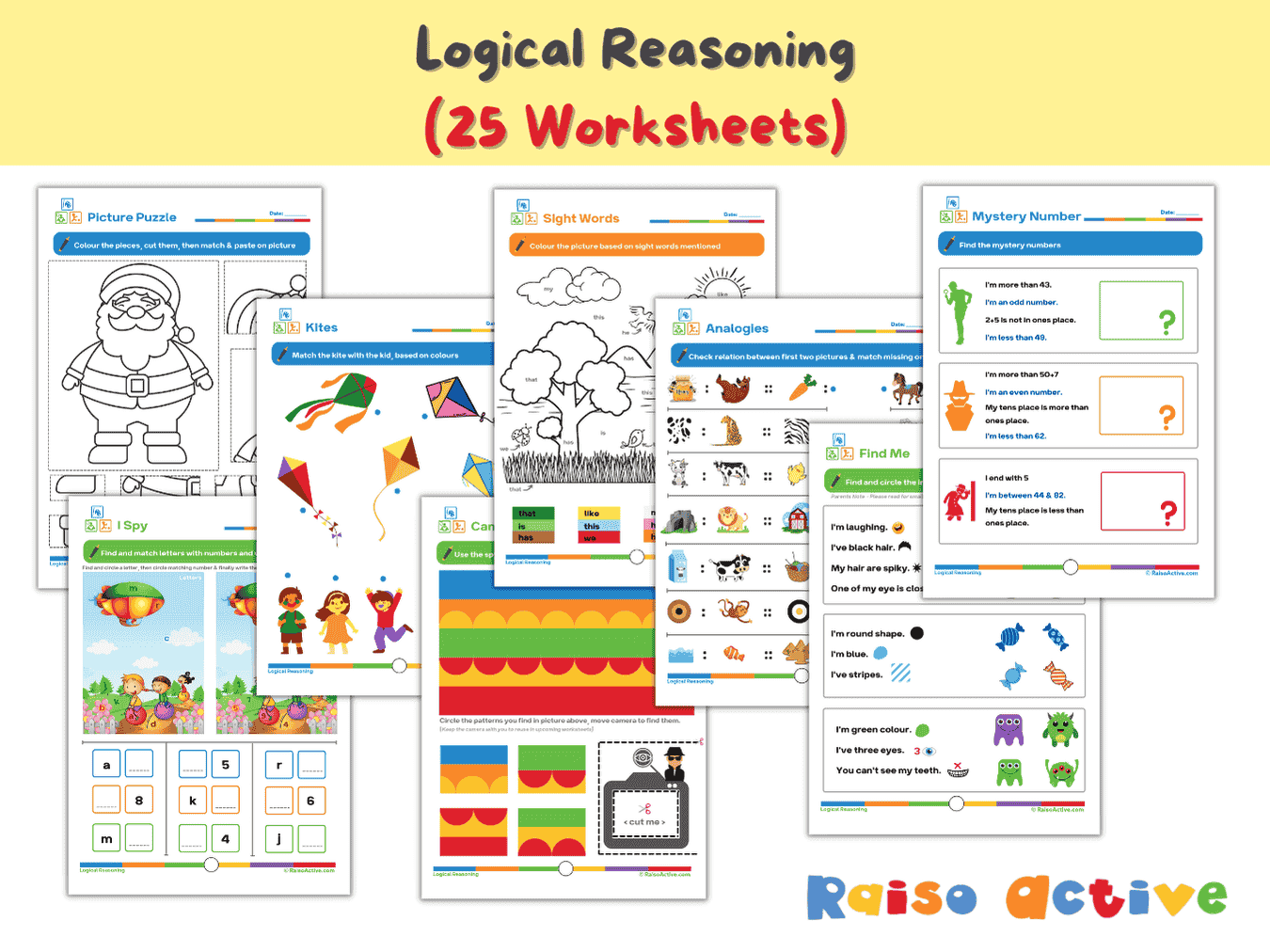

Logical Reasoning Activity Book for Preschool & Kindergarten | Patterns, Sudoku, Mazes & Coding
Ages 4-7 · Pre-K–Grade 1Ages 4-7 · Reception–Year 2Ages 4-7 · LKG–Class 1Ages 4-7 · 34 pages
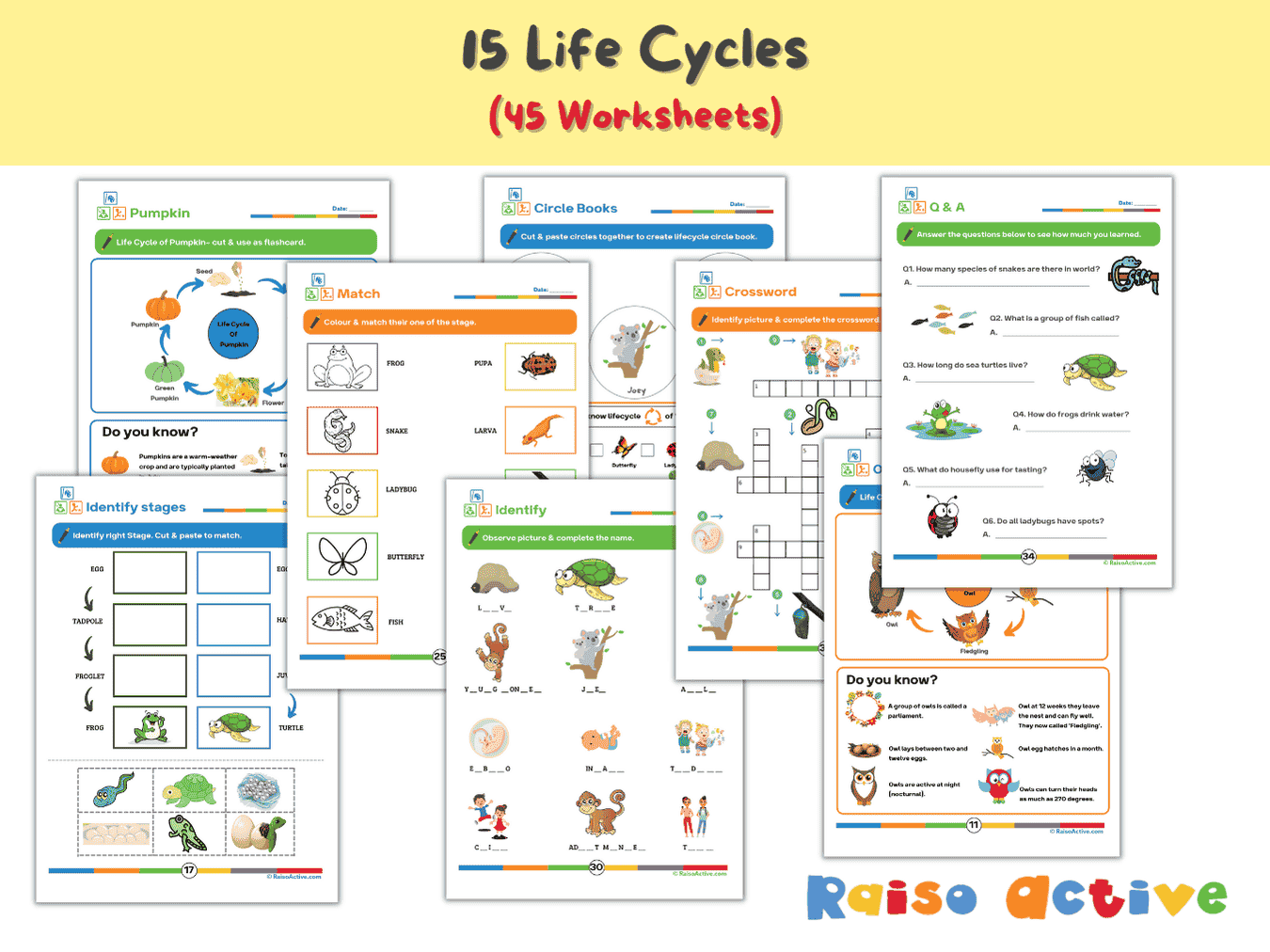

Lifecycles Activity Book & Flashcards for Preschool & Early Elementary
Ages 3-8 · Preschool–Grade 2Ages 3-8 · Nursery–Year 3Ages 3-8 · Nursery–Class 2Ages 3-8 · 46 pages
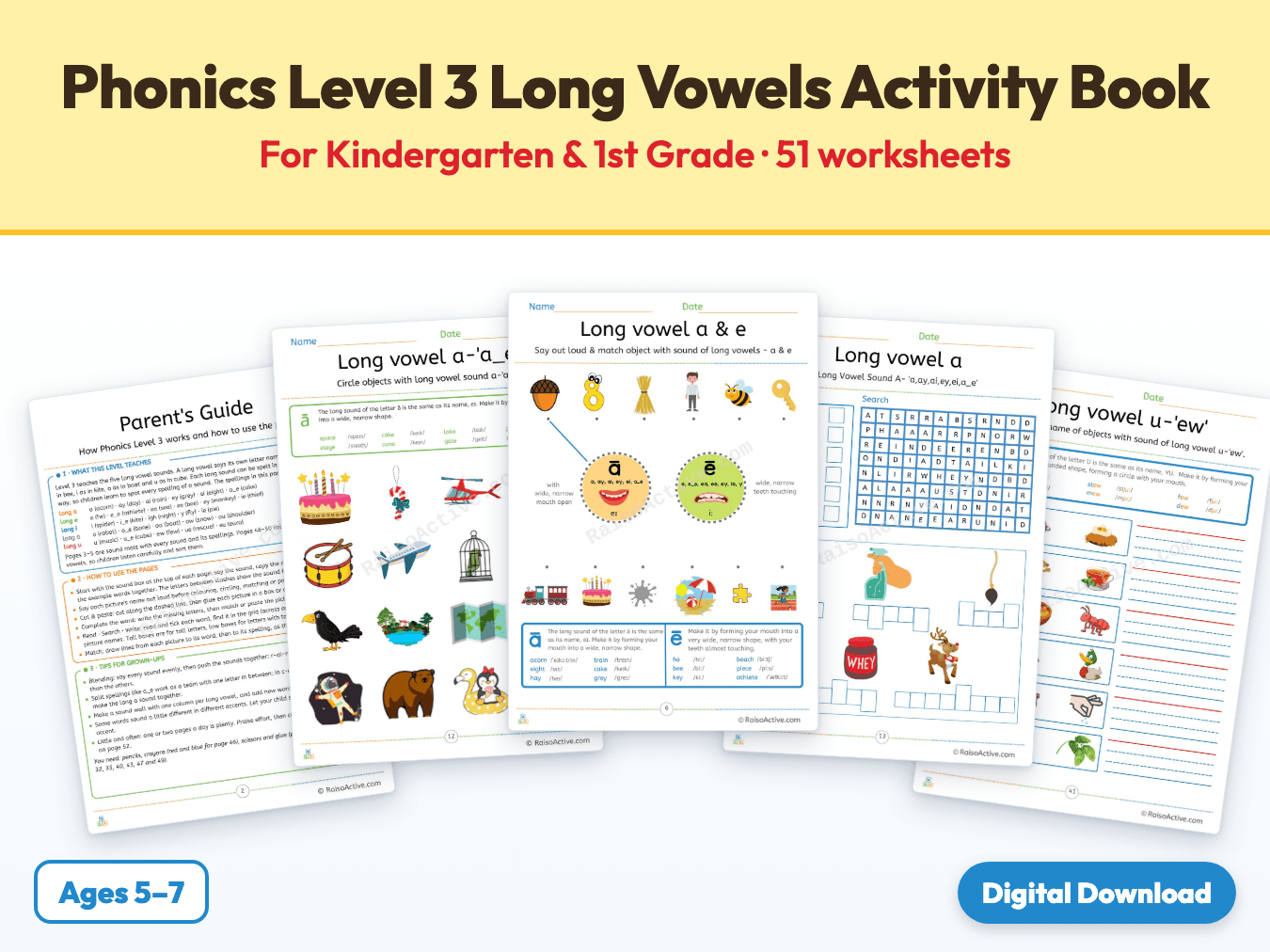

Phonics Level 3 Long Vowels Activity Book for Kindergarten & 1st Grade
Ages 5-7 · Kindergarten–Grade 1Ages 5-7 · Year 1–Year 2Ages 5-7 · UKG–Class 1Ages 5-7 · 52 pages
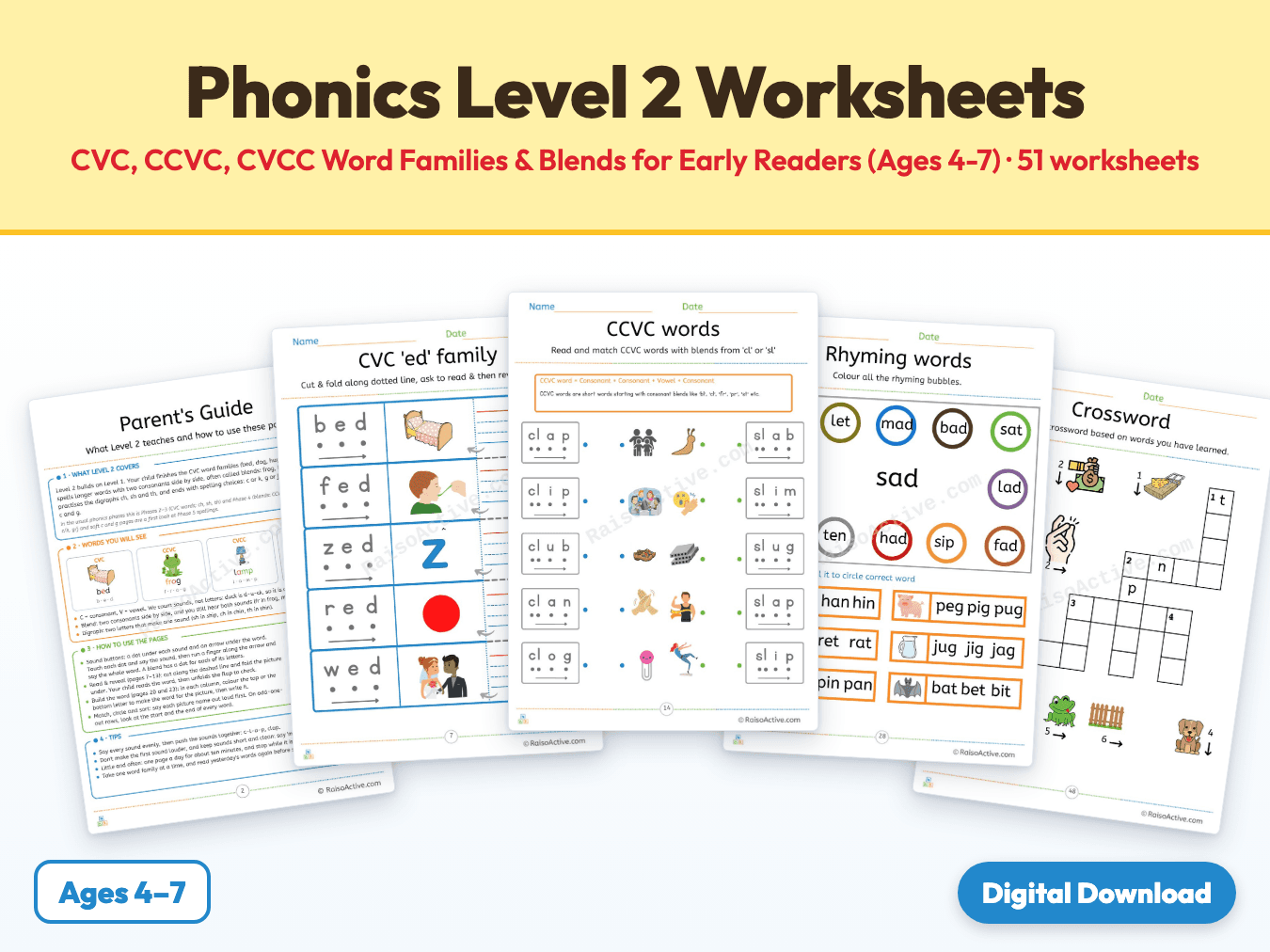
Phonics Level 2 Worksheets: CVC, CCVC, CVCC Word Families & Blends for Early Readers (Ages 4-7)
Ages 4-7 · Pre-K–Grade 1Ages 4-7 · Reception–Year 2Ages 4-7 · LKG–Class 1Ages 4-7 · 52 pages
Guides for parents and teachers
See all guides
Sight Words by Age: The First 50 Words and How to Teach Them Without Flashcard Fatigue
Which sight words to teach first and why, the heart-word method, a read-trace-write-find routine, games, and a by-age table of typical sight-word progress.

Number Formation Rhymes 0–9 and How to Fix Reversals
Original number formation rhymes for 0–9, the correct stroke order for each digit, why 3, 5 and 7 get reversed most often, and multisensory fixes that work.

Pre-Writing Strokes in Order: From Standing Lines to Loops (With Printable Patterns)
The developmental order of pre-writing strokes, from vertical lines to loops, and why practicing them in sequence makes letter formation much easier to learn.

Kindergarten Readiness Checklist: 25 Skills to Practice Before the First Day
A kindergarten readiness checklist of 25 literacy, math, motor, self-regulation and self-help skills, with an 8-week summer plan and notes on when not to worry.
Best Worksheets for 3-Year-Olds: What Works and What to Avoid
What works on worksheets for 3-year-olds: short sessions, crayons, tracing lines, matching, cutting, a free weekly plan, and signs one is too advanced.
Reception Year Explained: EYFS Learning and How to Help at Home
A teacher's plain-English guide to the Reception Year: the seven areas of learning, Early Learning Goals, Phase 2/3 phonics, the RBA and home routines.