Shape Sorting Worksheet: Cut and Paste Fun!
Sorting everyday objects — a plate, an egg, a clock — into 'circle' or 'oval' bins asks a 3-5 year old to look past what an object is and notice its geometric shape instead, an early step toward abstract categorization. Cutting along the outline of each picture and gluing it into the right column also builds the scissor control and hand-eye coordination that later supports handwriting.
Part of the pack
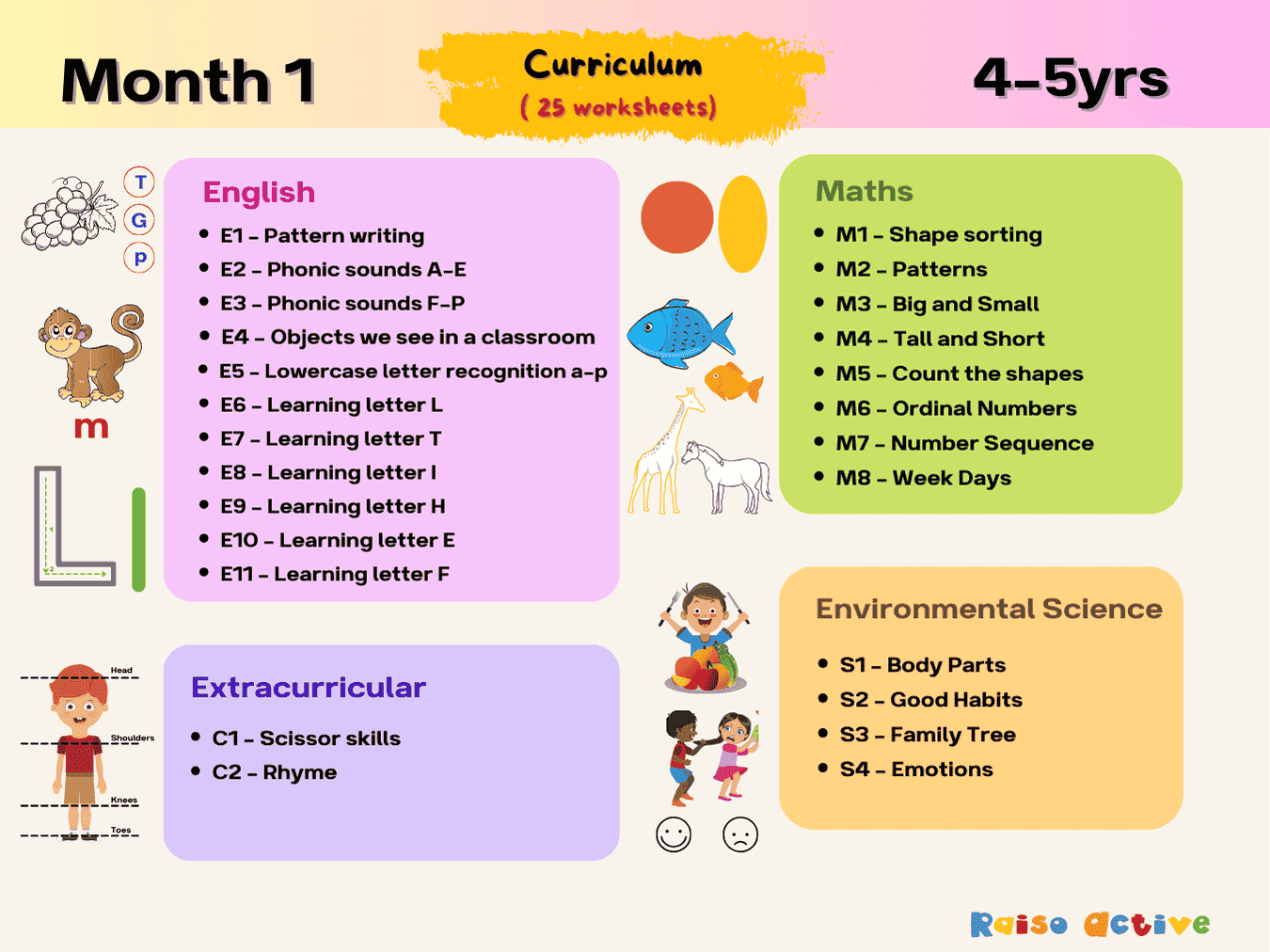
Month 1: Learning & Development | Ages 4-5
This is page 15 of the pack. Ages 4-5 · Pre-KAges 4-5 · ReceptionAges 4-5 · LKGAges 4-5
Curriculum
- 2D Shapes > Shapes & Sorting
How to use this worksheet
Cut out the small object pictures at the bottom of the page first, keeping them in a loose pile. Hold up each cutout and ask your child whether it looks more like a circle or an oval before they glue it — naming the shape out loud locks it in better than sorting silently. Once every piece has a shape category, glue each one into its matching column and let the glue dry flat before closing the page.
Materials needed
- Scissors
- Glue
- Pencil
Extension activities
- 1Trace around a real plate and a real egg to compare a true circle against a true oval side by side.
- 2Sort actual household objects — coins, cookies, a picture frame — into circle and oval piles.
- 3Draw a circle and an oval next to each other and have your child spot the difference out loud.
- 4Make shape prints in playdough using a cup (circle) and a spoon bowl (oval).
- 5Go on a shape walk and count how many circles versus ovals you spot outside.

Written by
Hemsweta Jain · Teacher Cheena
MBA and Early Childhood Educator, teaching since 2014 · Founder of RaisoActive, Mumbai
Every RaisoActive worksheet is designed and checked by the founder before publishing.
Published · Last reviewed
More from Month 1: Learning & Development | Ages 4-5

Diamond Shape Counting and Matching Worksheet for Preschoolers
Ages 3-5 · Preschool–Pre-KAges 3-5 · Nursery–ReceptionAges 3-5 · Nursery–LKGAges 3-5
This diamond-themed worksheet helps 3-5 year olds tell a diamond apart from squares, circles, and triangles by its four slanted sides and pointed top and bottom, a shape many preschoolers find trickier than rounder or more symmetrical ones. Counting the diamonds one at a time builds one-to-one correspondence, and matching same-sized diamonds strengthens visual discrimination, the skill of spotting small differences between similar-looking shapes.

My Family Tree Worksheet: Learn About Family Members!
Ages 3-5 · Preschool–Pre-KAges 3-5 · Nursery–ReceptionAges 3-5 · Nursery–LKGAges 3-5
Filling in a family tree helps children ages 3-5 practice family vocabulary, like mother, father, sibling, and grandparent, while also building an early sense of belonging and identity by seeing themselves as part of a larger family structure. Talking through each relationship as it's added also supports oral language development, since children have to describe who each person is and how that person relates to them.
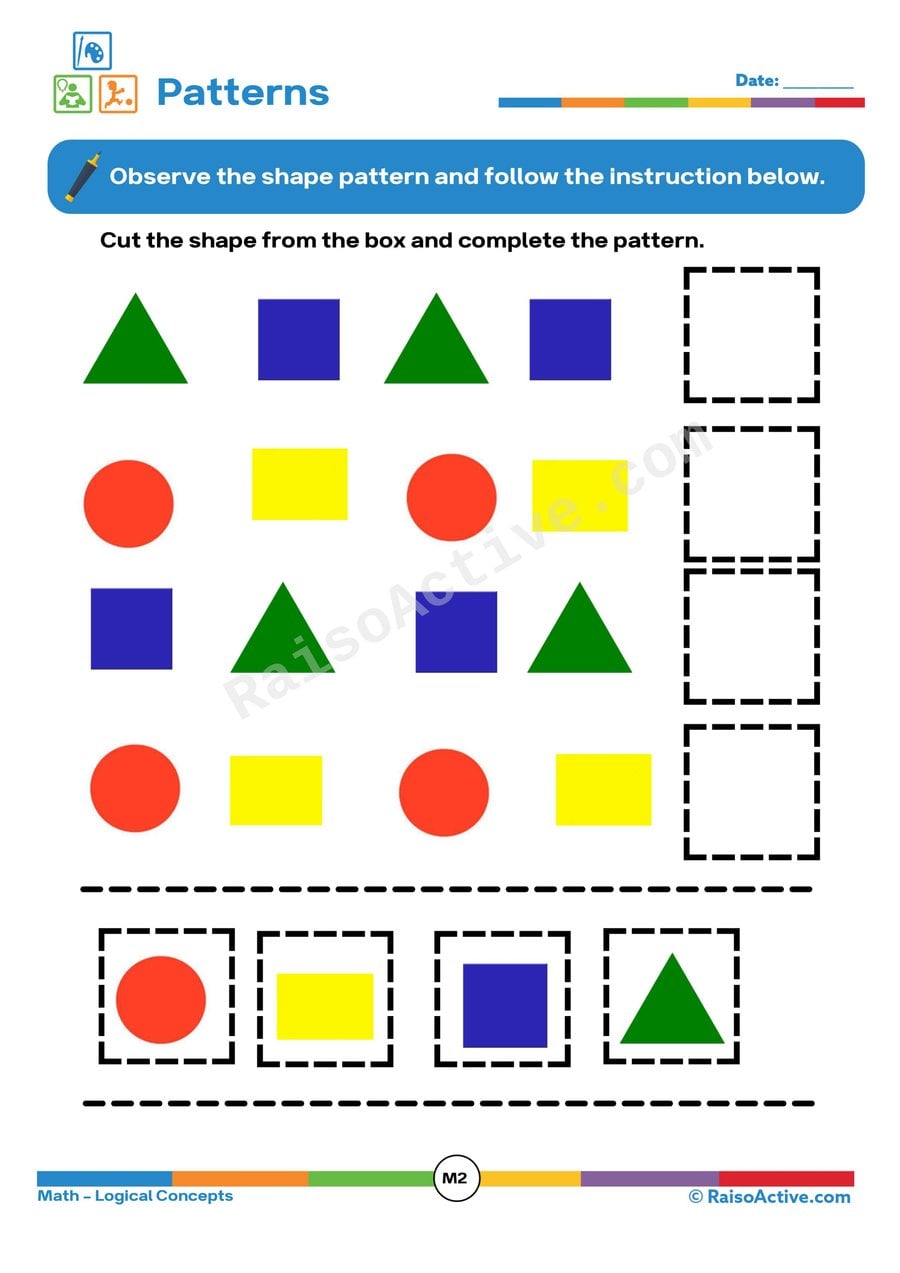
Shape Pattern Worksheet: Complete the Pattern!
Ages 3-5 · Preschool–Pre-KAges 3-5 · Nursery–ReceptionAges 3-5 · Nursery–LKGAges 3-5
Completing a repeating shape pattern asks children ages 3-5 to notice what comes next in a sequence and predict it correctly, an early form of the logical reasoning used in algebra much later on. Recognizing and continuing patterns also strengthens visual memory, since a child has to hold the beginning of the pattern in mind while figuring out what should come next.
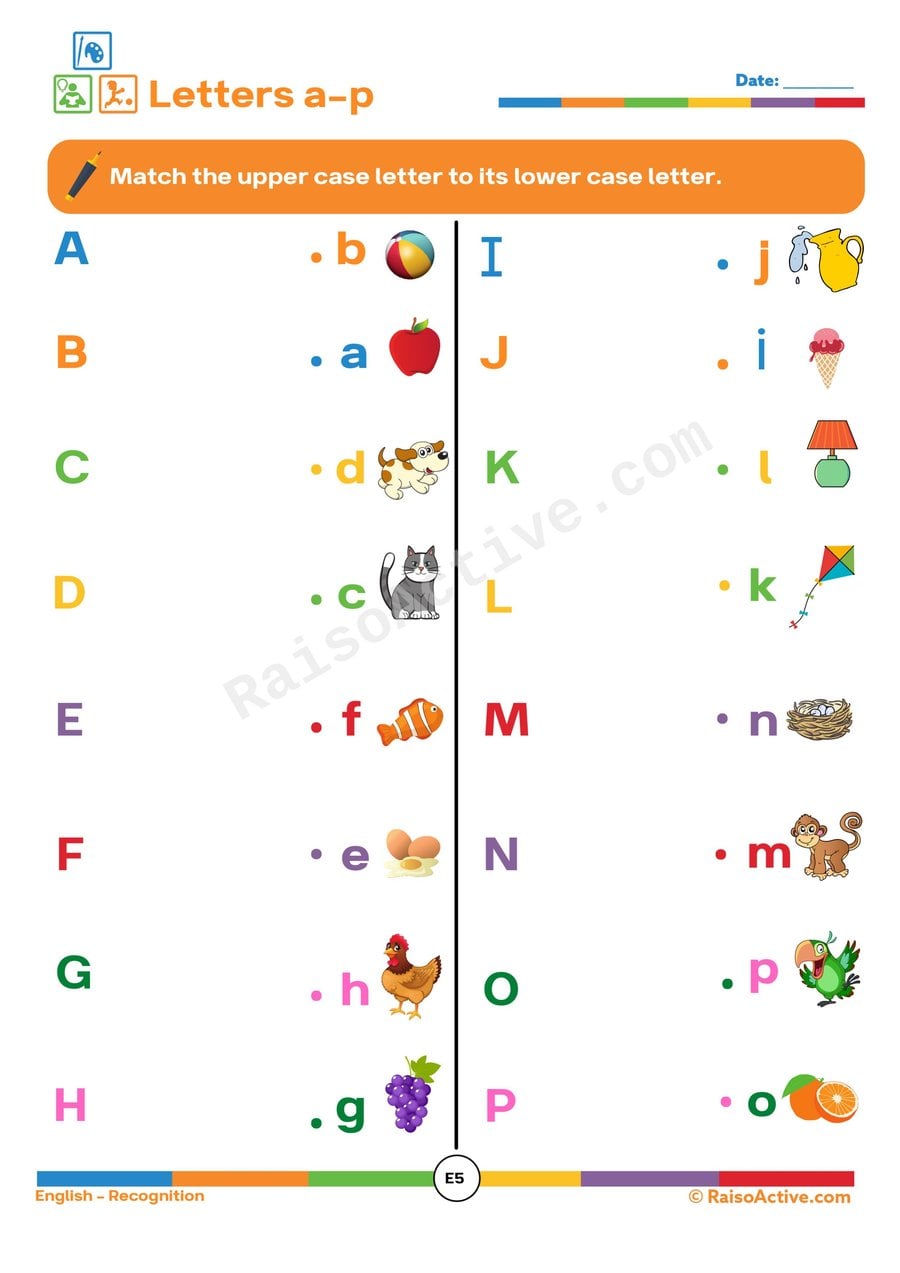
Match the Uppercase Letters: A-P Worksheet
Ages 4-5 · Pre-KAges 4-5 · ReceptionAges 4-5 · LKGAges 4-5
This worksheet strengthens your child's visual discrimination skills by focusing on uppercase letters from A to P. Children aged 4-5 years develop crucial pre-reading abilities as they learn to identify and pair identical letter forms. Mastering this matching task builds a strong foundation for future letter recognition and early literacy success.

Butterfly Cutting Practice Worksheet for Preschoolers
Ages 3-5 · Preschool–Pre-KAges 3-5 · Nursery–ReceptionAges 3-5 · Nursery–LKGAges 3-5
Cutting along a butterfly's wing outline gives children ages 3-5 focused scissor practice with a mix of straight and gently curved edges, building the specific hand strength and control needed for more advanced cutting tasks. Scissor skills like this directly support later pencil control too, since both rely on similar hand muscles and a steady, coordinated grip between two hands.

Big and Small Fish Counting Worksheet for Preschoolers
Ages 3-5 · Preschool–Pre-KAges 3-5 · Nursery–ReceptionAges 3-5 · Nursery–LKGAges 3-5
This worksheet helps children aged 3-5 develop crucial early numeracy by practicing one-to-one correspondence as they count specific groups of fish. Children will also strengthen their observation skills by distinguishing between 'big' and 'small' fish, a foundational step in understanding comparative sizes and classification. This combination builds both number sense and pre-mathematical reasoning.

Animal Babies Tracing Worksheet: Help the Babies Find Their Mothers!
Ages 3-5 · Preschool–Pre-KAges 3-5 · Nursery–ReceptionAges 3-5 · Nursery–LKGAges 3-5
This tracing worksheet sharpens fine motor skills and hand-eye coordination as children carefully follow the dotted lines. It helps them develop the controlled pencil movements essential for pre-writing while reinforcing visual discrimination to match baby animals with their mothers. Children also expand their vocabulary by identifying different animal families and their offspring.
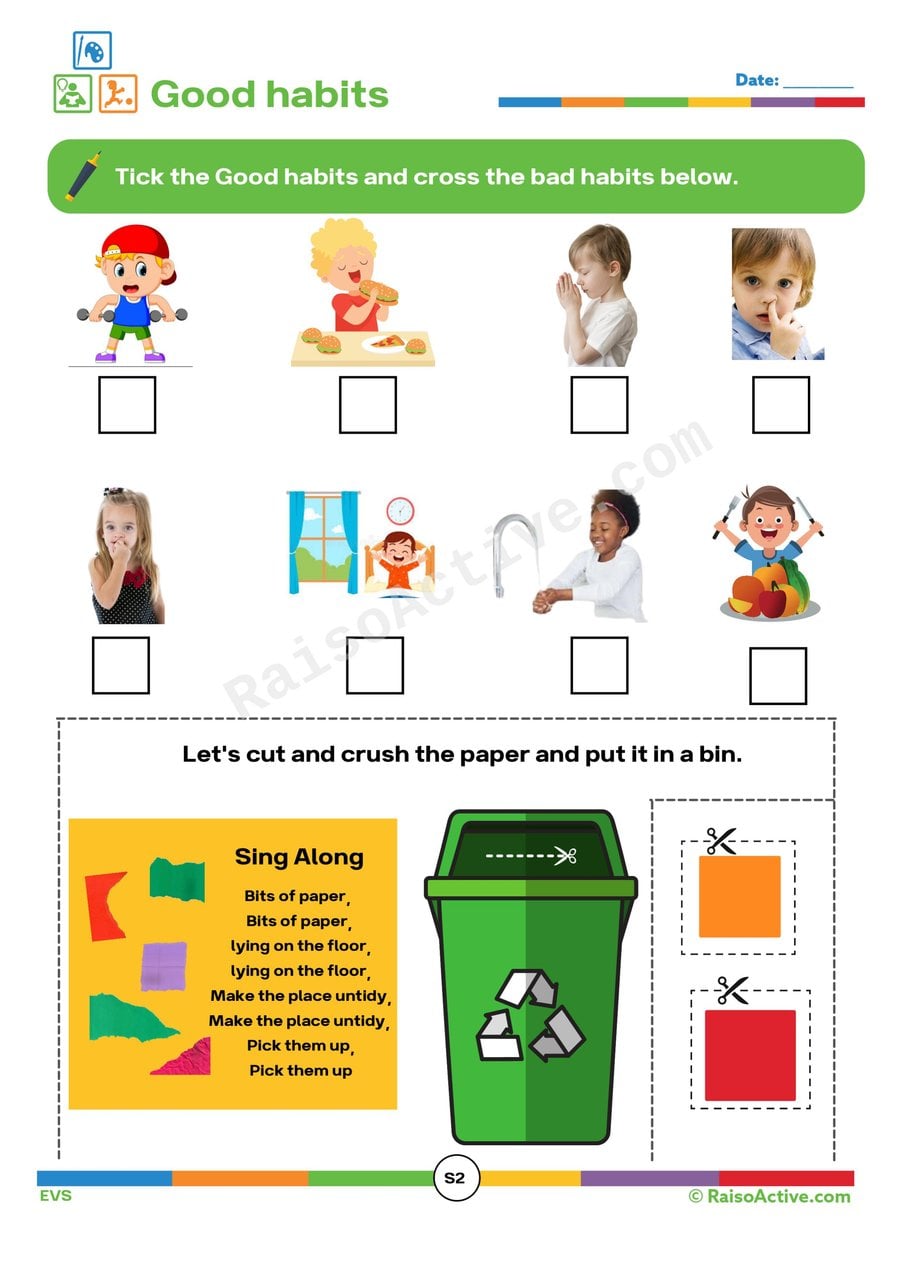
Good Habits Worksheet for Kids: Tick and Cross!
Ages 4-6 · Pre-K–KindergartenAges 4-6 · Reception–Year 1Ages 4-6 · LKG–UKGAges 4-6
Marking each pictured behavior with a tick or a cross asks children ages 4-6 to reason about whether an action is a good habit or a bad one, an early exercise in moral and social reasoning that goes beyond simple right-or-wrong memorization. Using tick and cross symbols also introduces basic symbol literacy, since children need to understand what each mark conventionally represents before they can use it correctly.
Related worksheets
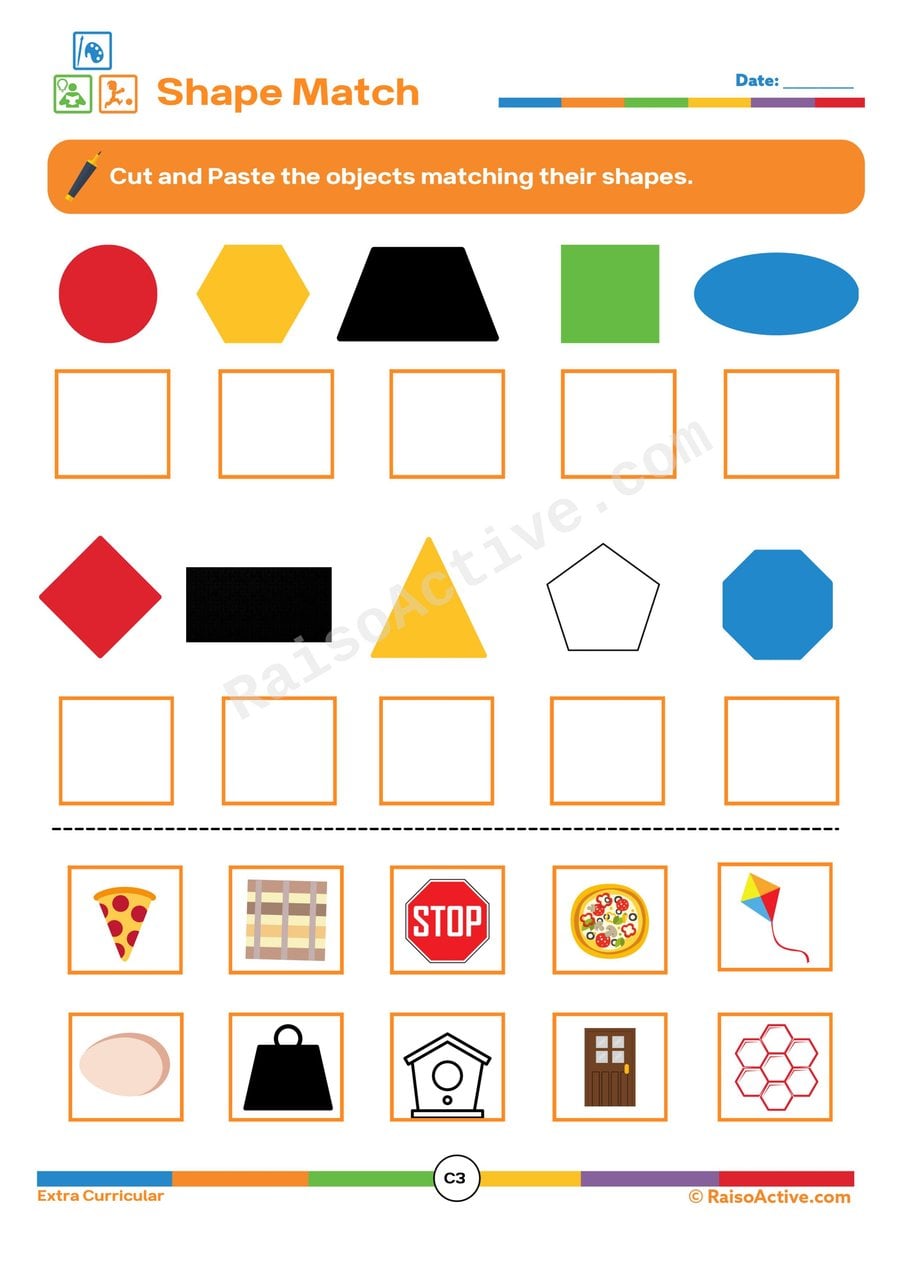
Shape Match Worksheet: Cut and Paste Shapes!
Ages 3-5 · Preschool–Pre-KAges 3-5 · Nursery–ReceptionAges 3-5 · Nursery–LKGAges 3-5
Children ages 3-5 practice shape recognition and visual discrimination as they cut out everyday objects and match each one to the 2D shape it most closely resembles, reinforcing that shapes exist all around them, not just on a worksheet page. This kind of real-world shape matching builds a stronger foundation than memorizing shape names in isolation.
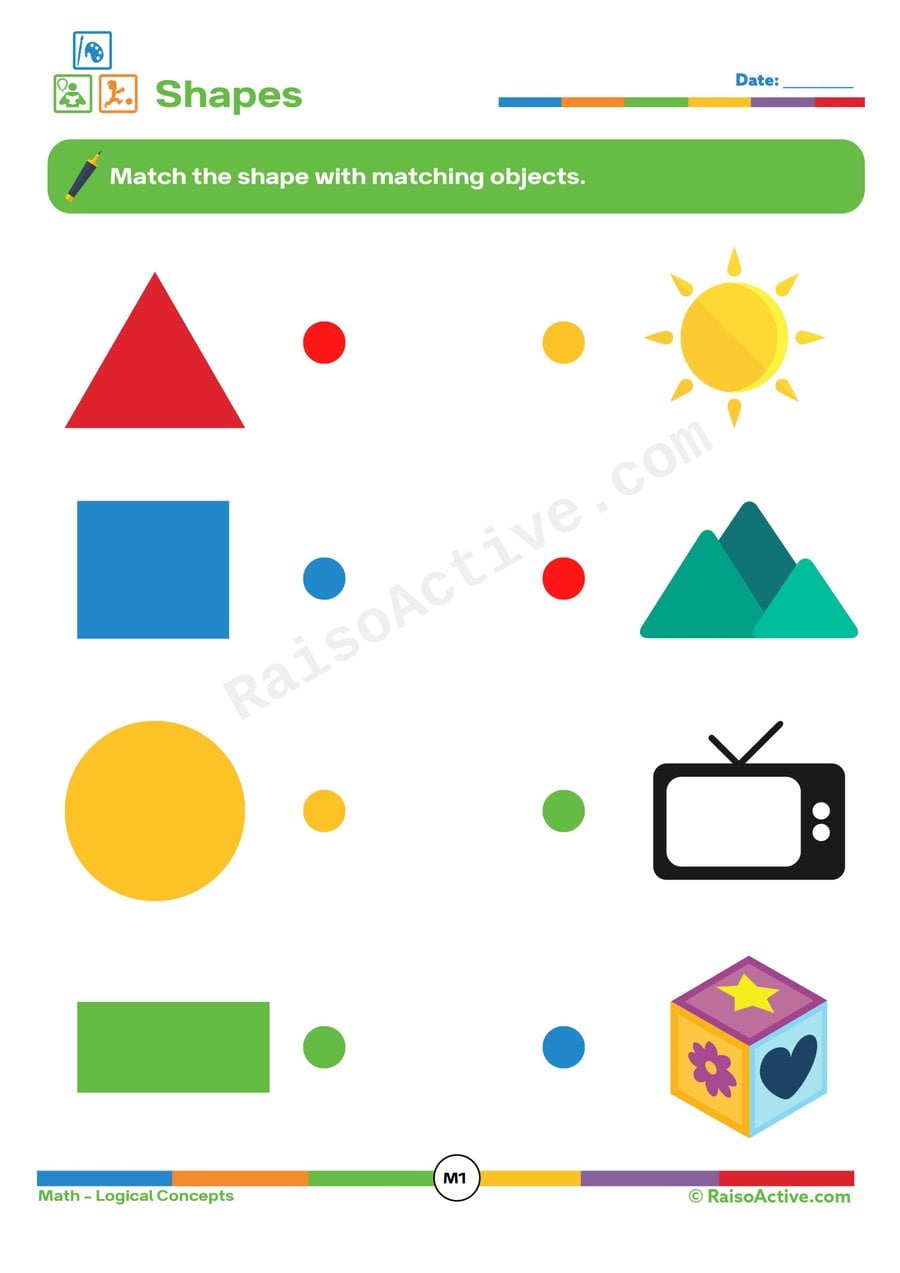
Shape Matching Worksheet for Preschoolers
Ages 3-5 · Preschool–Pre-KAges 3-5 · Nursery–ReceptionAges 3-5 · Nursery–LKGAges 3-5
This worksheet helps children ages 3-5 practice recognizing basic geometric shapes by connecting each shape outline to the everyday object it resembles. Pairing an abstract shape with a concrete object supports the transition from recognizing shapes in isolation to spotting them out in the real world. Drawing a connecting line between the matched pairs also builds hand-eye coordination and pencil control.

Shape Exploration: A Parent's Guide to Shapes and Movement
Ages 3-5 · Preschool–Pre-KAges 3-5 · Nursery–ReceptionAges 3-5 · Nursery–LKGAges 3-5
This parent-led guide helps children ages 3-5 connect shape knowledge to physical movement and everyday observation, exploring how shapes look, how they can move (rolling, sliding, stacking), and where they appear in the real world. Linking abstract shape names to hands-on exploration and movement builds a much deeper understanding than simply naming shapes on a page.

Shape Sorting Fun: Cut and Glue Worksheet for Preschoolers
Ages 3-5 · Preschool–Pre-KAges 3-5 · Nursery–ReceptionAges 3-5 · Nursery–LKGAges 3-5
Sorting cut-out shapes into matching rows builds shape recognition for children ages 3-5, requiring them to visually compare each piece's sides and corners before placing it correctly. This early geometry practice, paired with the fine motor demands of cutting and gluing, strengthens both cognitive classification skills and hand control at the same time.

Shape Dog Craft: Cut and Assemble a Fun Shapes Worksheet!
Ages 3-5 · Preschool–Pre-KAges 3-5 · Nursery–ReceptionAges 3-5 · Nursery–LKGAges 3-5
This worksheet helps children ages 3-5 recognize and assemble basic shapes, like circles, triangles, and squares, into a recognizable dog, reinforcing shape recognition while also building the fine motor precision needed to cut and place pieces accurately. Following a visual example to combine multiple shapes into one picture also strengthens early spatial reasoning.

Semi-Circle Fun: Tracing, Counting, and Patterns Worksheet for Preschoolers
Ages 3-5 · Preschool–Pre-KAges 3-5 · Nursery–ReceptionAges 3-5 · Nursery–LKGAges 3-5
This worksheet helps children ages 3-5 learn about semi-circles through tracing their curved edge, counting how many appear in a group, and identifying which shape comes next in a repeating pattern. Covering one shape across three different skills, tracing, counting, and patterning, gives children a well-rounded, layered understanding of what makes a semi-circle unique.
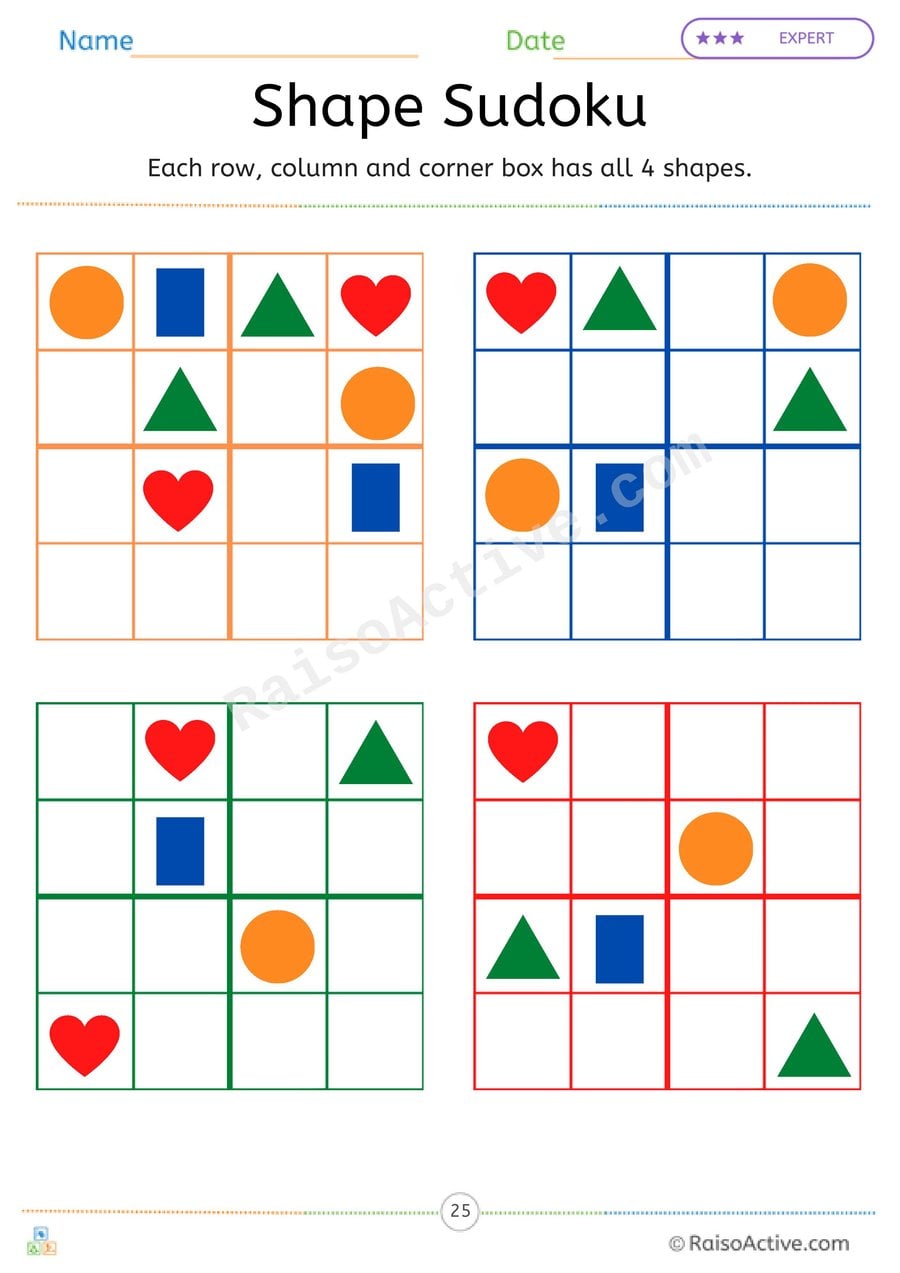
Shape Sudoku for Kids: 4x4 Shape Puzzles
Ages 4-7 · Pre-K–Grade 1Ages 4-7 · Reception–Year 2Ages 4-7 · LKG–Class 1Ages 4-7
This worksheet helps children develop logical reasoning skills by completing shape-based Sudoku puzzles.

Shape Song Fun: Color & Learn Shapes Worksheet for Preschoolers
Ages 3-5 · Preschool–Pre-KAges 3-5 · Nursery–ReceptionAges 3-5 · Nursery–LKGAges 3-5
Coloring each shape according to its outline helps children ages 3-5 practice recognizing 2D shapes while staying within lines, and singing the accompanying shape song adds a rhythmic memory aid that makes shape names easier to recall. Combining a physical coloring task with an auditory song appeals to multiple ways young children learn best.
Guides for this topic

Age-Appropriate Problem-Solving Activities: Building Critical Thinkers from the Ground Up
Discover fun, age-appropriate problem-solving activities for children ages 1-8. Build critical thinking, logic, and reasoning skills through play-based learning.

Christmas and Winter Activities That Combine Fun and Learning: Creating Magical Educational Experiences
Discover Christmas and winter activities that combine festive fun with real learning. Crafts, counting, literacy, and printable worksheets for ages 2 to 8 — perfect for home and school.
Age-Appropriate Halloween Learning Activities: Balancing Spooks and Skills for Young Learners
Discover fun, age-appropriate Halloween learning activities for young children. Spooky crafts, counting games, literacy ideas, and printable worksheets for ages 2 to 8.
Reviews
Every worksheet for ages 3–5, no watermark
Members download the full library of 1,000+ worksheets and every activity pack without watermarks or daily limits. One year costs ₹999 in India or $20 elsewhere.
See membership plansOr download any worksheet free with a watermark (5 a day).