Shape Song Fun: Color & Learn Shapes Worksheet for Preschoolers
Coloring each shape according to its outline helps children ages 3-5 practice recognizing 2D shapes while staying within lines, and singing the accompanying shape song adds a rhythmic memory aid that makes shape names easier to recall. Combining a physical coloring task with an auditory song appeals to multiple ways young children learn best.
Part of the pack
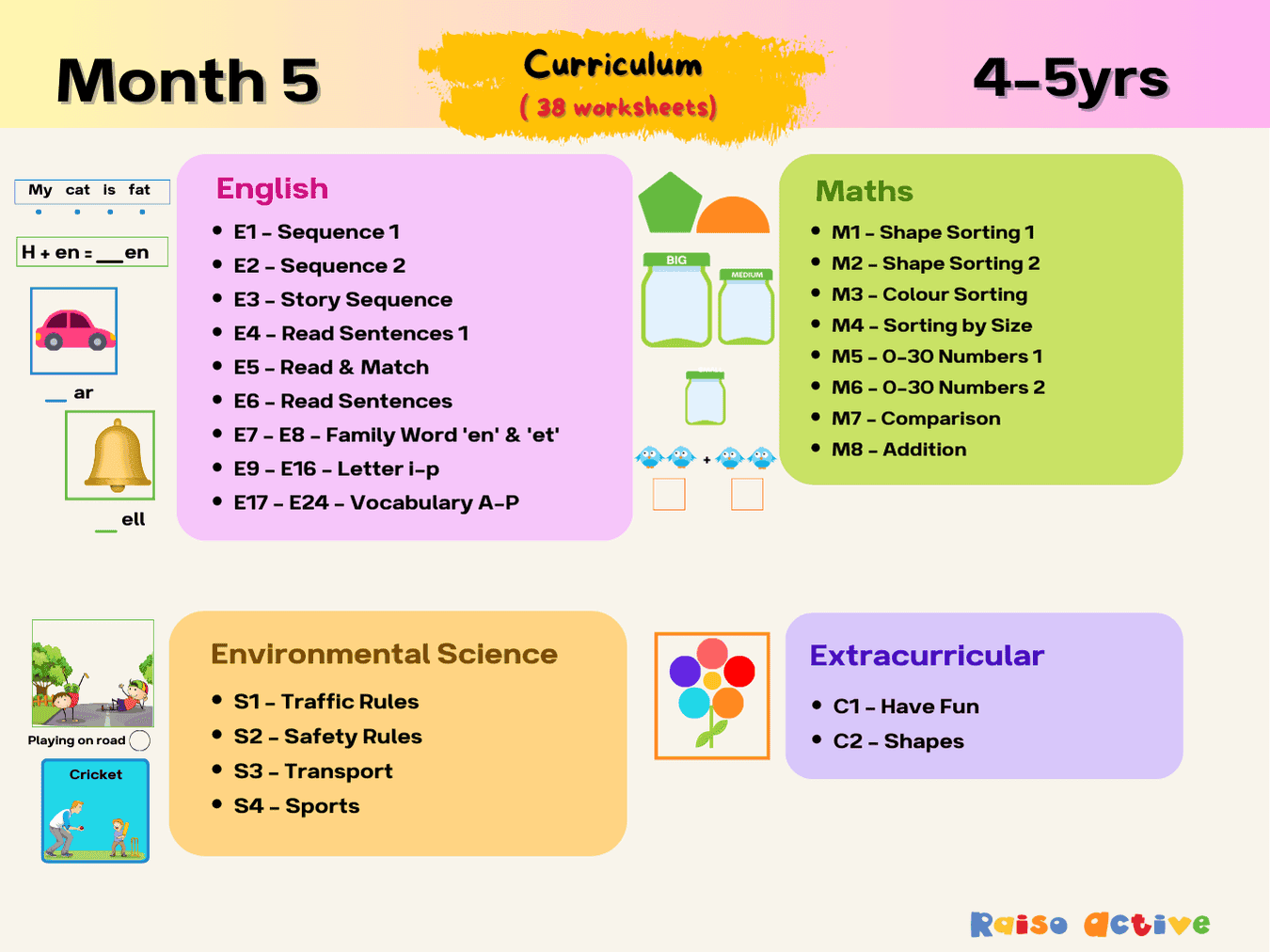
Month 5: Literacy, Math, Environmental Science | Ages 4-5
This is page 41 of the pack. Ages 4-5 · Pre-KAges 4-5 · ReceptionAges 4-5 · LKGAges 4-5
Made for your child
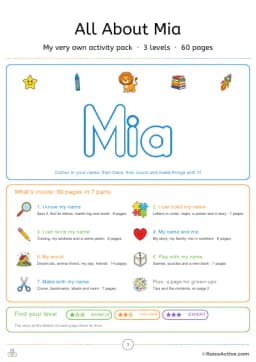
A whole activity pack made with their name
60 pages to spot, build, trace and write their own name, plus pages about their favourites, feelings and family. See a free preview with their name.
Make an All About Me packFree preview · free for members
Or start free: a name tracing sheet with their nameCurriculum
- 2D Shapes > Shapes & Sorting
How to use this worksheet
Look at each shape on the page together and name it before your child begins coloring. Have them color each shape neatly within its outline, saying the shape's name aloud as they work. Once all shapes are colored, read or sing the shape song together, pointing to each matching shape on the page as you go.
Materials needed
- Crayons
- Pencil
Extension activities
- 1Go on a shape hunt around the house, finding real objects that match the shapes from the song.
- 2Take a walk outside and point out shapes seen in windows, signs, and buildings.
- 3Create a shape collage using cut construction paper shapes glued onto a big sheet.
- 4Make up a new verse for the shape song using a shape not covered on the worksheet.
- 5Play a shape scavenger hunt game with a simple checklist of shapes to find.

Written by
Hemsweta Jain · Teacher Cheena
MBA and Early Childhood Educator, teaching since 2014 · Founder of RaisoActive, Mumbai
Every RaisoActive worksheet is designed and checked by the founder before publishing.
Published · Last reviewed
More from Month 5: Literacy, Math, Environmental Science | Ages 4-5

Learn the Letter 'm' Worksheet: Tracing, Matching, and Coloring Fun!
Ages 3-5 · Preschool–Pre-KAges 3-5 · Nursery–ReceptionAges 3-5 · Nursery–LKGAges 3-5
This worksheet builds letter 'm' recognition through four connected tasks — tracing its shape, matching pictures that start with the Mm sound, navigating a highlight maze to help an Eskimo find an igloo, and coloring 'm' objects — which together reinforce the letter through touch, sight, and sound rather than a single repetitive drill. Multi-step worksheets like this also build a young child's ability to follow a sequence of instructions across an activity, which is its own developmental skill at ages 3-5.

Learn the Letter 'n' Worksheet: Tracing, Matching, and Coloring Fun!
Ages 3-5 · Preschool–Pre-KAges 3-5 · Nursery–ReceptionAges 3-5 · Nursery–LKGAges 3-5
This worksheet builds letter 'n' recognition for 3-5 year olds through tracing, a highlighting search, matching to pictures, and coloring — four connected tasks that ask your child to hold onto the same letter across different formats and follow multi-step instructions in sequence. The letter 'n' is frequently confused with 'm' since both involve humps, so the repeated exposure here helps children start telling the two apart by sound and shape.

Learn the Letter 'L': Tracing, Matching, and Coloring Worksheet for Preschoolers
Ages 3-5 · Preschool–Pre-KAges 3-5 · Nursery–ReceptionAges 3-5 · Nursery–LKGAges 3-5
This worksheet builds letter 'L' recognition through tracing, matching, a themed maze that highlights the letter while guiding a lion to its meat, and coloring — a four-part structure that keeps 3-5 year olds engaged across several formats while reinforcing the same letter each time. The maze section in particular adds a playful goal to what would otherwise be repetitive letter-spotting, motivating your child to scan carefully for every 'L' along the path.

Read and Match: Sentence Reading Worksheet for Early Learners
Ages 4-6 · Pre-K–KindergartenAges 4-6 · Reception–Year 1Ages 4-6 · LKG–UKGAges 4-6
This worksheet has 4-6 year olds read a full sentence aloud and then identify which picture actually matches its meaning by coloring the circle beside it, building reading comprehension in a format that requires understanding the whole sentence rather than picking out a single keyword. Because more than one picture on the page may share surface similarities, your child has to genuinely process what the sentence says, which is a stronger comprehension check than simple word-picture matching.
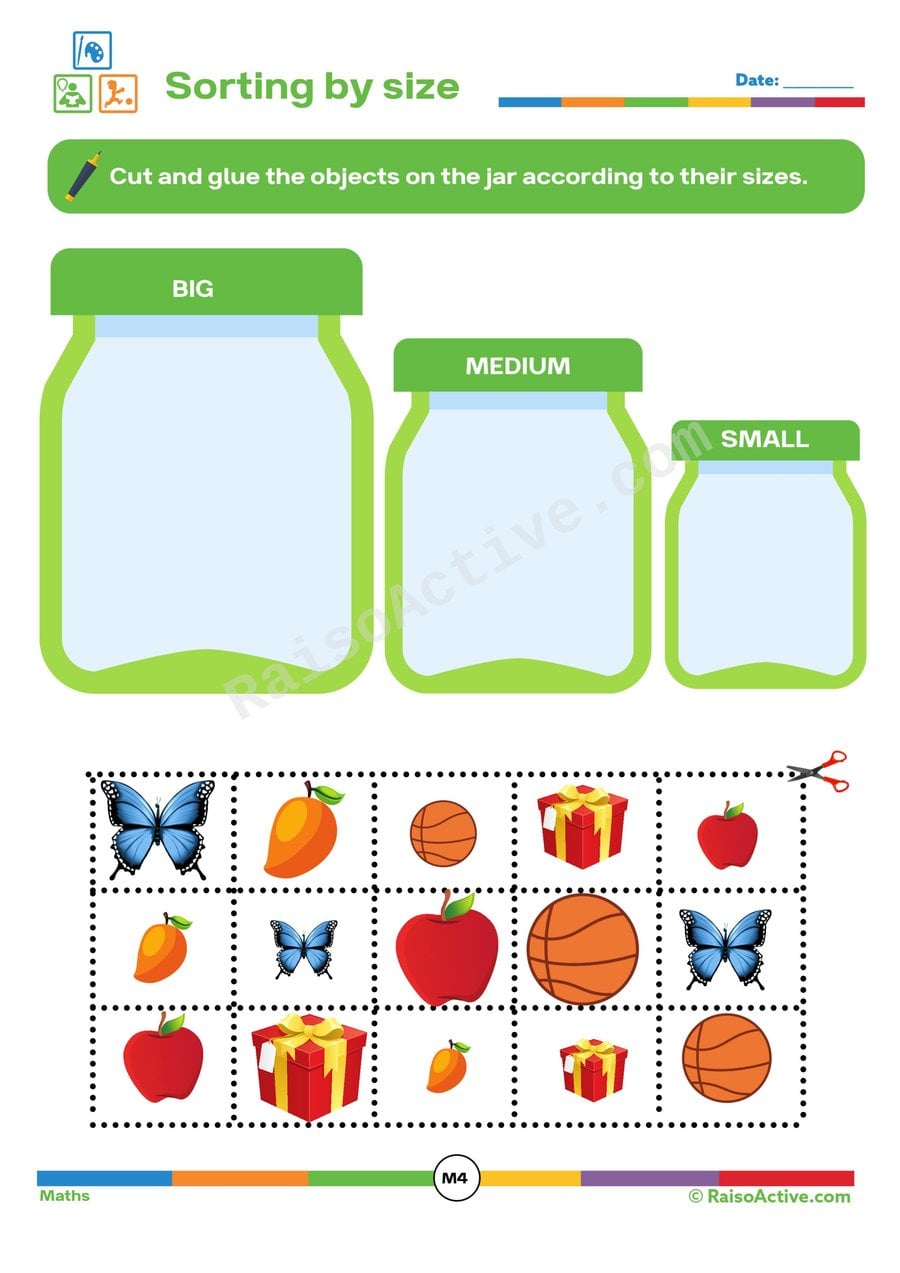
Sorting by Size: Cut and Paste Worksheet
Ages 3-5 · Preschool–Pre-KAges 3-5 · Nursery–ReceptionAges 3-5 · Nursery–LKGAges 3-5
This cut-and-paste worksheet asks 3-5 year olds to compare objects by size — big, medium, and small — and sort them into the correct jar, which is a genuinely tricky comparison since 'medium' only makes sense relative to the other two sizes rather than as an absolute category. Working through this sorting builds early comparative reasoning alongside the fine motor practice of cutting and gluing small pieces accurately.
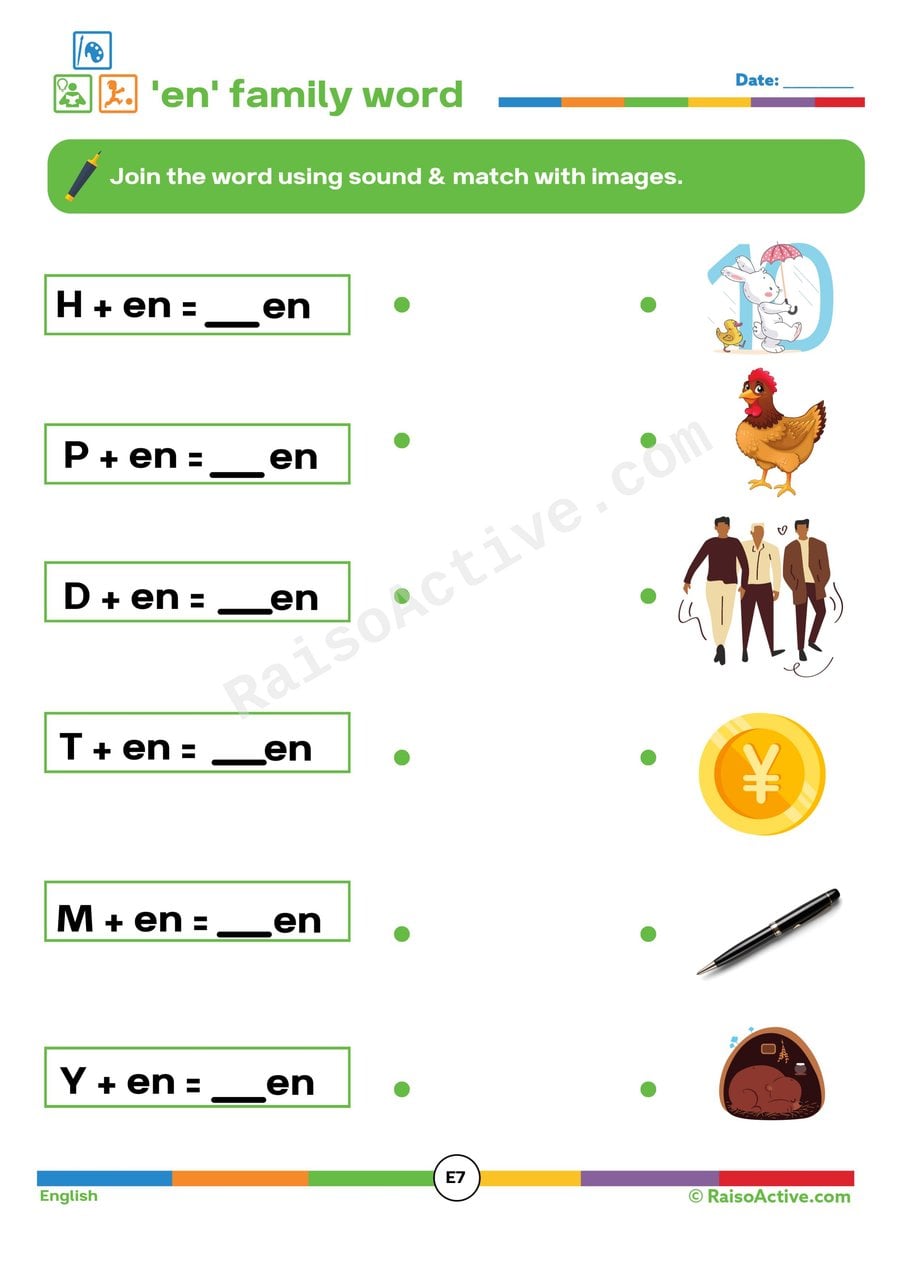
Fun 'en' Family Word Worksheet for Preschoolers
Ages 3-5 · Preschool–Pre-KAges 3-5 · Nursery–ReceptionAges 3-5 · Nursery–LKGAges 3-5
This worksheet introduces 3-5 year olds to the 'en' word family — pen, hen, ten — teaching them that once they know one ending pattern, they can read a whole group of words just by changing the beginning sound. That's a big efficiency gain in early phonics: instead of memorizing each word individually, your child learns to blend a new beginning sound onto a familiar chunk, which is exactly how fluent word-family reading develops.

First Letter Fun: Identify and Write! A Worksheet for Young Learners
Ages 3-5 · Preschool–Pre-KAges 3-5 · Nursery–ReceptionAges 3-5 · Nursery–LKGAges 3-5
This worksheet gives 3-5 year olds focused practice isolating the very first sound in a spoken word and writing the matching letter, building the same phonemic awareness skill that underlies spelling later on. Saying each picture's name aloud before writing forces your child to actively listen for the sound rather than guess at a letter from memory, which is what makes this different from copying pre-written letters.
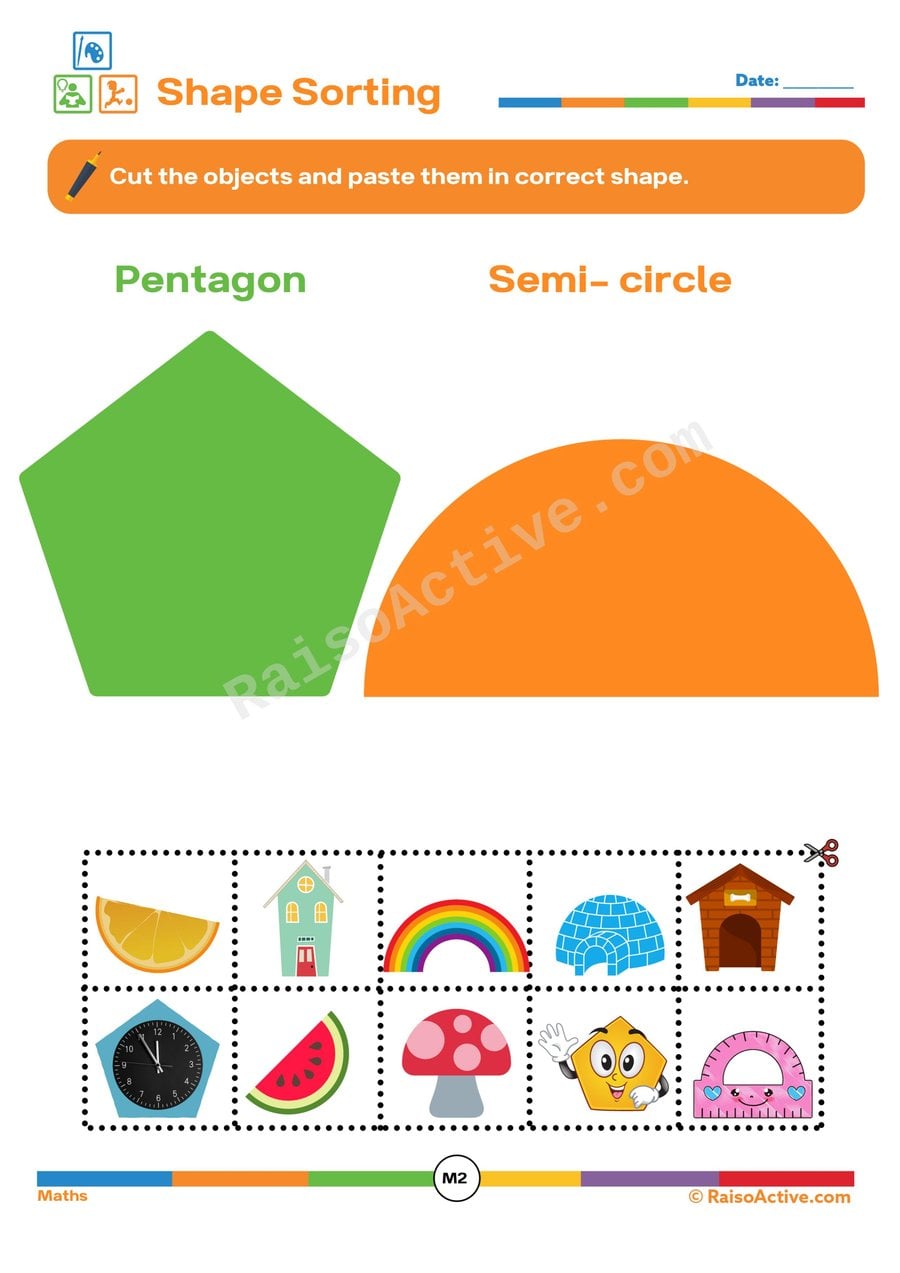
Shape Sorting Fun: Cut and Paste Shapes!
Ages 3-5 · Preschool–Pre-KAges 3-5 · Nursery–ReceptionAges 3-5 · Nursery–LKGAges 3-5
Cutting out shapes and pasting them into matching outlines teaches children ages 3-5 to recognize basic 2D shapes like circles, squares, and triangles by their defining features rather than just their color or size. The cutting and pasting also strengthens the fine motor coordination needed for handwriting later on.
Related worksheets

Shape Dog Craft: Cut and Assemble a Fun Shapes Worksheet!
Ages 3-5 · Preschool–Pre-KAges 3-5 · Nursery–ReceptionAges 3-5 · Nursery–LKGAges 3-5
This worksheet helps children ages 3-5 recognize and assemble basic shapes, like circles, triangles, and squares, into a recognizable dog, reinforcing shape recognition while also building the fine motor precision needed to cut and place pieces accurately. Following a visual example to combine multiple shapes into one picture also strengthens early spatial reasoning.

Rocket Shapes Cut and Glue Worksheet for Preschoolers
Ages 3-5 · Preschool–Pre-KAges 3-5 · Nursery–ReceptionAges 3-5 · Nursery–LKGAges 3-5
Cutting out triangles, circles, and rectangles and gluing them into place to build a rocket teaches children ages 3-5 to recognize basic 2D shapes and understand how they combine to form a larger, recognizable object. This activity strengthens scissor control along straight and curved edges while also introducing early engineering thinking, since children must consider how each shape's position contributes to the finished rocket's structure. Framing shape practice as a space-themed craft project keeps a repetitive geometry lesson feeling exciting and imaginative.
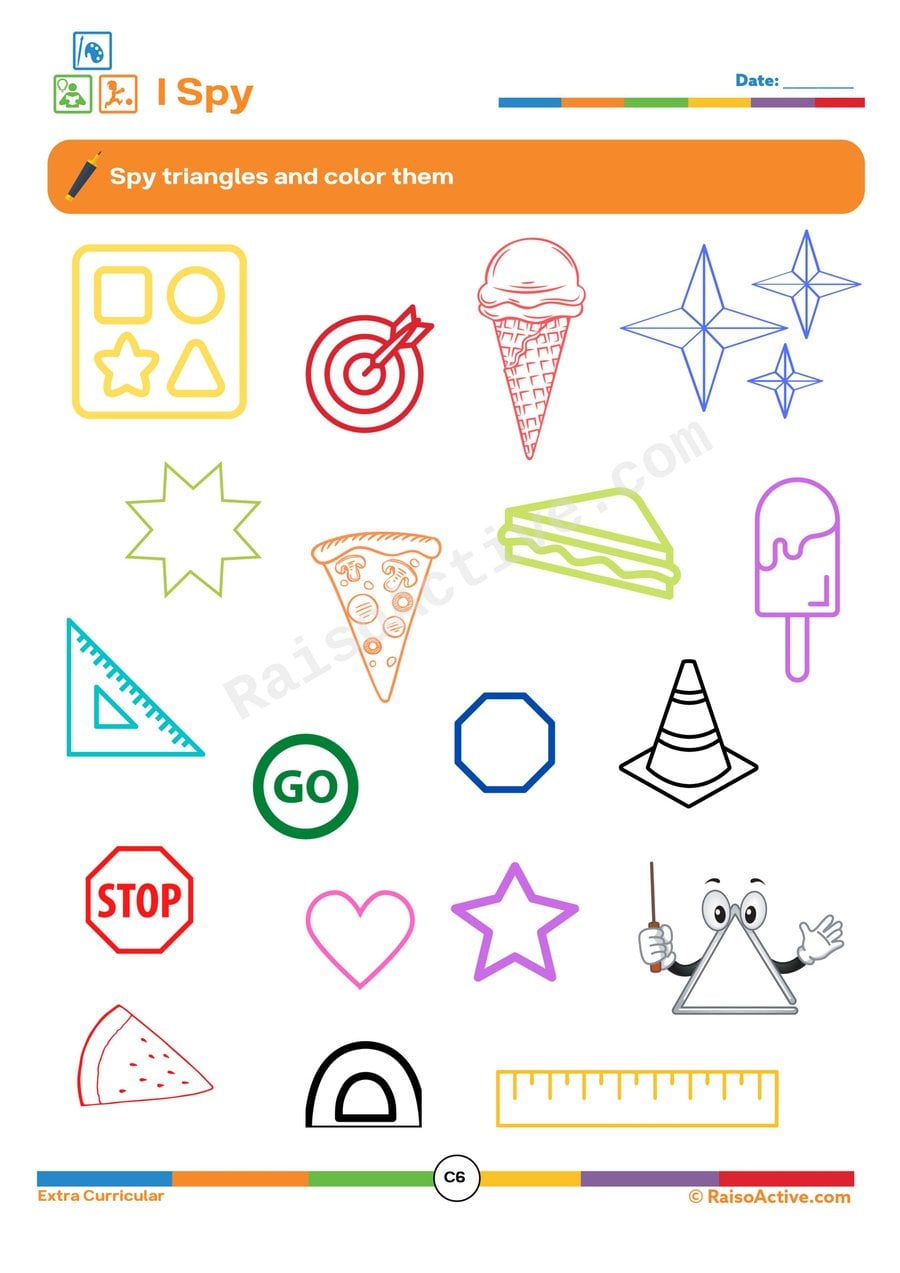
I Spy Triangles Worksheet: Find and Color!
Ages 3-5 · Preschool–Pre-KAges 3-5 · Nursery–ReceptionAges 3-5 · Nursery–LKGAges 3-5
This 'I Spy' style worksheet trains children ages 3-5 to visually pick out triangles hidden within a busier picture, building the visual discrimination skill of recognizing a specific shape by its defining feature — three straight sides and three corners — even when it's surrounded by other shapes or details. This kind of active shape-hunting goes beyond simple shape naming to real visual search practice.
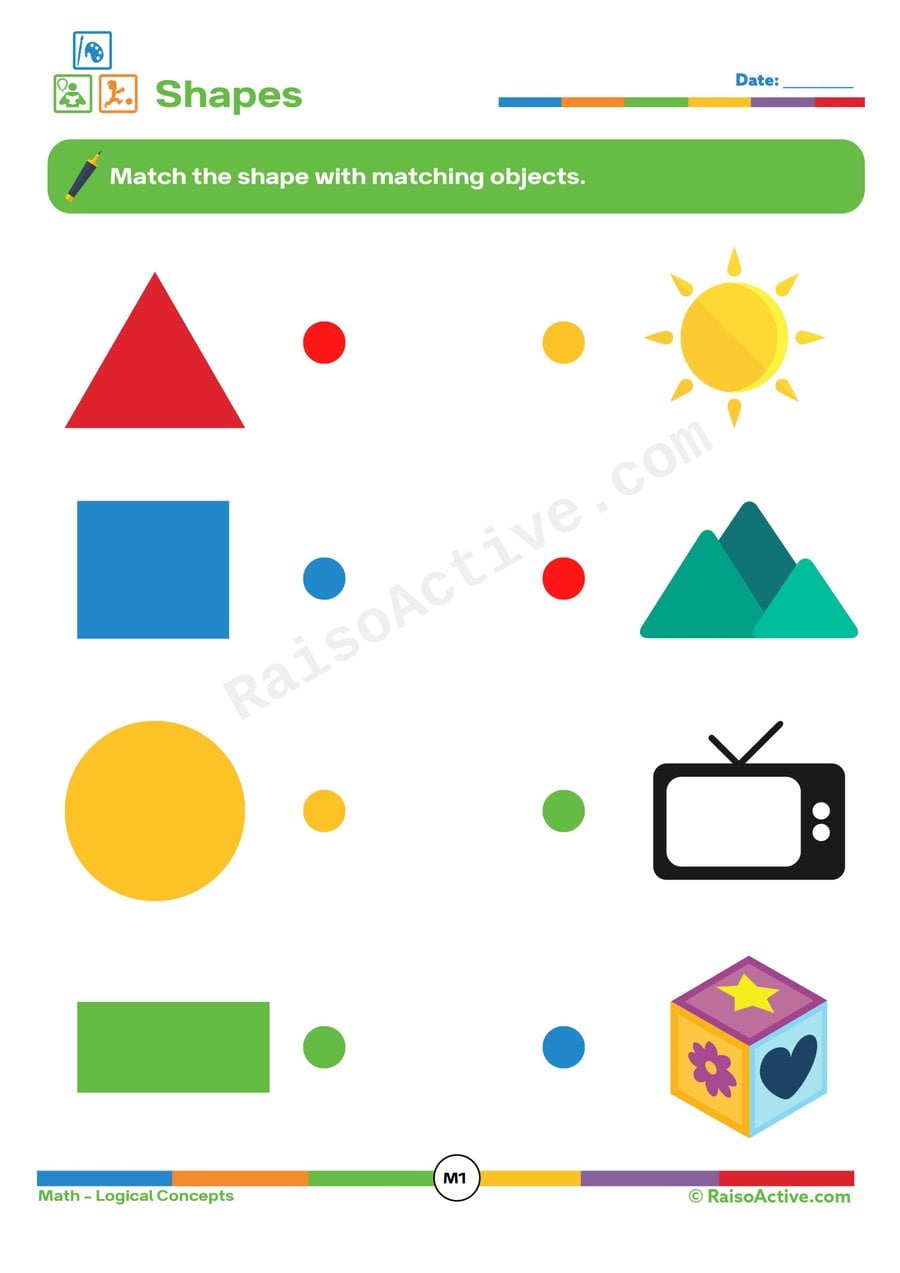
Shape Matching Worksheet for Preschoolers
Ages 3-5 · Preschool–Pre-KAges 3-5 · Nursery–ReceptionAges 3-5 · Nursery–LKGAges 3-5
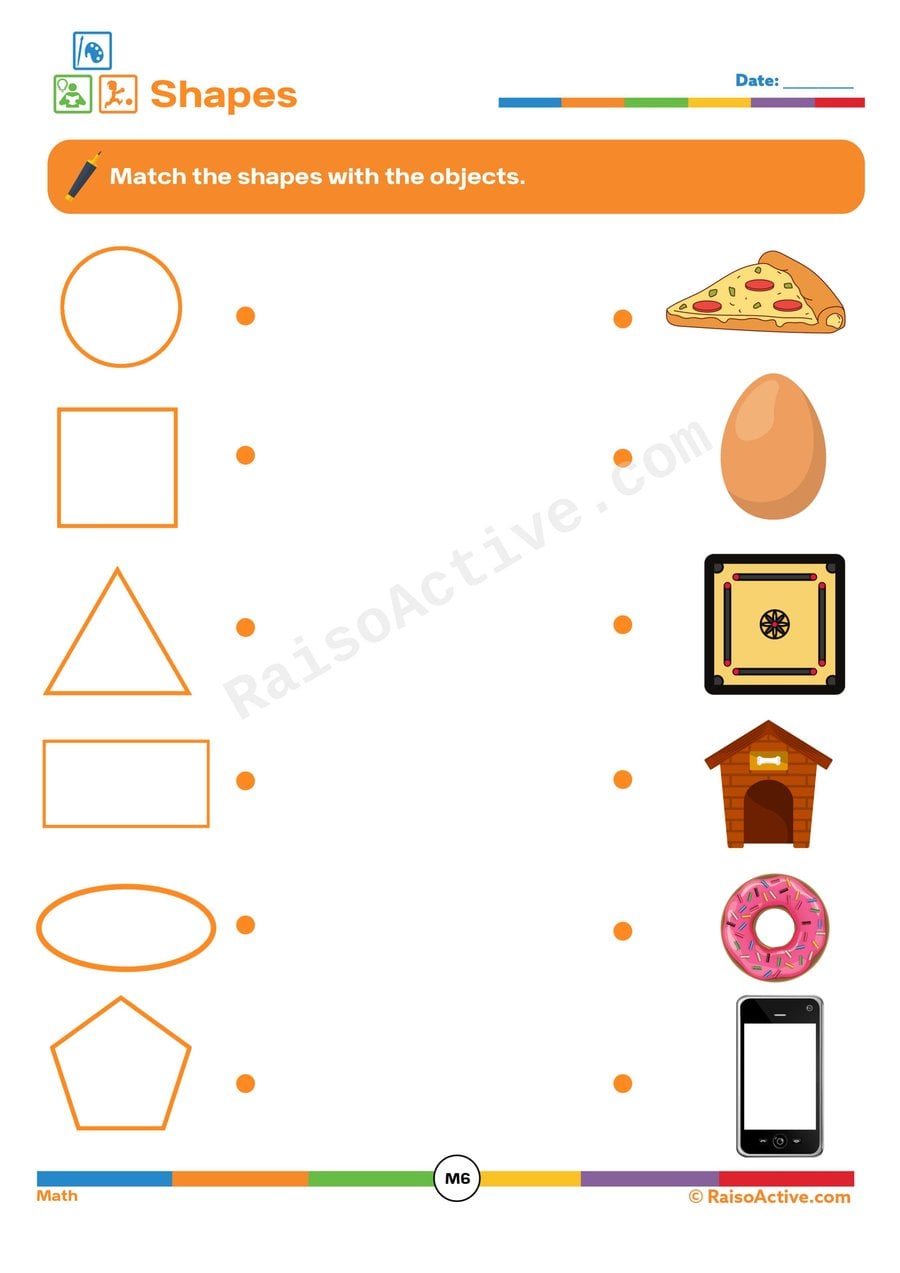
This worksheet helps children ages 3-5 practice recognizing basic geometric shapes by connecting each shape outline to the everyday object it resembles. Pairing an abstract shape with a concrete object supports the transition from recognizing shapes in isolation to spotting them out in the real world. Drawing a connecting line between the matched pairs also builds hand-eye coordination and pencil control.
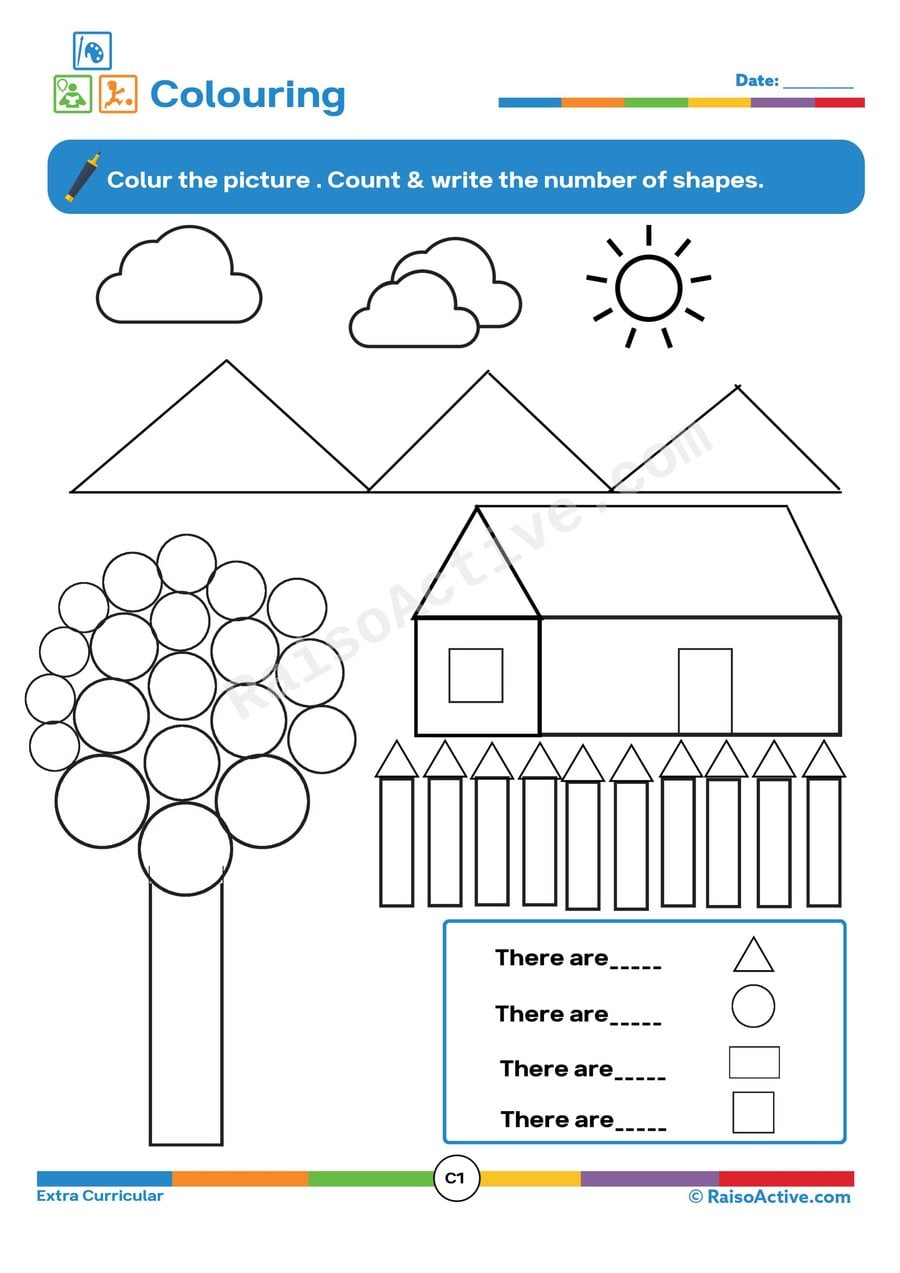
Shape Counting Fun: Count and Color the Shapes!
Ages 3-5 · Preschool–Pre-KAges 3-5 · Nursery–ReceptionAges 3-5 · Nursery–LKGAges 3-5
Preschoolers ages 3-5 combine shape recognition with counting practice by identifying different shapes within a larger picture, coloring them, and then counting how many of each shape appear. This dual task strengthens both geometry vocabulary and one-to-one correspondence as children tally shape totals. Coloring the picture first also builds sustained fine motor control before the counting portion begins.

Scarecrow Cut and Paste Worksheet for Preschoolers
Ages 3-5 · Preschool–Pre-KAges 3-5 · Nursery–ReceptionAges 3-5 · Nursery–LKGAges 3-5
This scarecrow-building activity gives children ages 3-5 focused practice in cutting and gluing basic shapes — circles, triangles, rectangles — into place to assemble a recognizable figure. Matching each shape to its correct spot on the scarecrow outline also reinforces spatial reasoning, since children must judge size and orientation before pasting. Naming the shapes aloud as they work connects the craft to early geometry vocabulary rather than treating it as pure art time.
Shape Matching Worksheet for Preschoolers
Ages 3-5 · Preschool–Pre-KAges 3-5 · Nursery–ReceptionAges 3-5 · Nursery–LKGAges 3-5
This worksheet strengthens shape recognition for children ages 3-5 by asking them to connect abstract shape outlines to the real-world objects that share that same shape. Recognizing that a shape like a circle or rectangle can apply to very different objects, such as a clock and a door, helps children generalize shape concepts beyond a single example. Drawing the connecting line between matched pairs also reinforces visual tracking and pencil control.

Connect the Dots: Hidden Shape Worksheet for Kids
Ages 3-5 · Preschool–Pre-KAges 3-5 · Nursery–ReceptionAges 3-5 · Nursery–LKGAges 3-5
Children ages 3-5 practice counting in sequence and fine motor line control as they connect numbered dots in order to reveal a hidden shape, combining numeracy with hand-eye coordination in one satisfying activity. The surprise of a shape emerging only once every dot is connected correctly also motivates children to stay careful and accurate rather than rushing through the numbers.
Guides for this topic

Best Worksheets for 3-Year-Olds: What Works and What to Avoid
What works on worksheets for 3-year-olds: short sessions, crayons, tracing lines, matching, cutting, a free weekly plan, and signs one is too advanced.

Age-Appropriate Problem-Solving Activities: Building Critical Thinkers from the Ground Up
Discover fun, age-appropriate problem-solving activities for children ages 1-8. Build critical thinking, logic, and reasoning skills through play-based learning.
Fostering Creativity in Structured Learning: The Perfect Balance for Young Minds
Learn how to blend creativity with structured learning for children ages 1-8. Practical strategies, activities, and printable worksheets for parents and teachers.
Reviews
Every worksheet for ages 3–5, no watermark
Members download the full library of 1,000+ worksheets and every activity pack without watermarks or daily limits. One year costs ₹999 in India or $20 elsewhere.
See membership plansOr download any worksheet free with a watermark (5 a day).