Phonics · Levels 1, 2 and 3
Phonics Worksheets (Ages 3–7)
Learning to read that feels like play.
Tap each sound, from left to right
Printable activity packs
Phonics packs, in order
Start with Level 1 and work up: letter sounds and first words, then word families and blends, then long vowels. Each pack has a parent guide, sound mats, an answer key and a certificate.
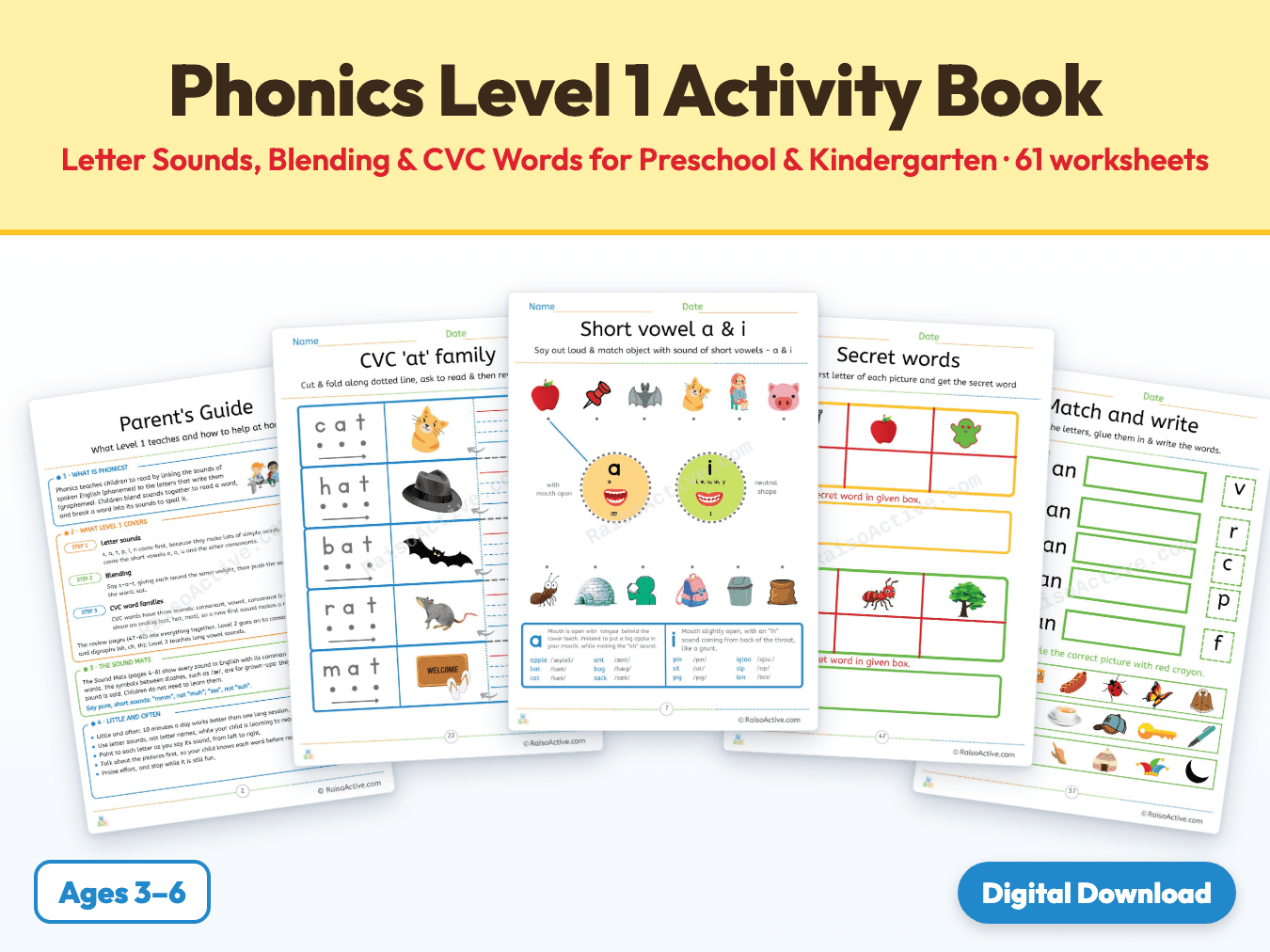
Phonics Level 1 (s a t p i n)
Letter sounds from s a t p i n onwards, blending and first CVC words: read and reveal flaps, secret words, sound mats and a certificate.
EnglishPhonics Level 1 Activity Book: Letter Sounds, Blending & CVC Words for Preschool & Kindergarten
Ages 3-6 · Preschool–KindergartenAges 3-6 · Nursery–Year 1Ages 3-6 · Nursery–UKGAges 3-6 · 62 pages
4.7(139)Up to 4 yrs | Toddler, Ages 4-5 | Pre-K, Ages 5-6 | Kindergarten, Ages 6-7 | Grade 1 or Full Access Free
FreeShort Vowel a and i Say and Match Worksheet
Ages 3-6 · Preschool–KindergartenAges 3-6 · Nursery–Year 1Ages 3-6 · Nursery–UKGAges 3-6
PhonicsShort VowelsChildren hear and say the a and i sounds, see the mouth shape for each one and match pictures to the right sound. a: apple, bat, cat, ant, bag and sack. i: pin, sit, pig, igloo, sip and bin.
NewDownload Free → Free
FreeLetter Sounds s and t Say and Match Worksheet
Ages 3-6 · Preschool–KindergartenAges 3-6 · Nursery–Year 1Ages 3-6 · Nursery–UKGAges 3-6
PhonicsConsonant SoundsChildren hear and say the s and t sounds, see the mouth shape for each one and match pictures to the right sound. s: snake, sun, sleep, mouse, soup and sock. t: tiger, table, tooth, top, letter and cat.
NewDownload Free → Free
FreeLetter Sounds p and n Say and Match Worksheet
Ages 3-6 · Preschool–KindergartenAges 3-6 · Nursery–Year 1Ages 3-6 · Nursery–UKGAges 3-6
PhonicsConsonant SoundsChildren hear and say the p and n sounds, see the mouth shape for each one and match pictures to the right sound. p: parrot, pot, pig, pizza, apple and pear. n: nose, nest, net, knife, dinner and knee.
NewDownload Free → Free
FreeRead and Reveal CVC Words: sit, pit, pat, tap, tip
Ages 3-6 · Preschool–KindergartenAges 3-6 · Nursery–Year 1Ages 3-6 · Nursery–UKGAges 3-6
PhonicsCvc WordsChildren blend their first CVC words using only s, a, t, i, p and n: sit, pit, pat, tap and tip.
NewDownload Free → Free
FreeRead and Reveal CVC Words: pan, nap, tap, tin, pin
Ages 3-6 · Preschool–KindergartenAges 3-6 · Nursery–Year 1Ages 3-6 · Nursery–UKGAges 3-6
PhonicsCvc WordsChildren practise blending more s a t p i n words: pan, nap, tap, tin and pin.
NewDownload Free → Free
Frees a t p i n Words Read and Find Worksheet
Ages 3-6 · Preschool–KindergartenAges 3-6 · Nursery–Year 1Ages 3-6 · Nursery–UKGAges 3-6
PhonicsCvc WordsChildren read s a t p i n words and find them hidden in a row of letters: sit, nap, pan, tip, pat, tap, tin, pin and pit.
NewDownload Free →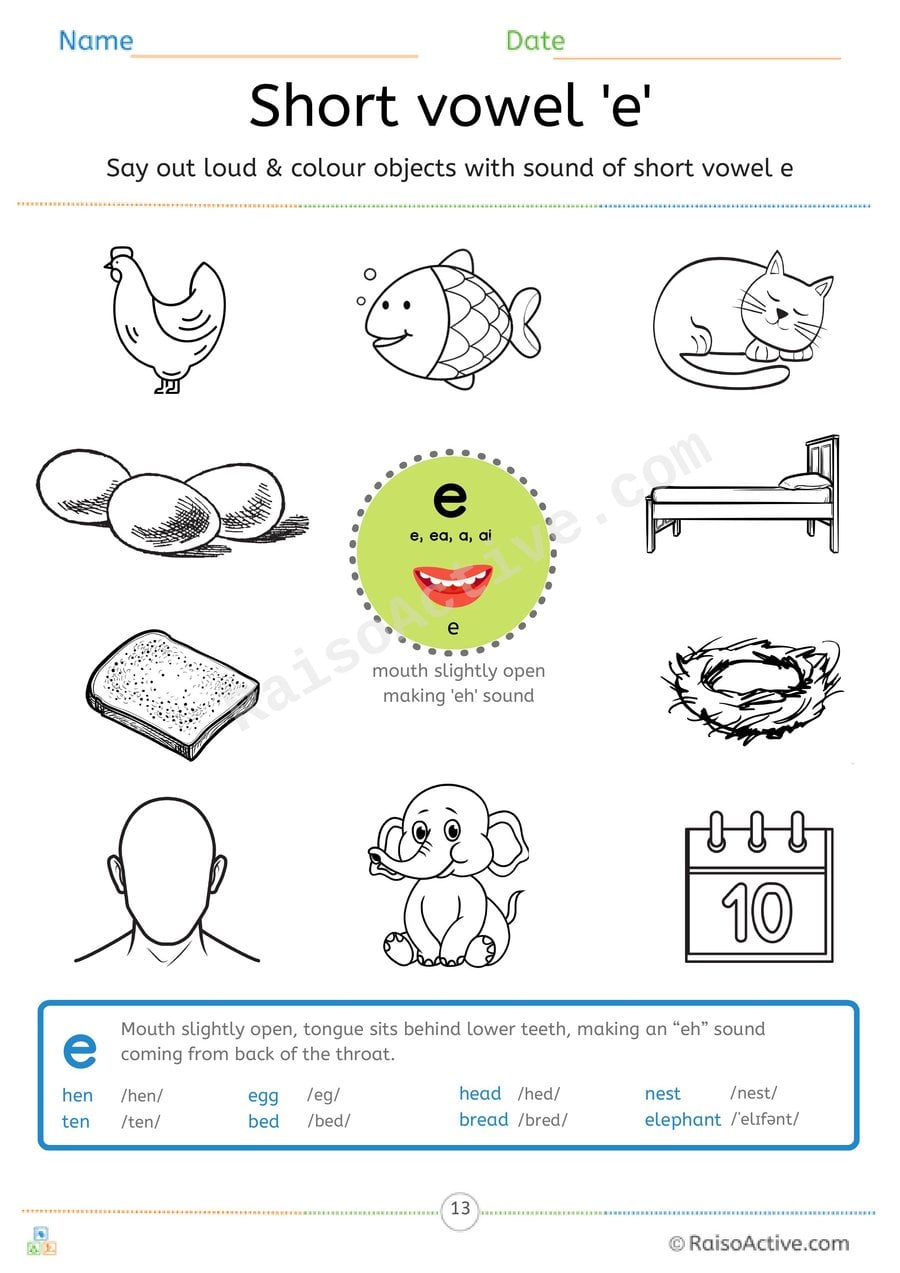 Free
FreeShort Vowel e Say and Colour Worksheet
Ages 3-6 · Preschool–KindergartenAges 3-6 · Nursery–Year 1Ages 3-6 · Nursery–UKGAges 3-6
PhonicsShort VowelsChildren hear the short e sound in the middle of words and pick it out: hen, eggs, bed, bread, nest, head, elephant and ten have it; fish and cat don't.
NewDownload Free → Free
FreeShort Vowel o and u Say and Match Worksheet
Ages 3-6 · Preschool–KindergartenAges 3-6 · Nursery–Year 1Ages 3-6 · Nursery–UKGAges 3-6
PhonicsShort VowelsChildren hear and say the o and u sounds, see the mouth shape for each one and match pictures to the right sound. o: pot, dog, mop, fox, stop and box. u: cup, sun, bus, monkey, bun and nut.
NewDownload Free →
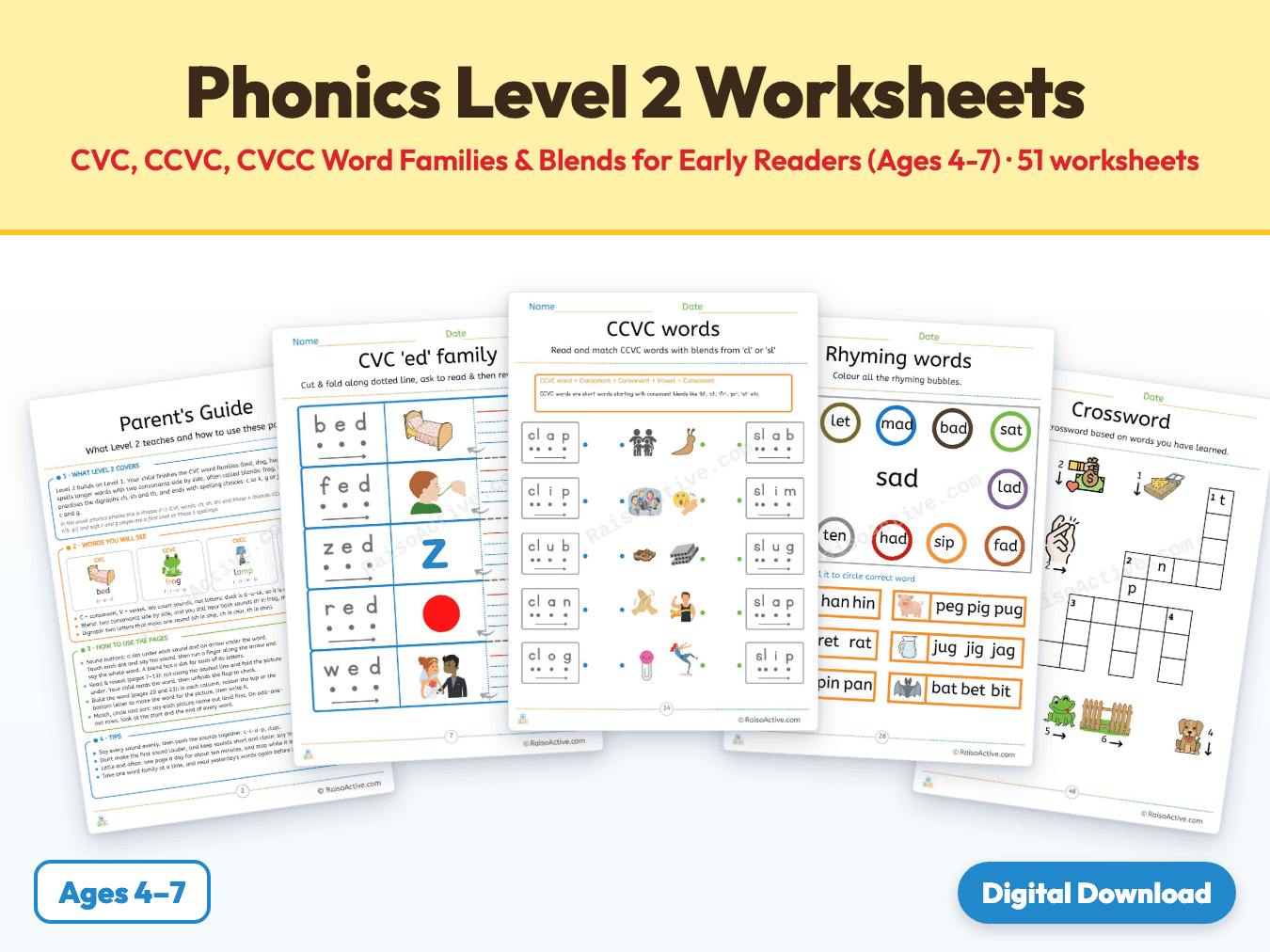
Phonics Level 2 (cat · frog · clap)
CVC word families and blends (CCVC, CVCC): cut and paste, rhyme hunts, word searches and unscrambles for early readers.
EnglishPhonics Level 2 Worksheets: CVC, CCVC, CVCC Word Families & Blends for Early Readers (Ages 4-7)
Ages 4-7 · Pre-K–Grade 1Ages 4-7 · Reception–Year 2Ages 4-7 · LKG–Class 1Ages 4-7 · 52 pages
4.9(150)Up to 4 yrs | Toddler, Ages 4-5 | Pre-K, Ages 5-6 | Kindergarten, Ages 6-7 | Grade 1 or Full Access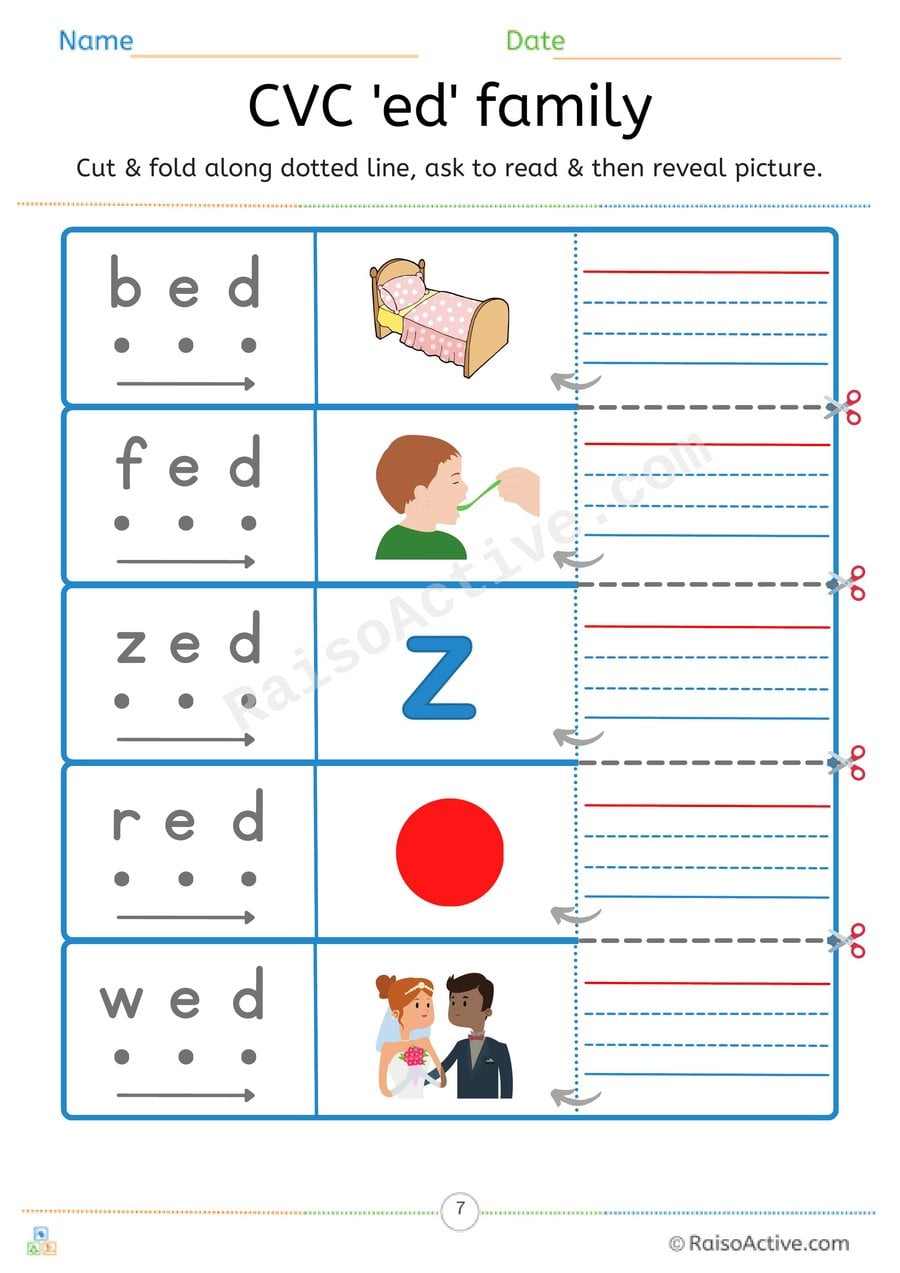 Free
FreeCVC 'ed' Word Family Read, Cut and Reveal Worksheet
Ages 4-7 · Pre-K–Grade 1Ages 4-7 · Reception–Year 2Ages 4-7 · LKG–Class 1Ages 4-7
PhonicsCvc WordsChildren read five 'ed' words (bed, fed, zed, red, wed) by blending three sounds, check each one against a hidden picture (a bed, a child being fed, a letter z, a red dot and a wedding) and write it, so they see that changing the first sound makes a new word.
NewDownload Free → Free
FreeCVC 'og' Word Family Read, Cut and Reveal Worksheet
Ages 4-7 · Pre-K–Grade 1Ages 4-7 · Reception–Year 2Ages 4-7 · LKG–Class 1Ages 4-7
PhonicsCvc WordsChildren read five 'og' words (dog, fog, hog, jog, log) by blending three sounds, check each one against a hidden picture (a dog, fog, a hog, two joggers and a log) and write it, so they see that changing the first sound makes a new word.
NewDownload Free →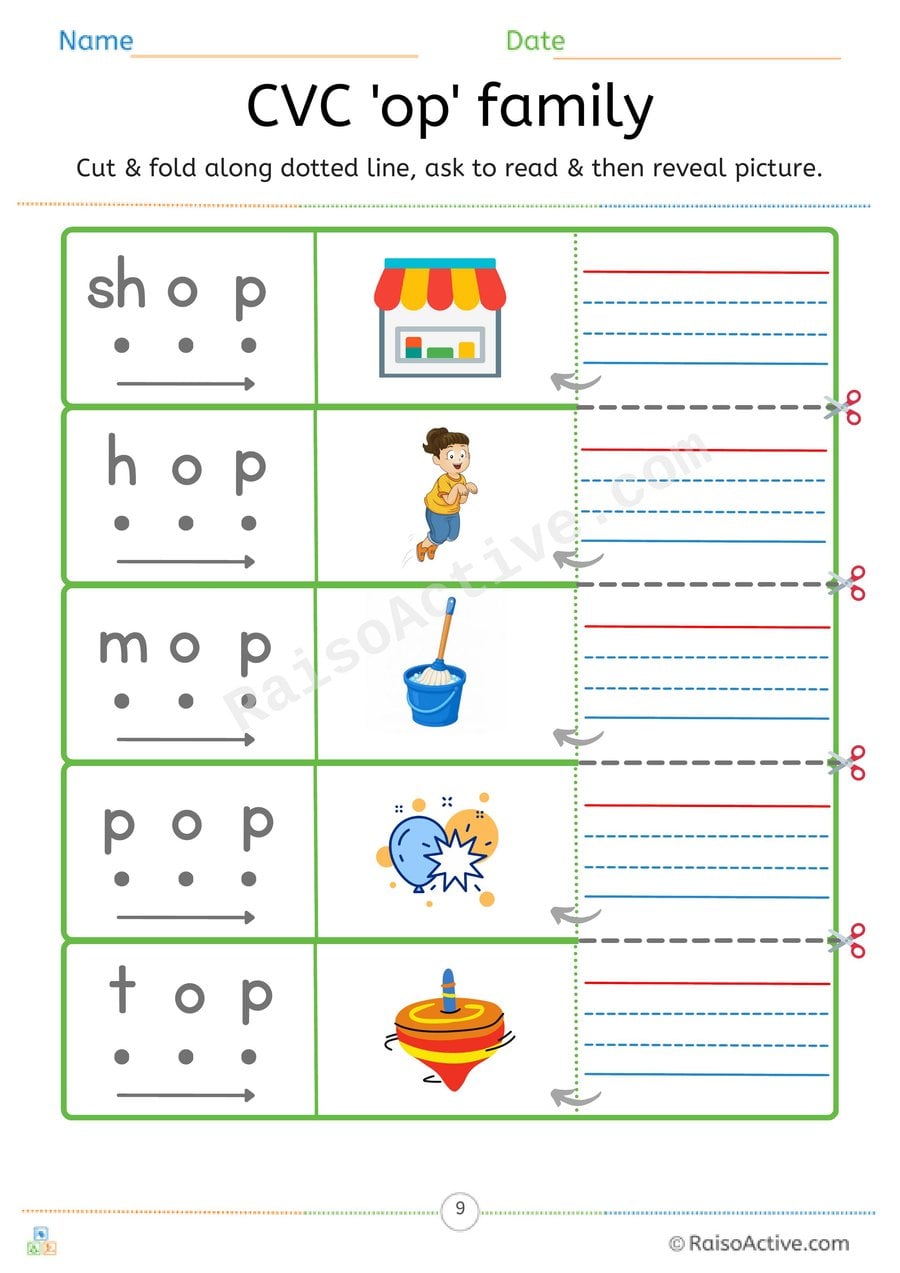 Free
FreeCVC 'op' Word Family Read, Cut and Reveal Worksheet
Ages 4-7 · Pre-K–Grade 1Ages 4-7 · Reception–Year 2Ages 4-7 · LKG–Class 1Ages 4-7
PhonicsCvc WordsChildren read five 'op' words (shop, hop, mop, pop, top) by blending three sounds, check each one against a hidden picture (a shop, a hopping child, a mop, a popping balloon and a spinning top) and write it, so they see that changing the first sound makes a new word.
NewDownload Free → Free
FreeCVC 'ob' Word Family Read, Cut and Reveal Worksheet
Ages 4-7 · Pre-K–Grade 1Ages 4-7 · Reception–Year 2Ages 4-7 · LKG–Class 1Ages 4-7
PhonicsCvc WordsChildren read five 'ob' words (cob, job, mob, rob, sob) by blending three sounds, check each one against a hidden picture (a corn cob, a person at work, a crowd, a monkey taking fruit and a crying child) and write it, so they see that changing the first sound makes a new word.
NewDownload Free →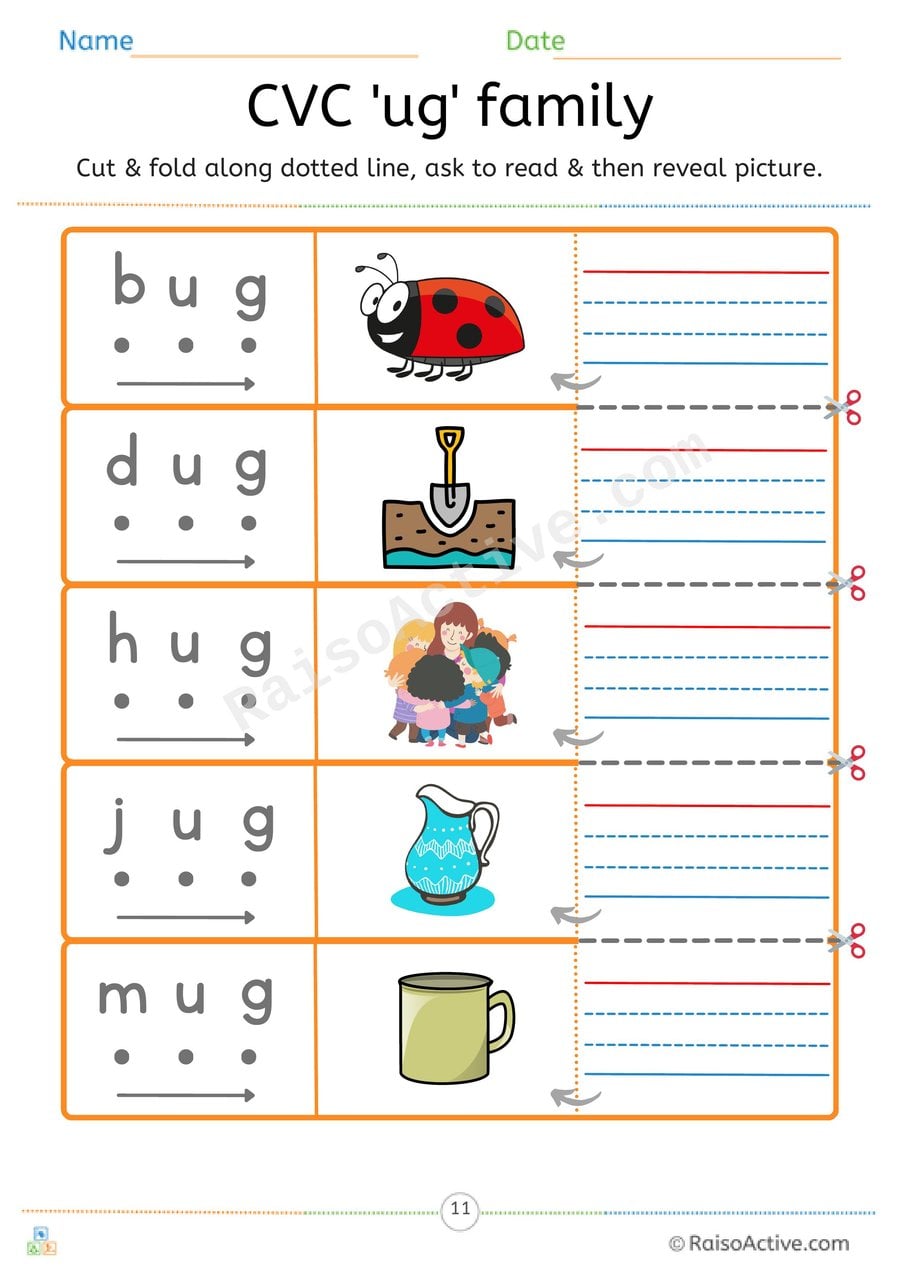 Free
FreeCVC 'ug' Word Family Read, Cut and Reveal Worksheet
Ages 4-7 · Pre-K–Grade 1Ages 4-7 · Reception–Year 2Ages 4-7 · LKG–Class 1Ages 4-7
PhonicsCvc WordsChildren read five 'ug' words (bug, dug, hug, jug, mug) by blending three sounds, check each one against a hidden picture (a ladybird, a spade in soil, a family hug, a jug and a mug) and write it, so they see that changing the first sound makes a new word.
NewDownload Free → Free
FreeCVC 'um' Word Family Read, Cut and Reveal Worksheet
Ages 4-7 · Pre-K–Grade 1Ages 4-7 · Reception–Year 2Ages 4-7 · LKG–Class 1Ages 4-7
PhonicsCvc WordsChildren read five 'um' words (yum, gum, hum, mum, sum) by blending three sounds, check each one against a hidden picture (a yummy face, bubble gum, a child humming, a mum and a baby, and a sum) and write it, so they see that changing the first sound makes a new word.
NewDownload Free →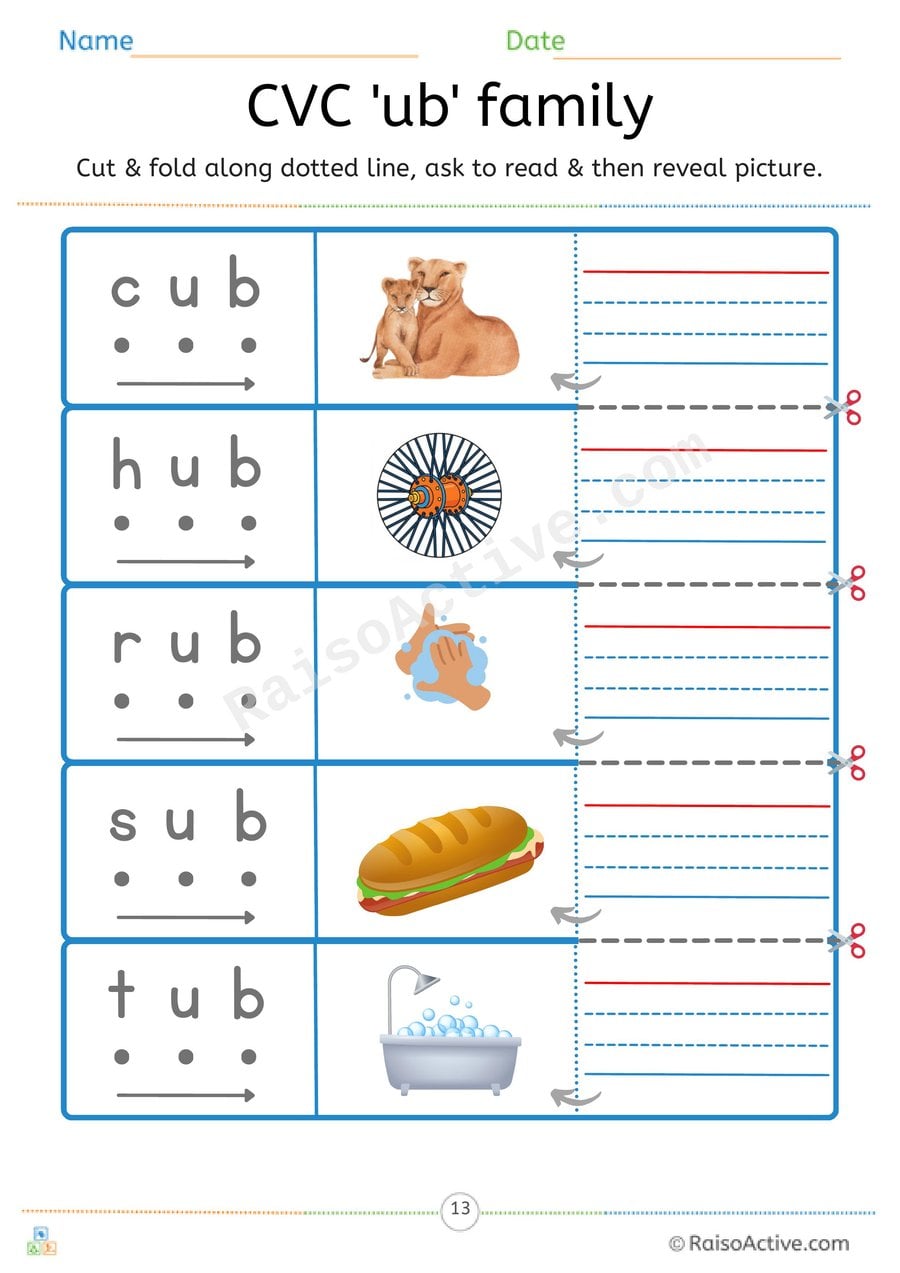 Free
FreeCVC 'ub' Word Family Read, Cut and Reveal Worksheet
Ages 4-7 · Pre-K–Grade 1Ages 4-7 · Reception–Year 2Ages 4-7 · LKG–Class 1Ages 4-7
PhonicsCvc WordsChildren read five 'ub' words (cub, hub, rub, sub, tub) by blending three sounds, check each one against a hidden picture (a lion and cub, a wheel hub, hands rubbing, a sub roll and a bath tub) and write it, so they see that changing the first sound makes a new word.
NewDownload Free → Free
FreeCCVC Words with cl and sl Blends Read and Match Worksheet
Ages 4-7 · Pre-K–Grade 1Ages 4-7 · Reception–Year 2Ages 4-7 · LKG–Class 1Ages 4-7
PhonicsCcvc WordsChildren read ten CCVC words with sound buttons (clap, clip, club, clan, clog, slab, slim, slug, slap, slip) and draw a line from each word to its picture.
NewDownload Free →
Phonics Level 3 (cake · kite · bone)
Long vowels and their spellings: magic e, long or short sorts, vowel teams, word searches and answer keys for every puzzle.
EnglishPhonics Level 3 Long Vowels Activity Book for Kindergarten & 1st Grade
Ages 5-7 · Kindergarten–Grade 1Ages 5-7 · Year 1–Year 2Ages 5-7 · UKG–Class 1Ages 5-7 · 52 pages
4.9(89)Ages 4-5 | Pre-K, Ages 5-6 | Kindergarten, Ages 6-7 | Grade 1 or Full Access Free
FreeLong Vowel a and e Say and Match Worksheet
Ages 5-7 · Kindergarten–Grade 1Ages 5-7 · Year 1–Year 2Ages 5-7 · UKG–Class 1Ages 5-7
PhonicsLong VowelsChildren hear and say the long a and long e sounds and match each picture to the right sound circle (long a: acorn, eight, hay, train, cake and grey; long e: he, bee, key, beach, piece and athlete).
NewDownload Free → Free
FreeLong Vowel a Say and Colour Worksheet
Ages 5-7 · Kindergarten–Grade 1Ages 5-7 · Year 1–Year 2Ages 5-7 · UKG–Class 1Ages 5-7
PhonicsLong VowelsChildren listen for the long a sound, which says its own letter name, and colour only the pictures that have it: paper, acorn, lady, radio, table and baby.
NewDownload Free → Free
FreeLong Vowel a 'ay' Cut and Paste Worksheet
Ages 5-7 · Kindergarten–Grade 1Ages 5-7 · Year 1–Year 2Ages 5-7 · UKG–Class 1Ages 5-7
PhonicsLong VowelsChildren practise the long a spelling 'ay' by finding the six pictures that have it: pray, tray, pay, play, day and clay.
NewDownload Free → Free
FreeLong Vowel a 'ai' Circle and Write Worksheet
Ages 5-7 · Kindergarten–Grade 1Ages 5-7 · Year 1–Year 2Ages 5-7 · UKG–Class 1Ages 5-7
PhonicsLong VowelsChildren spot the long a 'ai' word in each row of three pictures, then spell it: snail, rain, train, grain, paint and nail.
NewDownload Free → Free
FreeLong Vowel a 'ey' Complete the Word and Match Worksheet
Ages 5-7 · Kindergarten–Grade 1Ages 5-7 · Year 1–Year 2Ages 5-7 · UKG–Class 1Ages 5-7
PhonicsLong VowelsChildren finish six long a words by writing the 'ey' letters (prey, they, hey, obey, grey and survey) and match each word to its picture.
NewDownload Free → Free
FreeLong Vowel a 'ei' Complete the Word and Paste Worksheet
Ages 5-7 · Kindergarten–Grade 1Ages 5-7 · Year 1–Year 2Ages 5-7 · UKG–Class 1Ages 5-7
PhonicsLong VowelsChildren write the missing 'ei' letters to finish six long a words (eight, reindeer, weight, veil, sleigh and neigh) and paste the matching picture above each word.
NewDownload Free → Free
FreeLong Vowel a 'a_e' Circle the Pictures Worksheet
Ages 5-7 · Kindergarten–Grade 1Ages 5-7 · Year 1–Year 2Ages 5-7 · UKG–Class 1Ages 5-7
PhonicsLong VowelsChildren find the long a 'a_e' pictures among sixteen and circle them: cake, candy cane, plane, cage, stage, lake, gate and space.
NewDownload Free →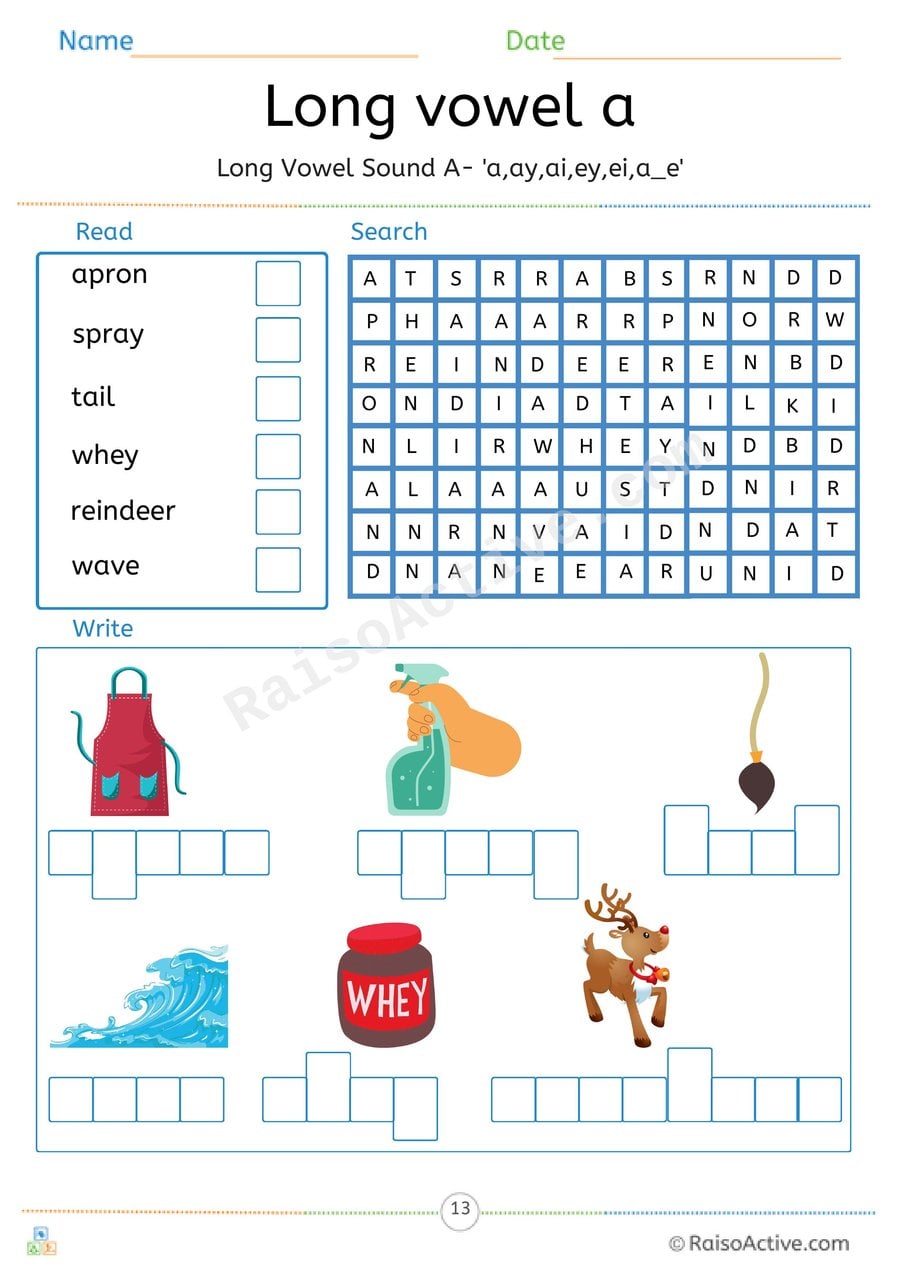 Free
FreeLong Vowel a Read, Search and Write Worksheet
Ages 5-7 · Kindergarten–Grade 1Ages 5-7 · Year 1–Year 2Ages 5-7 · UKG–Class 1Ages 5-7
PhonicsLong VowelsChildren review long a spellings (a, ay, ai, ey, ei, a_e) by reading, finding and writing the words apron, spray, tail, whey, reindeer and wave.
NewDownload Free →

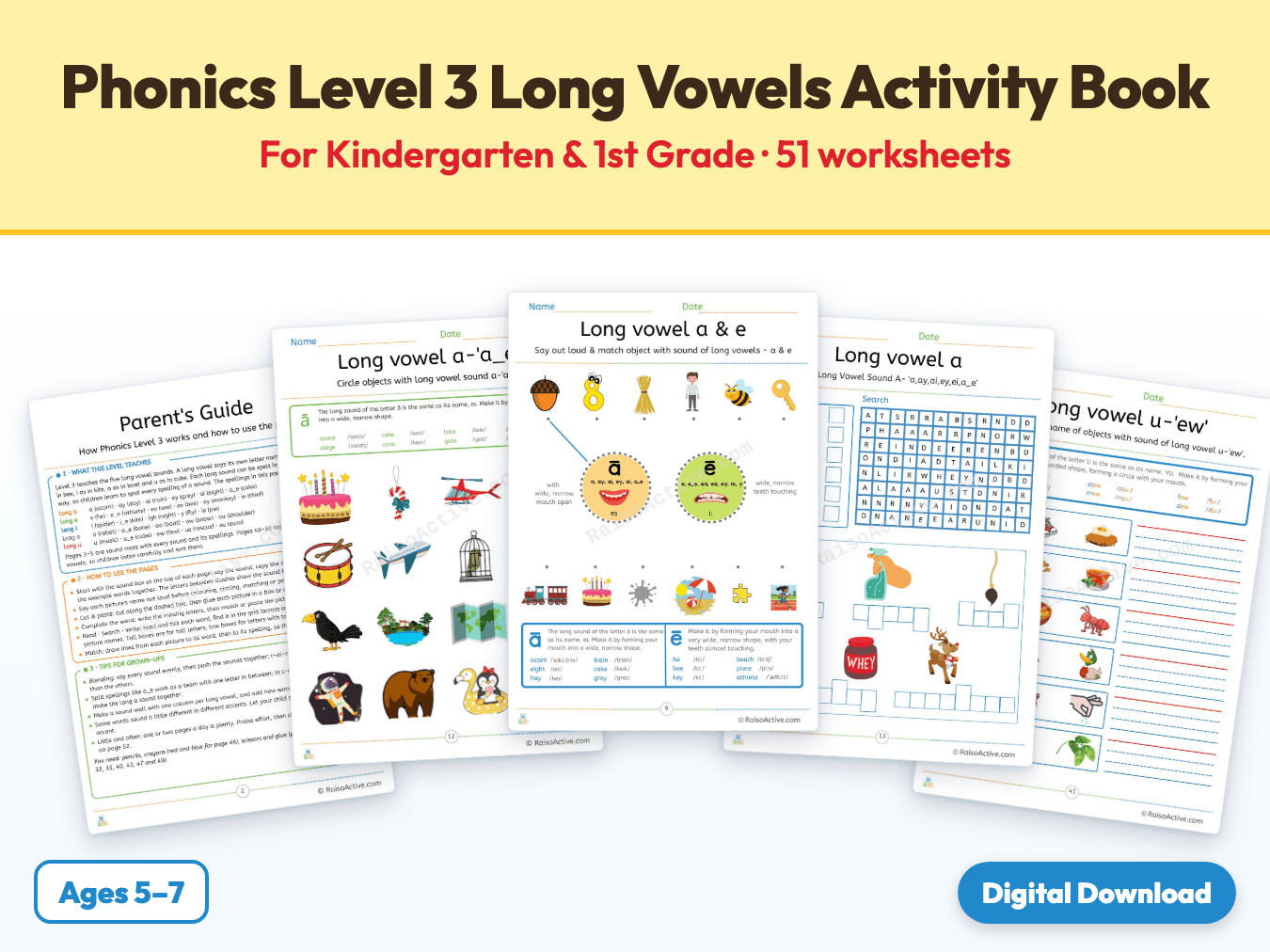
More packs for ages 3 to 7
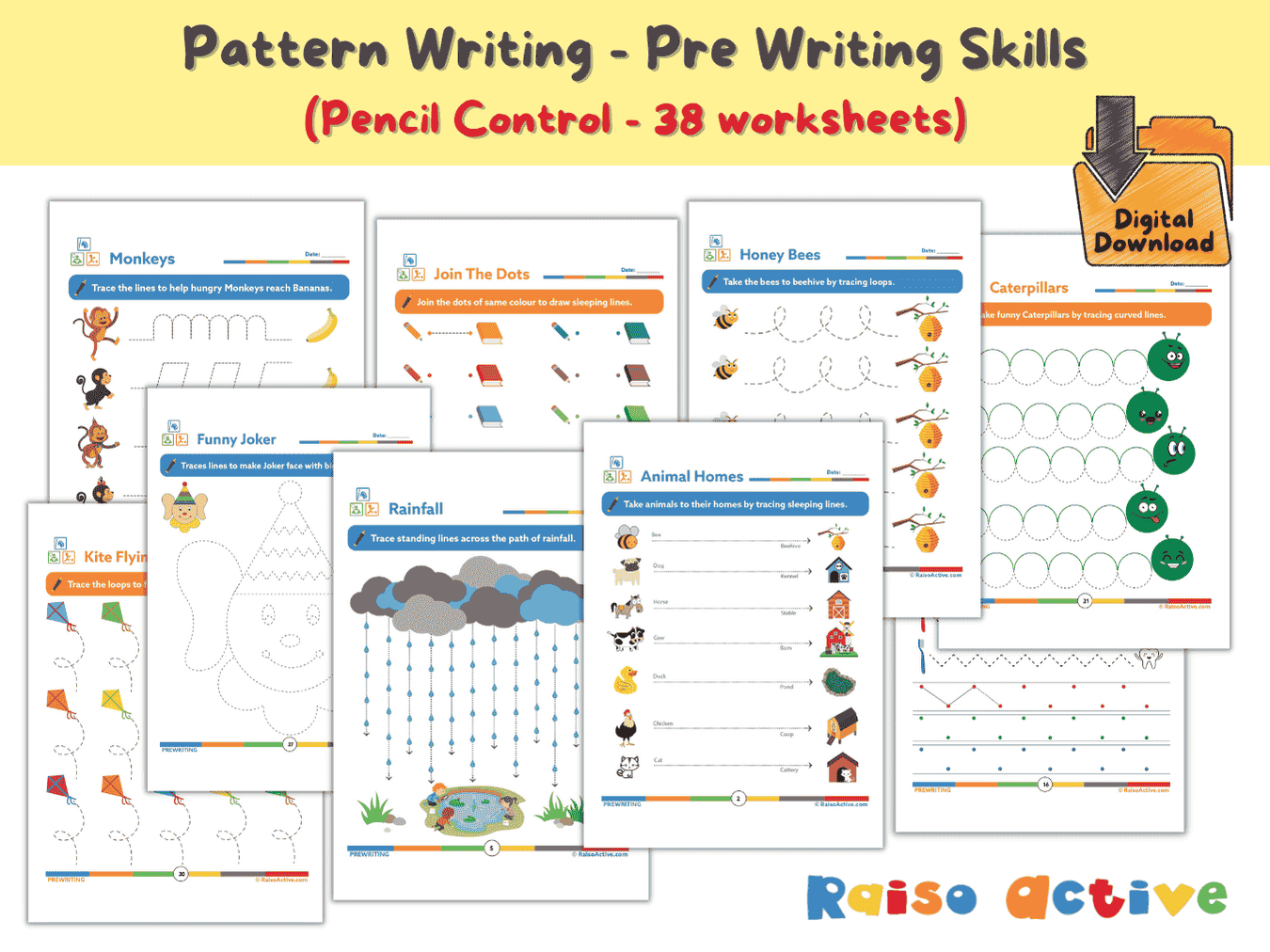
Pattern Writing Pre-writing Skills Activity Book for 3-4 Year Olds
Ages 3-4 · PreschoolAges 3-4 · NurseryAges 3-4 · 44 pages
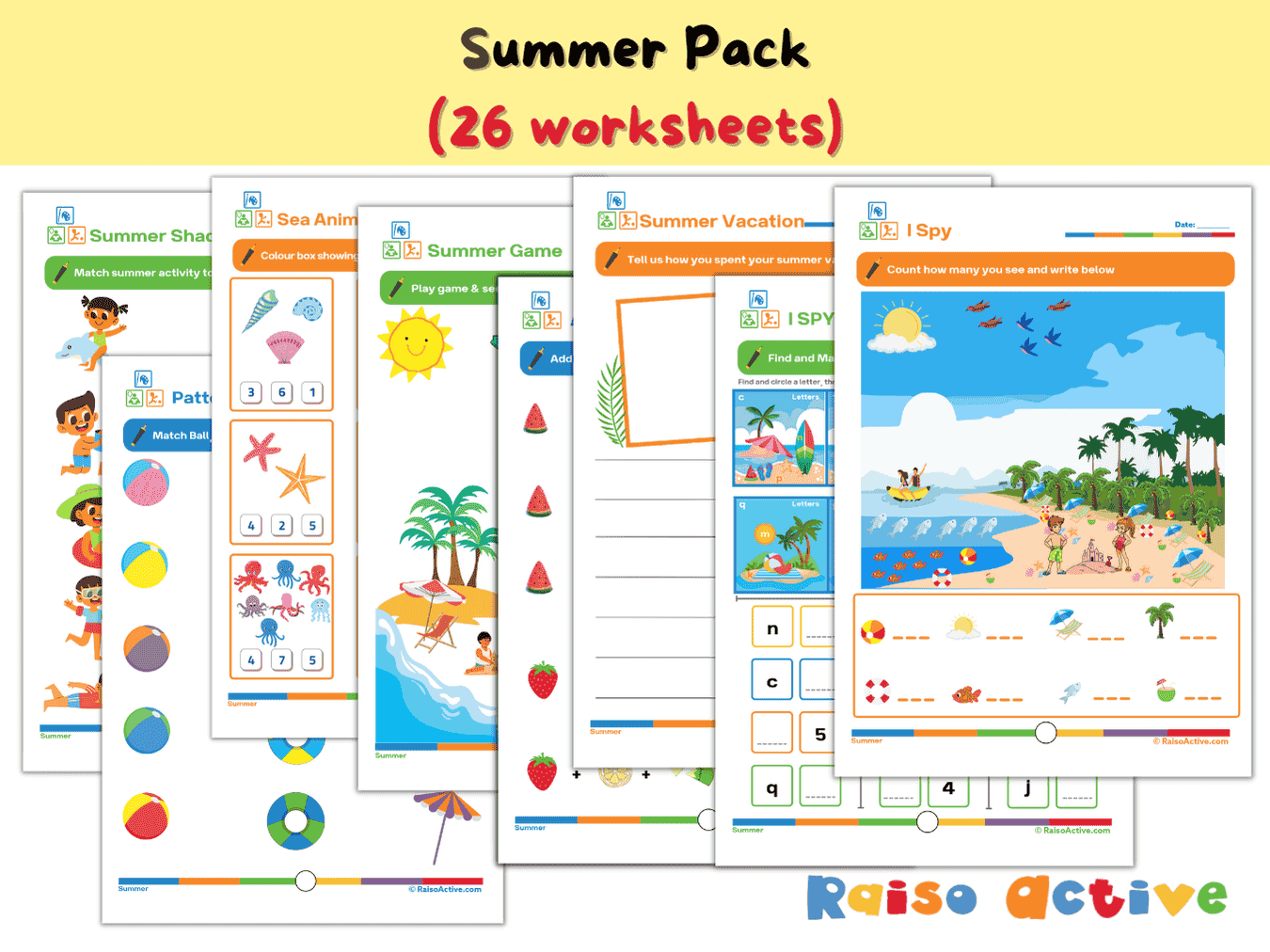

Summer Activity Pack: Math, Literacy, Puzzles & More for Preschool & Kindergarten
Ages 3-7 · Preschool–Grade 1Ages 3-7 · Nursery–Year 2Ages 3-7 · Nursery–Class 1Ages 3-7 · 26 pages
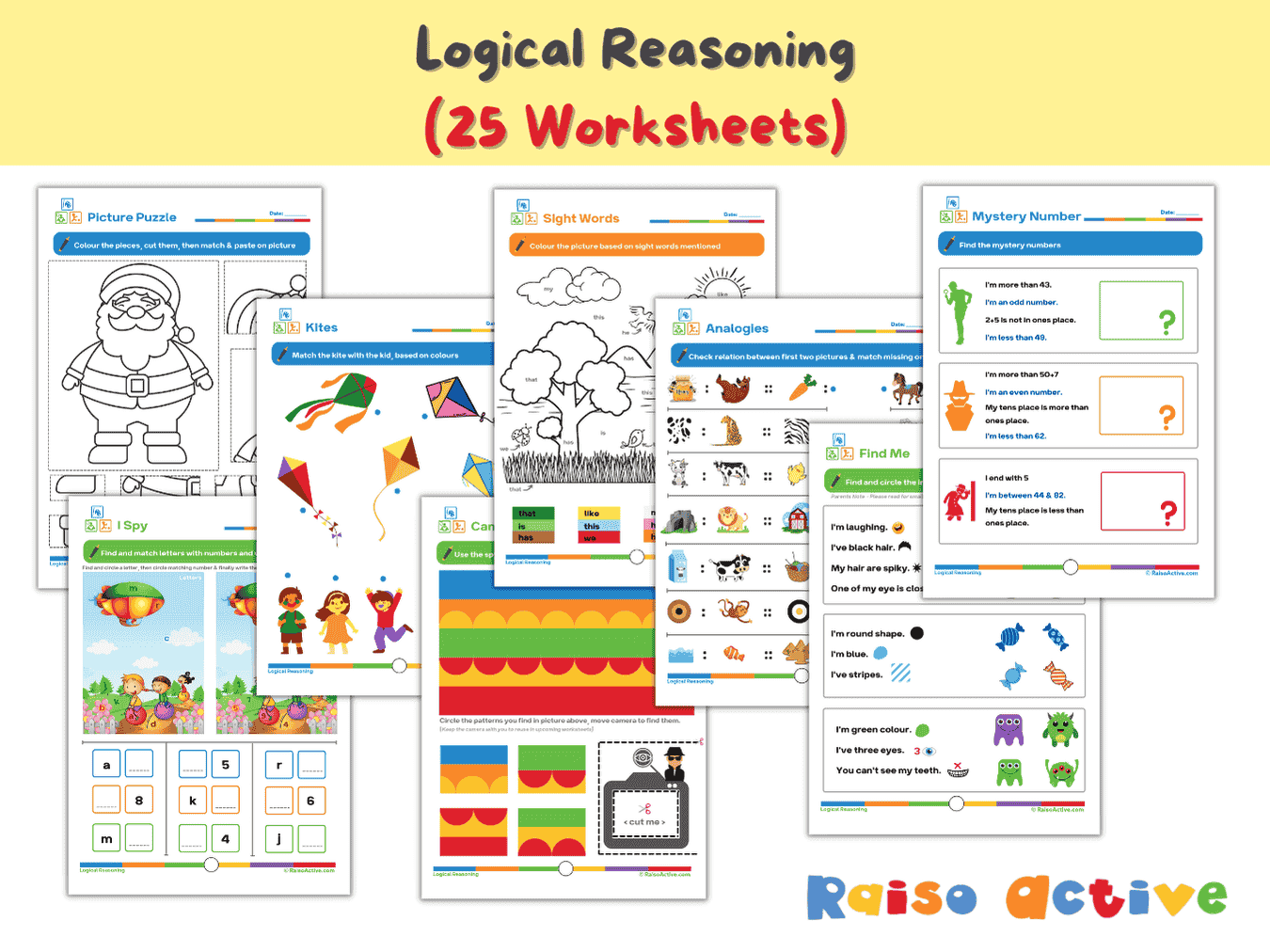

Logical Reasoning Activity Book for Preschool & Kindergarten | Patterns, Sudoku, Mazes & Coding
Ages 4-7 · Pre-K–Grade 1Ages 4-7 · Reception–Year 2Ages 4-7 · LKG–Class 1Ages 4-7 · 34 pages
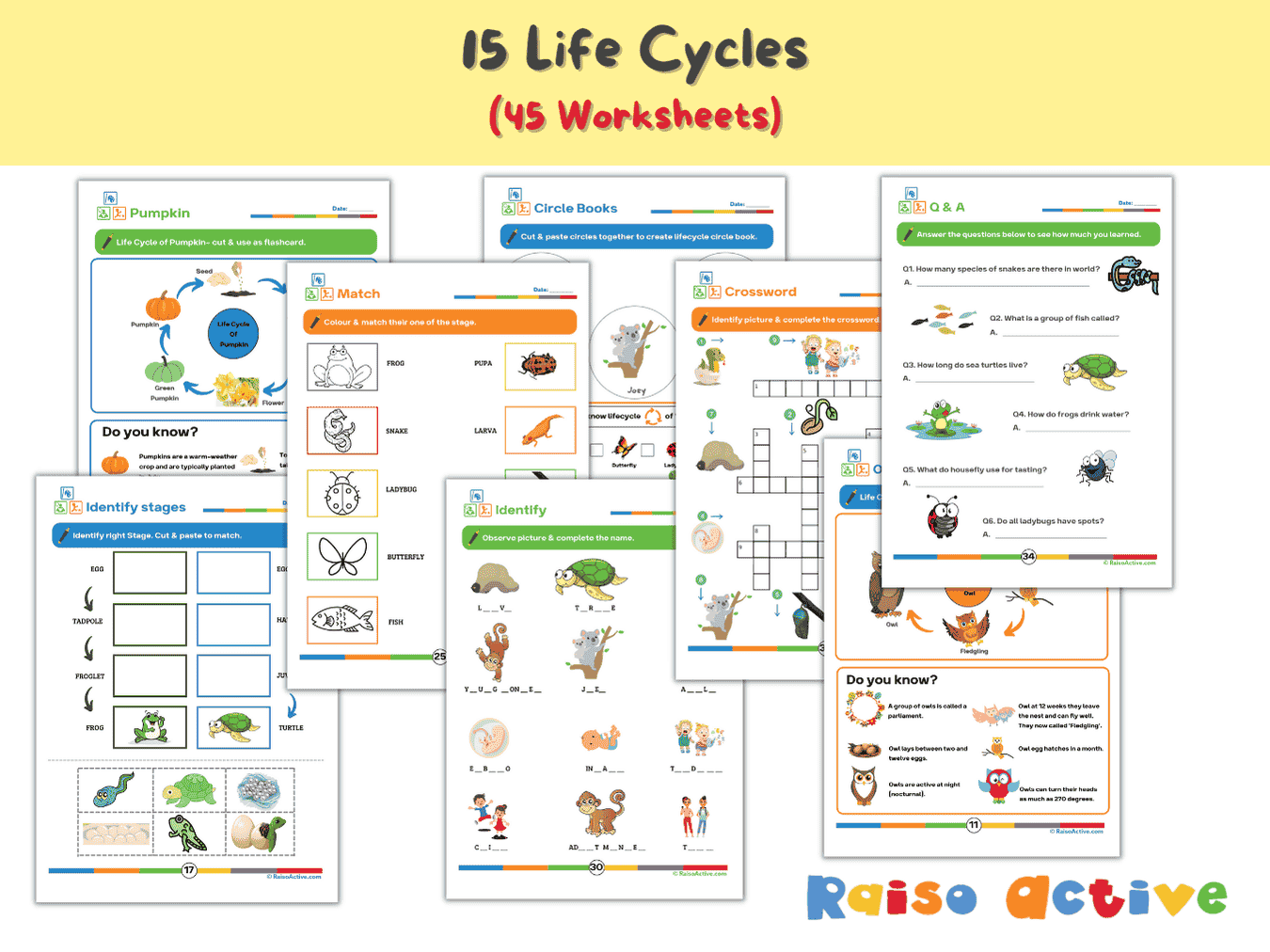

Lifecycles Activity Book & Flashcards for Preschool & Early Elementary
Ages 3-8 · Preschool–Grade 2Ages 3-8 · Nursery–Year 3Ages 3-8 · Nursery–Class 2Ages 3-8 · 46 pages
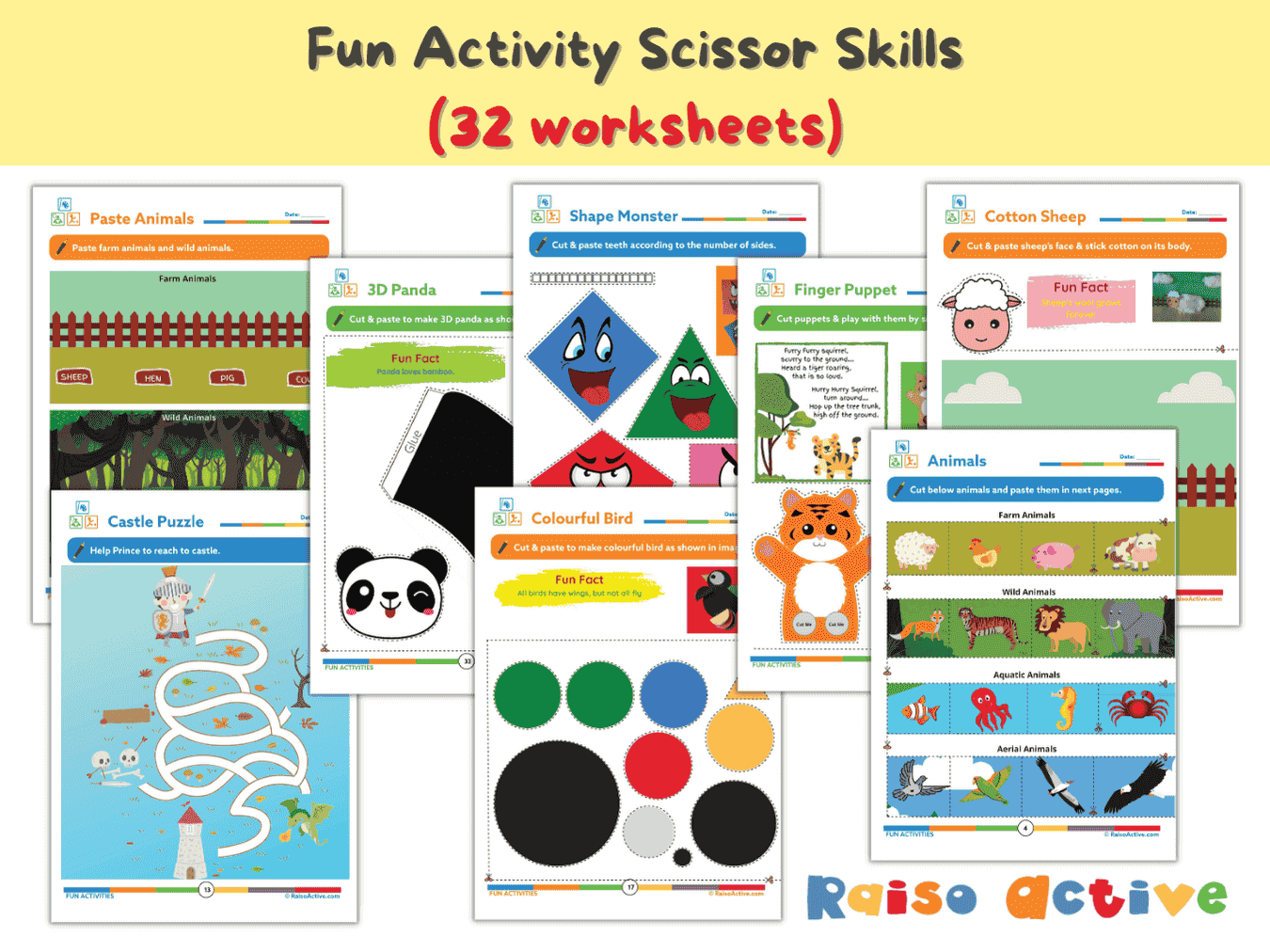
Preschool Scissor Skills Activity Book: Fine Motor & Craft Fun for Ages 3-6
Ages 3-6 · Preschool–KindergartenAges 3-6 · Nursery–Year 1Ages 3-6 · Nursery–UKGAges 3-6 · 35 pages
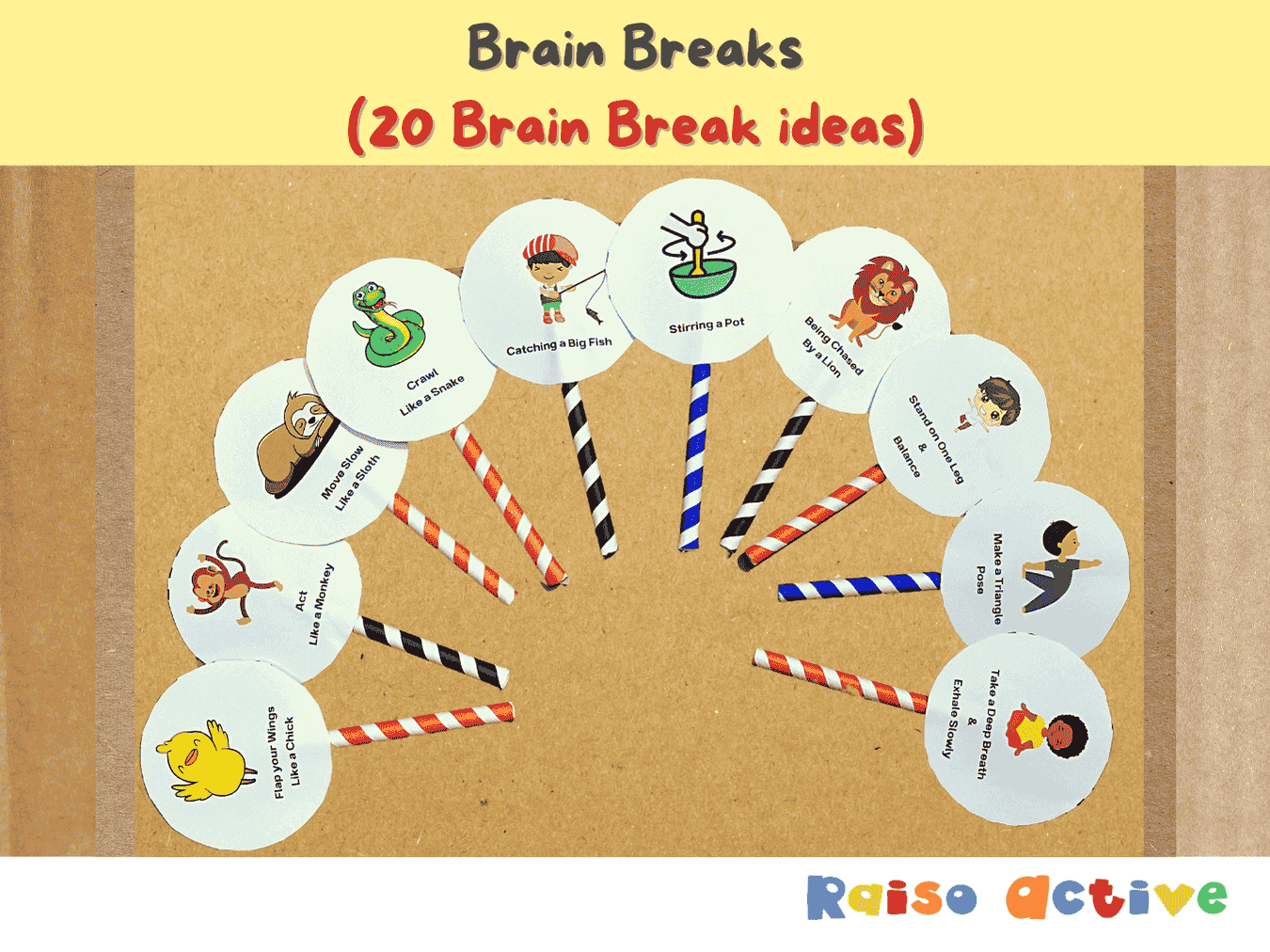
Gross Motor Movement & Imaginative Play Flashcards for Toddlers & Preschoolers
Ages 2-5 · Preschool–Pre-KAges 2-5 · Nursery–ReceptionAges 2-5 · Nursery–LKGAges 2-5 · 5 pages
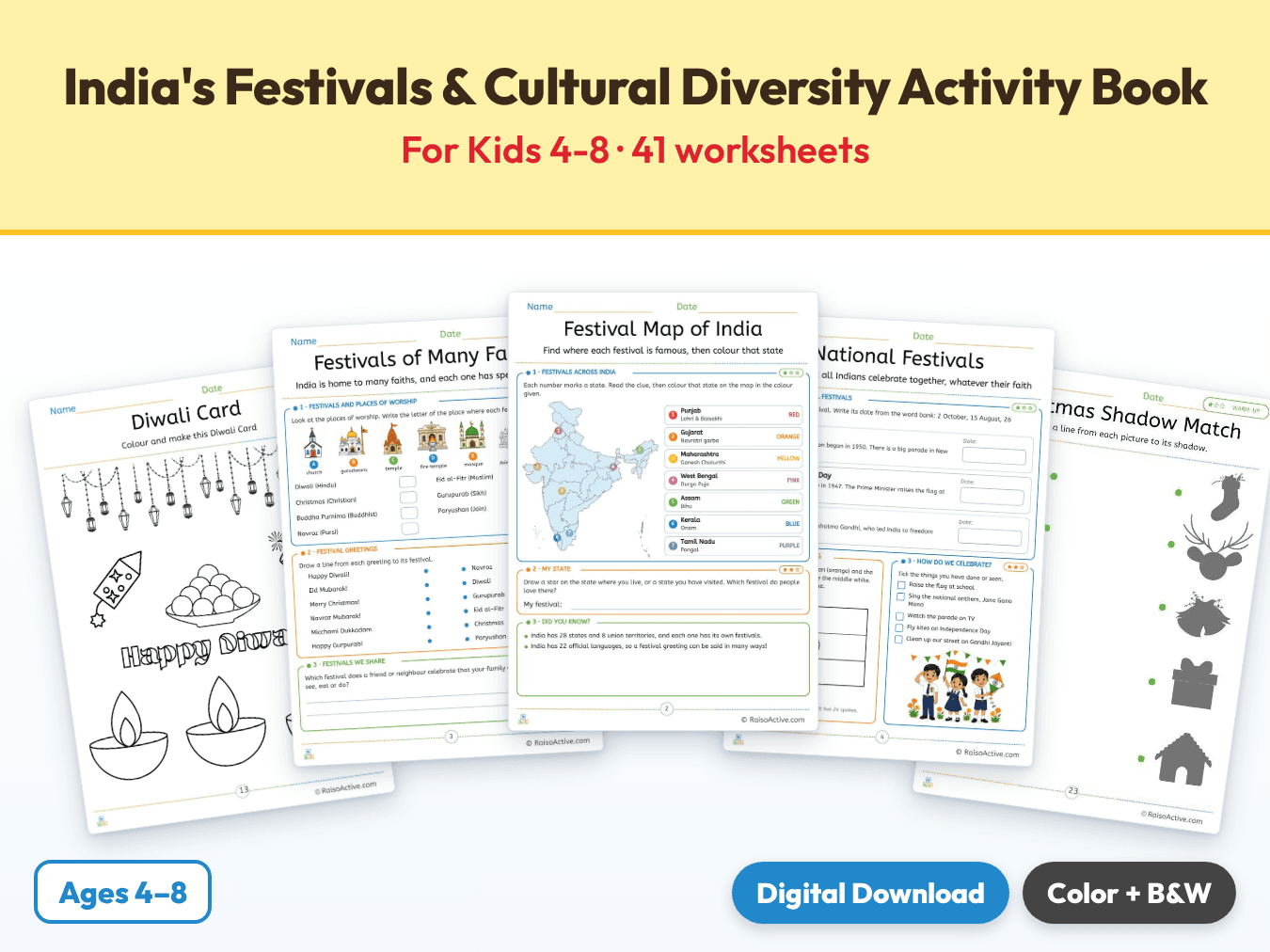
India's Festivals & Cultural Diversity Activity Book for Kids 4-8
Ages 4-8 · Pre-K–Grade 2Ages 4-8 · Reception–Year 3Ages 4-8 · LKG–Class 2Ages 4-8 · 42 pages
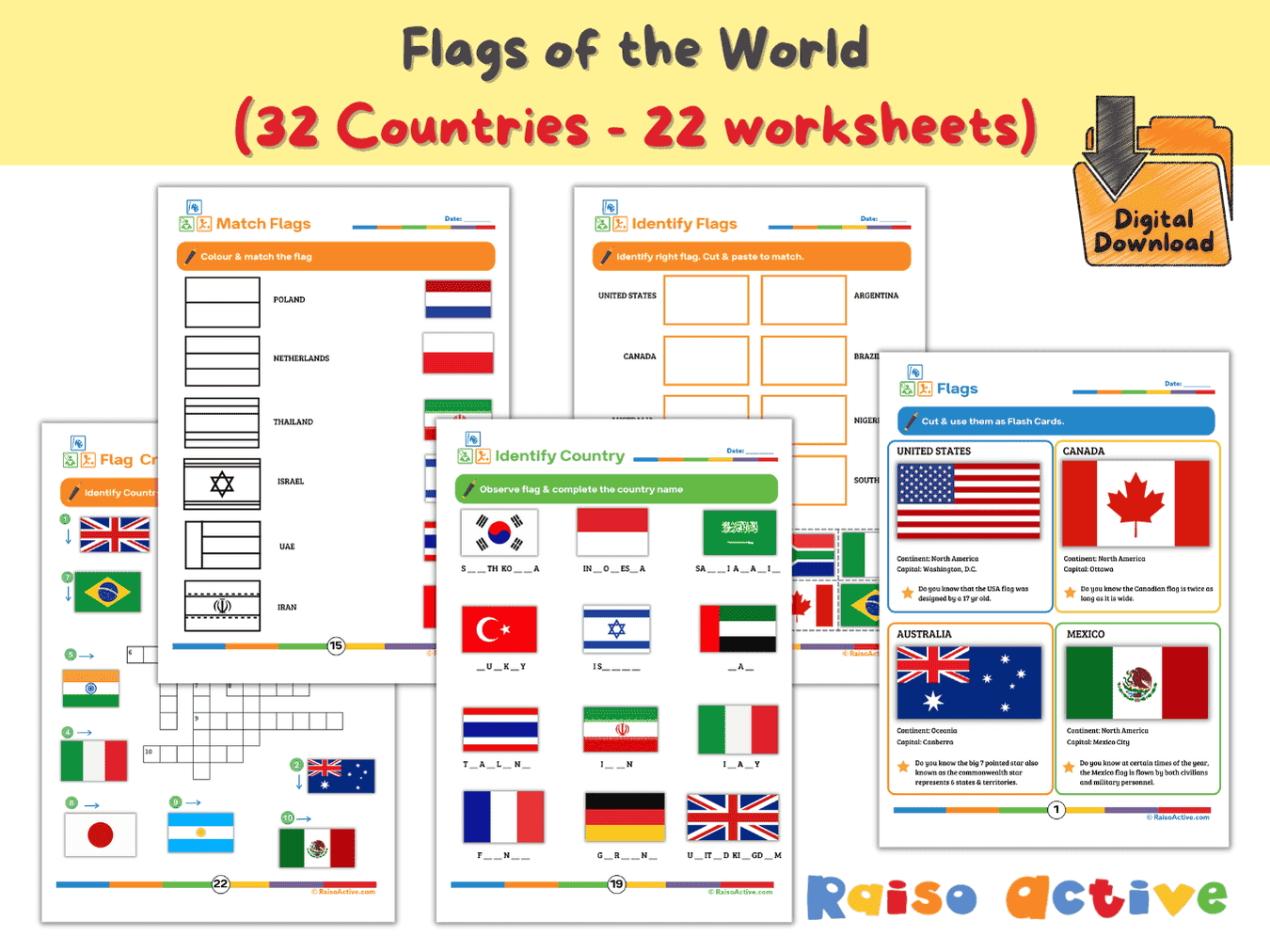
Flags of the World Activity Book & Flashcards for Kids (Ages 5-9)
Ages 5-8 · Kindergarten–Grade 2Ages 5-8 · Year 1–Year 3Ages 5-8 · UKG–Class 2Ages 5-8 · 23 pages
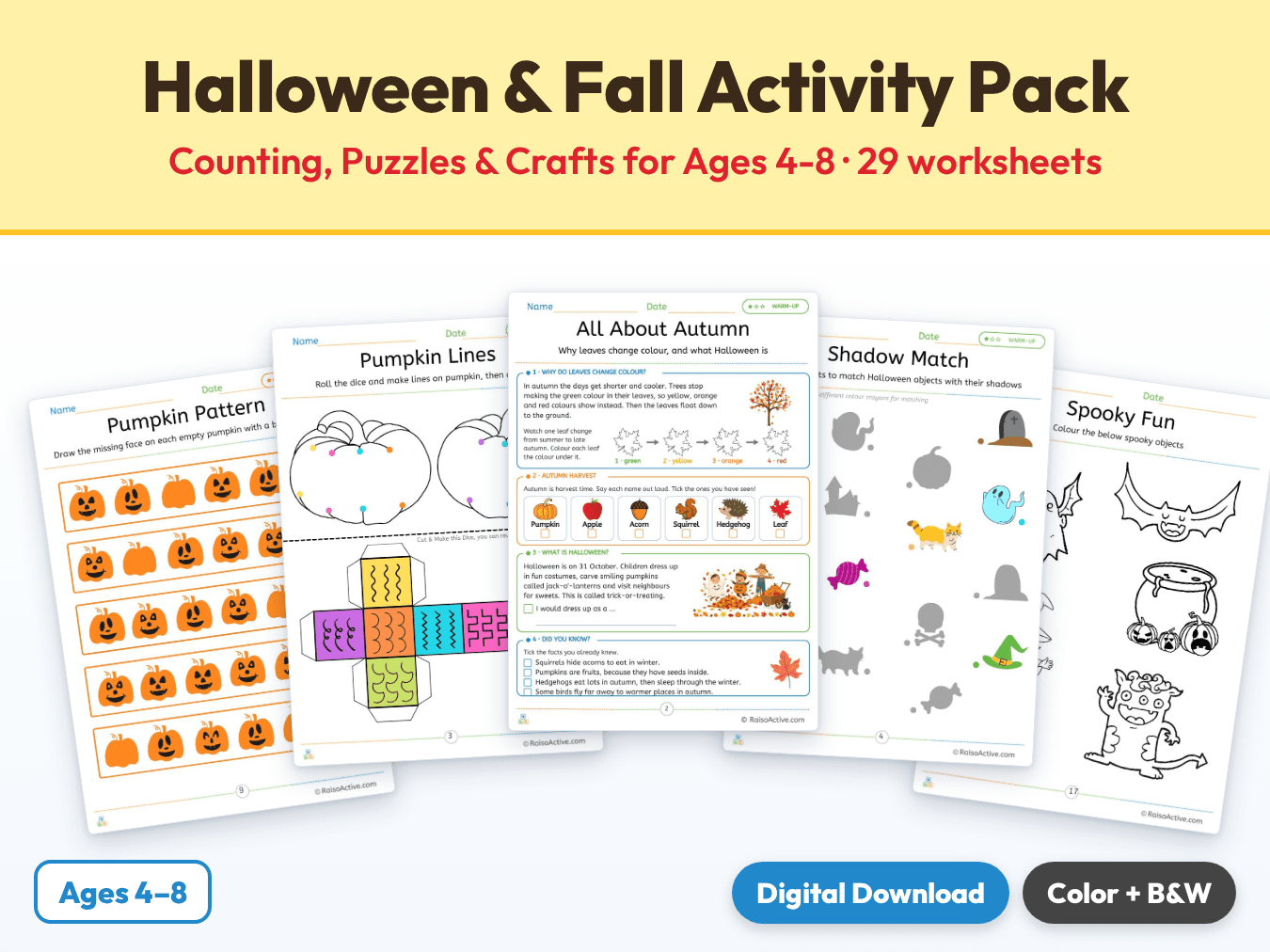
Halloween & Fall Activity Pack: Counting, Puzzles & Crafts for Ages 4-8
Ages 4-8 · Pre-K–Grade 2Ages 4-8 · Reception–Year 3Ages 4-8 · LKG–Class 2Ages 4-8 · 30 pages
Inside the packs
8 phonics games that feel like play
Every page is a small game: your child sounds out, blends, cuts, folds and hunts, and reads a little more each time. Play one page a day, about ten minutes.
- GAME 1Level 1
Fold, read, reveal
Sound out the word, blend it, then fold the flap to check the picture.
- GAME 2Level 1
Secret word
Say the first sound of each picture, write its letter and read the secret word.
- GAME 3Level 2
Cut, glue, write
Cut out a letter, glue it in front of the word family and write the new word.
- GAME 4Level 2
Rhyme hunt
Find every word that rhymes with sad and colour it in.
- GAME 5Level 2
Hidden words
Hunt for bat, cat, rat and pat in the word search.
- GAME 6Level 2
Say it, unscramble
Say the picture, put the letters in order, then write the word.
- GAME 7Level 3
Magic e
Add a magic e and hear the vowel say its name: cap becomes cape.
- GAME 8Level 3
Long or short?
Sort the pictures: long a in cake and train, short a in cat.
Phonics Worksheets to print
Browse all worksheets for ages 3–7
Family Words Worksheet: Picture Matching and Word Recognition
Ages 4-6 · Pre-K–KindergartenAges 4-6 · Reception–Year 1Ages 4-6 · LKG–UKGAges 4-6
This worksheet gives children ages 4-6 another round of practice recognizing family-member vocabulary words, reinforcing the connection between a printed word and the picture it names through both a tick-the-answer step and a cut-and-paste matching step. Repeating this pairing across two different formats on one page helps move these words from recognition with support toward more independent reading.

Blend Words Worksheet: Practice Blending Sounds with Pictures!
Ages 4-6 · Pre-K–KindergartenAges 4-6 · Reception–Year 1Ages 4-6 · LKG–UKGAges 4-6
This worksheet has children ages 4-6 practice blending two consonant sounds together at the start of a word by looking at a picture, saying the word, and writing in the missing blend to complete it. Unlike simply reading a finished blend word, this fill-in-the-blank format requires your child to actively recall which two letters combine to make the sound they hear, a more demanding skill than recognition alone. Strengthening blend spelling this way builds the foundation needed for more complex multisyllable words later in reading development.

Ot Word Family Worksheet: Read, Trace, and Identify!
Ages 4-6 · Pre-K–KindergartenAges 4-6 · Reception–Year 1Ages 4-6 · LKG–UKGAges 4-6
Reading, tracing, and identifying words from the 'ot' family — like pot, dot, and hot — helps children ages 4-6 see how changing the first letter of a word while keeping the same ending produces a whole new word, reinforcing the pattern-based phonics strategy known as word families. Tracing each word while reading it connects handwriting practice directly to reading practice, and identifying the matching picture afterward checks genuine comprehension rather than rote letter-sounding. Word family practice like this builds the foundation for decoding many more words independently later on.
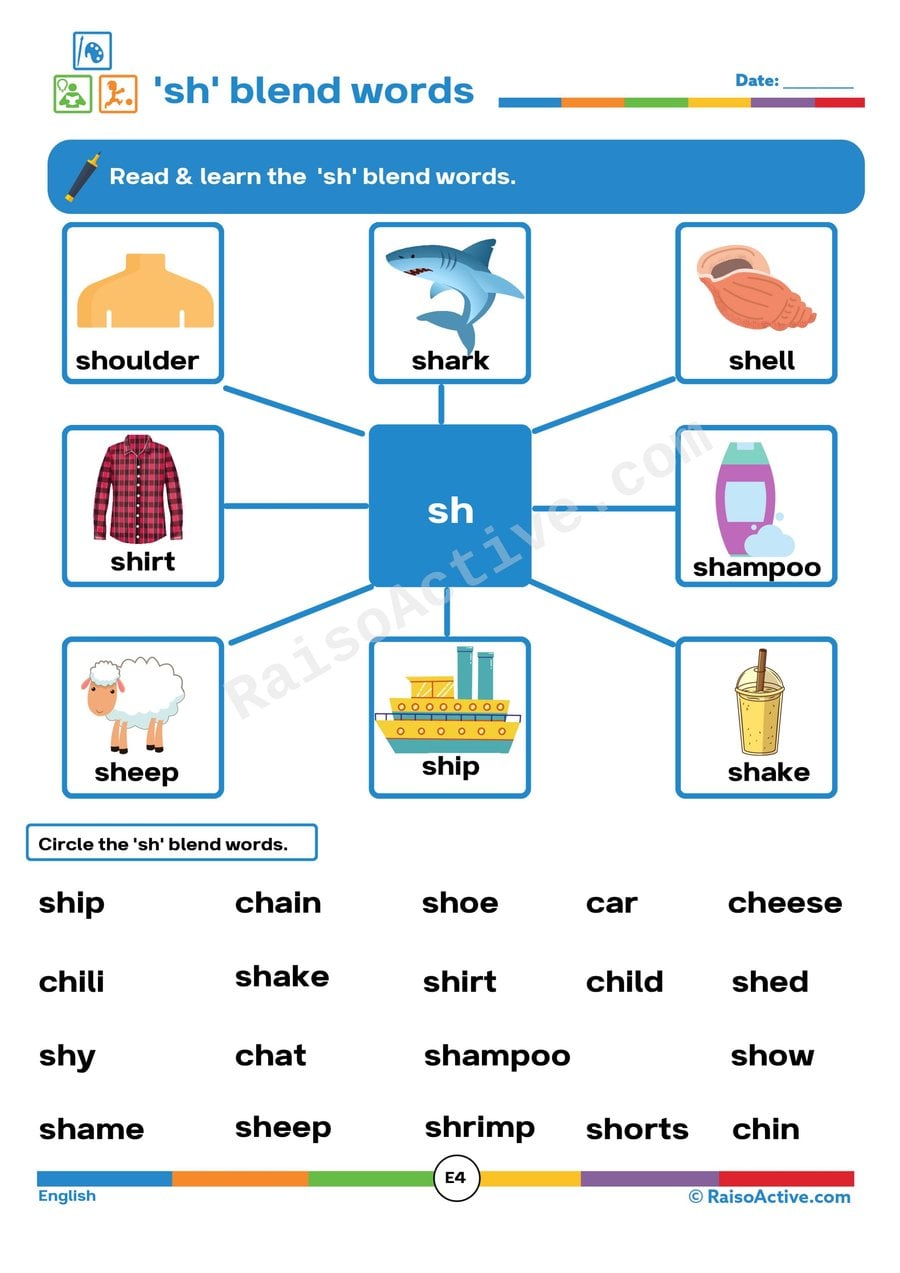
Sh Blend Words Worksheet: Read, Learn, and Circle!
Ages 4-6 · Pre-K–KindergartenAges 4-6 · Reception–Year 1Ages 4-6 · LKG–UKGAges 4-6
The 'sh' blend is one of the most common digraphs in early English words, appearing in everyday vocabulary like 'ship,' 'shell,' and 'shop,' which makes this worksheet especially useful for children ages 4-6 building toward independent reading. Recognizing that two letters, 's' and 'h,' combine to make one brand-new sound (rather than two separate sounds) is a key phonics milestone, since digraphs behave differently from regular consonant blends. Reading and then circling 'sh' words from a list reinforces both the sound and the specific letter pattern that represents it.

Blend Words Worksheet: Circle the Correct Picture!
Ages 4-6 · Pre-K–KindergartenAges 4-6 · Reception–Year 1Ages 4-6 · LKG–UKGAges 4-6
This worksheet strengthens blending skills for children ages 4-6, asking them to say a consonant blend like 'bl' or 'st' together with different word endings and identify which resulting word matches a picture. Blending two consonant sounds smoothly before adding a vowel is a more advanced phonics skill than single-letter sounds, and this practice directly supports decoding multisyllabic and blended words during independent reading.
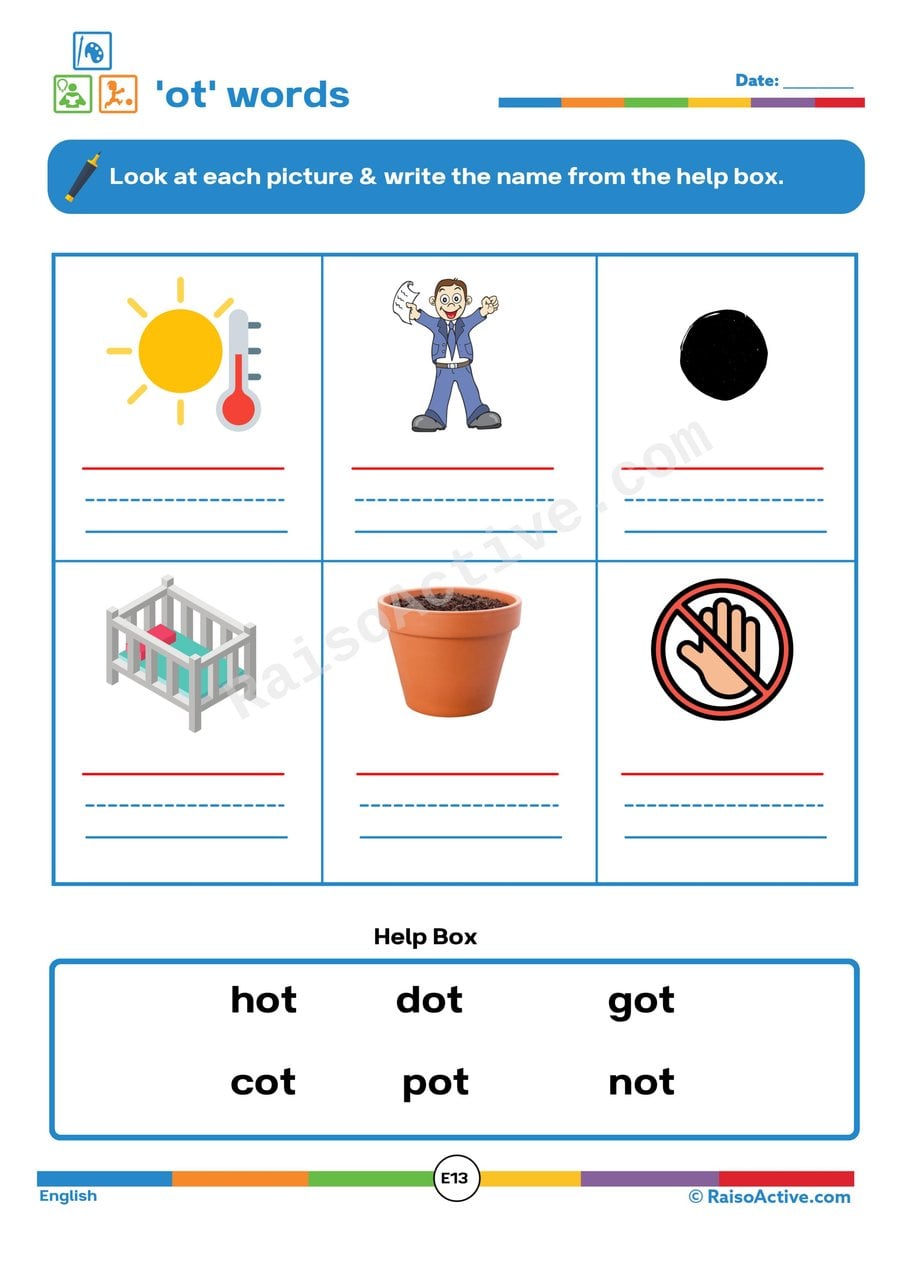
Ot Word Fun: 'ot' Word Worksheet for Early Readers
Ages 4-6 · Pre-K–KindergartenAges 4-6 · Reception–Year 1Ages 4-6 · LKG–UKGAges 4-6
Children ages 4-6 build phonics fluency by reading and writing CVC words in the 'ot' family, like 'pot', 'dot', and 'hot'. Recognizing this consistent letter pattern teaches early readers that groups of letters make predictable sounds, a key strategy for decoding unfamiliar words independently. Writing the words afterward reinforces the sound-to-letter connection needed for spelling.
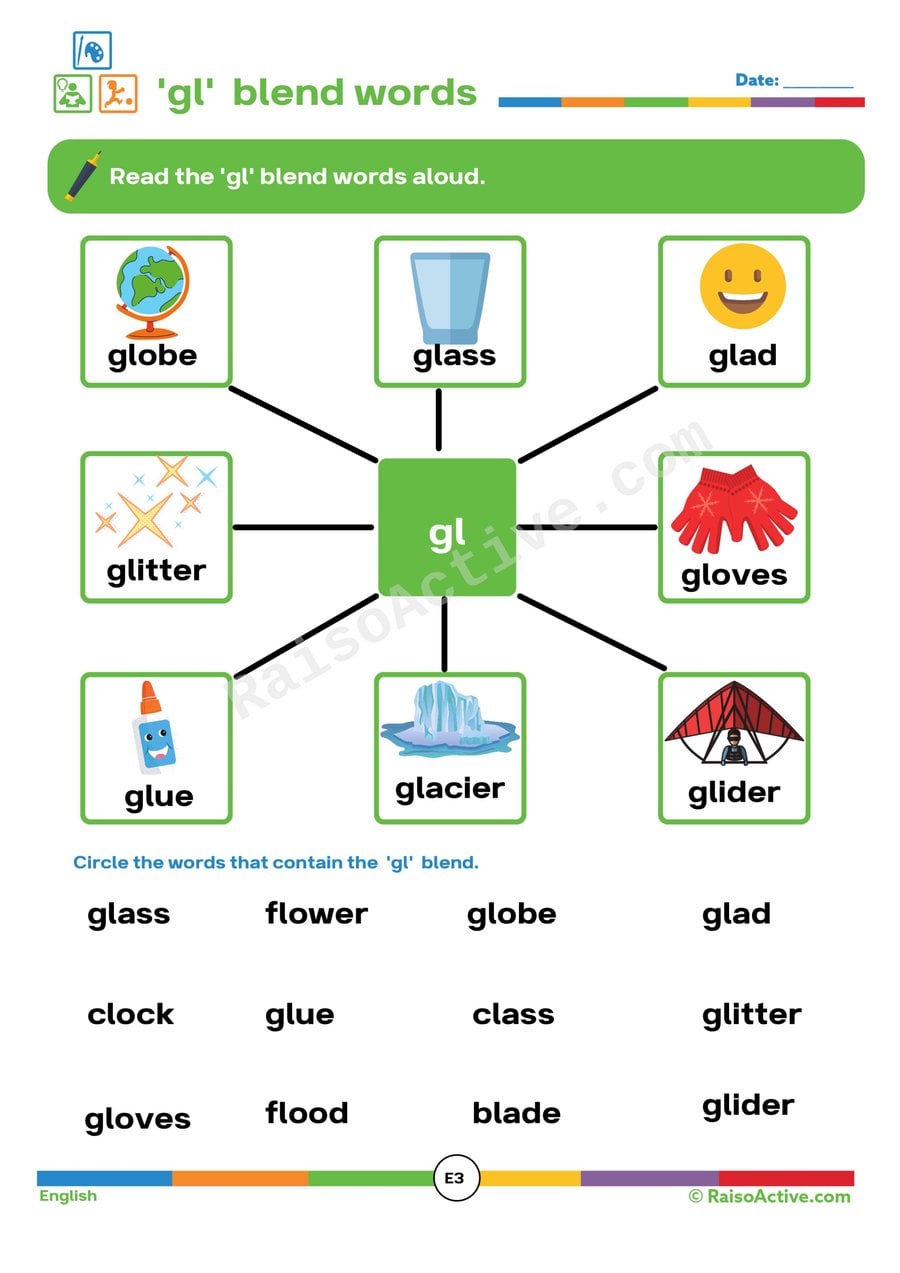
Gl Blend Words Worksheet: Read and Circle!
Ages 4-6 · Pre-K–KindergartenAges 4-6 · Reception–Year 1Ages 4-6 · LKG–UKGAges 4-6
This worksheet builds phonics skills around the 'gl' consonant blend, helping children recognize and read words like 'glass,' 'glue,' and 'glow' where the sounds of g and l combine at the start of a word. For ages 4-6, practicing blends like gl strengthens the sound-segmentation skills needed to decode increasingly complex words as reading develops.

Alphabet Adventures: Write the First Letter - Small Alphabet Worksheet
Ages 4-6 · Pre-K–KindergartenAges 4-6 · Reception–Year 1Ages 4-6 · LKG–UKGAges 4-6
This worksheet strengthens phonemic awareness by asking children ages 4-6 to isolate the very first sound in a spoken word and match it to its lowercase letter - a skill that sits at the heart of early decoding and spelling. Because it uses small (lowercase) letters specifically, it also reinforces letter-case recognition, since children encounter lowercase print far more often than capitals once they begin reading books.

Blend Words Worksheet: See the Pictures and Write the Correct Blend!
Ages 4-6 · Pre-K–KindergartenAges 4-6 · Reception–Year 1Ages 4-6 · LKG–UKGAges 4-6
Children ages 4-6 practice identifying missing consonant blends by looking at a picture, saying the word aloud, and writing the correct blend to complete it. This task requires children to isolate the blended sound at the beginning of a word and match it to its written letter combination, a more advanced phonics skill than single-letter sounds. Successfully completing each word strengthens both spelling accuracy and reading fluency with blended sounds.

Sl Blend Words Worksheet: Read, Identify, and Circle!
Ages 4-6 · Pre-K–KindergartenAges 4-6 · Reception–Year 1Ages 4-6 · LKG–UKGAges 4-6
Reading and circling words that begin with the 'sl' consonant blend helps children ages 4-6 hear that two consonants pressed together, like s and l, still form one connected sound at the start of a word. This is a more advanced phonics skill than single-letter sounds, since children must blend two consonants smoothly rather than separating them. Recognizing blends like 'sl' in words such as 'slide' or 'sled' builds the decoding fluency needed to read longer, less predictable words independently.

First Letter Fun: Identify and Write! A Vocabulary Worksheet for Kids
Ages 4-6 · Pre-K–KindergartenAges 4-6 · Reception–Year 1Ages 4-6 · LKG–UKGAges 4-6
Designed for 4-6 year olds, this worksheet pairs vocabulary building with first-letter phonics — your child has to recognize or learn each pictured object's name and then isolate and write its opening sound, which stretches both spoken vocabulary and early spelling skills together. Because this version targets a slightly older age range, it's a good check for whether your child can move through the naming-and-writing process more independently than a beginning 3-year-old would.
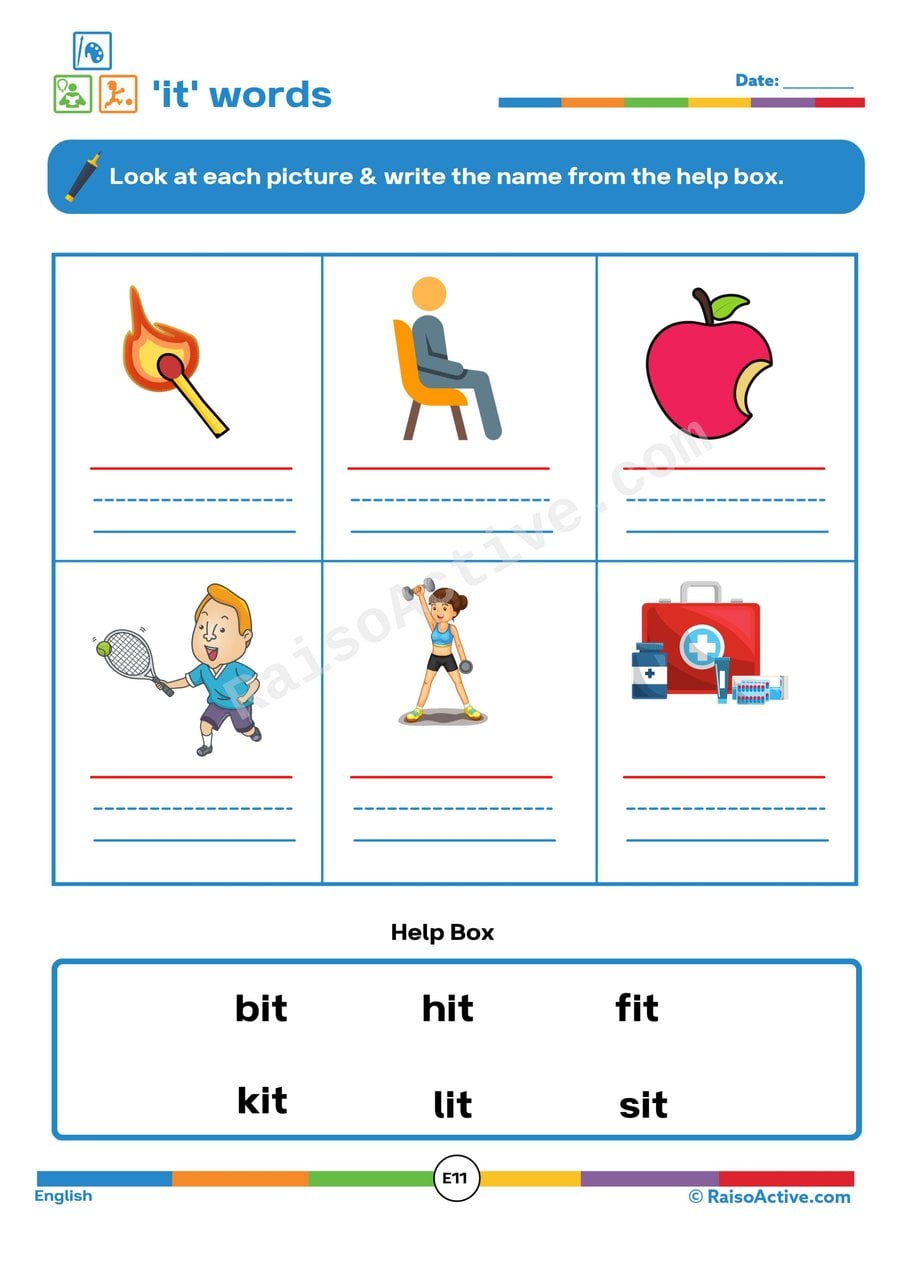
It Words Worksheet: Read and Write 'it' Words!
Ages 4-6 · Pre-K–KindergartenAges 4-6 · Reception–Year 1Ages 4-6 · LKG–UKGAges 4-6
Children ages 4-6 build phonics fluency by reading and writing CVC words from the 'it' family, such as 'sit', 'bit', and 'fit'. Recognizing this word family pattern teaches children that groups of letters carry predictable, reusable sounds, which speeds up decoding of new words they encounter later. Writing each word after identifying it also reinforces correct spelling and letter sequencing.
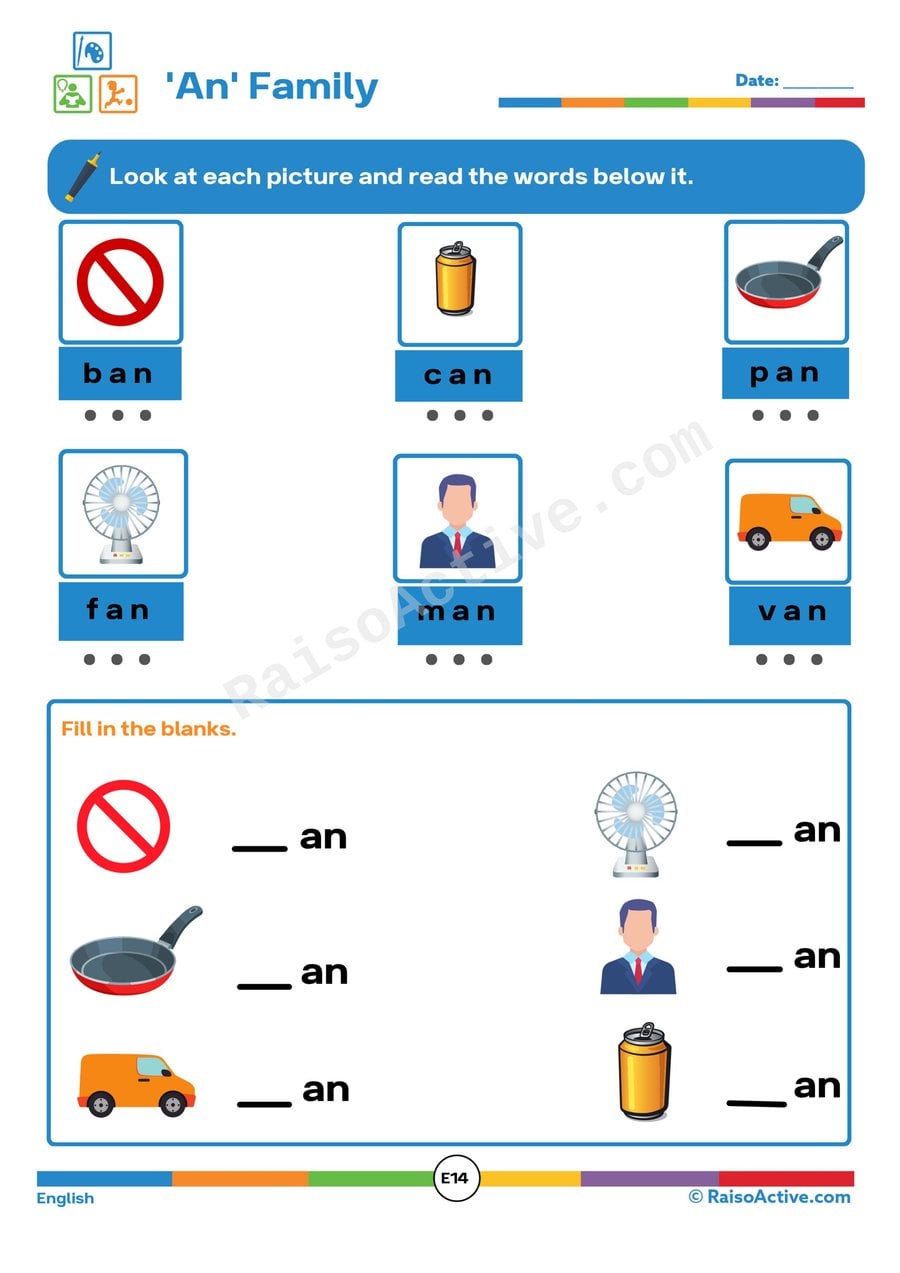
An Family Word Worksheet: Read, Match, and Write!
Ages 4-6 · Pre-K–KindergartenAges 4-6 · Reception–Year 1Ages 4-6 · LKG–UKGAges 4-6
This worksheet builds on word-family recognition by focusing on 'an' words like can, fan, and man, helping children ages 4-6 see that swapping the first letter of a familiar ending creates a whole new word. Practicing this pattern strengthens decoding skills and builds reading confidence, since children start recognizing chunks of words rather than sounding out every single letter.
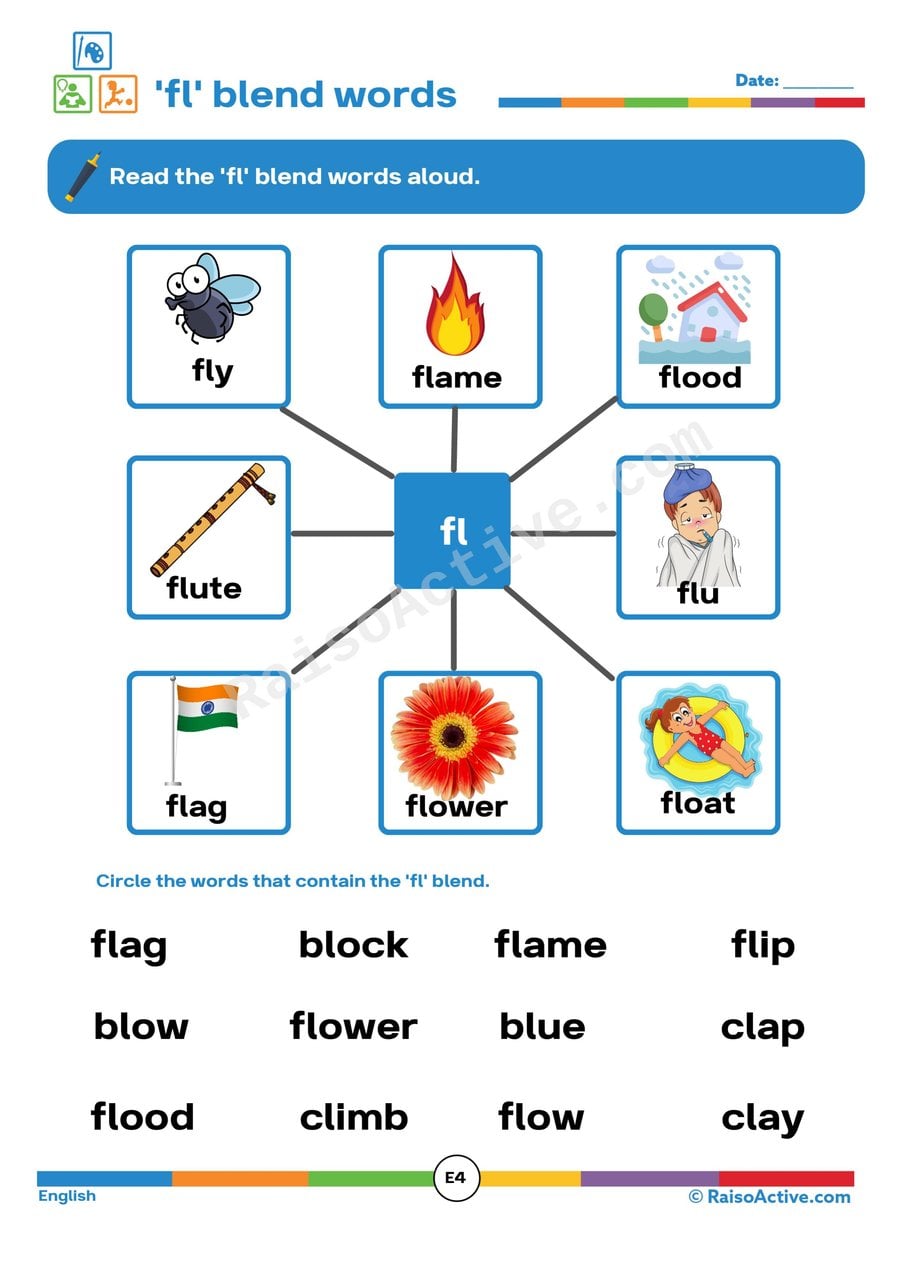
FL Blend Words Worksheet: Read, Circle, and Learn!
Ages 4-6 · Pre-K–KindergartenAges 4-6 · Reception–Year 1Ages 4-6 · LKG–UKGAges 4-6
Reading and circling words that begin with the 'fl' consonant blend teaches children ages 4-6 that two consonants together, like f and l, can combine into one smooth sound at the start of a word, a more advanced phonics concept than single-letter sounds. This kind of targeted blend practice builds the specific decoding skill needed to read common early words like 'flag,' 'fly,' and 'flower' without stumbling. Strengthening blend recognition now supports much smoother, more confident reading as vocabulary grows in later grades.
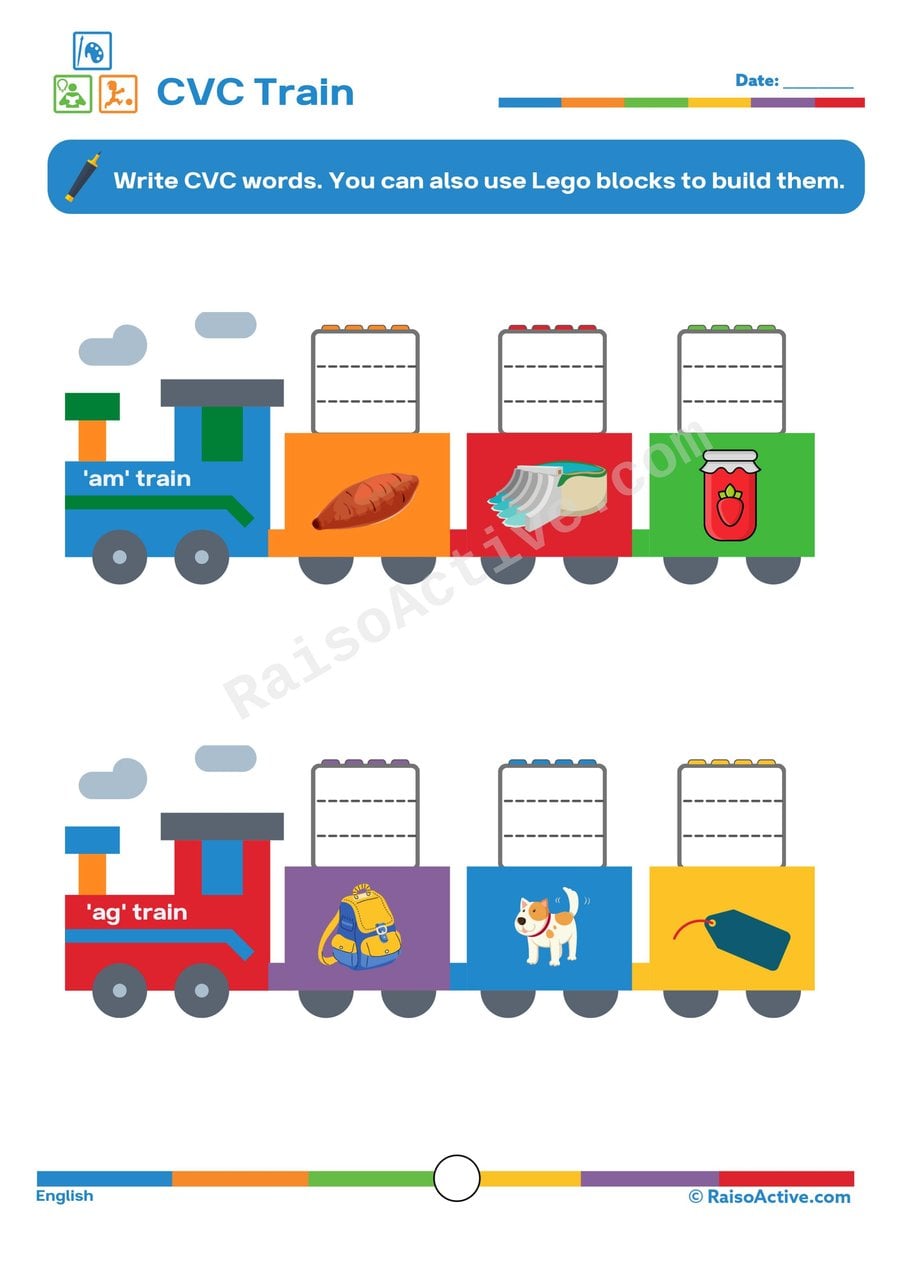
CVC Train Worksheet: Write CVC Words!
Ages 4-6 · Pre-K–KindergartenAges 4-6 · Reception–Year 1Ages 4-6 · LKG–UKGAges 4-6
Writing consonant-vowel-consonant words like 'cat,' 'sun,' or 'pig' under matching pictures gives children ages 4-6 direct practice with letter-sound blending, a core phonics skill that underpins independent reading. Because each train car pairs a picture clue with a blank space, children also practice translating a spoken word they can sound out into its correctly spelled written form.
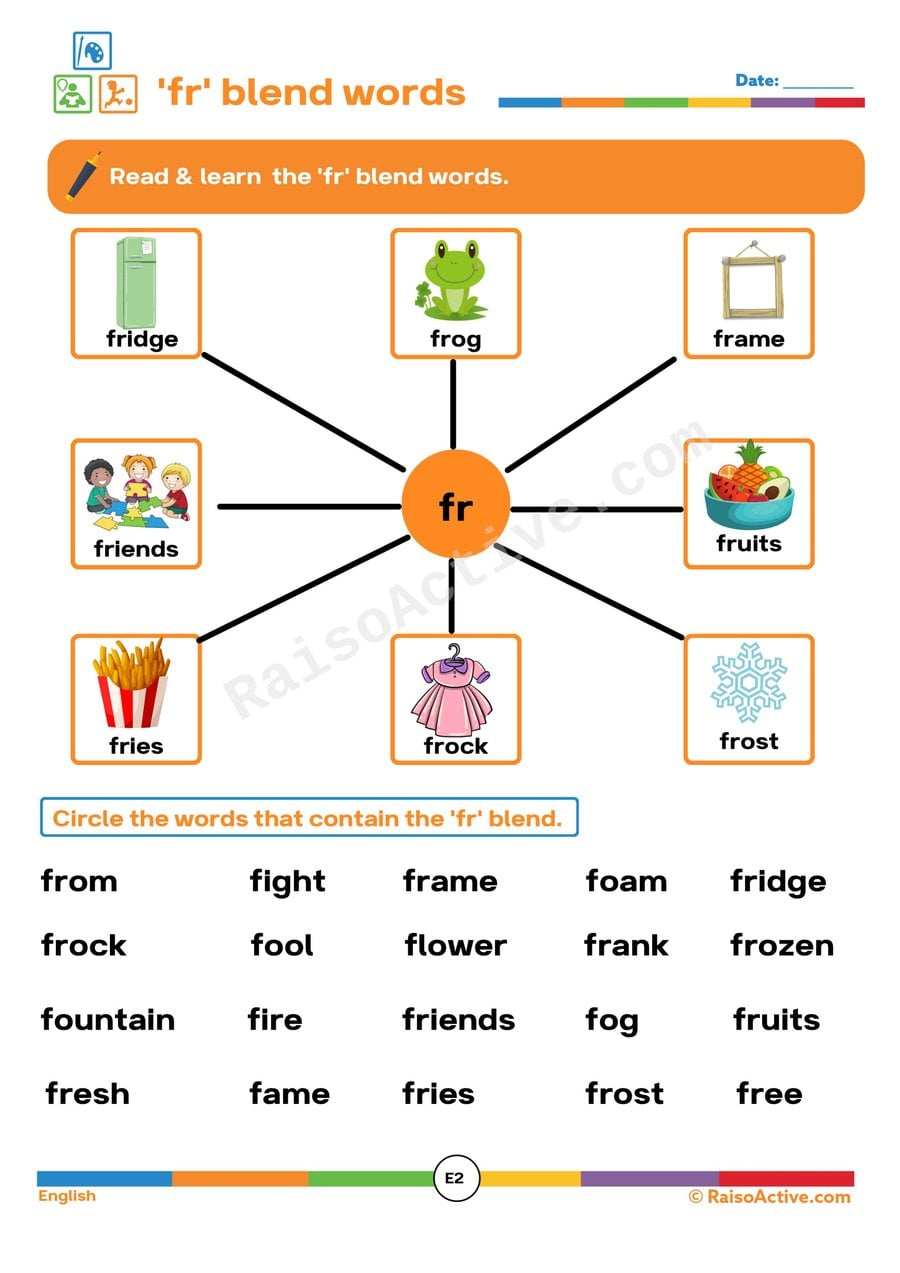
FR Blend Words Worksheet: Circle the Words!
Ages 4-6 · Pre-K–KindergartenAges 4-6 · Reception–Year 1Ages 4-6 · LKG–UKGAges 4-6
Children ages 4-6 practice recognizing the 'fr' consonant blend at the start of words, like 'frog' and 'friend', which requires blending two distinct sounds smoothly together rather than reading them as separate letters. Circling the correct words trains visual scanning alongside auditory sound recognition, both essential for fluent early reading. This kind of blend practice moves children beyond single-letter phonics into more complex word decoding.

Family Words Worksheet: Picture Matching and Word Recognition
Ages 4-6 · Pre-K–KindergartenAges 4-6 · Reception–Year 1Ages 4-6 · LKG–UKGAges 4-6
Children ages 4-6 practice recognizing and reading words from the 'family' word group, like 'candle' becoming 'candle-family' patterns or similar word-family endings, by matching written words to their corresponding pictures. Word family practice builds phonics pattern recognition, helping children read new words faster by spotting familiar chunks within them.
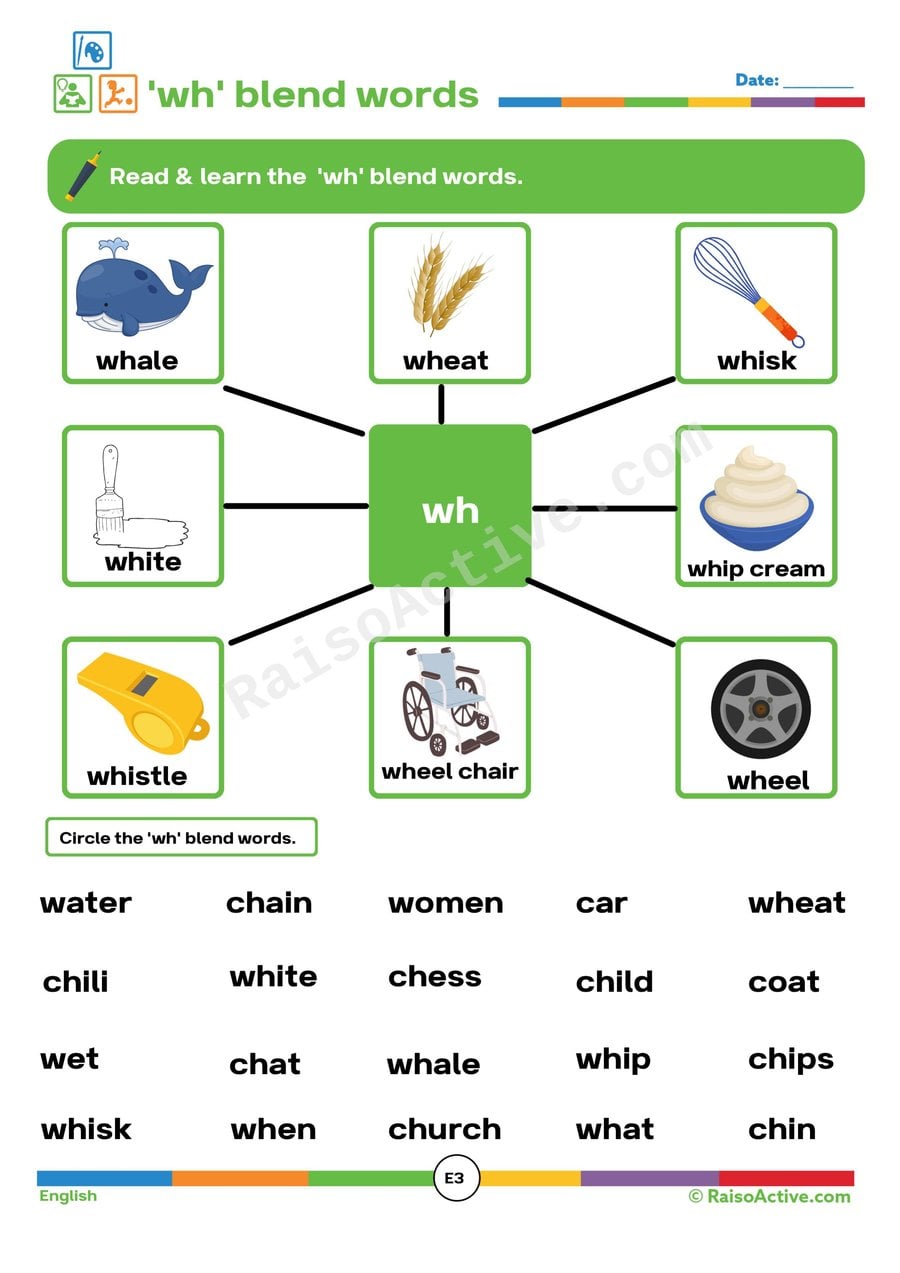
Wh' Blend Words Worksheet: Read, Learn, and Circle!
Ages 4-6 · Pre-K–KindergartenAges 4-6 · Reception–Year 1Ages 4-6 · LKG–UKGAges 4-6
The 'wh' blend appears in common early words like 'what,' 'when,' and 'why,' making it an especially high-value sound for children ages 4-6 to master, since these words show up constantly in questions and everyday speech. This worksheet has children read and recognize 'wh' words paired with pictures before circling them in a final list, reinforcing both the visual spelling pattern and the blended sound. Because 'wh' words are often question words, mastering this blend also supports oral language development alongside pure phonics skill.
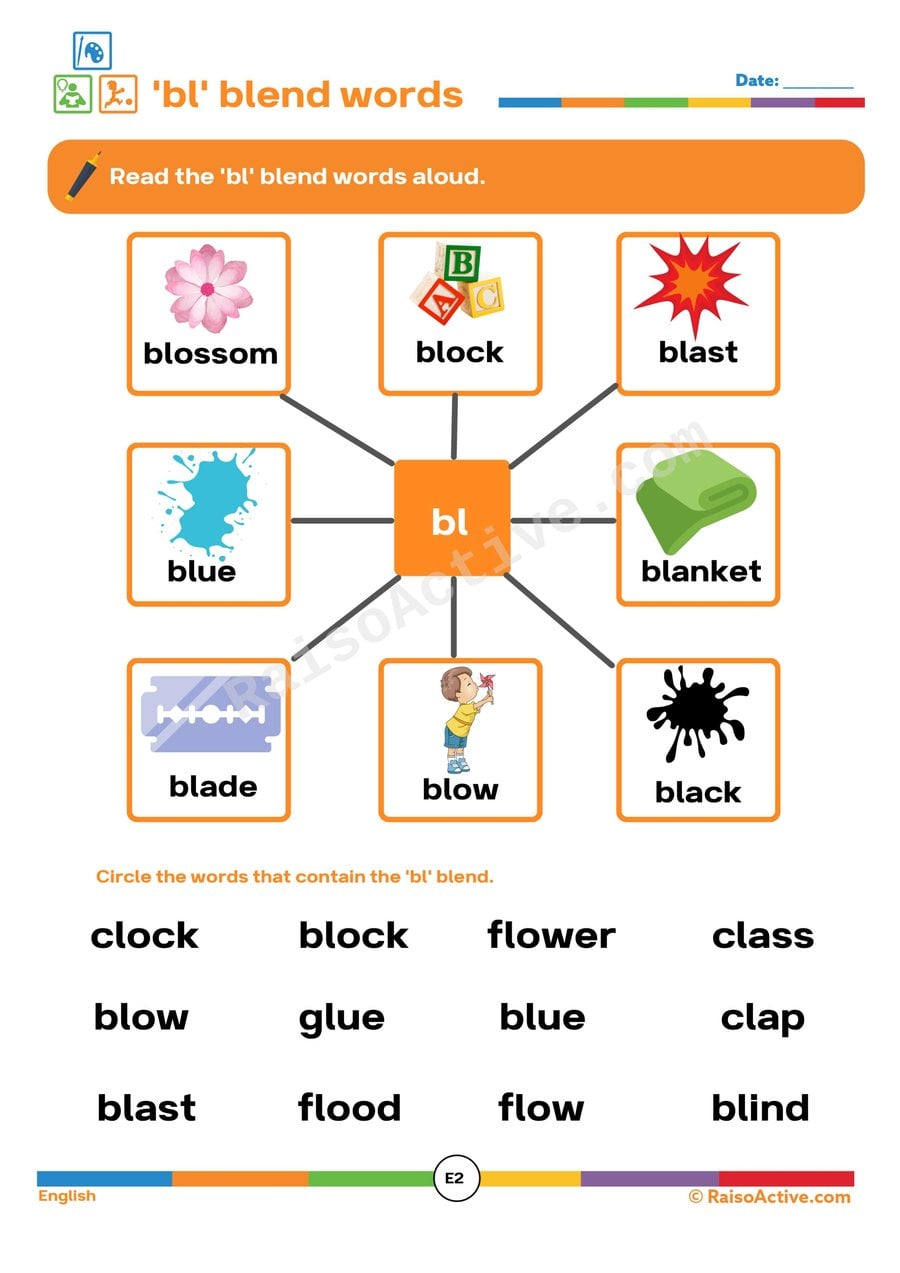
'bl' Blend Words Worksheet: Read, Circle, and Learn!
Ages 4-6 · Pre-K–KindergartenAges 4-6 · Reception–Year 1Ages 4-6 · LKG–UKGAges 4-6
Consonant blends like 'bl' require a child to smoothly join two sounds together (b + l) rather than saying them as separate beats, which is a distinct and harder phonics skill than single-letter sounds. This worksheet gives 4-6 year olds repeated practice reading words that start with 'bl' — like black, blue, or block — and then applying that recognition by circling the matching words, reinforcing the blend both by ear and by sight.

Blend Words Worksheet: Fill in the Blanks with Beginning Blends!
Ages 4-6 · Pre-K–KindergartenAges 4-6 · Reception–Year 1Ages 4-6 · LKG–UKGAges 4-6
Similar to blend recognition but with an added layer of choice, this worksheet gives children ages 4-6 a bank of possible beginning blends to choose from as they complete each picture word, building both phonics recall and careful selection skills. Choosing the correct blend from several options requires your child to test each possibility mentally against the word they're trying to spell, which strengthens their ability to self-check and problem-solve rather than just guessing. This kind of active decision-making with phonics elements builds toward more independent spelling down the road.

Unlocking 'un' Words: A Fun Worksheet for Early Readers!
Ages 4-6 · Pre-K–KindergartenAges 4-6 · Reception–Year 1Ages 4-6 · LKG–UKGAges 4-6
Ages 4-6 practice decoding and spelling CVC words in the 'un' family, such as 'sun' and 'bun', by matching each picture to its written word. This picture-to-word matching strengthens the bridge between spoken vocabulary and printed text, a core early literacy skill. Writing the word afterward locks in correct letter sequencing and spelling memory.
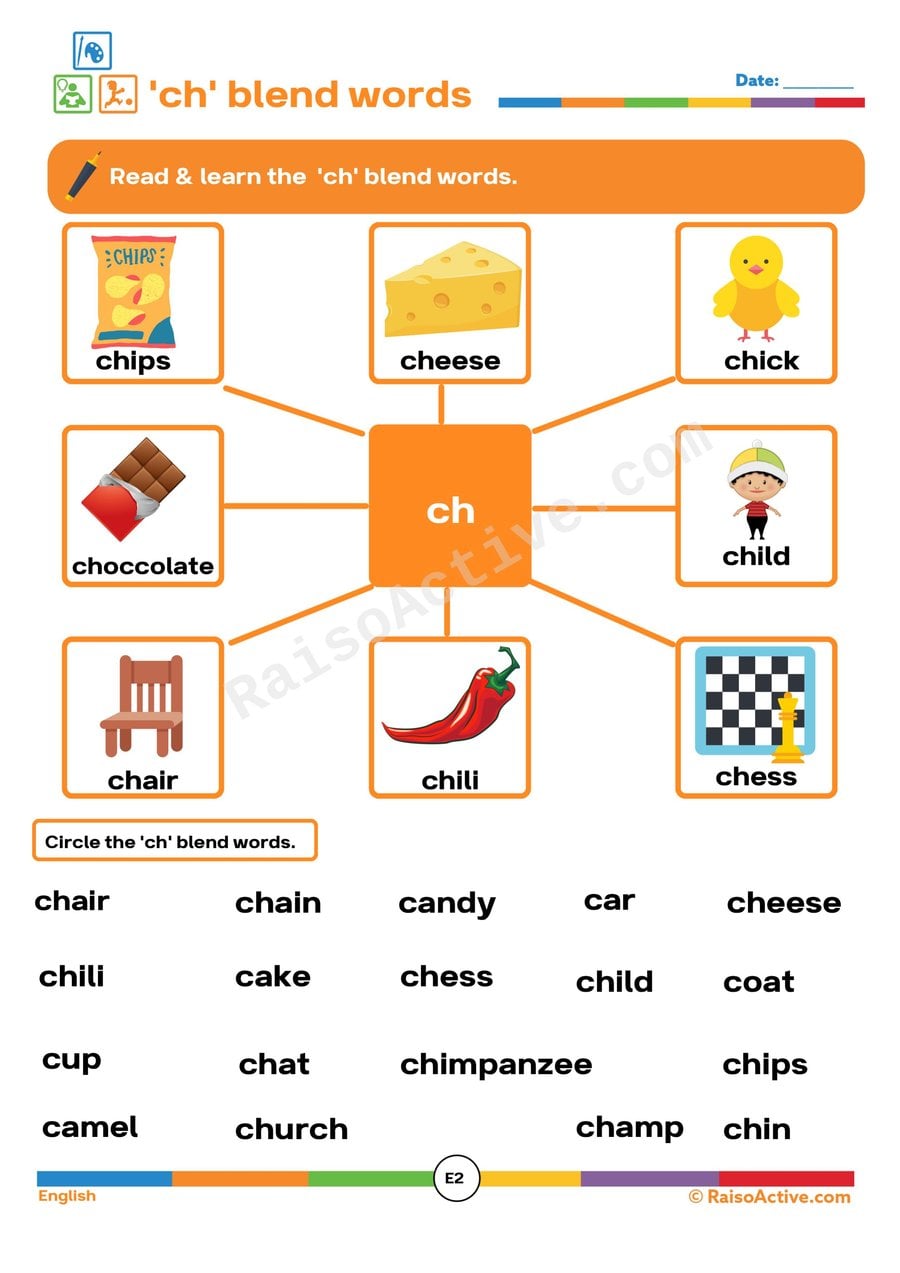
Ch Blend Words Worksheet: Read, Learn, and Circle!
Ages 4-6 · Pre-K–KindergartenAges 4-6 · Reception–Year 1Ages 4-6 · LKG–UKGAges 4-6
This worksheet focuses children ages 4-6 on recognizing words that begin with the 'ch' digraph, like 'chair' and 'cheese', asking them to read and then circle matching words. Because 'ch' represents a single new sound rather than two blended consonants, mastering it teaches children an important phonics rule: some letter pairs combine to make one brand-new sound entirely.

Phonics Fun: Connect the Letters S-X with Starting Sounds Worksheet
Ages 4-6 · Pre-K–KindergartenAges 4-6 · Reception–Year 1Ages 4-6 · LKG–UKGAges 4-6
Connecting pictures to their correct beginning letter across the range S through X helps children ages 4-6 extend their phonics practice beyond the most common early letters, building broader letter-sound matching skills. This wider range also introduces children to less frequently practiced sounds, rounding out their overall phonemic awareness.

Vowel Sounds Worksheet: Identify and Circle the Correct Vowel!
Ages 4-6 · Pre-K–KindergartenAges 4-6 · Reception–Year 1Ages 4-6 · LKG–UKGAges 4-6
Children ages 4-6 practice identifying vowel sounds within words by looking at a picture, saying its name aloud, and figuring out which vowel they hear, a specific phonics skill that builds toward independent reading and spelling. Isolating the vowel sound in a word is often trickier for children than identifying beginning consonant sounds, making this a meaningful next step in phonics.
About Phonics Worksheets
Phonics worksheets are printable sheets for children aged 3 to 7 that teach links between letters and sounds and how to blend sounds into words. They cover single letter sounds, beginning and ending sounds, CVC blending, consonant and vowel digraphs, long vowels and word families, from Pre-K to 1st Grade, Nursery to Year 2, and Nursery to Class 1.
Phonics is the method of teaching reading by mapping the 26 letters and their combinations to the roughly 44 sounds of spoken English, then blending those sounds left to right to read a word and segmenting them to spell it. Each letter-to-sound link is a grapheme-phoneme correspondence, and systematic synthetic phonics teaches those correspondences in a planned order rather than as they happen to appear in books. A three-year-old is at the listening stage: hearing rhymes and the first sound of their own name. A five-year-old in Kindergarten, Reception or UKG is decoding c-a-t and s-h-i-p. A seven-year-old is reading rain, ray and rake and choosing the right spelling for the long a sound. The phonics worksheets here follow that sequence, and each isolates a single correspondence or skill.
The phonics sequence from single sounds to long vowels
Single sounds come first, usually starting with s, a, t, p, i, n because they make many short words quickly. Once a child has around eight sounds they begin blending consonant-vowel-consonant words such as sat, tin and pan. Next come the remaining single letters and then consonant digraphs (sh, ch, th, ng) and vowel digraphs (ee, oo, ai, oa), where two letters make one sound. Last are the long vowel spellings and split digraphs (a-e in cake), where the same sound has several spellings.
In the Letters and Sounds framework used in UK Reception and Year 1, these are Phases 2, 3 and 5; Phase 1 is the listening work that precedes print. In US Common Core terms the single sounds and CVC blending are RF.K.3, and digraphs and long vowels are RF.1.3. Indian pre-primary programs following NEP 2020 place single sounds in Nursery and LKG and blending in UKG.
- Age 3–4: rhyme, first sounds, oral blending (what word is c-a-t?)
- Age 4–5: single letter sounds, matching pictures to beginning sounds
- Age 5–6: reading and writing CVC words, ending sounds, consonant digraphs
- Age 6–7: vowel digraphs, long vowel spellings, word families, decodable passages
How to use phonics worksheets at home
Say the sound, not the letter name, every time the child points to a letter, and keep sounds short and unvoiced (s not suh, m not muh) so blending works. On a blending sheet, run a finger under the word while sounding it, then say it fast. On a writing sheet, say the word slowly, count the sounds on fingers, and write one letter or digraph per sound. One correspondence per session is enough; five minutes a day beats a long weekly session.
What to watch for
A child who can say every sound but cannot blend them needs more oral blending without print, which the listening sheets provide. A child who reads a word correctly and immediately guesses the next from its first letter needs to slow down and sound through to the end. The Year 1 phonics screening check in England tests exactly this ability with made-up words, which is why decodable sheets here include nonsense words alongside real ones.
Frequently asked questions
What phonics should a child know by the end of Kindergarten?
By the end of Kindergarten, Reception or UKG, around age 5 to 6, a child is expected to know a sound for every letter of the alphabet, hear and say the first, middle and last sounds in a short word, blend sounds to read consonant-vowel-consonant words such as dog and ship, segment those words to spell them, and read a small set of common digraphs including sh, ch, th, ee and oo.
What age should a child start phonics?
Listening work (rhymes, clapping syllables, spotting first sounds) can begin at 3. Formal letter-sound teaching typically starts at 4 in Pre-K, Nursery and LKG, and blending at 4 to 5 in Kindergarten and Reception. Starting print work before a child can hear separate sounds in spoken words leads to memorizing rather than decoding, so the oral stage should not be skipped.
What is the difference between phonics and sight words?
Phonics reads a word by its sounds; sight words are read by memory as whole shapes. Most English words can be decoded once enough correspondences are known, but a small set of very common words (the, was, said, of) do not follow the usual patterns and are taught as sight words alongside phonics. A child needs both: phonics for the majority of words and sight words for the exceptions.
What is a digraph in phonics?
A digraph is two letters that together represent one sound. Consonant digraphs include sh in ship, ch in chip, th in thin and ng in ring. Vowel digraphs include ee in feet, oo in moon, ai in rain and oa in boat. Children usually meet consonant digraphs after they can blend three-letter words, and vowel digraphs after that, corresponding to Letters and Sounds Phase 3 and Common Core RF.1.3.
Why does my child sound out a word correctly but still say the wrong word?
This usually means the sounds are being said too slowly or with an added vowel (cuh-a-tuh), so the child cannot hear the word inside them. Practice saying the sounds quickly and cleanly, then squashing them together. It also happens when the word is not in the child's spoken vocabulary; a decoded word they have never heard will not click, which is why reading aloud to the child matters alongside phonics.
Are the phonics worksheets free to download?
Yes. After creating an account you can download any phonics sheet as a watermarked PDF at no charge, up to five a day. A yearly subscription of ₹1000 or $20 removes the watermark and daily limit for the whole library of more than 1,000 worksheets and the printable packs. All sheets are sized for A4 and US Letter.

Written by
Hemsweta Jain · Teacher Cheena
MBA and Early Childhood Educator, teaching since 2014 · Founder of RaisoActive, Mumbai
Written and reviewed by Hemsweta Jain (Teacher Cheena), who designs every RaisoActive worksheet.
Last reviewed
Guides for parents and teachers
See all guides
Sight Words by Age: The First 50 Words and How to Teach Them Without Flashcard Fatigue
Which sight words to teach first and why, the heart-word method, a read-trace-write-find routine, games, and a by-age table of typical sight-word progress.
How to Teach CVC Blending: A Step-by-Step Method That Works in Two Weeks
A step-by-step method for teaching CVC blending, covering continuous sounds, word families, common errors, and a 14-day plan that most children finish reading CVC words.
Phase 2 Phonics at Home: Sound Order, Blending Games, Worksheets
Phase 2 phonics at home: the five sound sets in order, oral blending, tricky words, a two-week routine, common mistakes, and free worksheets.

Reception Year Explained: EYFS Learning and How to Help at Home
A teacher's plain-English guide to the Reception Year: the seven areas of learning, Early Learning Goals, Phase 2/3 phonics, the RBA and home routines.
UKG Syllabus Explained: English, Maths and EVS Month by Month
What UKG classes typically cover in English, maths and EVS, month by month, aligned to NEP 2020, with ways to support at home and signs your child is behind.
Bridging Two Worlds: A Complete Guide to Teaching Heritage Languages Alongside English
A practical guide to raising bilingual children who speak both their heritage language and English with confidence. Research-backed strategies, activities, and tips for Indian families.