Wh' Blend Words Worksheet: Read, Learn, and Circle!
The 'wh' blend appears in common early words like 'what,' 'when,' and 'why,' making it an especially high-value sound for children ages 4-6 to master, since these words show up constantly in questions and everyday speech. This worksheet has children read and recognize 'wh' words paired with pictures before circling them in a final list, reinforcing both the visual spelling pattern and the blended sound. Because 'wh' words are often question words, mastering this blend also supports oral language development alongside pure phonics skill.
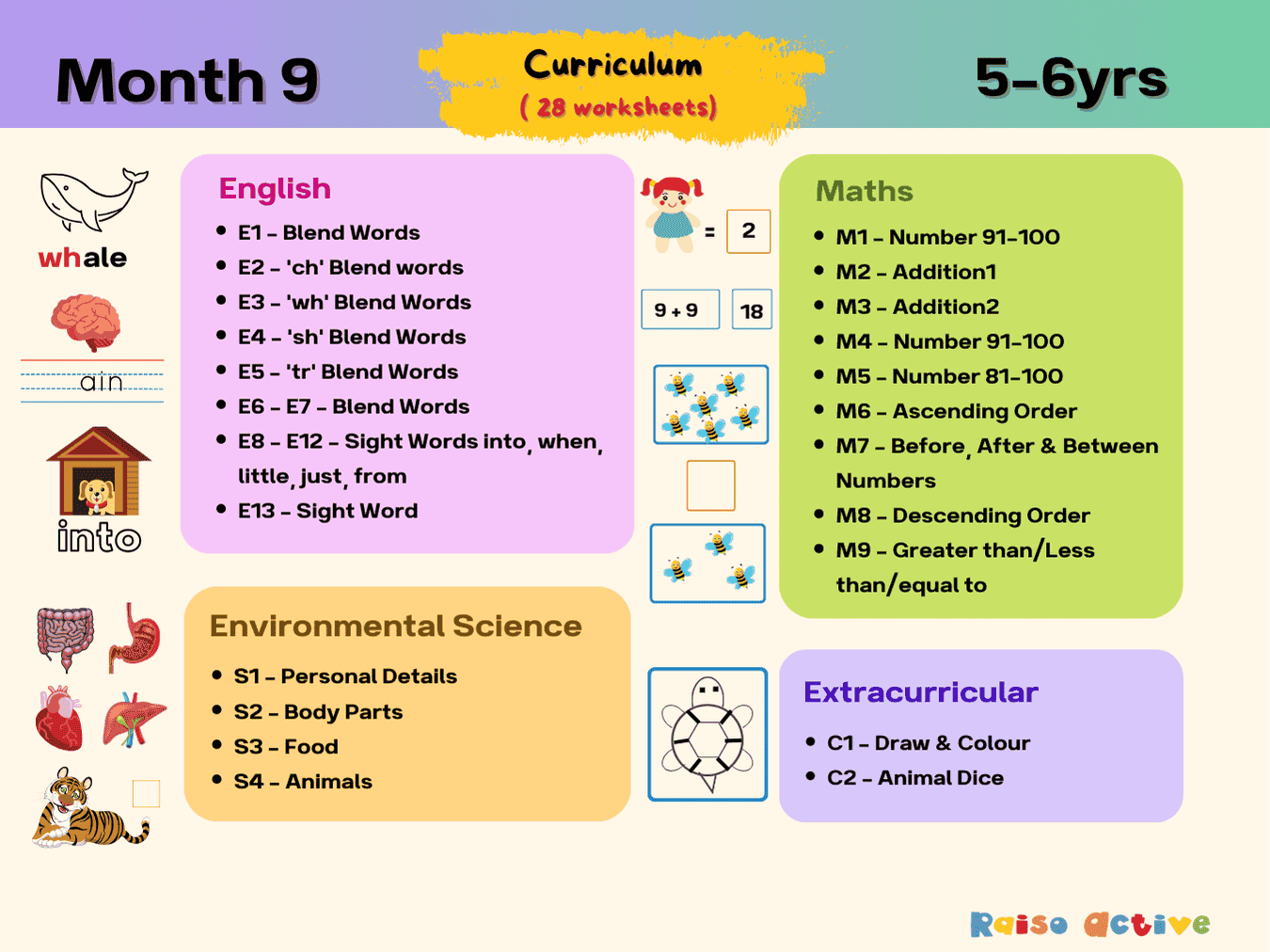
Part of the pack
Month 9: Early Learning English Math Science | Ages 5-6
This is page 6 of the pack. Ages 5-6 · KindergartenAges 5-6 · Year 1Ages 5-6 · UKGAges 5-6
Made for your child
Spelling practice, made for your child
Their own spelling words turned into a pack: trace or look-cover-write-check, roll and write, a secret picture code, a word search, a crossword and a test, with their name in it.
Make a spelling packFree preview · free for members
Or start free: a word search with sight wordsCurriculum
- Phonics - Blends > Consonant Blends
How to use this worksheet
Read each 'wh' blend word aloud together, emphasizing how the 'w' and 'h' combine into one smooth sound at the start. Look at the picture beside each word and talk about what it shows. Move to the list at the bottom of the page and have your child circle every word that begins with the 'wh' blend, reading each option aloud before deciding. Finish by rereading all the circled 'wh' words together as a group to reinforce the pattern.
Materials needed
- Pencil
- Crayons
Extension activities
- 1Have your child draw a picture to match each 'wh' word and label it underneath.
- 2Write simple sentences together using 'wh' question words, like 'What is your favorite color?'
- 3Play a question game where you take turns asking each other 'wh' questions out loud.
- 4Search for other 'wh' words in a favorite picture book and read them together.
- 5Make flashcards of the 'wh' words and practice quick recognition as a game.

Written by
Hemsweta Jain · Teacher Cheena
MBA and Early Childhood Educator, teaching since 2014 · Founder of RaisoActive, Mumbai
Every RaisoActive worksheet is designed and checked by the founder before publishing.
Published · Last reviewed
More from Month 9: Early Learning English Math Science | Ages 5-6
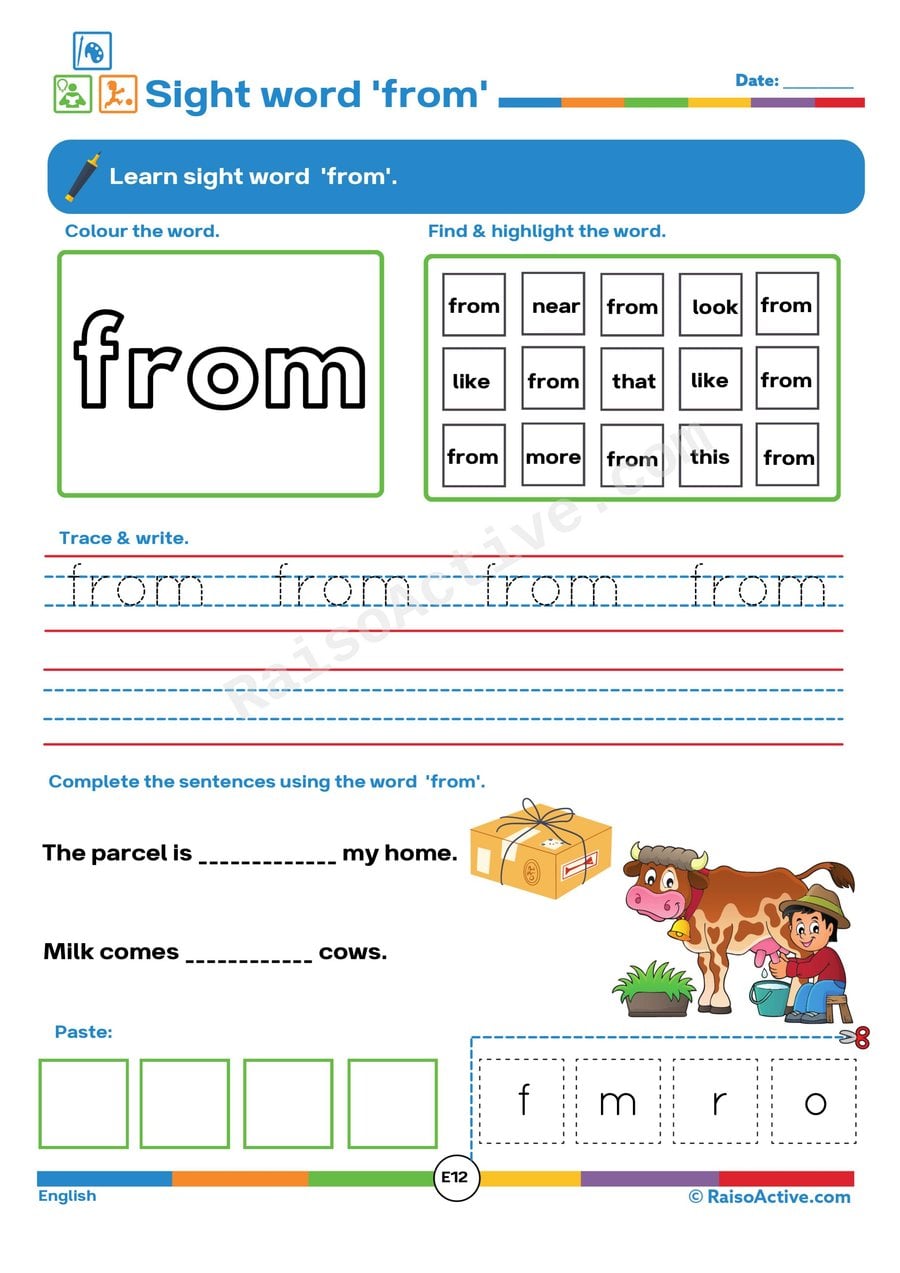
Sight Word 'From' Worksheet: Trace, Find, and Write!
Ages 4-5 · Pre-KAges 4-5 · ReceptionAges 4-5 · LKGAges 4-5
This worksheet targets the sight word 'from' through a five-step sequence of coloring, searching, tracing, writing, and sentence practice, giving children ages 4-5 the repeated, varied exposure needed to recognize this common word instantly rather than sounding it out each time. Because 'from' appears constantly in early reading material, building fluency with it directly supports smoother, more confident reading of simple sentences and books.

Just Right! Sight Word 'Just' Worksheet for Preschoolers
Ages 4-5 · Pre-KAges 4-5 · ReceptionAges 4-5 · LKGAges 4-5
The word 'just' shows up frequently in everyday speech and early reading material, and this worksheet gives children ages 4-5 a full, multi-step encounter with it — coloring, searching, tracing, and using it inside complete sentences. Building sight word recognition through several different activities rather than one repeated drill helps the word transfer from short-term memory into automatic recall. Completing sentences using 'just' also gives children early practice applying a memorized word correctly in a meaningful context, not just recognizing it in isolation.
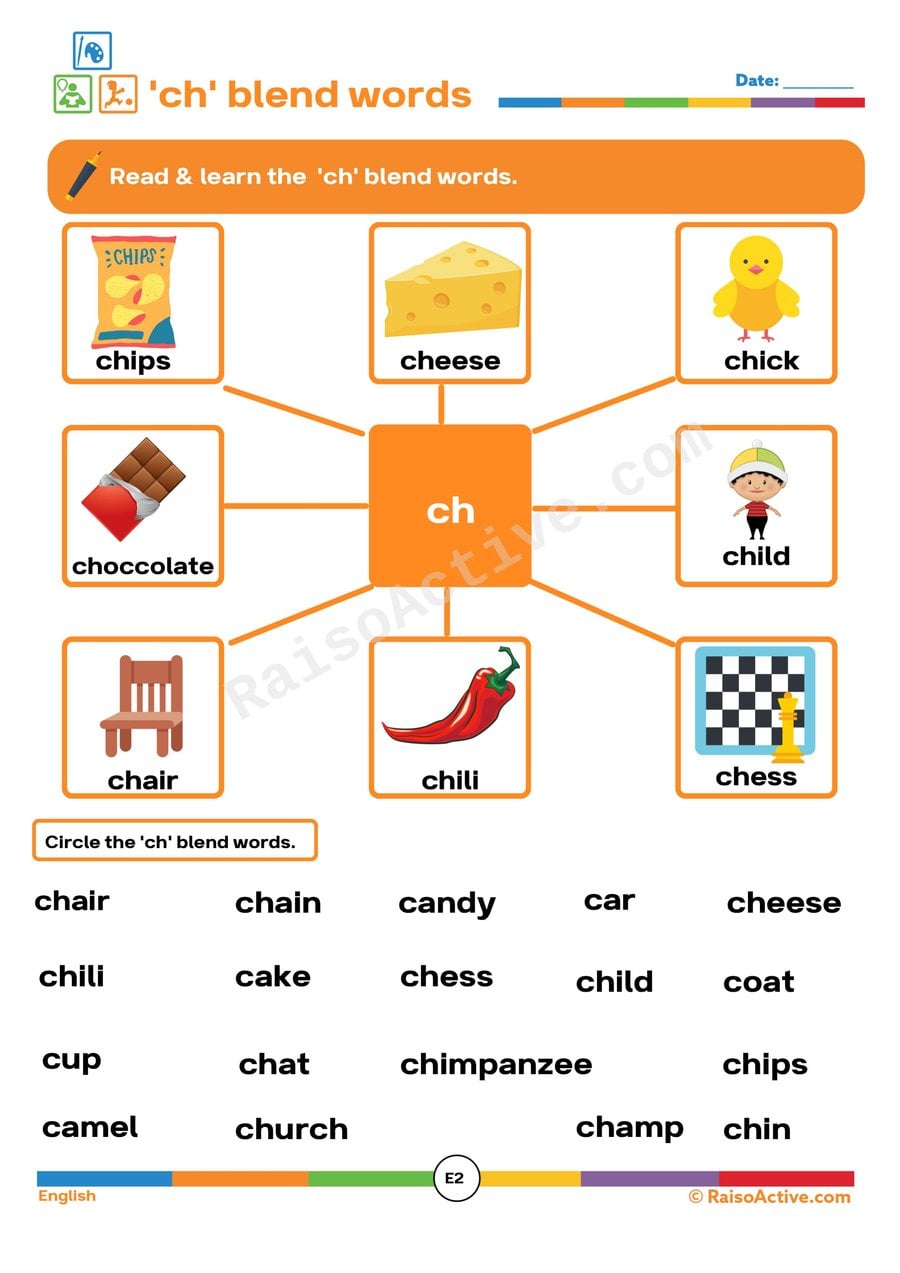
Ch Blend Words Worksheet: Read, Learn, and Circle!
Ages 4-6 · Pre-K–KindergartenAges 4-6 · Reception–Year 1Ages 4-6 · LKG–UKGAges 4-6
This worksheet focuses children ages 4-6 on recognizing words that begin with the 'ch' digraph, like 'chair' and 'cheese', asking them to read and then circle matching words. Because 'ch' represents a single new sound rather than two blended consonants, mastering it teaches children an important phonics rule: some letter pairs combine to make one brand-new sound entirely.

Color the Sight Words! A Fun Sight Word Coloring Worksheet
Ages 3-5 · Preschool–Pre-KAges 3-5 · Nursery–ReceptionAges 3-5 · Nursery–LKGAges 3-5
This worksheet turns sight word recognition into a color-matching game, asking children ages 3-5 to read a sight word and then color a shape with the color that corresponds to it, which keeps repeated word exposure feeling playful rather than like drilling. Because children must actually read each word correctly before knowing which color to use, the coloring choice becomes a built-in check on whether the word was recognized accurately. Repeating this recognize-and-respond pattern across many candies or shapes gives children dozens of low-pressure reps with common sight words in a single sitting.

Blend Words: Color the Correct Picture Worksheet for Preschoolers
Ages 4-5 · Pre-KAges 4-5 · ReceptionAges 4-5 · LKGAges 4-5
This worksheet gives children ages 4-5 practice reading consonant blend words — words that start with two consonant sounds blended together, like 'bl' or 'sn' — and coloring the picture that matches each one. Consonant blends are trickier to decode than single-letter sounds, so this focused, low-pressure coloring format lets children practice blending without the added challenge of writing at the same time.

Descending Order Worksheet for Kids: Numbers 63-100
Ages 4-6 · Pre-K–KindergartenAges 4-6 · Reception–Year 1Ages 4-6 · LKG–UKGAges 4-6
Arranging numbers from largest to smallest asks children ages 4-6 to apply their counting knowledge in reverse, which is a genuinely different mental skill from counting forward and helps solidify a flexible, deep understanding of number order rather than rote recitation. Working within the 63 to 100 range also pushes children to compare two-digit numbers directly, deciding which of two numbers is bigger based on both digits rather than just the first one. This kind of descending practice complements ascending counting practice and rounds out a child's overall number sense.

Little Sight Word Worksheet: Trace, Find, and Write!
Ages 3-5 · Preschool–Pre-KAges 3-5 · Nursery–ReceptionAges 3-5 · Nursery–LKGAges 3-5
The word 'little' is a common descriptive sight word that appears often in early picture books, and because it's longer than most beginner sight words, it gives children ages 3-5 valuable practice with multi-letter word recognition. This worksheet layers coloring, word-searching, tracing, and a cut-and-paste sentence completion on top of each other, which research on early literacy shows builds stronger word recall than any single repetition. Recognizing longer sight words like this also helps children start to notice smaller familiar chunks — like 'it' inside 'little' — within bigger words.

Ascending Order Worksheet: Heart-Filled Number Fun!
Ages 4-6 · Pre-K–KindergartenAges 4-6 · Reception–Year 1Ages 4-6 · LKG–UKGAges 4-6
Using a set of numbered hearts, this worksheet asks children ages 4-6 to compare several numbers at once and arrange them from smallest to largest, building number comparison and ordering skills that go beyond simple counting. Understanding relative size - knowing that 7 is bigger than 3 without needing to count up from one each time - is an important step toward more advanced number sense and mental math.
Related worksheets

Blend Words Worksheet: Circle the Correct Picture!
Ages 4-6 · Pre-K–KindergartenAges 4-6 · Reception–Year 1Ages 4-6 · LKG–UKGAges 4-6
This worksheet strengthens blending skills for children ages 4-6, asking them to say a consonant blend like 'bl' or 'st' together with different word endings and identify which resulting word matches a picture. Blending two consonant sounds smoothly before adding a vowel is a more advanced phonics skill than single-letter sounds, and this practice directly supports decoding multisyllabic and blended words during independent reading.

Blend Words Worksheet: See the Pictures and Write the Correct Blend!
Ages 4-6 · Pre-K–KindergartenAges 4-6 · Reception–Year 1Ages 4-6 · LKG–UKGAges 4-6
Children ages 4-6 practice identifying missing consonant blends by looking at a picture, saying the word aloud, and writing the correct blend to complete it. This task requires children to isolate the blended sound at the beginning of a word and match it to its written letter combination, a more advanced phonics skill than single-letter sounds. Successfully completing each word strengthens both spelling accuracy and reading fluency with blended sounds.

Blend Words Matching Worksheet: Read and Circle the Picture!
Ages 4-6 · Pre-K–KindergartenAges 4-6 · Reception–Year 1Ages 4-6 · LKG–UKGAges 4-6
This worksheet gives children ages 4-6 further practice reading consonant blend words and connecting them to their matching picture, this time by circling rather than cutting and pasting, which keeps the focus purely on reading and visual scanning. Repeated blend practice across different formats — matching, circling, and later independent writing — helps these two-consonant sounds become automatic rather than something a child has to sound out every time.
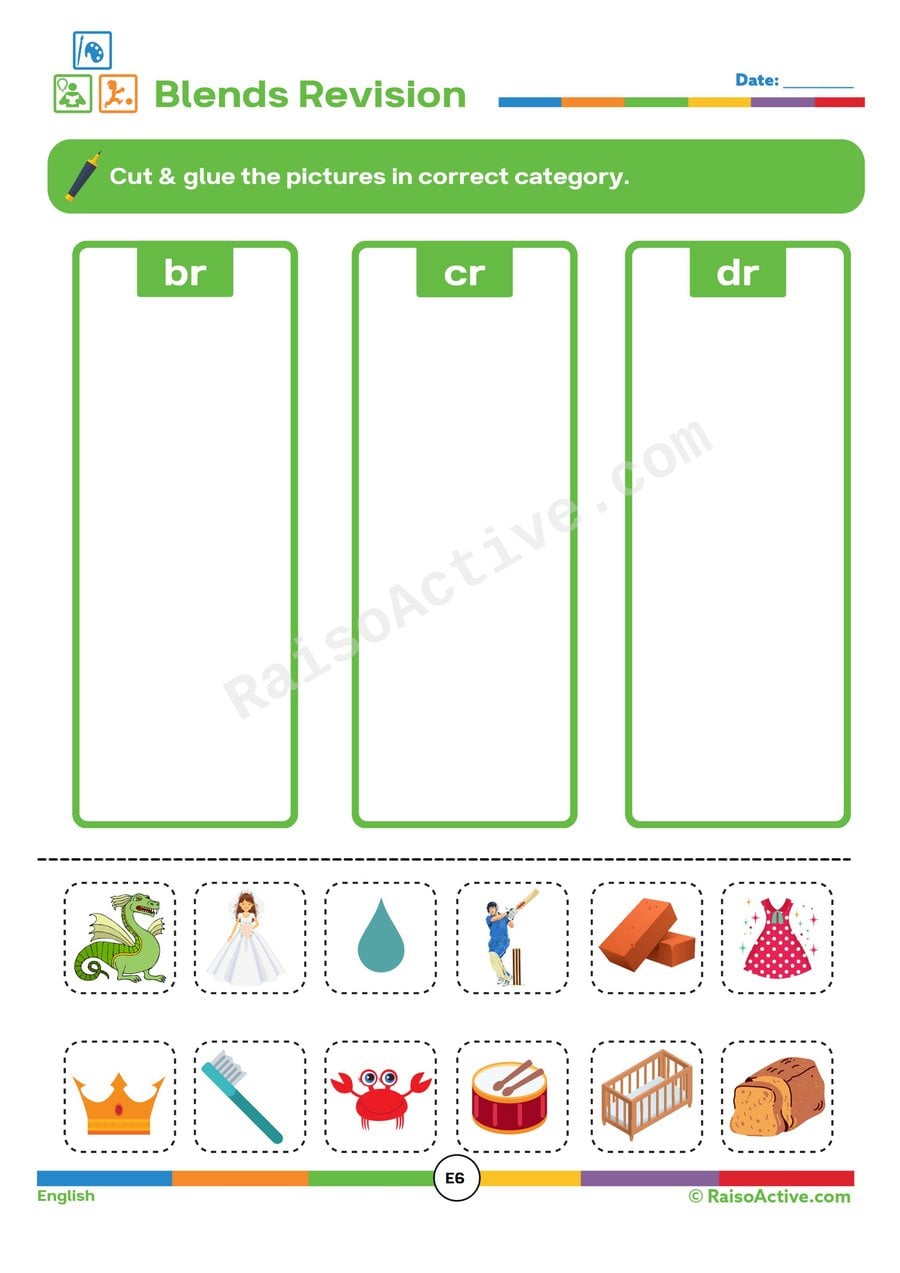
Blends Revision Worksheet: Cut and Glue!
Ages 4-5 · Pre-KAges 4-5 · ReceptionAges 4-5 · LKGAges 4-5
Sorting pictures by their beginning blend sound (br, cr, dr) sharpens phonemic awareness for children ages 4-5, teaching them that two consonants blended together still keep their own distinct sounds. This cut-and-glue format forces careful listening before pasting, since a picture can only go in one column, which builds the auditory discrimination that underlies early decoding.

Read and Circle: 'br' Blend Words Worksheet for Preschoolers
Ages 3-5 · Preschool–Pre-KAges 3-5 · Nursery–ReceptionAges 3-5 · Nursery–LKGAges 3-5
This worksheet trains children to hear and recognize the 'br' consonant blend at the start of words like 'bread' or 'brush,' building on single-letter phonics toward the more complex blended sounds that make up much of early reading vocabulary. For ages three to five, matching a read word to its picture also reinforces that written letters correspond to real, specific meanings rather than abstract symbols.
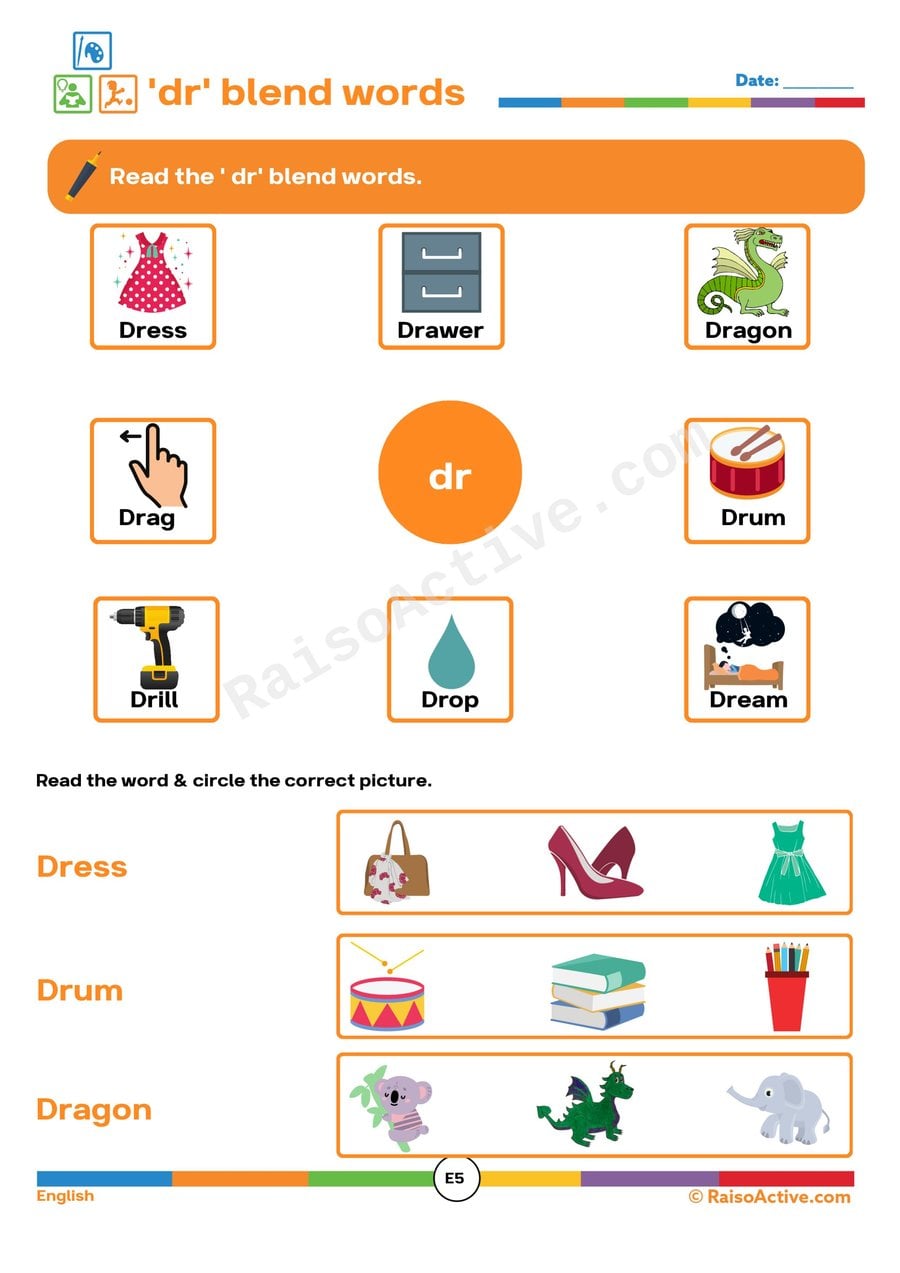
Dr Blend Words Worksheet: Read and Match!
Ages 4-6 · Pre-K–KindergartenAges 4-6 · Reception–Year 1Ages 4-6 · LKG–UKGAges 4-6
This worksheet focuses on the 'dr' blend, as in 'drum' or 'dress,' asking children to read the word first and then find its matching picture, which reverses the more common picture-first phonics approach and pushes children to truly decode the word rather than guess from an image. For ages four to six, reading the word independently before checking against a picture builds real decoding confidence.
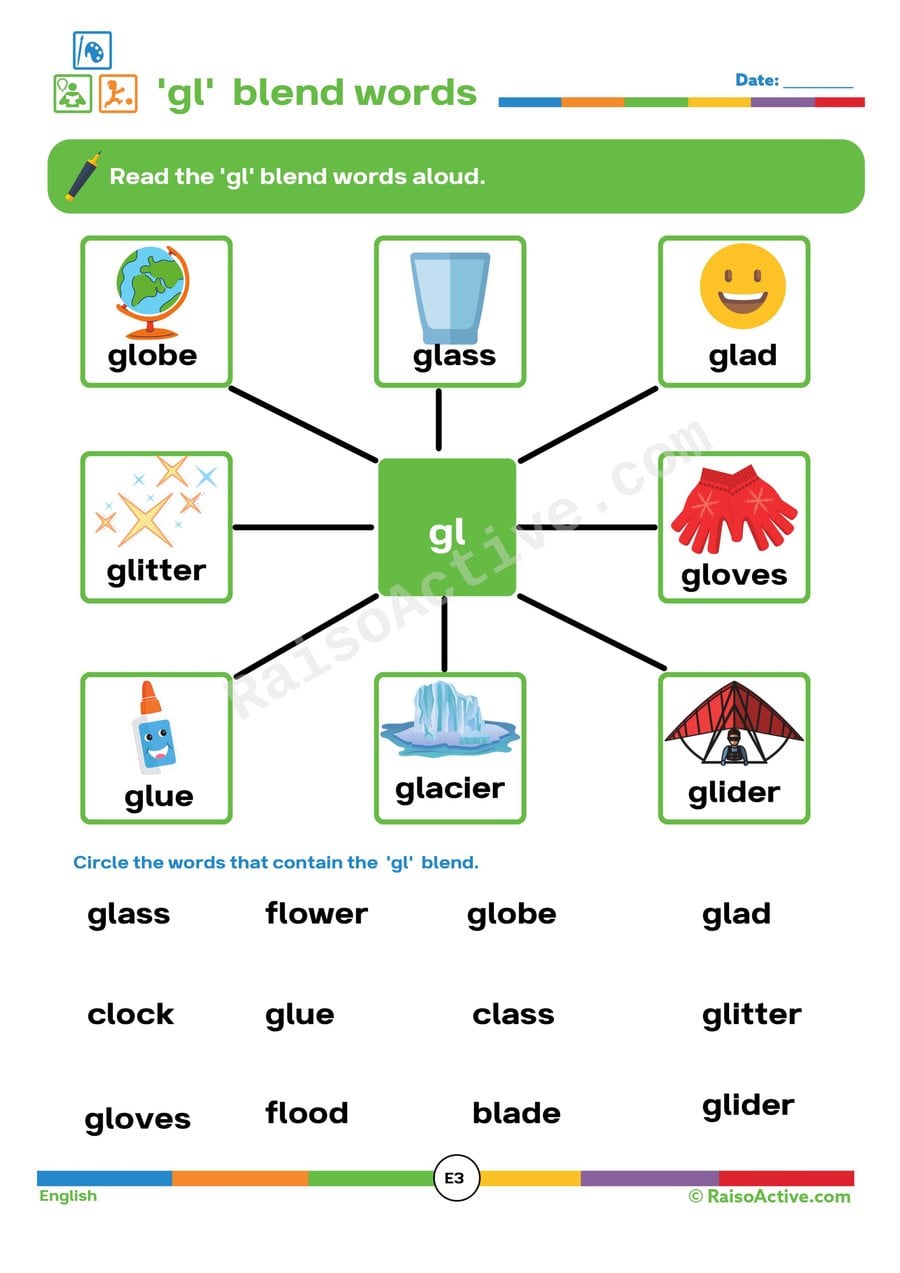
Gl Blend Words Worksheet: Read and Circle!
Ages 4-6 · Pre-K–KindergartenAges 4-6 · Reception–Year 1Ages 4-6 · LKG–UKGAges 4-6
This worksheet builds phonics skills around the 'gl' consonant blend, helping children recognize and read words like 'glass,' 'glue,' and 'glow' where the sounds of g and l combine at the start of a word. For ages 4-6, practicing blends like gl strengthens the sound-segmentation skills needed to decode increasingly complex words as reading develops.
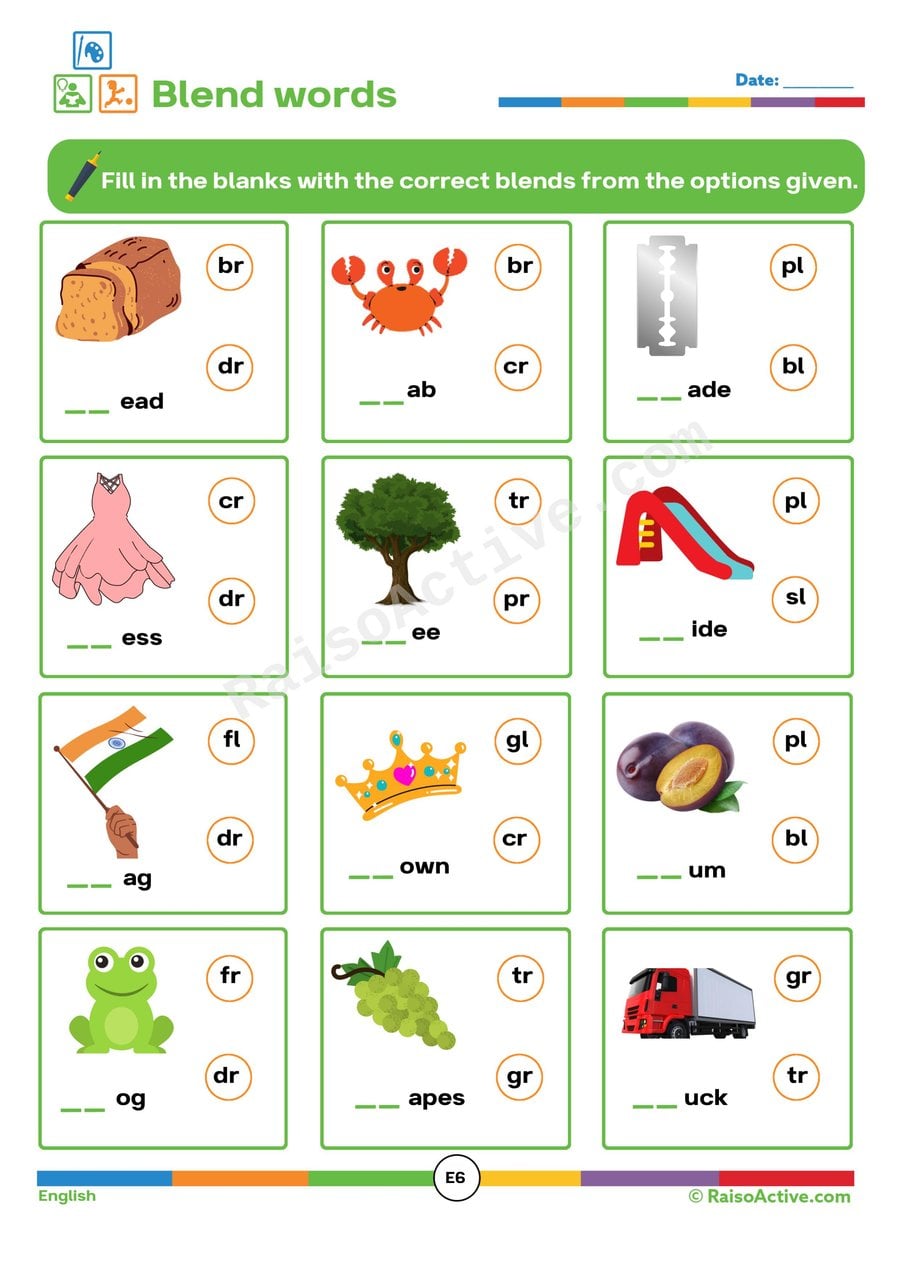
Blend Words Worksheet: Practice Blending Sounds!
Ages 4-6 · Pre-K–KindergartenAges 4-6 · Reception–Year 1Ages 4-6 · LKG–UKGAges 4-6
This worksheet gives children ages 4-6 focused practice blending initial consonant sounds, like 'cl' or 'fr,' with the rest of a word to complete a picture-labeled word. Unlike simple picture matching, writing the missing blend requires children to actively produce the correct letter combination from memory, which is a more demanding and valuable phonics skill than recognition alone.
Guides for this topic

How to Teach CVC Blending: A Step-by-Step Method That Works in Two Weeks
A step-by-step method for teaching CVC blending, covering continuous sounds, word families, common errors, and a 14-day plan that most children finish reading CVC words.
Phase 2 Phonics at Home: Sound Order, Blending Games, Worksheets
Phase 2 phonics at home: the five sound sets in order, oral blending, tricky words, a two-week routine, common mistakes, and free worksheets.

Reception Year Explained: EYFS Learning and How to Help at Home
A teacher's plain-English guide to the Reception Year: the seven areas of learning, Early Learning Goals, Phase 2/3 phonics, the RBA and home routines.
Reviews
Every worksheet for ages 4–6, no watermark
Members download the full library of 1,000+ worksheets and every activity pack without watermarks or daily limits. One year costs ₹999 in India or $20 elsewhere.
See membership plansOr download any worksheet free with a watermark (5 a day).