Free printable worksheets · India
India Children's Day Worksheets (Ages 3–7)
Children's Day worksheets are printable activity sheets for children aged 3 to 7 for the day that celebrates children. In India it is 14 November, Jawaharlal Nehru's birthday. The free sheets here are all-about-me and feelings activities; the Children's Day Activity Pack adds make-and-play pages, a children's rights page and a rose to trace.
Children's Day falls on Saturday, 14 November 2026 in India, Jawaharlal Nehru's birthday, and schools mark it with games, treats and craft rather than lessons. The United Nations has its own Universal Children's Day on 20 November, and other countries keep theirs on other dates. This page has two kinds of printables. The free worksheets are all-about-me and feelings sheets, which suit a day built around fun and self-expression: a four-year-old draws a self-portrait, and a seven-year-old matches faces to feeling words. For a whole afternoon, the Children's Day Activity Pack is a 14-page fair for ages 4 to 7, with a game, a crown to make and a page on children's rights.
- 37 worksheets
- Free PDF download
- Print on A4 or Letter
Printable activity pack
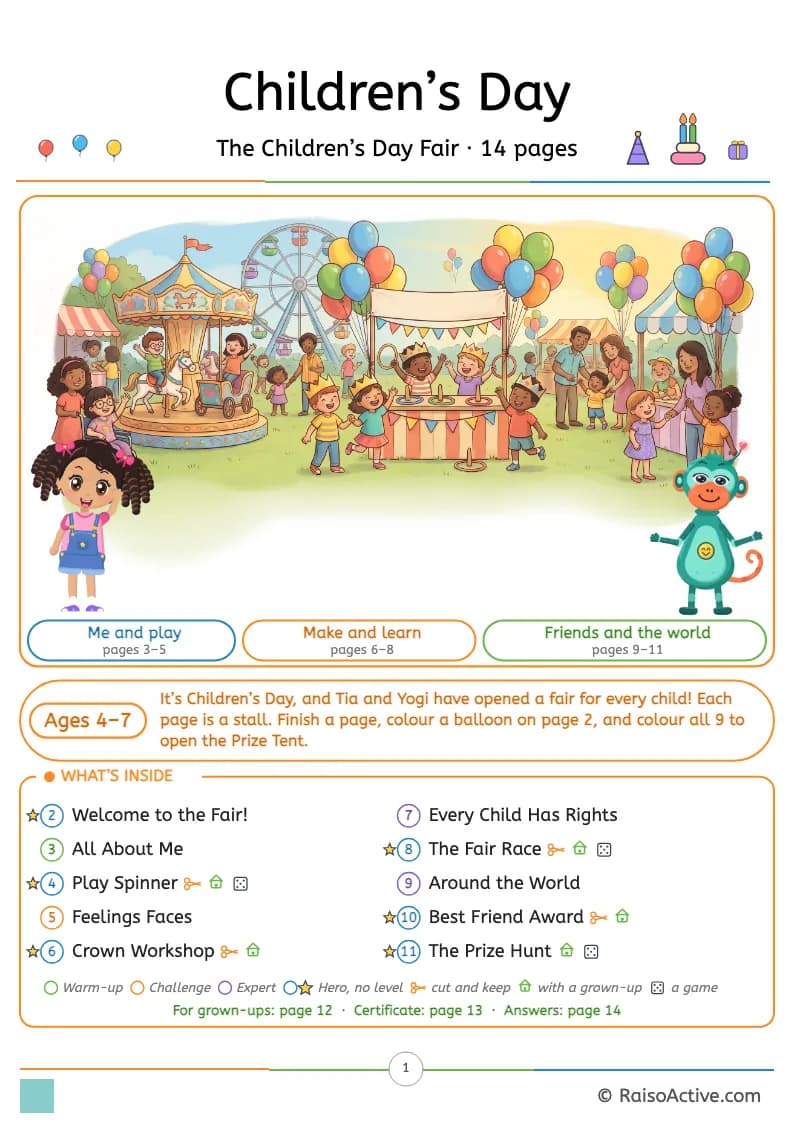
The Children's Day Fair: a 14-page activity pack
- 14 pages
- Ages 4–7
- Print at home
Tia and Yogi have opened a fair for every child. Each page is a stall: finish a page, colour a balloon on the fair map, and colour them all to open the Prize Tent. It ends with a certificate, a page for grown-ups and an answer key.
- All About Me: a portrait, favourites and a dream for the future
- Make-and-play: a Play Spinner, a wearable Crown Workshop and The Fair Race board game
- Feelings Faces, and a Best Friend Award to cut out and give
- Every Child Has Rights: a rights rainbow and a secret code, from the UN Convention on the Rights of the Child
- Around the World: when Children's Day is celebrated in six countries, plus a rose to trace
- The Prize Hunt: a bingo hunt around the home
India Children's Day Worksheets to print
Browse all worksheets for ages 3–7
Feelings Faces Worksheet: Match, Trace and Circle the Happy Faces
Ages 4-6 · Pre-K–KindergartenAges 4-6 · Reception–Year 1Ages 4-6 · LKG–UKGAges 4-6
Children link everyday moments (bubbles, ice cream, blocks, a storm, a gift) to the face that shows the feeling, trace four feelings words and count happy faces.

Meet My Feelings: Eight Feelings Faces and Feelings Weather for Little Stars
Ages 4-6 · Pre-K–KindergartenAges 4-6 · Reception–Year 1Ages 4-6 · LKG–UKGAges 4-6
Children meet eight feelings (happy, sad, angry, scared, worried, surprised, excited and calm), each paired with a weather picture. They learn that all feelings are OK and say how they feel today.

Kind Friends: Match Ways to Help a Friend with a Big Feeling
Ages 4-6 · Pre-K–KindergartenAges 4-6 · Reception–Year 1Ages 4-6 · LKG–UKGAges 4-6
Children think about how to help a friend who is sad, scared, angry or worried, colour kind hearts for things they did this week, and draw how they would help a new friend.

Feelings Puzzles: Spot 5 Differences, Odd One Out and Face Patterns
Ages 4-6 · Pre-K–KindergartenAges 4-6 · Reception–Year 1Ages 4-6 · LKG–UKGAges 4-6
Children practise looking closely with a spot-the-difference picture, find the face that shows a different feeling in each row, and finish simple face patterns (AB, AAB and ABC).

Flip-a-Feeling Finger Puppets: Two-Sided Puppets and a Puppet Show
Ages 4-6 · Pre-K–KindergartenAges 4-6 · Reception–Year 1Ages 4-6 · LKG–UKGAges 4-6
Children build eight finger puppets that each show two feelings (sad to happy, angry to calm, scared to brave, worried to excited). A short puppet show helps them practise a calm tool and flip the feeling.

Kai and the Stuck Kite: A Feelings Story with a Pull-Tab Slider
Ages 4-6 · Pre-K–KindergartenAges 4-6 · Reception–Year 1Ages 4-6 · LKG–UKGAges 4-6
Children listen to a short story where Kai feels sad, then angry, then calm after balloon breaths, and finally happy. They answer at their own level and build a feelings slider.

Feelings Detective for Kids: Clue Cards, Story Order and Draw a Proud Moment
Ages 4-6 · Pre-K–KindergartenAges 4-6 · Reception–Year 1Ages 4-6 · LKG–UKGAges 4-6
Children use body clues (fists, a wobbly tummy, standing tall) and what happened to work out the feeling, put three pictures in order and talk about a proud moment.

Stick Man Emotions Worksheet: Happy, Sad, Angry, and Surprised!
Ages 4-6 · Pre-K–KindergartenAges 4-6 · Reception–Year 1Ages 4-6 · LKG–UKGAges 4-6
Children ages 4-6 practice reading facial expressions on this worksheet, matching stick-figure faces to their correct emotion labels by noticing details like mouth shape and eyebrow position. This strengthens emotional literacy — the ability to name and recognize feelings in others — which supports empathy and smoother social interactions as children move into more group play and classroom settings.

Where Do I Feel It? Colour Body Clues for Big Feelings
Ages 4-6 · Pre-K–KindergartenAges 4-6 · Reception–Year 1Ages 4-6 · LKG–UKGAges 4-6
Children discover that feelings show up in our bodies: hot when angry, butterflies when worried, heavy when sad and bouncy when excited. There is no wrong answer.

Feelings Bingo: Printable Bingo Boards and Caller Cards
Ages 4-6 · Pre-K–KindergartenAges 4-6 · Reception–Year 1Ages 4-6 · LKG–UKGAges 4-6
Children play a bingo game that names eight feelings. A grown-up makes a face from a caller card, and players find and colour that feeling on their board. Three in a row wins.

Mix-a-Face Flip Book: Make Silly Faces and Find the Real Feelings
Ages 4-6 · Pre-K–KindergartenAges 4-6 · Reception–Year 1Ages 4-6 · LKG–UKGAges 4-6
Children see how eyebrows, eyes and mouths change a face. They mix faces, tick the ones they make, and decide which are real feelings and which are silly mixed-up faces.

My Feelings Wheel: Cut-Out Spinner to Show How You Feel and Pick a Calm Tool
Ages 4-6 · Pre-K–KindergartenAges 4-6 · Reception–Year 1Ages 4-6 · LKG–UKGAges 4-6
Children make a turnable wheel with eight feelings. Each feeling points to a calm tool, such as balloon breath, shake it out or hug and talk. They also circle a favourite tool.

My Feelings Garden: A Week of Feelings Flowers and Calm Sentences
Ages 4-6 · Pre-K–KindergartenAges 4-6 · Reception–Year 1Ages 4-6 · LKG–UKGAges 4-6
Children track a week of feelings with a flower for each day, choosing a feeling colour for the petals. They trace and write three kind sentences and record the weather.

Peek-a-Boo Feelings Flaps: Cut-and-Glue Lift-the-Flap Craft
Ages 4-6 · Pre-K–KindergartenAges 4-6 · Reception–Year 1Ages 4-6 · LKG–UKGAges 4-6
Children guess how a child feels, lift a flap to check, and practise cutting, creasing and gluing. Six feelings are covered: happy, sad, angry, scared, surprised and excited.
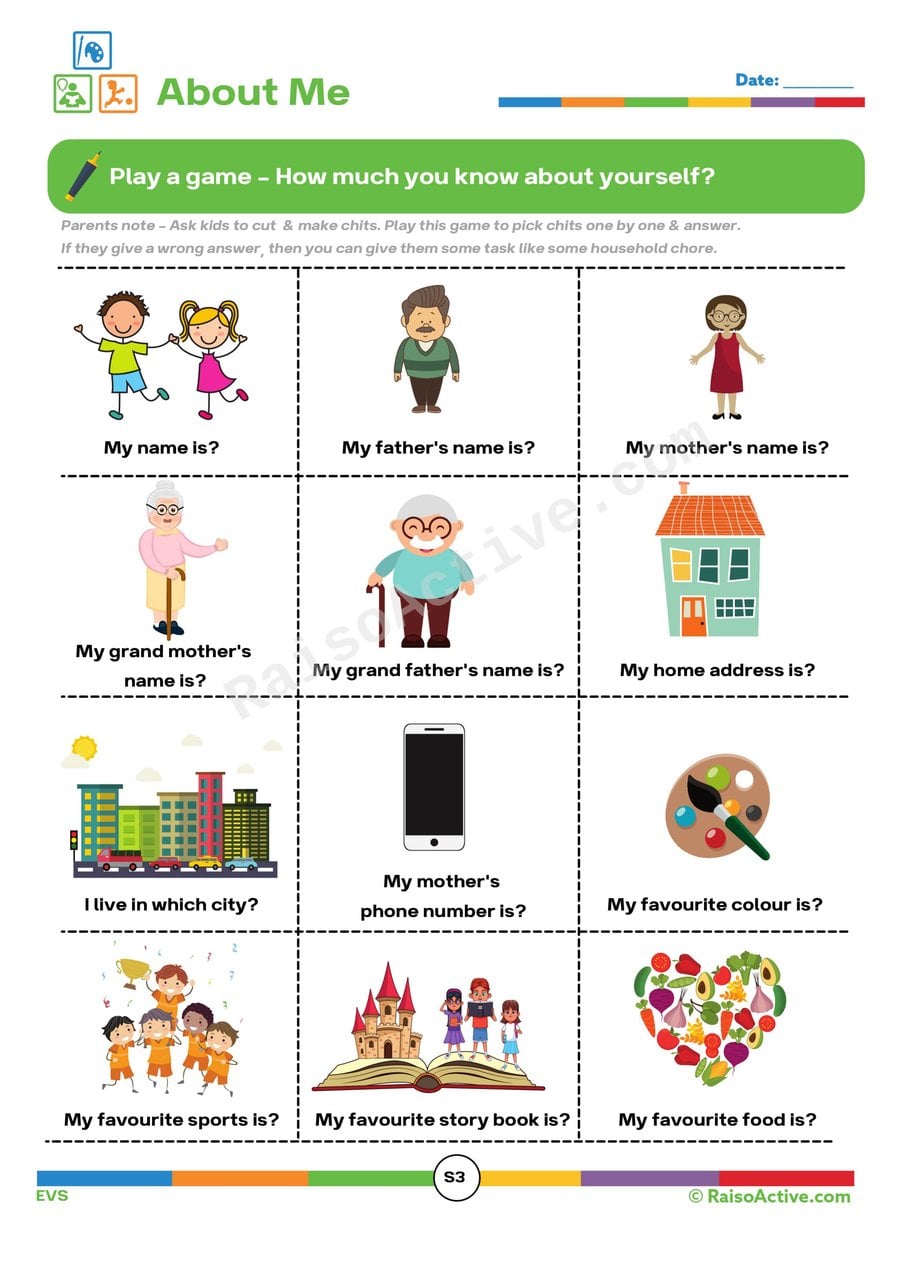
About Me Worksheet: Learn About Yourself!
Ages 3-5 · Preschool–Pre-KAges 3-5 · Nursery–ReceptionAges 3-5 · Nursery–LKGAges 3-5
This 'About Me' worksheet helps children ages 3-5 build self-awareness and early identity vocabulary by prompting them to describe their name, family, favorites, and feelings. Putting personal facts into words or pictures strengthens expressive language and gives children practice sharing information about themselves in a structured way. It's also a gentle first step into autobiographical writing, well before children can spell full sentences.
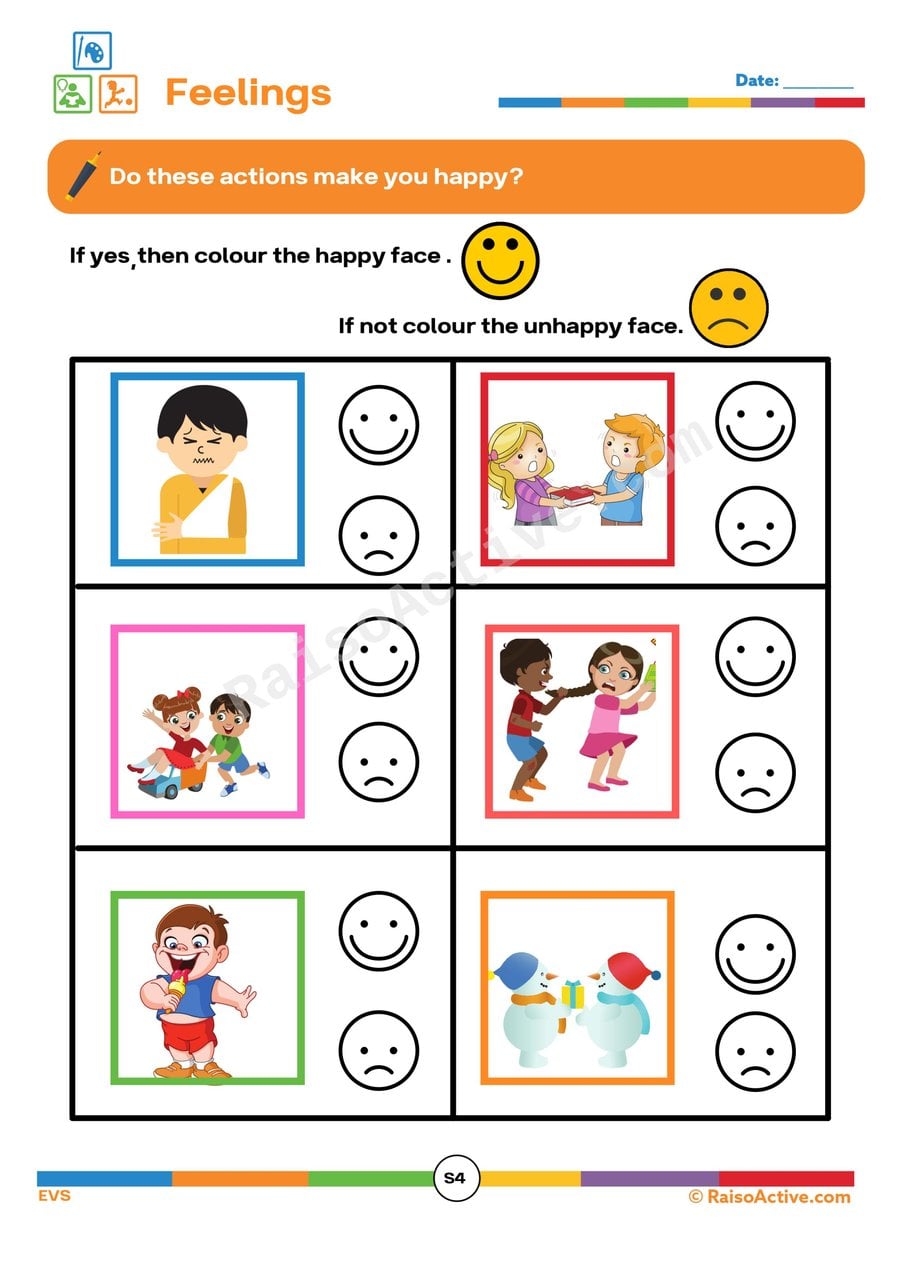
Feelings Worksheet: Happy or Sad?
Ages 3-5 · Preschool–Pre-KAges 3-5 · Nursery–ReceptionAges 3-5 · Nursery–LKGAges 3-5
Children ages 3-5 build emotional vocabulary and self-awareness as they decide whether different everyday situations would make them feel happy or sad. Naming and sorting emotions based on a scenario is an early social-emotional skill that helps children recognize and eventually talk about their own feelings more clearly.

Let's Talk About Me! Fun Conversation Worksheet for Kids
Ages 3-5 · Preschool–Pre-KAges 3-5 · Nursery–ReceptionAges 3-5 · Nursery–LKGAges 3-5
This worksheet gives children ages 3-5 a structured way to practice self-expression, prompting them to fill in blanks, draw, and color as they answer simple personal questions like their favorite color or food. Talking about themselves in a guided format builds both vocabulary and the confidence to share personal information out loud, a skill that supports classroom participation and social conversation. Combining writing, drawing, and coloring in one activity also keeps the session engaging across several different response styles.
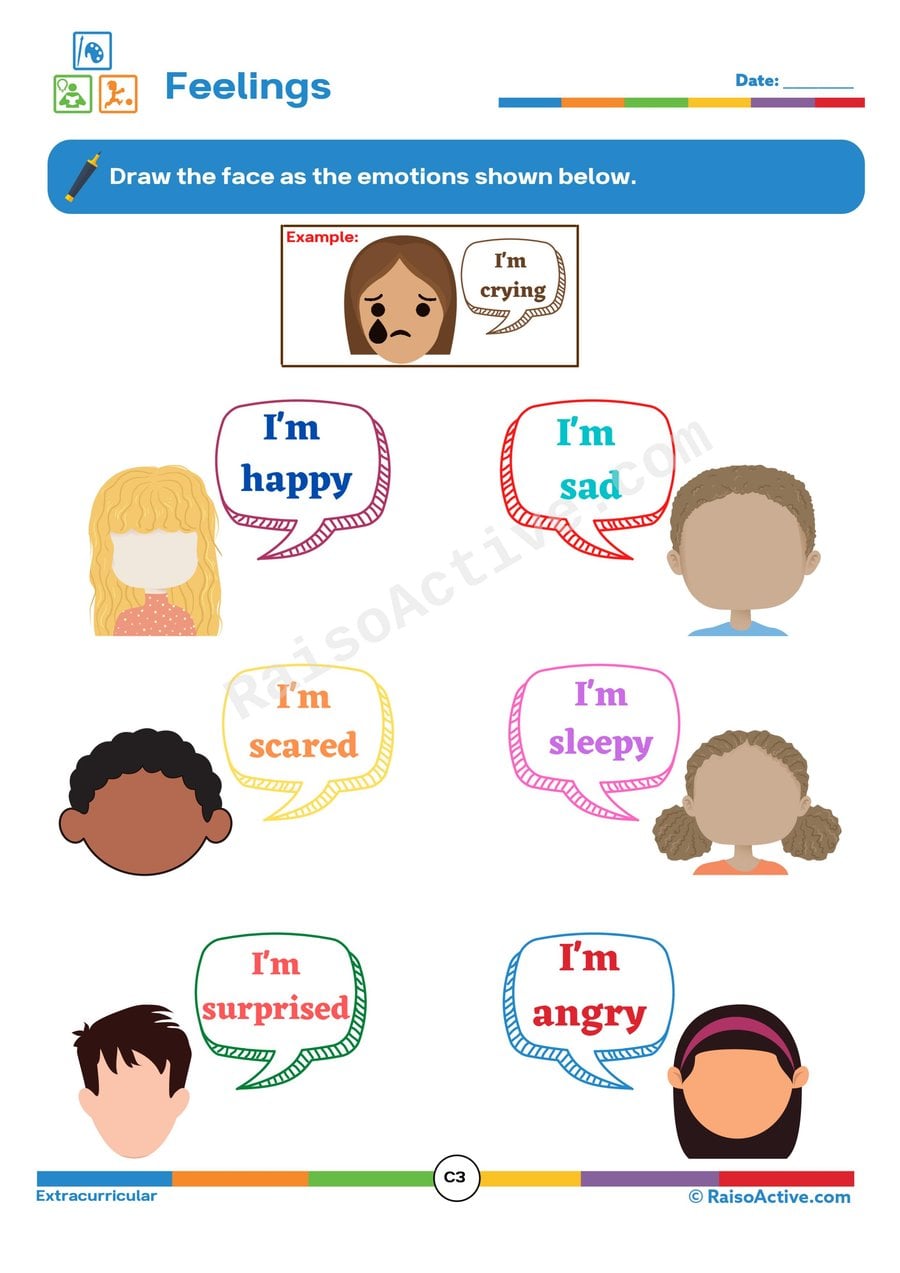
Feelings Worksheet: Draw the Faces!
Ages 3-5 · Preschool–Pre-KAges 3-5 · Nursery–ReceptionAges 3-5 · Nursery–LKGAges 3-5
This worksheet builds emotional literacy by having children draw a face expressing a specific feeling named in a word bubble, such as happy, sad, angry, or surprised. For three- to five-year-olds, practicing how to represent an emotion visually helps them build the vocabulary and self-awareness needed to name and talk about their own feelings, a key early social-emotional skill.
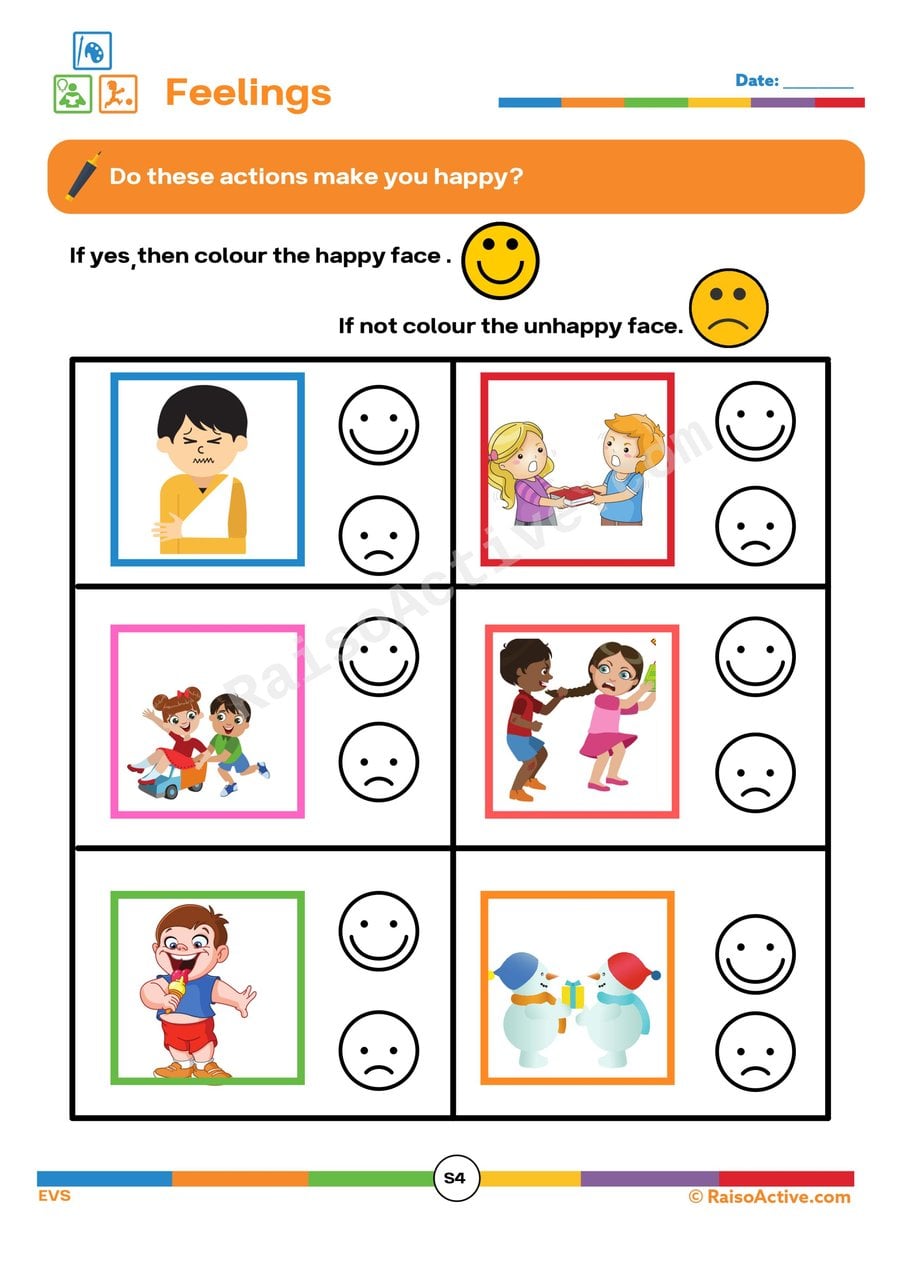
Feelings Worksheet: Happy or Sad?
Ages 3-5 · Preschool–Pre-KAges 3-5 · Nursery–ReceptionAges 3-5 · Nursery–LKGAges 3-5
Looking closely at faces and deciding whether they show happy or sad builds emotional literacy, the ability to read facial cues and put a name to a feeling, in children ages 3-5. This is an early and important social-emotional milestone, since recognizing emotions in others is a first step toward empathy and toward naming their own feelings instead of just acting them out.
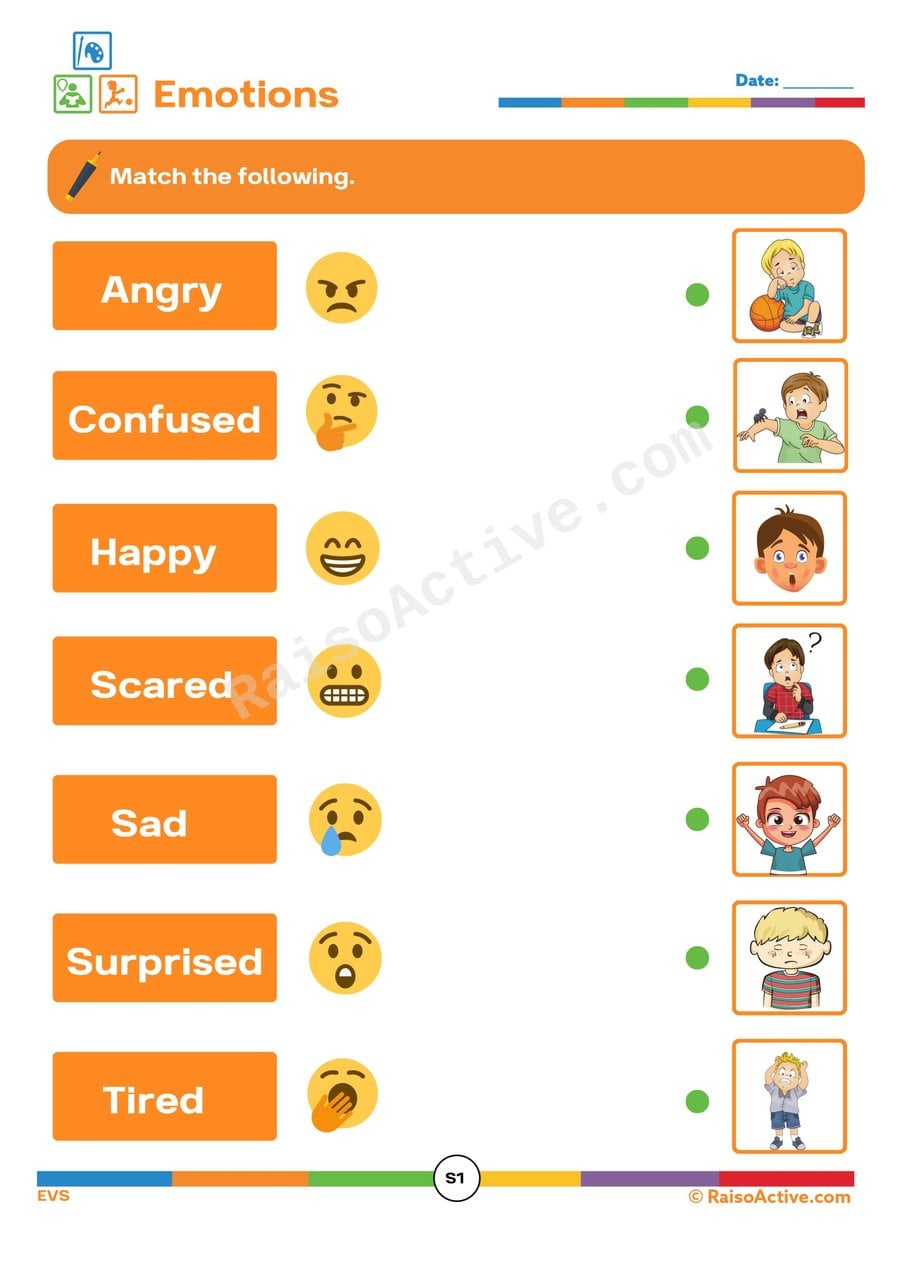
Emotions Matching Worksheet for Preschoolers
Ages 3-5 · Preschool–Pre-KAges 3-5 · Nursery–ReceptionAges 3-5 · Nursery–LKGAges 3-5
Recognizing and naming emotions is a foundational social-emotional skill for children ages 3-5, helping them build the vocabulary needed to express their own feelings and understand the feelings of others. This worksheet asks children to match emotion words to corresponding facial expressions, strengthening their ability to read facial cues — a skill that supports empathy and smoother social interactions. Building this kind of emotional vocabulary early also gives children better tools for self-regulation, since naming a feeling is often the first step toward managing it.
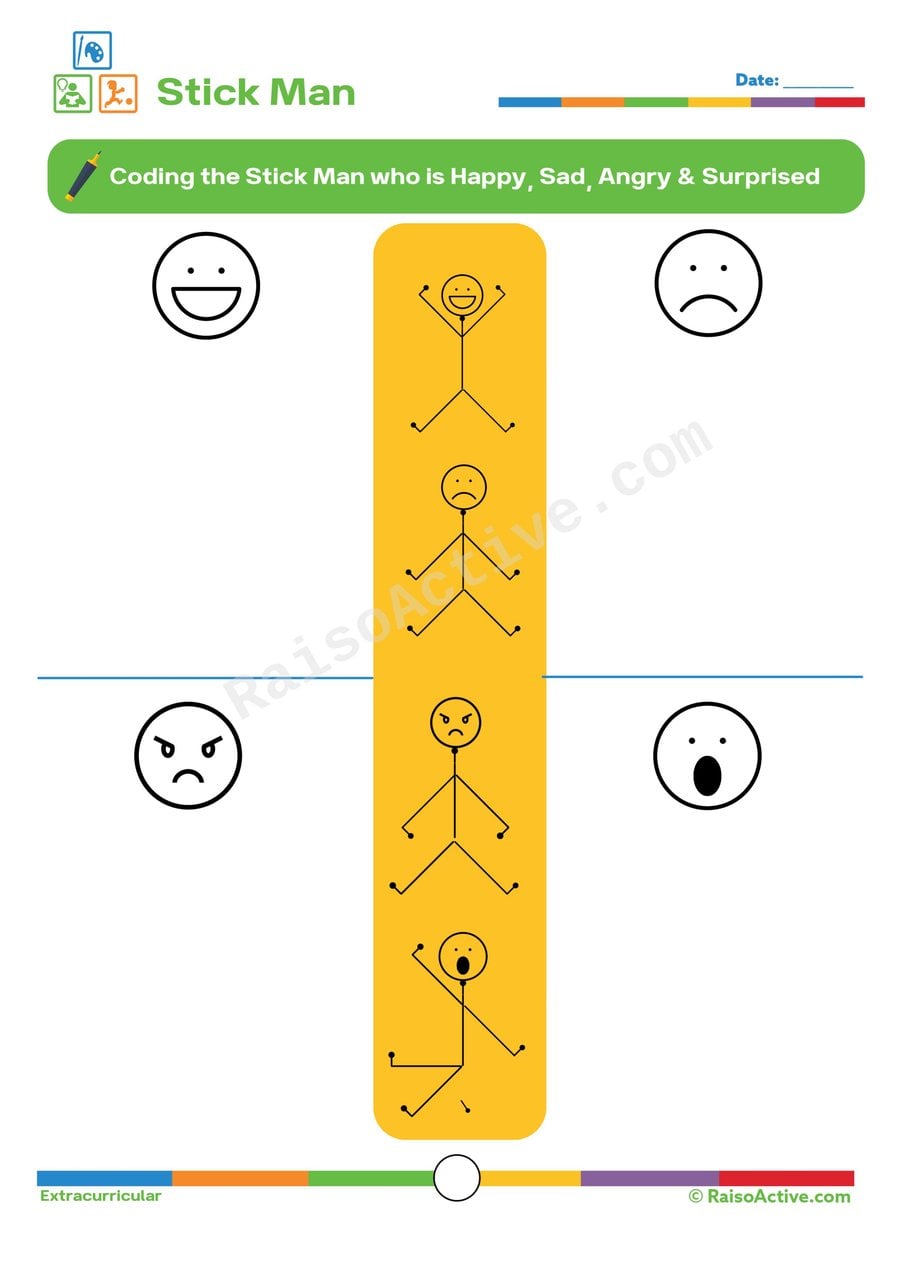
Stick Man Emotions Worksheet: Happy, Sad, Angry & Surprised!
Ages 3-5 · Preschool–Pre-KAges 3-5 · Nursery–ReceptionAges 3-5 · Nursery–LKGAges 3-5
Matching simple stick-figure faces to emotion words helps children ages 3-5 build an early emotional vocabulary, connecting facial cues like a curved mouth or raised eyebrows to specific feeling words. This kind of emotion recognition is a foundational social-emotional skill, helping children name what they and others are feeling instead of just reacting.
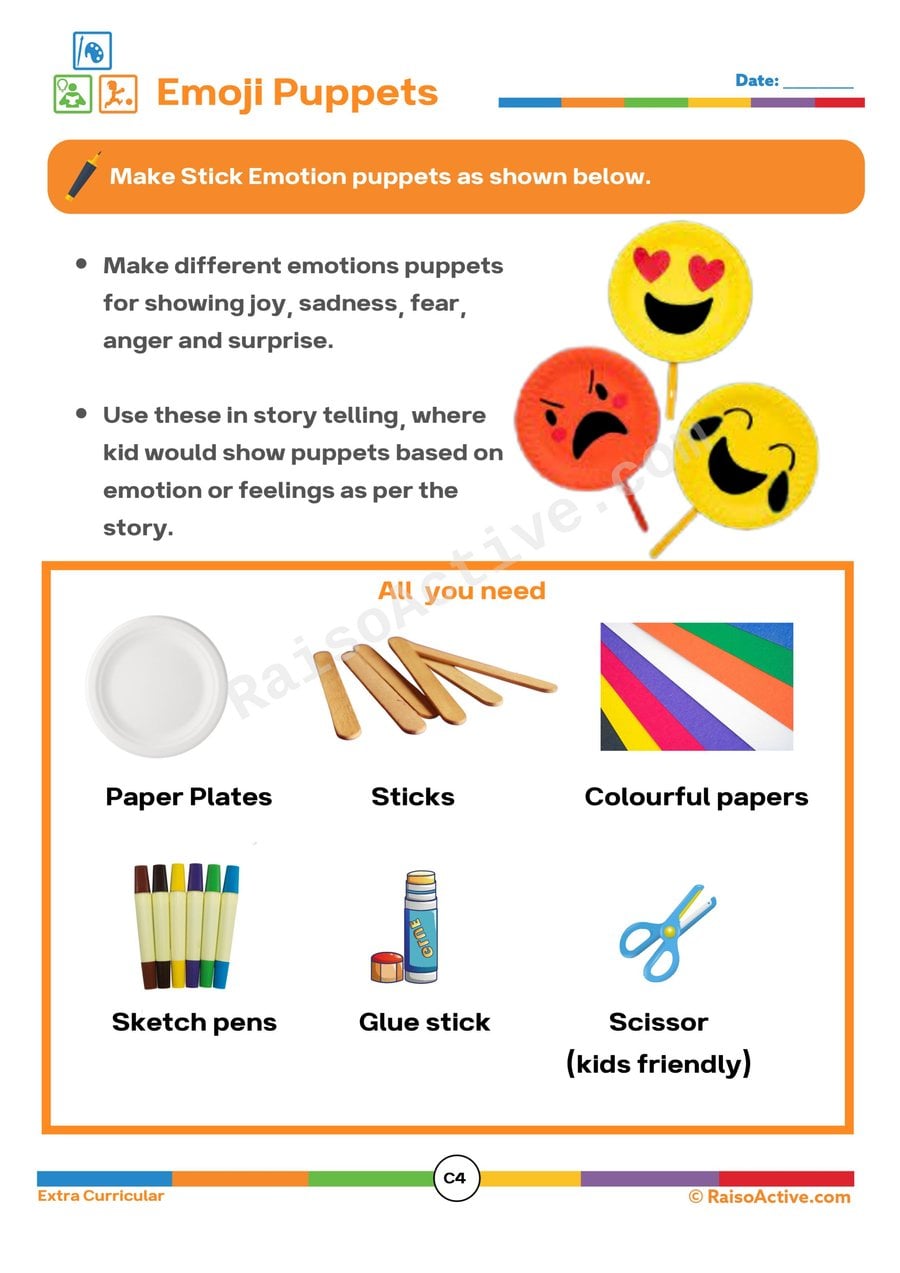
Emoji Puppets Craft Worksheet for Kids
Ages 3-5 · Preschool–Pre-KAges 3-5 · Nursery–ReceptionAges 3-5 · Nursery–LKGAges 3-5
This craft worksheet helps children ages 3-5 create emoji puppets representing different emotions, building emotional vocabulary and fine motor scissor skills at the same time as creative storytelling. Making a physical puppet for each feeling gives children a tangible way to talk about emotions that can feel abstract when discussed with words alone.

Emotions Worksheet: Count, Color, and Identify Feelings!
Ages 3-5 · Preschool–Pre-KAges 3-5 · Nursery–ReceptionAges 3-5 · Nursery–LKGAges 3-5
Identifying emotions from facial expressions and then counting and coloring them builds emotional literacy, the ability to name feelings like happy, sad, or surprised, alongside basic counting practice, giving children a vocabulary for something they experience daily but may not yet know how to describe. For ages three to five, naming emotions explicitly is an important early step in self-regulation and empathy.

Emotions Worksheet: Match the Emoji to the Feeling!
Ages 3-5 · Preschool–Pre-KAges 3-5 · Nursery–ReceptionAges 3-5 · Nursery–LKGAges 3-5
This worksheet helps children ages 3-5 identify and understand different emotions by comparing a child's facial expression in a picture to a set of emoji faces and choosing the one that matches. Learning to read facial cues and name feelings is a foundational social-emotional skill that helps children both recognize their own emotions and empathize with others.
What is in the Children's Day Activity Pack
The pack is a fair with a stall on every page. Children start at the fair map, finish a page, colour a balloon, and colour all nine to open the Prize Tent. The pages mix drawing and writing with things to make and play, so it works for a class party, a rainy afternoon or a group of cousins at home.
- All About Me: a portrait, favourites and a dream for the future
- Play Spinner and The Fair Race board game, both made and played at the table
- Crown Workshop: a crown to colour, cut out and wear
- Feelings Faces, and a Best Friend Award to cut out and give
- Every Child Has Rights: a rights rainbow and a secret code, from the UN Convention on the Rights of the Child
- Around the World: Children's Day dates in India (14 November), the UN (20 November), 1 June, Japan (5 May), Mexico (30 April) and Türkiye (23 April), plus a rose to trace
- The Prize Hunt, a bingo hunt around the home, then a certificate
- A page for grown-ups and an answer key at the back
What children learn through the free Children's Day worksheets
The free sheets use feelings faces and self-portraits as the subject for drawing, writing and matching. A three- to five-year-old draws a face or colours an emoji puppet; a six- or seven-year-old completes an "about me" page with short written answers or matches faces to feeling words. Talking about how they feel, and what they like, is the point of the day.
- Drawing a self-portrait and answering "about me" questions
- Matching feelings faces to their names
- Talking about feelings with a grown-up as they colour and cut
- Practising a steady pencil grip while drawing and tracing
What to prepare before Children's Day
Print a few free sheets, or the activity pack, a day or two before 14 November so there is a ready activity for a play-based school day or a day at home. Have crayons, safety scissors and a glue stick to hand, and keep a spare copy for a friend who visits.
- Print 3 or 4 free sheets, or the pack, ahead of the day
- Keep crayons, safety scissors and a glue stick ready for the cut-out pages
- Print a spare copy for a friend who joins in
- Practise writing the child's own name for the page headers
Frequently asked questions
What age are Children's Day worksheets for?
The free worksheets on this page suit children aged 3 to 7, roughly Nursery to Class 1 in Indian schools. Three- and four-year-olds do best with drawing and colouring sheets, and five- to seven-year-olds can do the matching and short about-me writing. The Children's Day Activity Pack is made for ages 4 to 7.
What is in the Children's Day Activity Pack?
It has 14 pages: a fair map to colour as you go, All About Me, a Play Spinner, Feelings Faces, a Crown Workshop, a children's rights page, The Fair Race board game, Around the World with Children's Day dates and a rose to trace, a Best Friend Award, The Prize Hunt, a page for grown-ups, a certificate and an answer key.
When is Children's Day in 2026?
In India, Children's Day is on Saturday, 14 November 2026, Jawaharlal Nehru's birthday. The United Nations marks Universal Children's Day on 20 November, a Friday in 2026. Other countries celebrate on other dates, for example 1 June, 5 May in Japan, 30 April in Mexico and 23 April in Türkiye, which the activity pack lists.
Why are there so many feelings and about-me sheets?
Children's Day is traditionally a day for games, treats and fun rather than lessons, so the free worksheets on this page are about children themselves: who they are, what they like and how they feel. They still build fine motor control and early writing and matching skills, without feeling like a test.
What are children's rights, and can a young child understand them?
Children's rights are things every child is entitled to, such as being safe, learning, playing and being listened to. They come from the UN Convention on the Rights of the Child. The pack's rights page keeps it simple for ages 4 to 7, with a rainbow to colour and a secret code to crack, and it is best done with a grown-up.
Are the Children's Day worksheets free to download?
The worksheets in the grid on this page can be downloaded free as a watermarked PDF after creating an account, with five downloads a day. An annual subscription removes the watermark and the daily limit across the worksheet library. The Children's Day Activity Pack is a separate printable pack with its own page, where its details are shown.

Written by
Hemsweta Jain · Teacher Cheena
MBA and Early Childhood Educator, teaching since 2014 · Founder of RaisoActive, Mumbai
Written and reviewed by Hemsweta Jain (Teacher Cheena), who designs every RaisoActive worksheet.
Last reviewed
Guides for parents and teachers
See all guides
Number Formation Rhymes 0–9 and How to Fix Reversals
Original number formation rhymes for 0–9, the correct stroke order for each digit, why 3, 5 and 7 get reversed most often, and multisensory fixes that work.
Pre-Writing Strokes in Order: From Standing Lines to Loops (With Printable Patterns)
The developmental order of pre-writing strokes, from vertical lines to loops, and why practicing them in sequence makes letter formation much easier to learn.

Kindergarten Readiness Checklist: 25 Skills to Practice Before the First Day
A kindergarten readiness checklist of 25 literacy, math, motor, self-regulation and self-help skills, with an 8-week summer plan and notes on when not to worry.
Best Worksheets for 3-Year-Olds: What Works and What to Avoid
What works on worksheets for 3-year-olds: short sessions, crayons, tracing lines, matching, cutting, a free weekly plan, and signs one is too advanced.
What Should a 4-Year-Old Know Before LKG? A Readiness Checklist
A calm, teacher-written LKG readiness checklist for 4-year-olds: language, pattern writing, numbers to 10, self-help and social skills, plus a 6-week plan.
Resources for Children with Multiple Disabilities: A Comprehensive Guide for Families
Discover essential resources for children with multiple disabilities. Therapies, inclusive learning, assistive technology, and printable activities for ages 1-8.