Emotions Matching Worksheet for Preschoolers
Recognizing and naming emotions is a foundational social-emotional skill for children ages 3-5, helping them build the vocabulary needed to express their own feelings and understand the feelings of others. This worksheet asks children to match emotion words to corresponding facial expressions, strengthening their ability to read facial cues — a skill that supports empathy and smoother social interactions. Building this kind of emotional vocabulary early also gives children better tools for self-regulation, since naming a feeling is often the first step toward managing it.
Part of the pack
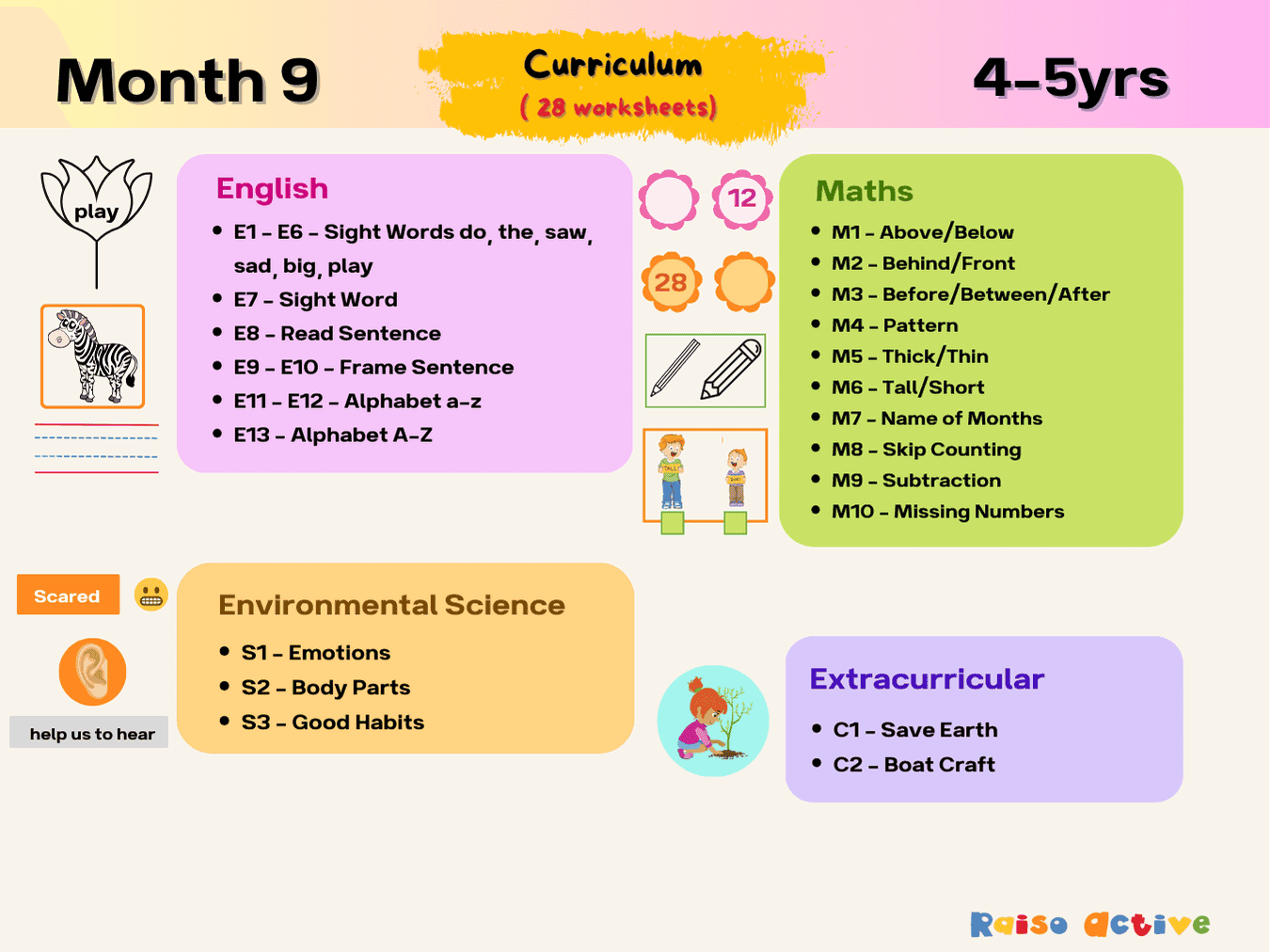
Month 9: Play-Based Preschool Foundational Skills | Ages 4-5
This is page 27 of the pack. Ages 4-5 · Pre-KAges 4-5 · ReceptionAges 4-5 · LKGAges 4-5
Made for your child
Counting to 10, made for your child
A maths pack with your child's name in it: pictures that explain, practice at three levels, puzzles and story sums about them. Print a new set whenever they finish.
Make a maths packFree preview · free for members
Curriculum
- SEL - Social Awareness > Social Skills
How to use this worksheet
Read each emotion word aloud together and talk briefly about what that feeling looks and feels like. Look at the row of emoji or facial expressions and ask your child to find the one that matches each word. Have them draw a line connecting each emotion word to its matching picture. Once finished, go back through the page and ask your child to make that facial expression themselves for a couple of the emotions.
Materials needed
- Pencil
- Eraser
Extension activities
- 1Discuss times when your child felt each emotion, encouraging them to describe what happened and how it felt.
- 2Act out different emotions together using only facial expressions and body language, guessing what the other person is feeling.
- 3Draw pictures of themselves expressing different feelings and label each drawing with the emotion word.
- 4Read a picture book with clear emotional moments and pause to name how a character might be feeling.

Written by
Hemsweta Jain · Teacher Cheena
MBA and Early Childhood Educator, teaching since 2014 · Founder of RaisoActive, Mumbai
Every RaisoActive worksheet is designed and checked by the founder before publishing.
Published · Last reviewed
More from Month 9: Play-Based Preschool Foundational Skills | Ages 4-5

Help the Hen! Alphabet Worksheet: Writing Missing Capital Letters
Ages 4-5 · Pre-KAges 4-5 · ReceptionAges 4-5 · LKGAges 4-5
This maze-style worksheet asks children ages 4-5 to fill in missing capital letters in alphabetical order to help a hen find her way to the coop, turning alphabet sequencing practice into a small story-driven challenge. Recalling which capital letter comes next in the sequence — without a full alphabet chart to copy from — builds genuine alphabet mastery rather than passive letter recognition. The path-following format also adds a light visual tracking element that keeps the activity from feeling like a plain fill-in-the-blank drill.

Tall and Short Worksheet: Comparing Sizes for Preschoolers
Ages 3-5 · Preschool–Pre-KAges 3-5 · Nursery–ReceptionAges 3-5 · Nursery–LKGAges 3-5
Comparing height is one of the earliest measurement concepts children encounter, and this worksheet asks children ages 3-5 to visually judge which of two objects is taller or shorter without using any numbers or rulers. This kind of direct visual comparison builds the intuitive sense of relative size that formal measurement skills will later be built on top of. Practicing the comparison in both directions — identifying the taller object in one set and the shorter object in another — also reinforces that 'tall' and 'short' are relative terms, not fixed labels.
Parent's Guide: Fun Activities for Kids!
Ages 3-5 · Preschool–Pre-KAges 3-5 · Nursery–ReceptionAges 3-5 · Nursery–LKGAges 3-5
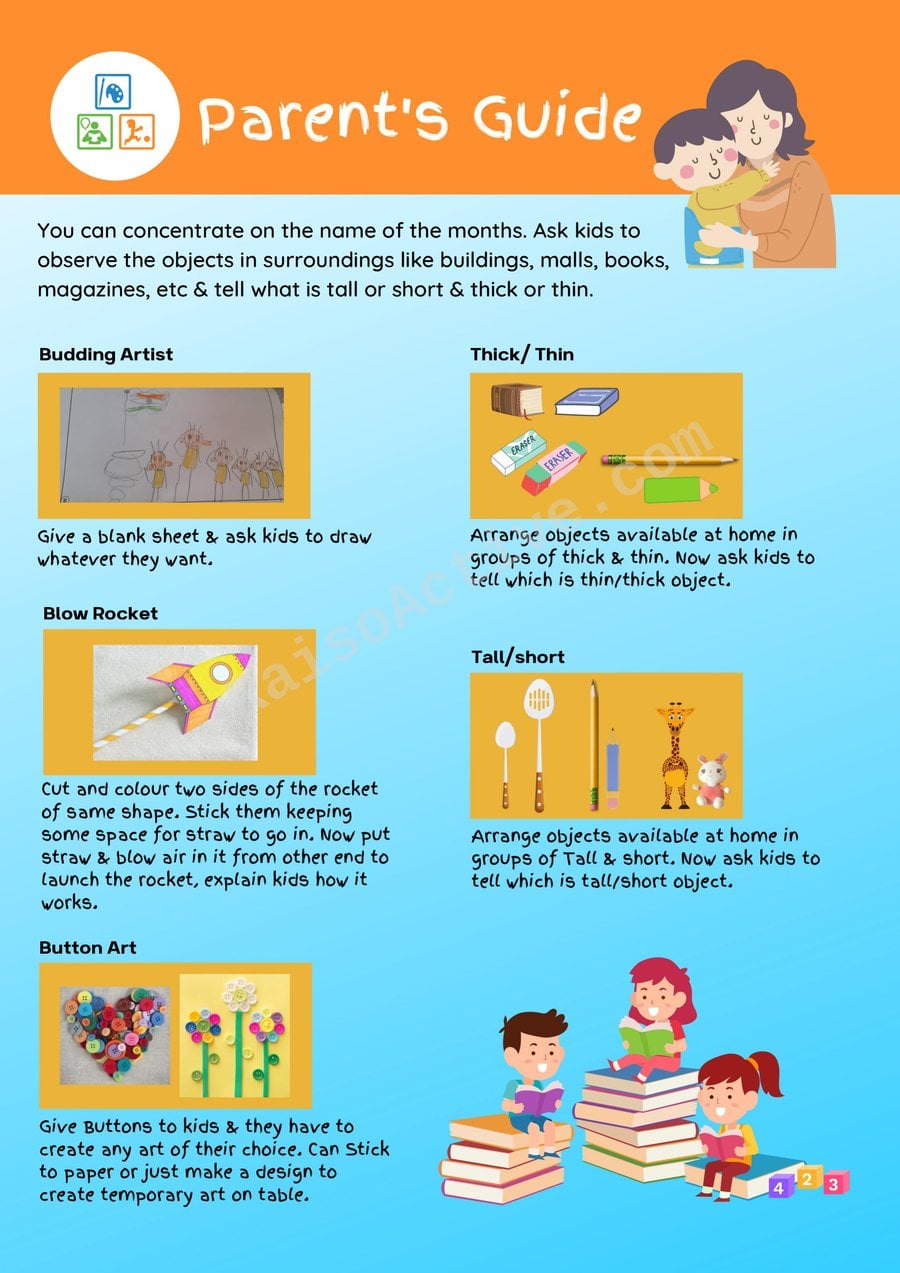
This parent's guide bundles several short activities that build early comparison vocabulary - thick versus thin, tall versus short - alongside fine motor practice with buttons and straws and beginning calendar awareness through talking about the months. For children ages 3-5, comparing sizes verbally is an important pre-math skill, while threading buttons onto straws strengthens the pincer grip needed later for writing. Together these activities give a well-rounded session touching language, math, and motor development.

Months of the Year Cut and Paste Worksheet for Preschoolers
Ages 3-5 · Preschool–Pre-KAges 3-5 · Nursery–ReceptionAges 3-5 · Nursery–LKGAges 3-5
Learning the twelve months in order gives children ages 3-5 an early framework for understanding calendars, seasons, and the passage of time, concepts that are quite abstract at this age without a hands-on anchor. This cut-and-paste activity turns that memorization into a physical sorting task, requiring children to recall the correct sequence while also practicing scissor control and precise gluing. Arranging the months onto train cars adds a visual, story-like structure that makes the lengthy sequence easier to hold in memory than a plain list would be.

Small Alphabet Letter Practice: Write the First Letter - Worksheet for Kids
Ages 3-5 · Preschool–Pre-KAges 3-5 · Nursery–ReceptionAges 3-5 · Nursery–LKGAges 3-5
Writing lowercase letters correctly is a distinct skill from recognizing them, and this worksheet asks children ages 3-5 to identify a pictured object, isolate its beginning sound, and then physically form the matching lowercase letter from memory. Combining sound identification with independent letter formation — rather than tracing — pushes children a step further toward true early spelling. This is often one of the first times children write letters without a dotted guide to follow, which builds real handwriting confidence.

Learn the Sight Word 'Do' - Tracing and Practice Worksheet
Ages 3-5 · Preschool–Pre-KAges 3-5 · Nursery–ReceptionAges 3-5 · Nursery–LKGAges 3-5
Sight words like 'do' can't be sounded out using regular phonics rules, so children ages 3-5 need repeated visual exposure and active practice to memorize them by sight — exactly what this multi-part worksheet provides through tracing, highlighting, filling blanks, and even dot-marking the word. Because sight words appear so frequently in early readers, automatic recognition of a word like 'do' removes a major stumbling block that would otherwise interrupt a child's reading flow on nearly every page. Practicing the same word in several different formats within one worksheet builds the strong repetition that sight-word memorization requires.

Subtraction Worksheet: Count and Subtract for Preschoolers
Ages 4-6 · Pre-K–KindergartenAges 4-6 · Reception–Year 1Ages 4-6 · LKG–UKGAges 4-6
This worksheet introduces children ages 4-6 to subtraction by having them count a group of objects, take away the indicated amount, and write the resulting difference. Grounding subtraction in physical counting rather than abstract number facts helps children build real number sense, understanding subtraction as 'taking away' rather than just memorizing symbols and answers.
Missing Numbers Worksheet: Sweet Treats!
Ages 3-5 · Preschool–Pre-KAges 3-5 · Nursery–ReceptionAges 3-5 · Nursery–LKGAges 3-5
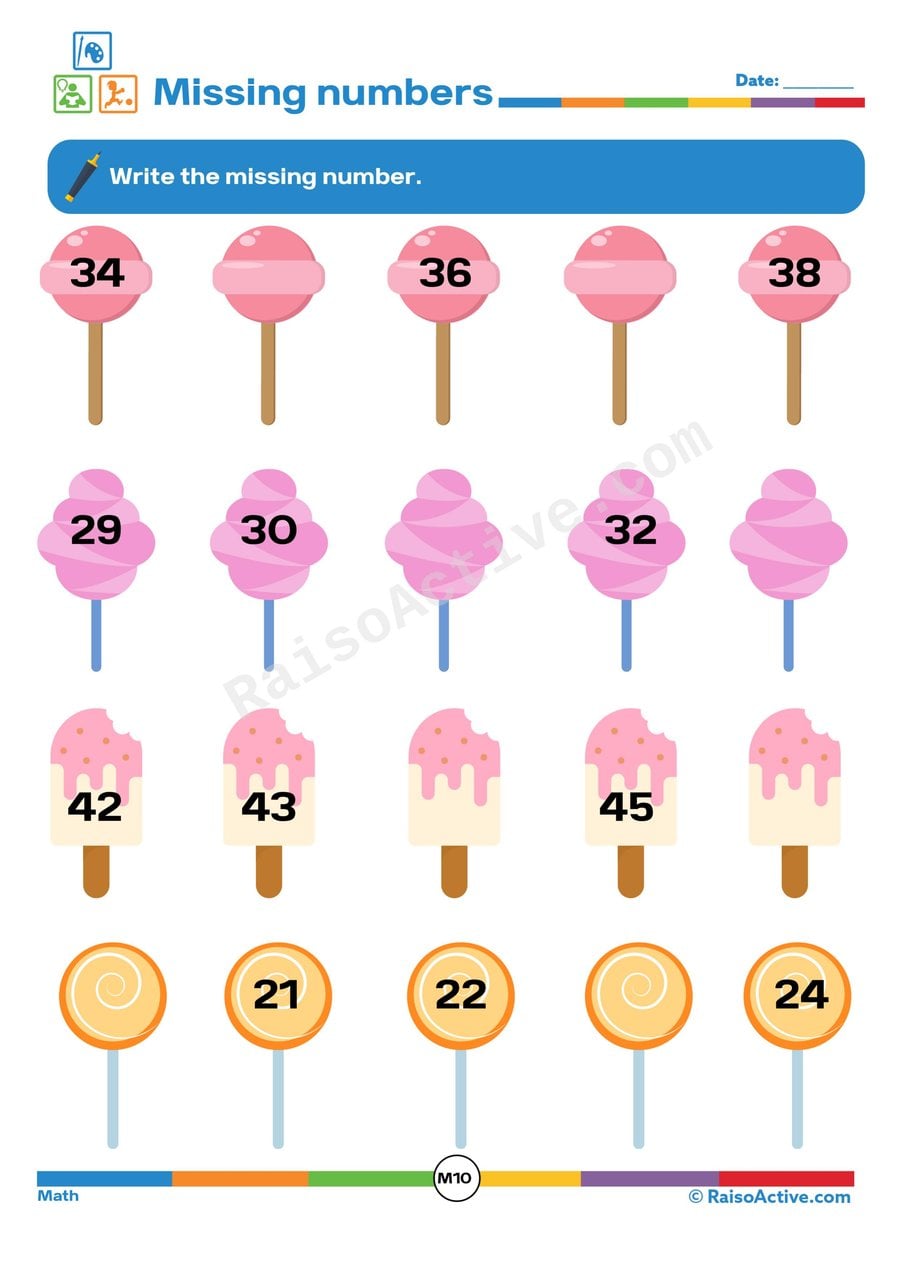
Set against a row of illustrated sweet treats, this worksheet gives children ages 3-5 practice with number sequencing - recognizing what comes before or after a given number in the counting order. This is a key early step toward understanding that numbers have a fixed, predictable order, which children need before they can count reliably or perform simple addition.
Related worksheets

Golden Words Worksheet: Practice Using 'Excuse Me', 'Please', 'Thank You', and 'Sorry'
Ages 3-5 · Preschool–Pre-KAges 3-5 · Nursery–ReceptionAges 3-5 · Nursery–LKGAges 3-5
This worksheet teaches children ages 3-5 when and how to use four essential polite phrases — 'Excuse Me,' 'Please,' 'Thank You,' and 'Sorry' — by choosing the correct one to complete everyday social scenarios. Learning to match the right polite phrase to the right situation, rather than just memorizing the words, builds real social communication skills that children use constantly in daily interactions.
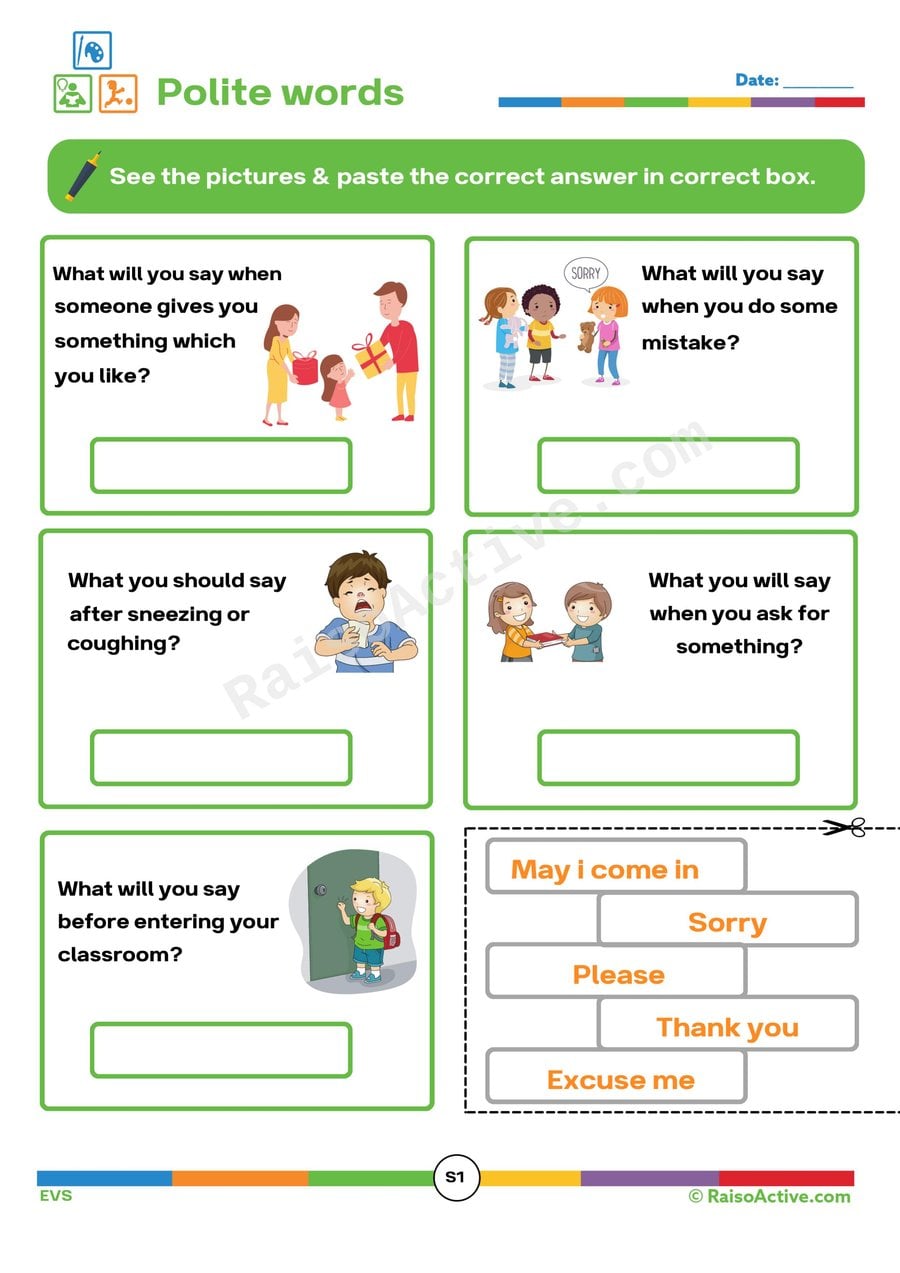
Polite Words Worksheet: Matching and Application
Ages 3-5 · Preschool–Pre-KAges 3-5 · Nursery–ReceptionAges 3-5 · Nursery–LKGAges 3-5
Matching pictures and scenarios to the right polite word teaches children ages 3-5 when and why to use phrases like please, thank you, sorry, and excuse me, building the pragmatic language skills needed for real social interactions. This kind of practice helps young children connect a word not just to its meaning but to the specific situation that calls for it.

May I? Permission and Future Possibilities Worksheet
Ages 3-5 · Preschool–Pre-KAges 3-5 · Nursery–ReceptionAges 3-5 · Nursery–LKGAges 3-5
This worksheet helps children ages 3-5 practice using the polite phrase 'May I' to ask for permission and to talk about things they might do in the future, building both grammar skills and an important social convention for respectful communication. Learning to phrase a request politely is a social-emotional skill that supports smoother interactions with teachers, family, and peers well beyond this single worksheet.

Use Please: A Fun Worksheet to Practice Polite Language!
Ages 3-5 · Preschool–Pre-KAges 3-5 · Nursery–ReceptionAges 3-5 · Nursery–LKGAges 3-5
This worksheet teaches children the specific social skill of using the word 'please' when making requests, connecting polite language to real, relatable everyday scenarios shown in pictures. For ages 3-5, learning concrete phrases for politeness supports both social-emotional development and early reading, since children practice recognizing and repeating a functional sight word in context.
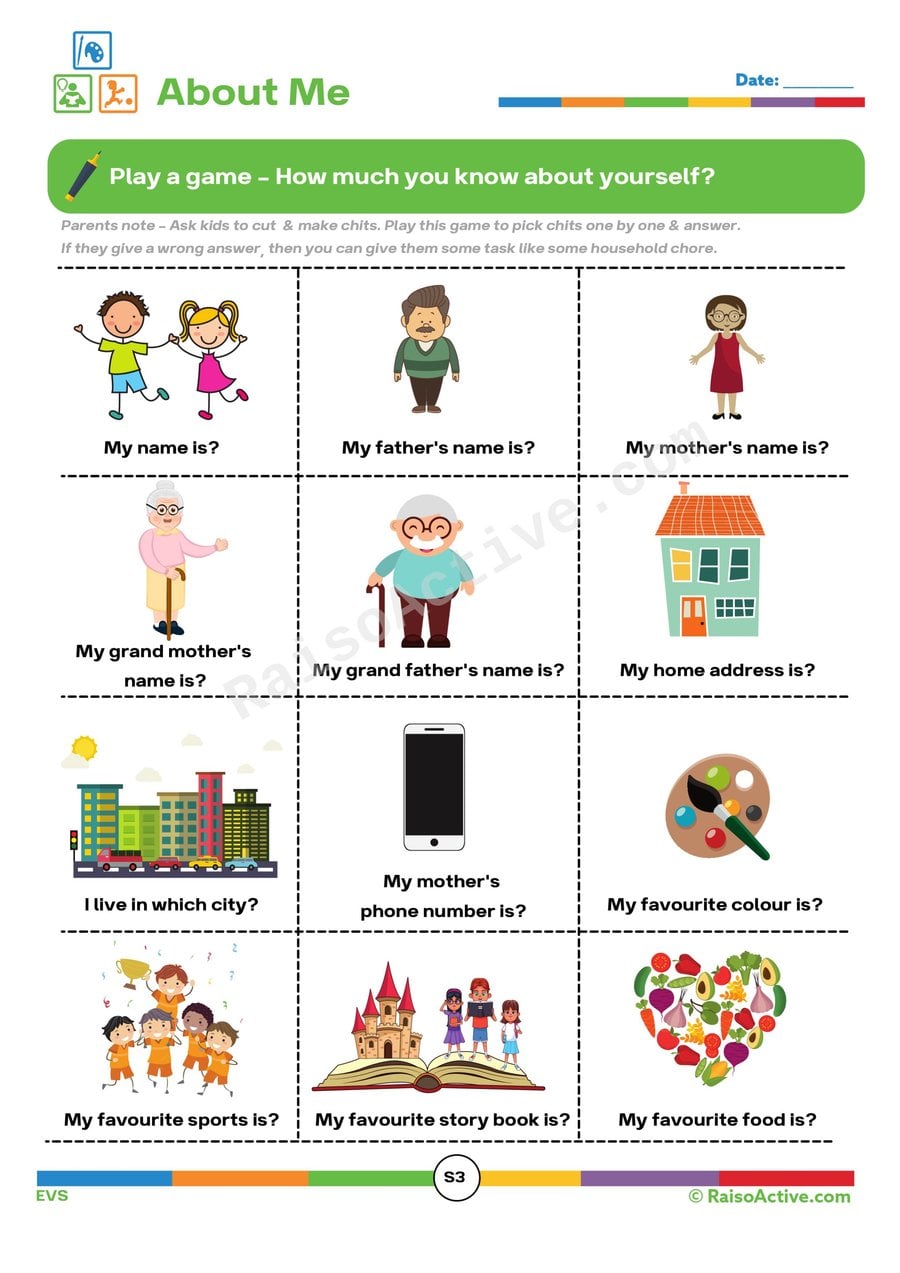
About Me Worksheet: Learn About Yourself!
Ages 3-5 · Preschool–Pre-KAges 3-5 · Nursery–ReceptionAges 3-5 · Nursery–LKGAges 3-5
This 'About Me' worksheet helps children ages 3-5 build self-awareness and early identity vocabulary by prompting them to describe their name, family, favorites, and feelings. Putting personal facts into words or pictures strengthens expressive language and gives children practice sharing information about themselves in a structured way. It's also a gentle first step into autobiographical writing, well before children can spell full sentences.
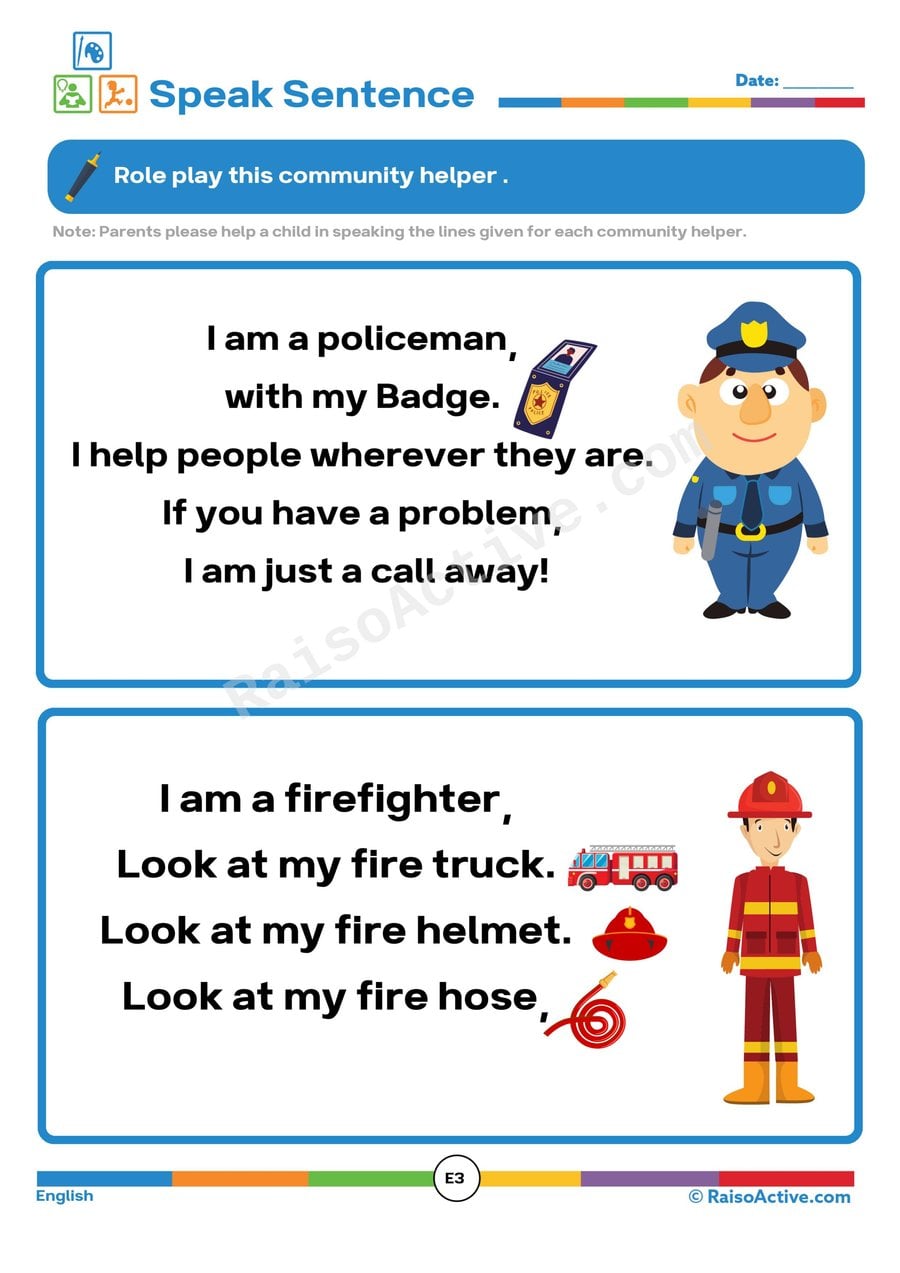
Community Helpers Role Play Worksheet for Kids
Ages 3-5 · Preschool–Pre-KAges 3-5 · Nursery–ReceptionAges 3-5 · Nursery–LKGAges 3-5
This worksheet helps children ages 3-5 learn about community helpers while practicing spoken sentence structure through guided role play. Reading a short scripted sentence aloud and then acting out the role of that helper builds oral language and expressive confidence alongside social studies knowledge, giving children a chance to practice full sentences in a low-pressure, playful context.

Easter Egg Match: Add and Find the Matching Designs!
Ages 3-5 · Preschool–Pre-KAges 3-5 · Nursery–ReceptionAges 3-5 · Nursery–LKGAges 3-5
This worksheet blends early addition with visual matching as children ages 3-5 combine two separate shape groups and then search for the Easter egg design that shows the same total. Because the 'answer' is a picture rather than a written number, children practice quantity comparison and pattern-matching without needing to know written numerals yet.

Symmetry Worksheet for Kids: Mirror Halves and Shadow Match
Ages 4-7 · Pre-K–Grade 1Ages 4-7 · Reception–Year 2Ages 4-7 · LKG–Class 1Ages 4-7
Children complete the other half of a butterfly and a house on a dot grid so both sides match like a mirror, then draw lines to match eight pictures to their shadows. This builds spatial reasoning and visual discrimination.
Guides for this topic

Best Worksheets for 3-Year-Olds: What Works and What to Avoid
What works on worksheets for 3-year-olds: short sessions, crayons, tracing lines, matching, cutting, a free weekly plan, and signs one is too advanced.

Age-Appropriate Problem-Solving Activities: Building Critical Thinkers from the Ground Up
Discover fun, age-appropriate problem-solving activities for children ages 1-8. Build critical thinking, logic, and reasoning skills through play-based learning.
Critical Thinking Activities That Actually Work for Young Children: Building Tomorrow's Thinkers Today
Discover proven critical thinking activities for young children. Age-wise logic games, questioning techniques, and hands-on ideas to build thinking skills at home.
Reviews
Every worksheet for ages 3–5, no watermark
Members download the full library of 1,000+ worksheets and every activity pack without watermarks or daily limits. One year costs ₹999 in India or $20 elsewhere.
See membership plansOr download any worksheet free with a watermark (5 a day).