Free printable worksheets · US · UK · India
Sight Words Worksheets (Ages 4–7)
Sight words worksheets are practice sheets for children aged 4 to 7 that teach high-frequency words such as "the", "and", "said" and "was" until they are recognized instantly. They draw on the Dolch and Fry lists and the UK tricky word lists, and build word recognition, reading fluency, spelling of irregular words, sentence reading and handwriting.
A few hundred high-frequency words make up a large share of any children's book, and many of them ("the", "was", "said", "come") cannot be sounded out with early phonics rules. Sight words worksheets give those words the repetition they need. Two- and three-year-olds recognize their own name and a few logos as whole shapes; deliberate word learning begins at four, when Pre-K, Reception and LKG children meet "I", "a", "the" and "to". Kindergarten, Year 1 and UKG add most of the Dolch primer list and the Letters and Sounds tricky words, and by six and seven, in 1st Grade, Year 2 and Class 1, children read and spell the first 100 Fry words and the KS1 common exception words inside sentences. Each sheet follows a read-trace-write-find pattern so every word is seen, formed and hunted for on one page.
1613+ worksheets · free PDF download · print on A4 or Letter
Sight Words Worksheets to print
Browse all worksheets for ages 4–7
Personal Pronouns Worksheet for Kids: Circle and Underline!
Circling the subject pronoun and underlining the object pronoun in each sentence teaches children ages 5-7 to recognize that pronouns play different grammatical roles depending on their position in a sentence, an important step toward more advanced grammar understanding. This careful, close-reading task also builds attention to sentence structure that supports stronger writing later on.

Punctuation Adventure: End Punctuation Worksheet for Kids
Children ages 5-7 practice choosing between periods, question marks, and exclamation points based on the meaning and tone of a sentence, a skill that connects punctuation directly to how a sentence should sound when read aloud. This builds the foundation for expressive, correctly punctuated writing later in school.
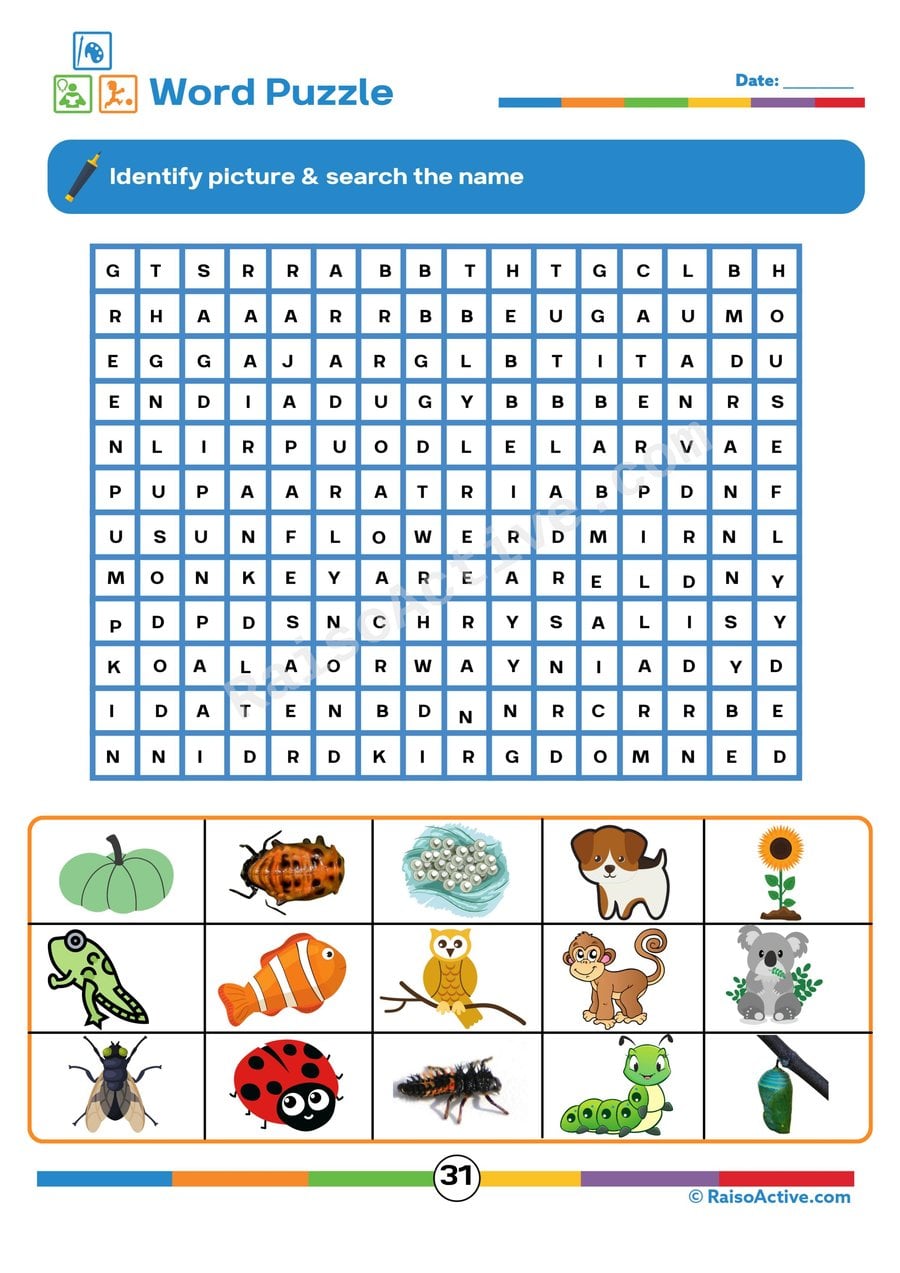
Word Search Worksheet: Find the Hidden Words!
Searching this life cycle-themed word grid strengthens children's letter-by-letter visual scanning and spelling recognition, both essential pre-reading skills for ages 5-7. As they hunt for words tied to animal growth stages — such as egg, larva, or adult — children reinforce life cycle vocabulary while training their eyes to track left-to-right and top-to-bottom across a busy grid. This dual focus on reading mechanics and science content makes the puzzle more valuable than a generic word search.

Sun Safety Worksheet for Kids: Learn About Staying Safe in the Sun!
This worksheet has children ages 4-7 answer questions about sun safety, such as why sunscreen and hats matter, building early health literacy alongside writing practice as they put their understanding into their own words. Because the questions ask children to reason about why certain sun-safety habits matter rather than just label a picture, this worksheet develops early explanatory thinking, a step up from simple factual recall. Practicing writing full answers, even short ones, also builds sentence-forming skills appropriate for this age range.
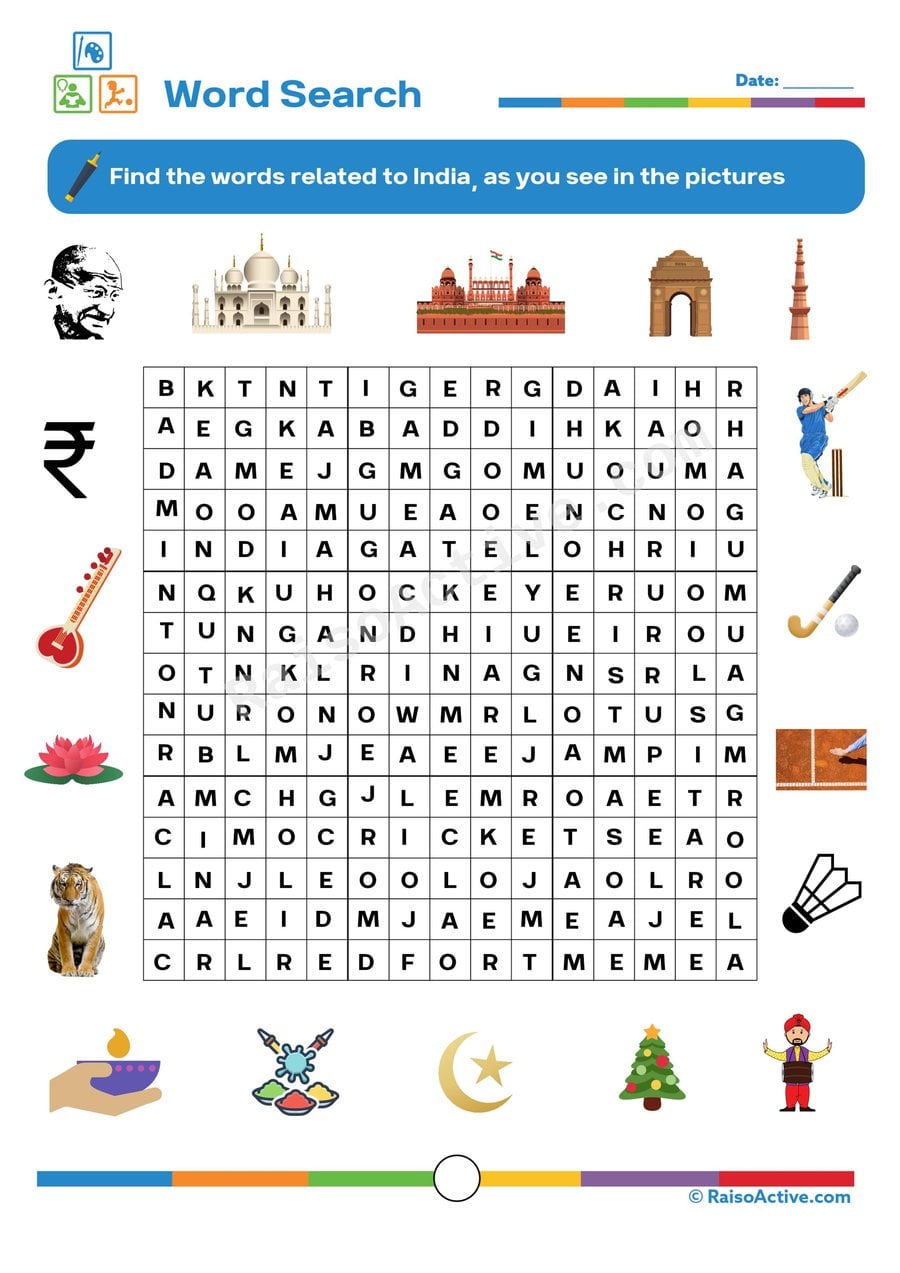
India Word Search Worksheet for Kids
Searching a letter grid for words connected to India, such as festival names, foods, or landmarks, builds visual scanning and word-recognition skills in children ages 4-7 while introducing vocabulary tied to Indian culture and geography. Because the target words vary in length and may run in different directions through the grid, children also practice sustained visual attention and letter-sequence tracking, both important pre-reading skills. This worksheet pairs literacy practice with cultural and social studies exposure in a single activity.
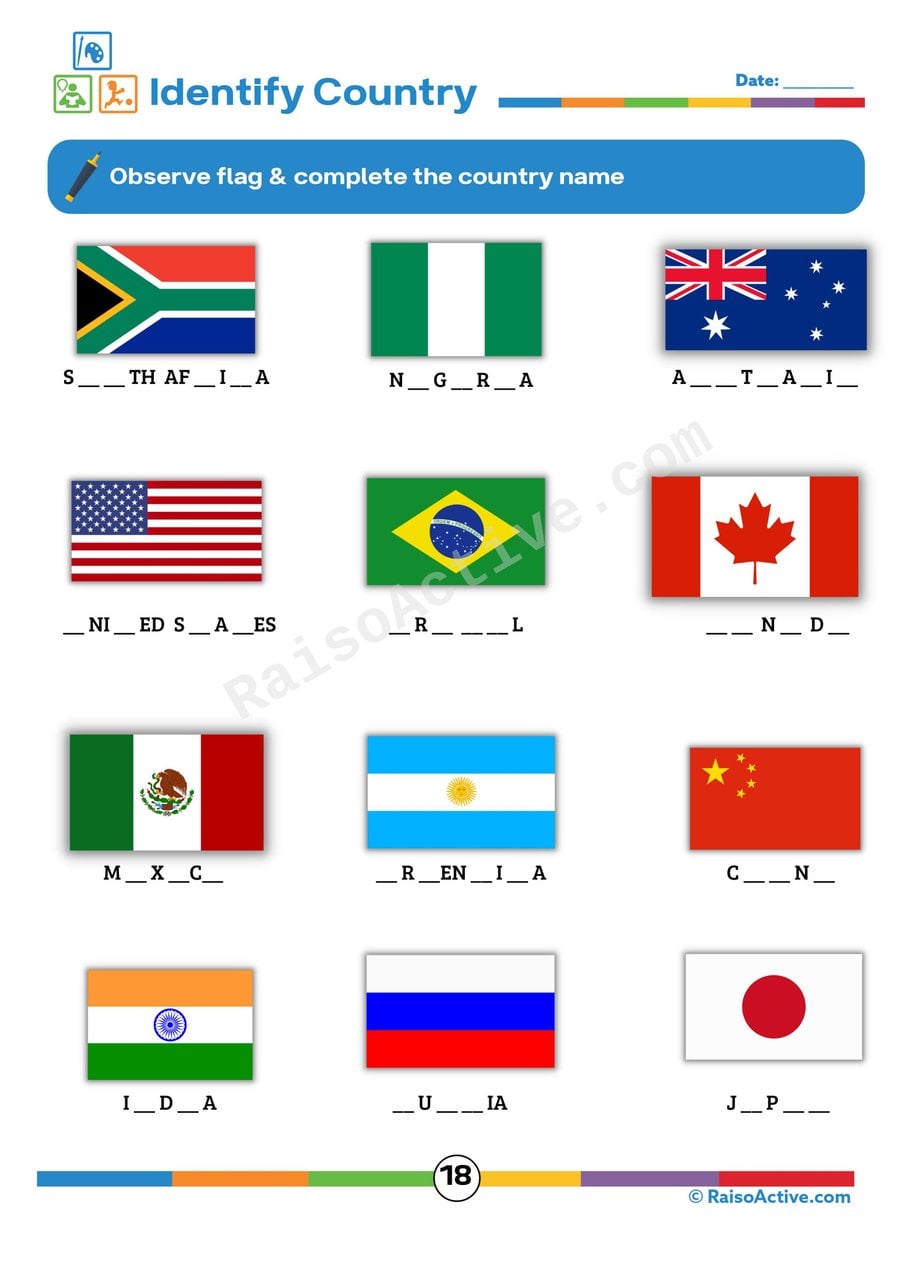
Identify the Country: Flag Matching Worksheet
Filling in the missing letters of each country's name while studying its flag gives children ages 4-7 practice with letter-sound correspondence and spelling patterns, since they must sound out the word and recall which letters are already provided as clues. It also builds early geography knowledge, helping children connect a visual symbol (the flag) to a country's name for the first time. This dual practice of decoding and world knowledge lays groundwork for both literacy and social studies skills.
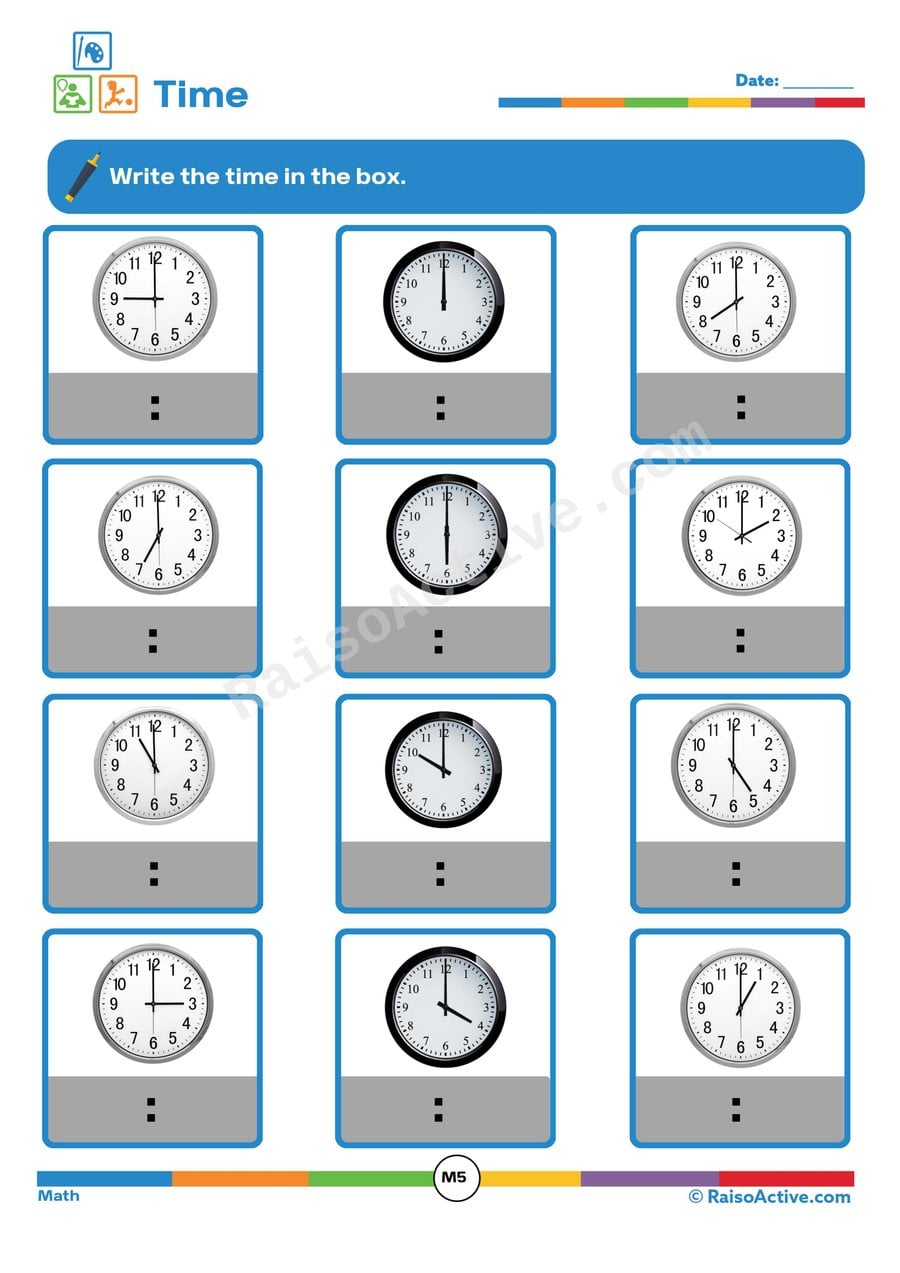
Time Telling Worksheet for Kids: Write the Time!
Reading the position of the hour and minute hands on an analog clock and writing the matching digital time teaches children ages 4-6 an important real-world math skill that connects visual, spatial reasoning with numeral writing. Because analog clocks require understanding both where the short hour hand and long minute hand point, this worksheet builds a more advanced skill than simple number recognition, introducing the idea that two hands work together to tell one time. Regular practice with clock reading also supports growing independence, as children begin to understand daily routines in terms of actual clock times.

Future Tense Fun: Fill-in-the-Blanks Worksheet for Kids
This worksheet introduces children ages 4-6 to the future tense, having them choose and write the correct verb form to complete sentences about things that 'will' happen. Understanding that verbs change to reflect when an action takes place — past, present, or future — is a foundational grammar concept that helps children communicate more precisely as their sentences grow longer and more complex.
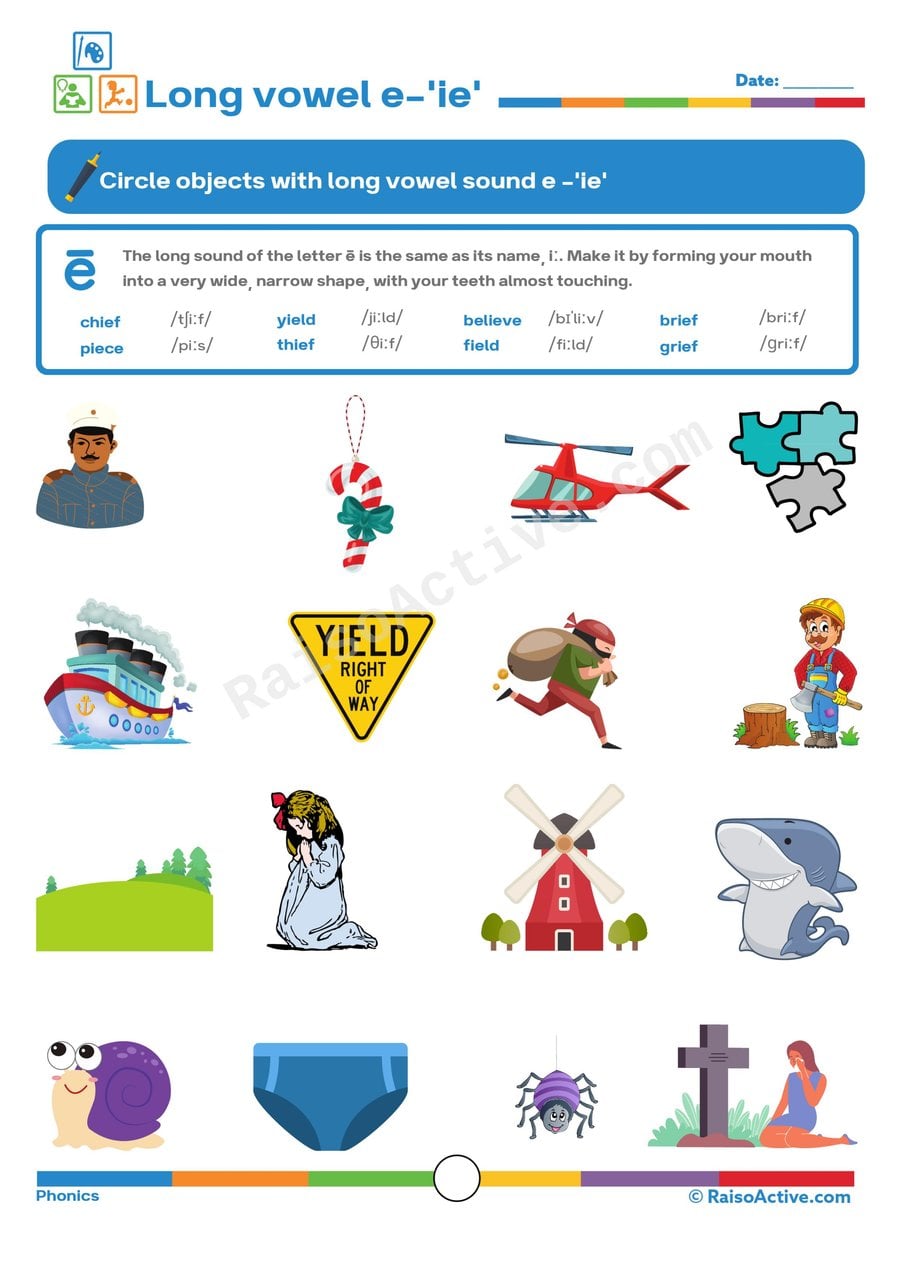
Long Vowel E 'ie' Worksheet: Circle the Pictures!
This worksheet asks children ages 4-6 to identify words with the long 'e' sound spelled using the less common 'ie' pattern, as in 'chief' and 'field', and circle the matching pictures. Because 'ie' is a trickier, less intuitive spelling for the long 'e' sound than more familiar patterns like 'ee', this worksheet stretches children's phonics knowledge toward more advanced and irregular spelling patterns.

Body Parts Worksheet: Identify and Paste the Correct Organ!
Reading a clue about a body part's function and finding the matching organ builds science vocabulary and reading comprehension for children ages 4-6, linking what a body part does to its correct name.
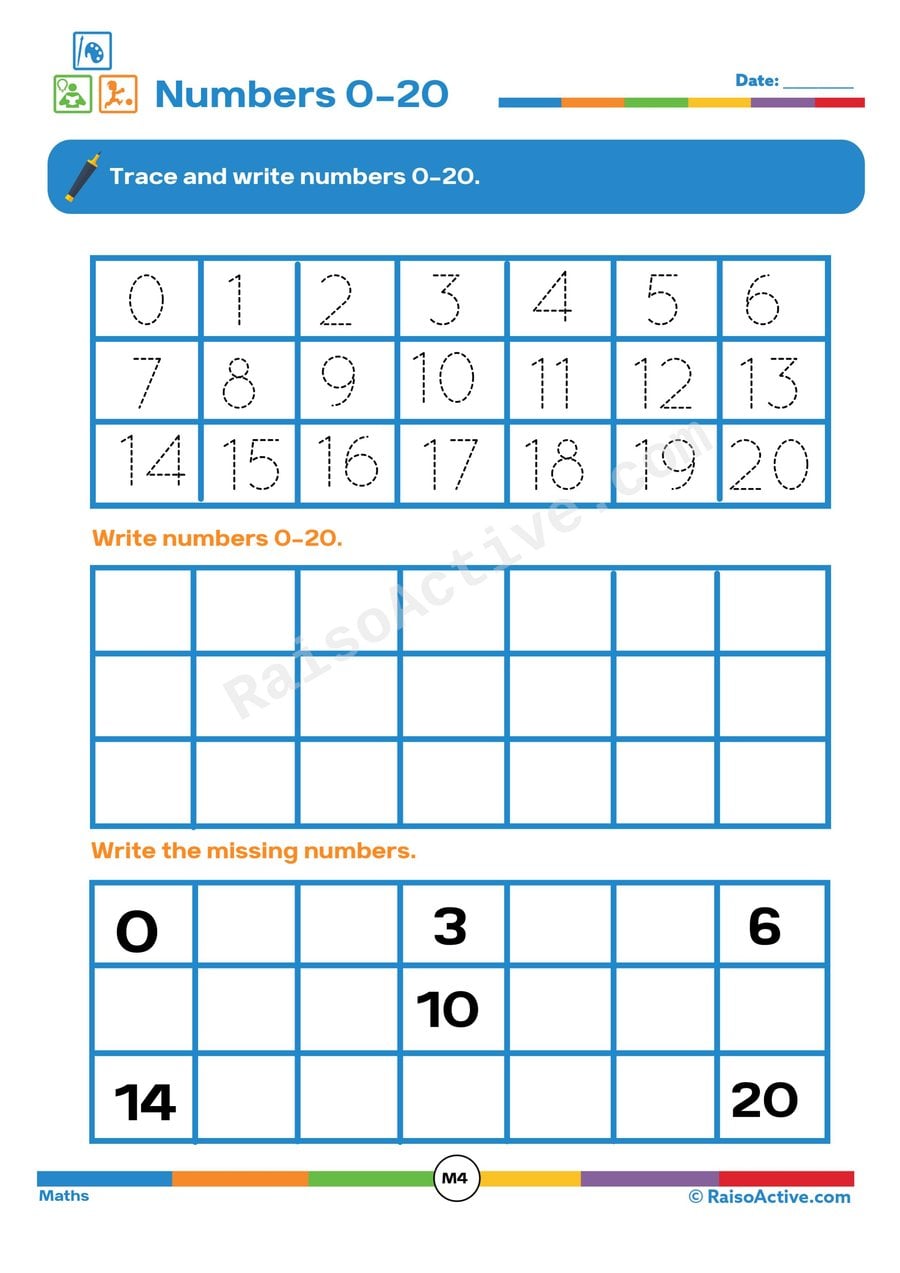
Trace and Write Numbers 0-20 Worksheet
This worksheet extends number formation practice across the full range from 0 to 20, giving children repeated tracing and writing practice on both single-digit and two-digit numerals. For four- to six-year-olds, moving past 10 into the teens and twenties is an important milestone, since it introduces the idea that numbers can be built from combinations of digits rather than each needing its own unique symbol.
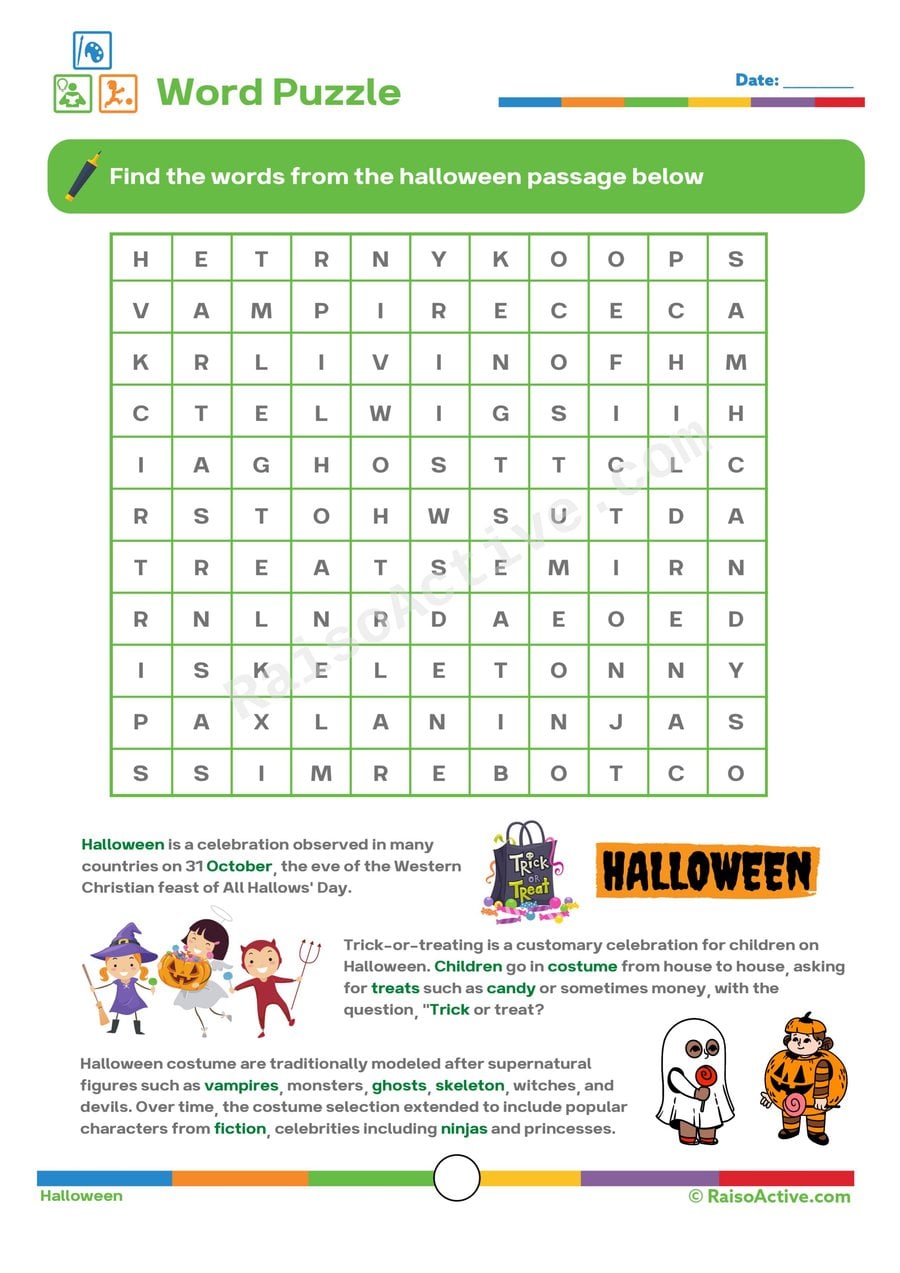
Halloween Word Search Worksheet for Kids
This Halloween word search has children ages 4-6 scan a grid of letters to locate seasonal vocabulary words, building visual tracking skills and reinforcing the spelling of words like 'pumpkin,' 'ghost,' or 'witch' that they can recognize from the picture-based worksheets in this set. Searching systematically through rows and columns also strengthens the left-to-right, top-to-bottom scanning pattern used in reading.

A or An Worksheet: Fill in the Blanks with Beginning Sounds!
This worksheet teaches children ages 4-6 the grammar rule for choosing between the articles 'a' and 'an,' based on whether the following word starts with a consonant or vowel sound. Applying this rule correctly requires listening carefully to a word's beginning sound rather than just its spelling, which sharpens phonemic awareness alongside grammar knowledge.

Sentence Building Fun: Using Words to Create Sentences Worksheet
This worksheet helps children ages 4-6 practice constructing complete, grammatically sound sentences by using a set of provided words alongside a picture prompt. Building sentences from a word bank forces children to think about word order and sentence structure directly, rather than just filling in a single blank, which is a meaningful step up in independent writing skill.

Long Vowel 'O' Worksheet: Circle and Write the Words!
This worksheet has children ages 4-6 identify and write words containing the long 'o' sound, building recognition of one of the five long vowel sounds that forms the backbone of early reading fluency. Circling pictures based on sound before writing the matching word reinforces the connection between what a child hears and what they need to spell, which is a more demanding task than simply reading a word that's already written. Practicing long 'o' alongside the other long vowels your child has likely already covered rounds out a complete long-vowel toolkit for decoding new words.

Match the Countries with Their Symbols Worksheet
Children ages 4-6 build early social studies awareness by matching country flags to their well-known national symbols, connecting visual recognition with basic geography and cultural knowledge. This kind of matching exercise strengthens careful observation, since children must compare colors, shapes, and details across both the flag and the symbol image. It also plants the seed for understanding that different countries have distinct identities and traditions.
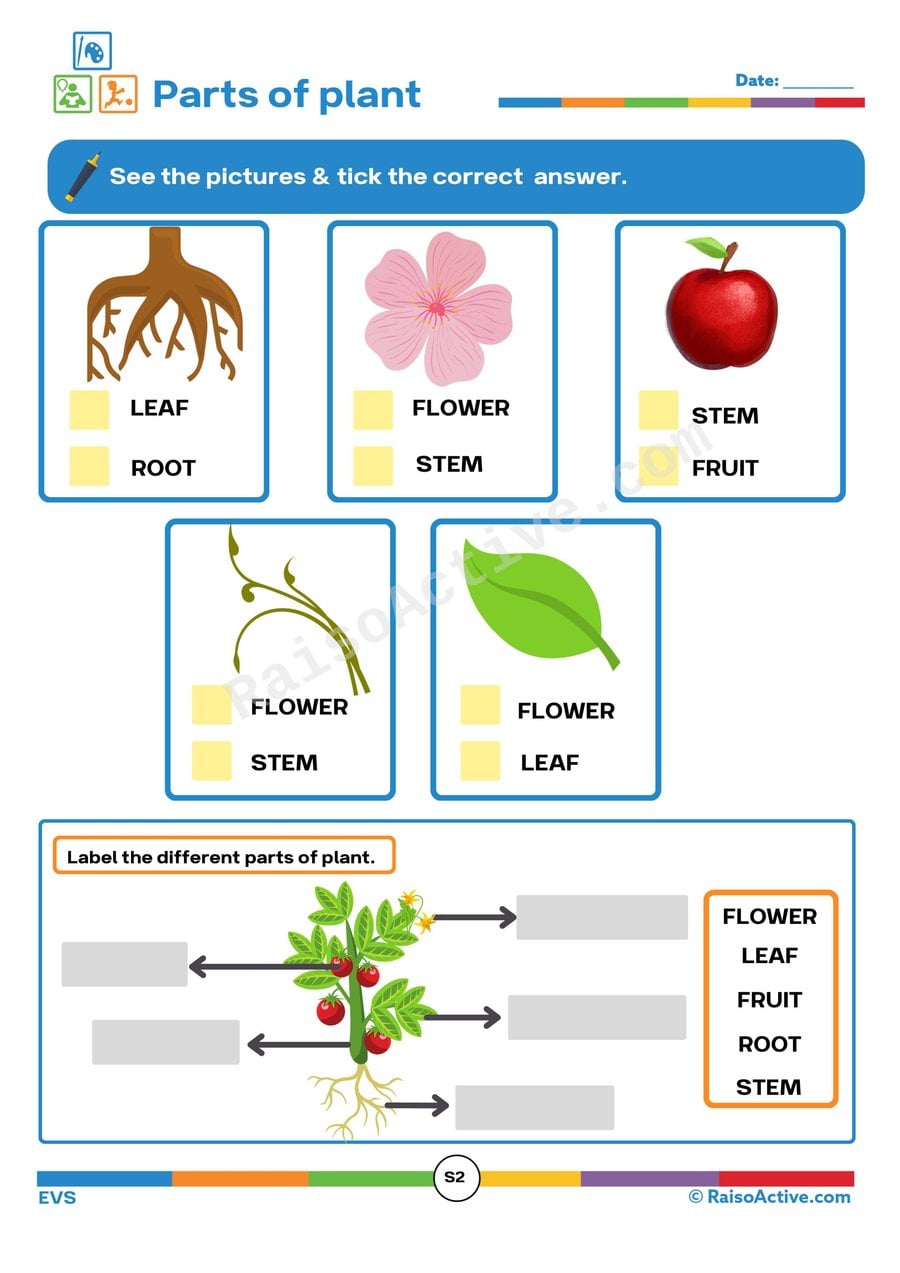
Parts of a Plant Worksheet for Kids
This worksheet helps children ages 4-6 identify and label the main parts of a plant — roots, stem, leaves, flower, and fruit — building foundational botany knowledge. Learning to associate each part with its picture and location on a plant diagram develops both vocabulary and an early understanding of plant structure, which supports later lessons on how plants grow and survive.
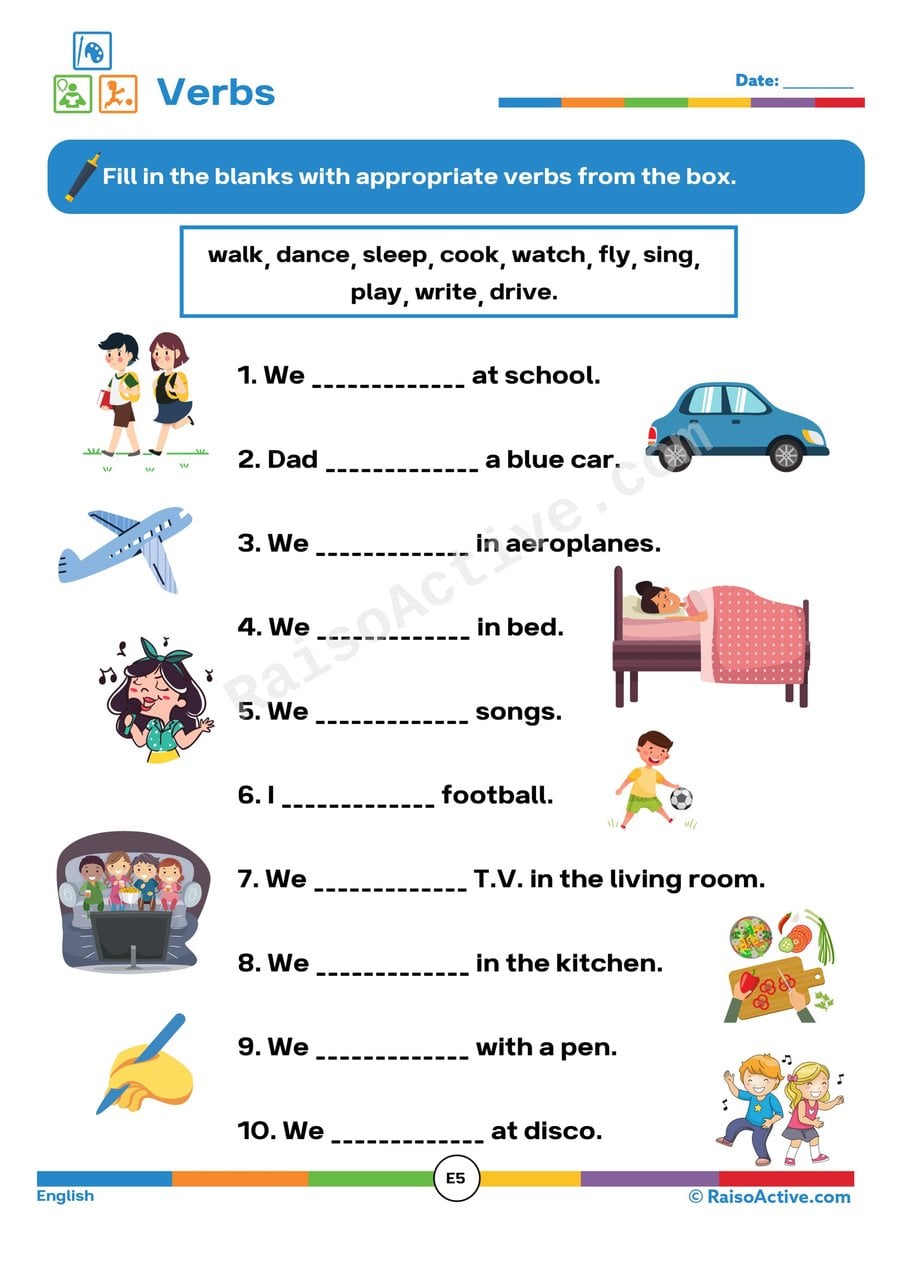
Action Verbs Worksheet: Fill in the Blanks!
This worksheet moves 4-6 year olds a step beyond matching verbs to pictures — now they have to read a full sentence, understand its meaning, choose the correct verb from a word box, and write it into the blank themselves. That combination of reading comprehension, vocabulary selection, and handwriting makes this noticeably more demanding than earlier action-word worksheets, and it's exactly the kind of sentence-completion task children will meet again in early elementary grammar lessons.

Family Words Worksheet: Picture Matching and Word Recognition
This worksheet gives children ages 4-6 another round of practice recognizing family-member vocabulary words, reinforcing the connection between a printed word and the picture it names through both a tick-the-answer step and a cut-and-paste matching step. Repeating this pairing across two different formats on one page helps move these words from recognition with support toward more independent reading.

Sentence Building Worksheet: Write Sentences with Given Words!
Using given words to build a complete sentence teaches children ages 4-6 how word order creates meaning, an essential step toward reading fluency and independent writing. Practicing this skill also reinforces sentence mechanics like starting with a capital letter and ending with a period, which many children this age are just beginning to apply consistently.

Formal vs. Informal Language Worksheet: Practice with Sentences!
Rewriting sentences between formal and informal versions teaches children ages 4-6 that the same message can be expressed differently depending on the audience, an early step toward social and register awareness in language. Because the task also involves matching a picture to each sentence, children practice connecting tone of language to context and setting, not just memorizing rules.
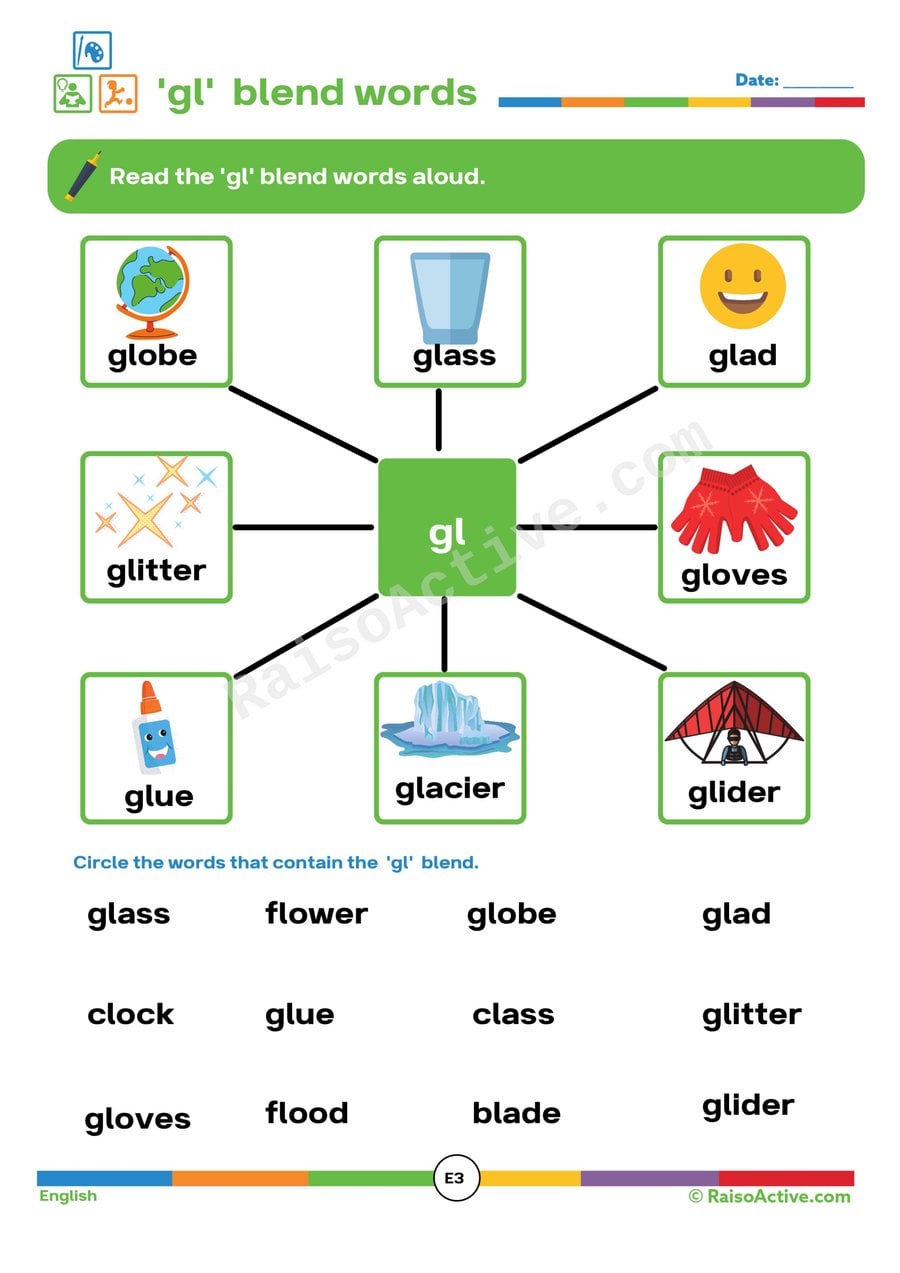
Gl Blend Words Worksheet: Read and Circle!
This worksheet builds phonics skills around the 'gl' consonant blend, helping children recognize and read words like 'glass,' 'glue,' and 'glow' where the sounds of g and l combine at the start of a word. For ages 4-6, practicing blends like gl strengthens the sound-segmentation skills needed to decode increasingly complex words as reading develops.

Apple Picking Fun: A Reading Comprehension Worksheet for Kids
This worksheet builds early reading comprehension skills in children ages 4-6 by having them read a short story about apple picking and then answer simple questions that check their understanding of what happened. Answering questions after reading, rather than just decoding words, pushes children to hold the story's meaning in mind and recall specific details, a critical skill for all future reading. Coloring an apple afterward gives a relaxing, creative close to the comprehension task.

CCVC Word Matching Worksheet: Read and Match 'cl' and 'sl' Blends
This worksheet gives children ages 4-6 focused practice reading and matching CCVC words that begin with the 'cl' and 'sl' consonant blends, like 'clap' and 'slide'. Practicing two specific, similarly structured blends side by side sharpens a child's ability to hear the subtle difference between them, a skill that becomes increasingly important as vocabulary and reading material grow more complex.
Dolch, Fry and tricky words explained
The Dolch list (220 service words plus 95 nouns, compiled in the 1930s) and the Fry list (1,000 words ranked by frequency, in groups of 100) are the two standard American sight word lists. UK phonics programs based on Letters and Sounds instead teach "tricky words" phase by phase, and the National Curriculum calls the Year 1 and Year 2 spelling sets "common exception words". The lists overlap heavily; the differences are in ordering and in whether decodable words such as "and" and "in" are included.
- Dolch pre-primer (40 words): a, and, I, the, to, you, see, go, can, big
- Fry first 100: the most frequent words in English print, taught across Kindergarten and 1st Grade
- Letters and Sounds Phase 2 tricky words: the, to, I, no, go, into
- Phase 3 tricky words: he, she, we, me, be, was, my, you, they, her, all, are
- KS1 common exception words: said, were, there, one, once, friend, school
Why some words cannot be sounded out
A word like "said" is irregular because the "ai" spells the short e sound, which a child will not have been taught. Words like "was", "of", "come" and "one" are similar. The heart-word method handles this: the child sounds out the regular parts and marks the irregular letter with a heart, meaning "learn this part by heart". This keeps phonics as the main strategy while accepting that a few words need memory, rather than teaching every word as a whole shape.
The read-trace-write-find format
Each sheet typically presents one word or a small set. The child reads it aloud, traces it on dotted letters, writes it independently on a line, then finds it in a short sentence or a box of similar words, and sometimes cuts and pastes letters to build it. This sequence gives visual, motor and reading practice on one word within a few minutes. Three to five new words a week, revisited daily, is the pace most Kindergarten and Year 1 teachers use.
Frequently asked questions
What are sight words?
Sight words are words that appear so often in print that a reader needs to recognize them instantly rather than sounding them out each time. Some are regular and decodable ("and", "in"); others have irregular spellings ("the", "was", "said") that early phonics cannot explain. The Dolch and Fry lists in the US, and tricky word and common exception word lists in the UK, catalog the most important ones for ages 4 to 7.
How many sight words should a kindergartener know?
By the end of Kindergarten (Year 1 in the UK, UKG in India), most children are expected to read around 50 to 100 high-frequency words on sight, including the Dolch pre-primer and primer lists or the Letters and Sounds Phase 2 to 4 tricky words, and to spell the most common 20 to 30. By the end of 1st Grade or Year 2, the target is typically the first 100 Fry words and the KS1 common exception words.
What is the difference between sight words and phonics?
Phonics teaches children to decode words by matching letters to sounds and blending. Sight word practice teaches instant recognition of frequent words, especially those with irregular spellings that phonics alone cannot decode. The two work together: phonics is the primary reading strategy, and a small store of sight words removes the roadblocks that would otherwise stop a child mid-sentence. UK phonics guidance and the US National Reading Panel both treat phonics as foundational.
What is a tricky word in phonics?
In UK phonics programs following Letters and Sounds, a tricky word is a high-frequency word whose spelling does not fully match the sound-letter rules taught so far, such as "the", "was", "you" and "said". They are introduced phase by phase alongside the sounds. The National Curriculum uses the term "common exception words" for the Year 1 and Year 2 spelling lists. In US terms these are irregular sight words or heart words.
How do you teach sight words at home?
Introduce three to five words at a time. Say the word, spell it, and point out any irregular part. Have the child read it, trace it, write it and find it in a sentence, which is the format of the sheets on this page. Then use the words in daily life: flashcards at breakfast, spotting them in a storybook, writing them in sand or with a finger. Review previous words every day; recognition comes from many short exposures rather than long sessions.

Written by
Hemsweta Jain · Teacher Cheena
MBA and Early Childhood Educator, teaching since 2014 · Founder of RaisoActive, Mumbai
Written and reviewed by Hemsweta Jain (Teacher Cheena), who designs every RaisoActive worksheet.
Last reviewed
Printable packs for ages 4–7
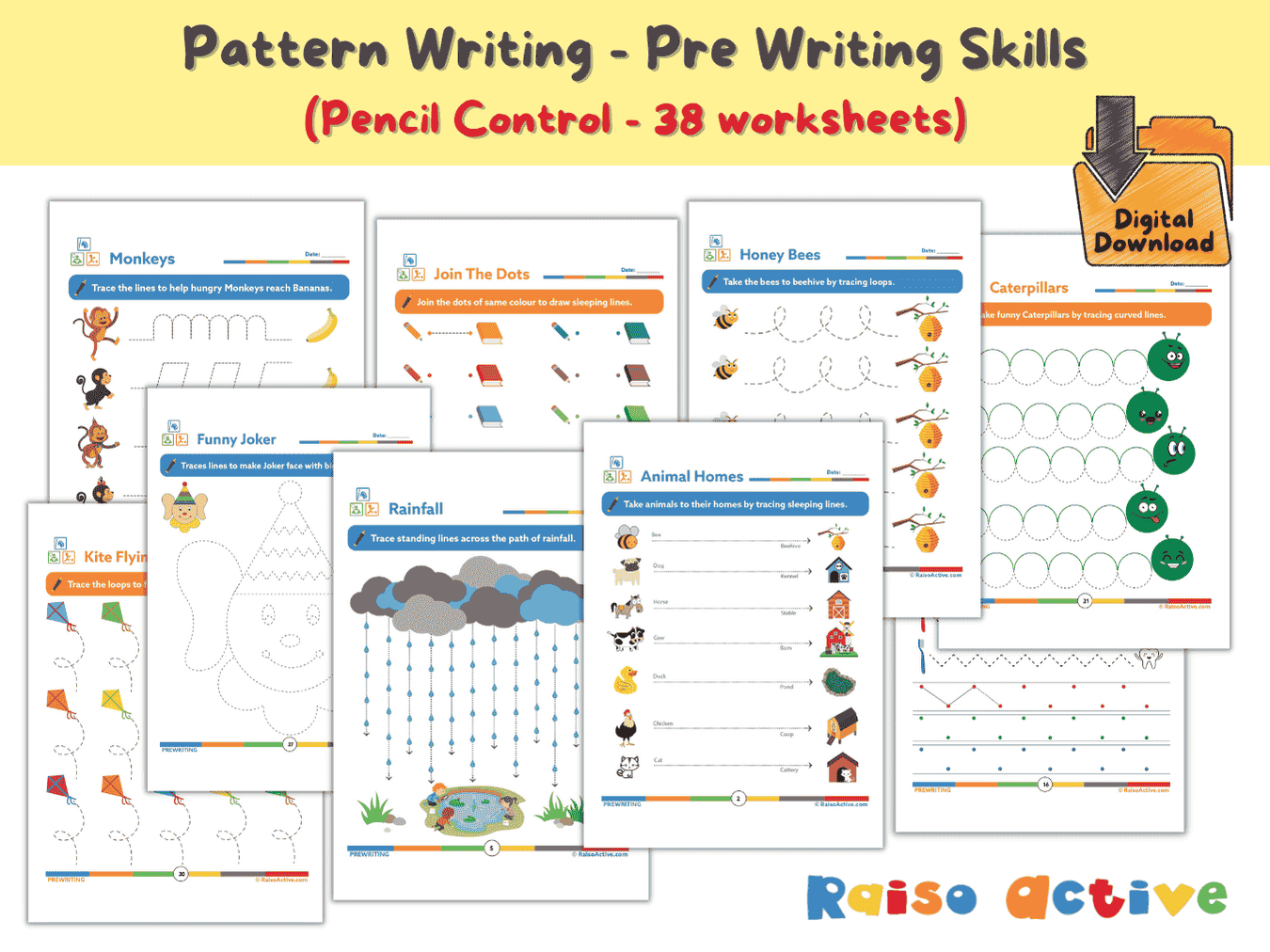
Pattern Writing Pre-writing Skills Activity Book for 3-4 Year Olds
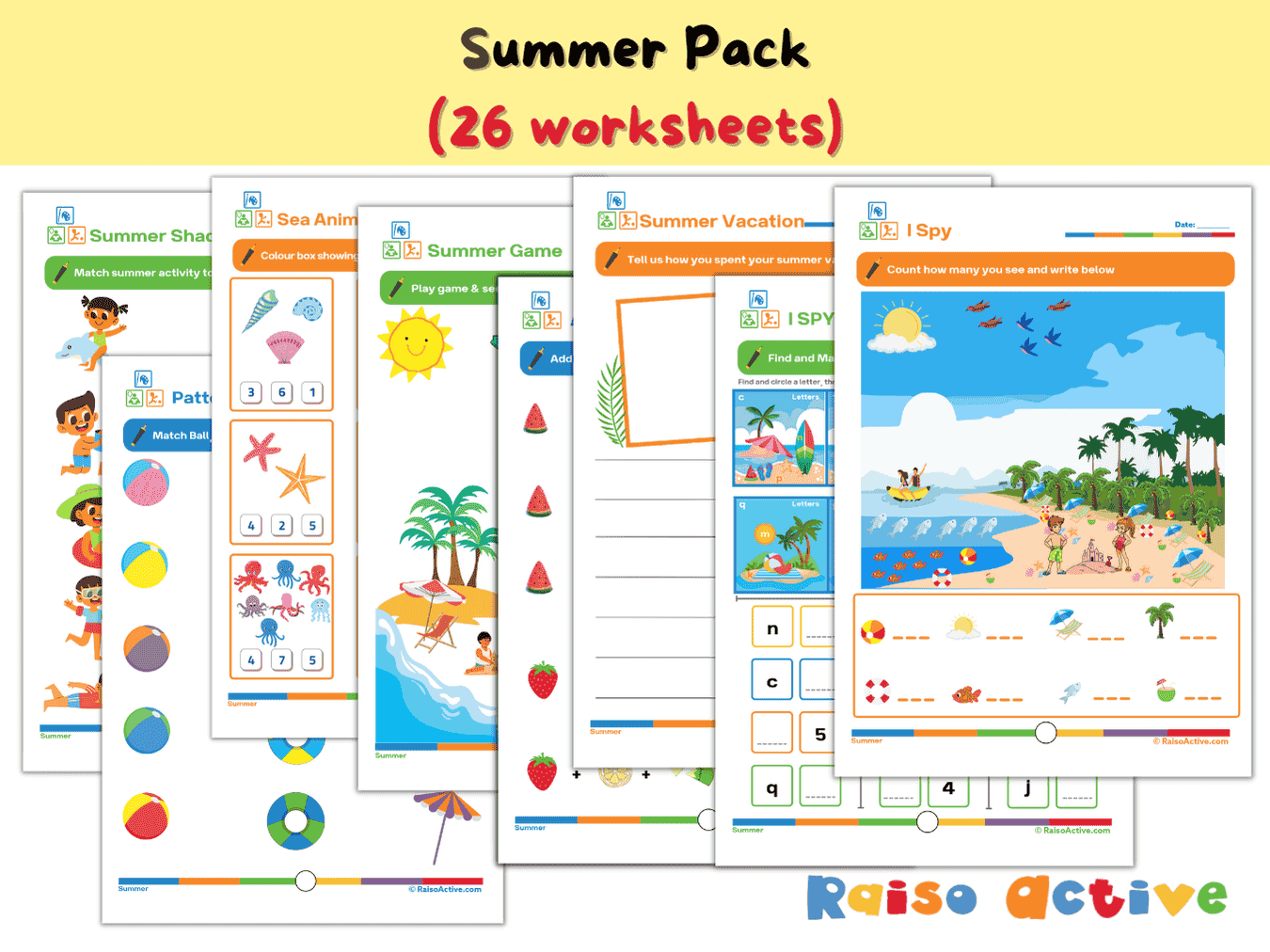
Summer Activity Pack: Math, Literacy, Puzzles & More for Preschool & Kindergarten
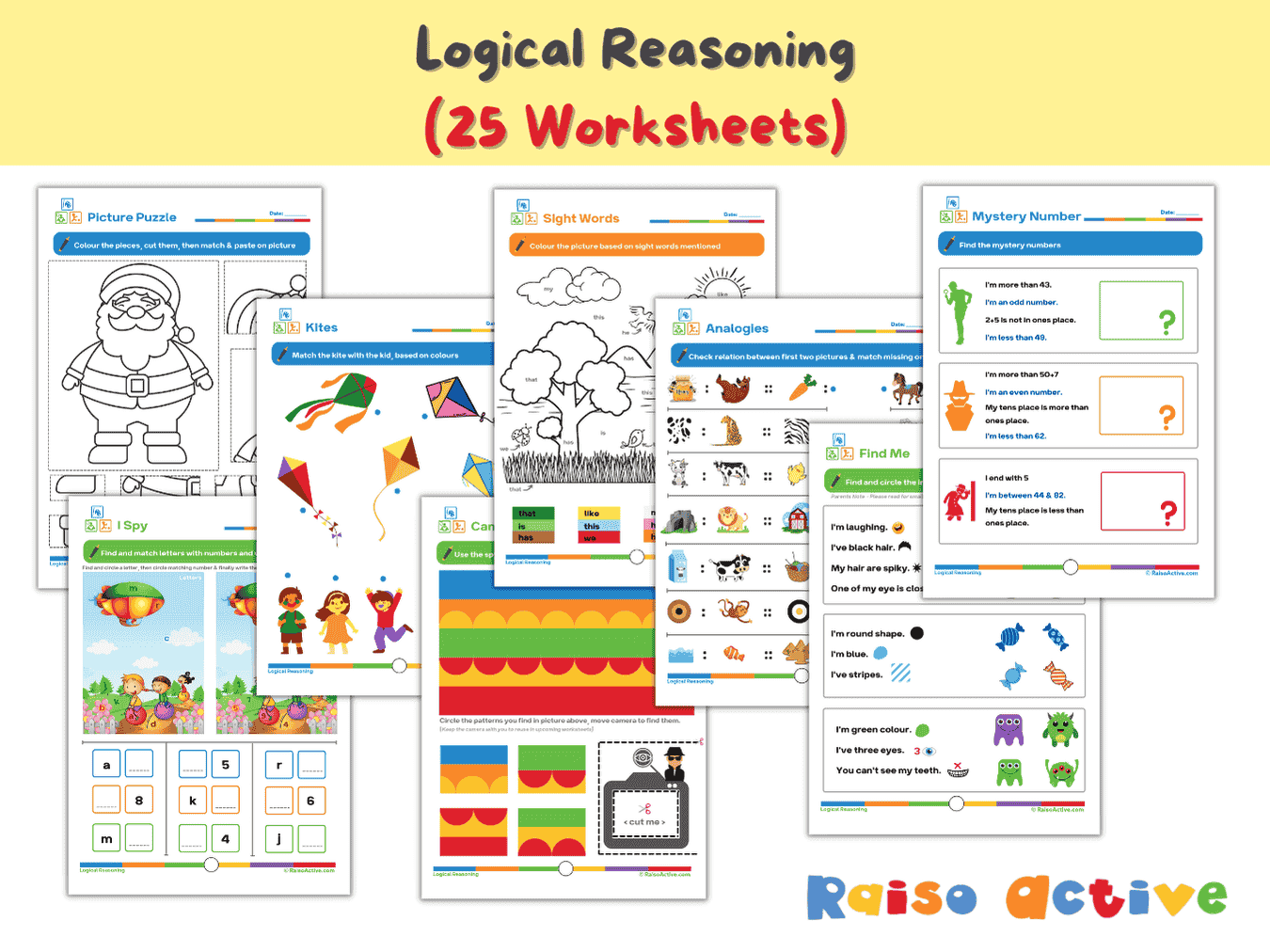
Logical Reasoning Activity Book for Preschool & Kindergarten | Patterns, Puzzles & Analogies
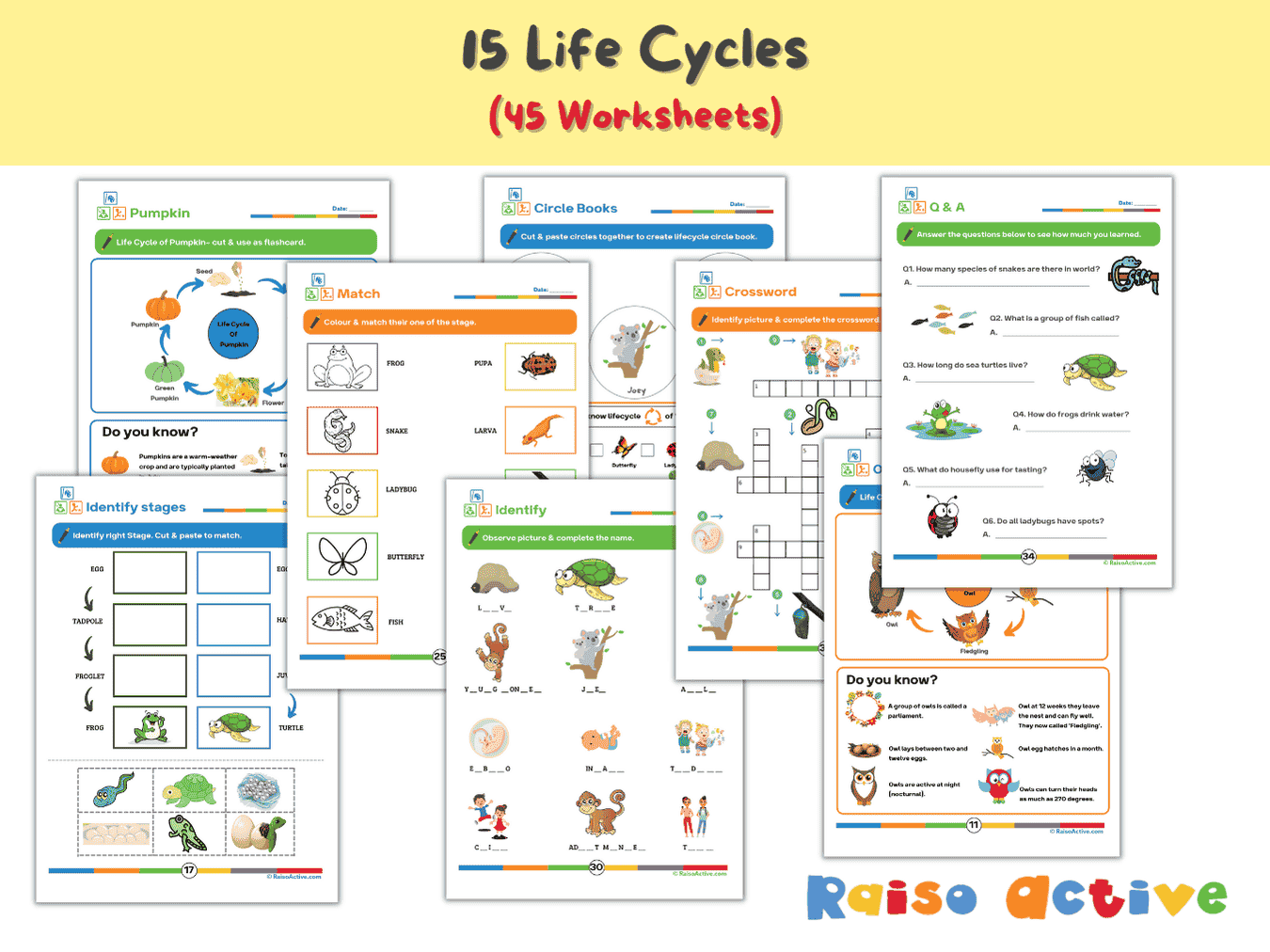
Lifecycles Activity Book & Flashcards for Preschool & Early Elementary
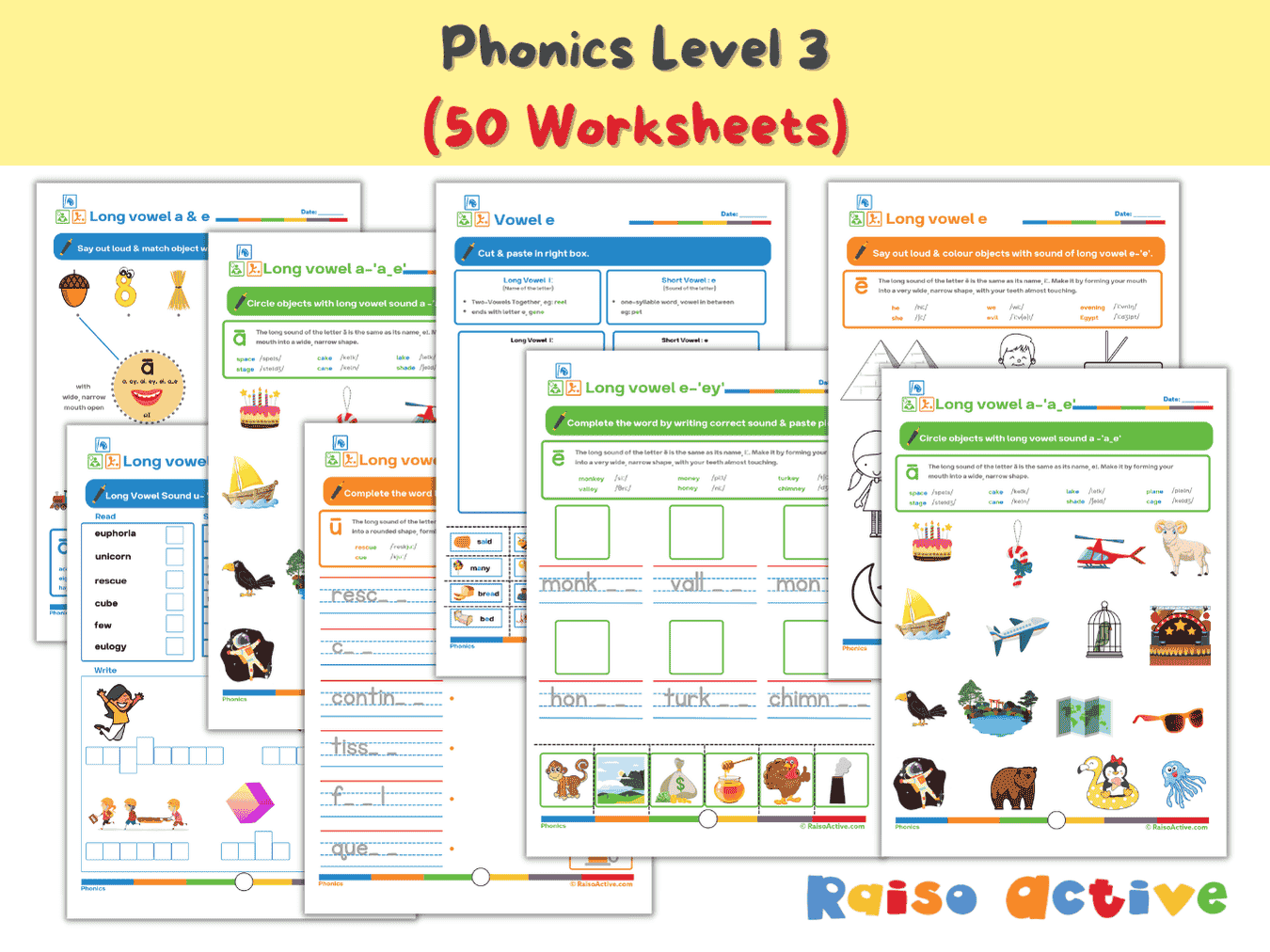
Phonics Level 3 Long Vowels Activity Book for Kindergarten & 1st Grade
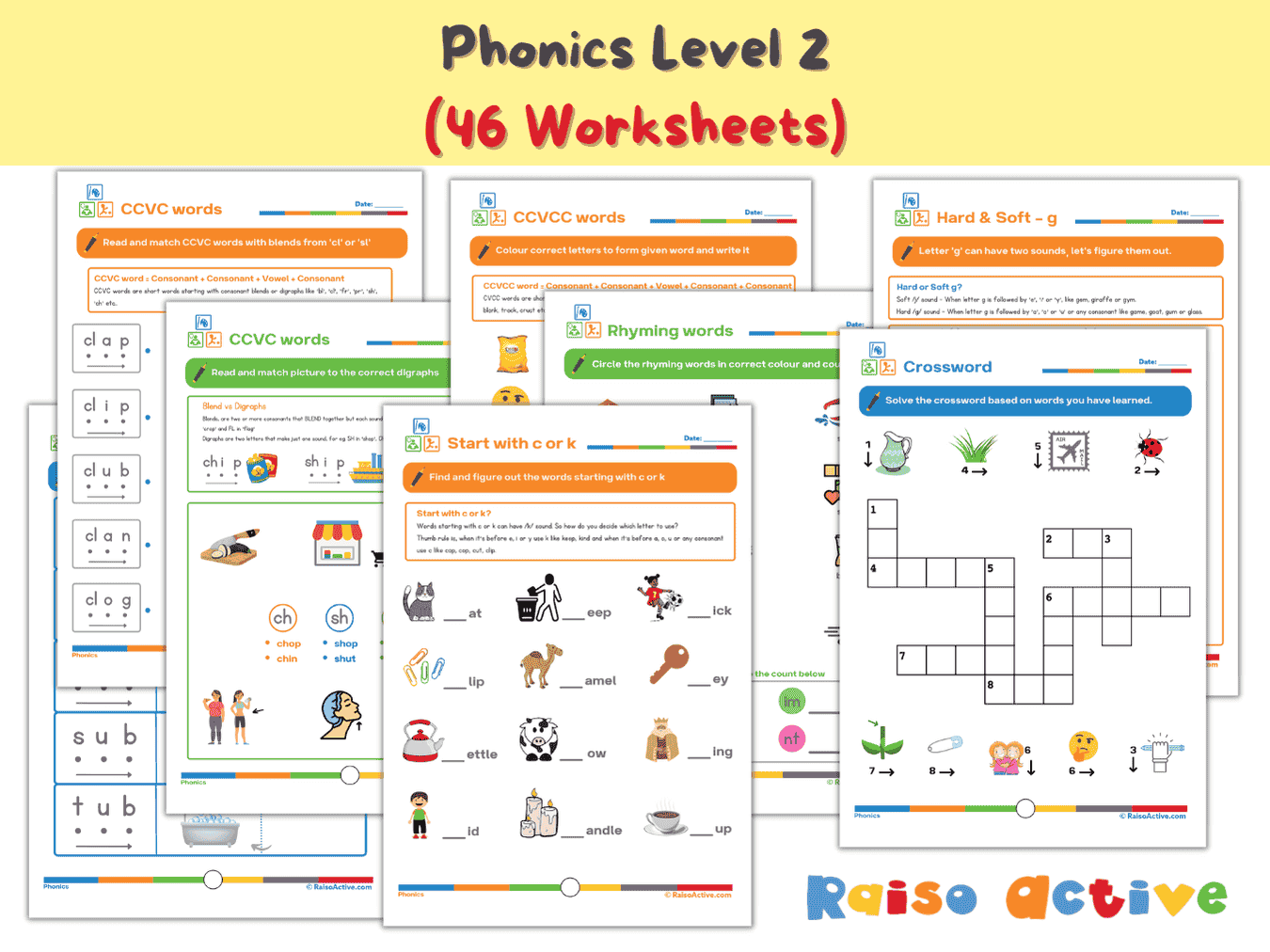
Phonics Level 2 Worksheets: CVC, CCVC, CVCC Word Families & Blends for Early Readers (Ages 4-7)
Guides for parents and teachers
See all guides →Sight Words by Age: The First 50 Words and How to Teach Them Without Flashcard Fatigue
Which sight words to teach first and why, the heart-word method, a read-trace-write-find routine, games, and a by-age table of typical sight-word progress.
How to Teach CVC Blending: A Step-by-Step Method That Works in Two Weeks
A step-by-step method for teaching CVC blending, covering continuous sounds, word families, common errors, and a 14-day plan that most children finish reading CVC words.
Phase 2 Phonics at Home: Sound Order, Blending Games, Worksheets
Phase 2 phonics at home: the five sound sets in order, oral blending, tricky words, a two-week routine, common mistakes, and free worksheets.
Reception Year Explained: EYFS Learning and How to Help at Home
A teacher's plain-English guide to the Reception Year: the seven areas of learning, Early Learning Goals, Phase 2/3 phonics, the RBA and home routines.
UKG Syllabus Explained: English, Maths and EVS Month by Month
What UKG classes typically cover in English, maths and EVS, month by month, aligned to NEP 2020, with ways to support at home and signs your child is behind.
Bridging Two Worlds: A Complete Guide to Teaching Heritage Languages Alongside English
A practical guide to raising bilingual children who speak both their heritage language and English with confidence. Research-backed strategies, activities, and tips for Indian families.