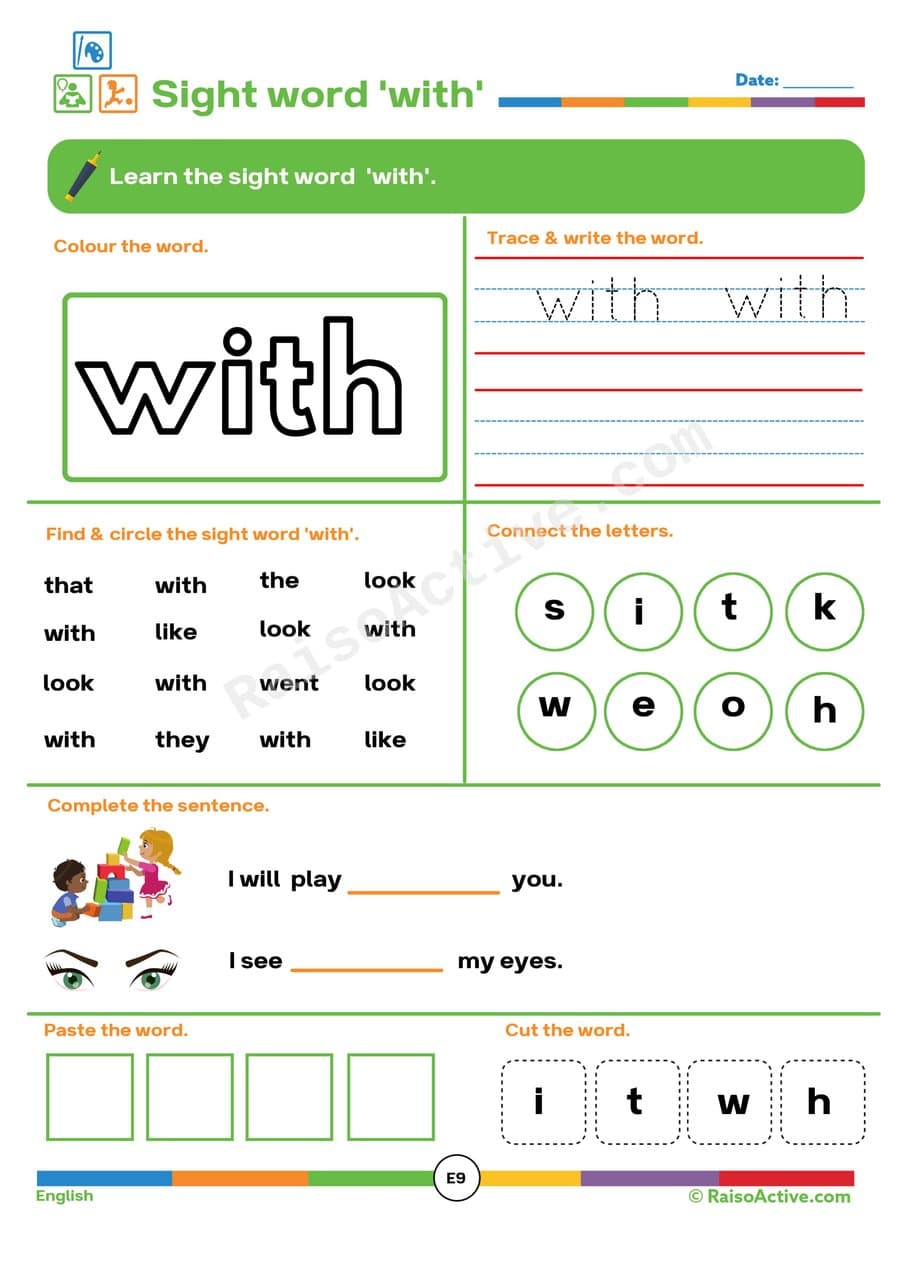
Sight Word 'With' Worksheet: Trace, Write, and Find!
This worksheet gives 4-5 year olds repeated, varied practice with the sight word 'with' — coloring it, tracing and writing it, finding it in a list, completing a sentence, and cutting and pasting it — because sight words like 'with' don't follow simple sound-out rules and need to be recognized instantly by sight rather than decoded each time. That instant recognition is what lets a young reader move smoothly through a sentence instead of stumbling on common connector words.
Part of the pack
Month 5: Play-based English Math Science | Ages 5-6Curriculum
How to use this worksheet
Begin with the coloring step, having your child say 'with' aloud each time they color a letter. Move to tracing and writing, watching that each letter is formed in the correct order — w, i, t, h. Have your child scan a list of similar words to find and circle every instance of 'with.' Finish with the sentence completion, reading the finished sentence together, and the cut-and-paste step, pasting the word into its final spot.
Materials needed
- Pencil
- Crayons
- Scissors
- Glue (optional)
Extension activities
- •Have your child make up their own sentence using the word 'with.'
- •Find the word 'with' in a favorite book and highlight or point to it each time it appears.
- •Practice writing 'with' in a tray of sand or a ball of playdough for a hands-on change of pace.
- •Play a quick word hunt, hiding printed copies of 'with' around a room for your child to find.
- •Read a simple sentence aloud and ask your child to clap when they hear the word 'with.'
Tips for parents and teachers
Have your child say the word 'with' aloud each time they trace or write it, since saying and writing together builds a stronger memory link than silent copying. Multisensory practice, like writing the word in sand, genuinely helps sight-word retention stick better than repeated worksheet tracing alone. Praise their effort at each step, since this word takes multiple exposures before it becomes automatic.

Written by
Hemsweta Jain · Teacher Cheena
MBA and Early Childhood Educator, teaching since 2014 · Founder of RaisoActive, Mumbai
Every RaisoActive worksheet is designed and checked by the founder before publishing.
Published · Last reviewed
Related worksheets
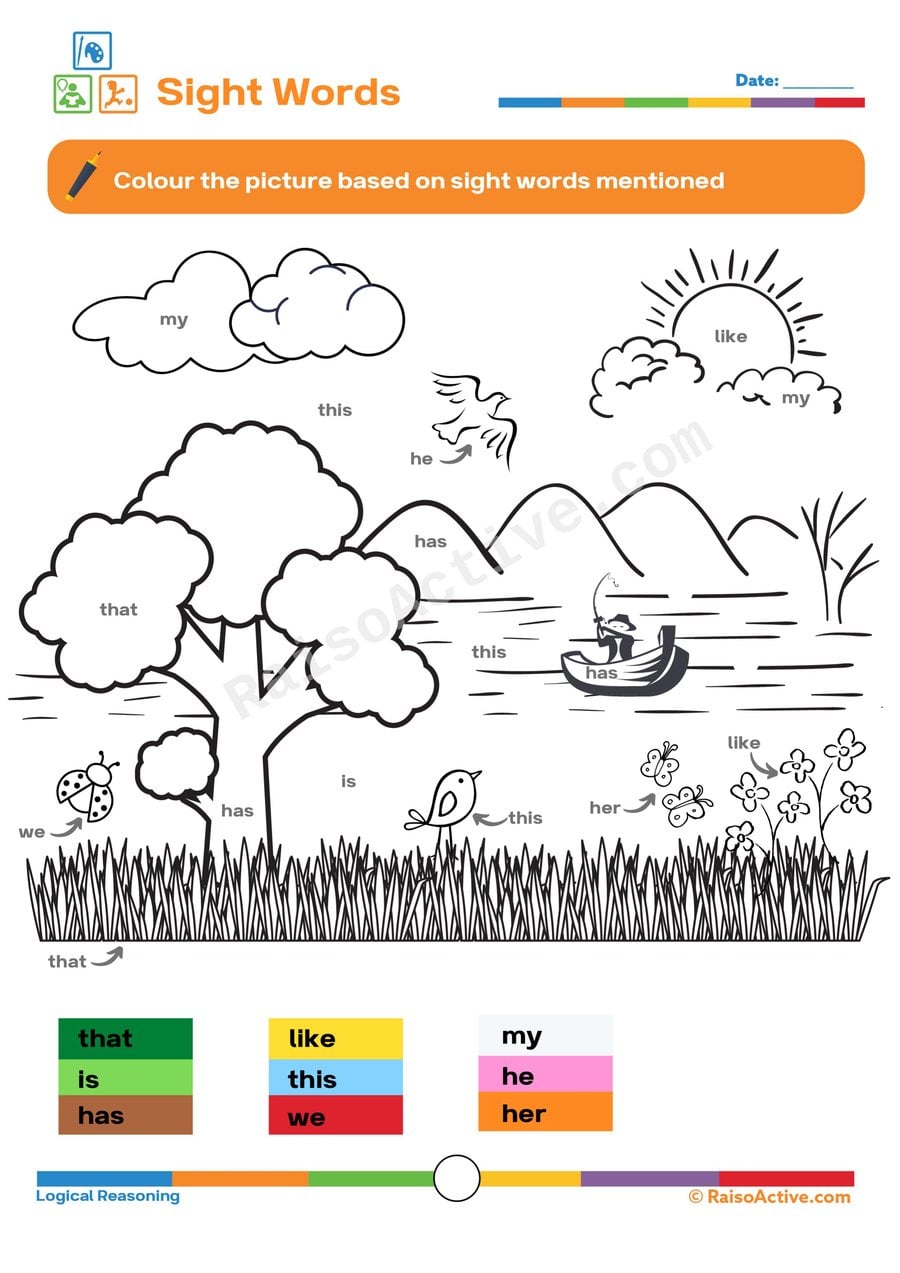
Sight Word Coloring Worksheet for Preschoolers
This worksheet helps children ages 3-5 build sight-word recognition by having them read common high-frequency words and use a color key to decide how to color the corresponding pictures. Connecting a printed word to a coloring decision requires children to actually read and recall the word's meaning, rather than just copying or tracing it, which is a genuine step toward independent reading. The coloring format also keeps the repeated word-reading practice feeling like an art activity rather than a drill.

Sight Words Worksheet: Practice with 'is', 'we', and 'my'
This worksheet challenges children ages 4-6 to choose the correct sight word from a small word bank — 'is,' 'we,' or 'my' — to complete a sentence, rather than simply tracing or copying a single word. Selecting the right word based on sentence meaning requires a deeper level of reading comprehension than earlier single-word practice, since children must understand what each sentence is saying before choosing correctly. Writing the chosen word from memory also builds spelling recall for these common words.

Learn the Sight Word 'My' - Tracing, Writing, and Matching Worksheet
This worksheet builds sight-word fluency for the word 'my' in children ages 3-5 through a combination of tracing, independent writing, fill-in-the-blank sentences, and a matching activity. Working with the same word across several different formats helps cement recognition, since 'my' is a high-frequency word that appears constantly in early reading material but doesn't follow simple phonics patterns. The matching component adds a visual-recognition check to confirm the word sticks even without tracing cues.
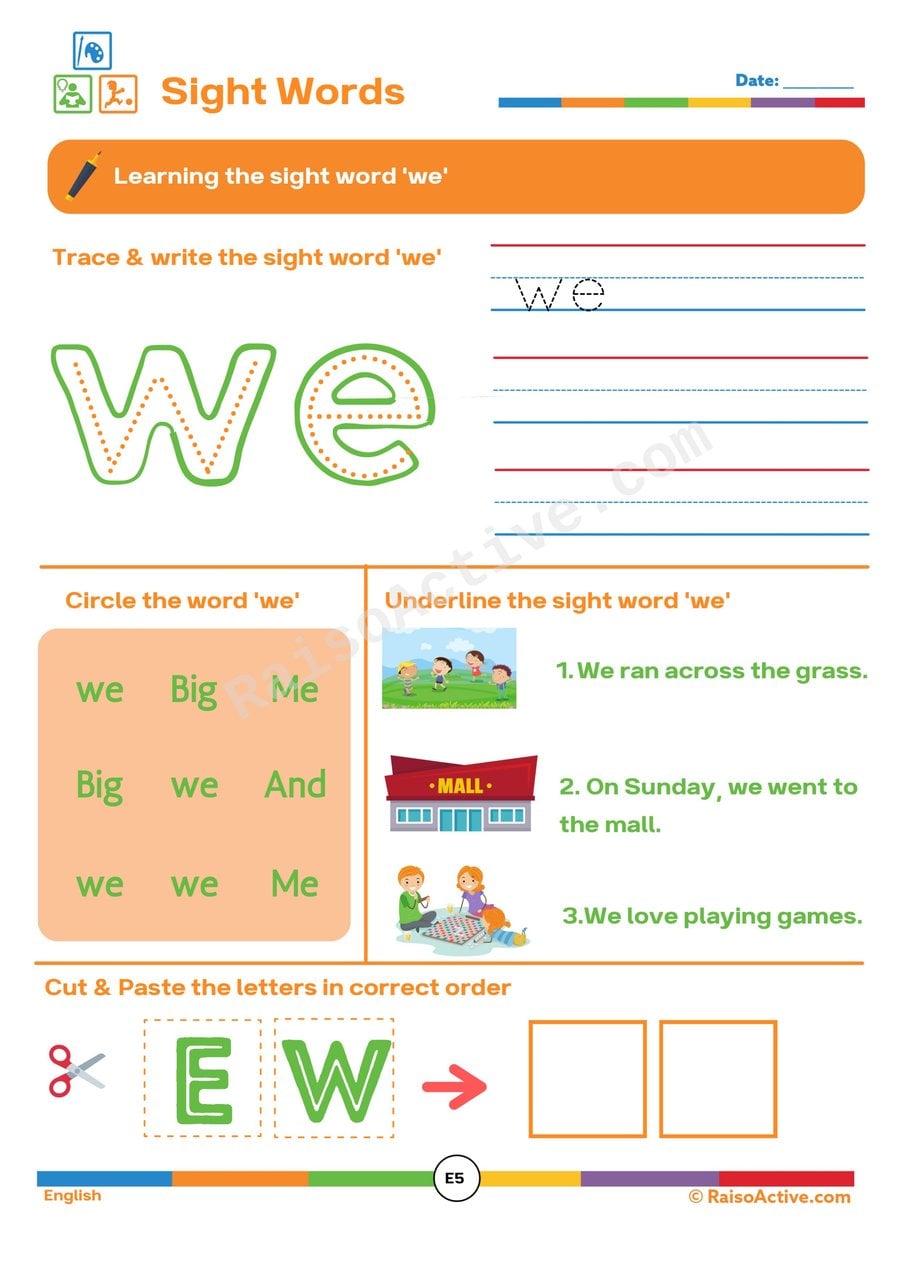
Sight Word 'We' Worksheet: Trace, Write, and Find!
This worksheet builds deep familiarity with the sight word 'we' in children ages 3-5 through four different practice formats — tracing, independent writing, circling, and finding the word within sentences — layered onto a single page. Repeating the same word across so many formats in one sitting is specifically designed to move 'we' from a word your child sounds out each time into one they recognize instantly on sight.

Learn the Sight Word 'Is' - Tracing and Writing Worksheet for Preschoolers
This worksheet helps children ages 4-5 build instant recognition of the sight word 'is' through a layered sequence of tracing, independent writing, sentence fill-in, coloring, and letter-order cut-and-paste practice. Because 'is' can't easily be sounded out using typical phonics rules, repeated multi-format exposure like this is exactly what helps a sight word move into a child's automatic reading vocabulary. Using the word inside real sentence blanks also connects the isolated word to meaningful, functional reading.

Sight Words Coloring Worksheet: 'His', 'My', and 'Her' Fun!
This coloring activity helps children ages 3-5 recognize and internalize the common sight words 'his,' 'my,' and 'her' by following a color-coded key, an approach that builds sight word memory through repeated visual association rather than isolated flashcard drilling. Because sight words like these don't sound out easily using phonics rules, repeated exposure in a fun context like coloring is one of the most effective ways for young children to memorize them. The activity also reinforces fine motor control as children carefully color within the lines of each labeled section.

Color the Sight Words: 'She' and 'He' Worksheet for Preschoolers
This worksheet helps children ages 3-5 build instant sight-word recognition for the common pronouns 'she' and 'he' by having them scan a page and color each word according to a color code. Because sight words like these can't be sounded out easily, repeated visual exposure through an engaging coloring task helps children recognize them instantly by shape, which is essential for early reading fluency. Differentiating between two similar short words also sharpens visual discrimination.

Sight Word Search and Reading Comprehension Worksheet for Preschoolers
This worksheet combines three literacy skills for children ages 4-6 in one activity: reading a short story and spotting sight words within it, answering comprehension questions about what happened, and finding those same sight words hidden in a word search grid. Practicing the same words across reading, comprehension, and search formats gives children multiple angles of exposure that build genuine reading confidence rather than rote memorization.
Guides for this topic
Sight Words by Age: The First 50 Words and How to Teach Them Without Flashcard Fatigue
Which sight words to teach first and why, the heart-word method, a read-trace-write-find routine, games, and a by-age table of typical sight-word progress.
How to Teach CVC Blending: A Step-by-Step Method That Works in Two Weeks
A step-by-step method for teaching CVC blending, covering continuous sounds, word families, common errors, and a 14-day plan that most children finish reading CVC words.
Phase 2 Phonics at Home: Sound Order, Blending Games, Worksheets
Phase 2 phonics at home: the five sound sets in order, oral blending, tricky words, a two-week routine, common mistakes, and free worksheets.
Reviews
Every worksheet for ages 4–5, no watermark
Members download the full library of 1,000+ worksheets and every activity pack without watermarks or daily limits. One year costs ₹1,000 in India or $20 elsewhere.
See membership plansOr download any worksheet free with a watermark (5 a day).