Physical Activity Dice Game Worksheet for Kids
Rolling a die and performing the matching action builds gross motor skills and number recognition together for children ages 3-5, since they must first read the number rolled before they can act on it. Following the sequence of steps also strengthens listening comprehension and the ability to carry out multi-step instructions.
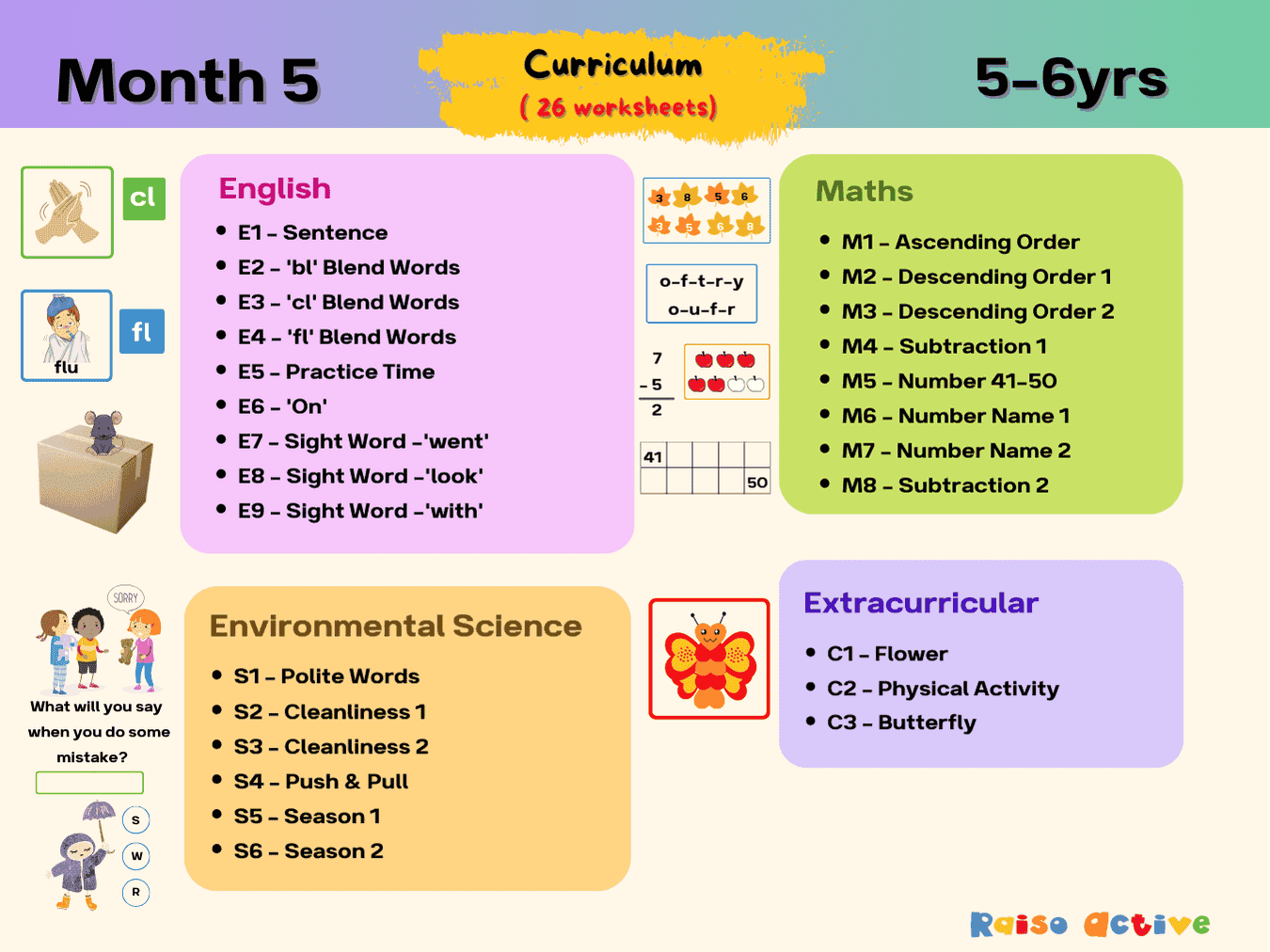
Part of the pack
Month 5: Play-based English Math Science | Ages 5-6
This is page 28 of the pack. Ages 5-6 · KindergartenAges 5-6 · Year 1Ages 5-6 · UKGAges 5-6
Curriculum
- Physical Education > Physical Activity
How to use this worksheet
Explain the list of actions tied to each number before starting, so your child knows what to expect. Take turns rolling the die, and have your child say the number shown out loud before performing the matching movement. Keep playing until every activity on the sheet has been completed at least once, cheering them on after each turn.
Materials needed
- Dice
- Pencil
Extension activities
- 1Create a new dice game together with your own set of silly physical actions.
- 2Invite a sibling or friend to play so your child takes turns and waits patiently.
- 3Have your child draw a picture of their favorite action from the game afterward.
- 4Turn it into a race by seeing how many rounds you can complete in five minutes.
- 5Add music and pause the song each time the die is rolled, like a movement version of musical chairs.

Written by
Hemsweta Jain · Teacher Cheena
MBA and Early Childhood Educator, teaching since 2014 · Founder of RaisoActive, Mumbai
Every RaisoActive worksheet is designed and checked by the founder before publishing.
Published · Last reviewed
More from Month 5: Play-based English Math Science | Ages 5-6
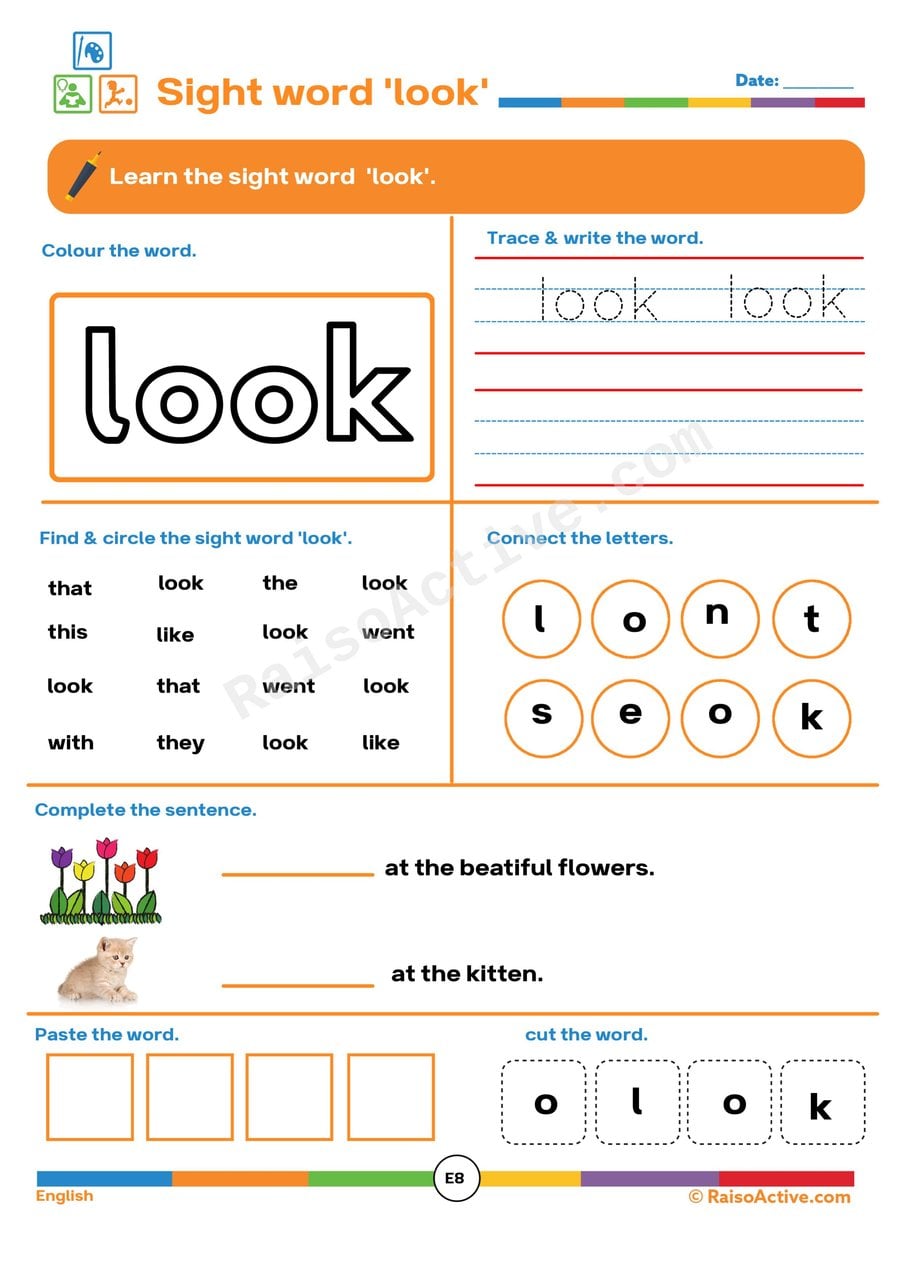
Look! Sight Word 'Look' Worksheet for Preschoolers
Ages 3-5 · Preschool–Pre-KAges 3-5 · Nursery–ReceptionAges 3-5 · Nursery–LKGAges 3-5
This worksheet builds automatic recognition of the sight word 'look' through six different activities — coloring, tracing, finding it in a list, spelling it by connecting letters, completing a sentence, and pasting it — which matters because sight words like 'look' don't sound out easily and have to be memorized by sight through repeated, varied exposure. Hitting the same word from six angles in one sitting is exactly the kind of repetition that turns a word from something your child sounds out slowly into one they recognize instantly.
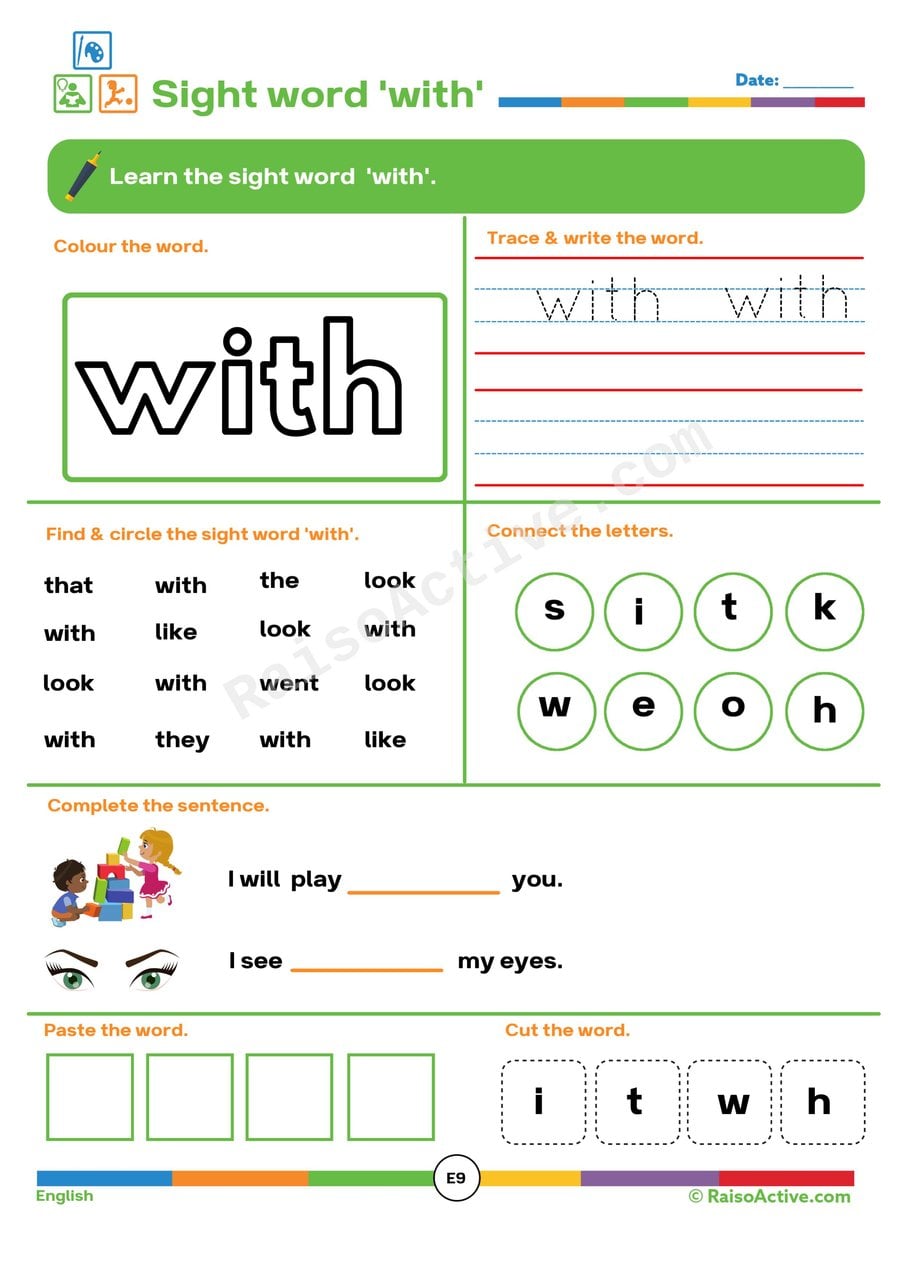
Sight Word 'With' Worksheet: Trace, Write, and Find!
Ages 4-5 · Pre-KAges 4-5 · ReceptionAges 4-5 · LKGAges 4-5
This worksheet gives 4-5 year olds repeated, varied practice with the sight word 'with' — coloring it, tracing and writing it, finding it in a list, completing a sentence, and cutting and pasting it — because sight words like 'with' don't follow simple sound-out rules and need to be recognized instantly by sight rather than decoded each time. That instant recognition is what lets a young reader move smoothly through a sentence instead of stumbling on common connector words.

Seasons Worksheet: Identify and Color the Correct Season!
Ages 3-5 · Preschool–Pre-KAges 3-5 · Nursery–ReceptionAges 3-5 · Nursery–LKGAges 3-5
Identifying which season a picture represents and coloring the matching letter code builds children's ages 3-5 awareness of how weather, clothing, and activities change throughout the year, an early and very relatable science concept. This worksheet asks children to actively classify each picture rather than passively look at seasonal images, sharpening their observational and reasoning skills. Understanding seasons also gives children a framework for talking about holidays, weather, and the passage of time in daily conversation.

Flower Craft: Make 5 Flowers with Pencil Shavings!
Ages 3-5 · Preschool–Pre-KAges 3-5 · Nursery–ReceptionAges 3-5 · Nursery–LKGAges 3-5
This craft activity has 3-5 year olds use actual pencil shavings — an unusual, tactile material — to build five flower shapes, following a multi-step visual example rather than a simple one-step instruction. That combination of following a sequence and precisely placing small, delicate shavings builds fine motor control and pincer grip in a way that's noticeably different from crayons or scissors, plus it introduces the idea of turning a leftover material into art.

Descending Order Snail Puzzle Worksheet for Preschoolers
Ages 3-5 · Preschool–Pre-KAges 3-5 · Nursery–ReceptionAges 3-5 · Nursery–LKGAges 3-5
Arranging cut-out puzzle pieces from the highest number down to the lowest asks children ages 3-5 to apply number order in the reverse direction from typical ascending counting, a genuinely different and more challenging skill than counting up. This descending-order practice deepens overall number sense, since children must compare values rather than just recite a memorized forward sequence. The reveal of a hidden picture once the pieces are correctly ordered adds a rewarding, motivating payoff to an otherwise abstract number task.

Cleanliness Worksheet: Match Body Parts to Cleaning Tools!
Ages 3-5 · Preschool–Pre-KAges 3-5 · Nursery–ReceptionAges 3-5 · Nursery–LKGAges 3-5
This matching worksheet builds hygiene awareness by asking 3-5 year olds to connect specific body parts — teeth, hands, hair — to the correct cleaning tool for each one, like a toothbrush, soap, or shampoo. That pairing goes beyond simply naming hygiene items; it requires your child to reason about which tool actually does the job for which body part, which is the beginning of understanding personal care routines rather than just memorizing object names.

Colorful Butterfly Cut and Paste Worksheet for Preschoolers
Ages 3-5 · Preschool–Pre-KAges 3-5 · Nursery–ReceptionAges 3-5 · Nursery–LKGAges 3-5
Cutting out heart shapes and arranging them into a butterfly gives children ages 3-5 focused practice with scissor control and precise gluing, since the final picture only comes together correctly if each heart is placed in the right spot. Following a visual example to build a specific, recognizable shape also strengthens spatial reasoning, requiring children to compare their work to a model rather than assembling pieces at random. This kind of guided craft bridges basic coloring and more advanced, independent art projects.
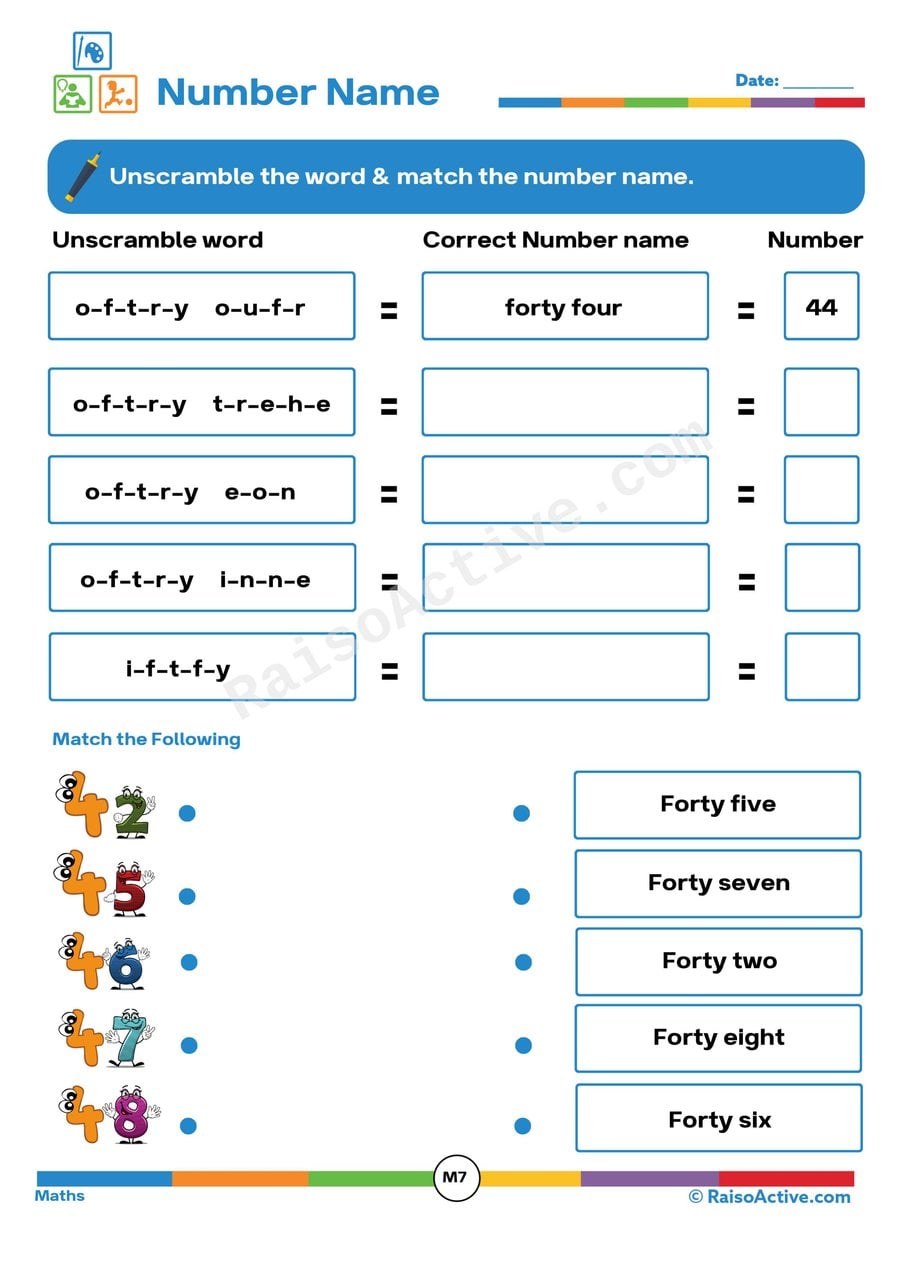
Number Name Matching Worksheet for Preschoolers
Ages 4-6 · Pre-K–KindergartenAges 4-6 · Reception–Year 1Ages 4-6 · LKG–UKGAges 4-6
This worksheet connects three related number skills at once: unscrambling a jumbled word to spell a number name correctly, writing that number name out, and then matching it to its numeral — a layered task that builds both early spelling and number recognition together. Because number-name spelling (like 'seven' or 'eight') doesn't always follow simple sound-out rules, this worksheet gives 4-6 year olds valuable repeated exposure to sight-word-style number vocabulary.
Related worksheets
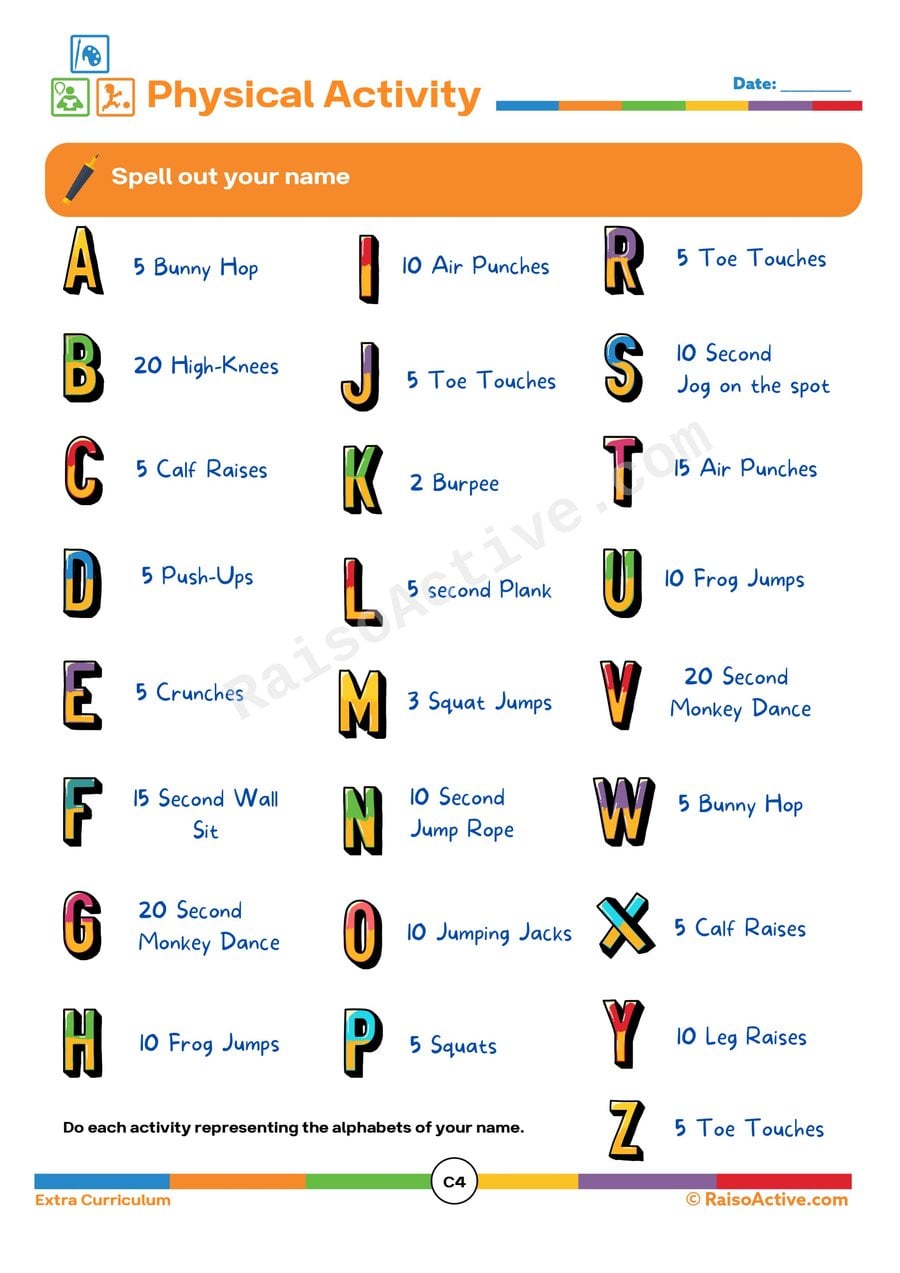
Physical Activity Worksheet: Spell Your Name!
Ages 3-5 · Preschool–Pre-KAges 3-5 · Nursery–ReceptionAges 3-5 · Nursery–LKGAges 3-5
This worksheet turns spelling practice into a physical activity by pairing each letter of the alphabet with a specific exercise, so children spell their name while getting active movement in between. For ages 3-5, connecting letter recognition to gross motor movement supports both early literacy and physical development at once, appealing especially to kinesthetic learners.
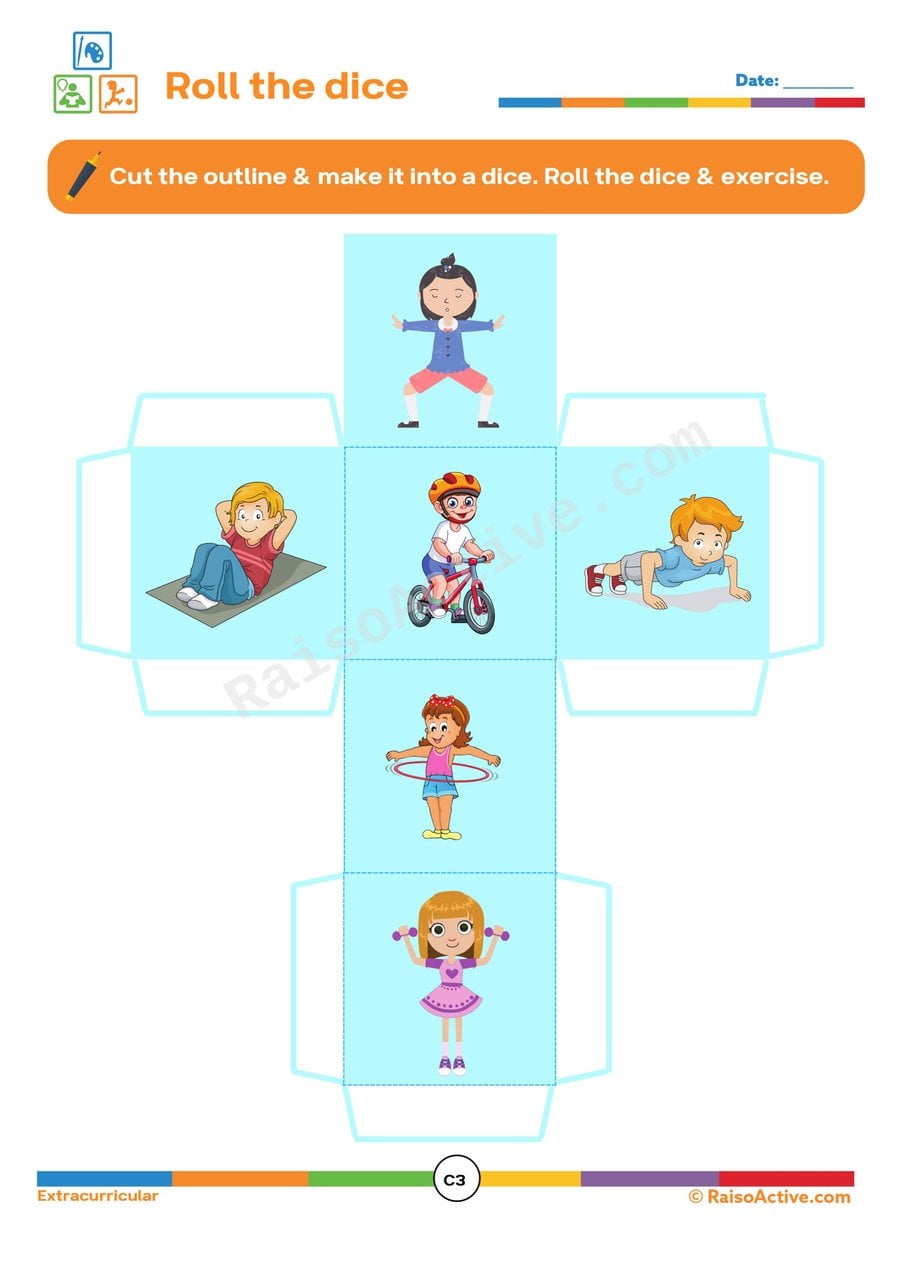
Roll the Dice Exercise Worksheet for Kids
Ages 3-5 · Preschool–Pre-KAges 3-5 · Nursery–ReceptionAges 3-5 · Nursery–LKGAges 3-5
This worksheet gets children ages 3-5 moving as they assemble a paper dice, roll it, and perform whichever physical exercise lands face-up, combining gross motor development with basic probability and turn-taking. Following a picture-based instruction and translating it into a physical action also builds the same instruction-following skill children need for classroom directions.

Caterpillar Activity Worksheet: Follow Instructions and Move!
Ages 3-5 · Preschool–Pre-KAges 3-5 · Nursery–ReceptionAges 3-5 · Nursery–LKGAges 3-5
This worksheet helps children ages 3-5 practice following multi-step instructions while getting active, as they move along a caterpillar's body and perform a different physical action in each circle, such as jumping or spinning. Combining movement with sequential instructions builds gross motor skills, listening comprehension, and the ability to hold a sequence of directions in mind.

Simon Says: Follow the Instructions and Get Moving!
Ages 3-5 · Preschool–Pre-KAges 3-5 · Nursery–ReceptionAges 3-5 · Nursery–LKGAges 3-5
This worksheet turns the classic listening game into a written record, having children track which Simon Says instructions they followed correctly. For three- to five-year-olds, the game builds gross motor skills like jumping, spinning, and balancing, while also strengthening auditory attention — the ability to listen carefully and act only when the right cue ('Simon says') is given.

Roll & Move Activity: Fun Physical Activity Cube for Kids!
Ages 3-5 · Preschool–Pre-KAges 3-5 · Nursery–ReceptionAges 3-5 · Nursery–LKGAges 3-5
This cut-and-fold craft combines fine motor skills with gross motor movement, as children build a paper cube featuring different physical actions and then roll it to determine which activity to perform. For ages 3-5, following multi-step folding and gluing instructions builds spatial reasoning and sequencing, while the resulting game encourages active movement and following simple rules.

Physical Activity Worksheet for Kids: Identify and Tick!
Ages 4-6 · Pre-K–KindergartenAges 4-6 · Reception–Year 1Ages 4-6 · LKG–UKGAges 4-6
This identify-and-tick worksheet asks children ages 4-6 to sort a row of pictures into 'physical activity' and 'everyday chore' categories, building the classification skills that underlie early scientific thinking. Ticking the correct boxes also reinforces visual discrimination, since children must notice differences in body position and action between, say, jumping and sweeping. At this age, connecting movement with fun helps children start to associate exercise with enjoyment rather than obligation.
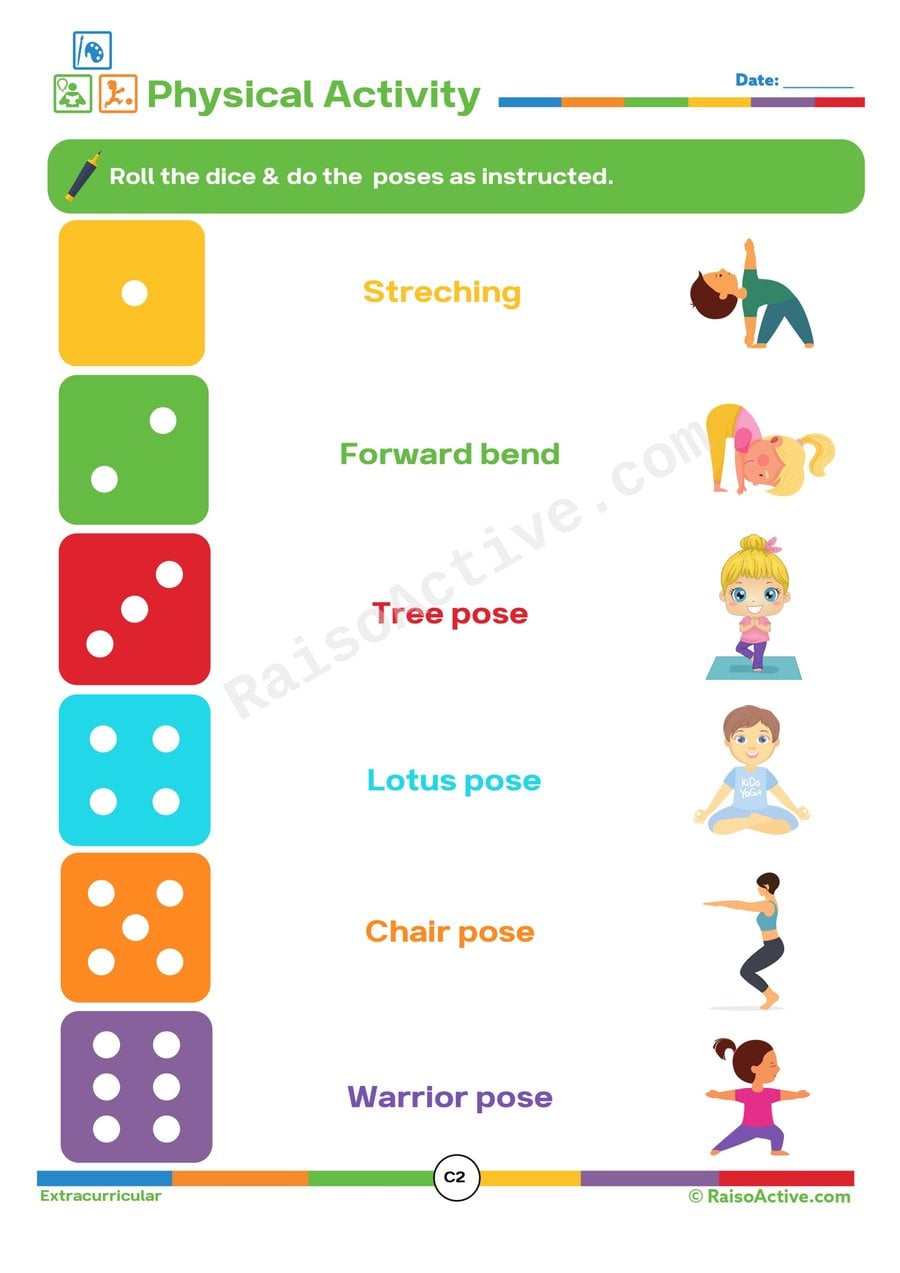
Physical Activity Dice Game: Yoga Poses for Kids!
Ages 3-5 · Preschool–Pre-KAges 3-5 · Nursery–ReceptionAges 3-5 · Nursery–LKGAges 3-5
Rolling a dice and matching the number to a yoga pose introduces children ages 3-5 to basic gross motor movement and body control in a playful, game-based format, while also reinforcing number recognition through the dice roll itself. Practicing simple yoga poses like this builds balance, body awareness, and an early habit of calm, mindful movement.
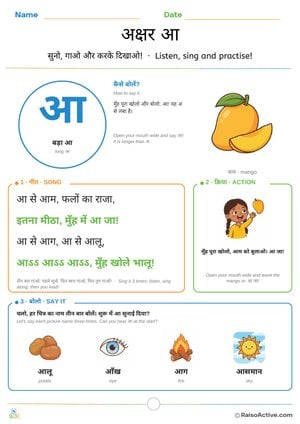
Hindi Letter आ (aa) Song, Action and Say It | अक्षर आ
Ages 3-7 · Preschool–Grade 1Ages 3-7 · Nursery–Year 2Ages 3-7 · Nursery–Class 1Ages 3-7
Children hear and say the long vowel आ, learn a short rhyme with an action, and say the names of the picture words आम (mango), आलू (potato), आँख (eye), आग (fire), आसमान (sky) to practise hearing आ at the start.
Guides for this topic

Learning Activities That Work: A Comprehensive Guide for Children with ADHD
Discover hands-on, movement-based learning activities that genuinely work for children with ADHD. Practical tips for Indian parents and educators, ages 1-8.
Beyond Worksheets: Engaging Alternatives for Your 5-Year-Old Who Refuses Paper-and-Pencil Activities
Discover practical, research-backed alternatives when your 5-year-old refuses worksheets. Hands-on activities, sensory play, and movement-based learning that build the same skills.
Help! My Child Won't Sit Still for Learning Activities — A Parent's Complete Guide
Is your child unable to sit still for learning? Discover the developmental science behind why movement IS learning, plus practical strategies for active kids aged 1–8.
Reviews
Every worksheet for ages 3–5, no watermark
Members download the full library of 1,000+ worksheets and every activity pack without watermarks or daily limits. One year costs ₹999 in India or $20 elsewhere.
See membership plansOr download any worksheet free with a watermark (5 a day).