Free printable worksheets · US · UK · India
Grade 1 / Class 1 Worksheets (Ages 6–7)
Grade 1 worksheets, called Class 1 in India and Year 2 in the UK, are practice sheets for children aged 6 to 7 in the first year of primary school. They cover place value with tens and ones, addition and subtraction within 20, reading short passages with comprehension questions, sentence writing, sight words, and telling time and counting money.
Grade 1 is where practice changes shape. A six-year-old can now work through a full page alone, read the instructions, and check an answer, so the sheets on this page look different from kindergarten sheets: more problems per page, short passages followed by questions, and spiral reviews that mix last month's skill with this week's. Whether your child is in 1st Grade, Class 1 under CBSE or ICSE, or Year 2, the core is the same: understanding that 14 is one ten and four ones, adding and subtracting within 20 with strategies rather than fingers, reading a decodable passage fluently, and writing a sentence that starts with a capital and ends with a period. Teachers use these for morning work, centers and homework.
- 460 worksheets
- Free PDF download
- Print on A4 or Letter
Made for your child
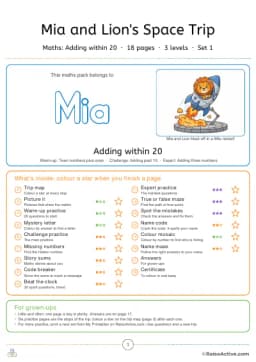
Adding within 20, made for your child
A maths pack with your child's name in it: pictures that explain, practice at three levels, puzzles and story sums about them. Print a new set whenever they finish.
Make a maths packFree preview · free for members
Grade 1 / Class 1 Worksheets to print
Browse all worksheets for ages 6–7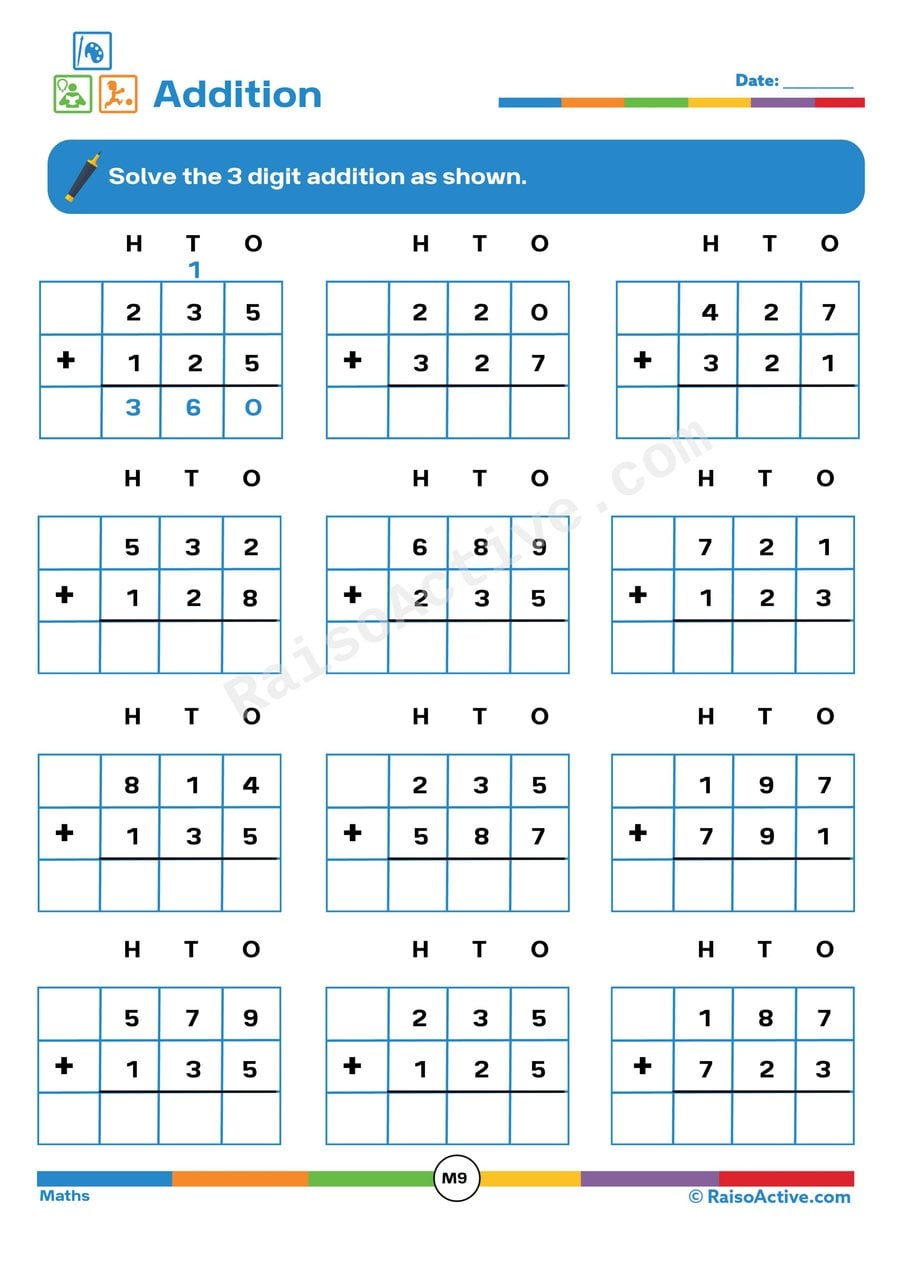
3-Digit Addition Worksheet for Kids
Ages 6-8 · Grade 1–Grade 2Ages 6-8 · Year 2–Year 3Ages 6-8 · Class 1–Class 2Ages 6-8
Adding two three-digit numbers requires children to work through the ones, tens, and hundreds columns in order and understand how a sum in one column can carry over into the next, a significant step up from single-digit addition. For ages six to eight, mastering this column-based process builds the procedural fluency needed for all future multi-digit arithmetic.

Personal Pronouns Worksheet for Kids: Circle and Underline!
Ages 5-7 · Kindergarten–Grade 1Ages 5-7 · Year 1–Year 2Ages 5-7 · UKG–Class 1Ages 5-7
Circling the subject pronoun and underlining the object pronoun in each sentence teaches children ages 5-7 to recognize that pronouns play different grammatical roles depending on their position in a sentence, an important step toward more advanced grammar understanding. This careful, close-reading task also builds attention to sentence structure that supports stronger writing later on.

Long Vowel a 'ey' Complete the Word and Match Worksheet
Ages 5-7 · Kindergarten–Grade 1Ages 5-7 · Year 1–Year 2Ages 5-7 · UKG–Class 1Ages 5-7
Children finish six long a words by writing the 'ey' letters (prey, they, hey, obey, grey and survey) and match each word to its picture.
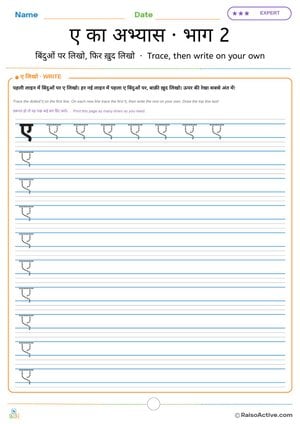
Hindi Letter ए (e) Practice 2: Trace, then Write on Your Own | ए का अभ्यास · भाग 2
Ages 5-7 · Kindergarten–Grade 1Ages 5-7 · Year 1–Year 2Ages 5-7 · UKG–Class 1Ages 5-7
An expert page for confident writers: trace the dotted ए on the first line, then on each new line trace the first ए and write the rest on your own, adding the top line last.

Long or Short Vowel i Picture Match Worksheet
Ages 5-7 · Kindergarten–Grade 1Ages 5-7 · Year 1–Year 2Ages 5-7 · UKG–Class 1Ages 5-7
Children hear the difference between long i (says its name, as in kite) and short i (as in pit). Long: spider, sky, kite. Short: sit, milk, pig, fish, zip.

Long Vowel i and o Say and Match Worksheet
Ages 5-7 · Kindergarten–Grade 1Ages 5-7 · Year 1–Year 2Ages 5-7 · UKG–Class 1Ages 5-7
Children hear and say the long i and long o sounds and match each picture to the right sound circle (long i: sky, pie, kite, spider, ice and night; long o: open, bone, cone, boat, dough and sow).

Long Vowel e 'ea' Circle and Write Worksheet
Ages 5-7 · Kindergarten–Grade 1Ages 5-7 · Year 1–Year 2Ages 5-7 · UKG–Class 1Ages 5-7
Children spot the long e 'ea' word in each row of three pictures, then spell it: eat, sea, tea, leaf, bean and jeans.

Long Vowel i 'igh' Circle and Write Worksheet
Ages 5-7 · Kindergarten–Grade 1Ages 5-7 · Year 1–Year 2Ages 5-7 · UKG–Class 1Ages 5-7
Children spot the long i 'igh' word in each row of three pictures, then spell it: high, sigh, flight, light, night and knight.

Long Vowel a 'ei' Complete the Word and Paste Worksheet
Ages 5-7 · Kindergarten–Grade 1Ages 5-7 · Year 1–Year 2Ages 5-7 · UKG–Class 1Ages 5-7
Children write the missing 'ei' letters to finish six long a words (eight, reindeer, weight, veil, sleigh and neigh) and paste the matching picture above each word.

Long Vowel u 'ue' Complete the Word and Match Worksheet
Ages 5-7 · Kindergarten–Grade 1Ages 5-7 · Year 1–Year 2Ages 5-7 · UKG–Class 1Ages 5-7
Children finish six long u words by writing the 'ue' letters (rescue, statue, barbecue, tissue, fuel and queue) and match each word to its picture.

Long Vowel i 'y' Complete the Word and Match Worksheet
Ages 5-7 · Kindergarten–Grade 1Ages 5-7 · Year 1–Year 2Ages 5-7 · UKG–Class 1Ages 5-7
Children finish six long i words by writing the 'y' letters (cry, dry, fry, fly, shy and spy) and match each word to its picture.

Punctuation Adventure: End Punctuation Worksheet for Kids
Ages 5-7 · Kindergarten–Grade 1Ages 5-7 · Year 1–Year 2Ages 5-7 · UKG–Class 1Ages 5-7
Children ages 5-7 practice choosing between periods, question marks, and exclamation points based on the meaning and tone of a sentence, a skill that connects punctuation directly to how a sentence should sound when read aloud. This builds the foundation for expressive, correctly punctuated writing later in school.
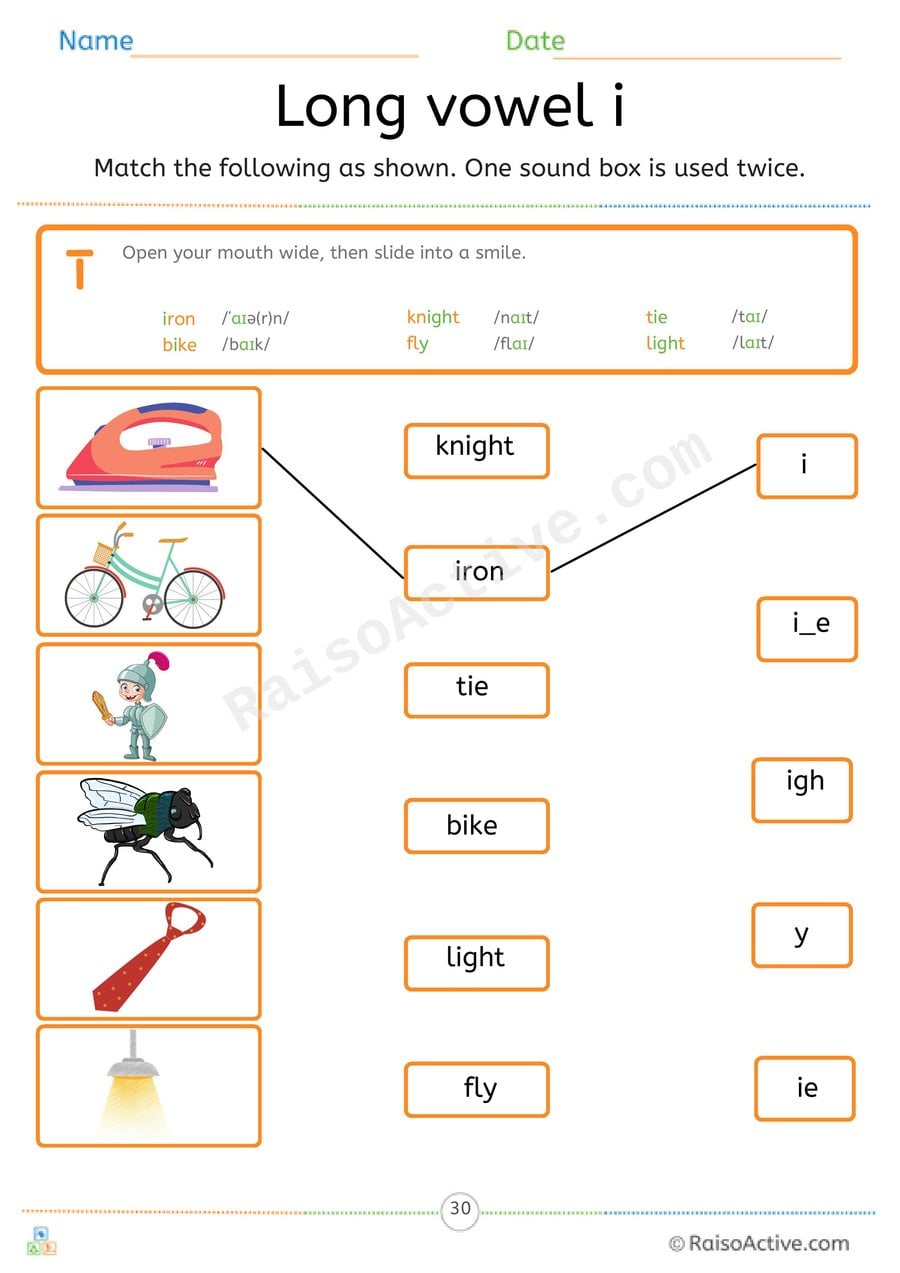
Long Vowel i Spellings Match Worksheet: i, i_e, igh, y, ie
Ages 5-7 · Kindergarten–Grade 1Ages 5-7 · Year 1–Year 2Ages 5-7 · UKG–Class 1Ages 5-7
Children link each picture to its word and then to its long i spelling (iron: i; bike: i_e; knight: igh; fly: y; tie: ie; light: igh). One spelling, igh, is used twice.
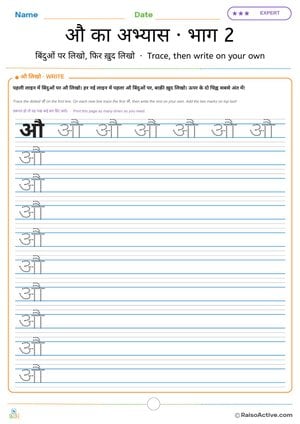
Hindi Letter औ (au) Practice 2: Trace, then Write on Your Own | औ का अभ्यास · भाग 2
Ages 5-7 · Kindergarten–Grade 1Ages 5-7 · Year 1–Year 2Ages 5-7 · UKG–Class 1Ages 5-7
An expert page for confident writers: trace the dotted औ on the first line, then on each new line trace the first औ and write the rest on your own, adding the two marks on top last.

Navaratri Dance Count: A Fun Counting Worksheet for Kids!
Ages 4-8 · Pre-K–Grade 2Ages 4-8 · Reception–Year 3Ages 4-8 · LKG–Class 2Ages 4-8
Children learn that Navratri honours Goddess Durga and that people dance garba and dandiya for nine nights, then count matching dance poses.

Long Vowel u Say and Match Worksheet
Ages 5-7 · Kindergarten–Grade 1Ages 5-7 · Year 1–Year 2Ages 5-7 · UKG–Class 1Ages 5-7
Children hear and say the long u sound and match each picture to the right sound circle (long u: music, ukulele, rescue, menu, unicorn, cube and dew). The apple does not have the long u sound.
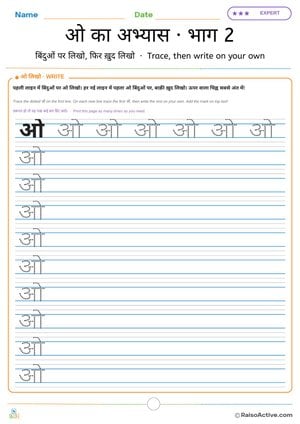
Hindi Letter ओ (o) Practice 2: Trace, then Write on Your Own | ओ का अभ्यास · भाग 2
Ages 5-7 · Kindergarten–Grade 1Ages 5-7 · Year 1–Year 2Ages 5-7 · UKG–Class 1Ages 5-7
An expert page for confident writers: trace the dotted ओ on the first line, then on each new line trace the first ओ and write the rest on your own, adding the mark on top last.
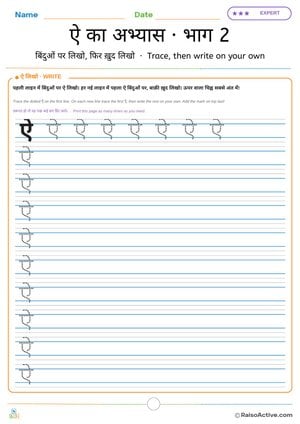
Hindi Letter ऐ (ai) Practice 2: Trace, then Write on Your Own | ऐ का अभ्यास · भाग 2
Ages 5-7 · Kindergarten–Grade 1Ages 5-7 · Year 1–Year 2Ages 5-7 · UKG–Class 1Ages 5-7
An expert page for confident writers: trace the dotted ऐ on the first line, then on each new line trace the first ऐ and write the rest on your own, adding the mark on top last.

Long Vowel i 'ie' Complete the Word and Paste Worksheet
Ages 5-7 · Kindergarten–Grade 1Ages 5-7 · Year 1–Year 2Ages 5-7 · UKG–Class 1Ages 5-7
Children write the missing 'ie' letters to finish six long i words (cried, pie, tried, fried, tie and lie) and paste the matching picture above each word.

Autumn Words and Rhymes: Rhyming, Syllables and Sentence Writing Worksheet
Ages 4-8 · Pre-K–Grade 2Ages 4-8 · Reception–Year 3Ages 4-8 · LKG–Class 2Ages 4-8
Children hear rhymes, split words into syllables by clapping and write a sentence using new autumn words.
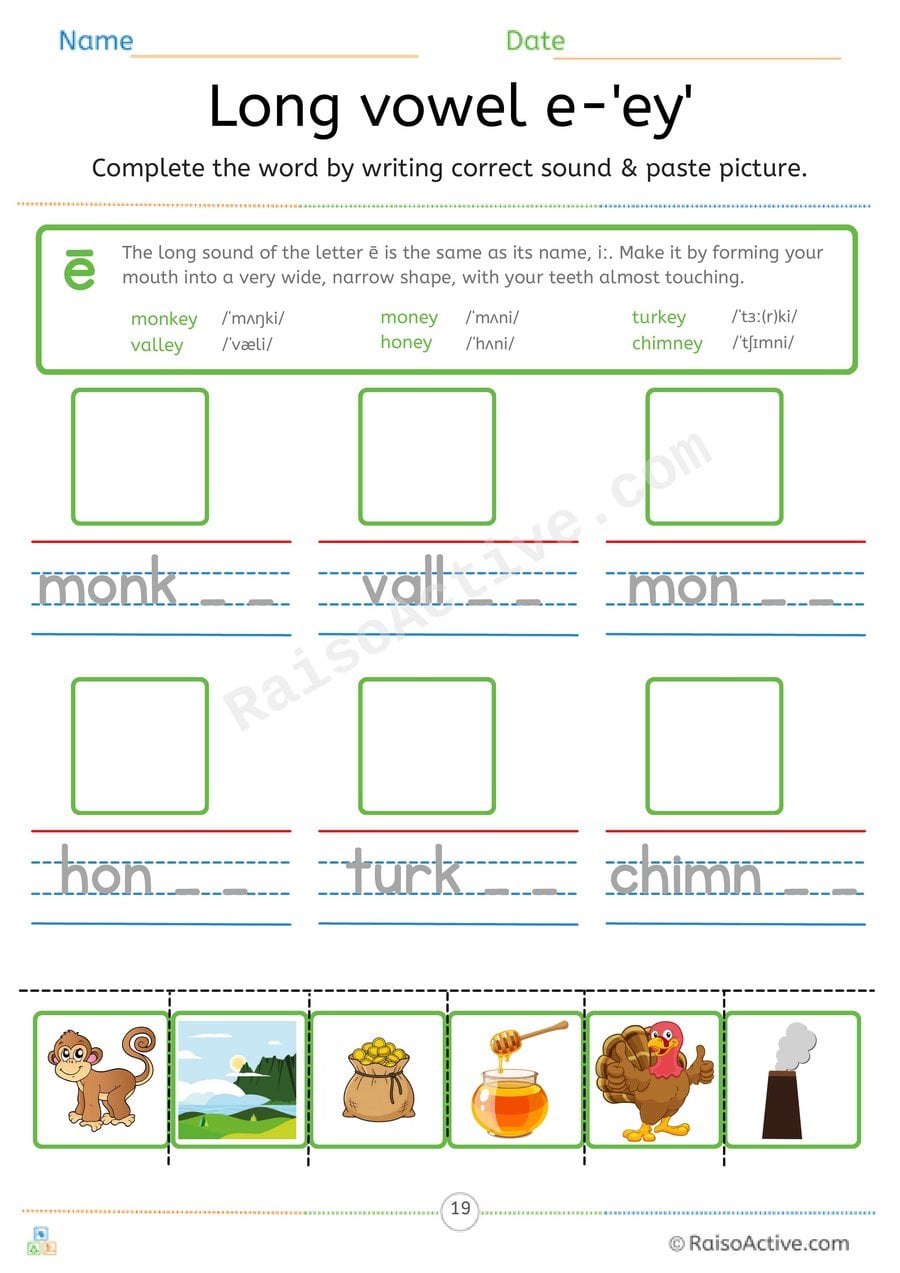
Long Vowel e 'ey' Complete the Word and Paste Worksheet
Ages 5-7 · Kindergarten–Grade 1Ages 5-7 · Year 1–Year 2Ages 5-7 · UKG–Class 1Ages 5-7
Children write the missing 'ey' letters to finish six long e words (monkey, valley, money, honey, turkey and chimney) and paste the matching picture above each word.
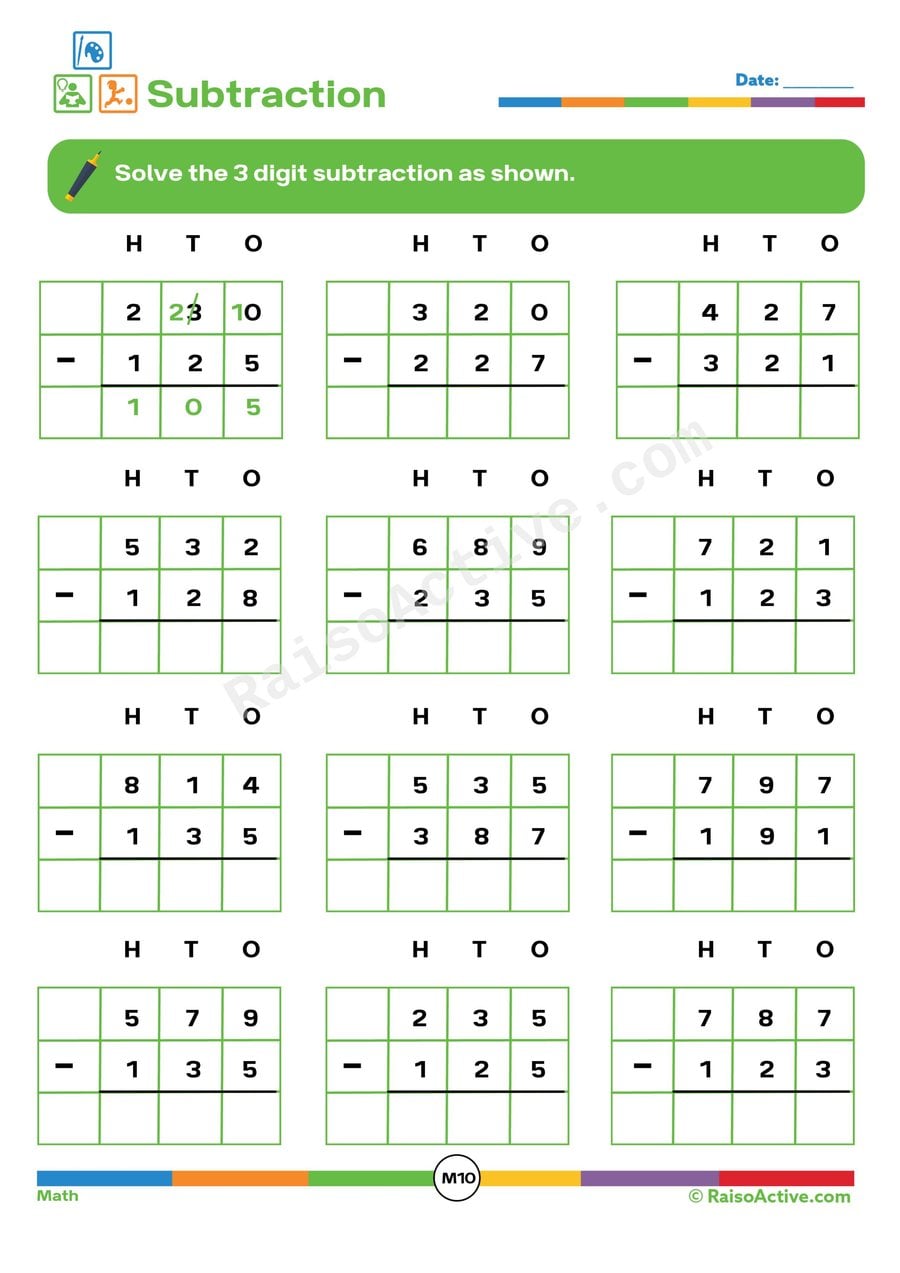
3-Digit Subtraction Worksheet for Kids
Ages 5-7 · Kindergarten–Grade 1Ages 5-7 · Year 1–Year 2Ages 5-7 · UKG–Class 1Ages 5-7
Subtracting three-digit numbers introduces children to borrowing, or regrouping, across place value columns, a more demanding skill than simple subtraction since it requires understanding that a ten can be 'broken' into ones when a column doesn't have enough to subtract from. For ages five to seven, this worksheet builds the procedural foundation for confident multi-digit subtraction going forward.
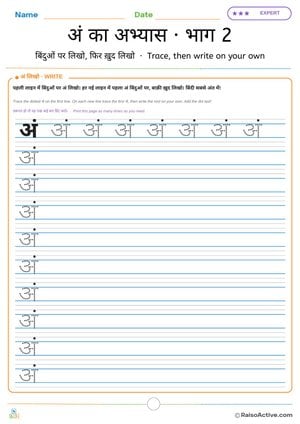
Hindi Letter अं (am) Practice 2: Trace, then Write on Your Own | अं का अभ्यास · भाग 2
Ages 5-7 · Kindergarten–Grade 1Ages 5-7 · Year 1–Year 2Ages 5-7 · UKG–Class 1Ages 5-7
An expert page for confident writers: trace the dotted अं on the first line, then on each new line trace the first अं and write the rest on your own, adding the dot last.

Festivals of Many Faiths: Places of Worship and Greetings
Ages 4-8 · Pre-K–Grade 2Ages 4-8 · Reception–Year 3Ages 4-8 · LKG–Class 2Ages 4-8
Children learn that India is home to many faiths, each with its own festivals, places of worship and festival greetings.
What your child learns in Grade 1
Across the year a first grader moves from counting to calculating. They learn that two-digit numbers are made of tens and ones, add and subtract within 20 using doubles, making ten and counting on, compare numbers with greater-than and less-than signs, read the time to the hour and half hour, and count coins. In reading they decode words with blends, digraphs and long vowels and answer who, what, where and why questions about a passage.
- Math: place value tens and ones, addition and subtraction within 20, comparing numbers, time to the half hour, money, 2D and 3D shapes
- Reading: decodable passages, comprehension questions, 100+ sight words, blends and digraphs, long vowel patterns
- Writing: complete sentences with capitals and end punctuation, short narratives, spelling of common words
- Review: spiral review pages that revisit earlier skills so nothing is forgotten
How to use Grade 1 worksheets at home and in class
At home, one math sheet and one reading sheet on alternate days, about 20 minutes, keeps skills moving without turning evenings into school. Let your child read the directions aloud before starting; that alone is reading practice. Check the work together and have them explain one answer, because explaining a strategy is where place value understanding actually forms.
In the classroom these sheets suit morning work, math centers, early finishers and homework folders. Grid drills work well as timed warm-ups; passage-response sheets fit guided reading groups; spiral reviews make a solid Friday assessment. Print on Letter or A4 without scaling so number lines and grids stay accurate.
Common difficulties in Grade 1 and what helps
The most common sticking points are subtraction within 20 (children who add confidently often count backwards on fingers), reading fluency that is accurate but slow, and sentences that run on without punctuation. Short daily grid drills build subtraction fact recall; rereading the same decodable passage three times over a week builds fluency; and a checklist of capital, spaces, period fixes most sentence problems within a month.
Frequently asked questions
What should a child know by the end of Grade 1 or Class 1?
By the end of Grade 1 a child is expected to add and subtract within 20, with fluency within 10, understand tens and ones in numbers to 100 (to 99 in most Indian Class 1 syllabi), tell time to the half hour, read grade-level decodable text with understanding, know a large bank of sight words, and write several related sentences with capitals and end punctuation. Common Core, CBSE and the KS1 curriculum all describe outcomes close to these.
Is Grade 1 the same as Class 1 and Year 2?
Broadly yes. Grade 1 in the US, Class 1 in India and Year 2 in the UK all serve children aged six to seven, and the skills overlap heavily: place value, addition and subtraction within 20, early reading comprehension and sentence writing. Year 2 children in the UK started formal school a year earlier, so their phonics may be more advanced, while Class 1 in India often adds Hindi or a regional language.
What math is taught in Grade 1?
Grade 1 math, in the Common Core domains 1.OA, 1.NBT, 1.MD and 1.G, covers addition and subtraction within 20, word problems, place value to 100, comparing two-digit numbers, adding a two-digit and a one-digit number, measuring length with units, telling time to the hour and half hour, and reasoning about shapes. CBSE Class 1 mathematics covers a very similar list with numbers to 99 and simple money problems.
How much homework should a first grader have?
A common guideline is about ten minutes per grade level, so around ten to twenty minutes a night for Grade 1, plus reading aloud. One worksheet, or one math and one reading sheet on alternate days, fits that comfortably. More than that tends to reduce willingness rather than increase learning at age six.
What reading level should a Grade 1 child be at?
By the end of first grade most children read short texts with one-syllable words, blends, digraphs and common long-vowel patterns, plus a bank of sight words, at a steady pace with some expression. They should answer literal questions about a passage and retell the main events in order. Decodable passages with response questions are the most reliable way to practice both parts.
Are the Grade 1 worksheets free to print?
Yes. Each sheet downloads as a watermarked PDF free after creating an account, up to five a day. An annual subscription (about $20 or ₹1000) removes the watermark and the daily limit for the full library, which is the usual choice for teachers printing class sets and for parents in India following the Class 1 syllabus through the year.

Written by
Hemsweta Jain · Teacher Cheena
MBA and Early Childhood Educator, teaching since 2014 · Founder of RaisoActive, Mumbai
Written and reviewed by Hemsweta Jain (Teacher Cheena), who designs every RaisoActive worksheet.
Last reviewed
Printable packs for ages 6–7
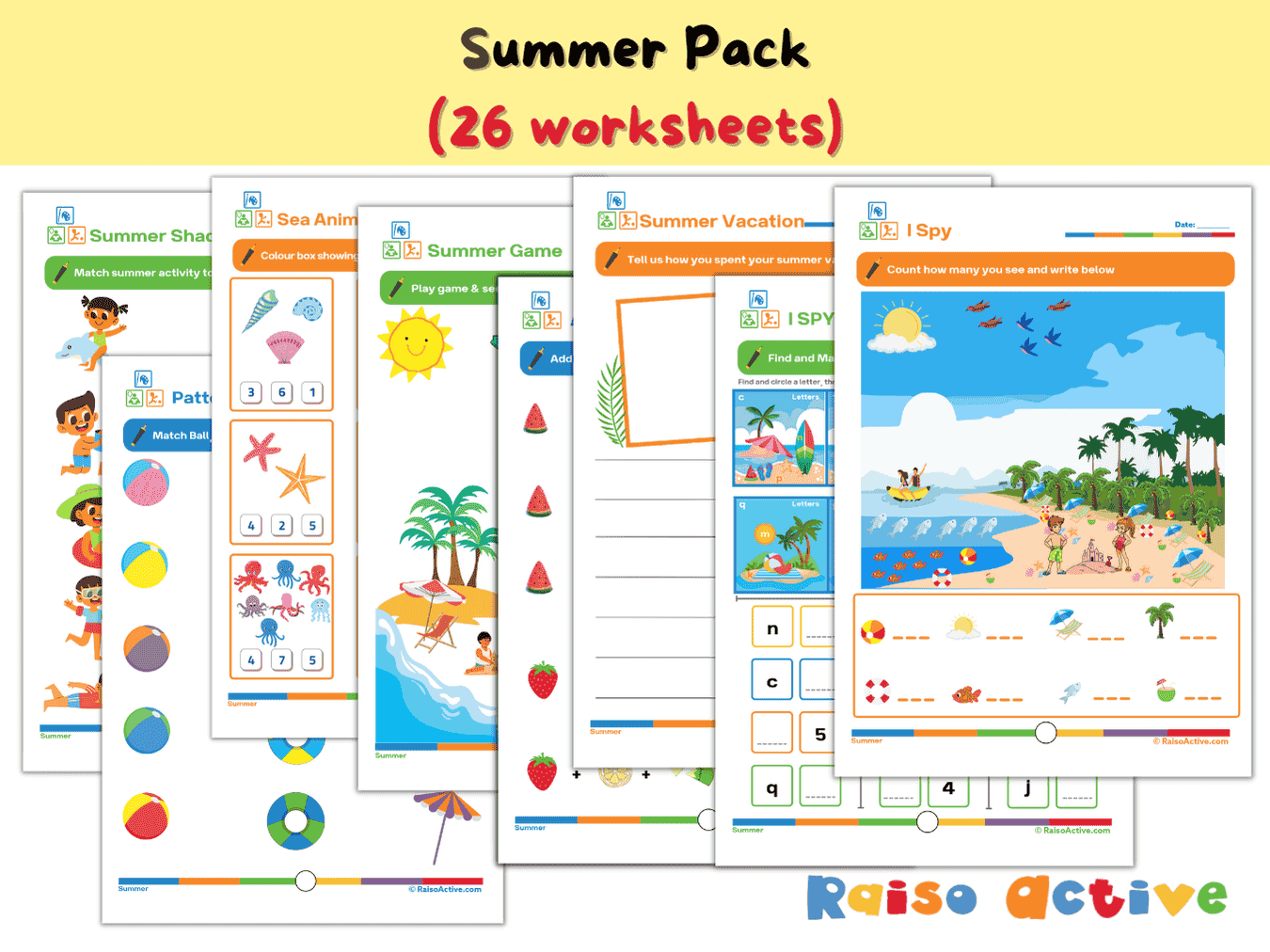

Summer Activity Pack: Math, Literacy, Puzzles & More for Preschool & Kindergarten
Ages 3-7 · Preschool–Grade 1Ages 3-7 · Nursery–Year 2Ages 3-7 · Nursery–Class 1Ages 3-7 · 26 pages
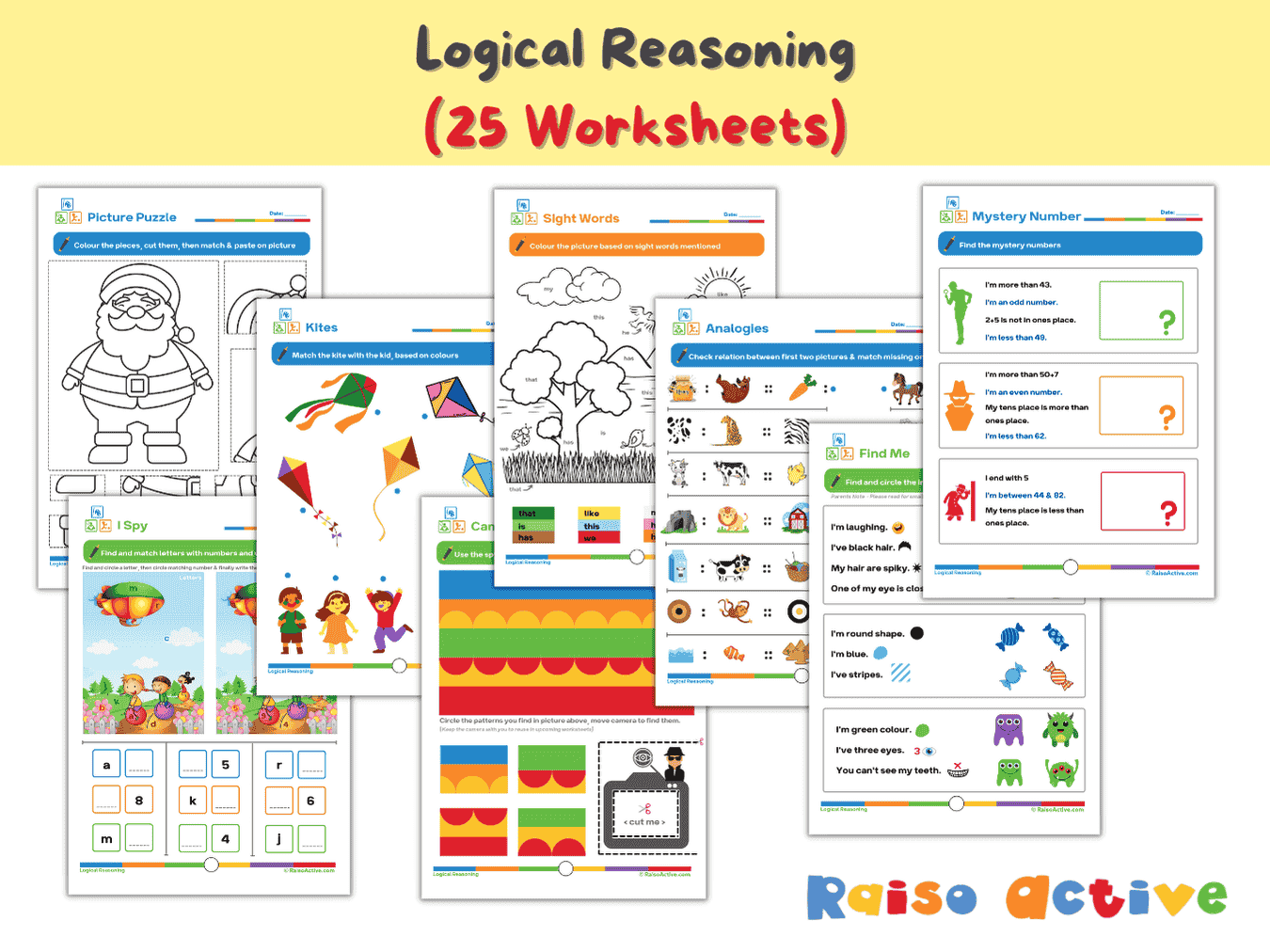

Logical Reasoning Activity Book for Preschool & Kindergarten | Patterns, Sudoku, Mazes & Coding
Ages 4-7 · Pre-K–Grade 1Ages 4-7 · Reception–Year 2Ages 4-7 · LKG–Class 1Ages 4-7 · 34 pages
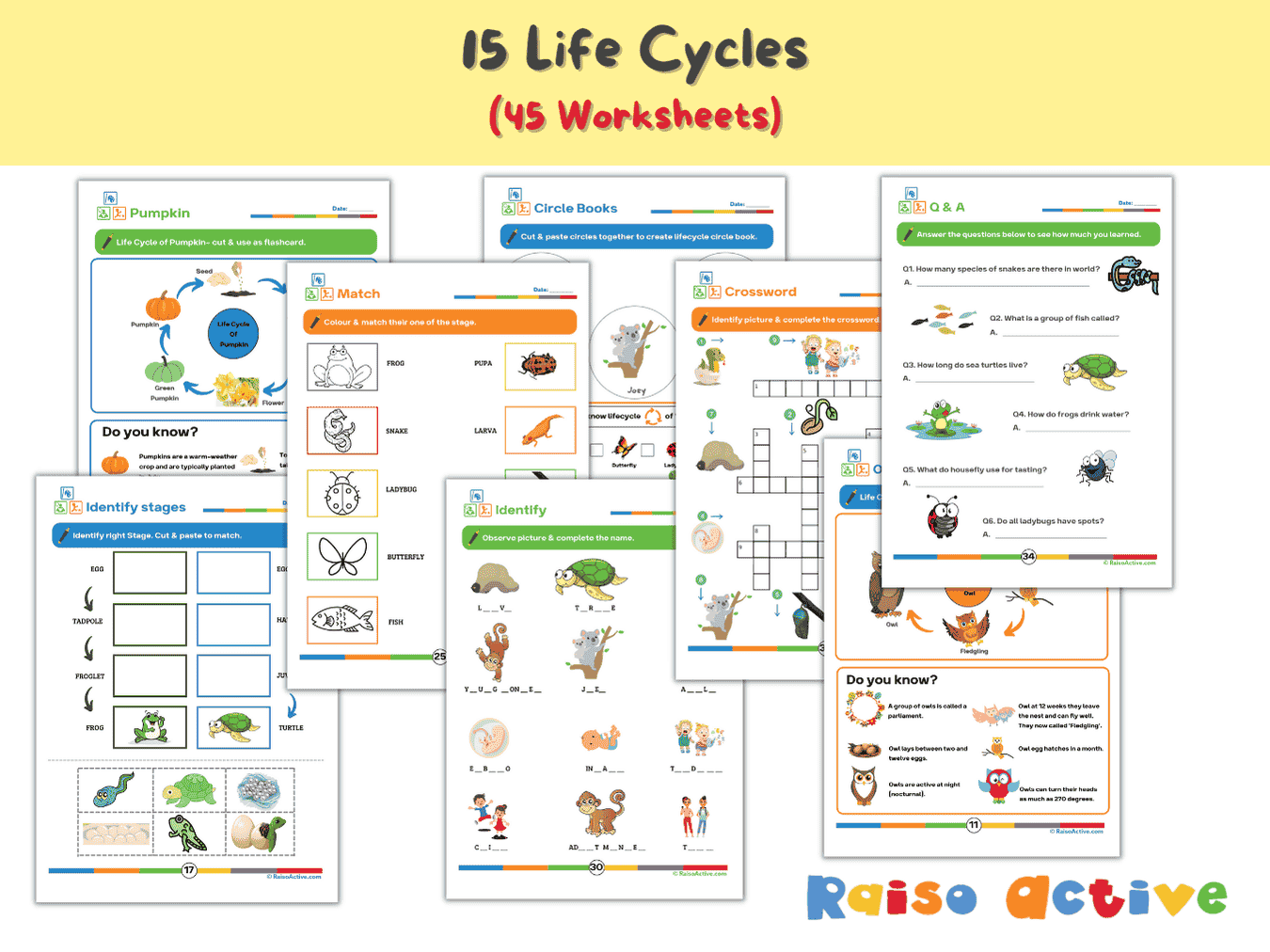

Lifecycles Activity Book & Flashcards for Preschool & Early Elementary
Ages 3-8 · Preschool–Grade 2Ages 3-8 · Nursery–Year 3Ages 3-8 · Nursery–Class 2Ages 3-8 · 46 pages
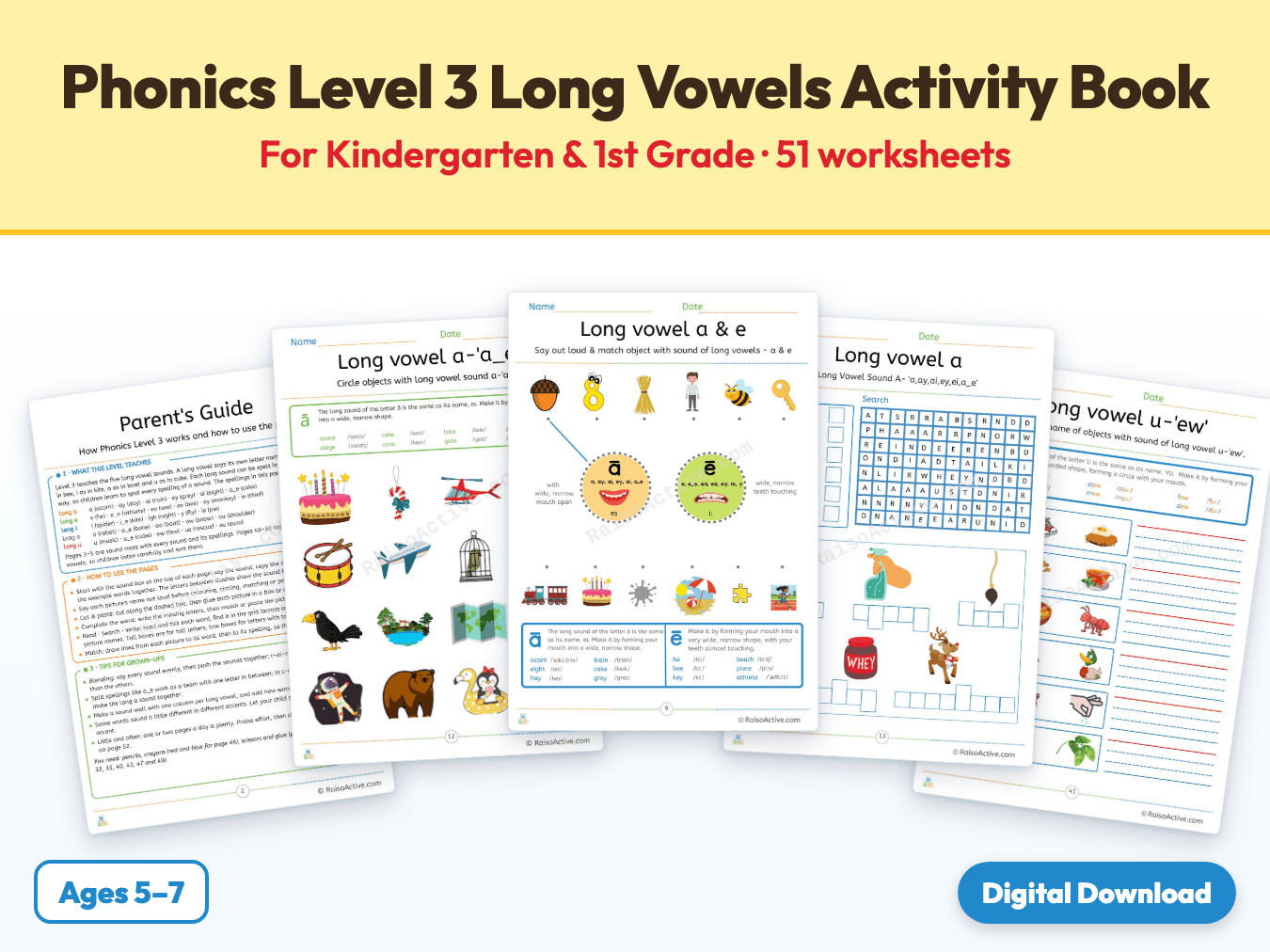

Phonics Level 3 Long Vowels Activity Book for Kindergarten & 1st Grade
Ages 5-7 · Kindergarten–Grade 1Ages 5-7 · Year 1–Year 2Ages 5-7 · UKG–Class 1Ages 5-7 · 52 pages
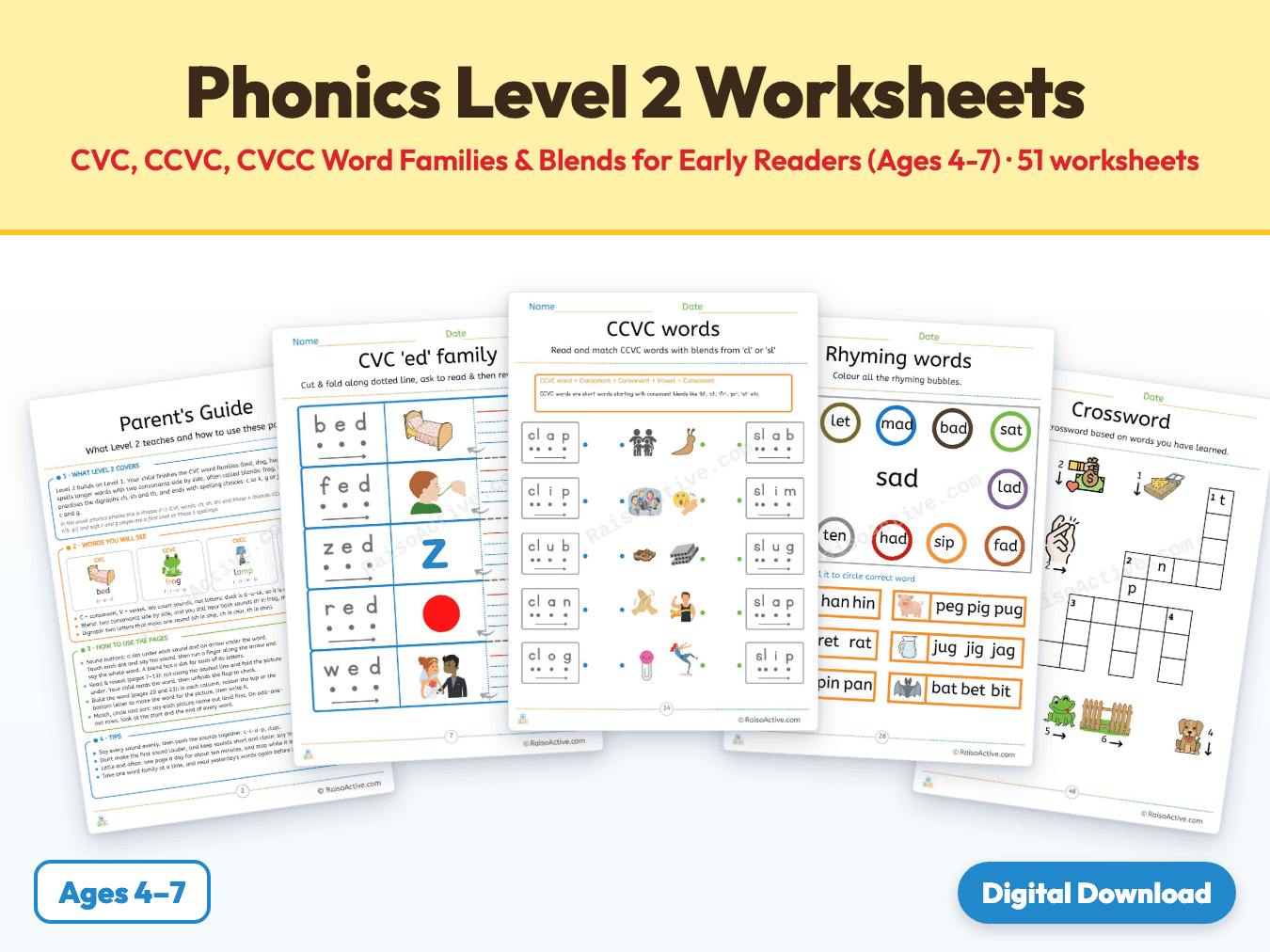
Phonics Level 2 Worksheets: CVC, CCVC, CVCC Word Families & Blends for Early Readers (Ages 4-7)
Ages 4-7 · Pre-K–Grade 1Ages 4-7 · Reception–Year 2Ages 4-7 · LKG–Class 1Ages 4-7 · 52 pages
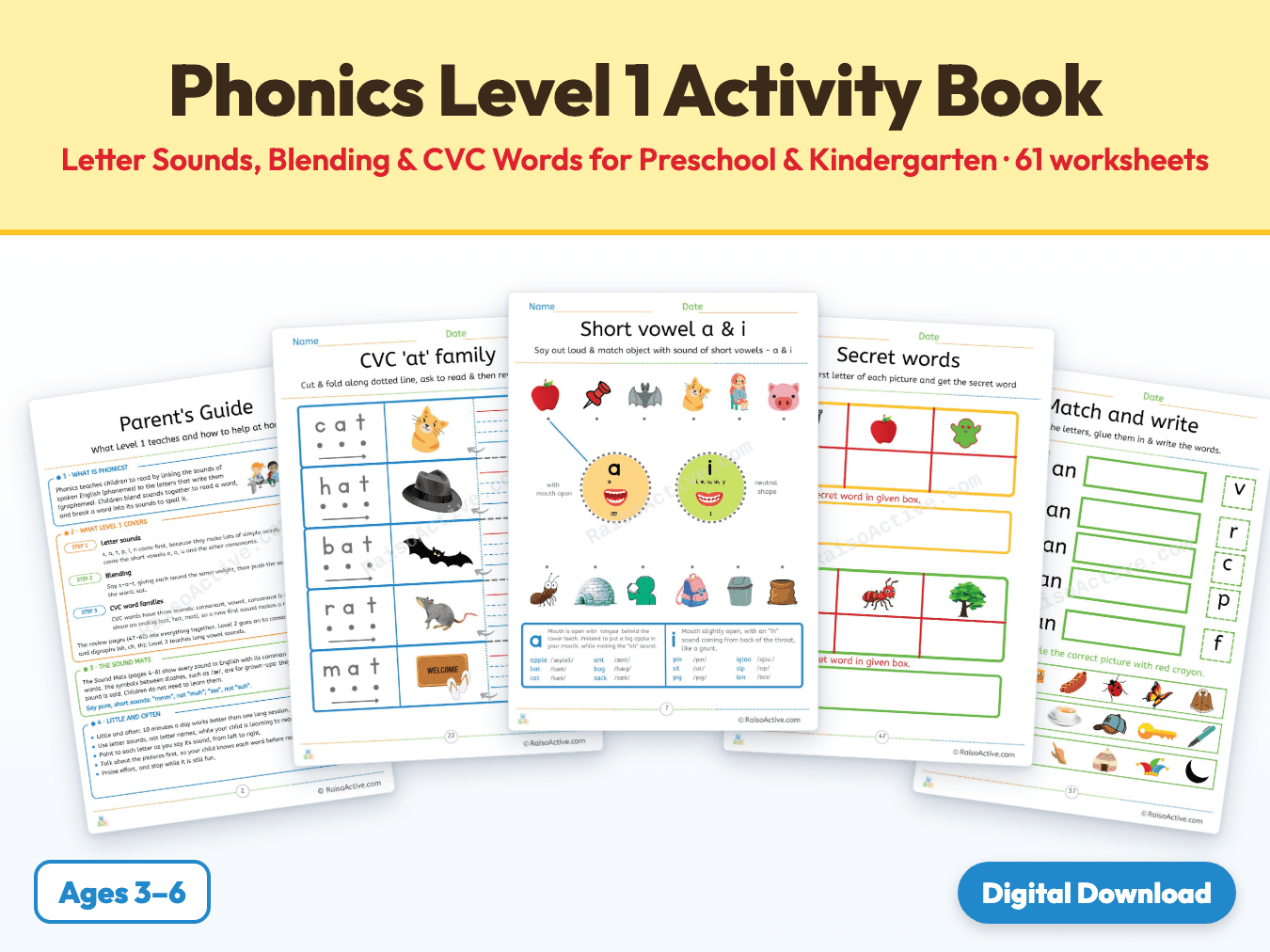
Phonics Level 1 Activity Book: Letter Sounds, Blending & CVC Words for Preschool & Kindergarten
Ages 3-6 · Preschool–KindergartenAges 3-6 · Nursery–Year 1Ages 3-6 · Nursery–UKGAges 3-6 · 62 pages
Guides for parents and teachers
See all guides
Sight Words by Age: The First 50 Words and How to Teach Them Without Flashcard Fatigue
Which sight words to teach first and why, the heart-word method, a read-trace-write-find routine, games, and a by-age table of typical sight-word progress.
How to Teach CVC Blending: A Step-by-Step Method That Works in Two Weeks
A step-by-step method for teaching CVC blending, covering continuous sounds, word families, common errors, and a 14-day plan that most children finish reading CVC words.
Phase 2 Phonics at Home: Sound Order, Blending Games, Worksheets
Phase 2 phonics at home: the five sound sets in order, oral blending, tricky words, a two-week routine, common mistakes, and free worksheets.
UKG Syllabus Explained: English, Maths and EVS Month by Month
What UKG classes typically cover in English, maths and EVS, month by month, aligned to NEP 2020, with ways to support at home and signs your child is behind.

Documenting Learning Without Drowning in Data: A Practical Guide for Parents and Teachers
Learn practical ways to document your child's learning without overwhelm. Simple portfolios, observation tips, and printable trackers for ages 1-8.
Understanding Standardized Testing in Early Childhood: A Parent's Guide to Assessment Balance
Learn how standardised tests work in early childhood, when they help, when they harm, and how to balance formal assessment with observation-based learning.