Personal Pronouns Worksheet for Kids: Circle and Underline!
Circling the subject pronoun and underlining the object pronoun in each sentence teaches children ages 5-7 to recognize that pronouns play different grammatical roles depending on their position in a sentence, an important step toward more advanced grammar understanding. This careful, close-reading task also builds attention to sentence structure that supports stronger writing later on.
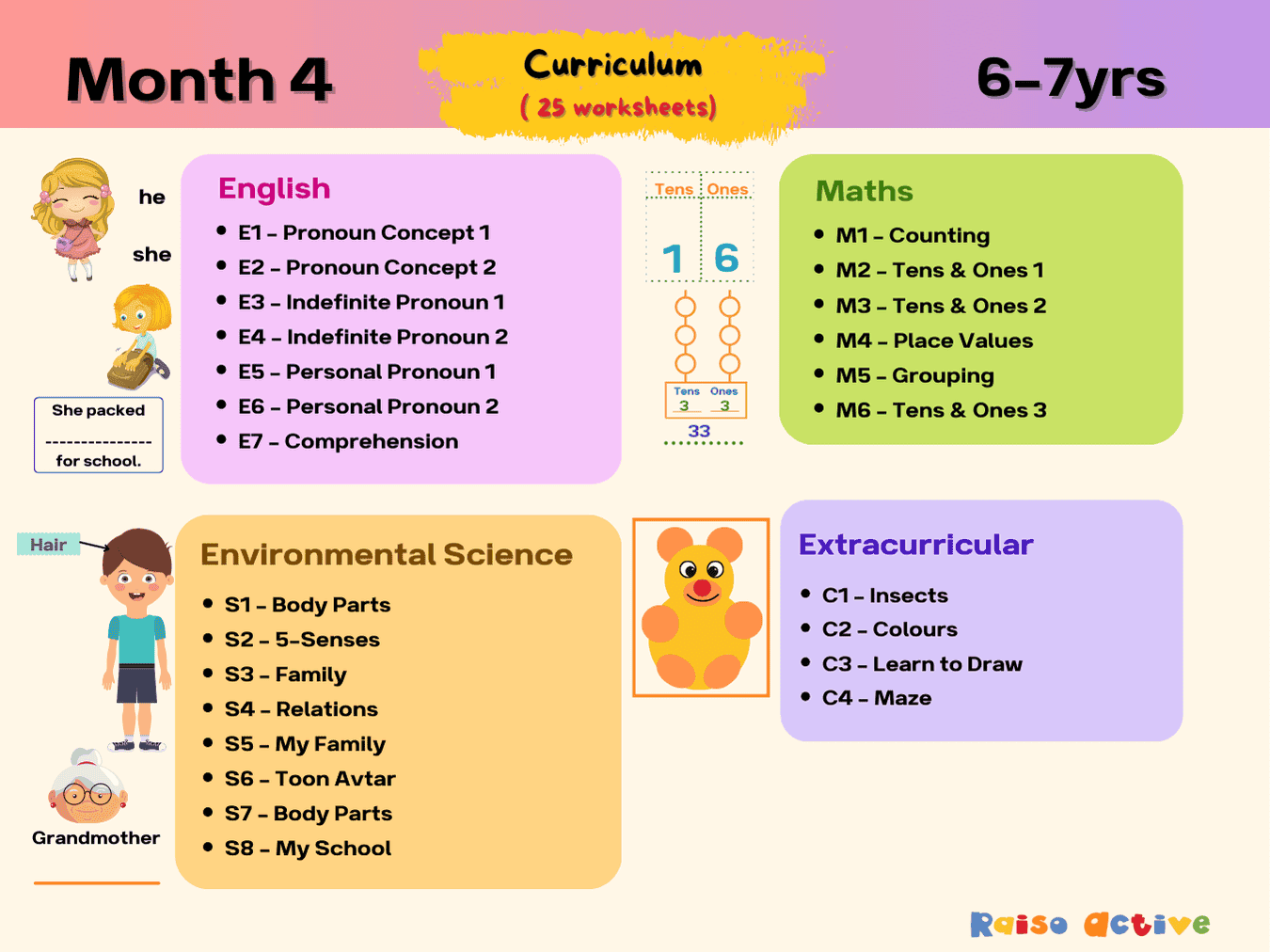
Part of the pack
Month 4: Learning & Development | Ages 6-7
This is page 8 of the pack. Ages 6-7 · Grade 1Ages 6-7 · Year 2Ages 6-7 · Class 1Ages 6-7
Made for your child
Spelling practice, made for your child
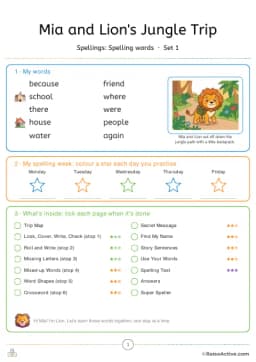
Their own spelling words turned into a pack: trace or look-cover-write-check, roll and write, a secret picture code, a word search, a crossword and a test, with their name in it.
Make a spelling packFree preview · free for members
Or start free: a word search with sight wordsCurriculum
- Grammar > Possessive Pronouns
How to use this worksheet
Read the first sentence aloud together and identify who or what is doing the action, which is the subject. Have your child circle the subject pronoun in that sentence. Then identify who or what is receiving the action, the object, and have them underline that pronoun, continuing through each remaining sentence the same way.
Materials needed
- Pencil
- Highlighter (optional)
Extension activities
- 1Write your own sentences using both a subject and object pronoun.
- 2Search a book for examples of subject and object pronouns in real sentences.
- 3Sort a set of pronoun cards into subject and object piles.
- 4Play a sentence-building game, swapping different pronouns into the same sentence frame.
- 5Act out short sentences to show who is doing an action versus who is receiving it.

Written by
Hemsweta Jain · Teacher Cheena
MBA and Early Childhood Educator, teaching since 2014 · Founder of RaisoActive, Mumbai
Every RaisoActive worksheet is designed and checked by the founder before publishing.
Published · Last reviewed
More from Month 4: Learning & Development | Ages 6-7
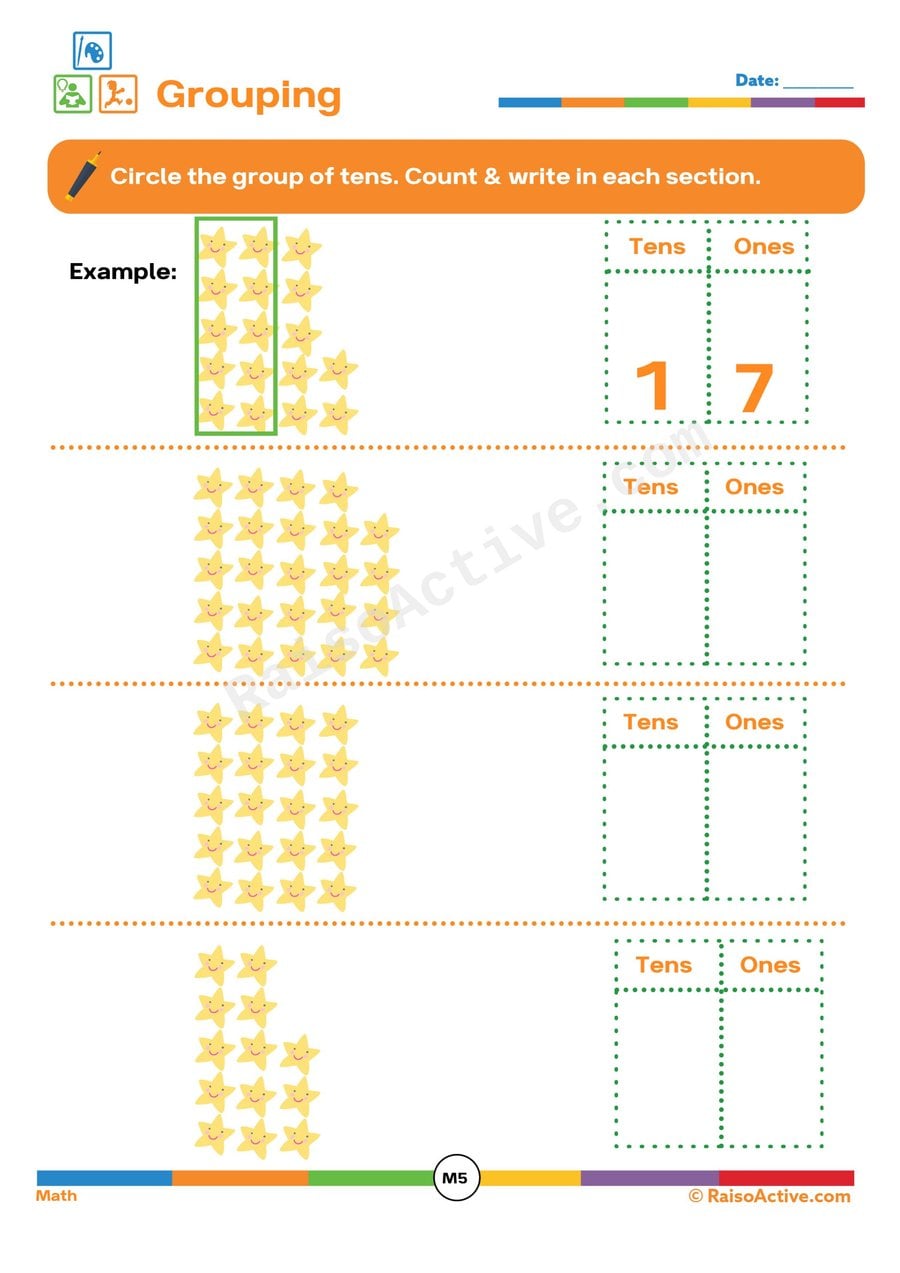
Grouping Stars: Tens and Ones Worksheet for Kids
Ages 4-6 · Pre-K–KindergartenAges 4-6 · Reception–Year 1Ages 4-6 · LKG–UKGAges 4-6
Circling groups of ten stars and counting the leftover ones teaches children ages 4-6 to see a two-digit number as tens plus ones, reinforcing place value in a visual, hands-on way. This grouping practice builds a stronger number sense than memorizing numerals alone, since children physically organize quantities before writing them down.

Indefinite Pronoun Worksheet: Fill-in-the-Blanks Fun!
Ages 3-5 · Preschool–Pre-KAges 3-5 · Nursery–ReceptionAges 3-5 · Nursery–LKGAges 3-5
Choosing the correct indefinite pronoun to complete each sentence introduces children ages 3-5 to words like something, someone, and anywhere in simple, everyday sentence contexts, building early grammar awareness alongside vocabulary. This gentle, sentence-level practice lays groundwork for more advanced grammar work in later years.

Body Parts Worksheet for Kids: Identify and Label!
Ages 3-5 · Preschool–Pre-KAges 3-5 · Nursery–ReceptionAges 3-5 · Nursery–LKGAges 3-5
This worksheet builds vocabulary and early writing skills as children ages 3-5 identify parts of the human body in a picture and write each body part's name in its labeled box. Connecting a spoken word to its written form and to the correct location on a diagram strengthens both language development and body awareness, an important self-knowledge skill at this age.

Pronoun Power: Circle the Correct Pronoun Worksheet
Ages 4-6 · Pre-K–KindergartenAges 4-6 · Reception–Year 1Ages 4-6 · LKG–UKGAges 4-6
This worksheet helps children ages 4-6 practice using the pronouns 'he' and 'she' correctly by looking at a picture of a person and circling the pronoun that matches. Correctly substituting a pronoun for a person's name is an early grammar milestone that makes spoken and written sentences smoother and less repetitive.

Learn to Draw: Teddy Bear Worksheet for Preschoolers
Ages 3-5 · Preschool–Pre-KAges 3-5 · Nursery–ReceptionAges 3-5 · Nursery–LKGAges 3-5
Following numbered steps to draw a teddy bear teaches children ages 3-5 that complex pictures can be broken down into simple shapes like circles, building both sequencing skills and hand-eye coordination. This step-by-step approach to drawing also builds confidence for children who feel intimidated by open-ended drawing tasks.

Tens and Ones Worksheet: Counting and Place Value Practice!
Ages 4-6 · Pre-K–KindergartenAges 4-6 · Reception–Year 1Ages 4-6 · LKG–UKGAges 4-6
This worksheet introduces children ages 4-6 to place value by having them look at a two-digit number, break it into groups of ten and single ones, and represent each group by drawing the matching number of crayons. Understanding that '23' means two full groups of ten plus three more is a foundational concept for all later multi-digit addition, subtraction, and number sense.

Reading Comprehension Worksheet: Max and Tuffy's Adventures!
Ages 4-6 · Pre-K–KindergartenAges 4-6 · Reception–Year 1Ages 4-6 · LKG–UKGAges 4-6
Reading the short story about Max and Tuffy and answering questions afterward helps children ages 4-6 practice true reading comprehension, recalling specific details like who did what and where, rather than just decoding words on the page. Writing out their answers also builds the connection between understanding a story and expressing that understanding in writing.

Counting Fun: Count by 5 or 10 Worksheet for Preschoolers!
Ages 4-6 · Pre-K–KindergartenAges 4-6 · Reception–Year 1Ages 4-6 · LKG–UKGAges 4-6
Counting objects arranged in groups of five or ten teaches children ages 4-6 skip counting, a faster strategy for finding a total than counting every single object one by one. This early efficiency strategy builds a foundation for later multiplication and for quickly estimating larger quantities.
Related worksheets

Pronoun Power: Fill-in-the-Blanks Worksheet for Kids
Ages 4-6 · Pre-K–KindergartenAges 4-6 · Reception–Year 1Ages 4-6 · LKG–UKGAges 4-6
Children ages 4-6 practice using indefinite pronouns like 'someone', 'anything', or 'everybody' correctly within sentences, an early grammar skill that helps their spoken and written language sound more natural and precise. Filling in blanks with the right pronoun requires reading comprehension, since children must understand the sentence's meaning to choose correctly. The coloring step adds a quick visual check that reinforces the correct answer.
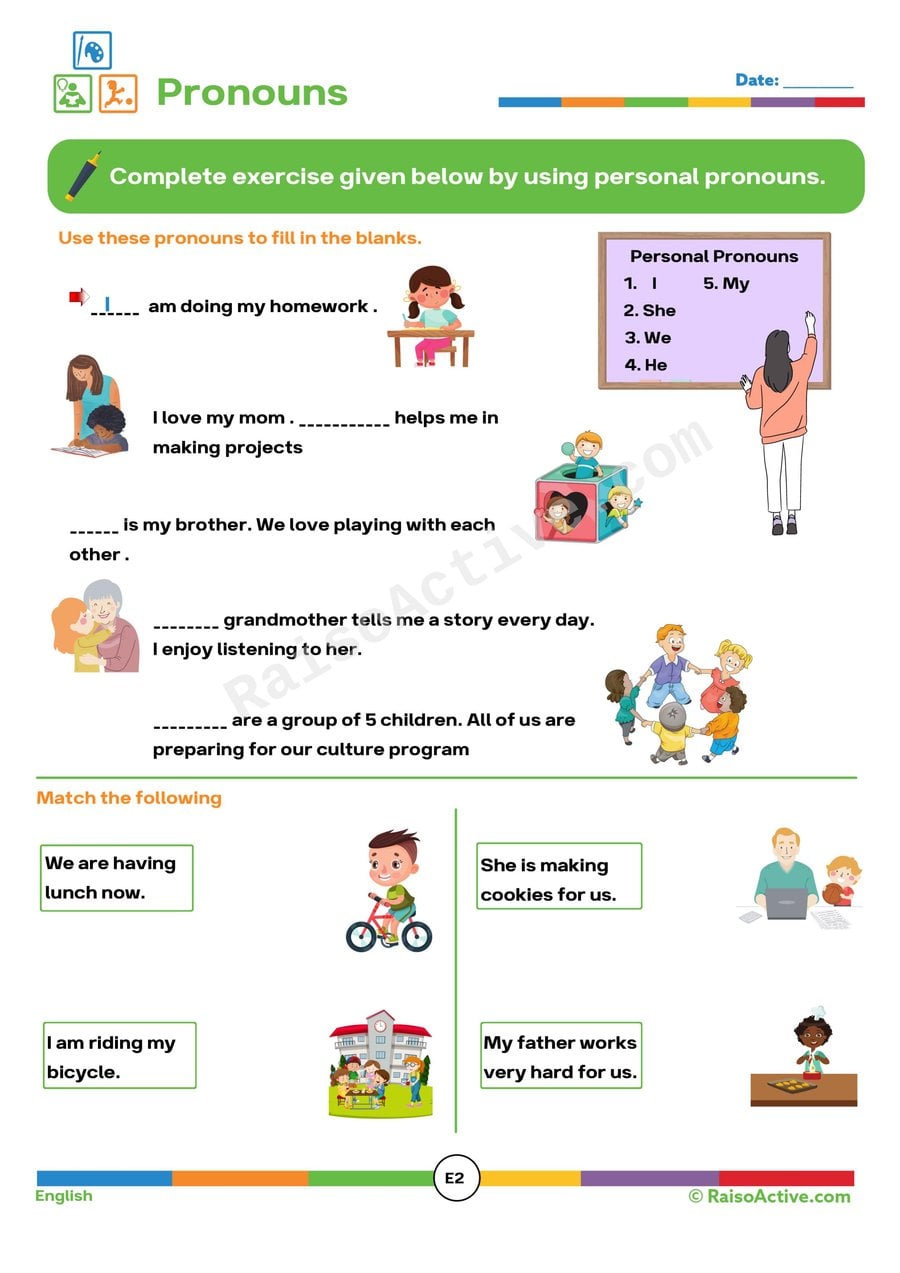
Pronouns Practice Worksheet for Preschoolers
Ages 4-6 · Pre-K–KindergartenAges 4-6 · Reception–Year 1Ages 4-6 · LKG–UKGAges 4-6
Children ages 4-6 practice using personal pronouns like 'I', 'she', 'we', 'he', and 'my' correctly within simple sentences, an early grammar skill that helps their speech and writing sound clear and natural. Matching completed sentences to images afterward reinforces comprehension, ensuring children understand the meaning behind the pronoun they chose rather than guessing. This combination of fill-in-the-blank and picture matching builds both grammar accuracy and reading comprehension together.

Pronoun Power: Cut & Paste Matching Worksheet for Preschoolers
Ages 4-6 · Pre-K–KindergartenAges 4-6 · Reception–Year 1Ages 4-6 · LKG–UKGAges 4-6
Children ages 4-6 practice recognizing and applying pronouns — he, she, it, they, and similar words — by reading a short sentence, deciding which pronoun fits the picture, and physically placing it in the right spot. Cutting and pasting adds a fine motor and sequencing component on top of the grammar skill, since children must locate, cut, and correctly position each pronoun piece. This hands-on format helps pronoun concepts stick better than reading alone.

This, That, These, and Those Worksheet: Practice with Demonstrative Pronouns
Ages 3-5 · Preschool–Pre-KAges 3-5 · Nursery–ReceptionAges 3-5 · Nursery–LKGAges 3-5
This worksheet introduces children ages 3-5 to demonstrative pronouns — 'this,' 'that,' 'these,' and 'those' — words used to point out objects based on their distance and number. Filling in the correct pronoun for each picture builds early grammar awareness and helps children notice the subtle rules of singular versus plural and near versus far that govern everyday speech.

Pronoun Power: Matching Worksheet for Young Learners
Ages 4-6 · Pre-K–KindergartenAges 4-6 · Reception–Year 1Ages 4-6 · LKG–UKGAges 4-6
Matching sentences and words to their correct pronoun type helps children see that pronouns like 'he,' 'her,' or 'mine' stand in for specific nouns, a concept that makes both their speech and their reading noticeably smoother once it clicks. For ages four to six, sorting pronouns by type also builds early grammatical categorization, a skill they'll rely on throughout their reading and writing years.

Number Names Matching Worksheet for Preschoolers
Ages 4-5 · Pre-KAges 4-5 · ReceptionAges 4-5 · LKGAges 4-5
This worksheet layers two skills for children ages 4-5: unscrambling the letters of a number-name word and then matching that word to its correct numeral. Unscrambling requires children to recognize familiar letter sequences, an early word-recognition skill, while matching reinforces that written number words correspond to specific quantities. Together these tasks push number-word literacy a step further than simple copying or tracing.

Read and Circle: Matching Sentences to Pictures Worksheet
Ages 4-5 · Pre-KAges 4-5 · ReceptionAges 4-5 · LKGAges 4-5
Children ages 4-5 build reading comprehension by reading a short, simple sentence and then identifying which of several pictures actually matches its meaning, rather than just decoding words in isolation. This step — connecting written language back to a real scene — is what separates true reading comprehension from mechanical word-calling, making it an important milestone activity for early readers.

Learn the Sight Word 'My' - Tracing, Writing, and Matching Worksheet
Ages 3-5 · Preschool–Pre-KAges 3-5 · Nursery–ReceptionAges 3-5 · Nursery–LKGAges 3-5
This worksheet builds sight-word fluency for the word 'my' in children ages 3-5 through a combination of tracing, independent writing, fill-in-the-blank sentences, and a matching activity. Working with the same word across several different formats helps cement recognition, since 'my' is a high-frequency word that appears constantly in early reading material but doesn't follow simple phonics patterns. The matching component adds a visual-recognition check to confirm the word sticks even without tracing cues.
Guides for this topic

Documenting Learning Without Drowning in Data: A Practical Guide for Parents and Teachers
Learn practical ways to document your child's learning without overwhelm. Simple portfolios, observation tips, and printable trackers for ages 1-8.

When Should My Child Learn to Read? Is Kindergarten Too Early? A Complete Guide to Reading Readiness
Discover the research-backed optimal age for reading, key readiness signs, and why pushing too early can backfire. A complete guide for parents of children aged 3-8.
What Phonics Program Works Best for Homeschooling? A Complete Guide to Choosing the Right Approach
Compare top phonics programs for homeschooling — Jolly Phonics, Read Write Inc, Explode the Code — plus a DIY approach with worksheets. Find what works for your child.
Reviews
Every worksheet for ages 5–7, no watermark
Members download the full library of 1,000+ worksheets and every activity pack without watermarks or daily limits. One year costs ₹999 in India or $20 elsewhere.
See membership plansOr download any worksheet free with a watermark (5 a day).