Pronoun Power: Matching Worksheet for Young Learners
Matching sentences and words to their correct pronoun type helps children see that pronouns like 'he,' 'her,' or 'mine' stand in for specific nouns, a concept that makes both their speech and their reading noticeably smoother once it clicks. For ages four to six, sorting pronouns by type also builds early grammatical categorization, a skill they'll rely on throughout their reading and writing years.
Part of the pack
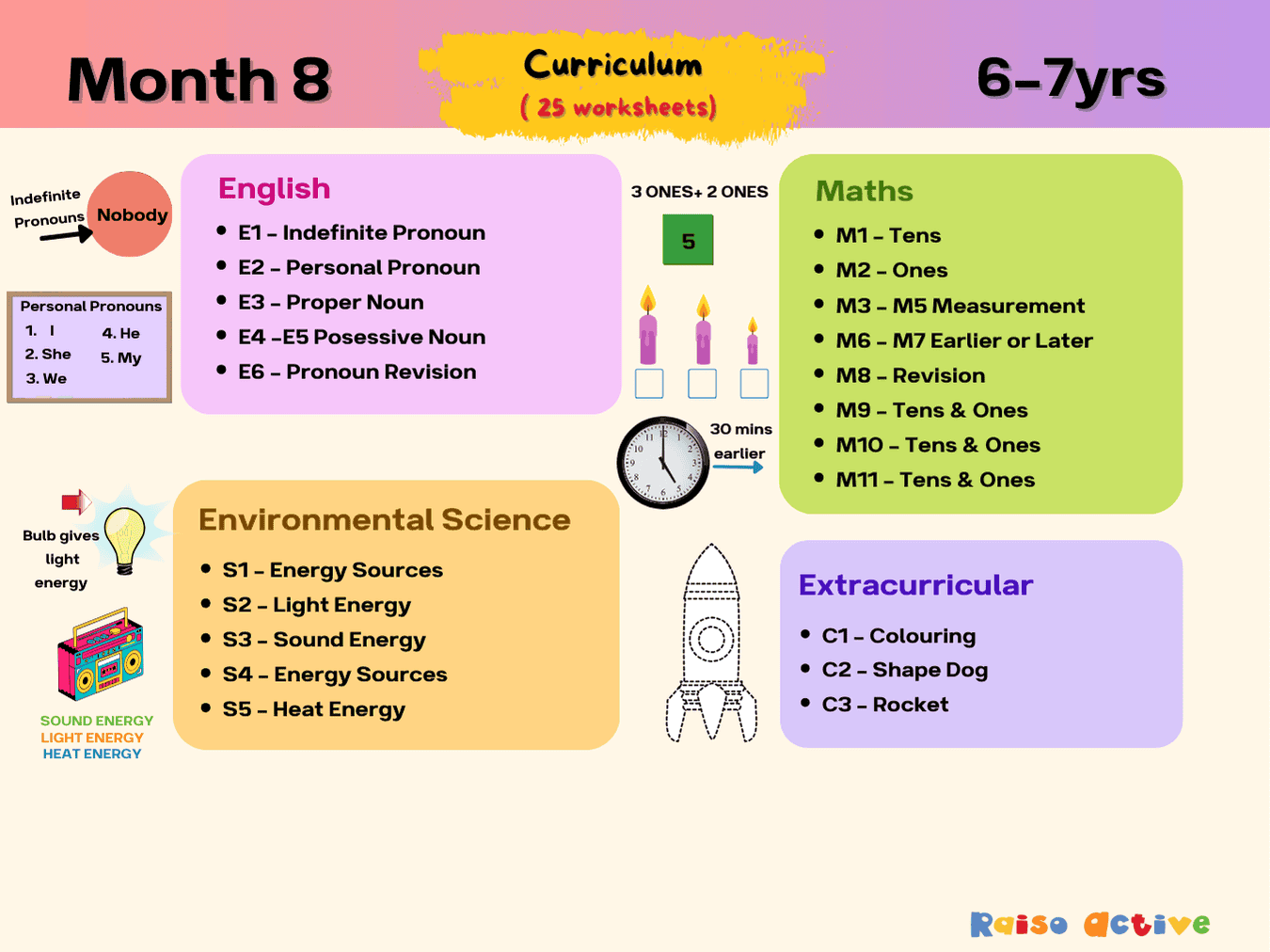
Month 8: English, Math, Science | Ages 6-7
This is page 9 of the pack. Ages 6-7 · Grade 1Ages 6-7 · Year 2Ages 6-7 · Class 1Ages 6-7
Made for your child
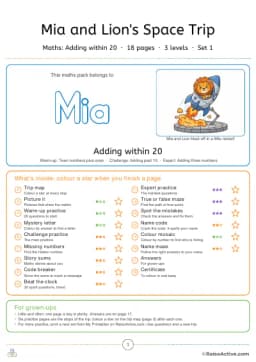
Numbers to 20, made for your child
A maths pack with your child's name in it: pictures that explain, practice at three levels, puzzles and story sums about them. Print a new set whenever they finish.
Make a maths packFree preview · free for members
Curriculum
- Grammar > Possessive Pronouns
How to use this worksheet
Read each sentence on the page aloud together and identify which pronoun it contains before matching it to its type. Have your child draw a line connecting each sentence to the correct pronoun category shown on the page. Then move to the second matching task, where individual words are matched to their pronoun type in the same way. Once finished, ask your child to make up a new sentence using one of the pronoun types from the page.
Materials needed
- Pencil
Extension activities
- 1Create your own sentences using different pronouns and see if a sibling or friend can identify the pronoun type.
- 2Find pronouns in a favorite book and highlight or point to them as you read together.
- 3Play a quick substitution game: say a sentence with a name, then ask your child to replace the name with the right pronoun.
- 4Sort pronoun word cards into piles by type as a timed matching challenge.

Written by
Hemsweta Jain · Teacher Cheena
MBA and Early Childhood Educator, teaching since 2014 · Founder of RaisoActive, Mumbai
Every RaisoActive worksheet is designed and checked by the founder before publishing.
Published · Last reviewed
More from Month 8: English, Math, Science | Ages 6-7
Possessive Noun Matching Worksheet for Kids
Ages 4-6 · Pre-K–KindergartenAges 4-6 · Reception–Year 1Ages 4-6 · LKG–UKGAges 4-6
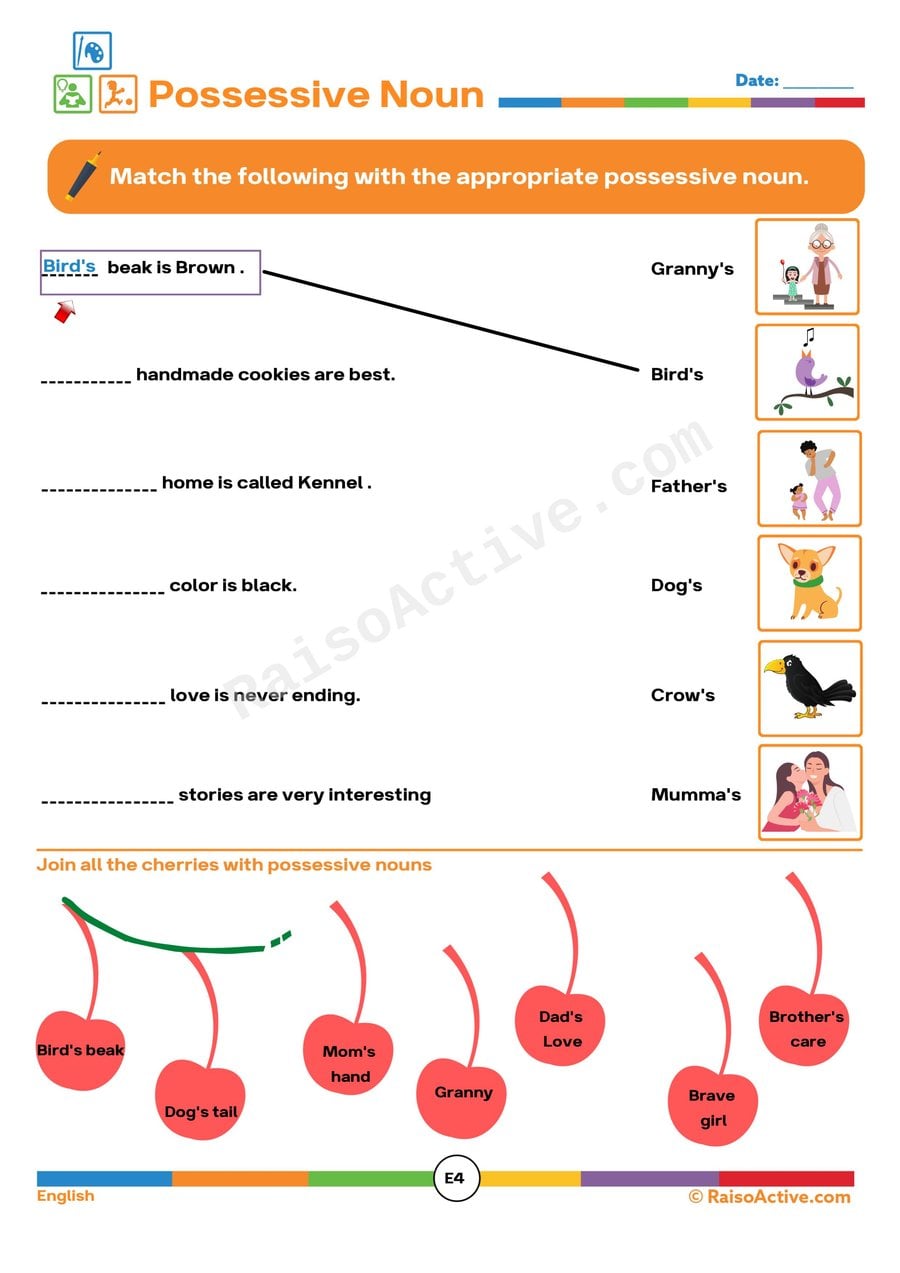
Children ages 4-6 learn to identify possessive nouns, like 'the dog's bone' or 'Mia's book', which show ownership using an apostrophe and 's'. Matching possessive phrases to their meaning builds early grammar awareness that will later support correct sentence writing and reading comprehension. The cherry-connecting activity adds a playful visual-tracking layer to reinforce the matching skill.

Number Matching and Counting Worksheet for Preschoolers
Ages 3-5 · Preschool–Pre-KAges 3-5 · Nursery–ReceptionAges 3-5 · Nursery–LKGAges 3-5
This worksheet combines counting, cutting and pasting, and a targeted number-recognition task, finding circles with '5' in the ones place, giving children practice with quantity, fine motor coordination, and number pattern spotting all in one page. For ages three to five, recognizing a specific digit within a larger number, like the '5' in '15' or '25', is early groundwork for understanding place value.

Counting Ones Worksheet: Match and Fill in the Blanks!
Ages 4-6 · Pre-K–KindergartenAges 4-6 · Reception–Year 1Ages 4-6 · LKG–UKGAges 4-6
Children ages 4-6 build early place value understanding by matching numbers to their corresponding sums and filling in blanks with the correct count of ones. This introduces the foundational idea that numbers are made up of countable units, a concept that underlies all later addition, subtraction, and multi-digit math. Matching and filling in blanks together reinforces both number recognition and basic counting accuracy.

Measurement Worksheet: Big to Small & Hand Measurement Fun!
Ages 3-5 · Preschool–Pre-KAges 3-5 · Nursery–ReceptionAges 3-5 · Nursery–LKGAges 3-5
Ranking objects from biggest to smallest teaches children to make and justify comparative judgments, while the hand-measurement activity introduces the idea of using a non-standard unit, their own hand, to measure length, both foundational concepts before children move on to rulers and standardized units. This combination suits ages three to five well, since it keeps measurement concrete and physical rather than abstract.

Tens and Ones Worksheet: Practice Place Value with Fun Elephants!
Ages 4-6 · Pre-K–KindergartenAges 4-6 · Reception–Year 1Ages 4-6 · LKG–UKGAges 4-6
This worksheet has children break two-digit numbers into their tens and ones parts, then apply that understanding to simple addition and subtraction, a natural next step once place value clicks. For ages four to six, using the playful elephant images keeps a fairly abstract math concept approachable while still building the numerical foundation they'll rely on for years of arithmetic to come.

Rocket Shapes Worksheet for Preschoolers: Tracing and Matching
Ages 3-5 · Preschool–Pre-KAges 3-5 · Nursery–ReceptionAges 3-5 · Nursery–LKGAges 3-5
Building a rocket picture out of basic shapes helps children ages 3-5 practice shape recognition in a real, assembled context rather than in isolated flashcard form, showing them how circles, triangles, and rectangles combine to make a recognizable object. Circling the shapes found in the picture first sharpens visual discrimination, requiring children to spot a shape even when it's part of a larger, more complex image. The tracing component that follows adds fine motor practice, asking children to follow a dotted outline precisely to complete the rocket shape.

Earlier and Later Time Worksheet for Preschoolers
Ages 4-6 · Pre-K–KindergartenAges 4-6 · Reception–Year 1Ages 4-6 · LKG–UKGAges 4-6
Children ages 4-6 build early time-sequencing skills by comparing clocks and everyday activities to decide which happens earlier and which happens later in the day. This worksheet introduces the abstract idea of time passing through the concrete lens of familiar routines, like meals or bedtime, which children already experience daily. Tracing the arrow toward the later activity also reinforces the logical, forward direction that time moves.
Heat Energy Matching Worksheet for Preschoolers
Ages 3-5 · Preschool–Pre-KAges 3-5 · Nursery–ReceptionAges 3-5 · Nursery–LKGAges 3-5
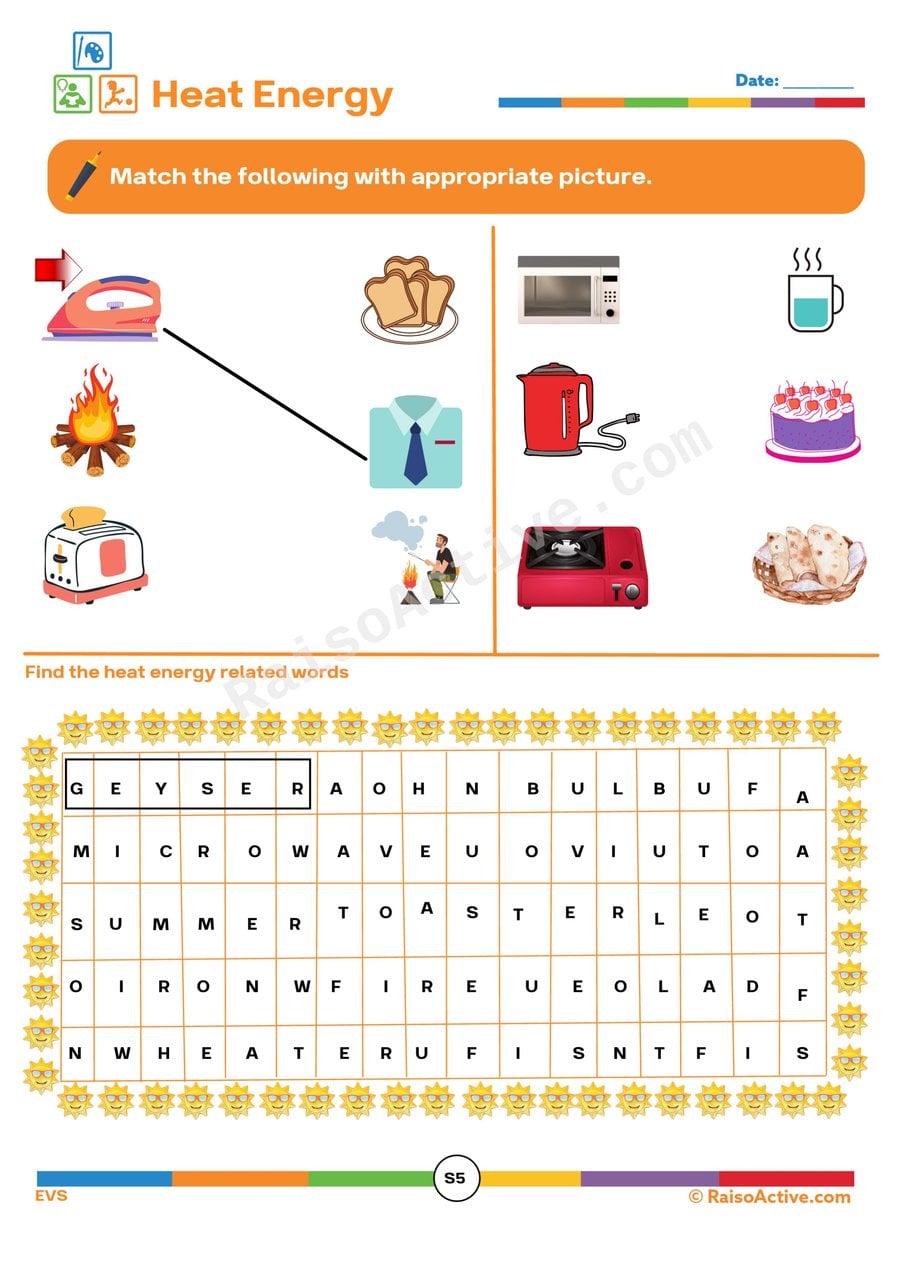
This worksheet narrows the broad concept of energy down to one specific, easy-to-observe type — heat — and asks children ages 3-5 to match everyday objects to pictures representing heat energy, like a stove, the sun, or a fire. Because heat is something children can directly feel and observe, it's an excellent entry point for early science vocabulary before moving to more abstract energy types like electricity. The word search portion adds early literacy practice, asking children to visually scan for heat-related vocabulary words among a grid of letters.
Related worksheets

Personal Pronouns Worksheet for Kids: Circle and Underline!
Ages 5-7 · Kindergarten–Grade 1Ages 5-7 · Year 1–Year 2Ages 5-7 · UKG–Class 1Ages 5-7
Circling the subject pronoun and underlining the object pronoun in each sentence teaches children ages 5-7 to recognize that pronouns play different grammatical roles depending on their position in a sentence, an important step toward more advanced grammar understanding. This careful, close-reading task also builds attention to sentence structure that supports stronger writing later on.

Pronoun Power: Matching and Writing Practice Worksheet
Ages 4-6 · Pre-K–KindergartenAges 4-6 · Reception–Year 1Ages 4-6 · LKG–UKGAges 4-6
Matching nouns to their correct pronouns and then rewriting sentences with a pronoun in place of an underlined word teaches children ages 4-6 how pronouns work as stand-ins for people, places, or things, a key grammar concept for writing smoother sentences. Practicing both matching and substitution gives two different angles on the same underlying skill.

Indefinite Pronoun Worksheet: Fill-in-the-Blanks Fun!
Ages 3-5 · Preschool–Pre-KAges 3-5 · Nursery–ReceptionAges 3-5 · Nursery–LKGAges 3-5
Choosing the correct indefinite pronoun to complete each sentence introduces children ages 3-5 to words like something, someone, and anywhere in simple, everyday sentence contexts, building early grammar awareness alongside vocabulary. This gentle, sentence-level practice lays groundwork for more advanced grammar work in later years.

This, That, These, and Those Worksheet: Practice with Demonstrative Pronouns
Ages 3-5 · Preschool–Pre-KAges 3-5 · Nursery–ReceptionAges 3-5 · Nursery–LKGAges 3-5
This worksheet introduces children ages 3-5 to demonstrative pronouns — 'this,' 'that,' 'these,' and 'those' — words used to point out objects based on their distance and number. Filling in the correct pronoun for each picture builds early grammar awareness and helps children notice the subtle rules of singular versus plural and near versus far that govern everyday speech.

Indefinite Pronouns Worksheet: Fill-in-the-Blanks Fun!
Ages 4-6 · Pre-K–KindergartenAges 4-6 · Reception–Year 1Ages 4-6 · LKG–UKGAges 4-6
Filling in the blanks with indefinite pronouns like something, someone, and somewhere teaches children ages 4-6 how these flexible words stand in for people, places, or things without naming them specifically, an important step in building more natural, varied sentences. Using picture clues alongside the sentences also helps children connect abstract grammar terms to concrete, familiar scenes.

Personal Pronouns Worksheet for Kids: Matching and Writing
Ages 3-5 · Preschool–Pre-KAges 3-5 · Nursery–ReceptionAges 3-5 · Nursery–LKGAges 3-5
Children ages 3-5 practice choosing and writing the correct personal pronoun — I, you, she, it, we, or they — for a picture or phrase, building an early grammar skill that makes their spoken and written sentences sound natural. Matching a pronoun to who or what it refers to also strengthens reading comprehension, since pronouns require tracking who is being talked about.

Pronoun Power: Circle the Correct Pronoun Worksheet
Ages 4-6 · Pre-K–KindergartenAges 4-6 · Reception–Year 1Ages 4-6 · LKG–UKGAges 4-6
This worksheet helps children ages 4-6 practice using the pronouns 'he' and 'she' correctly by looking at a picture of a person and circling the pronoun that matches. Correctly substituting a pronoun for a person's name is an early grammar milestone that makes spoken and written sentences smoother and less repetitive.

Pronoun Power: Cut & Paste Matching Worksheet for Preschoolers
Ages 4-6 · Pre-K–KindergartenAges 4-6 · Reception–Year 1Ages 4-6 · LKG–UKGAges 4-6
Children ages 4-6 practice recognizing and applying pronouns — he, she, it, they, and similar words — by reading a short sentence, deciding which pronoun fits the picture, and physically placing it in the right spot. Cutting and pasting adds a fine motor and sequencing component on top of the grammar skill, since children must locate, cut, and correctly position each pronoun piece. This hands-on format helps pronoun concepts stick better than reading alone.
Guides for this topic

Reviews
Every worksheet for ages 4–6, no watermark
Members download the full library of 1,000+ worksheets and every activity pack without watermarks or daily limits. One year costs ₹999 in India or $20 elsewhere.
See membership plansOr download any worksheet free with a watermark (5 a day).