Pronoun Power: Circle the Correct Pronoun Worksheet
This worksheet helps children ages 4-6 practice using the pronouns 'he' and 'she' correctly by looking at a picture of a person and circling the pronoun that matches. Correctly substituting a pronoun for a person's name is an early grammar milestone that makes spoken and written sentences smoother and less repetitive.
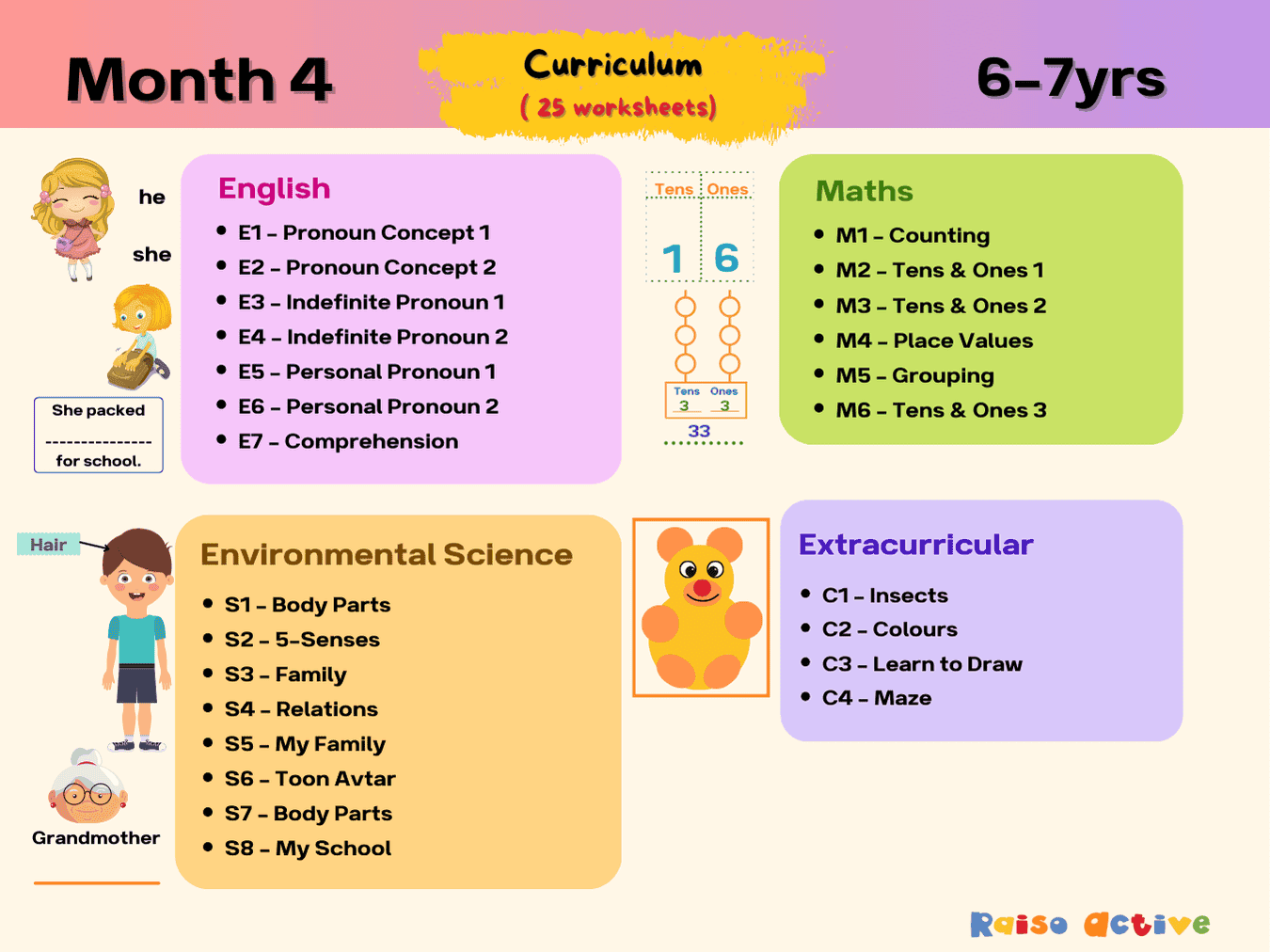
Part of the pack
Month 4: Learning & Development | Ages 6-7
This is page 5 of the pack. Ages 6-7 · Grade 1Ages 6-7 · Year 2Ages 6-7 · Class 1Ages 6-7
Made for your child
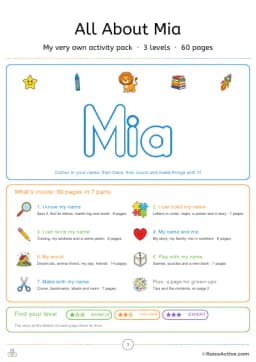
A whole activity pack made with their name
60 pages to spot, build, trace and write their own name, plus pages about their favourites, feelings and family. See a free preview with their name.
Make an All About Me packFree preview · free for members
Or start free: a name tracing sheet with their nameCurriculum
- Grammar > Possessive Pronouns
How to use this worksheet
Look at the first picture together and ask your child whether the person shown is a boy/man or a girl/woman. Read both pronoun options aloud, then have your child circle 'he' or 'she' based on the picture. Work through each picture the same way, saying a full sentence aloud using the chosen pronoun, like 'He is running.' Review the page together at the end, rereading each sentence.
Materials needed
- Pencil
- Crayons
Extension activities
- 1Point to family members or characters in a book and ask your child to describe them using 'he' or 'she.'
- 2Play a guessing game where you describe someone using only pronouns and your child guesses who you mean.
- 3Look through family photos and practice sentences like 'She is smiling' or 'He is jumping.'
- 4Read a short story together and pause to identify which pronoun refers to which character.

Written by
Hemsweta Jain · Teacher Cheena
MBA and Early Childhood Educator, teaching since 2014 · Founder of RaisoActive, Mumbai
Every RaisoActive worksheet is designed and checked by the founder before publishing.
Published · Last reviewed
More from Month 4: Learning & Development | Ages 6-7

Color Mixing Worksheet for Preschoolers: Learn Primary and Secondary Colors!
Ages 4-6 · Pre-K–KindergartenAges 4-6 · Reception–Year 1Ages 4-6 · LKG–UKGAges 4-6
Identifying primary colors and predicting which two combine to create each secondary color introduces children ages 4-6 to basic color theory, an early scientific concept about how colors interact. This worksheet builds the vocabulary and reasoning skills needed to understand color mixing before testing it out with real paint or crayons.
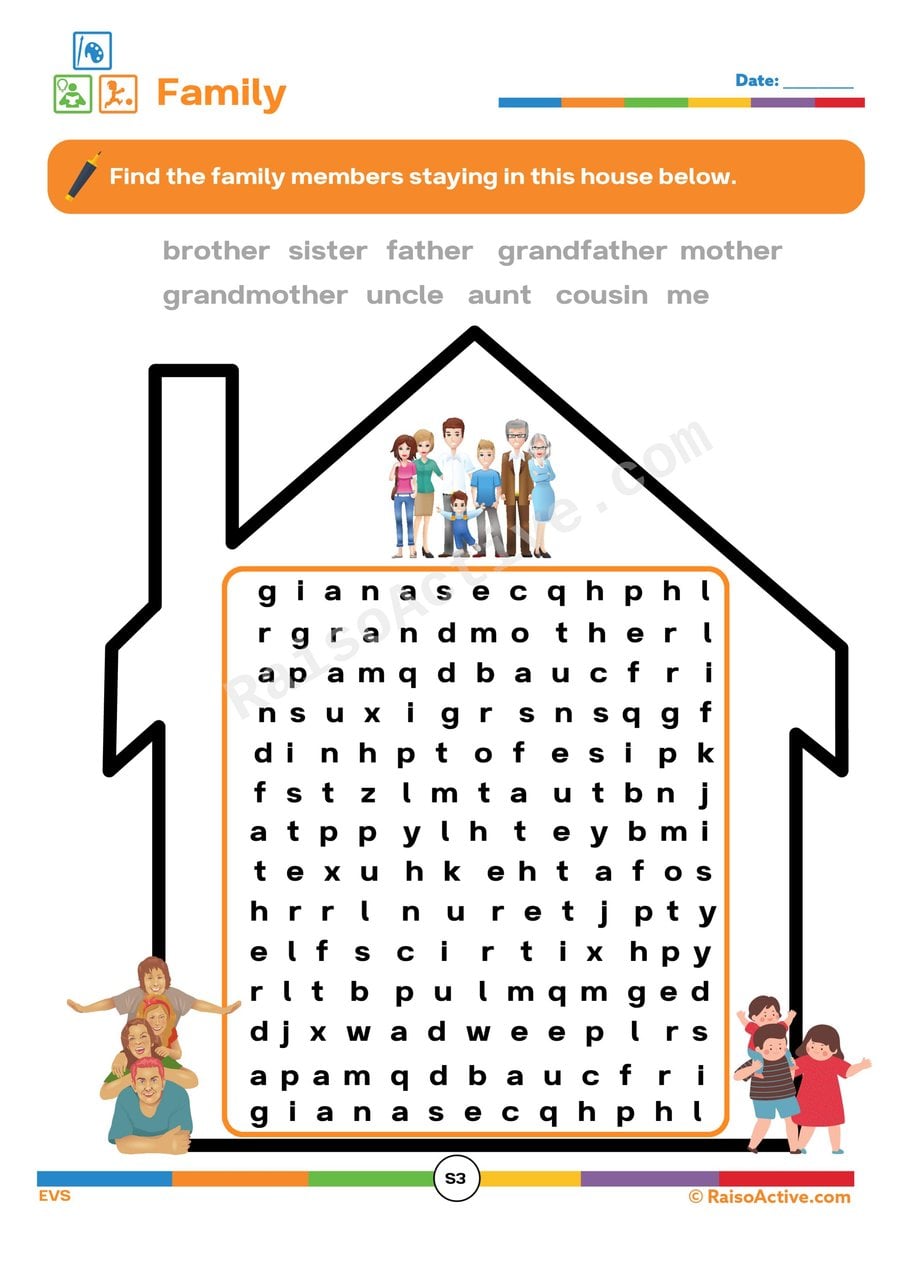
Family Word Search Worksheet for Kids
Ages 4-6 · Pre-K–KindergartenAges 4-6 · Reception–Year 1Ages 4-6 · LKG–UKGAges 4-6
Searching a grid for hidden family member words like mother, father, and sister builds vocabulary and visual scanning skills for children ages 4-6, requiring them to track letters carefully across rows, columns, and sometimes diagonals. This kind of focused letter tracking is excellent early practice for the visual attention reading fluency depends on later.
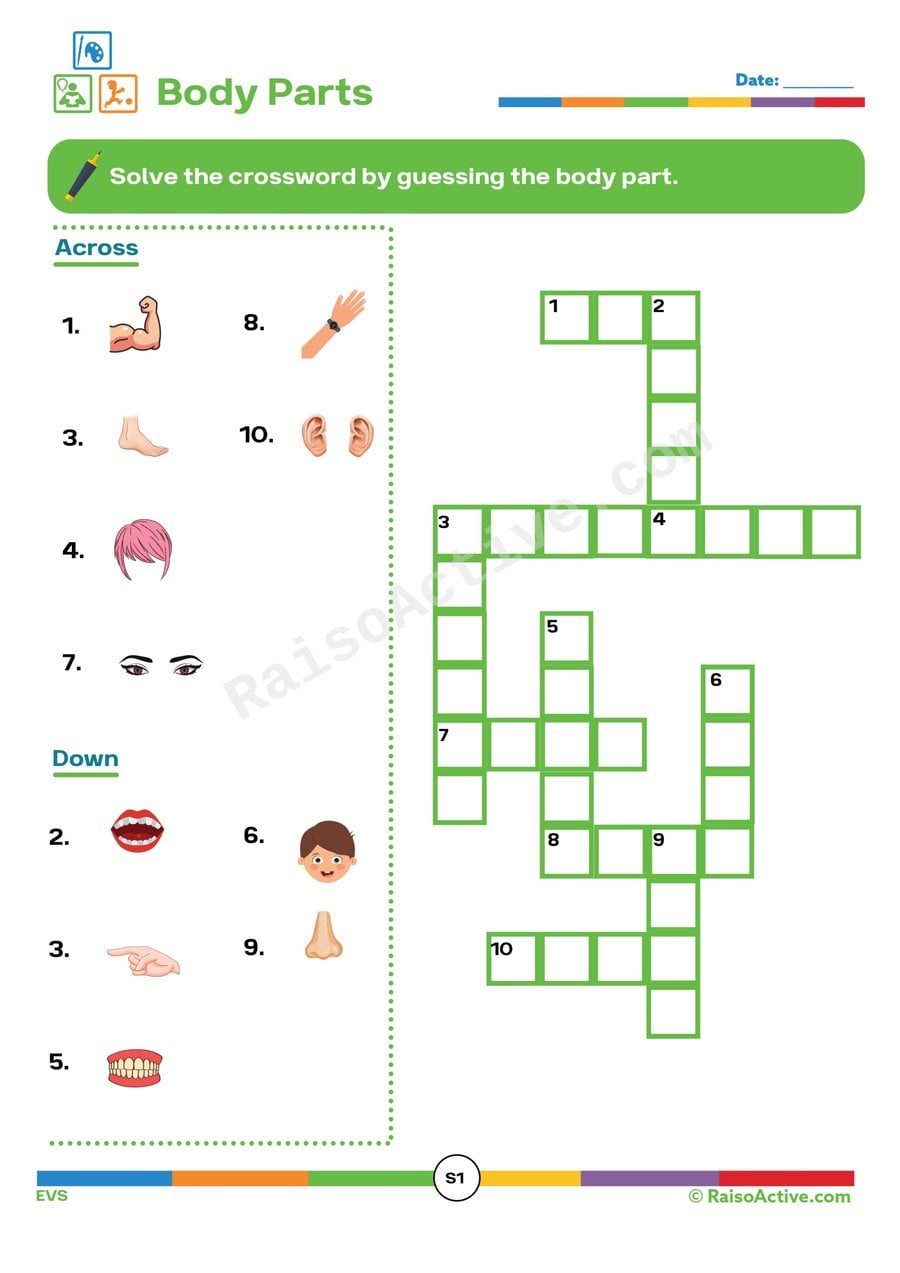
Body Parts Crossword Puzzle Worksheet for Kids
Ages 3-5 · Preschool–Pre-KAges 3-5 · Nursery–ReceptionAges 3-5 · Nursery–LKGAges 3-5
Solving a crossword using body part picture clues teaches children ages 3-5 to connect a visual image with its written name, building both vocabulary and early spelling skills. Working through the crossword's number grid also introduces the format of organizing answers into specific boxes, a small but useful pre-literacy skill.

Tens and Ones Worksheet: Counting and Place Value Practice!
Ages 4-6 · Pre-K–KindergartenAges 4-6 · Reception–Year 1Ages 4-6 · LKG–UKGAges 4-6
This worksheet introduces children ages 4-6 to place value by having them look at a two-digit number, break it into groups of ten and single ones, and represent each group by drawing the matching number of crayons. Understanding that '23' means two full groups of ten plus three more is a foundational concept for all later multi-digit addition, subtraction, and number sense.
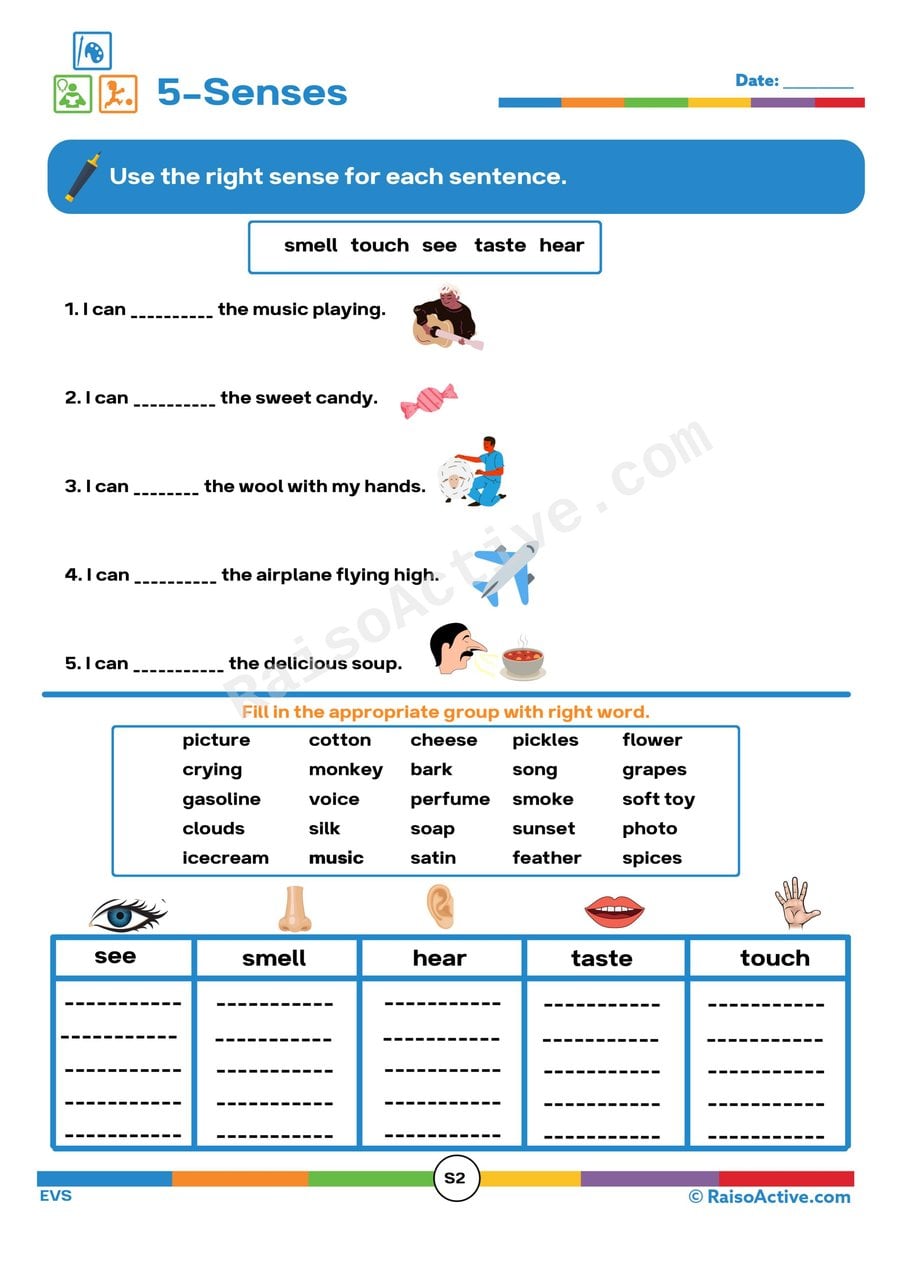
5 Senses Worksheet: Explore the World!
Ages 4-6 · Pre-K–KindergartenAges 4-6 · Reception–Year 1Ages 4-6 · LKG–UKGAges 4-6
Identifying which of the five senses, sight, smell, hearing, taste, or touch, is being used in each picture or sentence helps children ages 4-6 build scientific observation vocabulary and connect abstract sense words to concrete everyday actions. Matching the words to senses in a table afterward reinforces the vocabulary in a second, different format.

Place Value Beads: Count and Fill the Numbers Worksheet
Ages 3-5 · Preschool–Pre-KAges 3-5 · Nursery–ReceptionAges 3-5 · Nursery–LKGAges 3-5
Counting beads on an abacus-style picture and writing the tens and ones totals teaches children ages 3-5 place value through a visual, hands-on representation rather than abstract numerals alone. Solving the final abacus total afterward reinforces that a two-digit number is really the sum of its tens and ones parts.
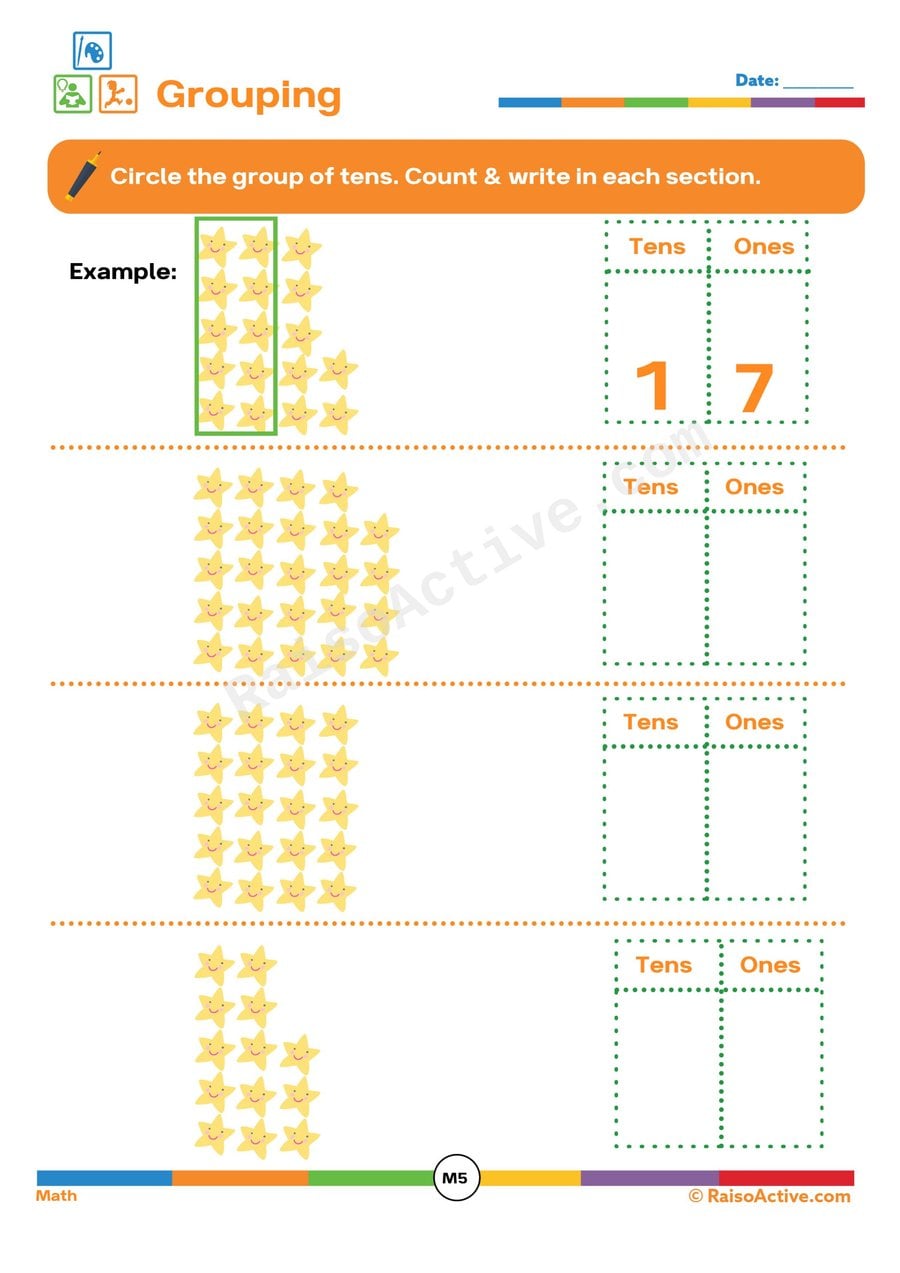
Grouping Stars: Tens and Ones Worksheet for Kids
Ages 4-6 · Pre-K–KindergartenAges 4-6 · Reception–Year 1Ages 4-6 · LKG–UKGAges 4-6
Circling groups of ten stars and counting the leftover ones teaches children ages 4-6 to see a two-digit number as tens plus ones, reinforcing place value in a visual, hands-on way. This grouping practice builds a stronger number sense than memorizing numerals alone, since children physically organize quantities before writing them down.

Pronoun Power: Matching and Writing Practice Worksheet
Ages 4-6 · Pre-K–KindergartenAges 4-6 · Reception–Year 1Ages 4-6 · LKG–UKGAges 4-6
Matching nouns to their correct pronouns and then rewriting sentences with a pronoun in place of an underlined word teaches children ages 4-6 how pronouns work as stand-ins for people, places, or things, a key grammar concept for writing smoother sentences. Practicing both matching and substitution gives two different angles on the same underlying skill.
Related worksheets

This, That, These, and Those Worksheet: Practice with Demonstrative Pronouns
Ages 3-5 · Preschool–Pre-KAges 3-5 · Nursery–ReceptionAges 3-5 · Nursery–LKGAges 3-5
This worksheet introduces children ages 3-5 to demonstrative pronouns — 'this,' 'that,' 'these,' and 'those' — words used to point out objects based on their distance and number. Filling in the correct pronoun for each picture builds early grammar awareness and helps children notice the subtle rules of singular versus plural and near versus far that govern everyday speech.

Pronoun Power: Fill-in-the-Blanks Worksheet for Kids
Ages 4-6 · Pre-K–KindergartenAges 4-6 · Reception–Year 1Ages 4-6 · LKG–UKGAges 4-6
Children ages 4-6 practice using indefinite pronouns like 'someone', 'anything', or 'everybody' correctly within sentences, an early grammar skill that helps their spoken and written language sound more natural and precise. Filling in blanks with the right pronoun requires reading comprehension, since children must understand the sentence's meaning to choose correctly. The coloring step adds a quick visual check that reinforces the correct answer.

Pronoun Power: Matching Worksheet for Young Learners
Ages 4-6 · Pre-K–KindergartenAges 4-6 · Reception–Year 1Ages 4-6 · LKG–UKGAges 4-6
Matching sentences and words to their correct pronoun type helps children see that pronouns like 'he,' 'her,' or 'mine' stand in for specific nouns, a concept that makes both their speech and their reading noticeably smoother once it clicks. For ages four to six, sorting pronouns by type also builds early grammatical categorization, a skill they'll rely on throughout their reading and writing years.

Pronoun Power: Cut & Paste Matching Worksheet for Preschoolers
Ages 4-6 · Pre-K–KindergartenAges 4-6 · Reception–Year 1Ages 4-6 · LKG–UKGAges 4-6
Children ages 4-6 practice recognizing and applying pronouns — he, she, it, they, and similar words — by reading a short sentence, deciding which pronoun fits the picture, and physically placing it in the right spot. Cutting and pasting adds a fine motor and sequencing component on top of the grammar skill, since children must locate, cut, and correctly position each pronoun piece. This hands-on format helps pronoun concepts stick better than reading alone.
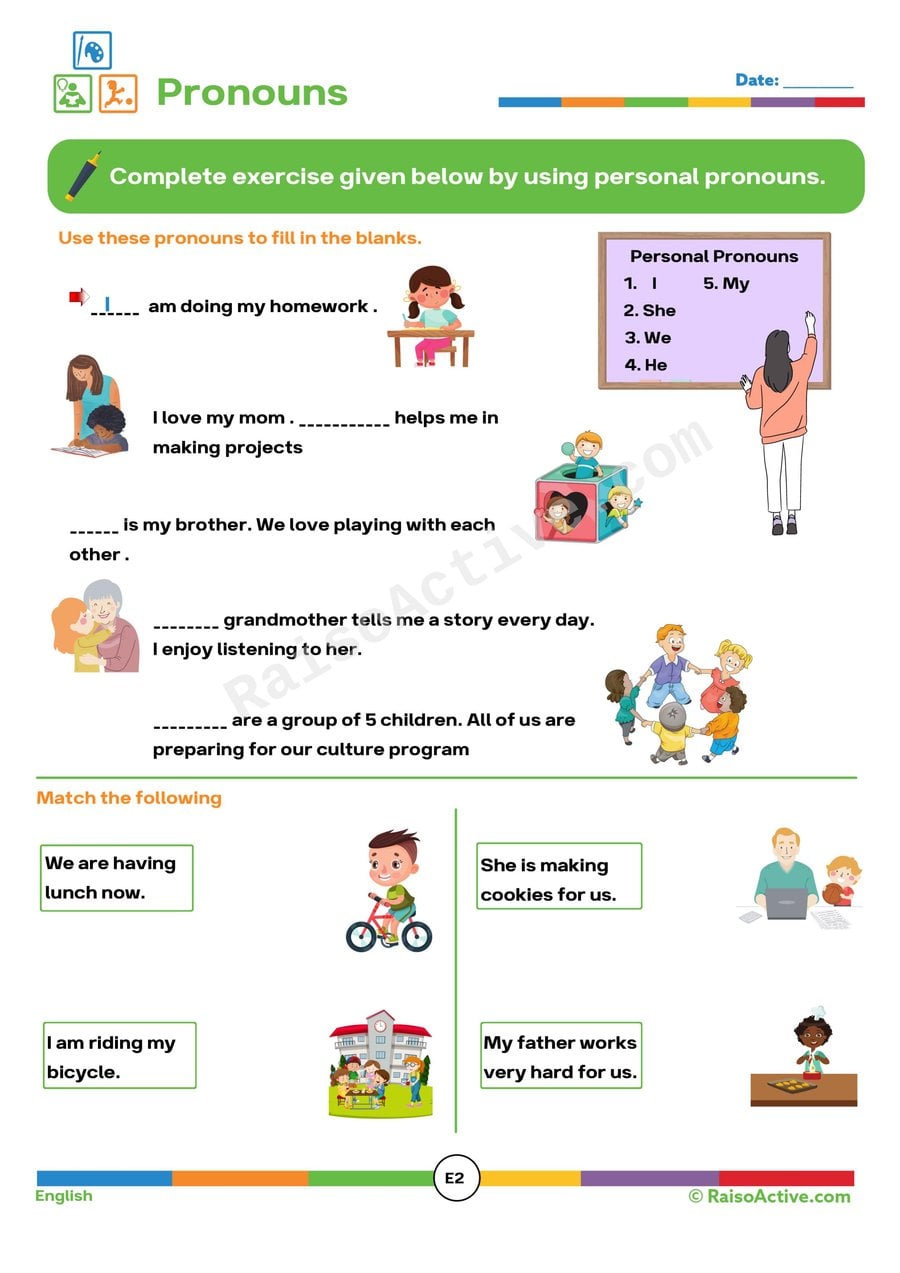
Pronouns Practice Worksheet for Preschoolers
Ages 4-6 · Pre-K–KindergartenAges 4-6 · Reception–Year 1Ages 4-6 · LKG–UKGAges 4-6
Children ages 4-6 practice using personal pronouns like 'I', 'she', 'we', 'he', and 'my' correctly within simple sentences, an early grammar skill that helps their speech and writing sound clear and natural. Matching completed sentences to images afterward reinforces comprehension, ensuring children understand the meaning behind the pronoun they chose rather than guessing. This combination of fill-in-the-blank and picture matching builds both grammar accuracy and reading comprehension together.
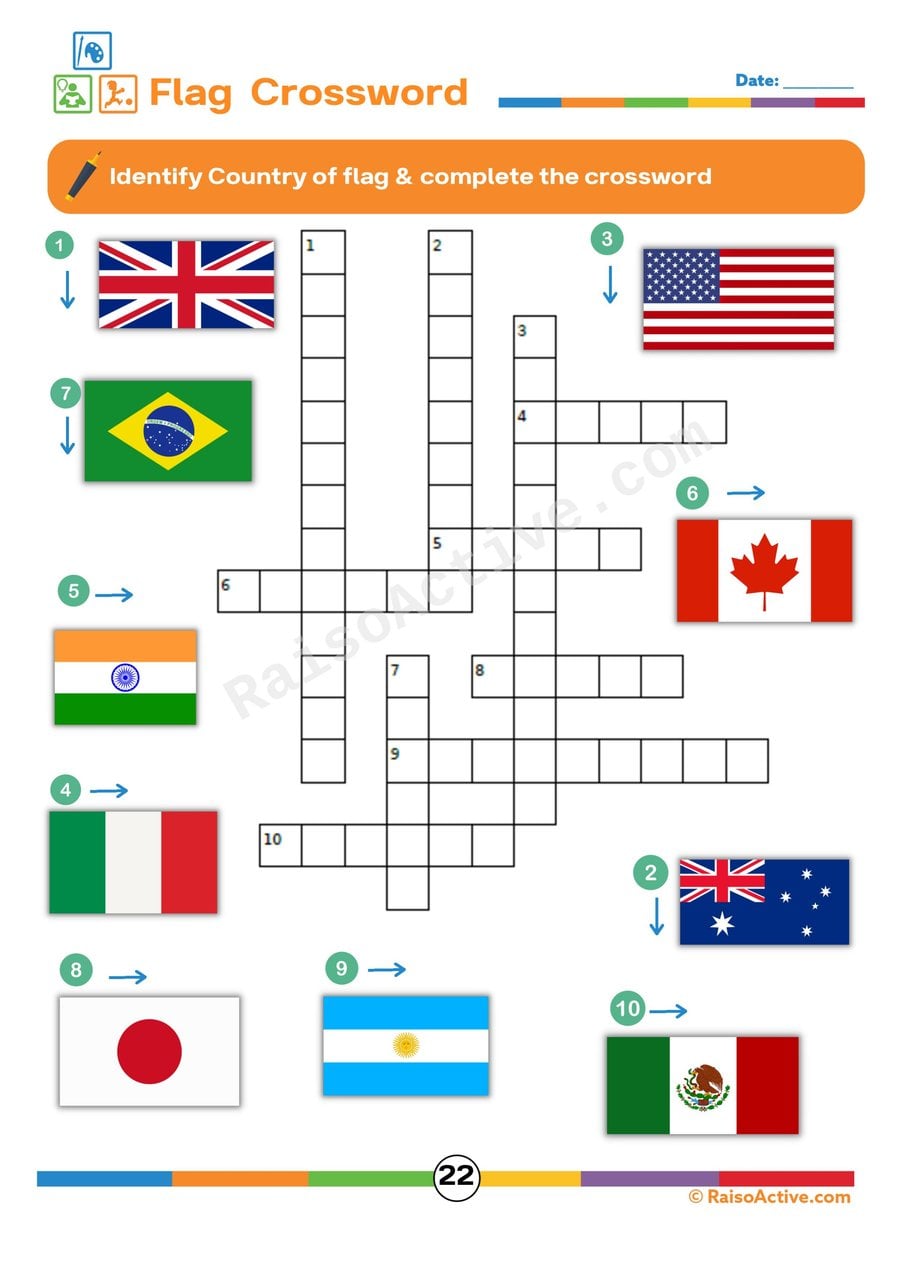
Flag Crossword Puzzle Worksheet for Kids
Ages 4-6 · Pre-K–KindergartenAges 4-6 · Reception–Year 1Ages 4-6 · LKG–UKGAges 4-6
This flag crossword challenges children ages 4-6 to identify a country from its flag image and then spell out its name letter by letter in a crossword grid, linking visual recognition with early spelling and word-structure skills. Fitting each answer into the correct number of boxes also reinforces letter counting and attention to word length.
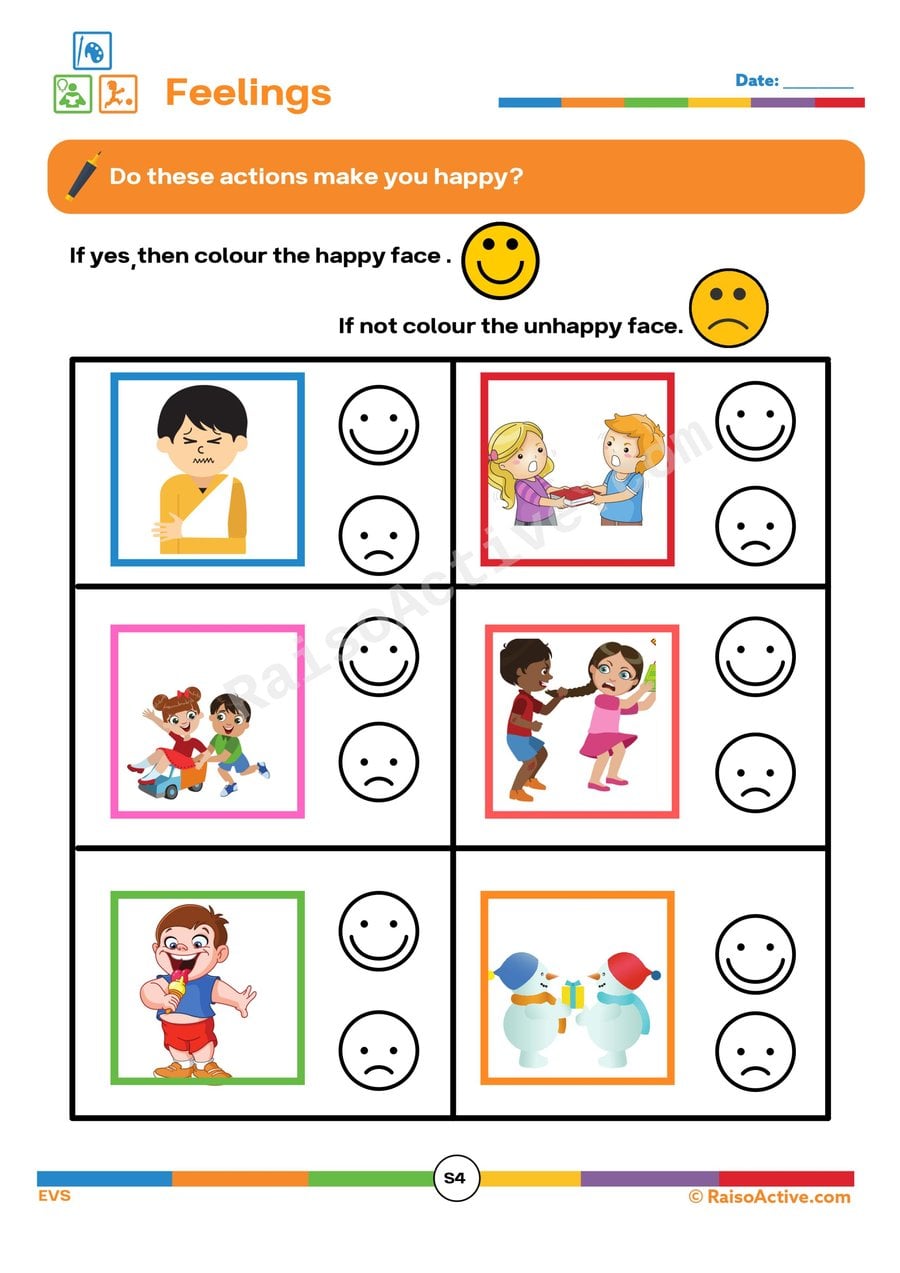
Feelings Worksheet: Happy or Sad?
Ages 3-5 · Preschool–Pre-KAges 3-5 · Nursery–ReceptionAges 3-5 · Nursery–LKGAges 3-5
Children ages 3-5 build emotional vocabulary and self-awareness as they decide whether different everyday situations would make them feel happy or sad. Naming and sorting emotions based on a scenario is an early social-emotional skill that helps children recognize and eventually talk about their own feelings more clearly.
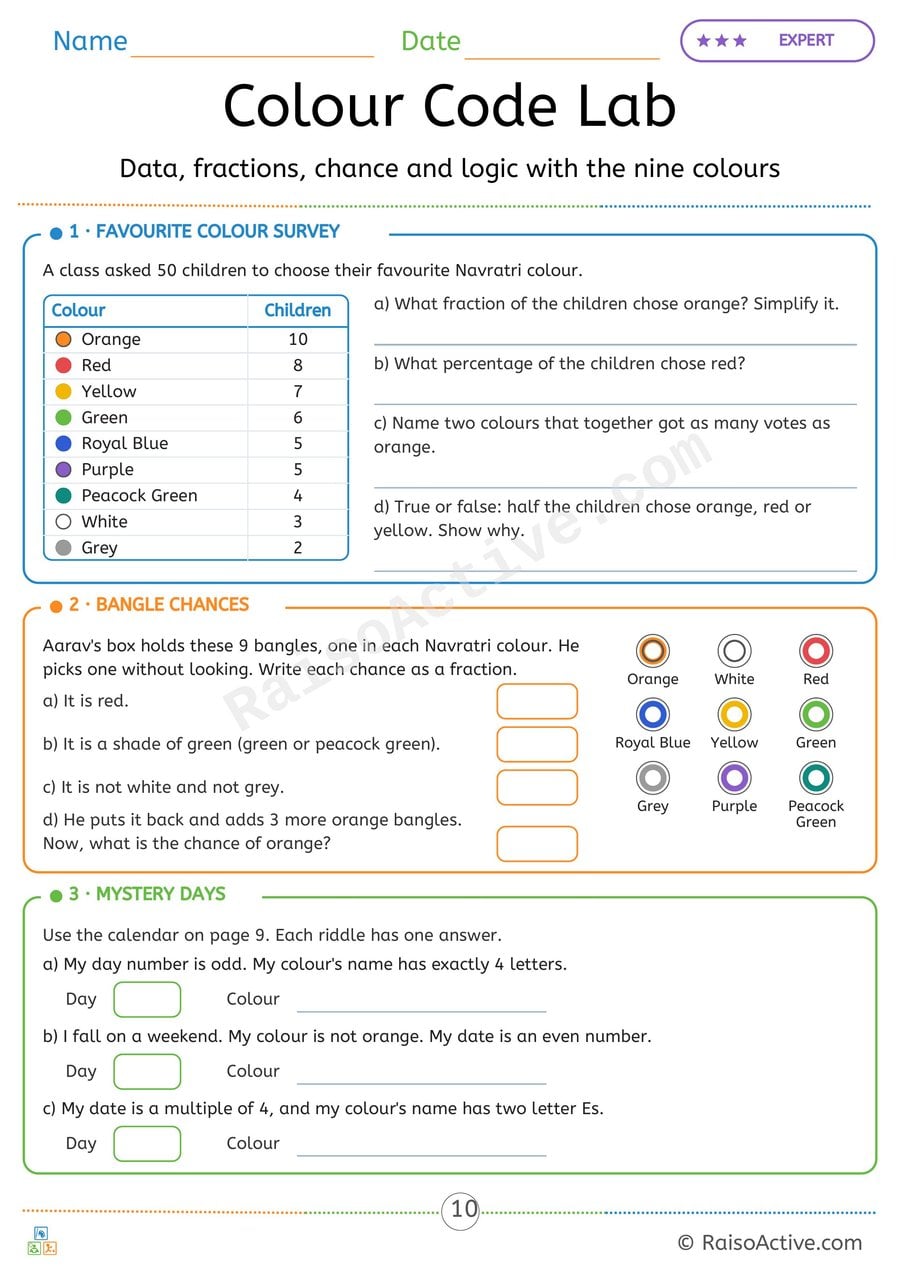
Colour Code Lab: Navratri Fractions, Percentages and Probability
Ages 7-11 · Grade 2–Grade 3Ages 7-11 · Year 3–Year 4Ages 7-11 · Class 2–Class 3Ages 7-11
Children read a survey of 50 children's favourite Navratri colours and write fractions and percentages, write the chance of picking each kind of bangle as a fraction, and solve three riddles using the colour calendar on page 9.
Guides for this topic

Age-Appropriate Problem-Solving Activities: Building Critical Thinkers from the Ground Up
Discover fun, age-appropriate problem-solving activities for children ages 1-8. Build critical thinking, logic, and reasoning skills through play-based learning.
Critical Thinking Activities That Actually Work for Young Children: Building Tomorrow's Thinkers Today
Discover proven critical thinking activities for young children. Age-wise logic games, questioning techniques, and hands-on ideas to build thinking skills at home.

Preparing Your Child for a Rapidly Changing World: Essential Skills for Future Success
Discover the essential 21st century skills your child needs for future success. Practical tips on creativity, critical thinking, digital literacy & emotional intelligence for ages 1-8.
Reviews
Every worksheet for ages 4–6, no watermark
Members download the full library of 1,000+ worksheets and every activity pack without watermarks or daily limits. One year costs ₹999 in India or $20 elsewhere.
See membership plansOr download any worksheet free with a watermark (5 a day).