Place Value Beads: Count and Fill the Numbers Worksheet
Counting beads on an abacus-style picture and writing the tens and ones totals teaches children ages 3-5 place value through a visual, hands-on representation rather than abstract numerals alone. Solving the final abacus total afterward reinforces that a two-digit number is really the sum of its tens and ones parts.
Part of the pack
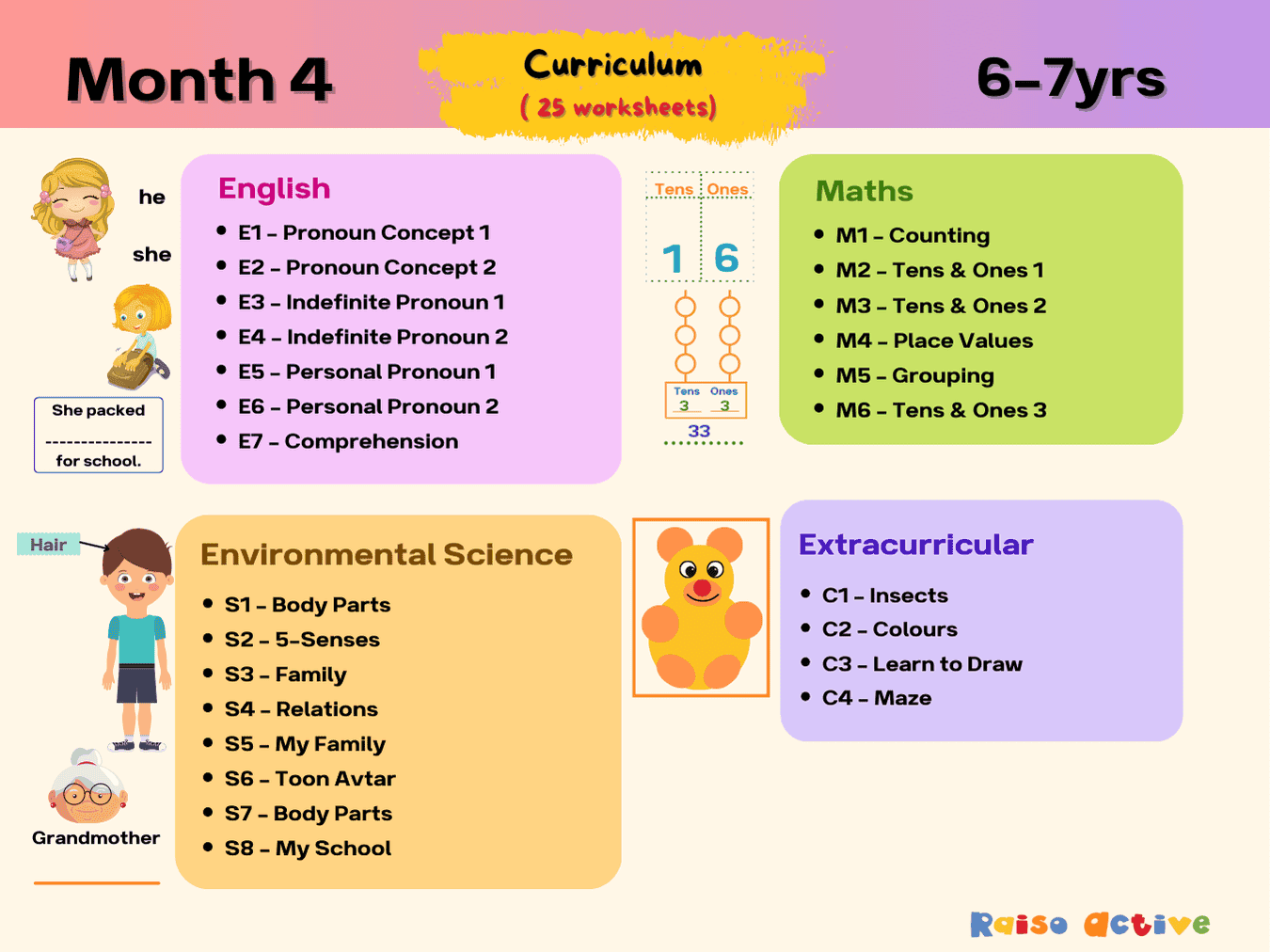
Month 4: Learning & Development | Ages 6-7
This is page 14 of the pack. Ages 6-7 · Grade 1Ages 6-7 · Year 2Ages 6-7 · Class 1Ages 6-7
Made for your child
Tens and ones, made for your child
A maths pack with your child's name in it: pictures that explain, practice at three levels, puzzles and story sums about them. Print a new set whenever they finish.
Make a maths packFree preview · free for members
Curriculum
- Number Recognition > Number Names
How to use this worksheet
Look at the first abacus picture together and count the beads in the tens row, then count the beads in the ones row separately. Have your child write each count in the correct tens and ones box. Once both boxes are filled in, ask them to combine the tens and ones to solve the abacus's total number.
Materials needed
- Pencil
- Crayons
Extension activities
- 1Build your own simple abacus using pipe cleaners threaded with beads.
- 2Count everyday objects and group them into tens and leftover ones.
- 3Draw new abacus pictures with different bead counts for extra practice.
- 4Practice with two-digit number cards, asking how many tens and ones make up each one.
- 5Use a real abacus toy, if you have one, to practice sliding beads to match numbers.

Written by
Hemsweta Jain · Teacher Cheena
MBA and Early Childhood Educator, teaching since 2014 · Founder of RaisoActive, Mumbai
Every RaisoActive worksheet is designed and checked by the founder before publishing.
Published · Last reviewed
More from Month 4: Learning & Development | Ages 6-7
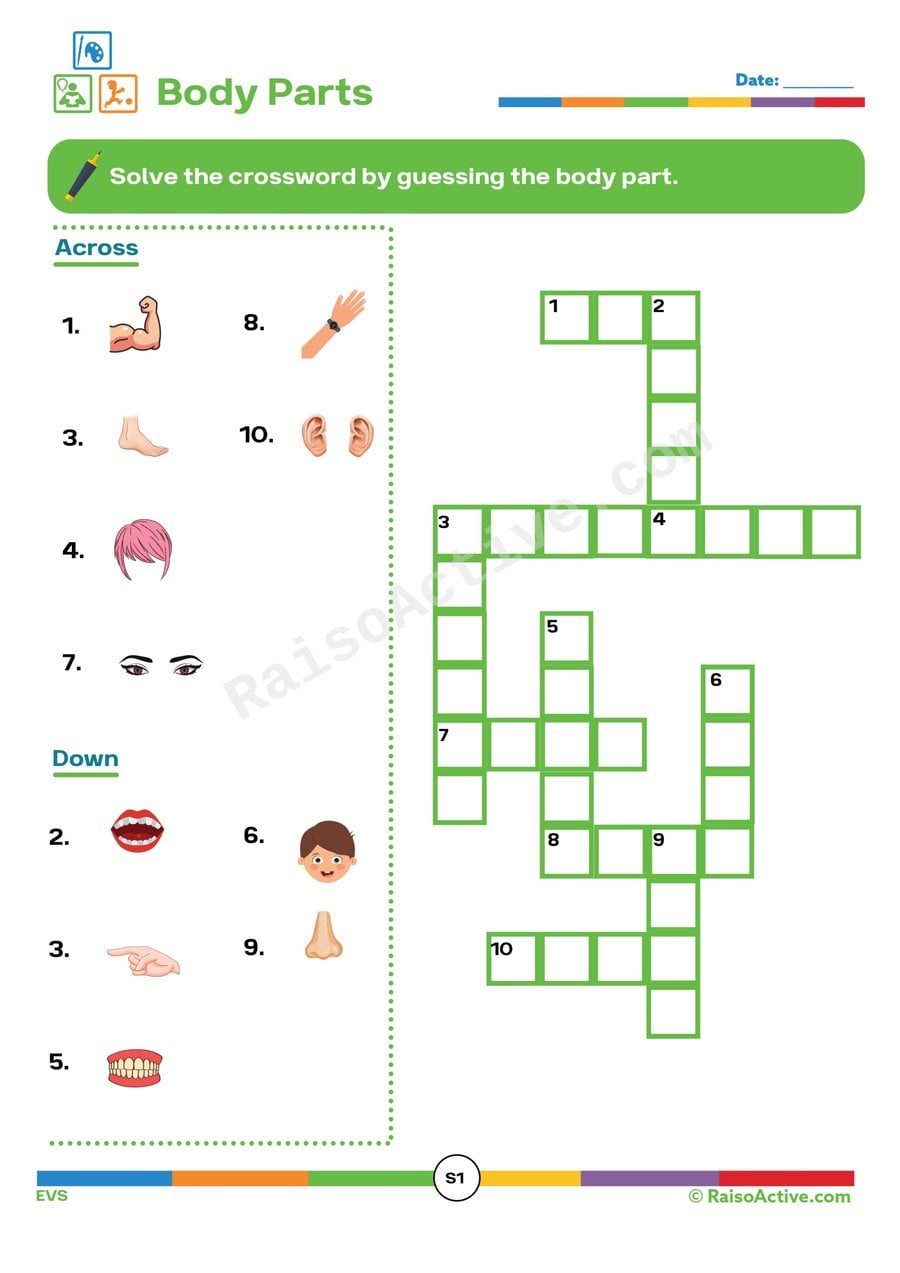
Body Parts Crossword Puzzle Worksheet for Kids
Ages 3-5 · Preschool–Pre-KAges 3-5 · Nursery–ReceptionAges 3-5 · Nursery–LKGAges 3-5
Solving a crossword using body part picture clues teaches children ages 3-5 to connect a visual image with its written name, building both vocabulary and early spelling skills. Working through the crossword's number grid also introduces the format of organizing answers into specific boxes, a small but useful pre-literacy skill.

My Family Worksheet: Learn About Family Members!
Ages 3-5 · Preschool–Pre-KAges 3-5 · Nursery–ReceptionAges 3-5 · Nursery–LKGAges 3-5
Writing the names of family members next to their pictures helps children ages 3-5 connect written words to real relationships in their own lives, combining early handwriting practice with meaningful, personal vocabulary. Because the content is about their own family, this worksheet tends to feel especially engaging and easy to talk about.

Indefinite Pronouns Worksheet: Fill-in-the-Blanks Fun!
Ages 4-6 · Pre-K–KindergartenAges 4-6 · Reception–Year 1Ages 4-6 · LKG–UKGAges 4-6
Filling in the blanks with indefinite pronouns like something, someone, and somewhere teaches children ages 4-6 how these flexible words stand in for people, places, or things without naming them specifically, an important step in building more natural, varied sentences. Using picture clues alongside the sentences also helps children connect abstract grammar terms to concrete, familiar scenes.

Personal Pronouns Worksheet for Kids: Matching and Writing
Ages 3-5 · Preschool–Pre-KAges 3-5 · Nursery–ReceptionAges 3-5 · Nursery–LKGAges 3-5
Children ages 3-5 practice choosing and writing the correct personal pronoun — I, you, she, it, we, or they — for a picture or phrase, building an early grammar skill that makes their spoken and written sentences sound natural. Matching a pronoun to who or what it refers to also strengthens reading comprehension, since pronouns require tracking who is being talked about.

Help the Boy Get Home! A Fun Maze Worksheet for Kids
Ages 3-5 · Preschool–Pre-KAges 3-5 · Nursery–ReceptionAges 3-5 · Nursery–LKGAges 3-5
Tracing a path through a maze to help a boy get home builds visual tracking and route-planning skills for children ages 3-5, since they must scan ahead and mentally test paths before committing to one. This kind of trial-and-error problem solving also strengthens the fine motor control needed to keep a pencil line steady along a winding path.

Pronoun Power: Circle the Correct Pronoun Worksheet
Ages 4-6 · Pre-K–KindergartenAges 4-6 · Reception–Year 1Ages 4-6 · LKG–UKGAges 4-6
This worksheet helps children ages 4-6 practice using the pronouns 'he' and 'she' correctly by looking at a picture of a person and circling the pronoun that matches. Correctly substituting a pronoun for a person's name is an early grammar milestone that makes spoken and written sentences smoother and less repetitive.
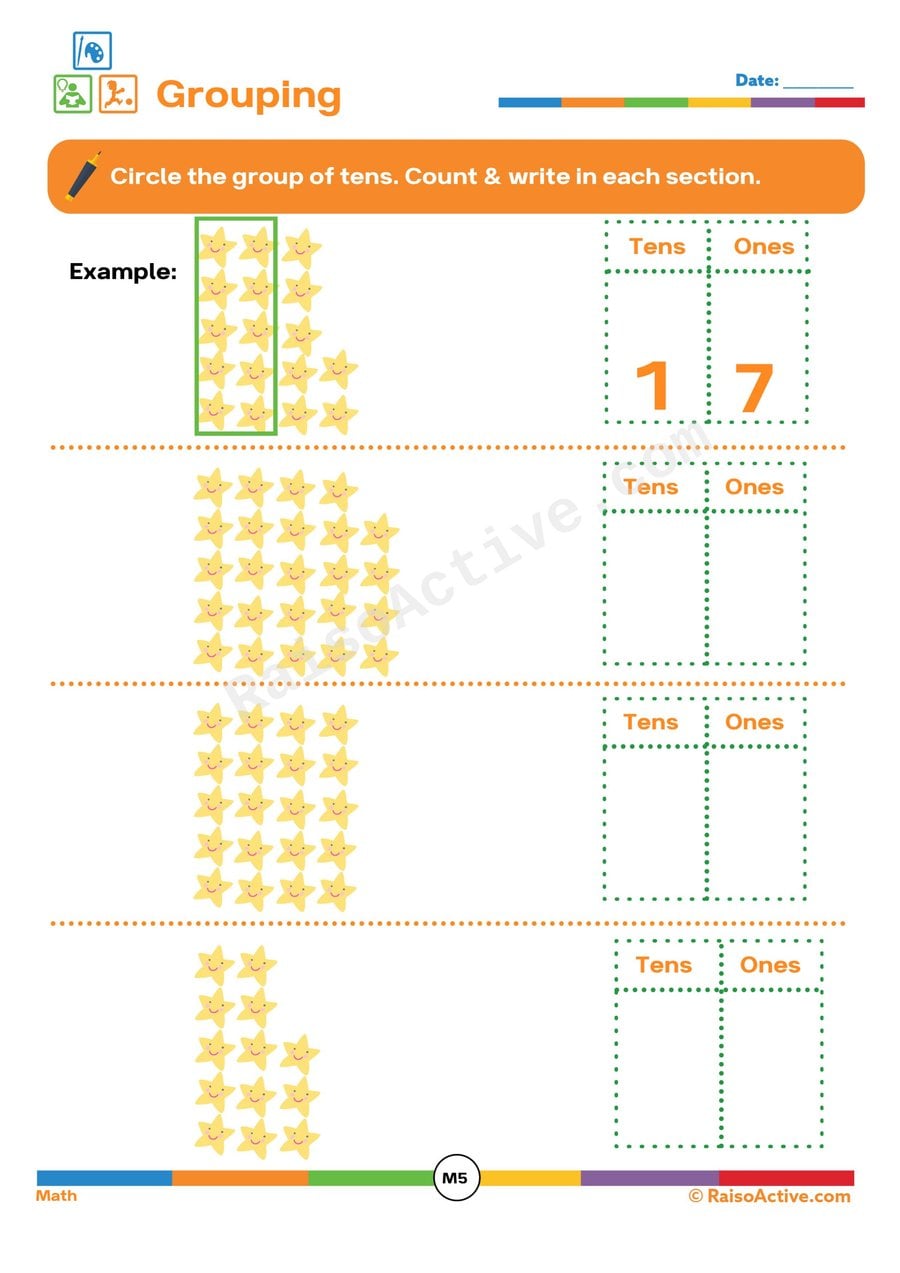
Grouping Stars: Tens and Ones Worksheet for Kids
Ages 4-6 · Pre-K–KindergartenAges 4-6 · Reception–Year 1Ages 4-6 · LKG–UKGAges 4-6
Circling groups of ten stars and counting the leftover ones teaches children ages 4-6 to see a two-digit number as tens plus ones, reinforcing place value in a visual, hands-on way. This grouping practice builds a stronger number sense than memorizing numerals alone, since children physically organize quantities before writing them down.

My School Cut and Paste Worksheet for Preschoolers
Ages 3-5 · Preschool–Pre-KAges 3-5 · Nursery–ReceptionAges 3-5 · Nursery–LKGAges 3-5
Cutting out school-related pictures and pasting them into the correct spaces on a school building teaches children ages 3-5 vocabulary for familiar school spaces, like a classroom or playground, while also strengthening spatial matching and fine motor cutting and pasting skills. This activity helps children who are new to school, or preparing to start, connect words to places they'll actually encounter.
Related worksheets

Tens and Ones Worksheet: Counting Fruits and Matching Numbers!
Ages 4-6 · Pre-K–KindergartenAges 4-6 · Reception–Year 1Ages 4-6 · LKG–UKGAges 4-6
Counting groups of fruit and organizing them into tens and ones builds early place value understanding for children ages 4-6, a foundational concept for reading and writing two-digit numbers correctly.

Number Names Matching Worksheet for Preschoolers
Ages 3-5 · Preschool–Pre-KAges 3-5 · Nursery–ReceptionAges 3-5 · Nursery–LKGAges 3-5
Matching numerals to their written number-word form, like connecting '5' to the word 'five,' teaches children ages 3-5 that numbers can be represented two different ways: as a symbol and as a spelled-out word. Searching for the correct number name within a word search grid also builds visual scanning and early sight-word recognition, since number words like 'one' or 'seven' don't always follow predictable spelling patterns. This dual practice strengthens both numeracy and literacy at the same time.

Number Names Worksheet: Write the Missing Letters!
Ages 4-6 · Pre-K–KindergartenAges 4-6 · Reception–Year 1Ages 4-6 · LKG–UKGAges 4-6
This worksheet builds early spelling and number-word recognition as children ages 4-6 look at a numeral and fill in the missing letters to complete its written name, such as turning 'f_ve' into 'five.' Connecting the numeral, the spoken word, and its written spelling all in one task strengthens both literacy and numeracy at the same time.

Number Names Worksheet: Matching and Writing Numbers
Ages 4-6 · Pre-K–KindergartenAges 4-6 · Reception–Year 1Ages 4-6 · LKG–UKGAges 4-6
This worksheet strengthens the connection between a written number name and its numeral for 4-6 year olds — first by circling the numeral that matches a given name, then by writing the number name out themselves, which adds a spelling and handwriting layer on top of simple recognition. Because number-name spelling doesn't always follow easy sound-out rules, this repeated practice with both reading and writing the words builds genuine sight-word familiarity with number vocabulary.

Number Matching and Counting Worksheet for Preschoolers
Ages 3-5 · Preschool–Pre-KAges 3-5 · Nursery–ReceptionAges 3-5 · Nursery–LKGAges 3-5
This worksheet combines counting, cutting and pasting, and a targeted number-recognition task, finding circles with '5' in the ones place, giving children practice with quantity, fine motor coordination, and number pattern spotting all in one page. For ages three to five, recognizing a specific digit within a larger number, like the '5' in '15' or '25', is early groundwork for understanding place value.

Number Names Worksheet: Unscramble, Match, and Write Numbers!
Ages 4-6 · Pre-K–KindergartenAges 4-6 · Reception–Year 1Ages 4-6 · LKG–UKGAges 4-6
This worksheet layers three literacy and numeracy skills together: unscrambling jumbled letters to spell out number names, writing the corresponding numeral, and matching numbers to their written names. For ages 4-6, connecting a numeral like '5' to its written word 'five' bridges math and reading skills, reinforcing that numbers can be represented in more than one way.

Number Path: Help the Boy Reach His House! (Numbers 41-50)
Ages 4-6 · Pre-K–KindergartenAges 4-6 · Reception–Year 1Ages 4-6 · LKG–UKGAges 4-6
This maze worksheet takes 4-6 year olds into two-digit number territory, asking them to recognize and sequence numbers 41 through 50 in order to trace a path — a step up in difficulty from single-digit counting since two-digit numbers are easy to reverse or confuse (41 versus 14). Tracing the connecting line also keeps pencil control and hand-eye coordination in play alongside the number work, and the payoff of guiding the boy home gives the counting task a clear, motivating goal.

Number Names Matching Worksheet for Preschoolers
Ages 3-5 · Preschool–Pre-KAges 3-5 · Nursery–ReceptionAges 3-5 · Nursery–LKGAges 3-5
This worksheet helps children ages 3-5 connect written number names, like 'three' or 'seven,' to the numeral they represent, an important step beyond simply recognizing digits since it introduces reading actual number words. Decoding a color clue to figure out and write each number name first adds an extra layer of visual attention before the matching step even begins.
Guides for this topic

Documenting Learning Without Drowning in Data: A Practical Guide for Parents and Teachers
Learn practical ways to document your child's learning without overwhelm. Simple portfolios, observation tips, and printable trackers for ages 1-8.

How to Help Your Child with Letter Reversals: A Complete Guide for Parents and Teachers
Letter reversals are normal until age 7-8. Learn the best multisensory strategies, anchor letter tricks, and activities to help children write b, d, p, and q correctly.

Activities That Help with Pencil Grip Development: A Complete Guide for Parents and Teachers
Discover fun, research-backed activities to develop pencil grip in young children. Age-wise exercises, play ideas, and expert tips for parents and teachers.
Reviews
Every worksheet for ages 3–5, no watermark
Members download the full library of 1,000+ worksheets and every activity pack without watermarks or daily limits. One year costs ₹999 in India or $20 elsewhere.
See membership plansOr download any worksheet free with a watermark (5 a day).