Free printable worksheets · US · UK · India
Math Worksheets for Kids (Ages 2–7)
Math worksheets for kids are printable practice sheets for children aged 2 to 7 that build number sense in stages: counting objects, recognizing and writing numerals, comparing quantities, adding and subtracting within 20, and understanding tens and ones. They match the content of Preschool through 1st Grade, Nursery through Year 2, and Nursery through Class 1.
Early math develops in a fixed order, and a worksheet only helps when it sits on the right rung. A three-year-old is learning that the last number said tells how many are in the pile. A five-year-old is joining and separating groups within 10 and writing the matching equation. A seven-year-old reads 47 as four tens and seven ones and adds two-digit numbers without regrouping. The sheets on this page are grouped by that ladder rather than by grade, because the same step is taught in Pre-K in the United States, Reception in the United Kingdom and LKG in India. Choose the stage your child is working at, not the age printed on the page, and move up when a sheet is completed correctly without finger counting.
- 694 worksheets
- Free PDF download
- Print on A4 or Letter
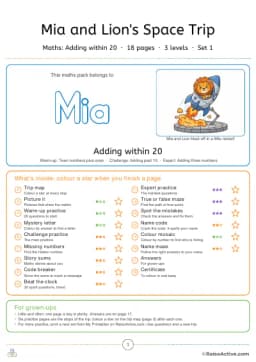
Made for your child
Numbers to 20, made for your child
A maths pack with your child's name in it: pictures that explain, practice at three levels, puzzles and story sums about them. Print a new set whenever they finish.
Make a maths packFree preview · free for members
Math Worksheets for Kids to print
Browse all worksheets for ages 2–7
Ascending Order Trucks Worksheet for Preschoolers
Ages 4-6 · Pre-K–KindergartenAges 4-6 · Reception–Year 1Ages 4-6 · LKG–UKGAges 4-6
Children ages 4-6 practice arranging numbers in ascending order, from smallest to largest, using a playful truck-themed sequencing task. Understanding ascending order requires comparing multiple numbers at once and deciding their correct relative position, a more advanced skill than simple counting forward. This kind of number ordering builds critical number sense that supports later skills like comparing quantities and reading number lines.

Addition Fun: Add and Match the Numbers! (Worksheet)
Ages 4-6 · Pre-K–KindergartenAges 4-6 · Reception–Year 1Ages 4-6 · LKG–UKGAges 4-6
Children ages 4-6 practice basic addition by counting two groups of pictured objects, finding their total, and then matching that sum to the correct number, combining counting, addition, and visual matching in a single activity. Drawing a line to connect an answer to its number reinforces that a math sentence and a numeral represent exactly the same quantity.

Tens and Ones Worksheet: Matching and Counting Fun!
Ages 4-6 · Pre-K–KindergartenAges 4-6 · Reception–Year 1Ages 4-6 · LKG–UKGAges 4-6
Understanding that a two-digit number is made up of groups of ten plus some extra ones is one of the most important early place value concepts for children ages 4-6, forming the foundation for all later multi-digit addition and subtraction. This worksheet combines an equation-matching task with an object-counting task, giving children practice with basic addition facts alongside the specific skill of grouping objects into tens and counting remaining ones. Seeing the same numerical ideas presented in two different formats on one page helps reinforce that place value isn't just an abstract rule but a way of organizing real quantities.

Addition Worksheet for Kids: Add Horizontally and Vertically!
Ages 4-6 · Pre-K–KindergartenAges 4-6 · Reception–Year 1Ages 4-6 · LKG–UKGAges 4-6
Children ages 4-6 practice basic addition by solving problems arranged both horizontally, like '3 + 2 =,' and vertically, in a stacked column format, building flexibility with the two most common ways addition problems appear in early math worksheets and textbooks. Learning both formats now means neither will feel unfamiliar once formal school math introduces them side by side.

Apples to Basket: Sorting Math Worksheet for Preschoolers
Ages 4-6 · Pre-K–KindergartenAges 4-6 · Reception–Year 1Ages 4-6 · LKG–UKGAges 4-6
This worksheet combines basic addition and subtraction practice with sorting skills as children ages 4-6 solve a math problem written on each apple, then decide which basket it belongs in based on whether the answer is more or less than a target number. Categorizing numbers by size after calculating them adds a layer of number-sense reasoning beyond simply finding the right answer.
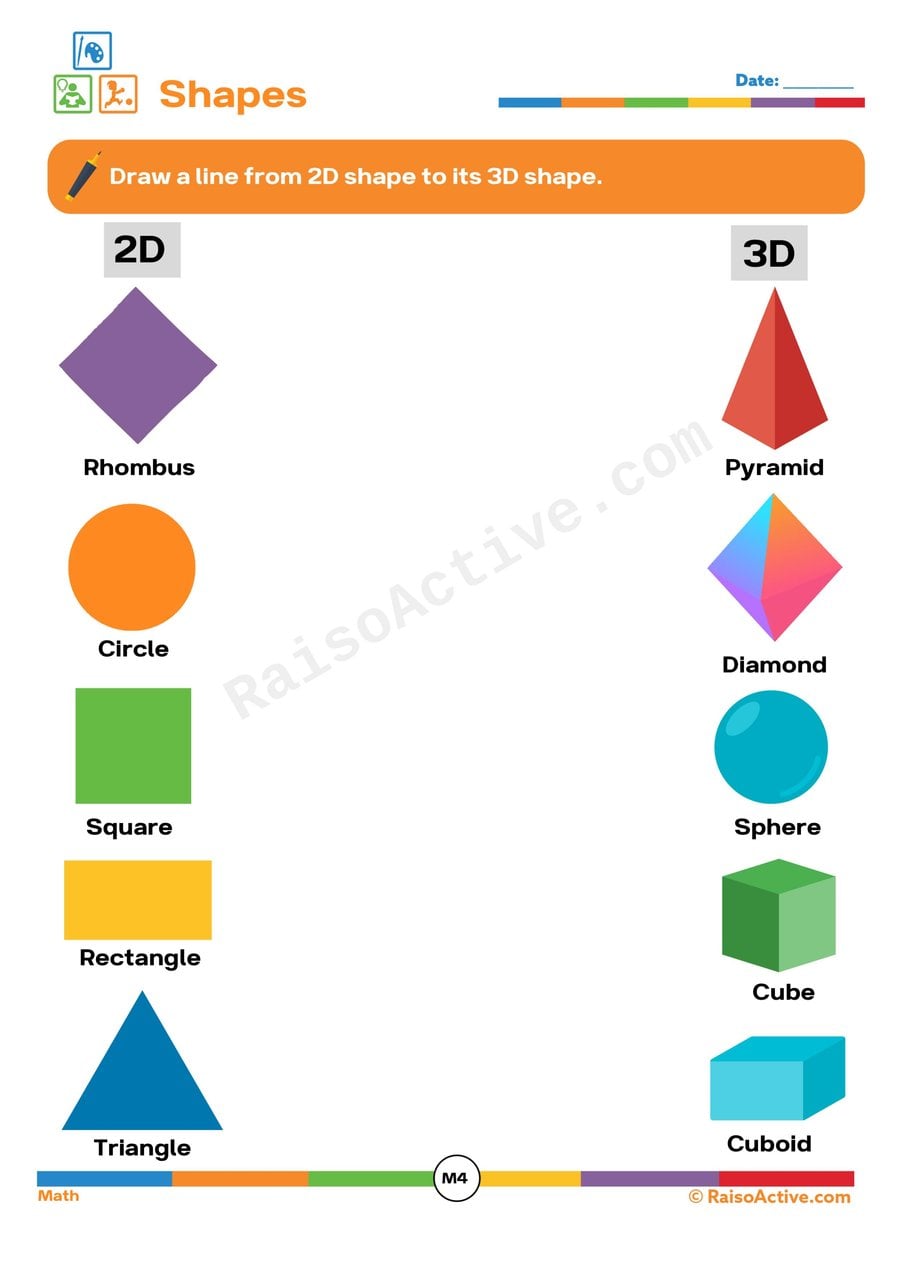
Shape Match: 2D to 3D Shapes Worksheet
Ages 4-6 · Pre-K–KindergartenAges 4-6 · Reception–Year 1Ages 4-6 · LKG–UKGAges 4-6
This worksheet introduces 4-6 year olds to the relationship between flat 2D shapes and solid 3D shapes — connecting a circle to a sphere, a square to a cube — which is an important spatial reasoning leap, since a 3D shape's flat 'face' is what actually corresponds to its related 2D shape. Making this connection explicit helps children understand that the shapes they've been learning aren't just flat pictures but also describe the surfaces of real, solid objects around them.
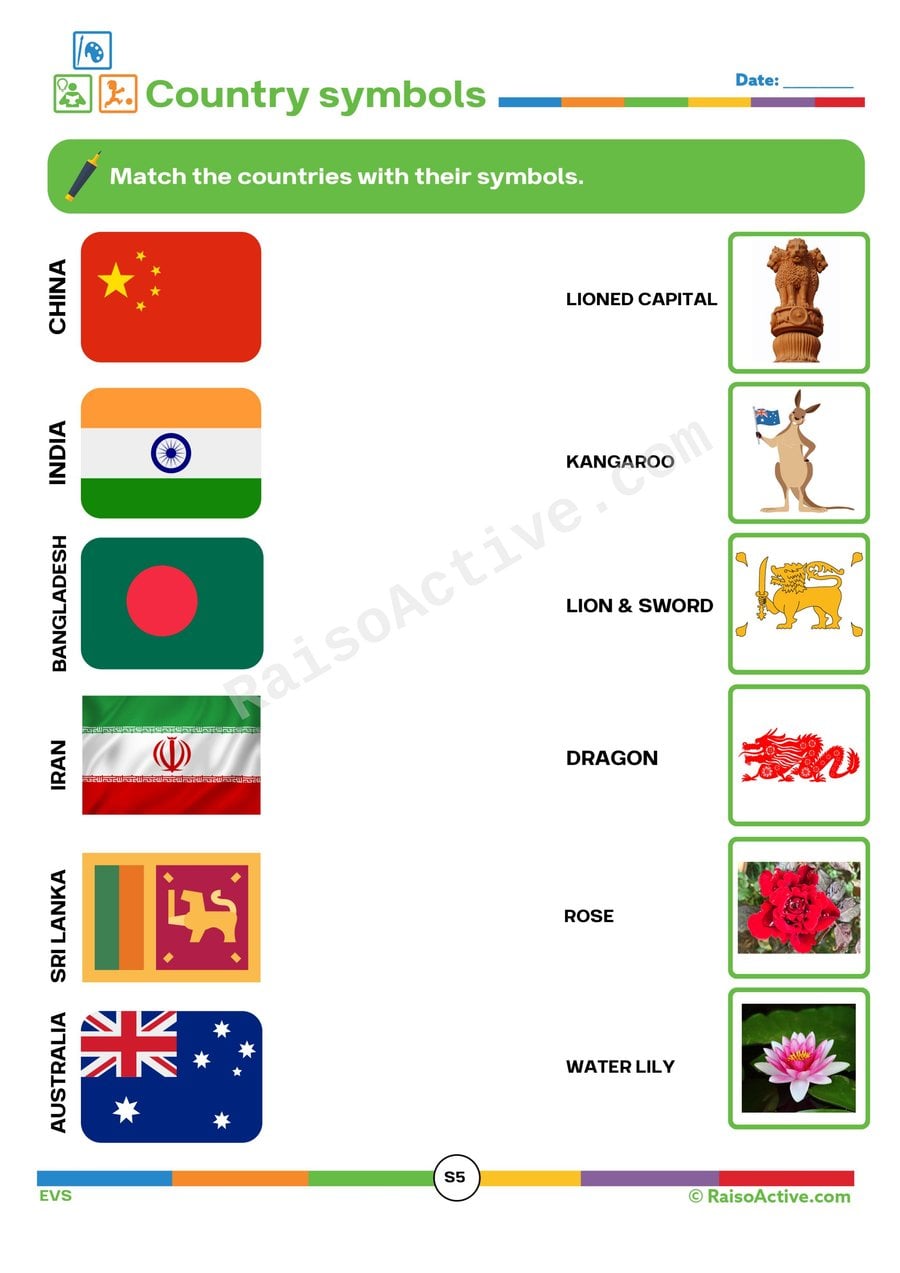
Match the Country Symbols Worksheet for Kids
Ages 4-6 · Pre-K–KindergartenAges 4-6 · Reception–Year 1Ages 4-6 · LKG–UKGAges 4-6
Matching country flags to their national symbols introduces children ages 4-6 to the idea that countries have their own distinct visual identities, an early and engaging entry point into geography and cultural awareness. This matching task builds visual discrimination, since flags and symbols can share similar colors or shapes that require careful comparison. Learning to associate a flag with a symbol also plants early vocabulary for talking about different countries and cultures around the world.

Adjective Adventure: Matching Sentences Worksheet for Kids
Ages 4-6 · Pre-K–KindergartenAges 4-6 · Reception–Year 1Ages 4-6 · LKG–UKGAges 4-6
This worksheet teaches 4-6 year olds that adjectives are the words that describe nouns, asking them to fill in a missing adjective in a sentence and then physically mark the noun and adjective separately by underlining and circling. That separation step — telling apart which word names a thing and which word describes it — is a genuinely useful grammar distinction that most children haven't consciously noticed before, even though they use adjectives constantly in speech.
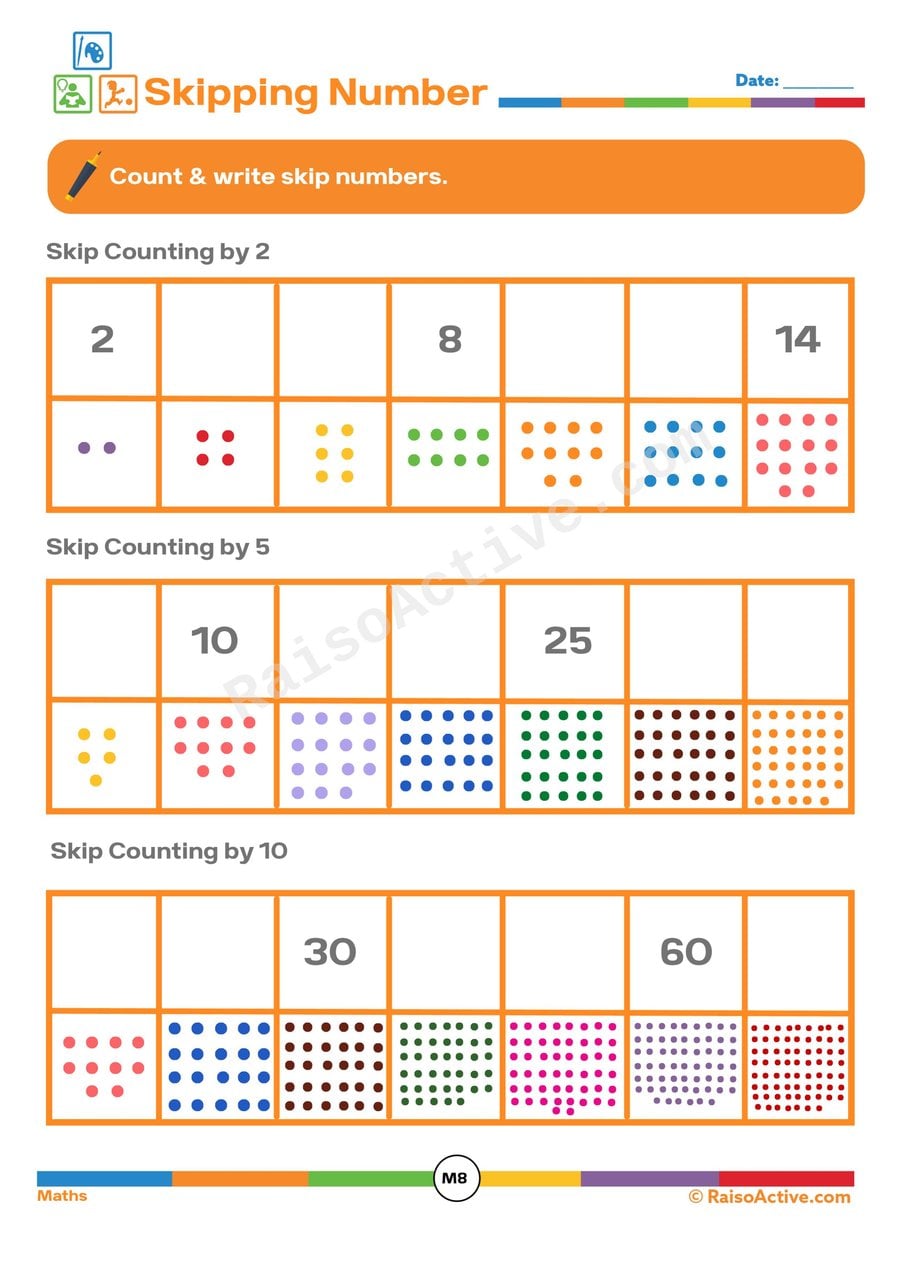
Skip Counting Adventure: Counting by 2, 5, and 10!
Ages 4-6 · Pre-K–KindergartenAges 4-6 · Reception–Year 1Ages 4-6 · LKG–UKGAges 4-6
Children ages 4-6 practice skip counting by 2s, 5s, and 10s, recognizing the repeating number patterns that let them count large groups faster than counting one by one. Skip counting is an early stepping stone toward multiplication and a genuinely useful shortcut children can apply well beyond this worksheet.

Navratri Mix and Pattern: Mixing Colours and Bead Patterns
Ages 4-6 · Pre-K–KindergartenAges 4-6 · Reception–Year 1Ages 4-6 · LKG–UKGAges 4-6
Children learn which two colours mix to make green, orange, purple and grey, continue colour patterns on beads and read a simple chart to answer questions.

Tens and Ones Worksheet: Practice Place Value with Fun Elephants!
Ages 4-6 · Pre-K–KindergartenAges 4-6 · Reception–Year 1Ages 4-6 · LKG–UKGAges 4-6
This worksheet has children break two-digit numbers into their tens and ones parts, then apply that understanding to simple addition and subtraction, a natural next step once place value clicks. For ages four to six, using the playful elephant images keeps a fairly abstract math concept approachable while still building the numerical foundation they'll rely on for years of arithmetic to come.

Comparing Numbers Worksheet: Greater Than, Less Than, and Equal To!
Ages 4-6 · Pre-K–KindergartenAges 4-6 · Reception–Year 1Ages 4-6 · LKG–UKGAges 4-6
Children ages 4-6 learn to compare two numbers and choose the correct symbol — greater than, less than, or equal to — building an essential foundation for later work with inequalities and algebra. Comparing quantities and representing the relationship symbolically is a more abstract skill than simple counting, so this worksheet stretches children just past straightforward number recognition into true numerical reasoning.

Counting and Comparing: Greater Than, Less Than, or Equal To Worksheet
Ages 4-6 · Pre-K–KindergartenAges 4-6 · Reception–Year 1Ages 4-6 · LKG–UKGAges 4-6
This worksheet builds on basic counting by asking children to compare two separate groups of pictures and decide whether one group has more, fewer, or the same number as the other, then represent that relationship with the correct symbol. For four- to six-year-olds, this task combines accurate counting with comparative reasoning, both of which are essential building blocks for later mathematical problem solving.

Tens and Ones Matching Worksheet for Preschoolers
Ages 4-6 · Pre-K–KindergartenAges 4-6 · Reception–Year 1Ages 4-6 · LKG–UKGAges 4-6
Children ages 4-6 begin exploring the concept of tens and ones by matching groups of objects to their corresponding number sentences, an early step toward understanding place value in two-digit numbers. Cutting and pasting pictures into the correct boxes reinforces the matching logic while adding fine motor practice. This groundwork prepares children for later math concepts like regrouping and multi-digit addition.

Tens and Ones Worksheet: Counting Fruits and Matching Numbers!
Ages 4-6 · Pre-K–KindergartenAges 4-6 · Reception–Year 1Ages 4-6 · LKG–UKGAges 4-6
Counting groups of fruit and organizing them into tens and ones builds early place value understanding for children ages 4-6, a foundational concept for reading and writing two-digit numbers correctly.

Word Problems Worksheet: Addition Practice for Young Learners
Ages 4-6 · Pre-K–KindergartenAges 4-6 · Reception–Year 1Ages 4-6 · LKG–UKGAges 4-6
Solving simple addition word problems teaches children ages 4-6 to translate a short story into a number sentence, practicing both reading comprehension and the mechanics of combining two groups into a total.

Froggy Skip Counting Worksheet: Practice Number Patterns!
Ages 4-6 · Pre-K–KindergartenAges 4-6 · Reception–Year 1Ages 4-6 · LKG–UKGAges 4-6
This worksheet introduces children ages 4-6 to skip counting — counting forward by a number other than one, such as by 2s or 5s — using a playful frog theme to keep the repetitive number pattern engaging. Recognizing and continuing a skip-counting sequence builds early number pattern awareness, a skill that later supports multiplication, telling time, and counting money.

Subtraction Worksheet: Count and Subtract for Preschoolers
Ages 4-6 · Pre-K–KindergartenAges 4-6 · Reception–Year 1Ages 4-6 · LKG–UKGAges 4-6
This worksheet introduces children ages 4-6 to subtraction by having them count a group of objects, take away the indicated amount, and write the resulting difference. Grounding subtraction in physical counting rather than abstract number facts helps children build real number sense, understanding subtraction as 'taking away' rather than just memorizing symbols and answers.
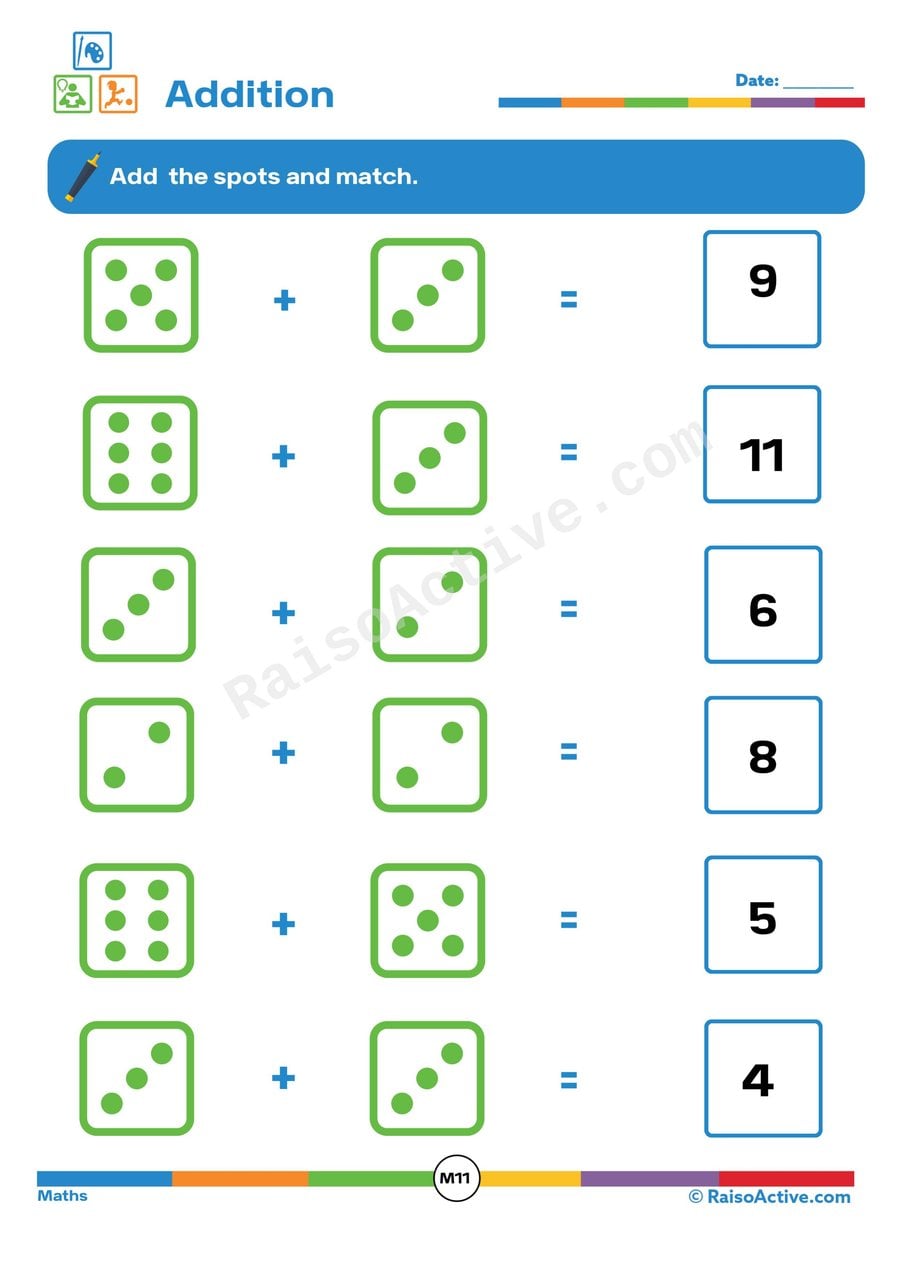
Dice Addition Worksheet: Add the Spots and Match!
Ages 4-6 · Pre-K–KindergartenAges 4-6 · Reception–Year 1Ages 4-6 · LKG–UKGAges 4-6
This worksheet builds basic addition fluency by having children count the dots on two dice, add the totals together, and match the resulting sum to the correct number. For four- to six-year-olds, using dice as the counting tool adds a layer of subitizing practice — the ability to recognize a small quantity of dots at a glance without counting one by one — which speeds up addition over time.
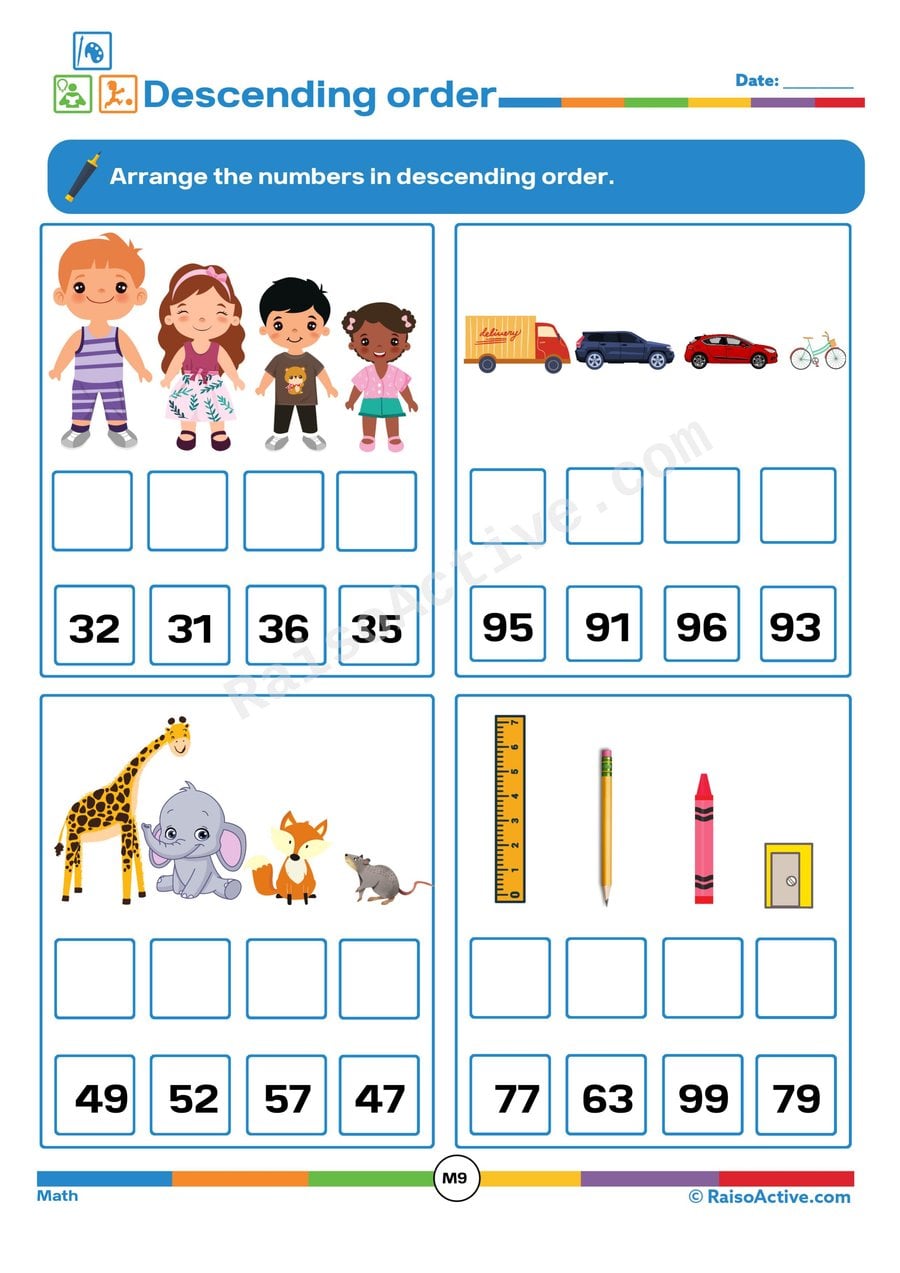
Descending Order Worksheet: Numbers 31-99
Ages 4-6 · Pre-K–KindergartenAges 4-6 · Reception–Year 1Ages 4-6 · LKG–UKGAges 4-6
This worksheet extends number-sequencing skills for children ages 4-6 into the two-digit range of 31 to 99, asking them to arrange given numbers from largest to smallest. Working with larger numbers requires understanding that the tens digit generally determines size first, an important step toward place-value thinking. Practicing descending order, which is less intuitive than counting up, also strengthens flexible number sense.

Numeracy Match: Counting and Number Recognition Worksheet
Ages 4-6 · Pre-K–KindergartenAges 4-6 · Reception–Year 1Ages 4-6 · LKG–UKGAges 4-6
Children ages 4-6 strengthen number recognition by matching written numerals to their corresponding word names or quantities, reinforcing that numbers can be represented in more than one way. This kind of numeral-to-word matching deepens number sense beyond simple counting, helping children see the relationship between symbol, word, and quantity. Coloring in their birth date personalizes the practice and connects it to something meaningful in their own life.
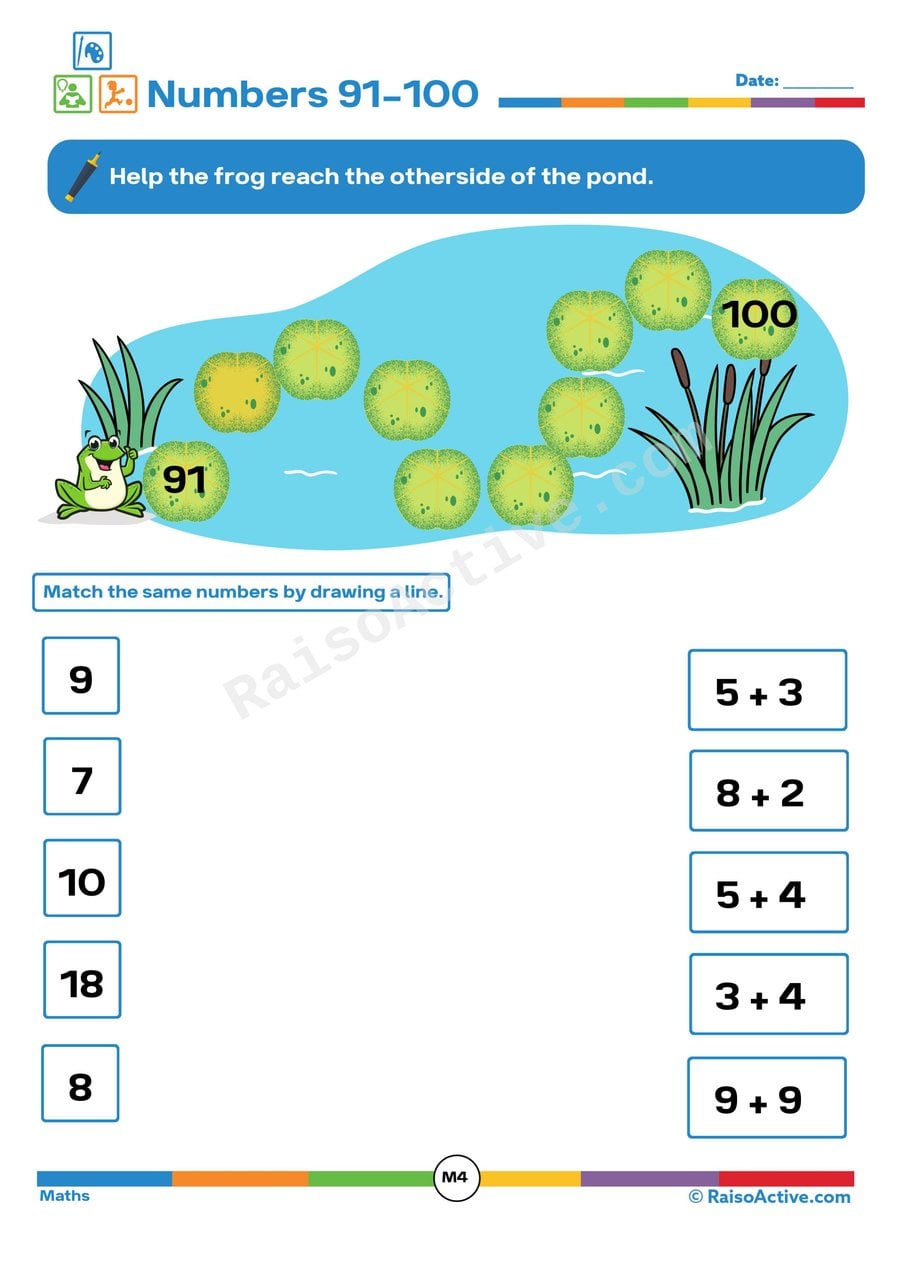
Numbers 91-100 Worksheet: Help the Frog!
Ages 4-6 · Pre-K–KindergartenAges 4-6 · Reception–Year 1Ages 4-6 · LKG–UKGAges 4-6
Numbers in the 90s are a milestone range for children ages 4-6, since they require holding two-digit number recognition steady while approaching the conceptually significant number 100. This worksheet has children match numbers on lily pads to their corresponding value or sum, reinforcing number recognition within this higher range through a playful matching format. Building fluency with numbers up to 100 lays essential groundwork for place value concepts like tens and ones that children will tackle soon after.

Sheep's Barnyard Adventure: A Fun Counting and Movement Worksheet
Ages 4-6 · Pre-K–KindergartenAges 4-6 · Reception–Year 1Ages 4-6 · LKG–UKGAges 4-6
This board-game-style worksheet helps children ages 4-6 practice counting and number recognition by rolling a die and moving a sheep piece along a numbered path, following simple instructions at each stop. Turning counting practice into a game with chance and movement keeps children engaged far longer than a static worksheet, while still reinforcing accurate counting and number sequence recognition along the path.

Festive Math Fun: Counting and Addition Worksheet for Kids
Ages 4-6 · Pre-K–KindergartenAges 4-6 · Reception–Year 1Ages 4-6 · LKG–UKGAges 4-6
Children ages 4-6 sharpen counting accuracy and practice basic addition using festive Christmas visuals, including a snowman scene where sums are recorded directly on its body. This worksheet also introduces subtraction-style thinking by having children count what remains after some objects are 'struck out,' giving an early, concrete preview of take-away math.
What your child learns from age 2 to 7
The progression runs from counting to place value. Counting comes first: saying the number words in order, then touching one object per word, then knowing the final word is the total. Number recognition follows, matching the spoken word to the written numeral and to a quantity. Comparing comes next (more, fewer, the same), and only then do addition and subtraction make sense, because both are ways of comparing a whole with its parts.
By 1st Grade, Year 2 or Class 1 the focus shifts to place value. A child who can say that 36 is three tens and six ones can add 36 and 21 by columns, and that understanding, not speed, is what the sheets at the top of the range are checking.
- Ages 2–3: counting to 5 with objects, matching identical quantities, big and small
- Ages 3–4: counting to 10, recognizing numerals 1–10, sorting by one attribute
- Ages 4–5: counting to 20, writing numerals, comparing groups, simple patterns
- Ages 5–6: addition and subtraction within 10, number bonds, ten frames, counting to 100
- Ages 6–7: facts within 20, tens and ones, column addition, time to the hour, coins
How to use math worksheets at home
Put real objects next to the page for every sheet below the addition stage: buttons, blocks or dry pasta. The worksheet records what the hands have already done, so a child who has just moved four blocks and three blocks together will write 4 + 3 = 7 with understanding rather than by copying. Ten minutes on one sheet, three or four times a week, is a realistic routine that covers a full year of Kindergarten, Year 1 or UKG content.
Check answers together and ask how the child got each one. A wrong answer with a sensible method (counting on from the wrong number) needs a different fix from a right answer reached by guessing, and hearing the method tells you which math worksheets to print next.
Signs your child is ready for the next stage
Move from counting sheets to addition when the child can count out a requested number of objects from a larger pile and stop at the right point. Move from picture addition to number-only sums when they can say the answer to 3 + 2 without touching each picture. Move to place value when they can count past 100 and read two-digit numerals without reversing the digits. If a stage is skipped, gaps show up later as finger counting in 1st Grade.
Frequently asked questions
What math should a child know by age 5?
By age 5, the end of Pre-K, Reception or LKG, most children can count to 20 aloud, count a group of up to 10 objects accurately, recognize and write numerals 0 to 10, say which of two groups has more, copy and continue a simple repeating pattern, and name a circle, square, triangle and rectangle. Adding and subtracting within 5 using objects is emerging but not expected to be fluent.
When should a child start math worksheets?
Around age 3, once the child can hold a crayon and is already counting objects in play. The first sheets should be matching and counting pages with large pictures and no numeral writing. Before 3, math is better learned by sorting toys, setting the table and counting stairs; a worksheet adds nothing that a pile of blocks does not already give.
How do I know if a math worksheet is too hard?
A sheet is too hard if the child cannot start it without being shown each step, if they guess rather than count, or if more than a third of the answers are wrong. Drop back one stage in the progression, such as from number sums to picture sums, until the child gets nearly everything right, then move up again. Getting a page mostly correct is what builds fluency.
What is the difference between preschool and kindergarten math worksheets?
Preschool math worksheets (ages 3–4, Nursery in the UK and India) are about quantity: counting pictures, matching numbers to groups, sorting and simple patterns, with little writing. Kindergarten math worksheets (ages 5–6, Year 1 or UKG) expect the child to write numerals, complete number bonds, add and subtract within 10 with and without pictures, and count to 100.
Do worksheets teach math or only test it?
A worksheet practices a skill that has already been introduced with objects or a short explanation. It is the repetition that turns slow, deliberate counting into quick recall, and it gives a written record of what the child can do. On its own, without the hands-on step first, a sheet becomes copying, which is why the guidance on every page here pairs the print with real materials.
Are these math worksheets free to download?
Yes. Each sheet downloads as a watermarked PDF at no cost once you have an account, up to five downloads a day. An annual subscription of ₹1000 or $20 removes the watermark and the daily cap across the full library of more than 1,000 worksheets and every printable pack. All sheets print on A4 and US Letter.

Written by
Hemsweta Jain · Teacher Cheena
MBA and Early Childhood Educator, teaching since 2014 · Founder of RaisoActive, Mumbai
Written and reviewed by Hemsweta Jain (Teacher Cheena), who designs every RaisoActive worksheet.
Last reviewed
Printable packs for ages 2–7
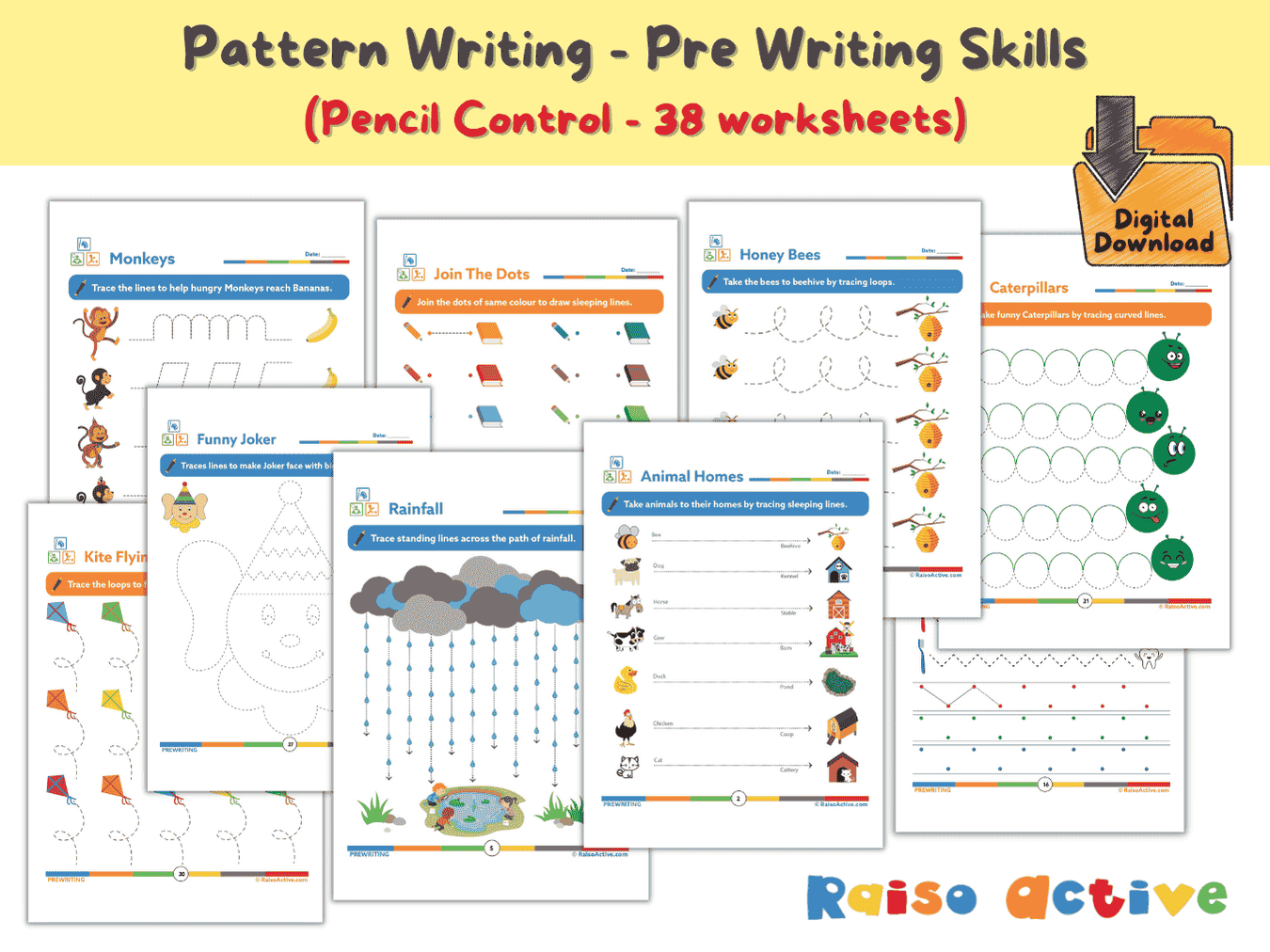

Pattern Writing Pre-writing Skills Activity Book for 3-4 Year Olds
Ages 3-4 · PreschoolAges 3-4 · NurseryAges 3-4 · 44 pages
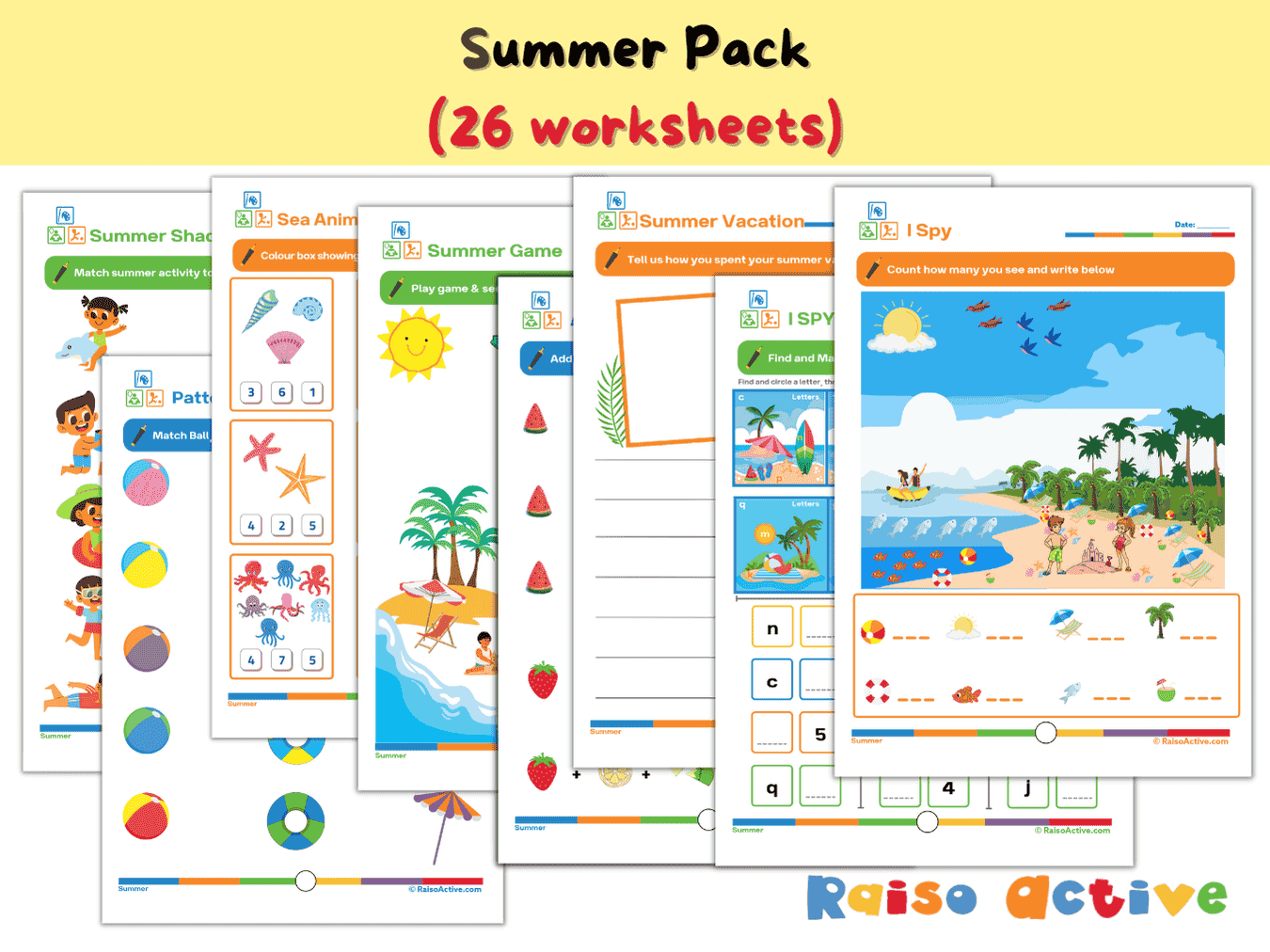

Summer Activity Pack: Math, Literacy, Puzzles & More for Preschool & Kindergarten
Ages 3-7 · Preschool–Grade 1Ages 3-7 · Nursery–Year 2Ages 3-7 · Nursery–Class 1Ages 3-7 · 26 pages
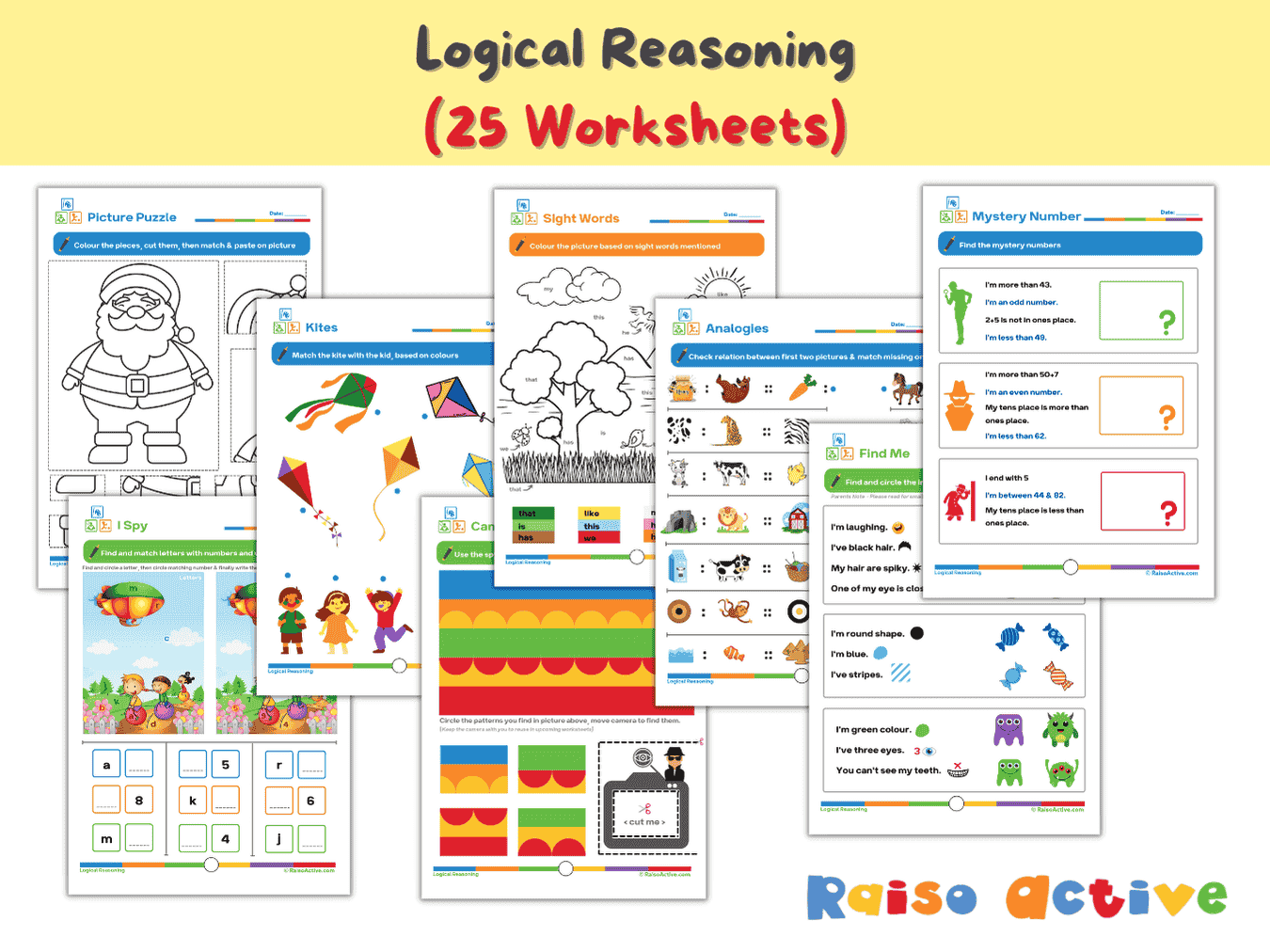

Logical Reasoning Activity Book for Preschool & Kindergarten | Patterns, Sudoku, Mazes & Coding
Ages 4-7 · Pre-K–Grade 1Ages 4-7 · Reception–Year 2Ages 4-7 · LKG–Class 1Ages 4-7 · 34 pages
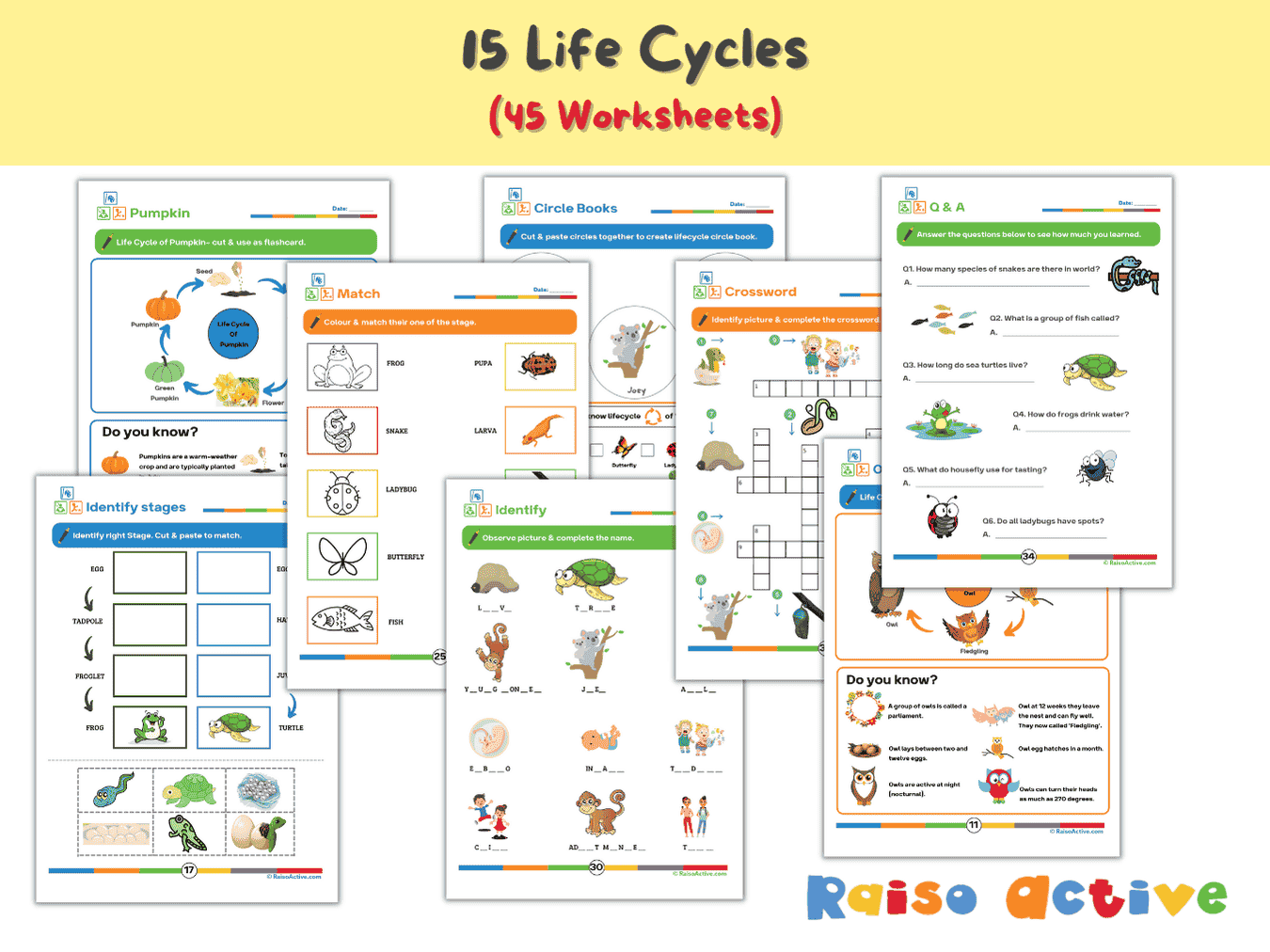

Lifecycles Activity Book & Flashcards for Preschool & Early Elementary
Ages 3-8 · Preschool–Grade 2Ages 3-8 · Nursery–Year 3Ages 3-8 · Nursery–Class 2Ages 3-8 · 46 pages
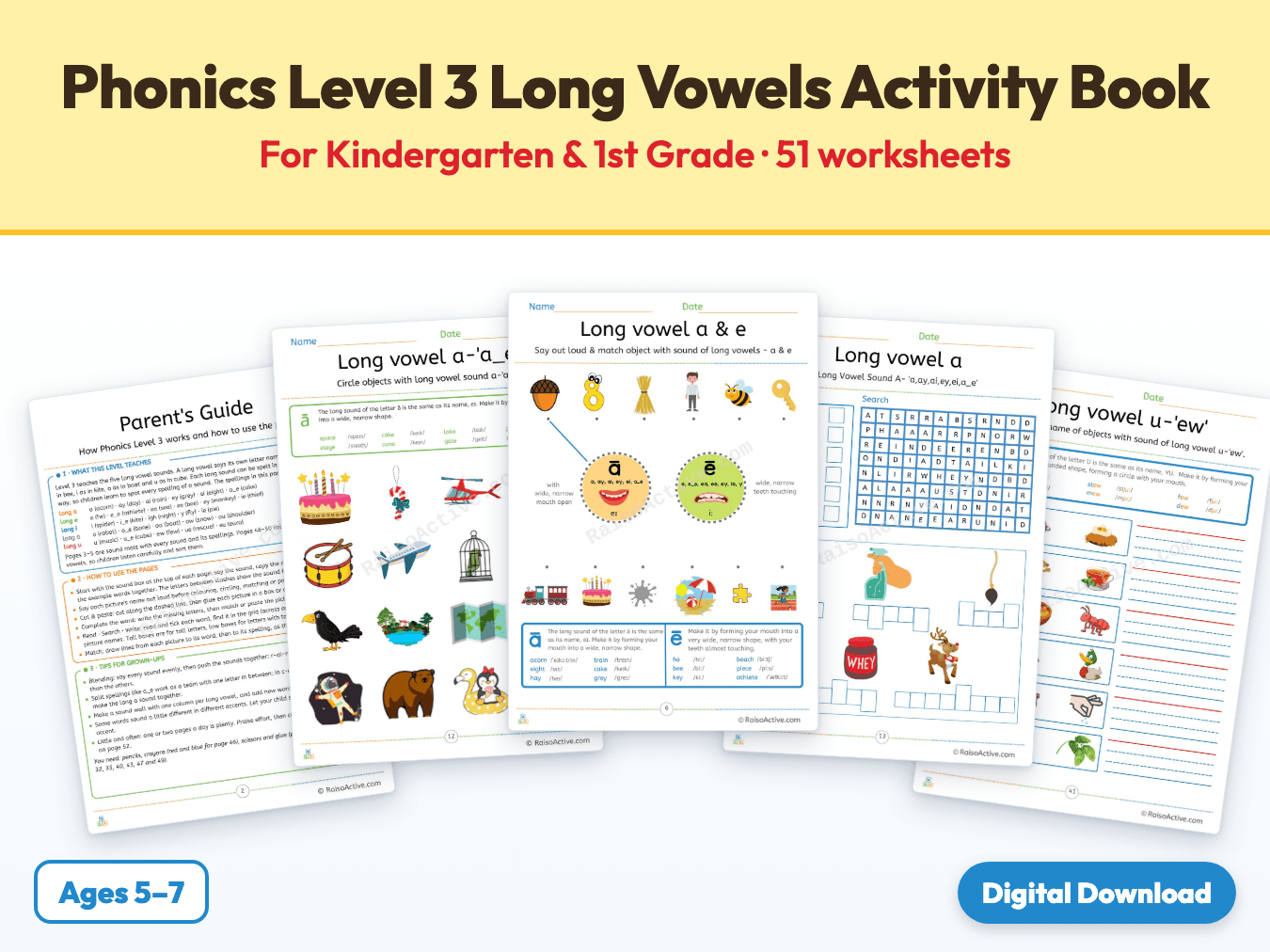

Phonics Level 3 Long Vowels Activity Book for Kindergarten & 1st Grade
Ages 5-7 · Kindergarten–Grade 1Ages 5-7 · Year 1–Year 2Ages 5-7 · UKG–Class 1Ages 5-7 · 52 pages
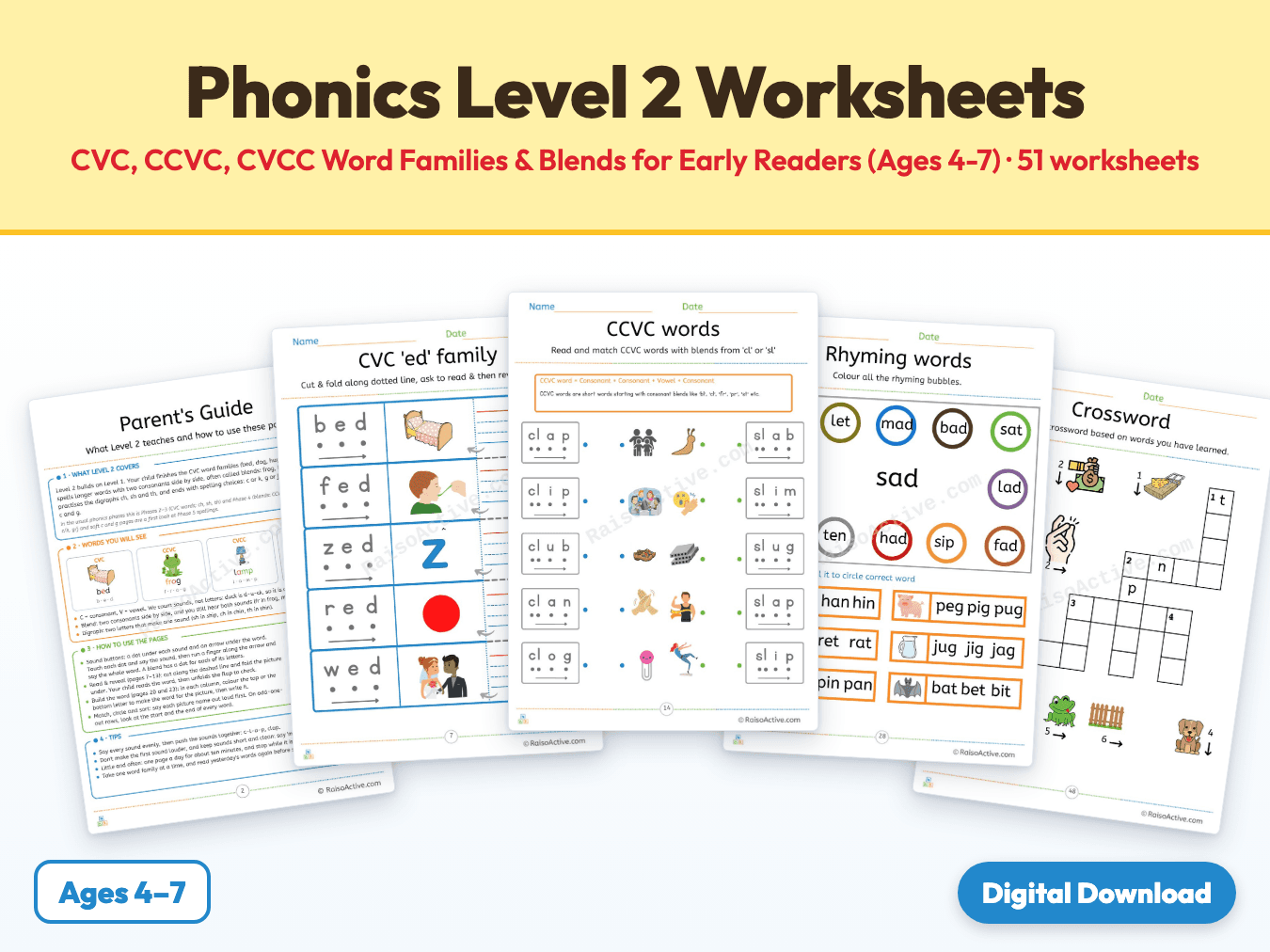
Phonics Level 2 Worksheets: CVC, CCVC, CVCC Word Families & Blends for Early Readers (Ages 4-7)
Ages 4-7 · Pre-K–Grade 1Ages 4-7 · Reception–Year 2Ages 4-7 · LKG–Class 1Ages 4-7 · 52 pages
Guides for parents and teachers
See all guides
Number Formation Rhymes 0–9 and How to Fix Reversals
Original number formation rhymes for 0–9, the correct stroke order for each digit, why 3, 5 and 7 get reversed most often, and multisensory fixes that work.

Pre-Writing Strokes in Order: From Standing Lines to Loops (With Printable Patterns)
The developmental order of pre-writing strokes, from vertical lines to loops, and why practicing them in sequence makes letter formation much easier to learn.

UKG Syllabus Explained: English, Maths and EVS Month by Month
What UKG classes typically cover in English, maths and EVS, month by month, aligned to NEP 2020, with ways to support at home and signs your child is behind.

Age-Appropriate Problem-Solving Activities: Building Critical Thinkers from the Ground Up
Discover fun, age-appropriate problem-solving activities for children ages 1-8. Build critical thinking, logic, and reasoning skills through play-based learning.

Fostering Creativity in Structured Learning: The Perfect Balance for Young Minds
Learn how to blend creativity with structured learning for children ages 1-8. Practical strategies, activities, and printable worksheets for parents and teachers.
Coding Activities for Preschoolers: Building Tomorrow's Thinkers Today
Discover 15+ unplugged and screen-based coding activities for preschoolers that build sequencing, logic, and problem-solving skills through play. NEP 2020 aligned.