Tens and Ones Worksheet: Matching and Counting Fun!
Understanding that a two-digit number is made up of groups of ten plus some extra ones is one of the most important early place value concepts for children ages 4-6, forming the foundation for all later multi-digit addition and subtraction. This worksheet combines an equation-matching task with an object-counting task, giving children practice with basic addition facts alongside the specific skill of grouping objects into tens and counting remaining ones. Seeing the same numerical ideas presented in two different formats on one page helps reinforce that place value isn't just an abstract rule but a way of organizing real quantities.
Part of the pack
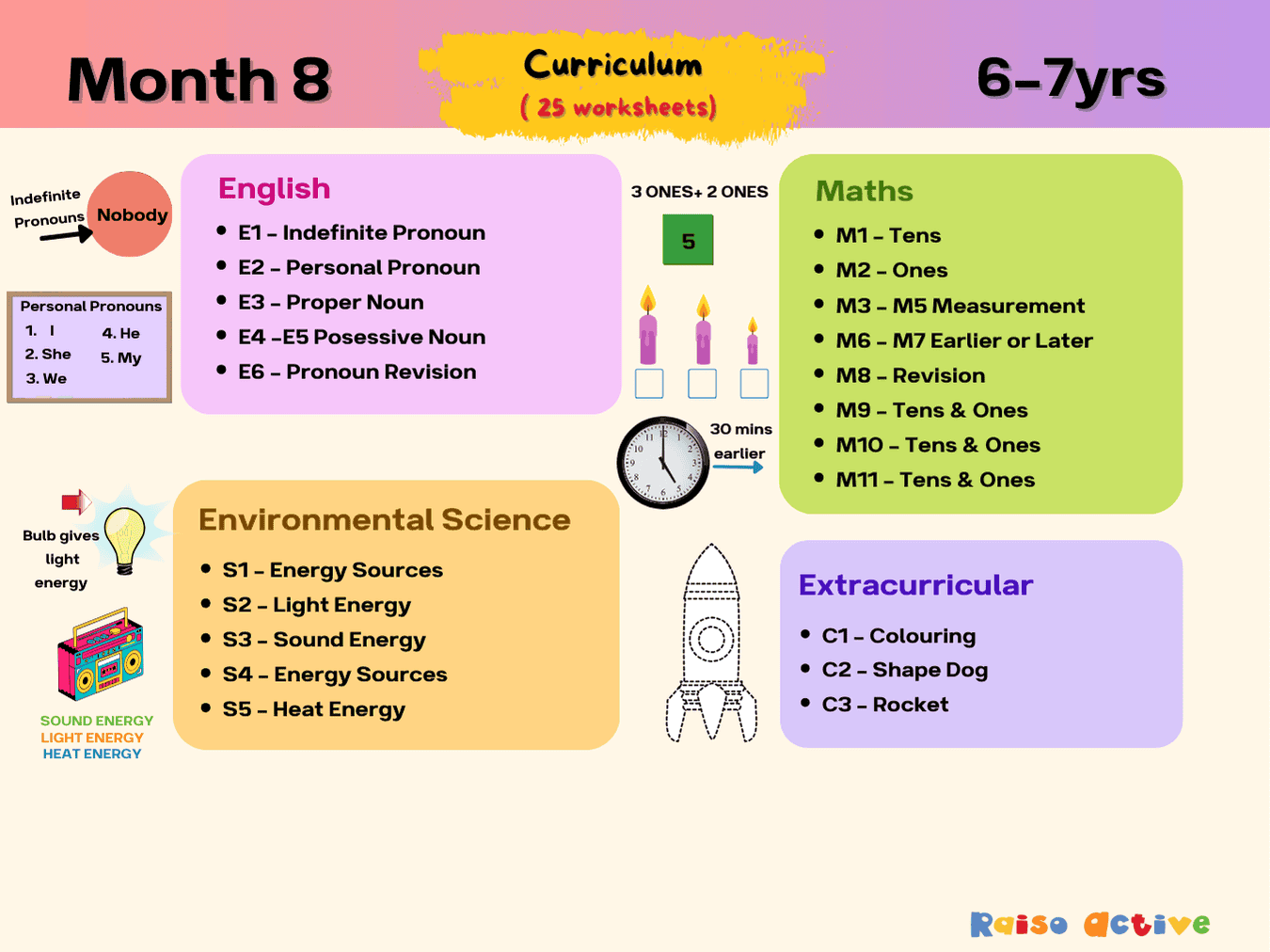
Month 8: English, Math, Science | Ages 6-7
This is page 19 of the pack. Ages 6-7 · Grade 1Ages 6-7 · Year 2Ages 6-7 · Class 1Ages 6-7
Made for your child
Tens and ones, made for your child
A maths pack with your child's name in it: pictures that explain, practice at three levels, puzzles and story sums about them. Print a new set whenever they finish.
Make a maths packFree preview · free for members
Curriculum
- Number Sense > Number Sequencing
How to use this worksheet
Look at the equations on the left side of the page together and read each one aloud. Have your child solve each equation and draw a line to match it with the correct answer on the right. Move to the counting section, and ask your child to count the objects shown, grouping them into sets of ten where possible. Have them fill in the blanks with the correct number of tens and ones, then read the completed number aloud together.
Materials needed
- Pencil
- Crayons
Extension activities
- 1Have the child draw their own sets of tens and ones using groups of ten dots and extra single dots.
- 2Use manipulatives like blocks or beads to physically represent the numbers, bundling ten together with a rubber band.
- 3Play a place value game, calling out a two-digit number and asking your child to show it with tens and ones blocks.
- 4Count a jar of small objects together by grouping them into tens as you go, to make the total easier to find.

Written by
Hemsweta Jain · Teacher Cheena
MBA and Early Childhood Educator, teaching since 2014 · Founder of RaisoActive, Mumbai
Every RaisoActive worksheet is designed and checked by the founder before publishing.
Published · Last reviewed
More from Month 8: English, Math, Science | Ages 6-7

Sound Energy Worksheet: Identifying Sound Producers!
Ages 4-6 · Pre-K–KindergartenAges 4-6 · Reception–Year 1Ages 4-6 · LKG–UKGAges 4-6
This worksheet asks children to identify which objects produce sound and to think about how the ear allows us to hear those sounds, introducing basic science vocabulary around sound energy at an age when they're ready to start reasoning about cause and effect. Circling and matching sound-producing objects also sharpens observation, since children must consider whether an object truly makes noise or is simply pictured near something that does.

Rocket Shapes Worksheet for Preschoolers: Tracing and Matching
Ages 3-5 · Preschool–Pre-KAges 3-5 · Nursery–ReceptionAges 3-5 · Nursery–LKGAges 3-5
Building a rocket picture out of basic shapes helps children ages 3-5 practice shape recognition in a real, assembled context rather than in isolated flashcard form, showing them how circles, triangles, and rectangles combine to make a recognizable object. Circling the shapes found in the picture first sharpens visual discrimination, requiring children to spot a shape even when it's part of a larger, more complex image. The tracing component that follows adds fine motor practice, asking children to follow a dotted outline precisely to complete the rocket shape.
Counting Tens Worksheet: Group and Count!
Ages 4-6 · Pre-K–KindergartenAges 4-6 · Reception–Year 1Ages 4-6 · LKG–UKGAges 4-6
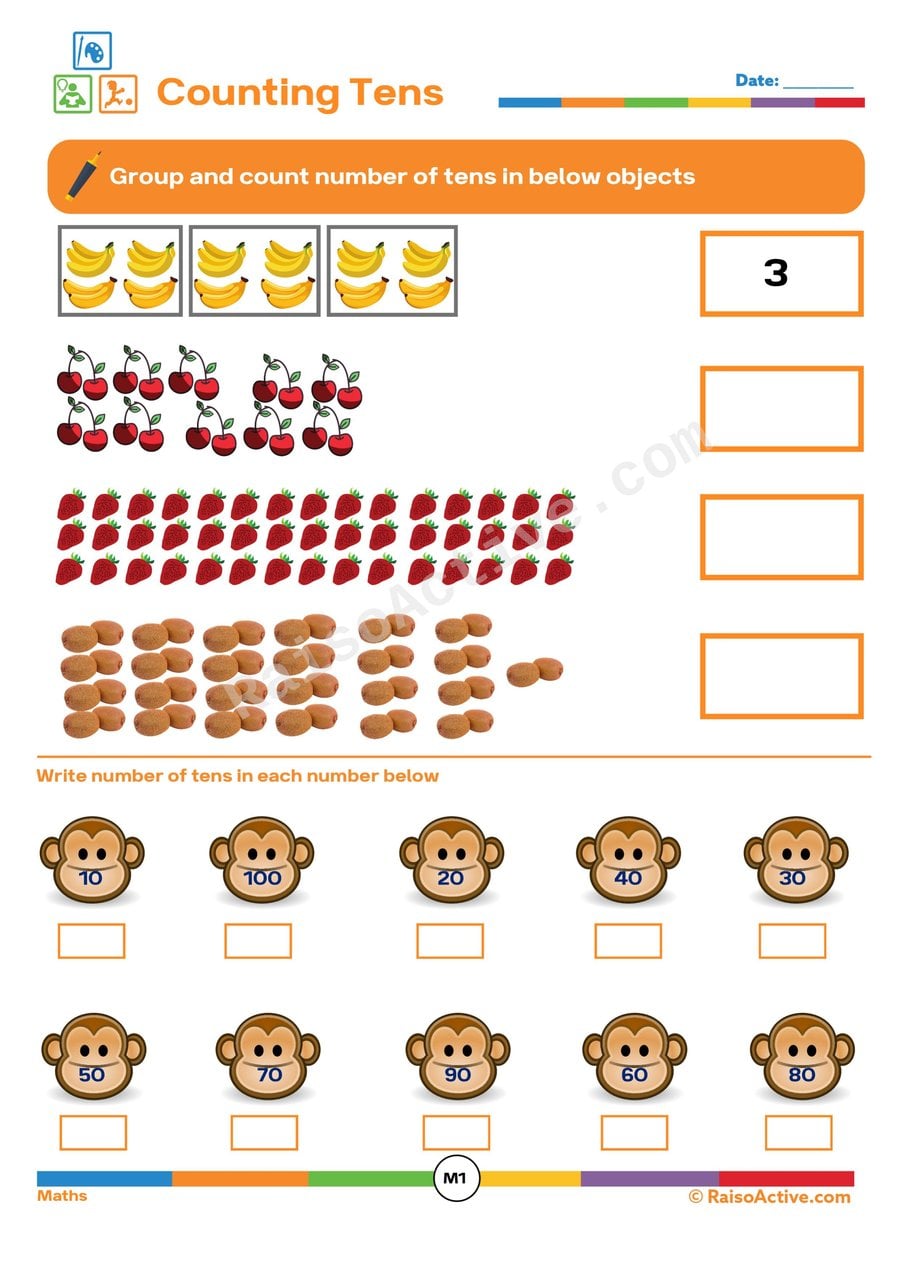
Grouping objects into sets of ten and counting the groups introduces the foundation of place value, the idea that a 'ten' is both ten individual ones and a single unit worth counting on its own. This worksheet gives ages four to six early, hands-on exposure to that concept well before they encounter formal place-value charts in school.
Possessive Noun Matching Worksheet for Kids
Ages 4-6 · Pre-K–KindergartenAges 4-6 · Reception–Year 1Ages 4-6 · LKG–UKGAges 4-6
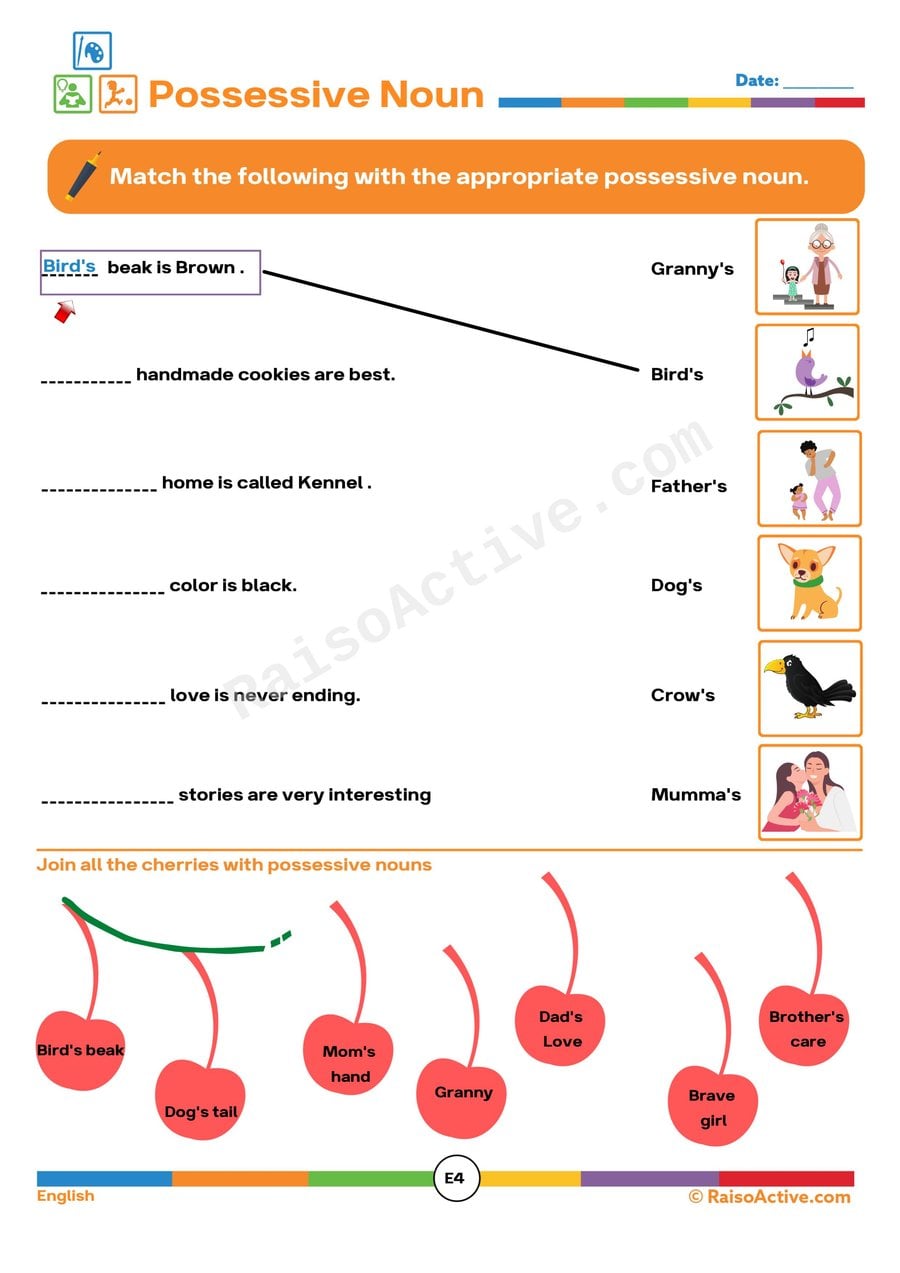
Children ages 4-6 learn to identify possessive nouns, like 'the dog's bone' or 'Mia's book', which show ownership using an apostrophe and 's'. Matching possessive phrases to their meaning builds early grammar awareness that will later support correct sentence writing and reading comprehension. The cherry-connecting activity adds a playful visual-tracking layer to reinforce the matching skill.

Measurement Worksheet: Big to Small & Hand Measurement Fun!
Ages 3-5 · Preschool–Pre-KAges 3-5 · Nursery–ReceptionAges 3-5 · Nursery–LKGAges 3-5
Ranking objects from biggest to smallest teaches children to make and justify comparative judgments, while the hand-measurement activity introduces the idea of using a non-standard unit, their own hand, to measure length, both foundational concepts before children move on to rulers and standardized units. This combination suits ages three to five well, since it keeps measurement concrete and physical rather than abstract.

Earlier and Later Time Worksheet for Preschoolers
Ages 4-6 · Pre-K–KindergartenAges 4-6 · Reception–Year 1Ages 4-6 · LKG–UKGAges 4-6
Children ages 4-6 build early time-sequencing skills by comparing clocks and everyday activities to decide which happens earlier and which happens later in the day. This worksheet introduces the abstract idea of time passing through the concrete lens of familiar routines, like meals or bedtime, which children already experience daily. Tracing the arrow toward the later activity also reinforces the logical, forward direction that time moves.
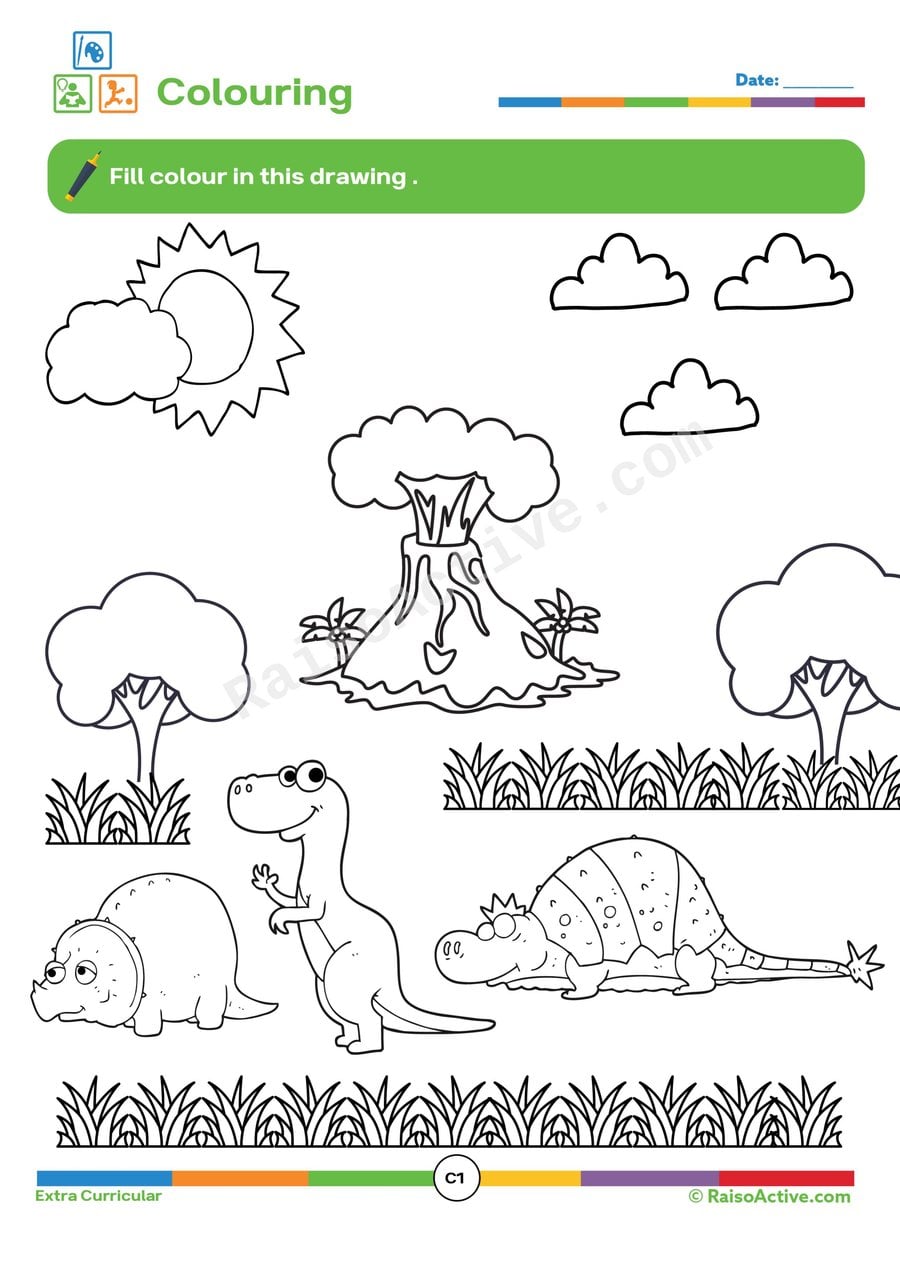
Dinosaur Coloring Worksheet for Kids
Ages 3-5 · Preschool–Pre-KAges 3-5 · Nursery–ReceptionAges 3-5 · Nursery–LKGAges 3-5
This dinosaur coloring page gives children ages 3-5 focused practice with fine motor control and color choice as they fill in a detailed illustration. Staying within defined lines and boundaries strengthens the hand and wrist muscles needed for future handwriting. Choosing colors thoughtfully for different parts of the dinosaur also builds early decision-making and creative expression.

Measurement Worksheet: Matching and Measuring Objects!
Ages 4-6 · Pre-K–KindergartenAges 4-6 · Reception–Year 1Ages 4-6 · LKG–UKGAges 4-6
This worksheet moves children from an intuitive sense of size toward the more formal skill of using a ruler to measure length in units, bridging estimation with actual measurement. For ages four to six, matching objects to an approximate number of units first, then confirming with a ruler, helps them see measurement as something they can predict and then verify rather than an arbitrary number.
Related worksheets

Before and After Numbers Worksheet for Preschoolers
Ages 3-5 · Preschool–Pre-KAges 3-5 · Nursery–ReceptionAges 3-5 · Nursery–LKGAges 3-5
Identifying which numbers come immediately before or after a given number and physically sorting pictures into place links number sequence recall with the fine motor practice of cutting and pasting, building confidence for children ages 3-5.

Descending Order Balloons Worksheet for Preschoolers
Ages 4-6 · Pre-K–KindergartenAges 4-6 · Reception–Year 1Ages 4-6 · LKG–UKGAges 4-6
This worksheet asks children ages 4-6 to arrange the numbers on a row of balloons from largest to smallest, practicing descending order as a companion skill to the more commonly taught ascending order. Comparing several numbers at once and deciding their relative size builds a flexible sense of number magnitude that supports later skills like rounding and estimation.
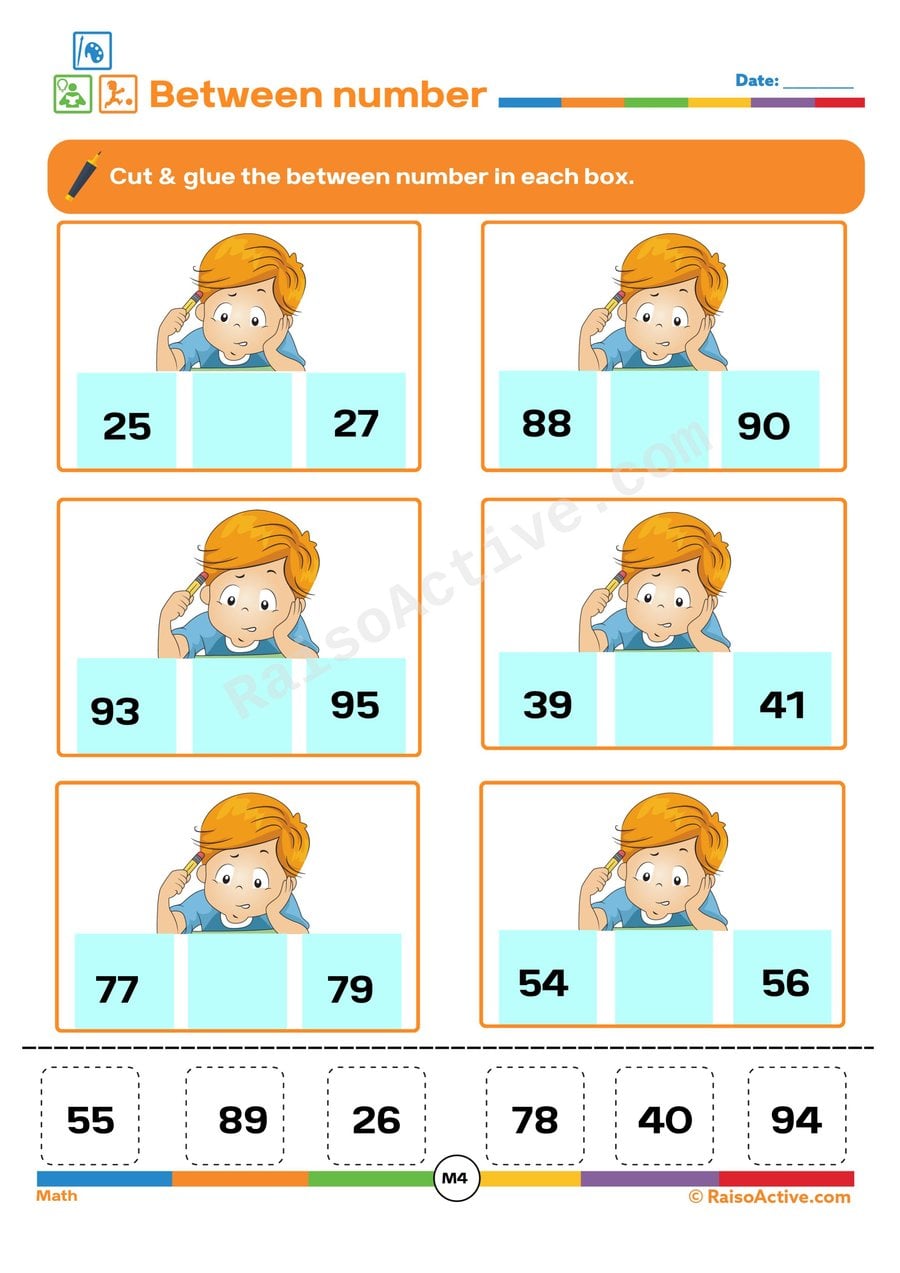
Find the Missing Number Worksheet for Kids
Ages 4-5 · Pre-KAges 4-5 · ReceptionAges 4-5 · LKGAges 4-5
Children ages 4-5 strengthen number recognition and sequencing by figuring out which number is missing from a short sequence, then physically cutting and pasting the correct number into place. The cut-and-paste format adds a search-and-select step on top of the math, since children must locate the right numeral among several choices before placing it, reinforcing both number recognition and careful visual scanning.

Hopscotch Numbers 1-50 Worksheet: Fill in the Missing Numbers!
Ages 4-6 · Pre-K–KindergartenAges 4-6 · Reception–Year 1Ages 4-6 · LKG–UKGAges 4-6
This hopscotch-themed worksheet gives children ages 4-6 practice filling in missing numbers within the 1-50 range, extending their number sequencing beyond the more commonly rehearsed 1-20 range and building familiarity with two-digit number patterns like the '20s' or '30s.' Framing the numbers as a hopscotch grid connects the paper activity to a familiar physical game, helping children mentally picture themselves counting forward as they move up the grid. This kind of extended-range practice is an important bridge toward comfortable counting to 100.
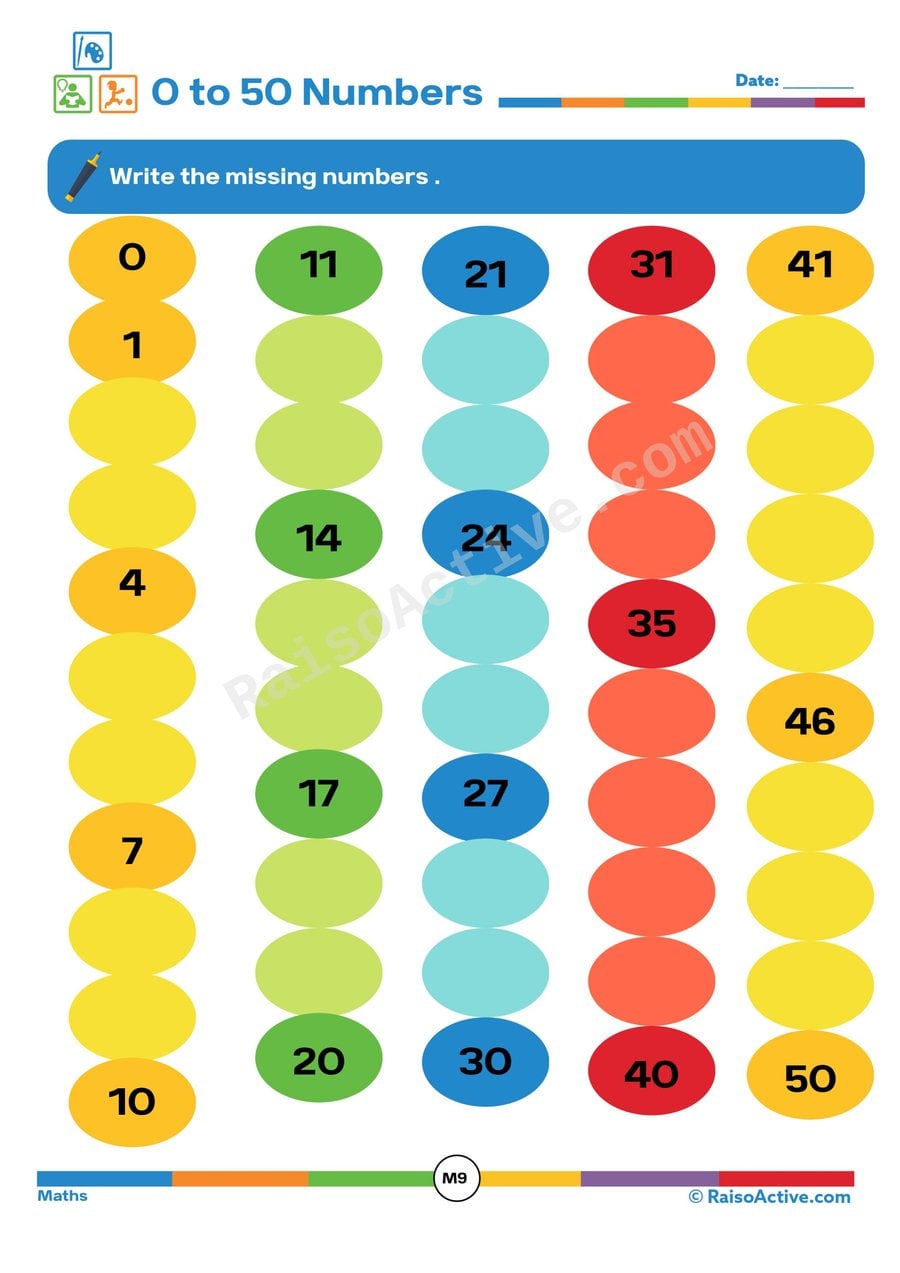
Missing Numbers Worksheet: 0 to 50
Ages 4-5 · Pre-KAges 4-5 · ReceptionAges 4-5 · LKGAges 4-5
Filling in missing numbers across the 0-50 range asks children ages 4-5 to hold a much longer counting sequence in mind than typical 1-20 worksheets, strengthening both number recognition and the pattern sense needed to predict what comes next at any point in the range. This kind of extended practice also introduces children to the way numbers group into decades, like the 20s or 30s, which becomes important for later place-value understanding. Successfully completing a long sequence like this builds real counting stamina and confidence.

Sequencing Numbers Train Worksheet for Preschoolers
Ages 4-5 · Pre-KAges 4-5 · ReceptionAges 4-5 · LKGAges 4-5
Writing numbers 0-20 into a sequence of train cars pushes children ages 4-5 to internalize the full early counting range in fixed order, not just recite it aloud, which is a meaningfully different and more durable skill. Filling in the numbers by hand also builds numeral formation alongside sequencing, so children practice both remembering what comes next and writing it correctly. The train-car visual keeps a fairly long numeric range broken into manageable, engaging chunks rather than one intimidating list.
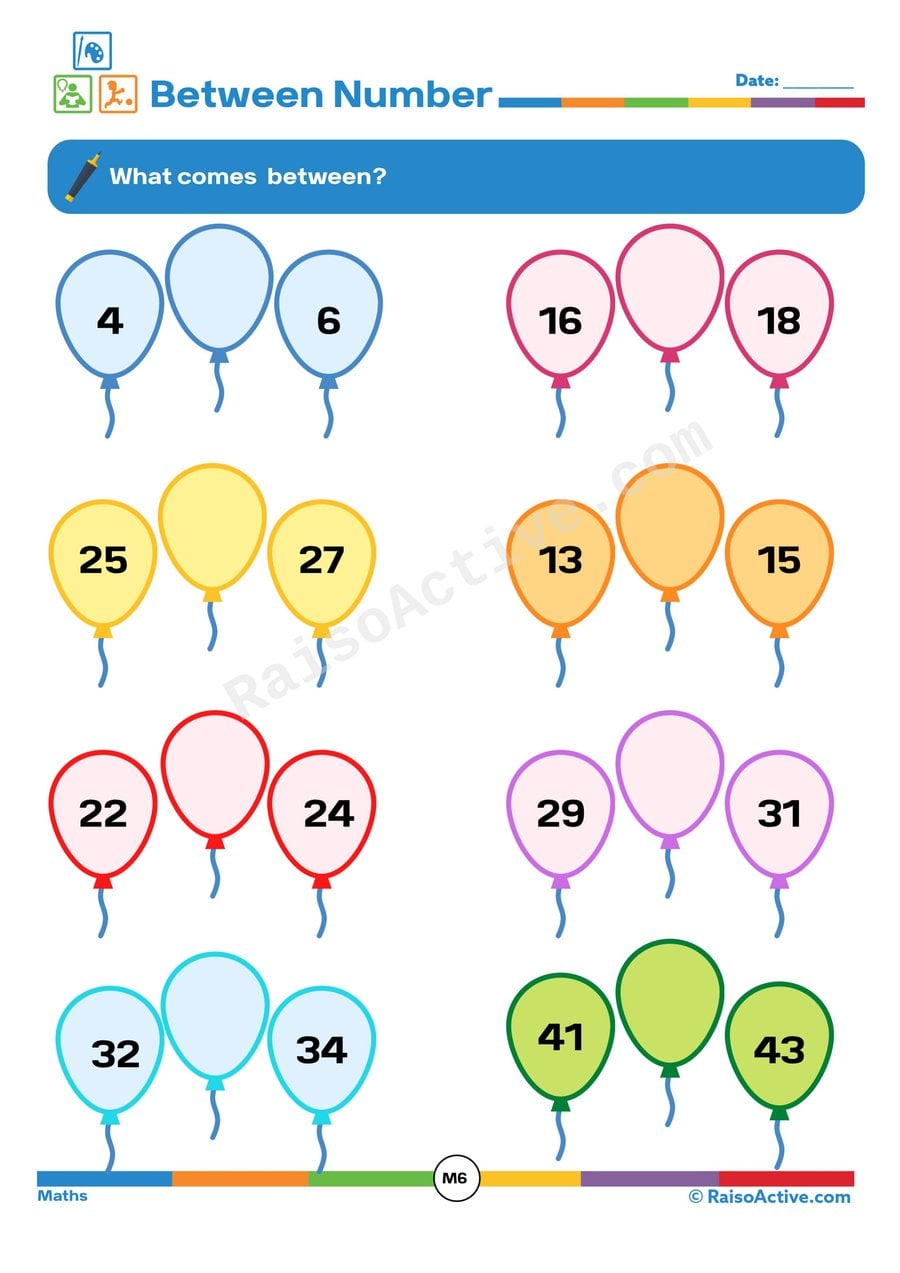
What Comes Between? Number Worksheet for Kids
Ages 4-5 · Pre-KAges 4-5 · ReceptionAges 4-5 · LKGAges 4-5
This worksheet targets a specific numeracy skill, finding the number that falls between two given numbers, which requires children to hold two values in mind and mentally place a third between them. For ages 4-5, this 'in-between' reasoning is more demanding than simply counting forward and strengthens the mental number line that underlies later subtraction and comparison skills.
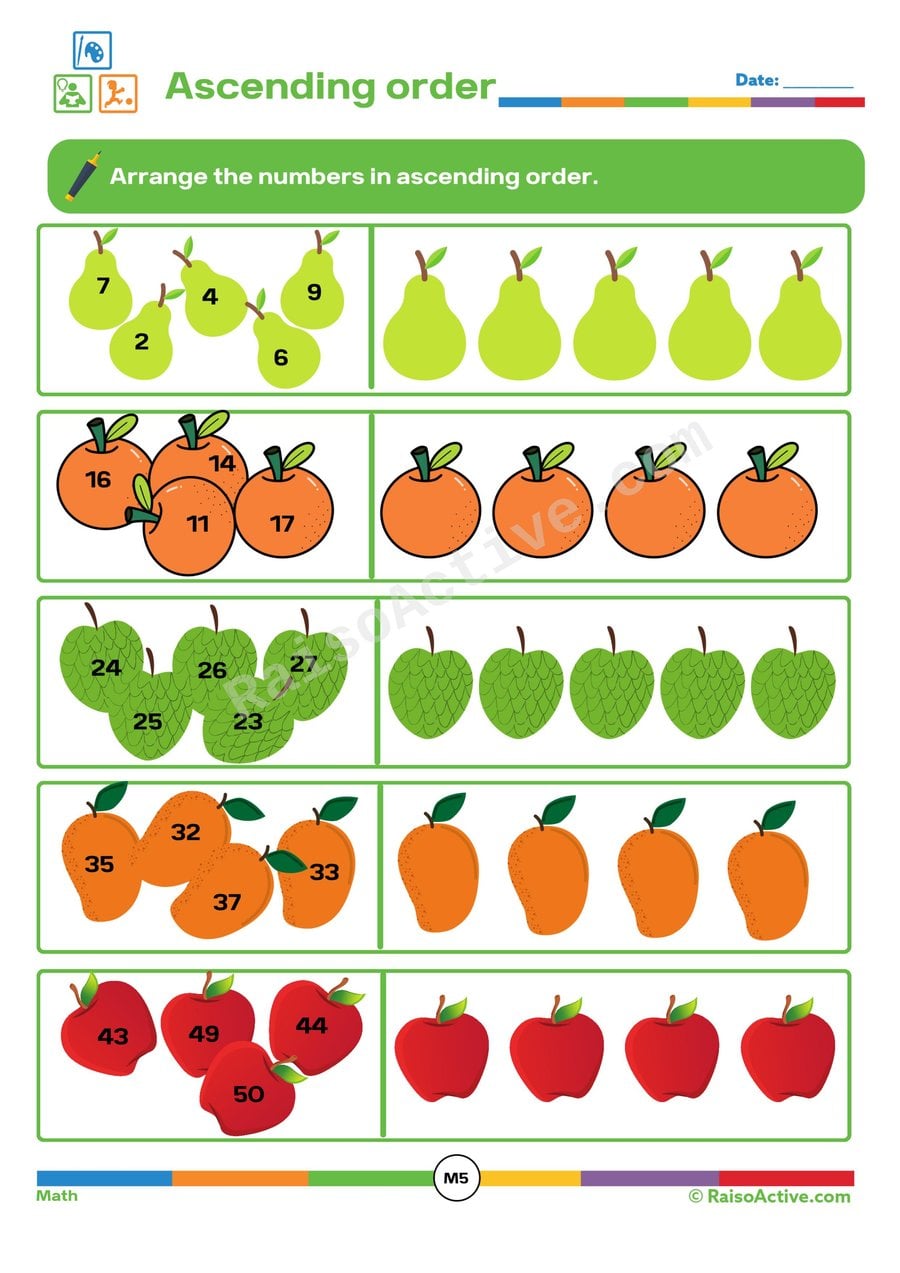
Ascending Order Worksheet: Fruit Fun!
Ages 4-6 · Pre-K–KindergartenAges 4-6 · Reception–Year 1Ages 4-6 · LKG–UKGAges 4-6
Arranging numbers on groups of fruit from smallest to largest teaches children ages 4-6 to compare quantities and understand ascending order, a core numeracy skill that supports later work with number lines and place value.
Guides for this topic

Number Formation Rhymes 0–9 and How to Fix Reversals
Original number formation rhymes for 0–9, the correct stroke order for each digit, why 3, 5 and 7 get reversed most often, and multisensory fixes that work.

Best Worksheets for 3-Year-Olds: What Works and What to Avoid
What works on worksheets for 3-year-olds: short sessions, crayons, tracing lines, matching, cutting, a free weekly plan, and signs one is too advanced.
Christmas and Winter Activities That Combine Fun and Learning: Creating Magical Educational Experiences
Discover Christmas and winter activities that combine festive fun with real learning. Crafts, counting, literacy, and printable worksheets for ages 2 to 8 — perfect for home and school.
Reviews
Every worksheet for ages 4–6, no watermark
Members download the full library of 1,000+ worksheets and every activity pack without watermarks or daily limits. One year costs ₹999 in India or $20 elsewhere.
See membership plansOr download any worksheet free with a watermark (5 a day).