Before and After Numbers Worksheet for Preschoolers
Identifying which numbers come immediately before or after a given number and physically sorting pictures into place links number sequence recall with the fine motor practice of cutting and pasting, building confidence for children ages 3-5.

Part of the pack
Month 11: Learning & Development | Ages Up to 4
This is page 17 of the pack. Ages 2-4 · PreschoolAges 2-4 · NurseryAges 2-4

Made for your child
Counting to 10, made for your child
A maths pack with your child's name in it: pictures that explain, practice at three levels, puzzles and story sums about them. Print a new set whenever they finish.
Make a maths packFree preview · free for members
Curriculum
- Number Sense > Number Sequencing
How to use this worksheet
Look at the number written in the box together and say it aloud. Have your child find the picture card with the number that comes before it, cut it out carefully, and glue it in the 'before' spot. Repeat for the number that comes after, cutting and pasting it into the 'after' spot, then continue through the remaining number boxes on the page.
Materials needed
- Scissors
- Glue
- Pencil
Extension activities
- 1Line up number cards 1-10 and remove one, asking your child to say what number is missing.
- 2Practice with dominoes or dice, naming the number before and after the rolled number.
- 3Play a hopscotch-style game on a chalk number line, hopping to the number before or after a called number.

Written by
Hemsweta Jain · Teacher Cheena
MBA and Early Childhood Educator, teaching since 2014 · Founder of RaisoActive, Mumbai
Every RaisoActive worksheet is designed and checked by the founder before publishing.
Published · Last reviewed
More from Month 11: Learning & Development | Ages Up to 4

Help Dad Reach Home! Missing Number Maze Worksheet
Ages 4-6 · Pre-K–KindergartenAges 4-6 · Reception–Year 1Ages 4-6 · LKG–UKGAges 4-6
Filling in missing numbers along a maze path combines number sequencing from 1-20 with the planning skills needed to trace a route from start to finish, giving children ages 4-6 practice in both counting recall and spatial navigation.

Fruit and Vegetable Sorting Worksheet for Preschoolers
Ages 3-5 · Preschool–Pre-KAges 3-5 · Nursery–ReceptionAges 3-5 · Nursery–LKGAges 3-5
This worksheet helps children ages 3-5 practice identifying and categorizing fruits and vegetables by coloring circles next to each pictured food item. Learning to tell fruits and vegetables apart, and eventually name specific ones, builds early categorization skills alongside healthy eating awareness, since recognizing food groups is a foundation for later nutrition education.

Connect the Dots: Mushroom House Worksheet for Kids (Numbers 26-50)
Ages 4-6 · Pre-K–KindergartenAges 4-6 · Reception–Year 1Ages 4-6 · LKG–UKGAges 4-6
Extending number sequencing into the 26-50 range pushes children ages 4-6 past the more familiar 1-20 span while reinforcing the fine motor control needed to draw controlled connecting lines that reveal a mushroom house picture.

Connect the Dots: Help the Prince Find the Princess! Numbers 1-25 Worksheet
Ages 3-5 · Preschool–Pre-KAges 3-5 · Nursery–ReceptionAges 3-5 · Nursery–LKGAges 3-5
Locating dots in order from 1 to 25 and drawing a steady connecting line combines number recognition and sequencing with the pencil control children ages 3-5 need for handwriting readiness.
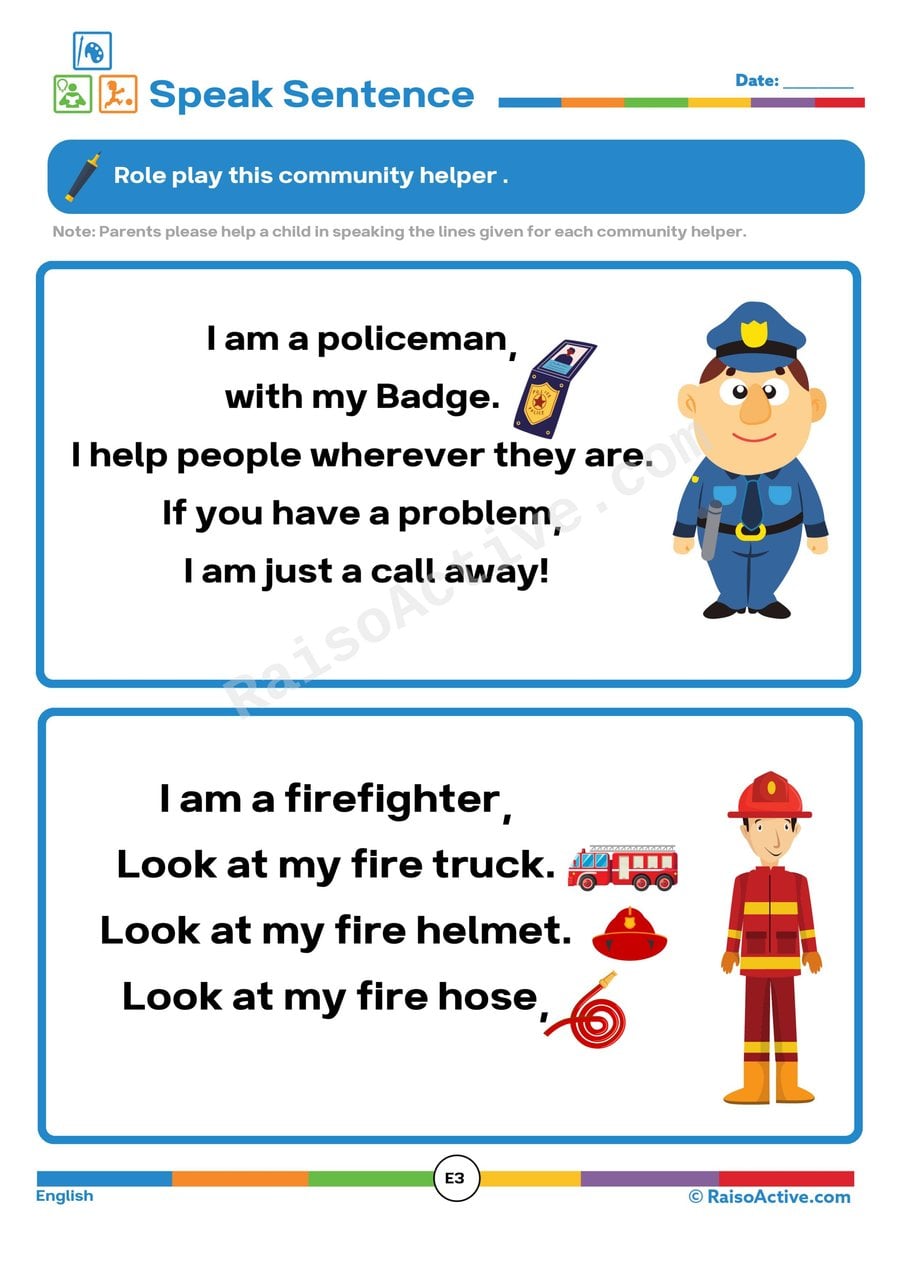
Community Helpers Role Play Worksheet for Kids
Ages 3-5 · Preschool–Pre-KAges 3-5 · Nursery–ReceptionAges 3-5 · Nursery–LKGAges 3-5
This worksheet helps children ages 3-5 learn about community helpers while practicing spoken sentence structure through guided role play. Reading a short scripted sentence aloud and then acting out the role of that helper builds oral language and expressive confidence alongside social studies knowledge, giving children a chance to practice full sentences in a low-pressure, playful context.

Color the Circles: Vocabulary Worksheet for Preschoolers
Ages 3-5 · Preschool–Pre-KAges 3-5 · Nursery–ReceptionAges 3-5 · Nursery–LKGAges 3-5
Matching a chart of letter-color pairings to circles below reinforces alphabet recognition for children ages 3-5 while training them to hold a two-step visual instruction in mind — find the letter, then find its color — while coloring.
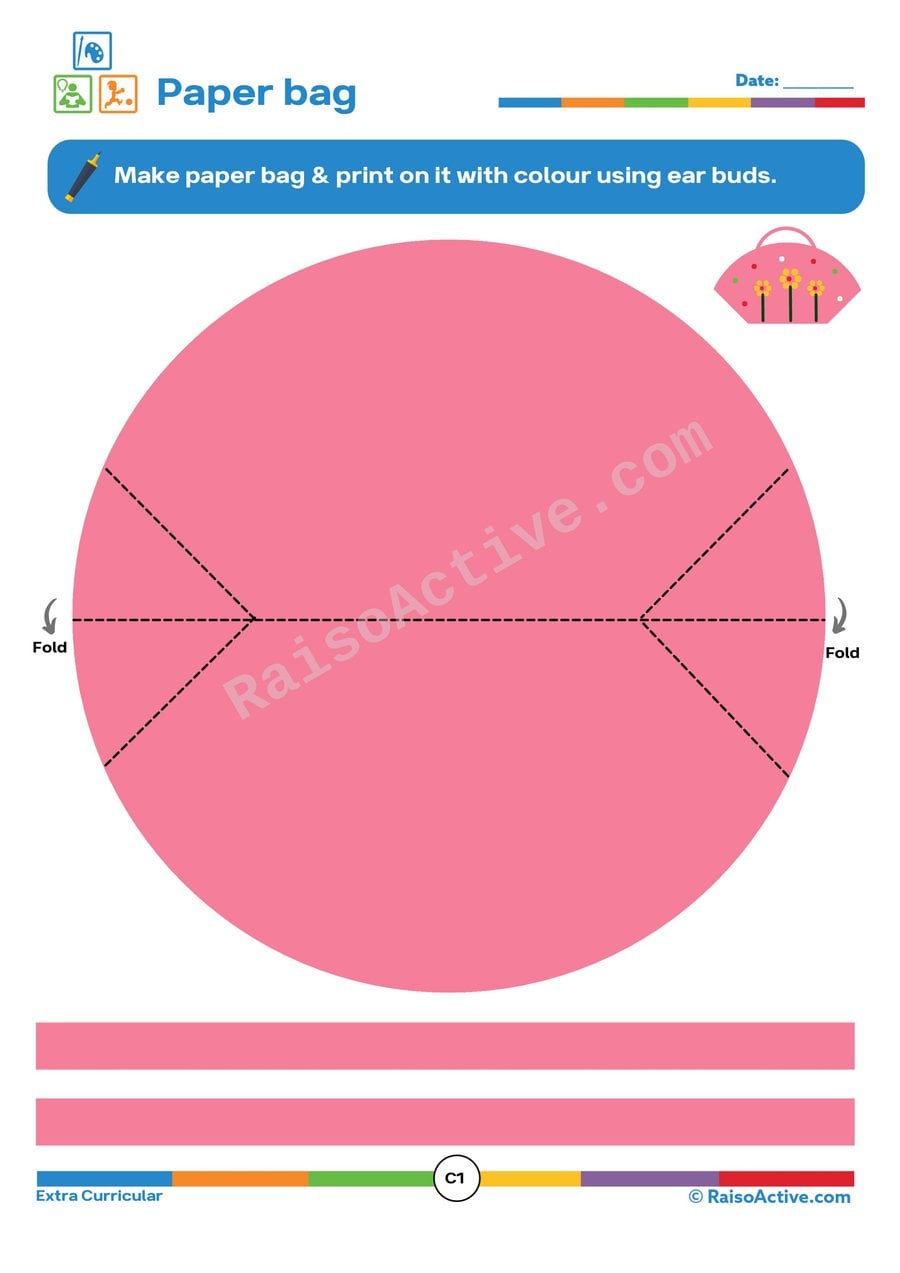
Paper Bag Craft Worksheet for Kids
Ages 3-5 · Preschool–Pre-KAges 3-5 · Nursery–ReceptionAges 3-5 · Nursery–LKGAges 3-5
Children ages 3-5 practice fine motor control and following multi-step craft instructions by folding a paper bag and decorating it using a cotton swab dipped in color, an unusual painting tool that builds hand control and creative expression at the same time. Following each folding and coloring step in order also strengthens early sequencing and listening skills.
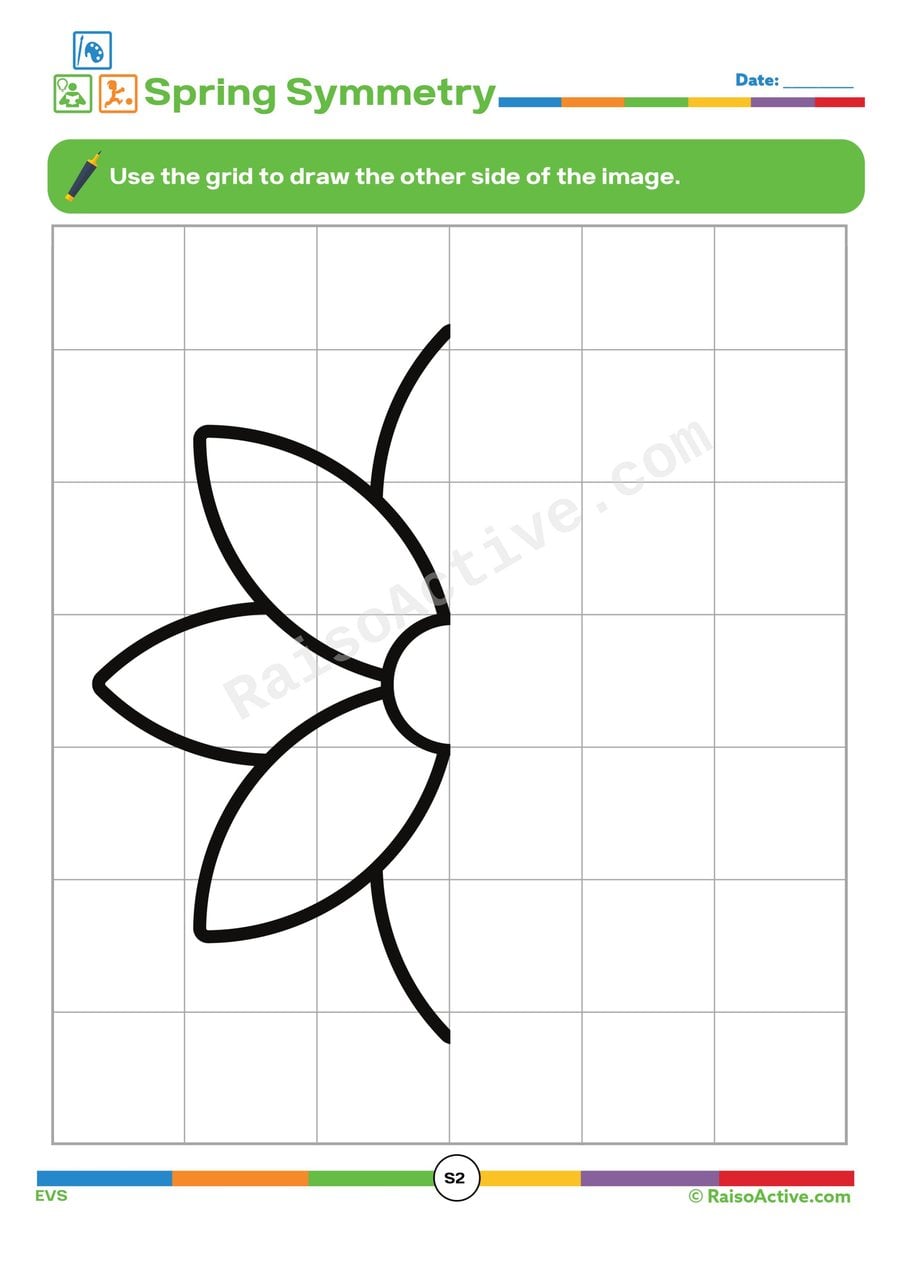
Spring Symmetry Worksheet: Draw the Other Half!
Ages 3-5 · Preschool–Pre-KAges 3-5 · Nursery–ReceptionAges 3-5 · Nursery–LKGAges 3-5
This worksheet introduces children ages 3-5 to the concept of symmetry by having them draw the missing half of a flower using a grid as a visual guide. Replicating a shape on the opposite side of a center line builds spatial reasoning and careful observation, while the drawing itself strengthens pencil control and hand-eye coordination in a way that's more open-ended than simple tracing.
Related worksheets
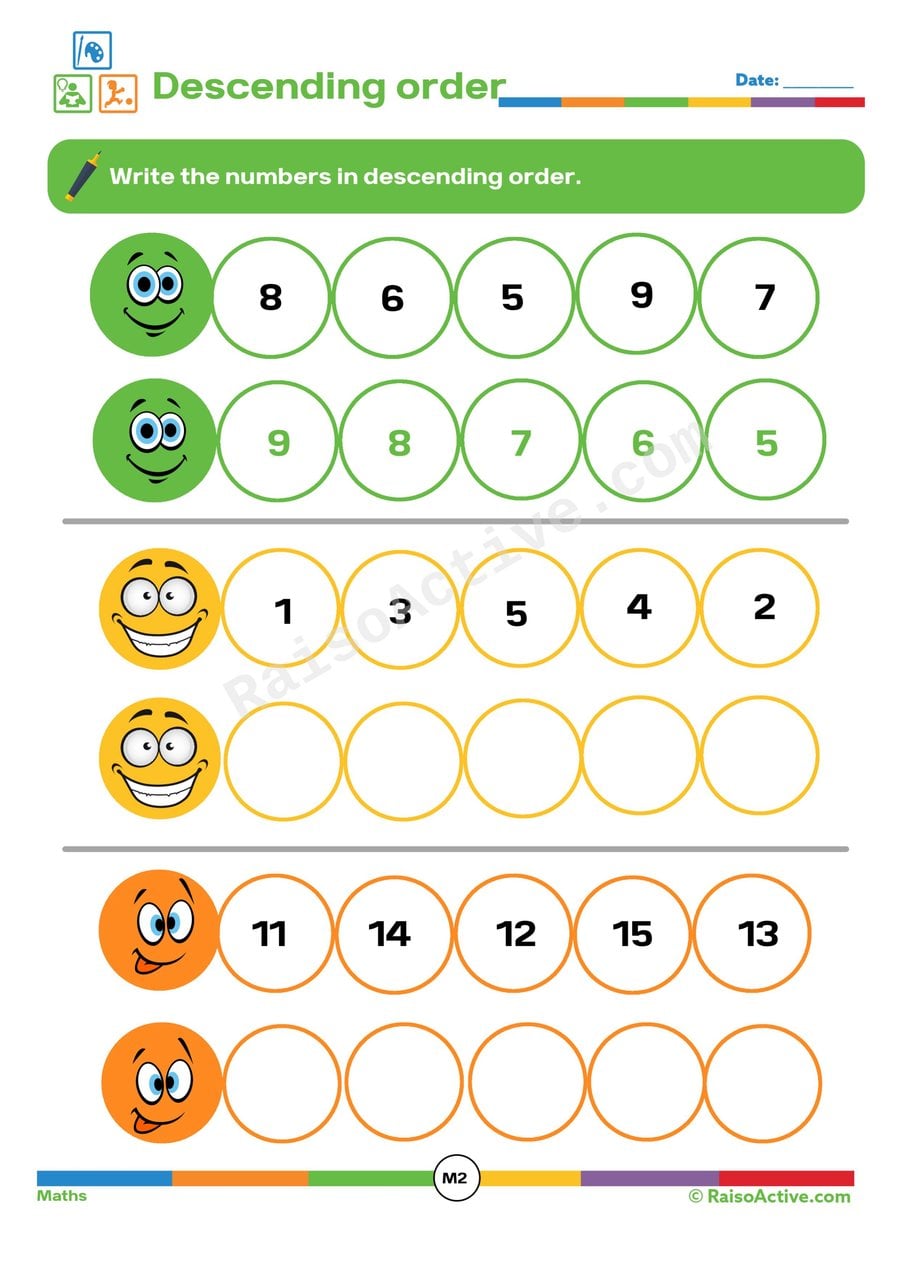
Descending Order Worksheet: Numbers 5-15
Ages 4-5 · Pre-KAges 4-5 · ReceptionAges 4-5 · LKGAges 4-5
Writing numbers in descending order asks 4-5 year olds to hold a full sequence in mind and reverse it — a genuinely different mental task from the more familiar ascending count, since children have to think about 'what comes before' rather than 'what comes after.' Practicing this with numbers 5 through 15 also reinforces number formation and one-to-one number-word correspondence, since each digit has to be written accurately as your child works backward.

Caterpillar Number Sequencing Worksheet for Preschoolers
Ages 3-5 · Preschool–Pre-KAges 3-5 · Nursery–ReceptionAges 3-5 · Nursery–LKGAges 3-5
This worksheet helps children ages 3-5 practice number recognition and sequencing skills by cutting out numbered circles and arranging them in the correct order to build a caterpillar's body. The hands-on cut-and-paste format adds fine motor practice to the numeracy task, since children must precisely place each circle in its correct spot.

Sequencing Numbers Train Worksheet for Preschoolers
Ages 4-5 · Pre-KAges 4-5 · ReceptionAges 4-5 · LKGAges 4-5
Writing numbers 0-20 into a sequence of train cars pushes children ages 4-5 to internalize the full early counting range in fixed order, not just recite it aloud, which is a meaningfully different and more durable skill. Filling in the numbers by hand also builds numeral formation alongside sequencing, so children practice both remembering what comes next and writing it correctly. The train-car visual keeps a fairly long numeric range broken into manageable, engaging chunks rather than one intimidating list.

Number Path Adventure: Write Numbers 1-20 Worksheet
Ages 4-6 · Pre-K–KindergartenAges 4-6 · Reception–Year 1Ages 4-6 · LKG–UKGAges 4-6
Children ages 4-6 practice writing numerals in correct sequence as they fill in missing numbers along a path of stepping stones from 1 to 20. This strengthens number-order memory and numeral formation together, both needed before a child can count on reliably or recognize number patterns like the teens. Following a winding path also adds a light visual-tracking challenge that keeps attention on the correct next stone.
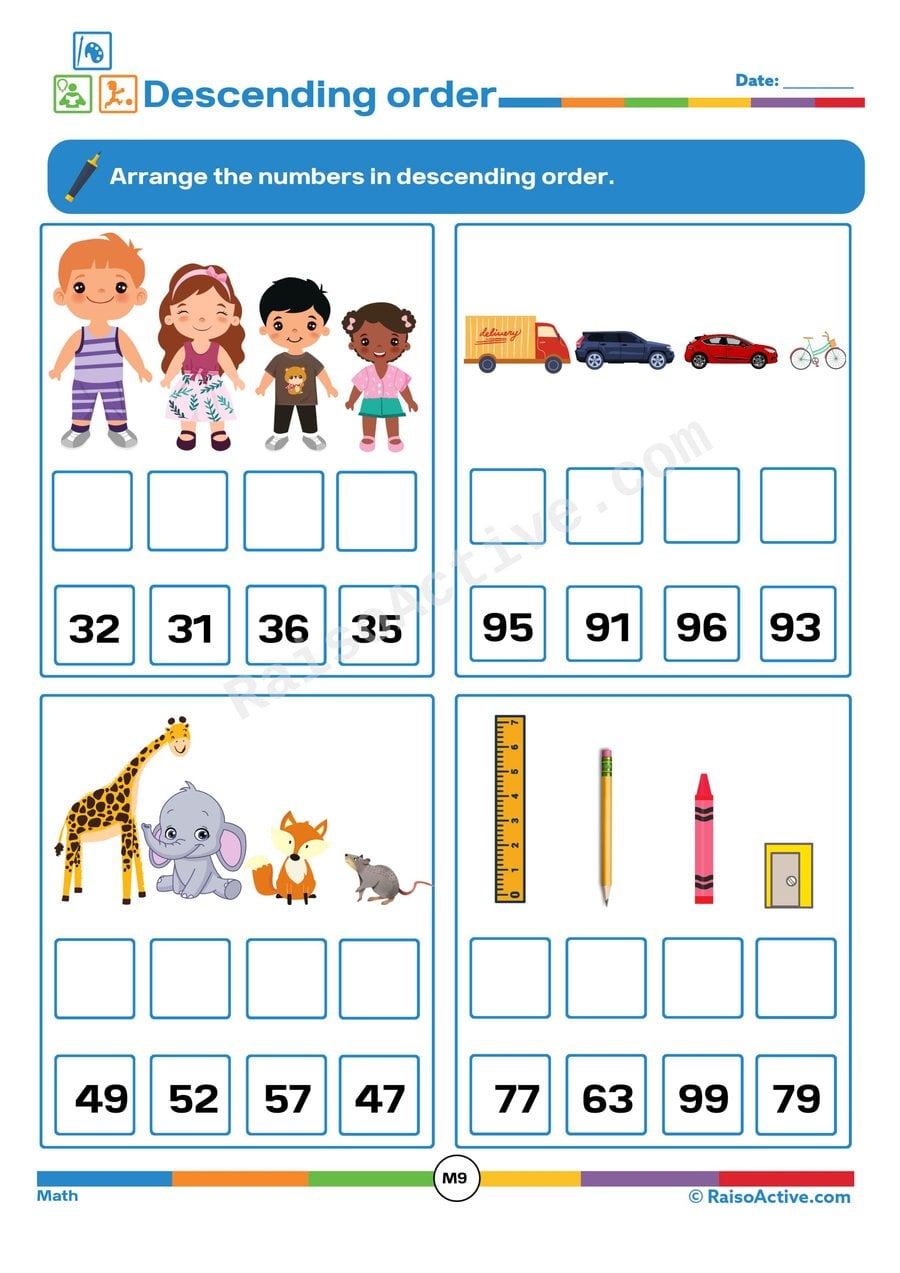
Descending Order Worksheet: Numbers 31-99
Ages 4-6 · Pre-K–KindergartenAges 4-6 · Reception–Year 1Ages 4-6 · LKG–UKGAges 4-6
This worksheet extends number-sequencing skills for children ages 4-6 into the two-digit range of 31 to 99, asking them to arrange given numbers from largest to smallest. Working with larger numbers requires understanding that the tens digit generally determines size first, an important step toward place-value thinking. Practicing descending order, which is less intuitive than counting up, also strengthens flexible number sense.
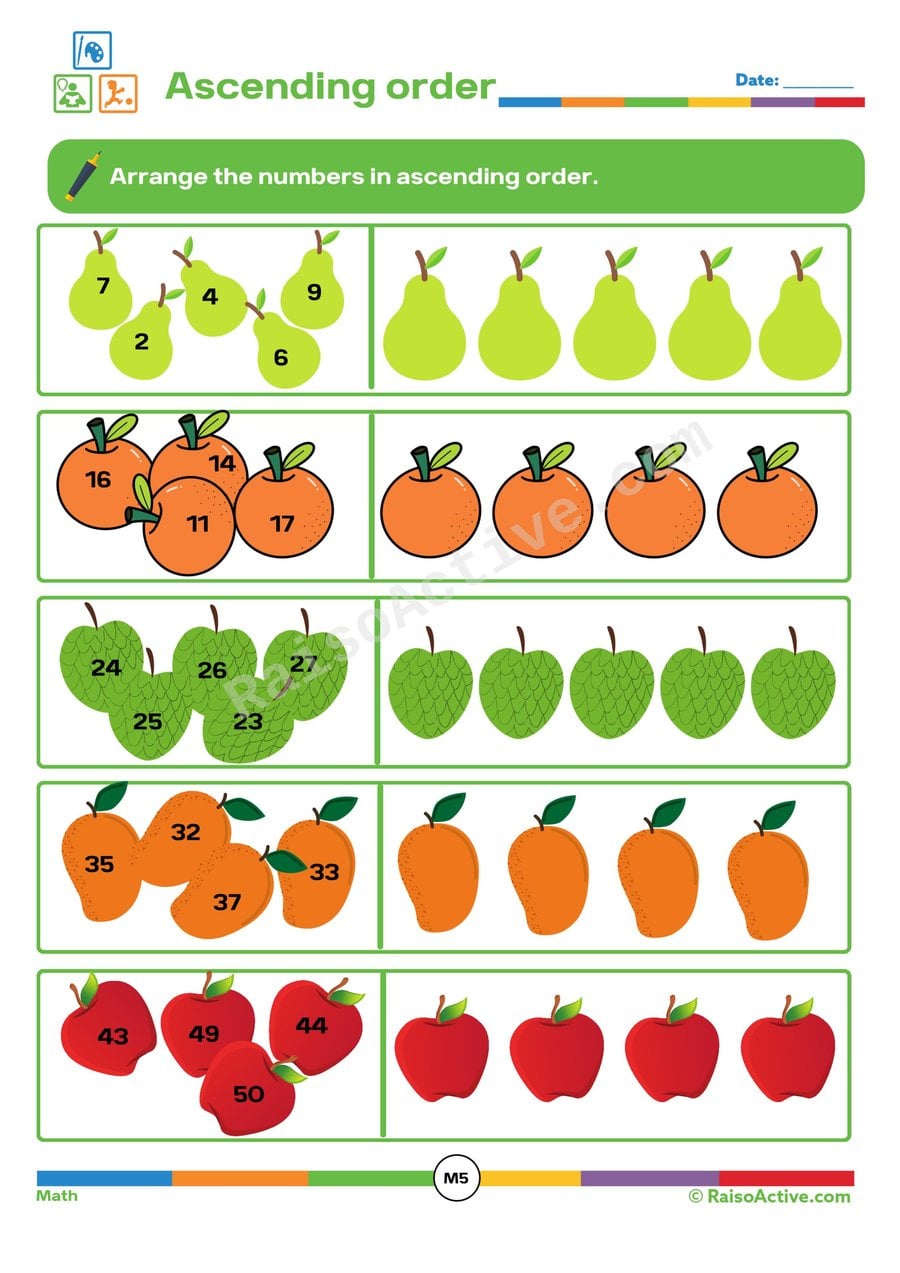
Ascending Order Worksheet: Fruit Fun!
Ages 4-6 · Pre-K–KindergartenAges 4-6 · Reception–Year 1Ages 4-6 · LKG–UKGAges 4-6
Arranging numbers on groups of fruit from smallest to largest teaches children ages 4-6 to compare quantities and understand ascending order, a core numeracy skill that supports later work with number lines and place value.
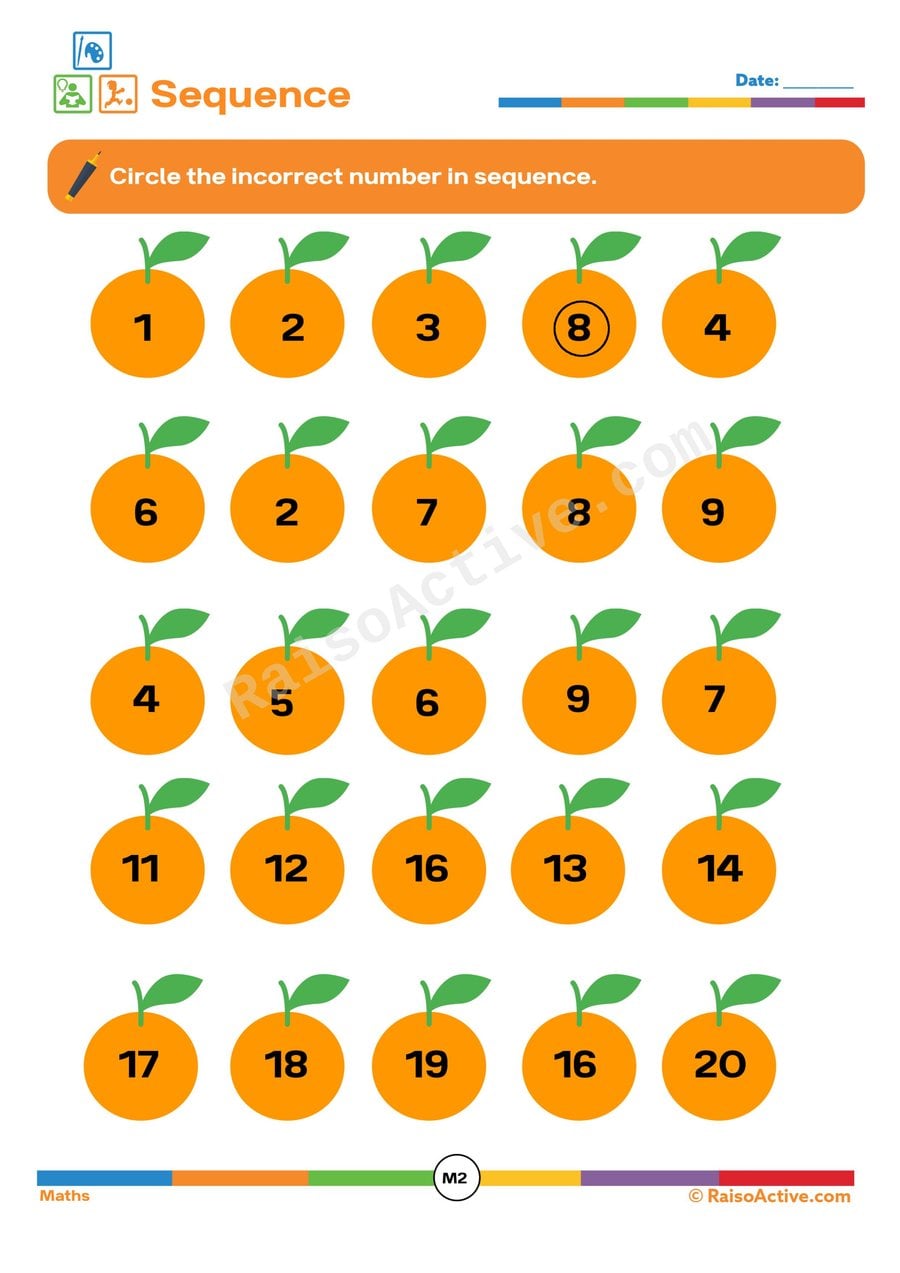
Sequence Worksheet: Find the Incorrect Number!
Ages 4-5 · Pre-KAges 4-5 · ReceptionAges 4-5 · LKGAges 4-5
This worksheet sharpens number pattern recognition by having children scan a row of numbers in sequence and spot the one number that breaks the pattern. For four- and five-year-olds, this kind of 'odd one out' task requires holding the counting sequence in mind while comparing it against what's actually written, building both number sense and early attention to detail.

Duckling's Number Path: Connect the Dots Worksheet
Ages 3-5 · Preschool–Pre-KAges 3-5 · Nursery–ReceptionAges 3-5 · Nursery–LKGAges 3-5
Children ages 3-5 practice number sequencing and counting up to 30 as they connect numbered dots in order to draw the duckling's path back to its mother, reinforcing number recognition while completing a satisfying, story-driven picture. Following numbers in strict order without skipping builds the counting fluency children need before tackling addition and more advanced number work.
Guides for this topic

Number Formation Rhymes 0–9 and How to Fix Reversals
Original number formation rhymes for 0–9, the correct stroke order for each digit, why 3, 5 and 7 get reversed most often, and multisensory fixes that work.

Documenting Learning Without Drowning in Data: A Practical Guide for Parents and Teachers
Learn practical ways to document your child's learning without overwhelm. Simple portfolios, observation tips, and printable trackers for ages 1-8.

How to Help Your Child with Letter Reversals: A Complete Guide for Parents and Teachers
Letter reversals are normal until age 7-8. Learn the best multisensory strategies, anchor letter tricks, and activities to help children write b, d, p, and q correctly.
Reviews
Every worksheet for ages 3–5, no watermark
Members download the full library of 1,000+ worksheets and every activity pack without watermarks or daily limits. One year costs ₹999 in India or $20 elsewhere.
See membership plansOr download any worksheet free with a watermark (5 a day).