Ascending Order Worksheet: Fruit Fun!
Arranging numbers on groups of fruit from smallest to largest teaches children ages 4-6 to compare quantities and understand ascending order, a core numeracy skill that supports later work with number lines and place value.
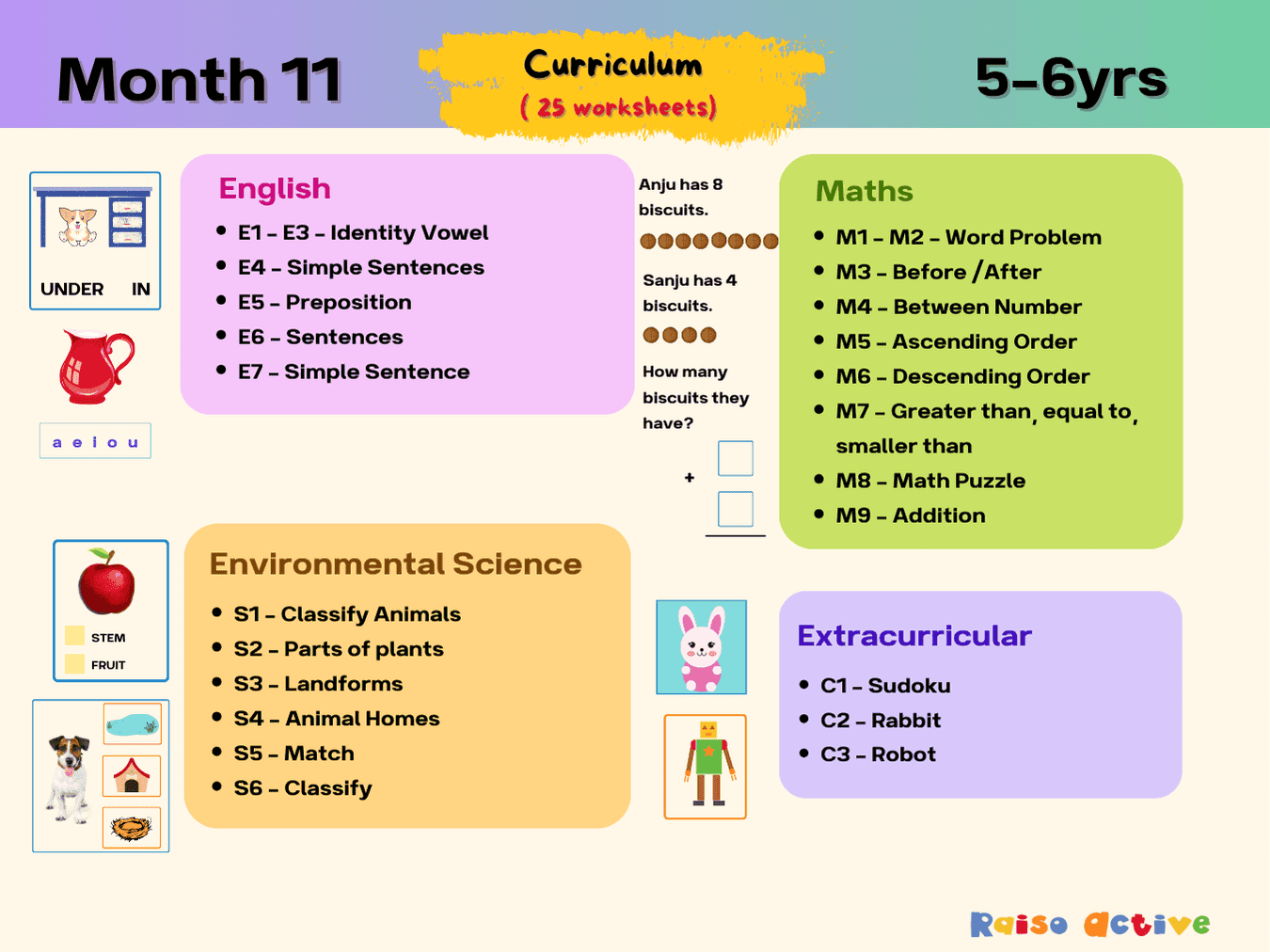
Part of the pack
Month 11: Learning & Development | Ages 5-6
This is page 15 of the pack. Ages 5-6 · KindergartenAges 5-6 · Year 1Ages 5-6 · UKGAges 5-6
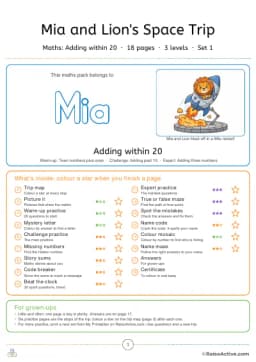
Made for your child
Counting to 10, made for your child
A maths pack with your child's name in it: pictures that explain, practice at three levels, puzzles and story sums about them. Print a new set whenever they finish.
Make a maths packFree preview · free for members
Curriculum
- Number Sense > Number Sequencing
How to use this worksheet
Look at the numbers written on each group of fruits together. Ask your child to identify which number is smallest and which is largest among the group. Have them write the numbers in order from smallest to largest in the space provided, repeating for each new set of fruit numbers on the page.
Materials needed
- Pencil
- Eraser
Extension activities
- 1Have your child create their own number sequences using household objects.
- 2Use real fruits with number labels to physically practice ascending order.
- 3Play a card game where you deal random number cards and race to put them in order.
- 4Build a number staircase out of blocks, shortest to tallest, matching it to numbers.

Written by
Hemsweta Jain · Teacher Cheena
MBA and Early Childhood Educator, teaching since 2014 · Founder of RaisoActive, Mumbai
Every RaisoActive worksheet is designed and checked by the founder before publishing.
Published · Last reviewed
More from Month 11: Learning & Development | Ages 5-6

Simple Sentences Worksheet: Rewriting Sentences for Early Readers
Ages 4-6 · Pre-K–KindergartenAges 4-6 · Reception–Year 1Ages 4-6 · LKG–UKGAges 4-6
Children ages 4-6 practice sentence construction by rearranging scrambled words into a grammatically correct, meaningful sentence, building an understanding of proper word order in English. This hands-on rearranging task teaches children to recognize where a sentence's subject, action, and details belong, a skill they'll use in all future writing.

Preposition Worksheet: Circle the Correct Position!
Ages 3-5 · Preschool–Pre-KAges 3-5 · Nursery–ReceptionAges 3-5 · Nursery–LKGAges 3-5
Children ages 3-5 practice identifying prepositions like 'in,' 'on,' and 'under' by looking at a picture and circling the word that correctly describes where an object is positioned. This builds early spatial vocabulary that children use constantly in everyday communication, from describing where a toy is to following directions.

Landforms Worksheet: Identify and Label the Pictures!
Ages 3-5 · Preschool–Pre-KAges 3-5 · Nursery–ReceptionAges 3-5 · Nursery–LKGAges 3-5
Writing the correct name for pictures of mountains, rivers, and other landforms from a word bank builds early science vocabulary and spelling practice for children ages 3-5, connecting a visual image to its written word.

Classify Animals: Sorting Worksheet for Preschoolers
Ages 3-5 · Preschool–Pre-KAges 3-5 · Nursery–ReceptionAges 3-5 · Nursery–LKGAges 3-5
Deciding which category — birds, fish, insects, or reptiles — each animal belongs to builds classification thinking for children ages 3-5, an early scientific skill of grouping things by shared characteristics.
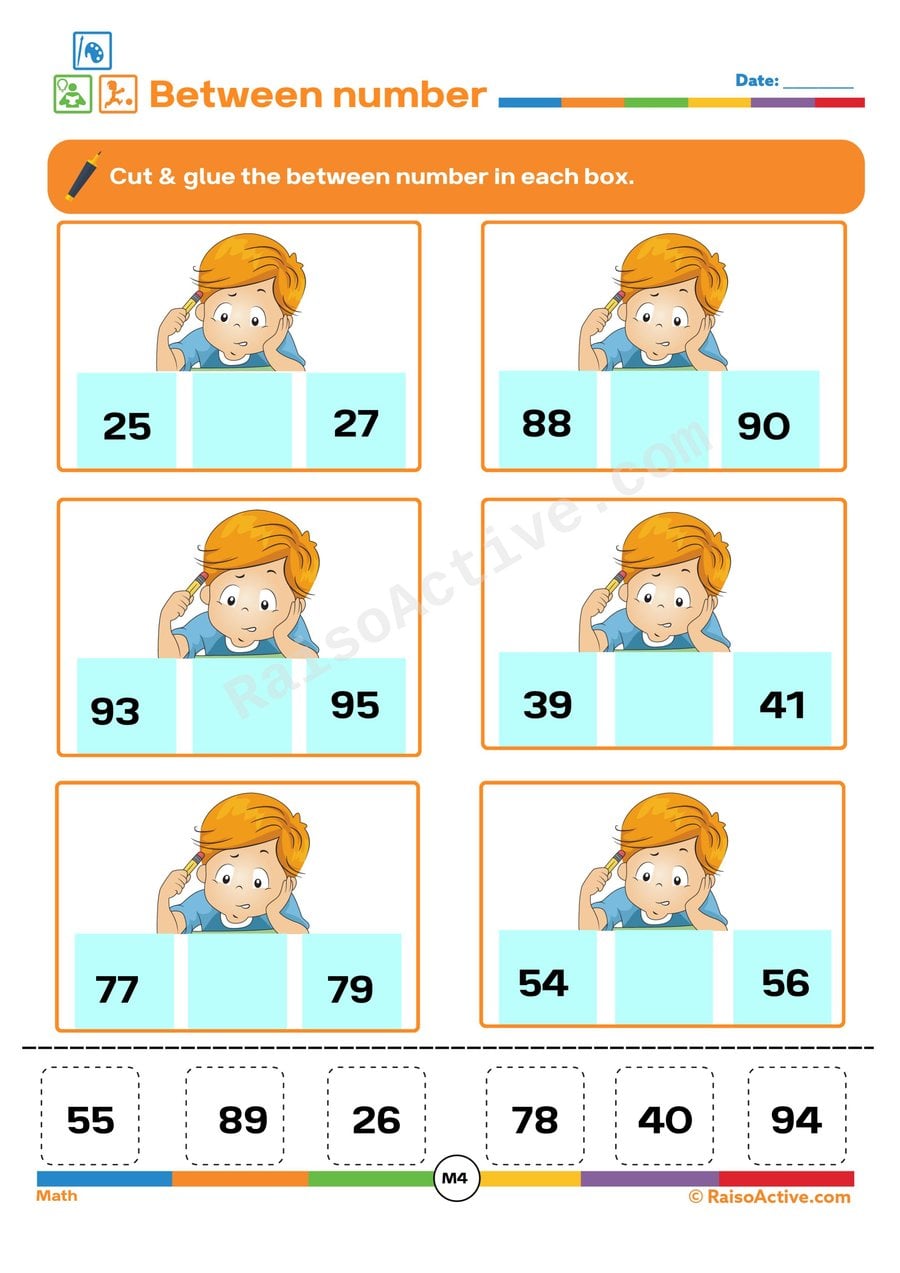
Find the Missing Number Worksheet for Kids
Ages 4-5 · Pre-KAges 4-5 · ReceptionAges 4-5 · LKGAges 4-5
Children ages 4-5 strengthen number recognition and sequencing by figuring out which number is missing from a short sequence, then physically cutting and pasting the correct number into place. The cut-and-paste format adds a search-and-select step on top of the math, since children must locate the right numeral among several choices before placing it, reinforcing both number recognition and careful visual scanning.

Word Problems Worksheet: Addition Practice for Young Learners
Ages 4-6 · Pre-K–KindergartenAges 4-6 · Reception–Year 1Ages 4-6 · LKG–UKGAges 4-6
Solving simple addition word problems teaches children ages 4-6 to translate a short story into a number sentence, practicing both reading comprehension and the mechanics of combining two groups into a total.

Animal Homes Worksheet: Circle the Correct Answer!
Ages 3-5 · Preschool–Pre-KAges 3-5 · Nursery–ReceptionAges 3-5 · Nursery–LKGAges 3-5
Matching an animal to its correct home among three picture choices builds science classification skills for children ages 3-5, introducing the idea that different animals are suited to different environments.

Addition Worksheet for Kids: Add Horizontally and Vertically!
Ages 4-6 · Pre-K–KindergartenAges 4-6 · Reception–Year 1Ages 4-6 · LKG–UKGAges 4-6
Children ages 4-6 practice basic addition by solving problems arranged both horizontally, like '3 + 2 =,' and vertically, in a stacked column format, building flexibility with the two most common ways addition problems appear in early math worksheets and textbooks. Learning both formats now means neither will feel unfamiliar once formal school math introduces them side by side.
Related worksheets
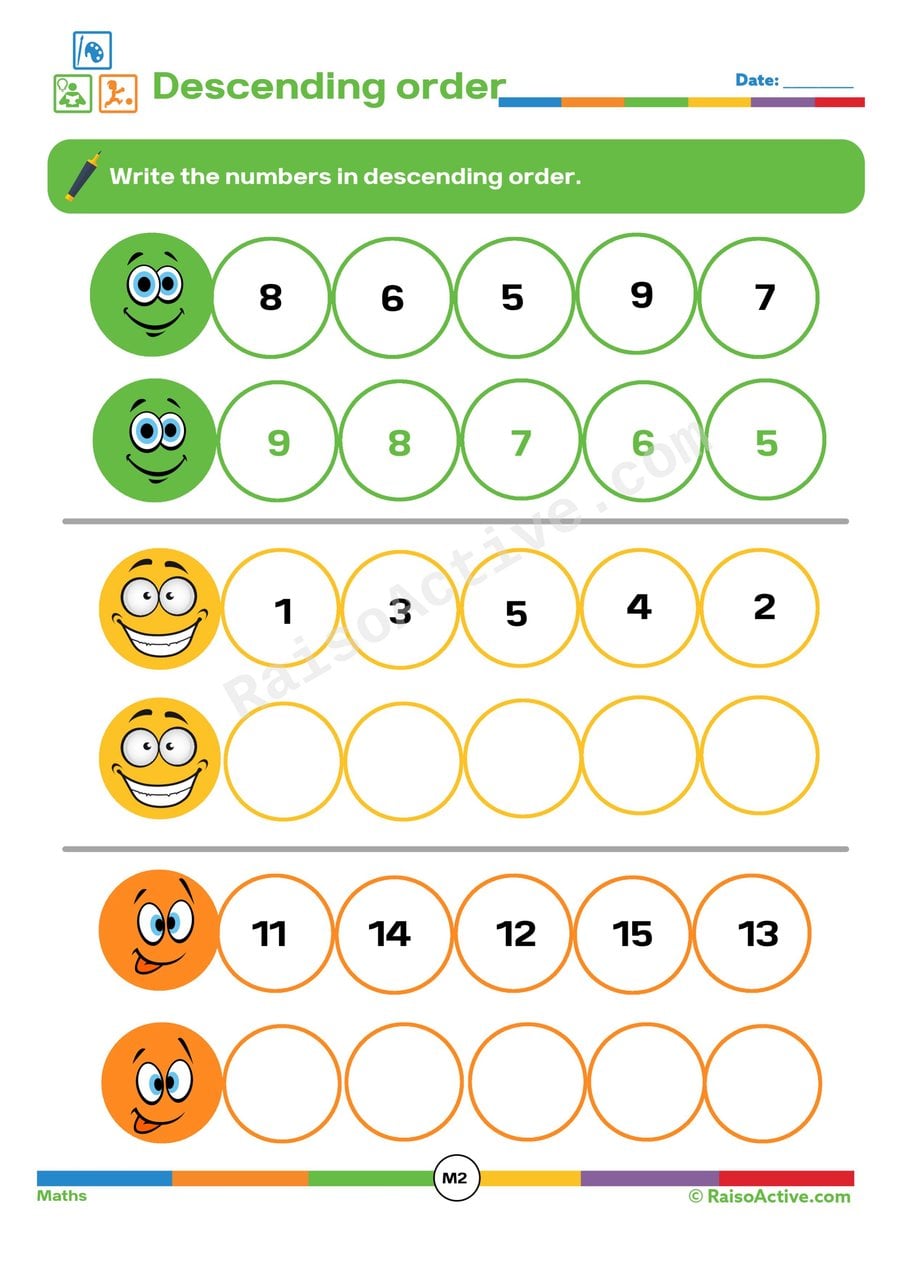
Descending Order Worksheet: Numbers 5-15
Ages 4-5 · Pre-KAges 4-5 · ReceptionAges 4-5 · LKGAges 4-5
Writing numbers in descending order asks 4-5 year olds to hold a full sequence in mind and reverse it — a genuinely different mental task from the more familiar ascending count, since children have to think about 'what comes before' rather than 'what comes after.' Practicing this with numbers 5 through 15 also reinforces number formation and one-to-one number-word correspondence, since each digit has to be written accurately as your child works backward.

Descending Order Fruits Worksheet for Preschoolers
Ages 4-5 · Pre-KAges 4-5 · ReceptionAges 4-5 · LKGAges 4-5
Arranging fruits labeled with numbers from largest to smallest builds descending order recognition for children ages 4-5, reinforcing number comparison skills that complement the more commonly practiced ascending order.
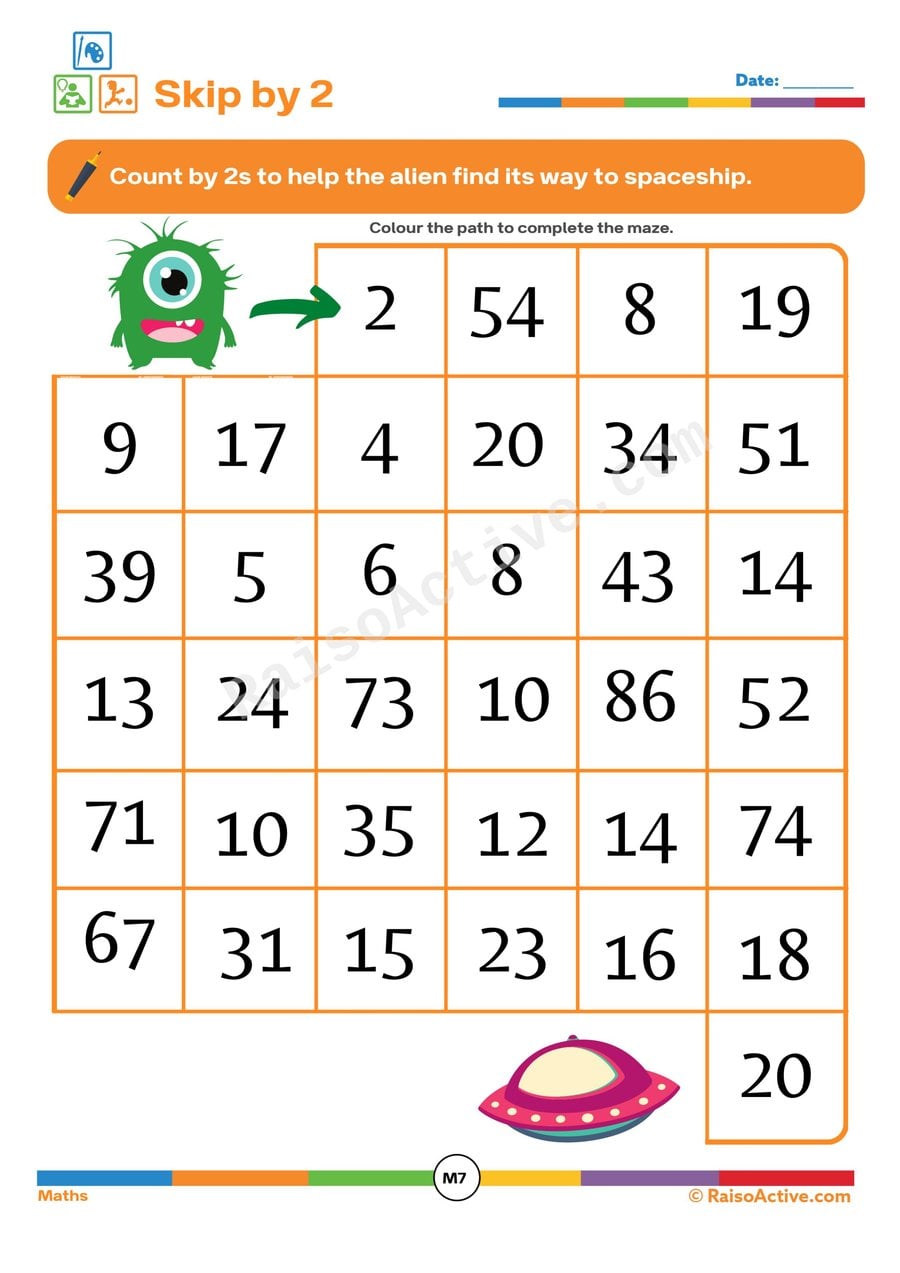
Alien Maze: Skip Counting by 2s Worksheet
Ages 3-5 · Preschool–Pre-KAges 3-5 · Nursery–ReceptionAges 3-5 · Nursery–LKGAges 3-5
This maze worksheet combines skip counting by 2s with fine motor tracing, requiring children to find and follow the correct numerical path from number 2 up through the sequence to reach the spaceship. For ages 3-5, this pairs a physical, engaging maze format with the numeracy skill of counting by 2s, which lays groundwork for later even-number recognition and faster counting strategies.

Number Path Adventure: Write Numbers 1-20 Worksheet
Ages 4-6 · Pre-K–KindergartenAges 4-6 · Reception–Year 1Ages 4-6 · LKG–UKGAges 4-6
Children ages 4-6 practice writing numerals in correct sequence as they fill in missing numbers along a path of stepping stones from 1 to 20. This strengthens number-order memory and numeral formation together, both needed before a child can count on reliably or recognize number patterns like the teens. Following a winding path also adds a light visual-tracking challenge that keeps attention on the correct next stone.

Summer Puzzle Worksheet: Cut and Arrange Numbers 11-20!
Ages 4-5 · Pre-KAges 4-5 · ReceptionAges 4-5 · LKGAges 4-5
This worksheet extends number sequencing practice into the teens and twenties by having children cut out numbered puzzle pieces and arrange them from 11 to 20 to reveal a hidden summer picture. For four- and five-year-olds, the puzzle format adds motivation to get the sequence right, since an incorrect order means the picture won't come together properly, giving children immediate, visual feedback on their own work.
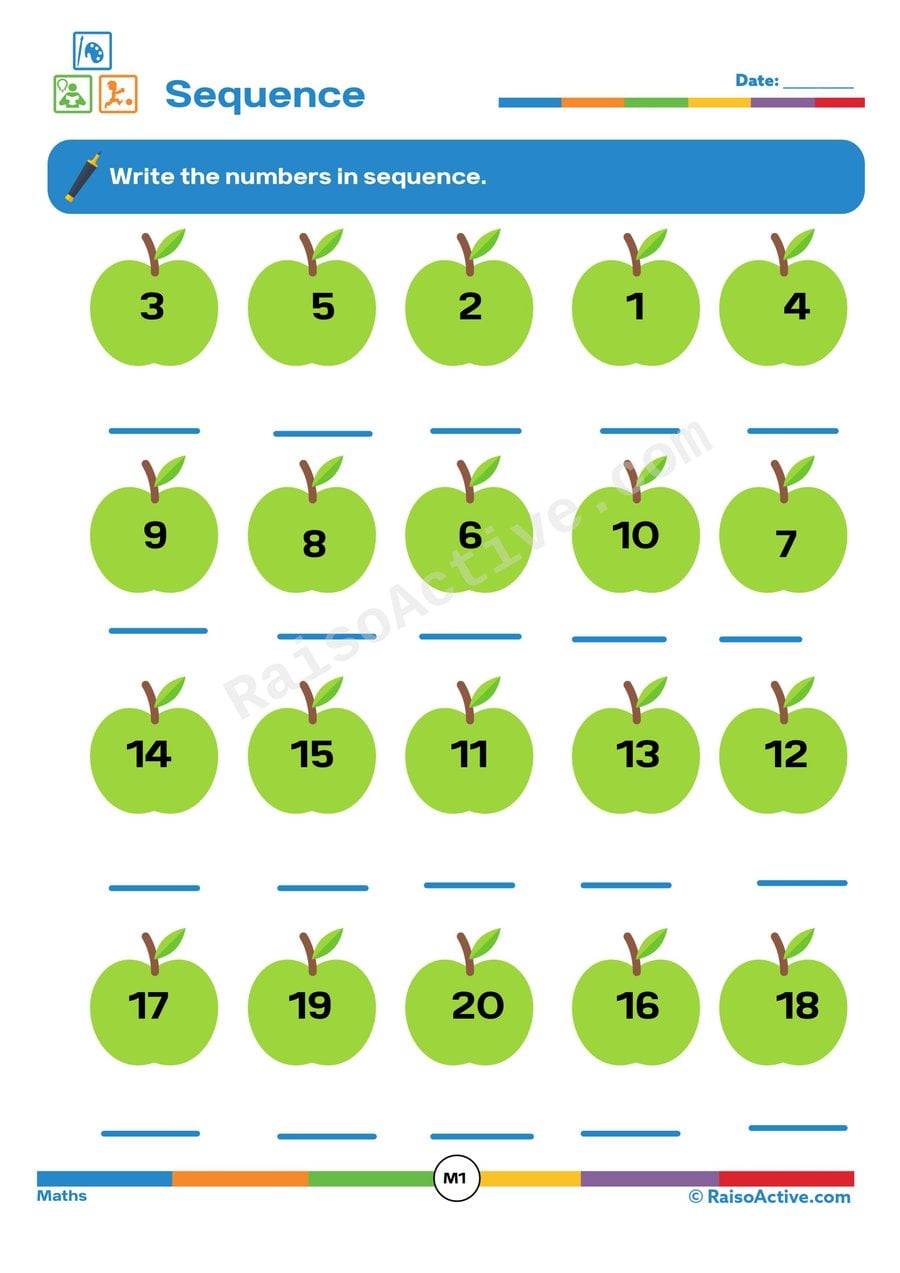
Sequence Fun: Writing Numbers in Order Worksheet
Ages 4-5 · Pre-KAges 4-5 · ReceptionAges 4-5 · LKGAges 4-5
This worksheet helps children ages 4-5 practice writing numbers in the correct sequence, reinforcing both number recognition and the concept that numbers have a fixed, predictable order. Filling in missing numbers along a row of apples also builds the pattern-recognition skills that underlie later skip-counting and place value work.

Before and After Numbers Worksheet for Preschoolers
Ages 3-5 · Preschool–Pre-KAges 3-5 · Nursery–ReceptionAges 3-5 · Nursery–LKGAges 3-5
Identifying which numbers come immediately before or after a given number and physically sorting pictures into place links number sequence recall with the fine motor practice of cutting and pasting, building confidence for children ages 3-5.
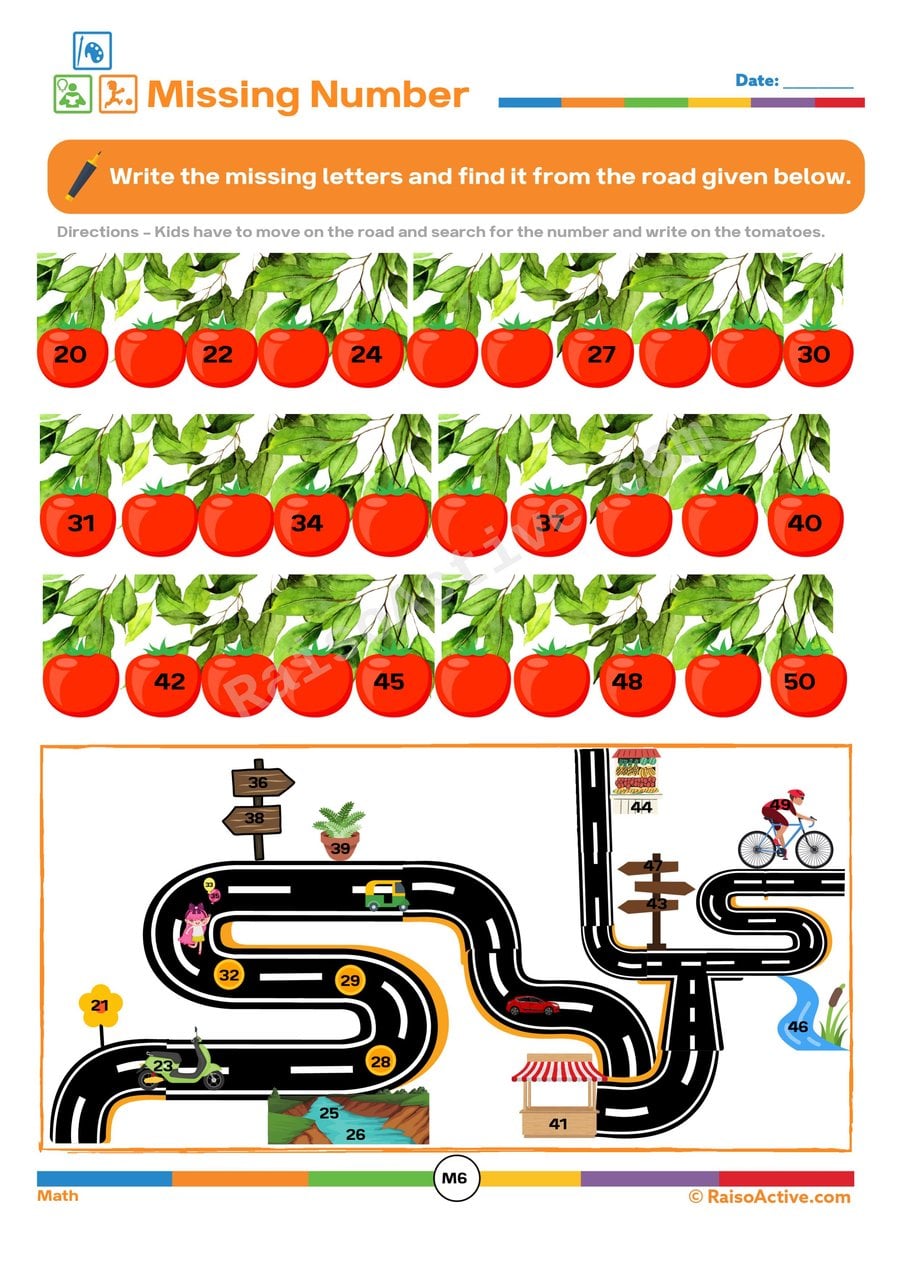
Missing Number Road Trip Worksheet for Kids
Ages 4-6 · Pre-K–KindergartenAges 4-6 · Reception–Year 1Ages 4-6 · LKG–UKGAges 4-6
Children ages 4-6 practice number sequencing by identifying which numbers are missing from a road of tomatoes, a skill that requires understanding what comes before and after a given number in counting order. This strengthens number recognition and prepares children to count confidently without needing to start from one every time.
Guides for this topic

Number Formation Rhymes 0–9 and How to Fix Reversals
Original number formation rhymes for 0–9, the correct stroke order for each digit, why 3, 5 and 7 get reversed most often, and multisensory fixes that work.

Christmas and Winter Activities That Combine Fun and Learning: Creating Magical Educational Experiences
Discover Christmas and winter activities that combine festive fun with real learning. Crafts, counting, literacy, and printable worksheets for ages 2 to 8 — perfect for home and school.
Age-Appropriate Halloween Learning Activities: Balancing Spooks and Skills for Young Learners
Discover fun, age-appropriate Halloween learning activities for young children. Spooky crafts, counting games, literacy ideas, and printable worksheets for ages 2 to 8.
Reviews
Every worksheet for ages 4–6, no watermark
Members download the full library of 1,000+ worksheets and every activity pack without watermarks or daily limits. One year costs ₹999 in India or $20 elsewhere.
See membership plansOr download any worksheet free with a watermark (5 a day).