Free printable worksheets · India
Nursery Worksheets (Ages 3–4)
Nursery worksheets are practice sheets for children aged 3 to 4 in the first year of Indian pre-primary school. They build the pre-writing strokes, colouring control, shape and colour recognition, matching, counting to 5 and first letter and number recognition that Playgroup and Nursery children need before LKG.
Nursery is the first year most Indian children hold a pencil with purpose. At three, fingers are still learning to grip, so the sheets on this page start with standing lines, sleeping lines, curves and zigzags before any letter appears. Colouring pages build the hand control that later becomes handwriting; matching and odd-one-out sheets train the eye to notice sameness and difference; counting sheets stop at five because that is what a three-year-old can hold in mind. Children in Playgroup or Pre-nursery (ages 2–3) can use the simpler colouring and matching sheets. Print on A4, use a thick crayon or jumbo pencil, and keep each session under ten minutes.
1212+ worksheets · free PDF download · print on A4 or Letter
Nursery Worksheets to print
Browse all worksheets for ages 3–4
Clothing Pattern Match Worksheet for Preschoolers
This worksheet has children ages 3-5 study repeating patterns on clothing items — stripes, polka dots, or checks — and match each item to its identical twin, building visual discrimination and early pattern-sequencing skills. Distinguishing between similar-looking patterns also sharpens attention to detail, a skill that later supports letter and word recognition.

Letter Z Tracing Worksheet for Preschoolers: Learn to Write the Letter Z!
Tracing the uppercase letter Z introduces children ages 3-5 to a distinctive zigzag stroke pattern, different from the curved or straight strokes used in most other letters, which builds versatile pencil control. Coloring pictures that start with Z afterward links this less common letter to real, memorable words like zebra or zipper.

Slanting Line Tracing Worksheet: Help the Balls Roll Down!
Tracing diagonal lines that guide a ball down a slide teaches children ages 3-5 a prewriting stroke that's more challenging than straight horizontal or vertical lines, since slanted strokes require angling the wrist and controlling direction at the same time. This kind of diagonal line practice directly prepares the hand for letters like A, K, and X, which all rely on slanted strokes. The playful slide-and-ball theme gives an otherwise repetitive motor exercise a sense of motion and purpose.
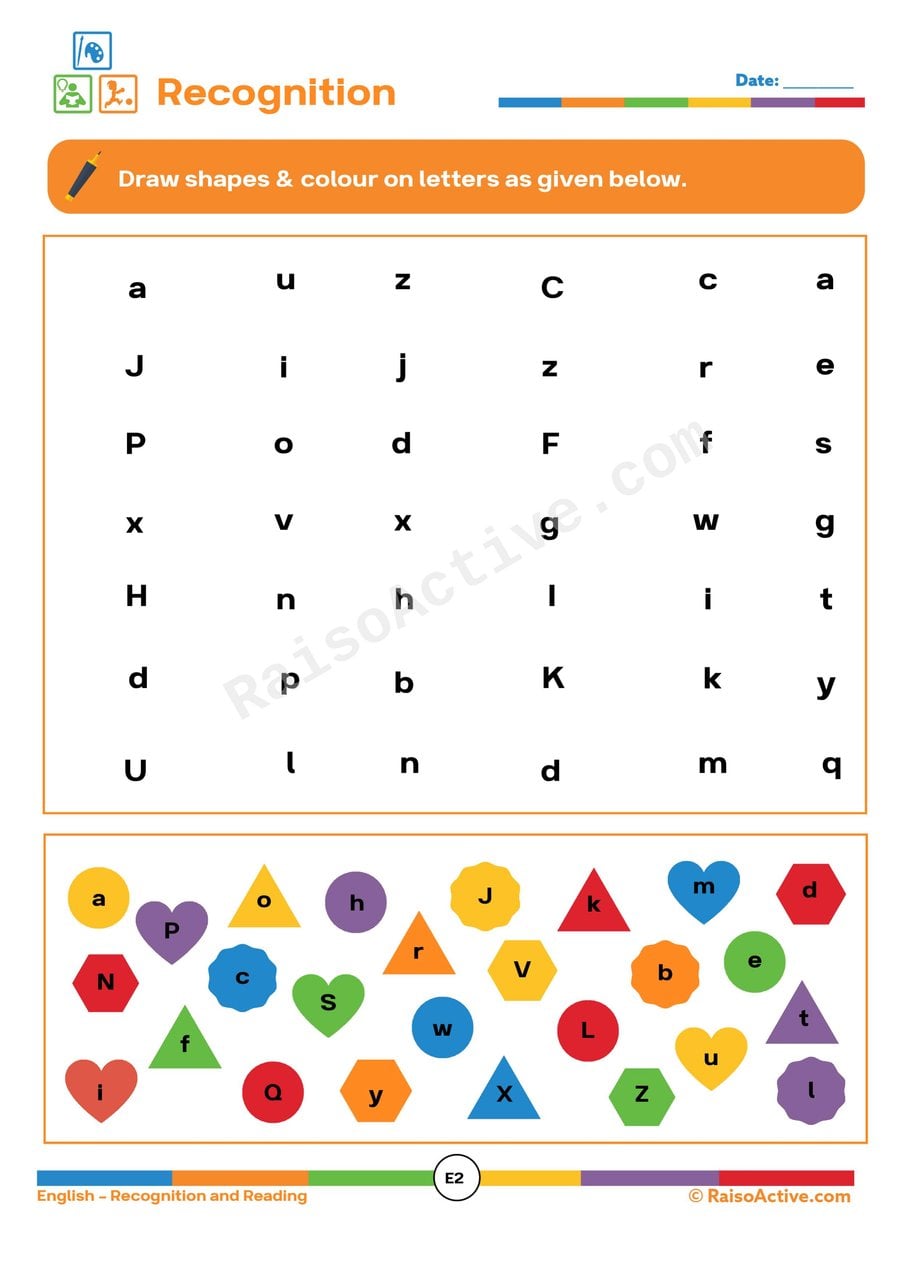
Letter Recognition Worksheet: Draw Shapes & Color!
Pairing letter recognition with drawing shapes gives children ages 3-5 practice on two skills at once: identifying printed letters by sight and following simple shape instructions with a pencil. Coloring the letters afterward reinforces the letter's visual form through repeated, focused attention rather than a quick glance, while the shape-drawing task builds the same pre-writing control needed for forming letters later. Combining these tasks keeps the page varied and engaging for a young attention span.
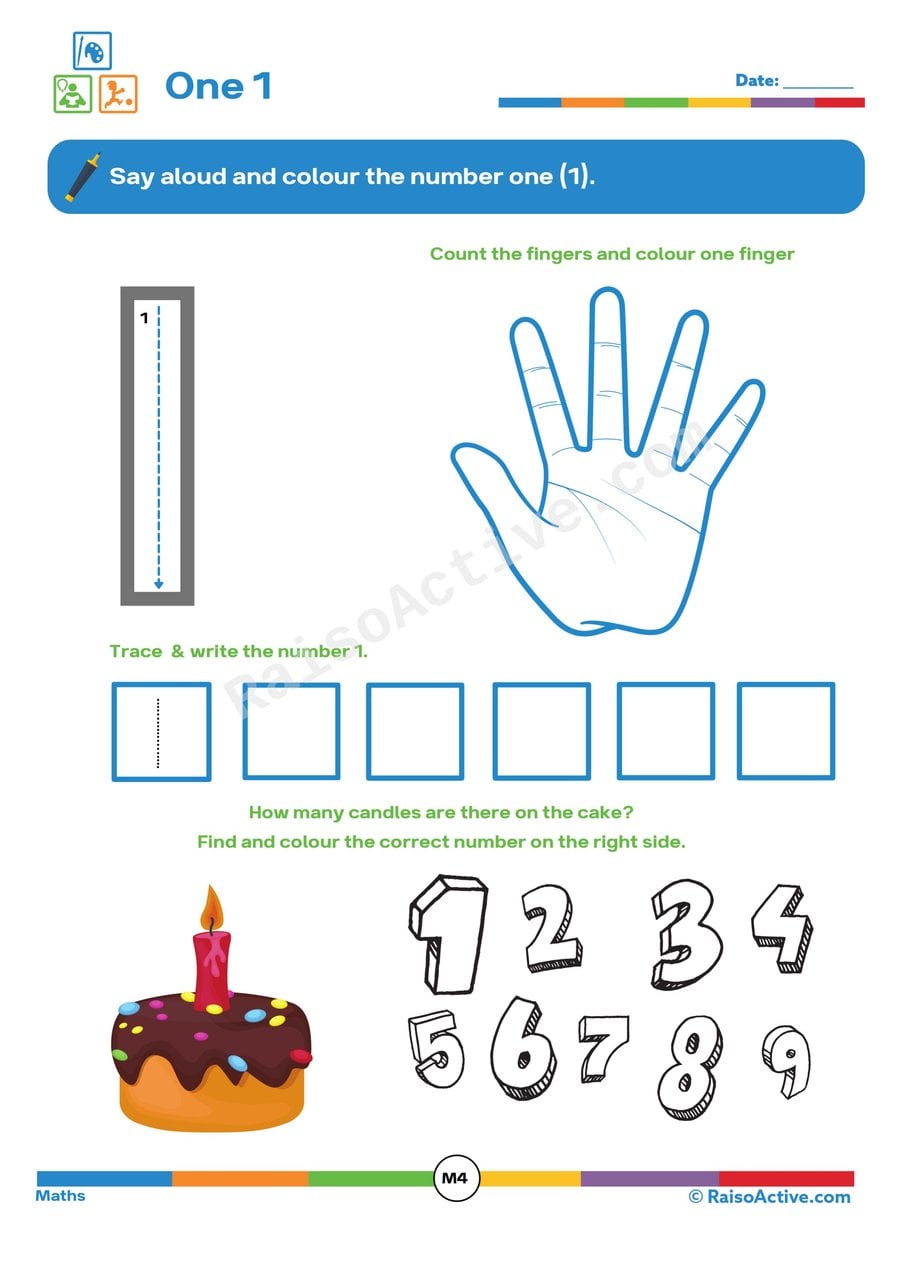
Number One Worksheet: Trace, Count, and Color!
Children ages 3-5 practice forming the number 1 through guided tracing while also reinforcing what the quantity 'one' represents by counting a single finger and a single candle. Linking the written symbol directly to a real quantity is a key early step in number sense before children move on to larger numbers.

Summer Counting Worksheet: Count and Color Summer Objects!
This summer-themed counting page has children ages 3-5 count groups of sun, beach, and vacation-related objects and write the matching numeral in a box, directly practicing one-to-one correspondence, the skill of counting each item exactly once. Because the objects are grouped by theme rather than lined up in neat rows, children also practice visually organizing a scattered set before counting it, a slightly harder skill than counting objects in a straight line. Writing the total afterward connects the physical act of counting to the abstract symbol that represents it.

Rocket Shapes Worksheet for Preschoolers: Tracing and Matching
Building a rocket picture out of basic shapes helps children ages 3-5 practice shape recognition in a real, assembled context rather than in isolated flashcard form, showing them how circles, triangles, and rectangles combine to make a recognizable object. Circling the shapes found in the picture first sharpens visual discrimination, requiring children to spot a shape even when it's part of a larger, more complex image. The tracing component that follows adds fine motor practice, asking children to follow a dotted outline precisely to complete the rocket shape.
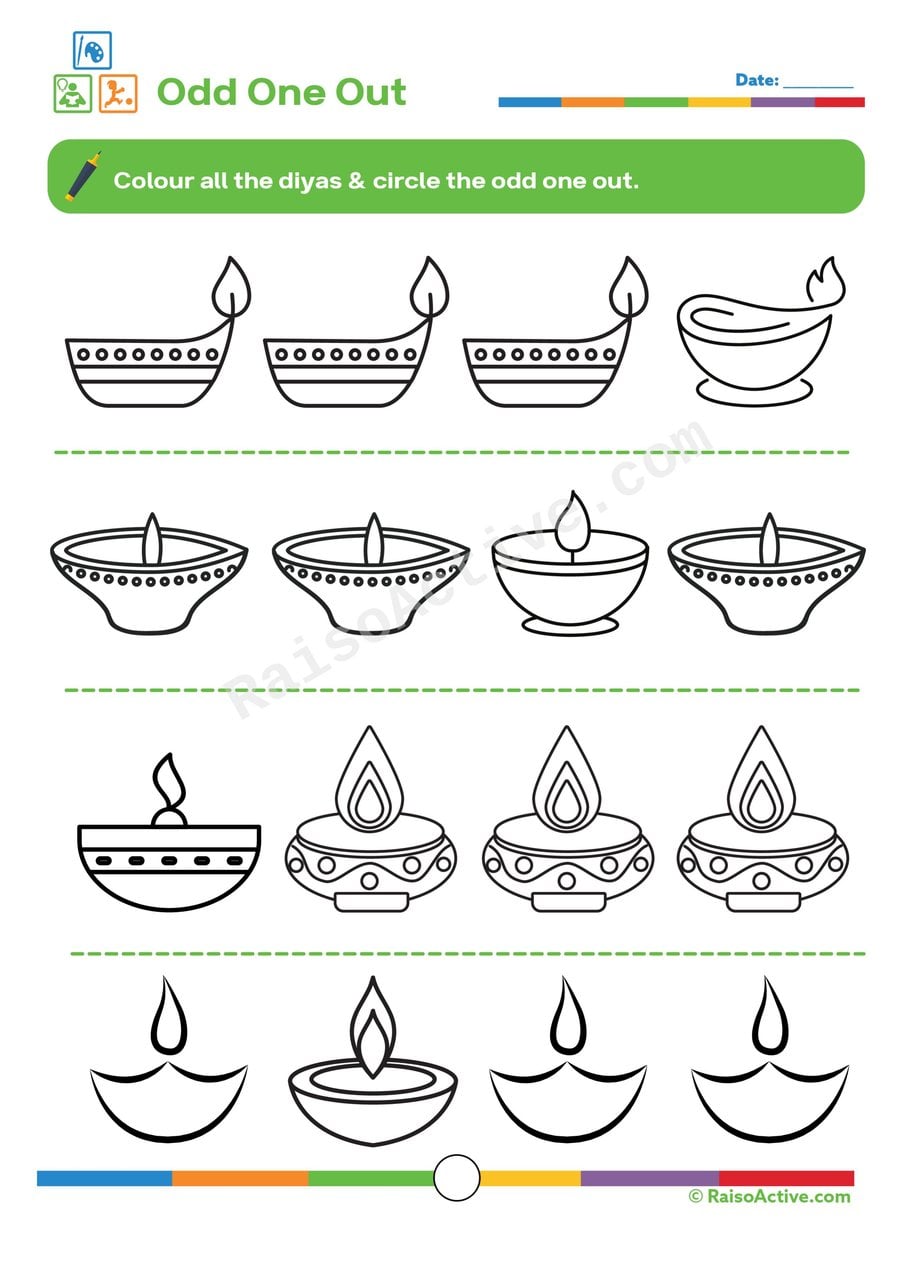
Diya Odd One Out Worksheet for Kids
This worksheet builds visual discrimination skills in children ages 3-5 as they compare a row of diyas and identify the one that differs from the rest. Spotting subtle differences in shape, color, or design is an early critical-thinking skill that lays groundwork for later pattern recognition and attention-to-detail tasks in reading and math.
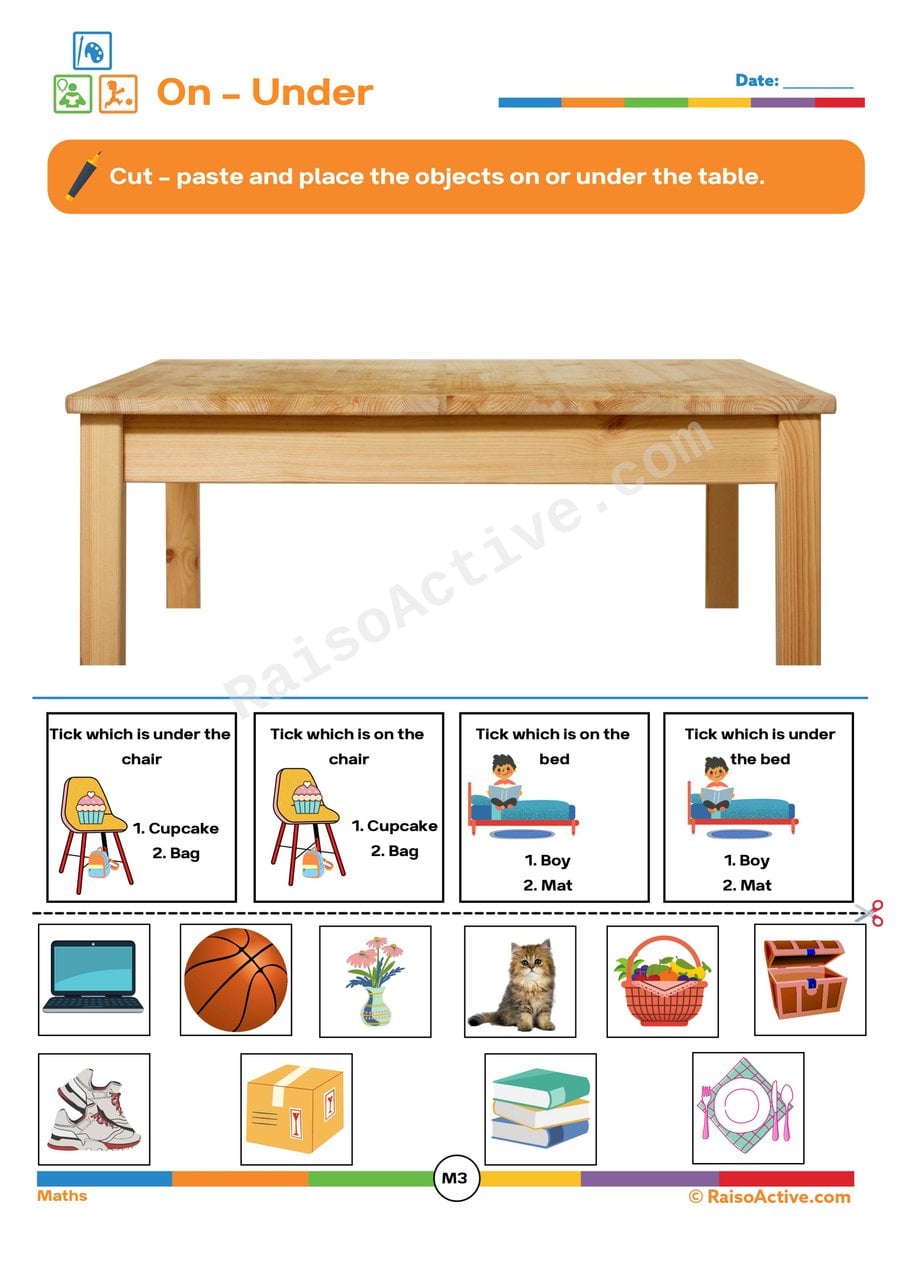
On and Under Worksheet: Table Placement Fun!
Cutting out pictures and gluing them either on or under a table teaches children ages 3-5 the spatial prepositions 'on' and 'under' by requiring them to physically place an object according to a specific instruction rather than just hearing the words. This hands-on placement task builds spatial reasoning and reinforces receptive language, since children must correctly interpret which word means which position before acting on it. Prepositions like these are often tricky to grasp through listening alone, so the visual, hands-on nature of this worksheet makes the concept concrete.

Color the Shapes! A Fun Coloring Worksheet for Kids
This worksheet strengthens children ages 3-5 in both shape recognition and color matching by having them reproduce a colored key onto a black-and-white picture made of shapes. Matching a printed example rather than choosing colors freely also builds a new skill: following a visual reference precisely, which is different from — and complements — open-ended coloring.

Snowman Cut and Paste Worksheet for Preschoolers
This cut-and-paste craft builds fine motor precision as children cut out and arrange a snowman's body parts, while decorating with buttons, cotton, and googly eyes adds open-ended creative expression. For ages 3-5, the multi-step nature of cutting, arranging, and gluing several separate pieces in the right order and position strengthens both scissor control and sequencing skills.
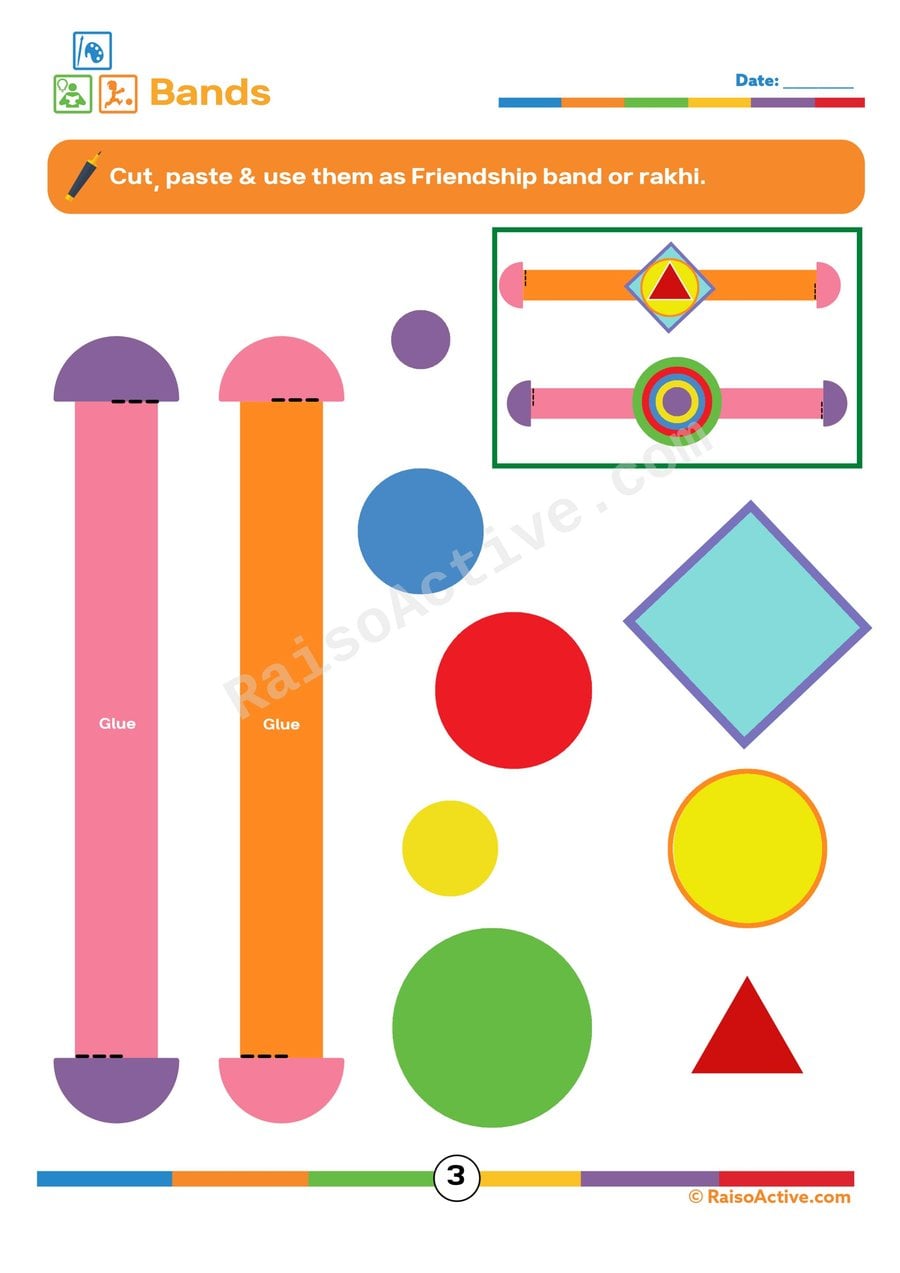
Friendship Band Craft: Cut, Paste, and Create!
Children ages 3-5 build fine motor control and creative decision-making as they cut out band shapes, decorate them, and paste on decorative elements to design their own friendship band or rakhi. Choosing and arranging decorations independently also introduces early design thinking — planning how individual pieces come together into a finished object.
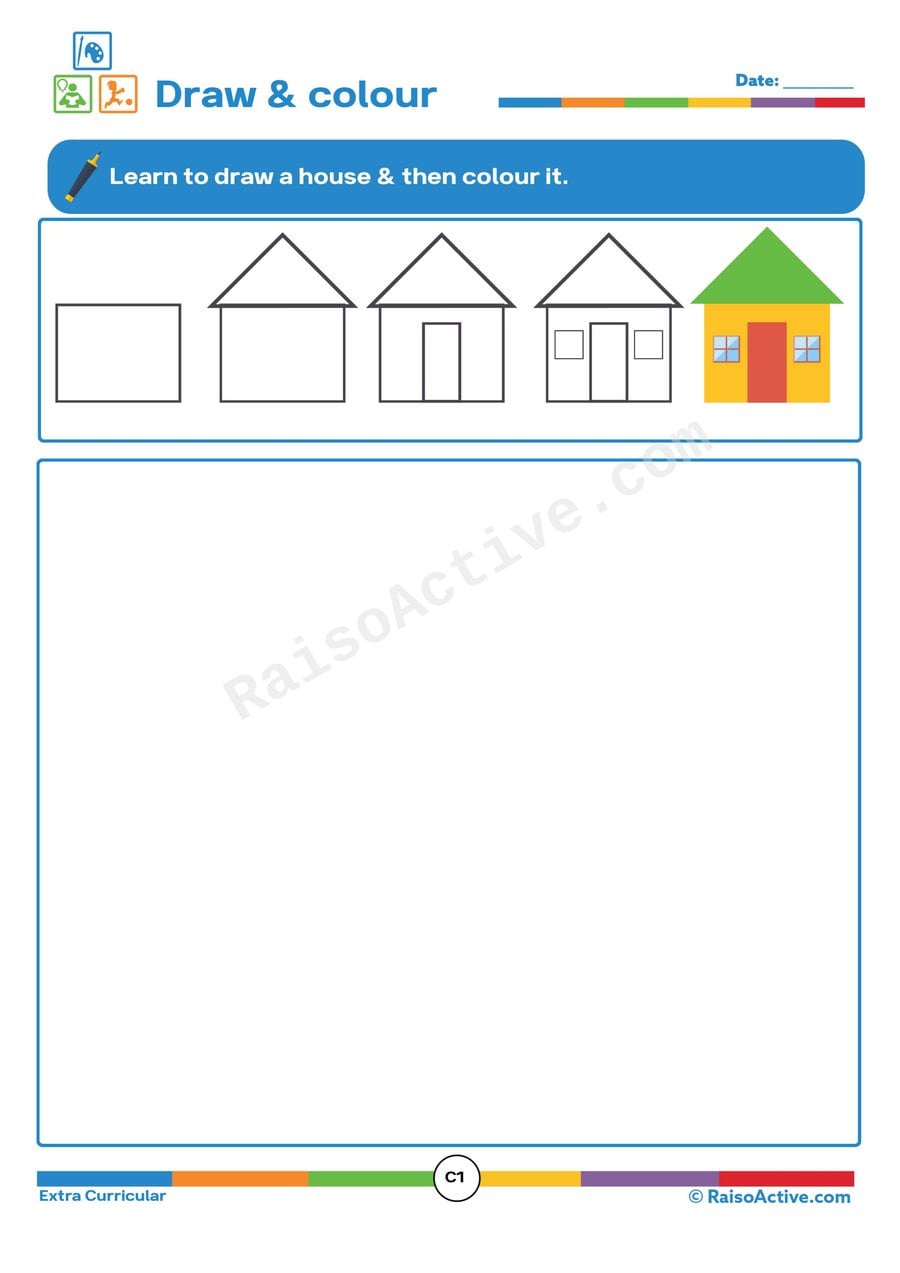
Draw and Color a House: A Fun Worksheet for Kids!
Children ages 3-5 build drawing confidence and step-by-step visual planning by following simple guided steps to construct a house shape, then adding color to complete the picture. Learning to build a picture from basic shapes, like a square, triangle, and rectangle, introduces early geometry concepts through creative expression. Coloring the finished house afterward continues strengthening fine motor control and thoughtful color choice.

Count and Write: Fun Counting Worksheet for Preschoolers
This counting worksheet has children ages 3-5 count small groups of objects and write the matching numeral in a box, directly linking the physical act of counting to the written symbol that represents a quantity. Writing the number immediately after counting — rather than just counting aloud — reinforces that numerals are a shorthand for real, countable amounts.

Learn to Write the Sight Word 'I' Worksheet for Preschoolers
This worksheet gives children ages 3-5 focused, repeated practice recognizing, tracing, and writing the sight word 'I,' one of the very first words most children learn to read and write since it appears constantly in their own speech. Because 'I' is a single letter that stands for a whole word, it's also a gentle introduction to the idea that capitalization carries meaning.
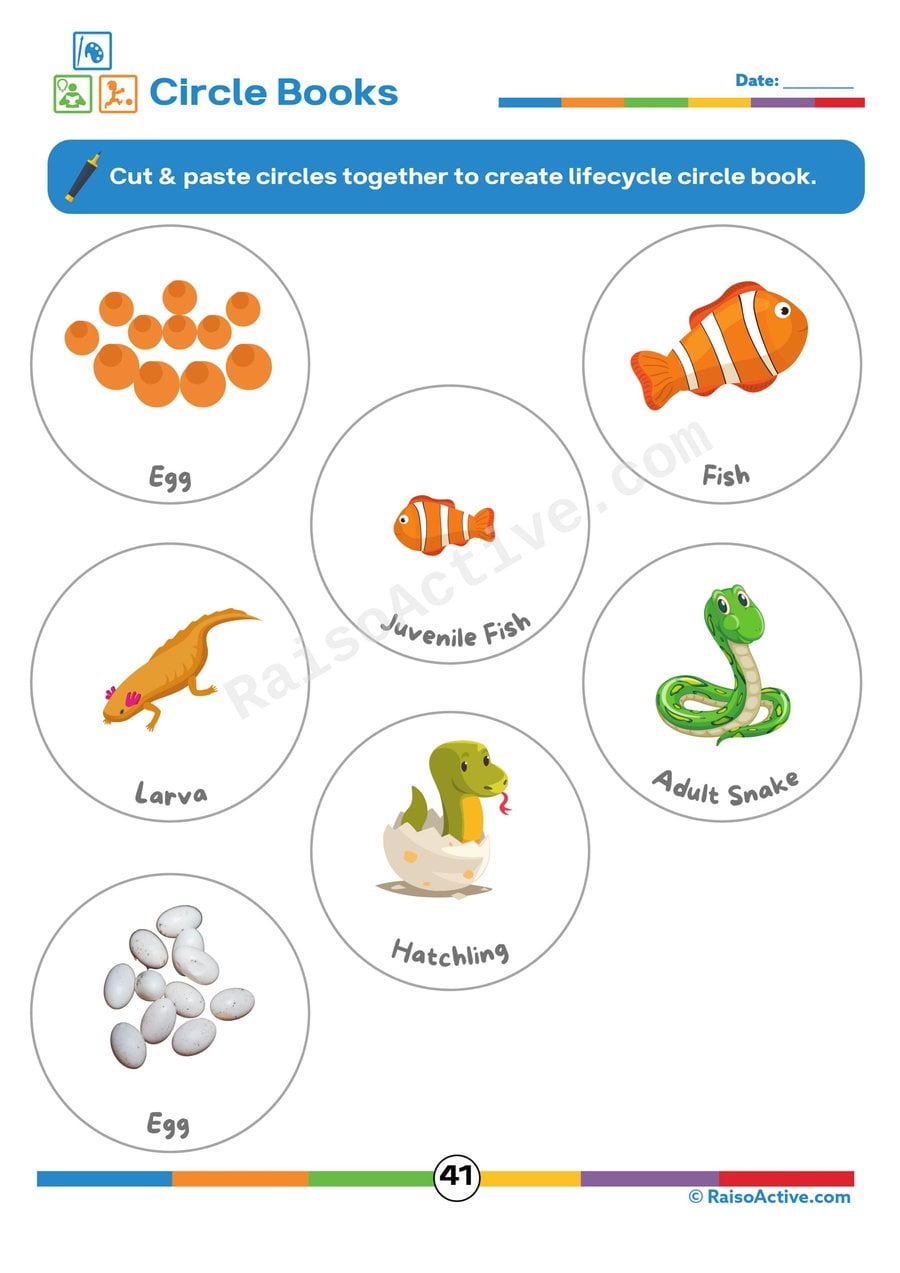
Lifecycle Circle Book: Cut and Paste Worksheet
This worksheet gives children ages 3-5 practice matching pictures to the correct stage of an animal's life cycle while assembling a hands-on circular book. Beyond sequencing, the rotating format helps children internalize that growth is a continuous, repeating process rather than a fixed line from start to finish.
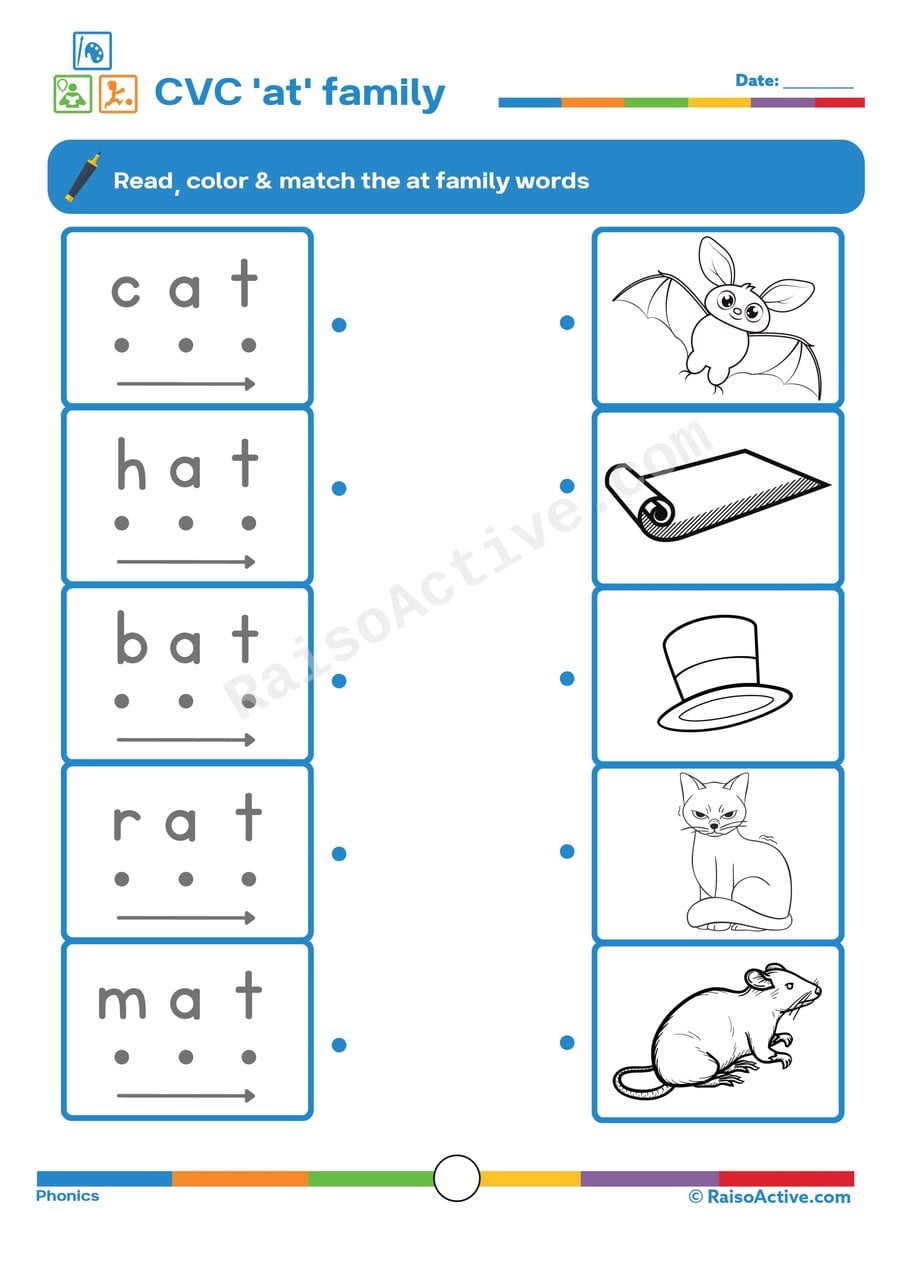
CVC 'at' Family Words Matching Worksheet for Kids
This worksheet introduces children ages 3-5 to the 'at' word family — cat, bat, hat, mat, and similar words that share the same ending sound — helping them notice that once they know how 'at' sounds, they can read many new words just by swapping the first letter. Word family practice is one of the most efficient ways young readers build a large sight vocabulary quickly, since the pattern transfers across dozens of words. Matching each word to its picture confirms real understanding, not just mechanical sounding-out.
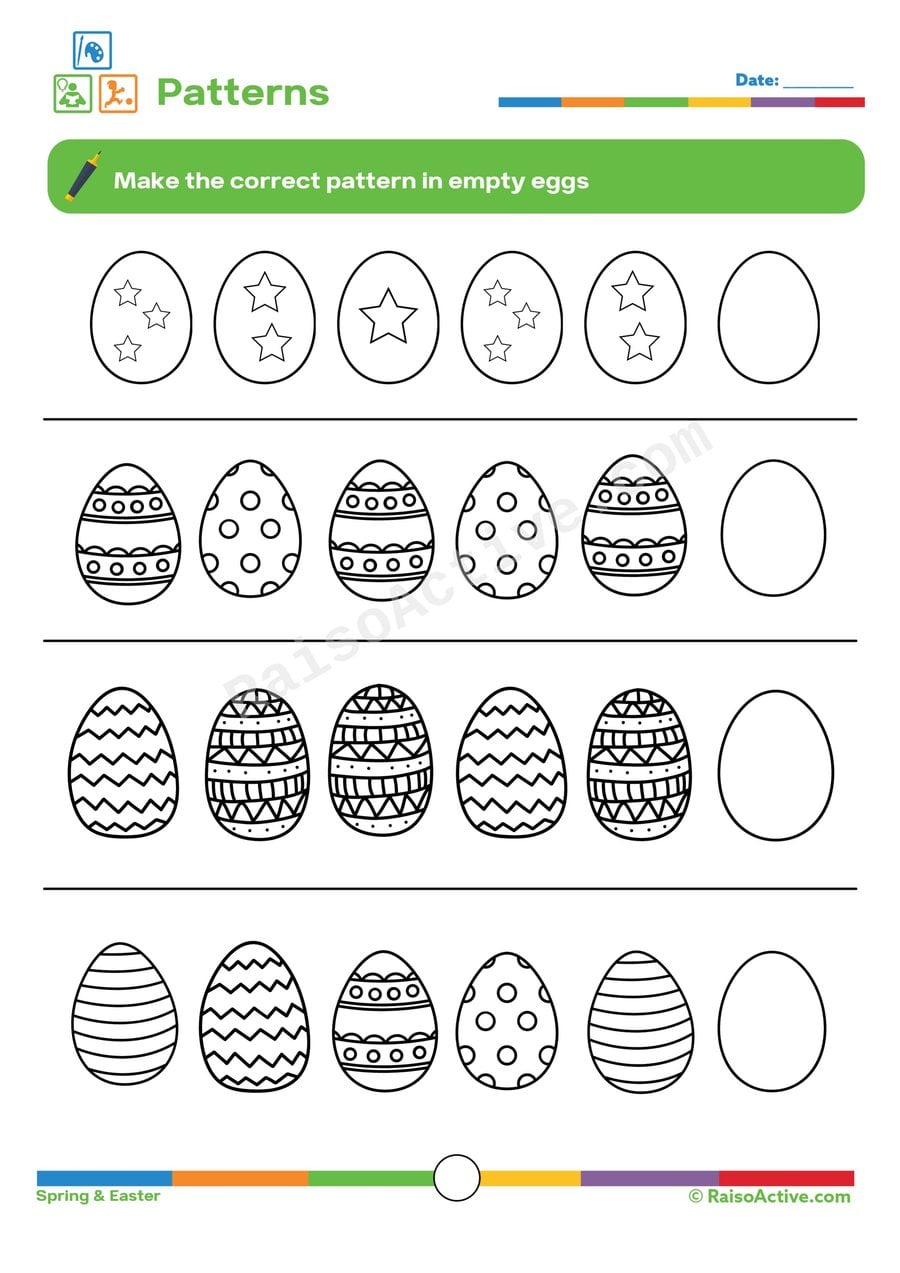
Easter Egg Patterns Worksheet for Preschoolers
This worksheet asks children ages 3-5 to study a sequence of patterned Easter eggs and figure out what design should come next, then draw it into the empty egg themselves. Predicting and completing a pattern, rather than just matching an existing one, pushes children a step further into the kind of what-comes-next reasoning that underlies early math and logic.

Say My Sound: Beginning Letter Sounds Worksheet for Preschoolers
Saying a picture's name aloud and then circling the letter that matches its beginning sound builds phonemic awareness in children ages 3-5, teaching them to isolate the very first sound in a spoken word before connecting it to a printed letter. Because several letter options are given for each picture, this worksheet requires children to actively compare sounds rather than simply recognize a single correct letter by memory. This kind of applied letter-sound practice is one of the strongest early predictors of later reading success.
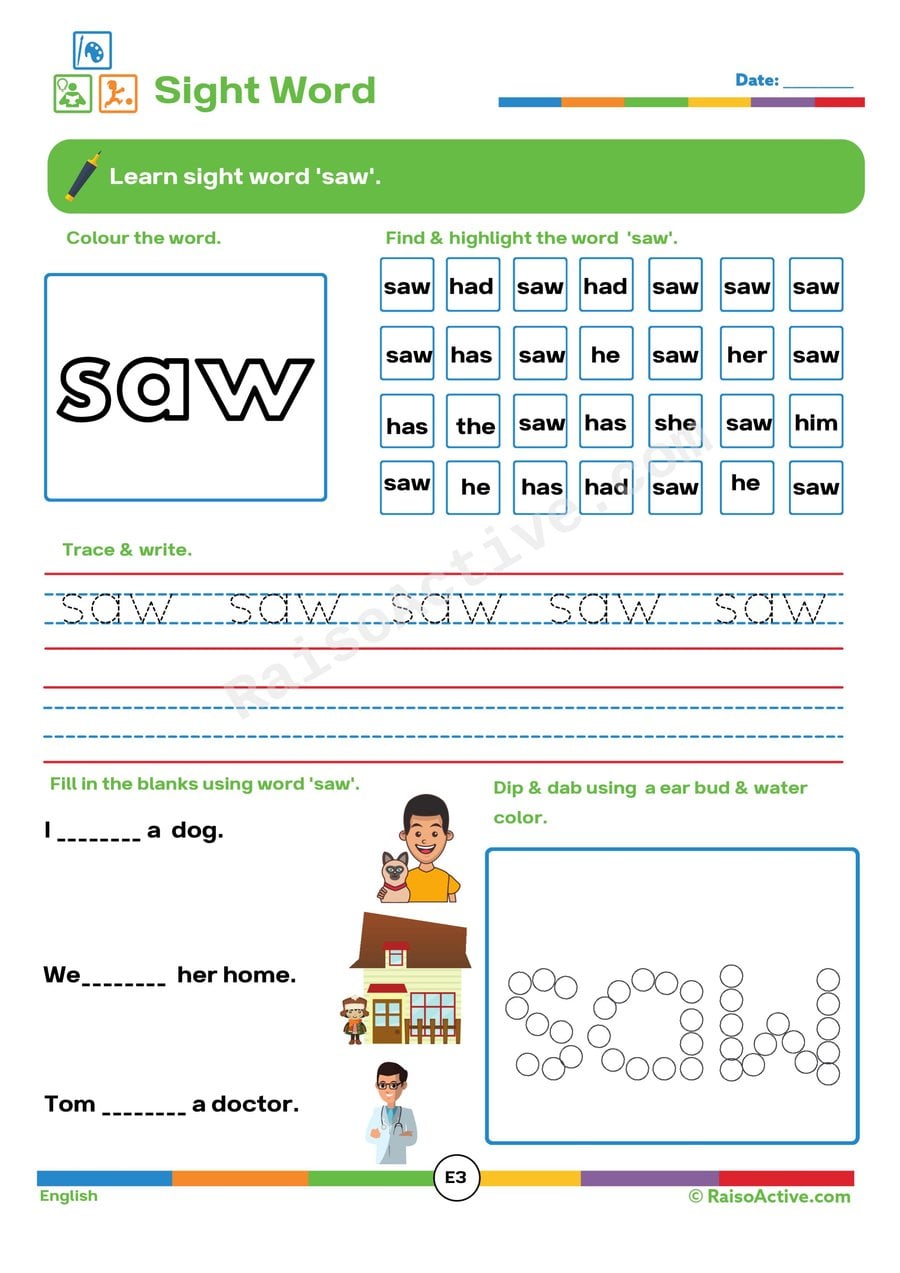
Sight Word 'Saw' Worksheet: Trace, Find, and Color!
The word 'saw' is another high-frequency sight word that doesn't follow standard phonics patterns, so children ages 3-5 need this kind of layered, multi-format practice — coloring, tracing, searching, and sentence completion — to build automatic recognition. Repeated exposure to the same word through different activities strengthens the visual memory needed for instant sight-word recall, which is essential since sight words make up a large percentage of the words in early beginner books. The variety of formats here also keeps a young child's attention across a longer practice session than a single repetitive task would.

Easter Egg Match: Add and Find the Matching Designs!
This worksheet blends early addition with visual matching as children ages 3-5 combine two separate shape groups and then search for the Easter egg design that shows the same total. Because the 'answer' is a picture rather than a written number, children practice quantity comparison and pattern-matching without needing to know written numerals yet.

Trace and Write the Letter Y Worksheet for Preschoolers
Tracing the uppercase letter Y gives children ages 3-5 repeated practice with the diagonal-to-vertical stroke pattern that makes Y one of the trickier capital letters to form by hand. Because Y starts words like 'yellow,' 'yarn,' and 'yo-yo,' this page also reinforces the /y/ sound so children begin connecting how a letter looks with how it sounds. That letter-sound pairing is a core building block for early reading.
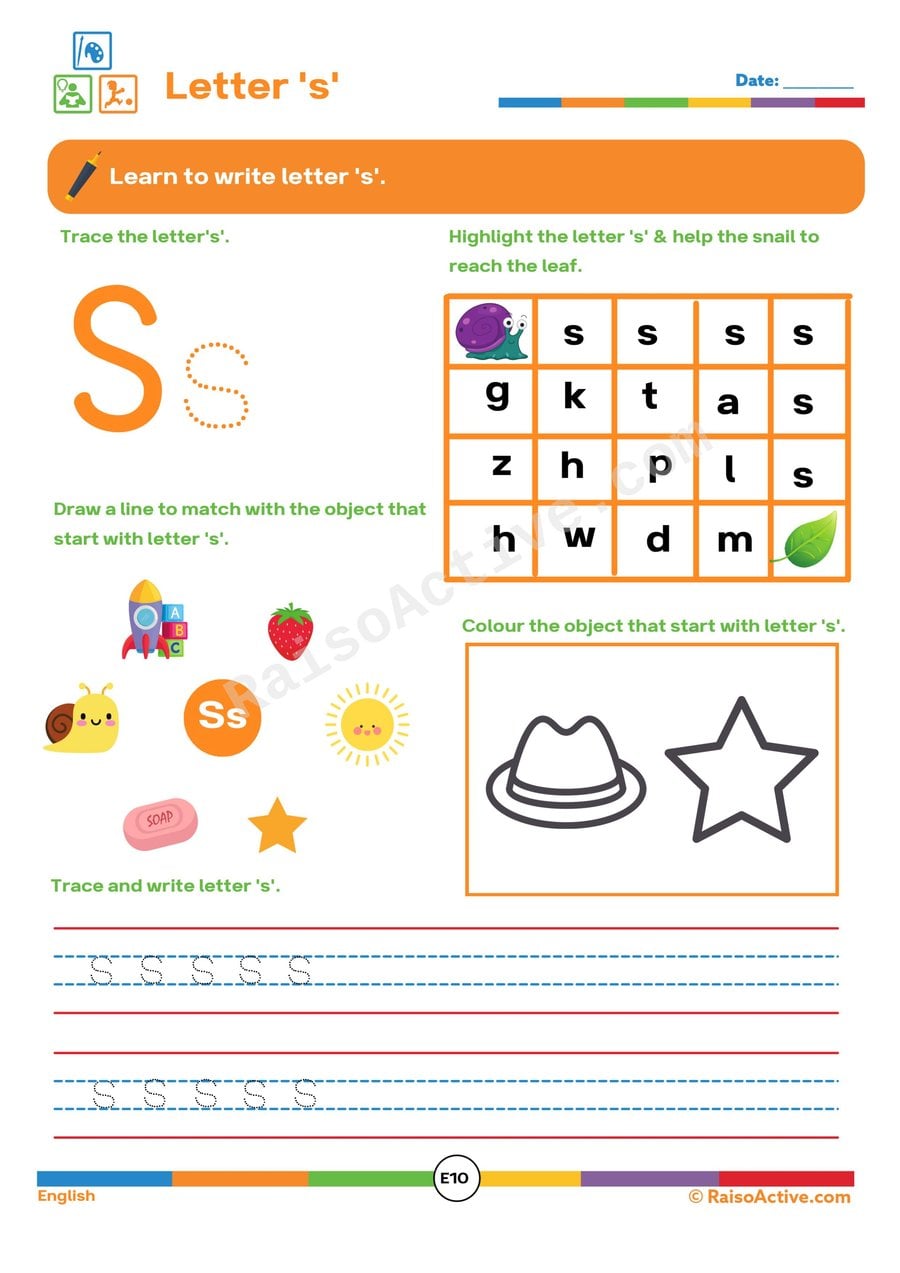
Letter 's' Worksheet: Trace, Match, and Color!
This worksheet gives children ages 3-5 focused practice forming the letter 's,' one of the trickier curved strokes for beginning writers to control with a pencil. Beyond handwriting, matching pictures to the letter and coloring only the 's' objects builds phonemic awareness by linking the letter shape to its /s/ sound at the start of words. Combining tracing, matching, and coloring in one page also keeps a young child's attention across multiple related tasks.

Color the Teddy Bear Valentine's Day Worksheet for Kids
Coloring a teddy bear surrounded by Valentine's hearts gives children ages 3-5 practice with sustained hand control as they work to stay within an outline, a skill that develops gradually through repeated, low-pressure coloring practice rather than all at once. The holiday theme also builds simple color-word vocabulary and gives your child a chance to make deliberate color choices, an early form of creative decision-making.
What your child learns in Nursery
By the end of Nursery a child is usually expected to trace standing, sleeping, slanting and curved lines, colour a large picture without leaving the outline too often, name basic colours and shapes, match identical pictures, sort big from small, count objects to five and recognise a few capital letters and the numerals 1 to 5.
- Pre-writing: standing lines, sleeping lines, slanting lines, curves, zigzags and spirals
- Maths readiness: counting 1–5, big and small, more and less, circle, square and triangle
- English readiness: capital letter recognition, beginning with the letters in the child's own name
- EVS and general awareness: colours, fruits, vegetables, animals, parts of the body
- Fine motor: colouring, sticking, tearing paper, simple cut-and-paste
How to use Nursery worksheets at home
Sit beside your child rather than across the table, show the stroke once with your finger, and then let them try with a jumbo pencil or crayon. One sheet a day is enough. Praise the attempt, not the neatness; at three the goal is a comfortable grip and the habit of finishing a task, not accuracy.
Rotate the type of sheet across the week: a colouring page on Monday, a pattern sheet on Tuesday, matching on Wednesday, a counting sheet on Thursday and a free choice on Friday. Laminate favourite pattern sheets and reuse them with a whiteboard marker so tracing gets repeated without printing again.
Signs your child is ready for Nursery worksheets
A child is ready when they can hold a crayon with fingers rather than a fist, scribble on purpose, sit for five minutes at a table and follow a one-step instruction such as "colour the apple". If any of these is missing, stay with the Playgroup sheets: large colouring pages, sticker matching and dot-marker activities that need no pencil control at all.
Frequently asked questions
What should a Nursery child know by the end of the year?
Most CBSE and ICSE Nursery classes expect a child to recite numbers to 10 and count objects to 5, recognise the numerals 1 to 5, identify basic colours and shapes, trace pre-writing patterns, recognise several capital letters, name common fruits, vegetables and animals, and colour within a large outline. Speaking in short sentences and following simple instructions matter as much as any written work.
What is the difference between Playgroup, Pre-nursery and Nursery?
Playgroup and Pre-nursery are names schools use for the 2–3 age group, where the day is play, songs and sensory activity with almost no paper work. Nursery is the 3–4 year, the first formal year of the NEP 2020 Foundational Stage, where children begin pre-writing strokes, colouring, matching and counting on paper. The simpler colouring and matching sheets on this page suit Playgroup children too.
Which pencil should a Nursery child use?
A jumbo or triangular pencil, or a thick crayon, suits three-year-old hands better than a standard pencil. The wider barrel encourages a tripod grip and does not need much pressure. Move to a regular pencil only when the child holds the thick one comfortably with three fingers, usually towards the end of Nursery or in LKG.
How long should a Nursery worksheet session be?
Five to ten minutes at a time is enough for a three-year-old, once or twice a day. Attention at this age comes in short bursts, so stop before the child gets restless. A single sheet finished cheerfully teaches more than three sheets done under pressure, and it keeps the child willing to sit again tomorrow.
Should a Nursery child be writing letters already?
Not independently. In Nursery the aim is recognition and the pre-writing strokes that letters are made of. Tracing large capital letters is fine once lines and curves are steady, and many schools begin with the letters in the child's name. Independent letter writing is an LKG outcome under NCF-FS 2022, so there is no need to rush.
Are Nursery worksheets free to download and print?
Yes. Each worksheet on this page downloads as a watermarked PDF at no cost after creating an account, with a limit of five downloads a day. An annual subscription removes the watermark and the daily cap across the whole library, which is useful for teachers printing full class sets on A4.

Written by
Hemsweta Jain · Teacher Cheena
MBA and Early Childhood Educator, teaching since 2014 · Founder of RaisoActive, Mumbai
Written and reviewed by Hemsweta Jain (Teacher Cheena), who designs every RaisoActive worksheet.
Last reviewed
Printable packs for ages 3–4
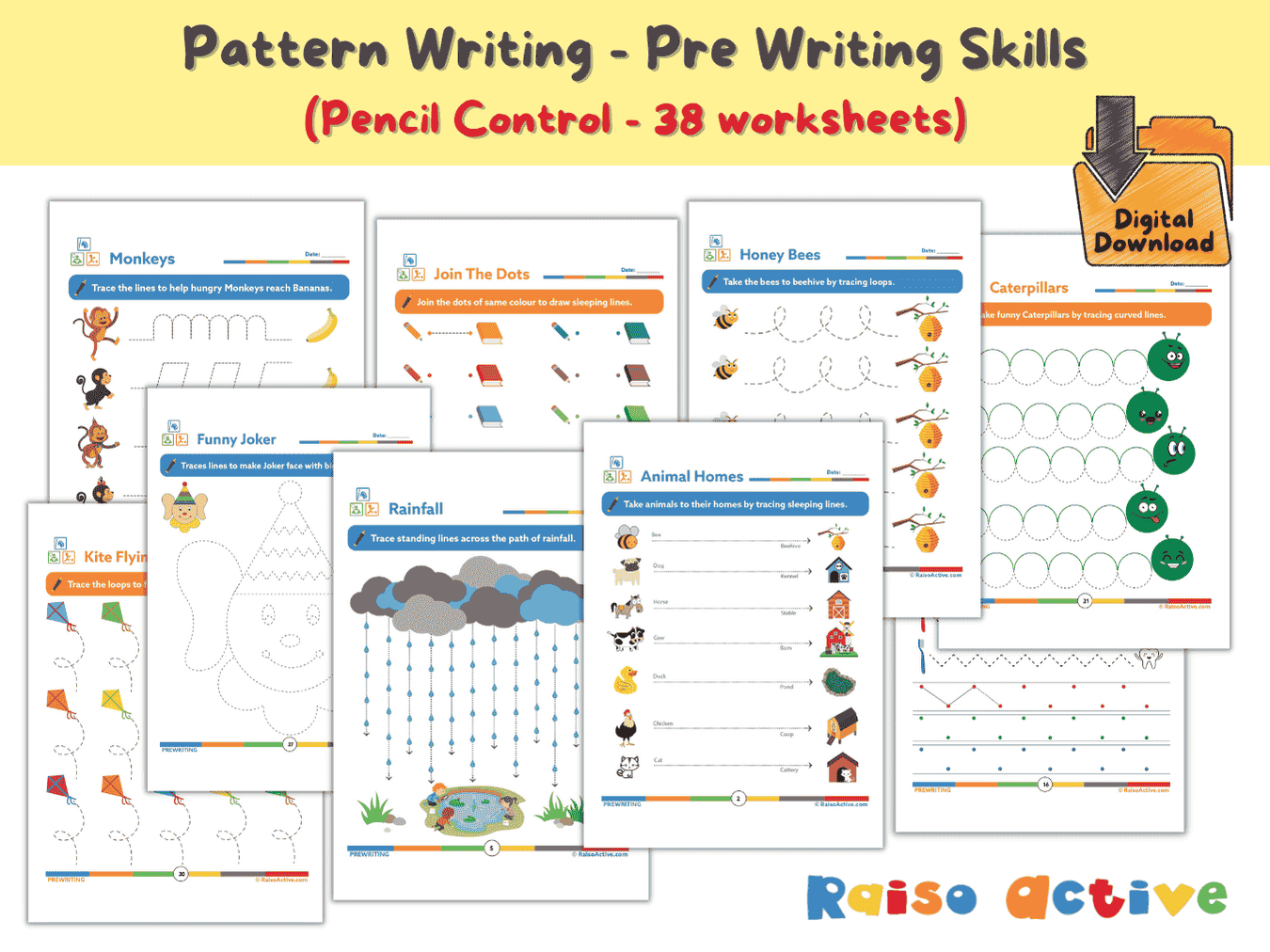
Pattern Writing Pre-writing Skills Activity Book for 3-4 Year Olds
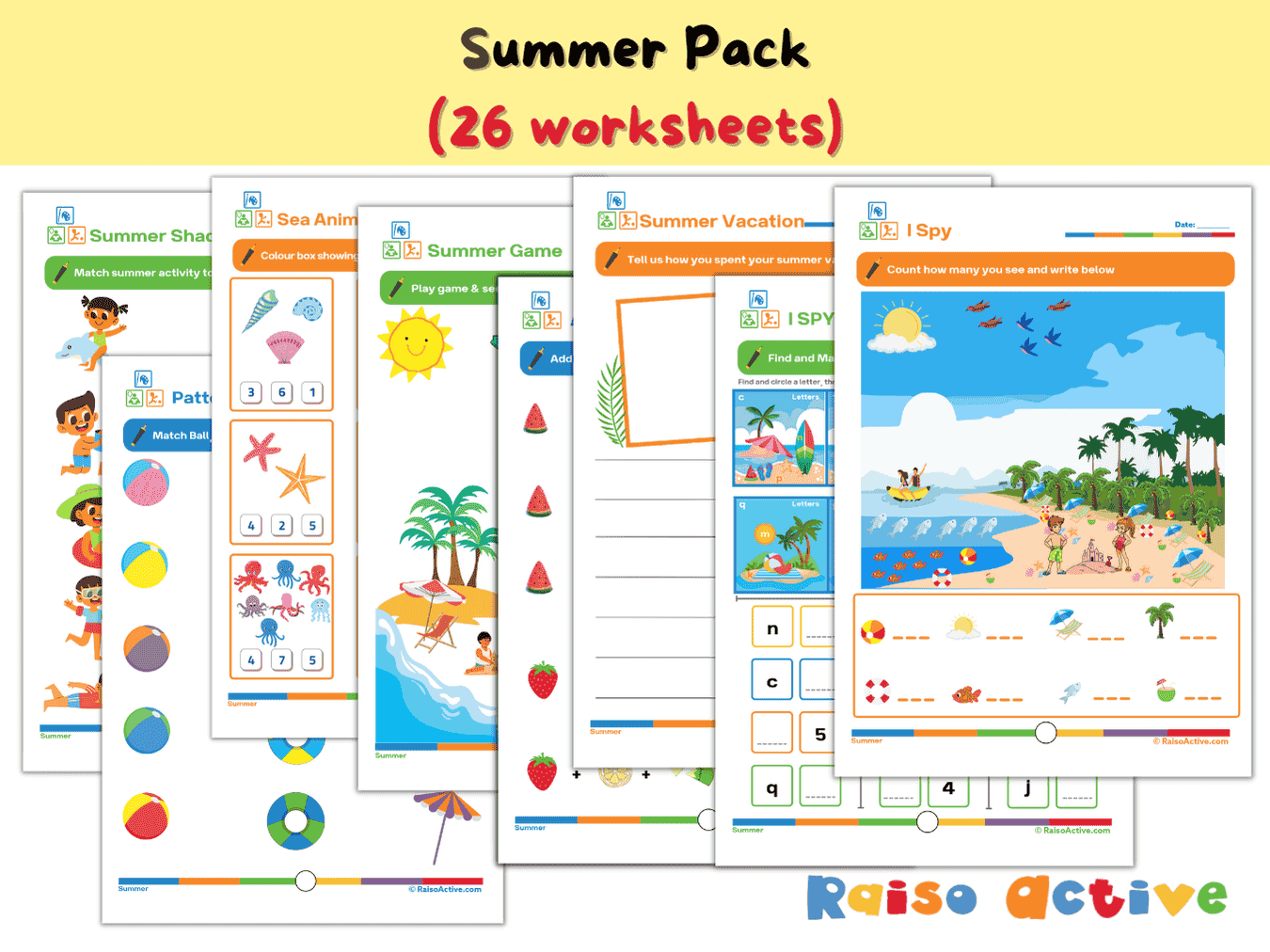
Summer Activity Pack: Math, Literacy, Puzzles & More for Preschool & Kindergarten
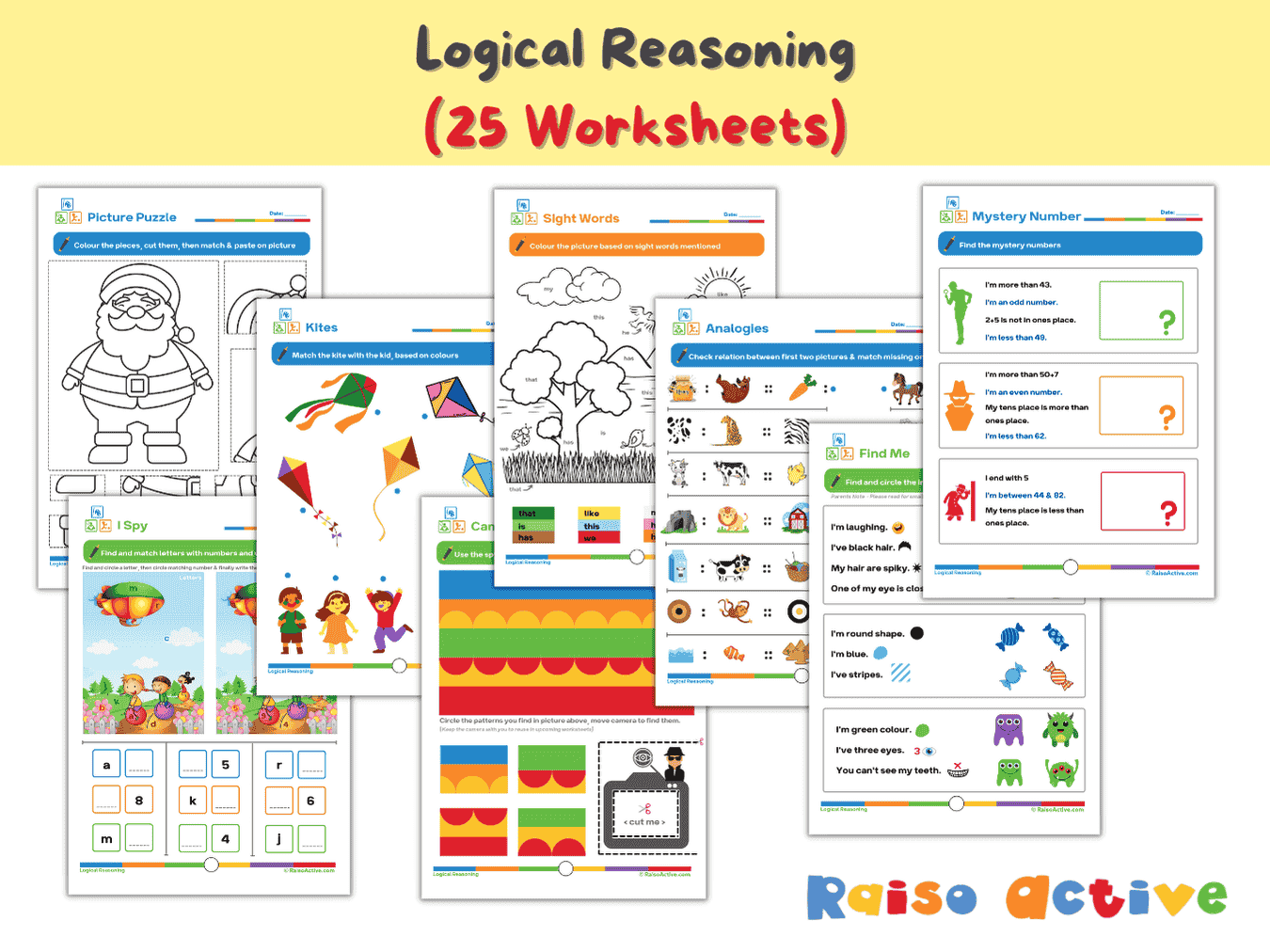
Logical Reasoning Activity Book for Preschool & Kindergarten | Patterns, Puzzles & Analogies
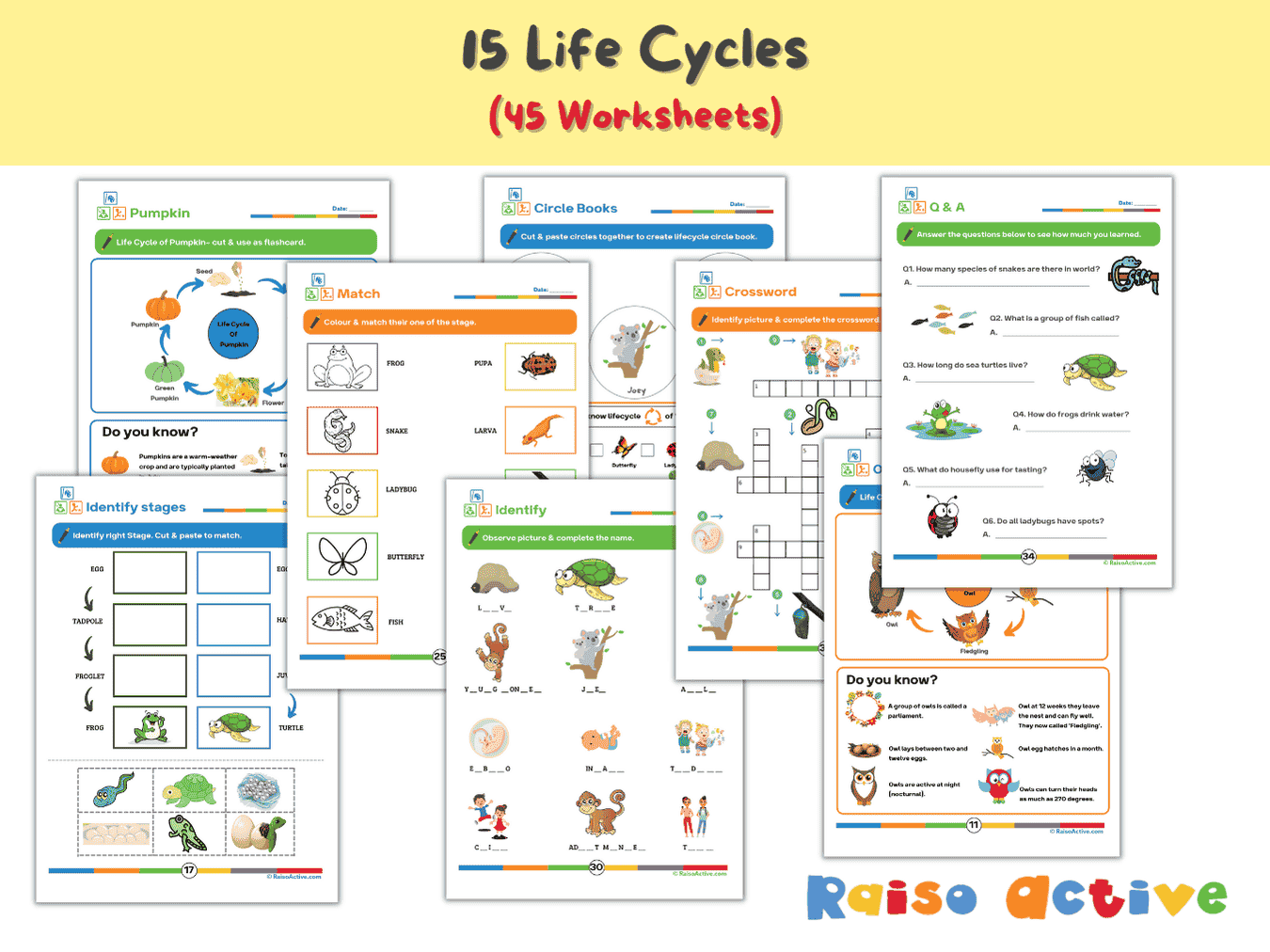
Lifecycles Activity Book & Flashcards for Preschool & Early Elementary
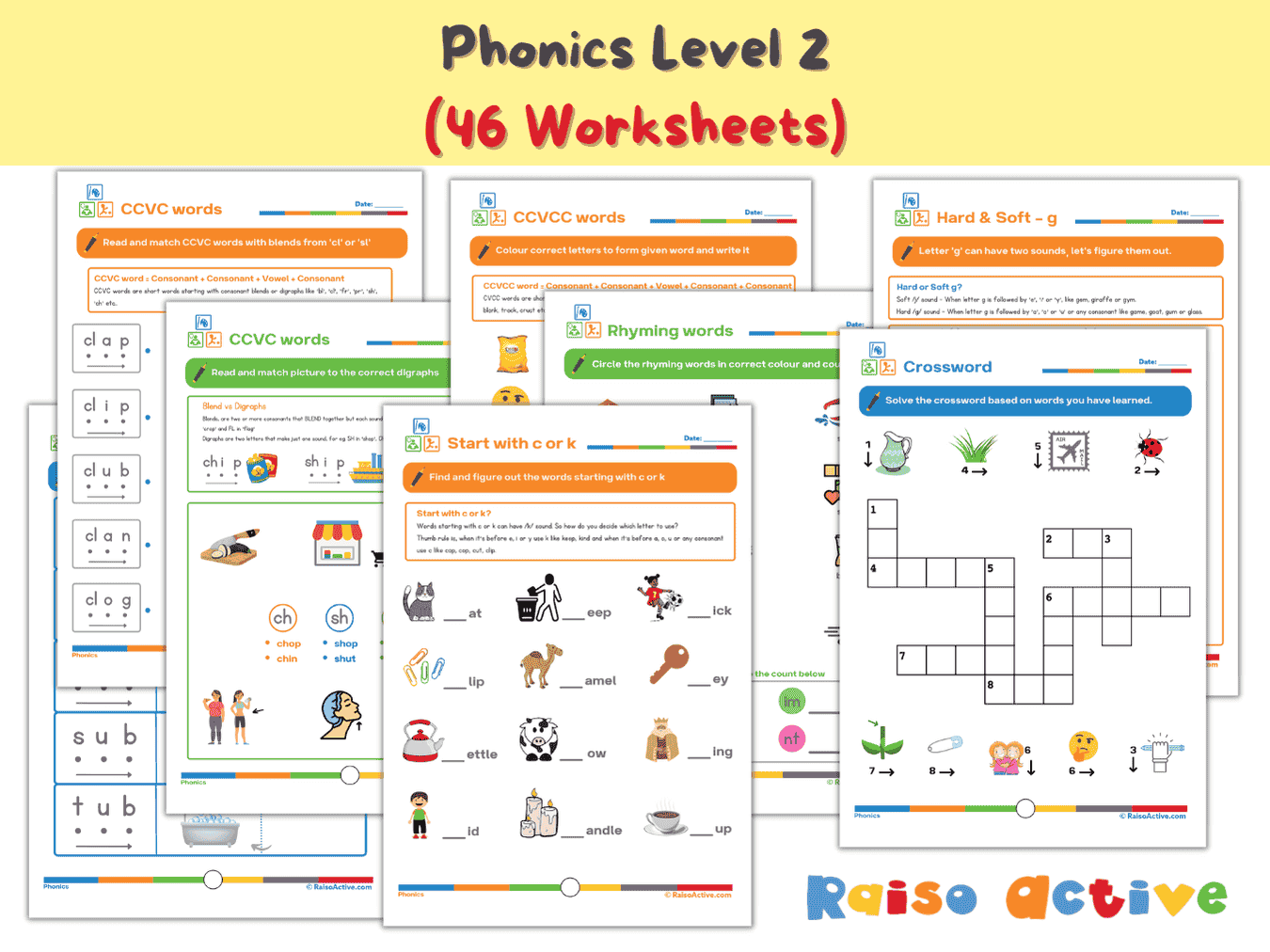
Phonics Level 2 Worksheets: CVC, CCVC, CVCC Word Families & Blends for Early Readers (Ages 4-7)
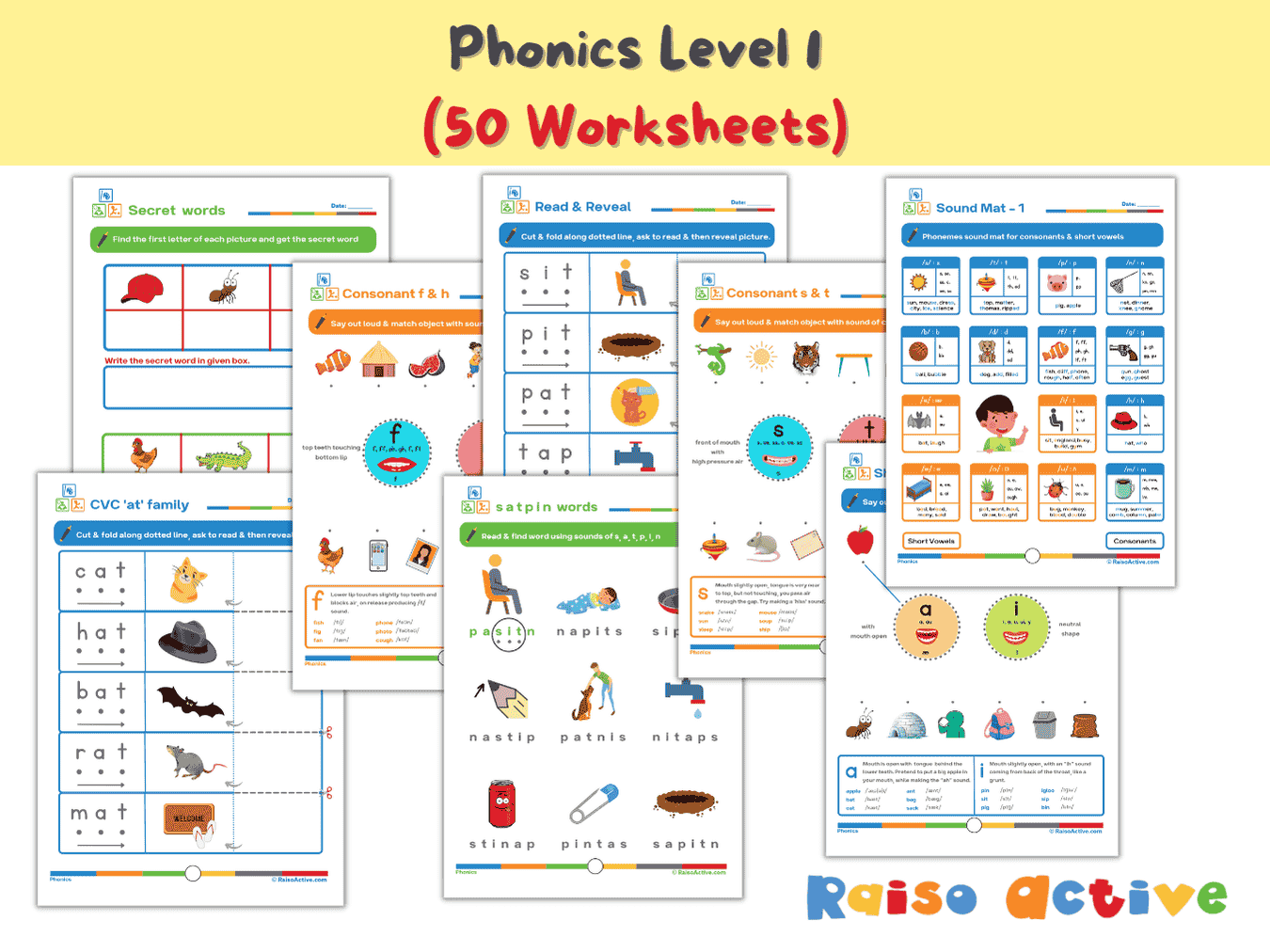
Phonics Level 1 Activity Book: Letter Sounds, Blending & CVC Words for Preschool & Kindergarten
Guides for parents and teachers
See all guides →Number Formation Rhymes 0–9 and How to Fix Reversals
Original number formation rhymes for 0–9, the correct stroke order for each digit, why 3, 5 and 7 get reversed most often, and multisensory fixes that work.
Pre-Writing Strokes in Order: From Standing Lines to Loops (With Printable Patterns)
The developmental order of pre-writing strokes, from vertical lines to loops, and why practicing them in sequence makes letter formation much easier to learn.
Kindergarten Readiness Checklist: 25 Skills to Practice Before the First Day
A kindergarten readiness checklist of 25 literacy, math, motor, self-regulation and self-help skills, with an 8-week summer plan and notes on when not to worry.
Best Worksheets for 3-Year-Olds: What Works and What to Avoid
What works on worksheets for 3-year-olds: short sessions, crayons, tracing lines, matching, cutting, a free weekly plan, and signs one is too advanced.
Reception Year Explained: EYFS Learning and How to Help at Home
A teacher's plain-English guide to the Reception Year: the seven areas of learning, Early Learning Goals, Phase 2/3 phonics, the RBA and home routines.
What Should a 4-Year-Old Know Before LKG? A Readiness Checklist
A calm, teacher-written LKG readiness checklist for 4-year-olds: language, pattern writing, numbers to 10, self-help and social skills, plus a 6-week plan.
Canonical: https://raisoactive.com/worksheets/nursery