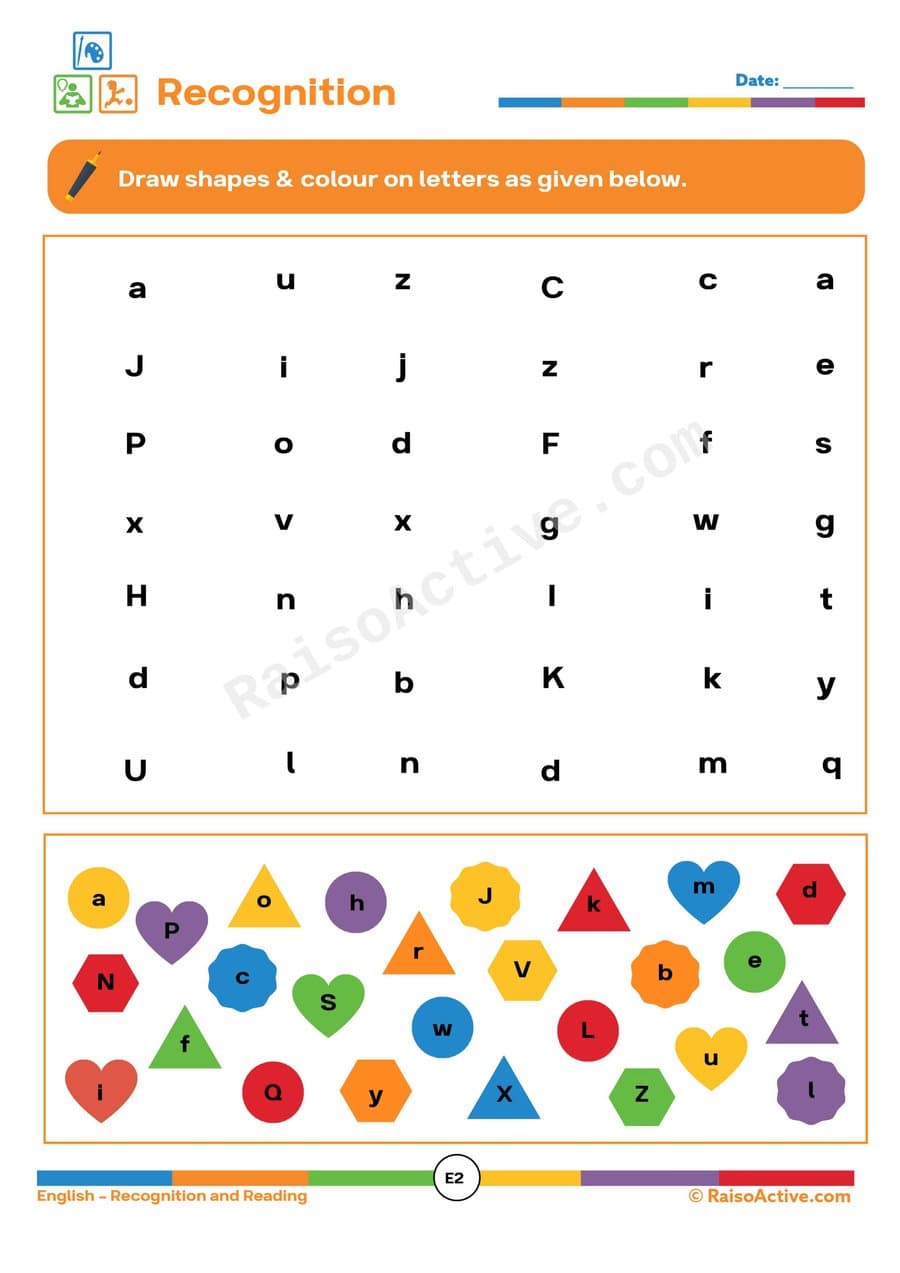
Letter Recognition Worksheet: Draw Shapes & Color!
Pairing letter recognition with drawing shapes gives children ages 3-5 practice on two skills at once: identifying printed letters by sight and following simple shape instructions with a pencil. Coloring the letters afterward reinforces the letter's visual form through repeated, focused attention rather than a quick glance, while the shape-drawing task builds the same pre-writing control needed for forming letters later. Combining these tasks keeps the page varied and engaging for a young attention span.
Part of the pack
Month 5: Preschool Subjects and Play | Ages Up to 4Curriculum
How to use this worksheet
Look at each letter on the page together and say its name aloud before beginning. Read the instruction beside each letter, which tells your child what shape to draw next to it, such as a circle or a triangle, and have them draw it as neatly as they can. Once the shapes are drawn, hand your child the crayons matching the colors listed and have them color each letter according to the key provided. Review the finished page together, naming each letter and its shape one more time.
Materials needed
- Pencil
- Crayons
Extension activities
- •Find the letters from the worksheet in a favorite storybook and point them out together.
- •Practice writing the same letters on a whiteboard, comparing lowercase and capital forms.
- •Draw a simple shape scavenger hunt around the house, asking your child to find real objects shaped like circles, squares, and triangles.
- •Create letter flashcards and mix in a shape-drawing challenge for each one your child picks.
- •Use playdough to form both a letter and its matching shape side by side.
Tips for parents and teachers
If your child confuses similar shapes, like a square and a rectangle, name the defining feature out loud ('a square has four equal sides') rather than just correcting the drawing. Letter and shape recognition develop at different rates, so it's normal for a child to be stronger in one area than the other on this page. Keep color instructions simple at first, and only add more colors once your child is confidently matching letters.

Written by
Hemsweta Jain · Teacher Cheena
MBA and Early Childhood Educator, teaching since 2014 · Founder of RaisoActive, Mumbai
Every RaisoActive worksheet is designed and checked by the founder before publishing.
Published · Last reviewed
Related worksheets

Secret Words Worksheet: Matching Shapes and Letters!
Matching shapes to letters and then using that code to figure out a sequence of pictures teaches children ages 3-5 early symbolic reasoning, understanding that one thing, a shape, can stand in for another, a letter. This kind of code-breaking task builds logical thinking and pattern recognition beyond simple matching, since children must apply a rule consistently across multiple steps to reach a final answer. Framing the activity as uncovering a 'secret word' adds a sense of mystery and motivation that keeps children engaged through a multi-step reasoning task.

Match the Pictures: Letter Matching Worksheet for Preschoolers
Connecting pictures to their matching letters helps children ages 3-5 build the foundation of phonics, learning that a printed letter represents the beginning sound of a spoken word. Circling the animals that specifically start with the letter B adds a second layer of practice, requiring children to apply that letter-sound knowledge rather than just matching shapes. This two-step approach moves children from simple visual matching toward true letter-sound recognition, a critical pre-reading skill.

Fun Phonics Worksheet: Matching Uppercase and Lowercase Letters!
This matching worksheet teaches children ages 3-5 to recognize that uppercase and lowercase versions of the same letter — like S and s — represent one letter despite looking different, a concept that trips up many early readers. Drawing a line between the four matching pairs builds visual discrimination and letter-form memory, while the follow-up task of circling pictures that start with 'C' adds practice connecting a letter to its sound.

Alphabet Games Worksheet: Match the Letters to the Games!
This worksheet helps children ages 4-6 practice beginning-sound letter recognition by matching alphabet cards to pictures of games whose names start with that letter. Placing a letter card on its matching game picture, rather than simply circling an answer, adds a hands-on sorting element that keeps the activity active and physical rather than purely paper-based.

Matching Uppercase and Lowercase Letters: q-z Worksheet
This worksheet builds letter recognition by having children match uppercase letters from Q to Z with their corresponding lowercase forms, a pairing that can be tricky since several lowercase letters in this range, like 'q' and 'g,' don't closely resemble their capital counterparts. For four- and five-year-olds, mastering the second half of the alphabet's upper-lowercase pairs completes the foundational letter knowledge needed before reading fluently.

Circle the Correct Letter: Fun Phonics Worksheet for Kids
This phonics worksheet helps children ages 4-5 connect a picture's beginning sound to its matching letter, a key decoding skill on the path to independent reading. Circling the correct letter from a small set of choices also builds visual discrimination, since children must tell similar-looking letters apart under a bit of time pressure.

Small Letter a-h Matching Worksheet for Preschoolers
This worksheet builds lowercase letter recognition for a through h by having children match each letter to a picture whose name starts with that sound. For three- to five-year-olds, focusing on lowercase forms specifically matters because most of the text children encounter in books is written in lowercase, making this recognition more directly useful for early reading than uppercase alone.

Small Letter Matching Worksheet: Cut and Paste Fun!
This worksheet helps children ages 3-5 recognize and match lowercase letters to their corresponding capital letters, a skill children need before they can read text that mixes both letter cases fluently. The cut-and-paste format adds fine motor practice, since children must precisely place a small paper letter next to its match.
Guides for this topic
Kindergarten Readiness Checklist: 25 Skills to Practice Before the First Day
A kindergarten readiness checklist of 25 literacy, math, motor, self-regulation and self-help skills, with an 8-week summer plan and notes on when not to worry.
Best Worksheets for 3-Year-Olds: What Works and What to Avoid
What works on worksheets for 3-year-olds: short sessions, crayons, tracing lines, matching, cutting, a free weekly plan, and signs one is too advanced.
Phase 2 Phonics at Home: Sound Order, Blending Games, Worksheets
Phase 2 phonics at home: the five sound sets in order, oral blending, tricky words, a two-week routine, common mistakes, and free worksheets.
Reviews
Every worksheet for ages 3–5, no watermark
Members download the full library of 1,000+ worksheets and every activity pack without watermarks or daily limits. One year costs ₹1,000 in India or $20 elsewhere.
See membership plansOr download any worksheet free with a watermark (5 a day).