Lowercase Letter Matching Worksheet for Preschoolers
This worksheet trains children ages 4-5 to connect an uppercase letter to its lowercase counterpart, a skill that's genuinely tricky since many lowercase letters look quite different from their capital form (like G and g, or Q and q). Matching cases correctly is essential groundwork for reading real books and sentences, which are written mostly in lowercase.
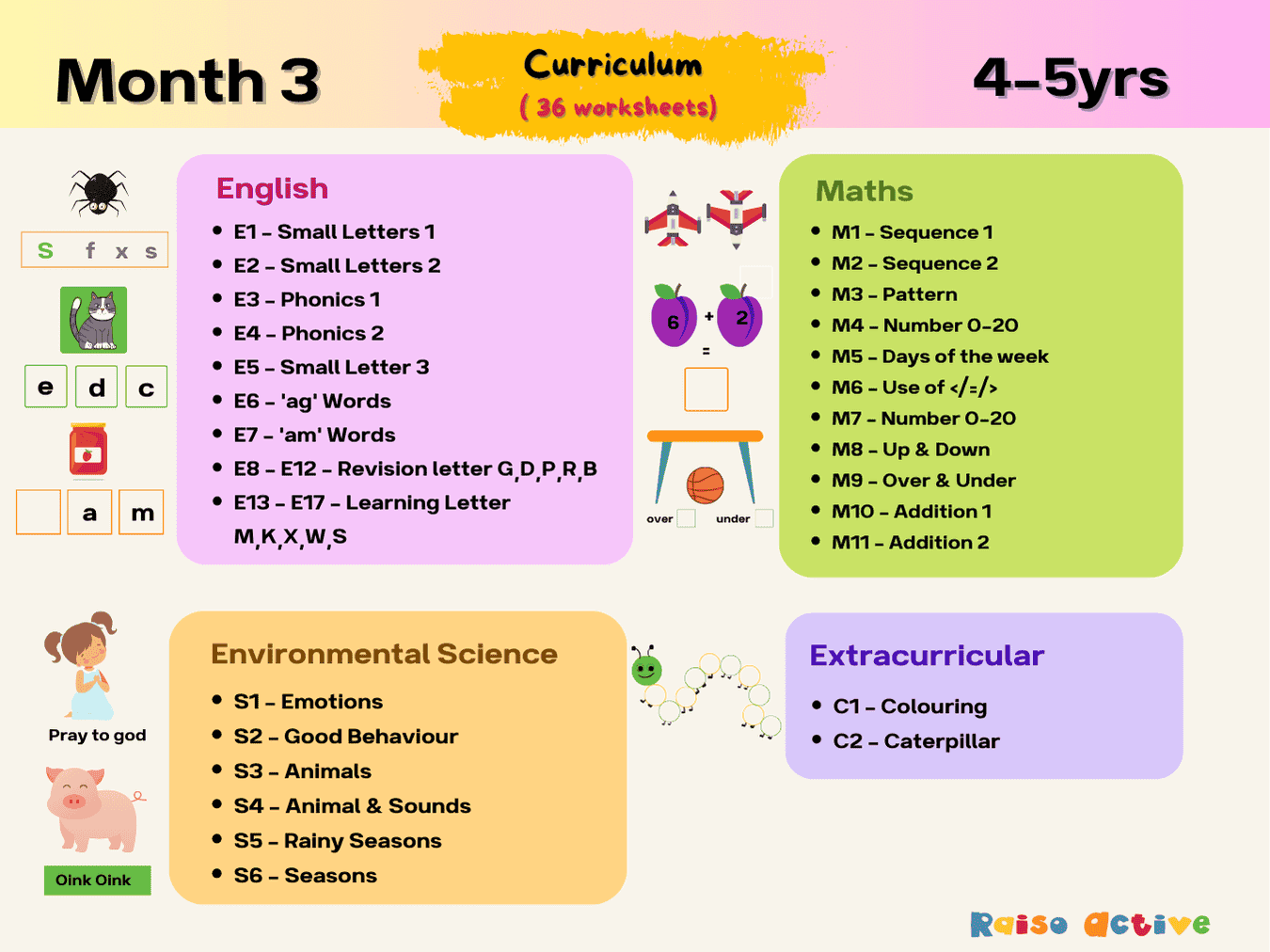
Part of the pack
Month 3: Learning & Development | Ages 4-5
This is page 5 of the pack. Ages 4-5 · Pre-KAges 4-5 · ReceptionAges 4-5 · LKGAges 4-5
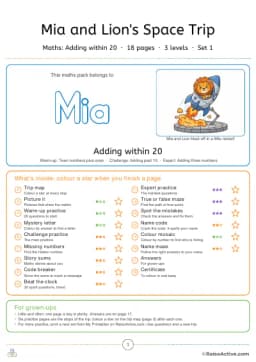
Made for your child
Numbers to 20, made for your child
A maths pack with your child's name in it: pictures that explain, practice at three levels, puzzles and story sums about them. Print a new set whenever they finish.
Make a maths packFree preview · free for members
Curriculum
- Writing > Letter Tracing A-Z
How to use this worksheet
Look at the uppercase letter shown for each item and say its name aloud together. Show your child the row of lowercase letter choices and ask them to find the one that matches. Have them circle the correct lowercase letter, then move on to the next uppercase letter and repeat the process. Once the page is complete, read through all the matched pairs together, naming each uppercase and lowercase letter in turn.
Materials needed
- Pencil
- Crayons
Extension activities
- 1Play a matching card game using homemade uppercase and lowercase letter cards spread face-down.
- 2Sing the alphabet song while pointing to uppercase and lowercase versions of each letter on a chart.
- 3Search a book or cereal box for both the uppercase and lowercase version of a chosen letter.
- 4Write a few uppercase letters on paper and have your child write the matching lowercase letter next to each.
- 5Build letter pairs out of playdough, making one big (uppercase) and one small (lowercase) version side by side.

Written by
Hemsweta Jain · Teacher Cheena
MBA and Early Childhood Educator, teaching since 2014 · Founder of RaisoActive, Mumbai
Every RaisoActive worksheet is designed and checked by the founder before publishing.
Published · Last reviewed
More from Month 3: Learning & Development | Ages 4-5

Letter M Tracing and Coloring Worksheet for Preschoolers
Ages 3-5 · Preschool–Pre-KAges 3-5 · Nursery–ReceptionAges 3-5 · Nursery–LKGAges 3-5
This worksheet helps children ages 3-5 practice tracing the letter M's up-down-up-down strokes, identifying words that start with M, and coloring both capital and lowercase versions of the letter. Comparing the capital and lowercase forms side by side helps children notice that the same letter can look different in size while representing the same sound.

Phonics Worksheet: Color the Correct Letter - Letter Sounds
Ages 3-5 · Preschool–Pre-KAges 3-5 · Nursery–ReceptionAges 3-5 · Nursery–LKGAges 3-5
This phonics worksheet asks children ages 3-5 to say the name of each pictured object and identify which letter matches its beginning sound, then color that letter box. Isolating and identifying the very first sound in a spoken word is one of the core early literacy skills that predicts later reading success, and practicing it with real pictures rather than abstract letters makes it concrete.
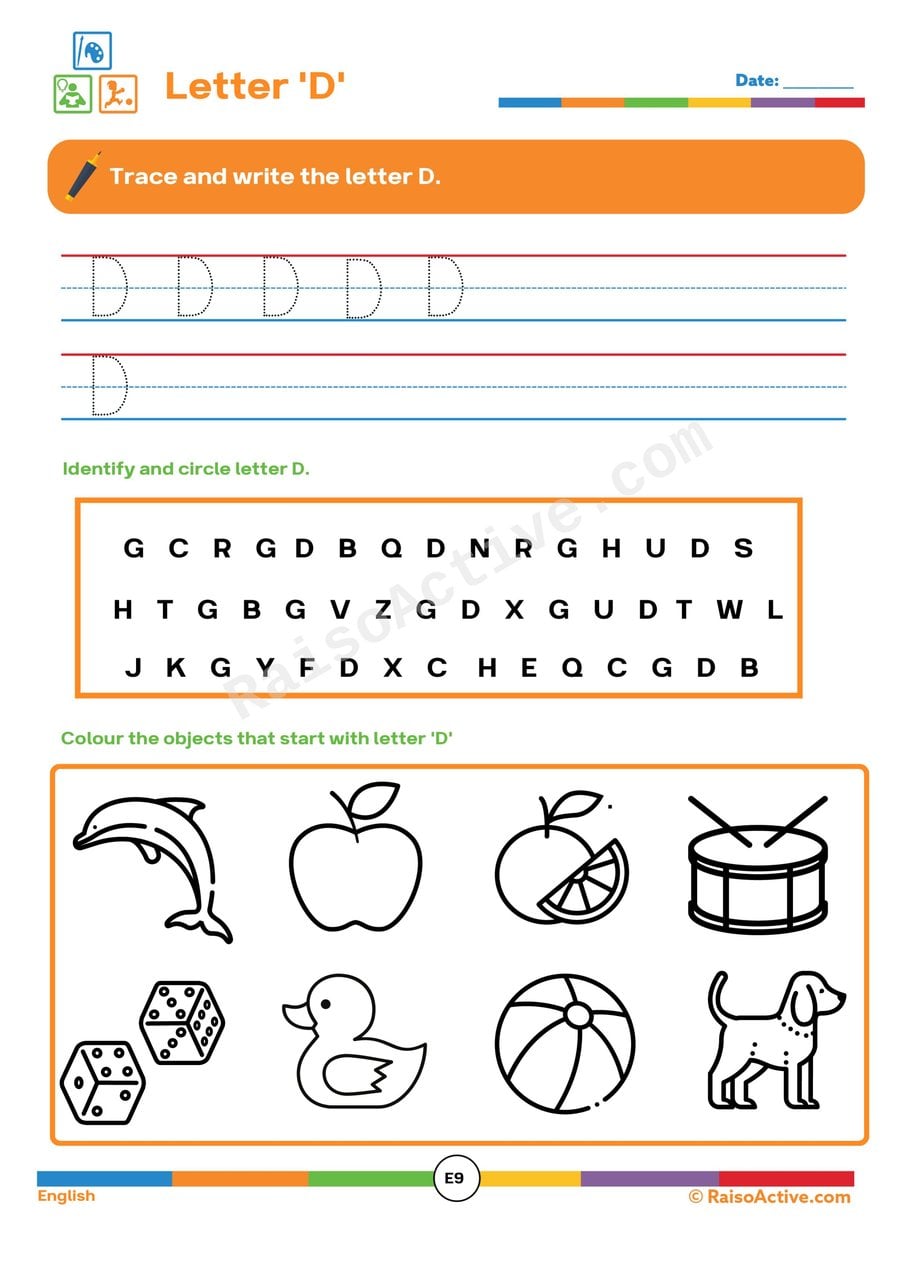
Letter D Worksheet: Trace, Identify, and Color!
Ages 3-5 · Preschool–Pre-KAges 3-5 · Nursery–ReceptionAges 3-5 · Nursery–LKGAges 3-5
This worksheet helps children ages 3-5 practice letter recognition, pencil-controlled tracing, and beginning sound awareness all centered on the letter D. Searching for D within a group of letters builds visual discrimination, an important pre-reading skill for telling similar shapes apart quickly.

Phonics Worksheet: Color the Correct Letter Sounds!
Ages 4-6 · Pre-K–KindergartenAges 4-6 · Reception–Year 1Ages 4-6 · LKG–UKGAges 4-6
This worksheet gives children ages 4-6 practice matching a picture to its correct beginning letter sound by coloring the box containing the right letter, reinforcing the phonics skill of connecting spoken sounds to written symbols. Because children choose from a set of letter options rather than writing freehand, the activity isolates sound recognition from the separate challenge of handwriting.

Lowercase Letter Matching Worksheet for Preschoolers
Ages 4-5 · Pre-KAges 4-5 · ReceptionAges 4-5 · LKGAges 4-5
This worksheet gives children ages 4-5 practice connecting uppercase letters to their lowercase form by circling the correct match from a set of answer choices, a skill that's essential since most of the reading material children encounter is printed in lowercase. Many lowercase letters look quite different from their uppercase counterpart, so this matching task genuinely tests whether the connection has been learned rather than guessed.

Color the Sea Animals Worksheet for Preschoolers
Ages 3-5 · Preschool–Pre-KAges 3-5 · Nursery–ReceptionAges 3-5 · Nursery–LKGAges 3-5
This worksheet helps children ages 3-5 learn to recognize different sea animals, like fish, crabs, and octopuses, while practicing fine motor coloring skills that build hand strength and control. Naming and coloring each creature also introduces early marine science vocabulary in a low-pressure, creative format.

Am Words Worksheet: Read, Match, and Fill-in the Blanks!
Ages 4-5 · Pre-KAges 4-5 · ReceptionAges 4-5 · LKGAges 4-5
This worksheet builds phonics skills within the 'am' word family — words like 'ham,' 'jam,' and 'Sam' — by having children read words aloud, match them to pictures, and fill in missing letters to complete them. For four- and five-year-olds, working within a single rime family like '-am' helps children generalize a decoding pattern they can apply to many new words, rather than sounding out every word from scratch.

Emotions Worksheet: Match the Emoji to the Feeling!
Ages 3-5 · Preschool–Pre-KAges 3-5 · Nursery–ReceptionAges 3-5 · Nursery–LKGAges 3-5
This worksheet helps children ages 3-5 identify and understand different emotions by comparing a child's facial expression in a picture to a set of emoji faces and choosing the one that matches. Learning to read facial cues and name feelings is a foundational social-emotional skill that helps children both recognize their own emotions and empathize with others.
Related worksheets

Capital and Small Letter Matching Worksheet for Preschoolers
Ages 3-5 · Preschool–Pre-KAges 3-5 · Nursery–ReceptionAges 3-5 · Nursery–LKGAges 3-5
Children ages 3-5 build letter recognition fluency by matching each uppercase letter to its corresponding lowercase form, a skill essential for reading since text uses both cases interchangeably. Recognizing that 'B' and 'b' represent the same letter sound despite looking different is a genuinely tricky early literacy milestone. Circling words that begin with a capital letter adds an extra layer of practice noticing capitalization in real context.
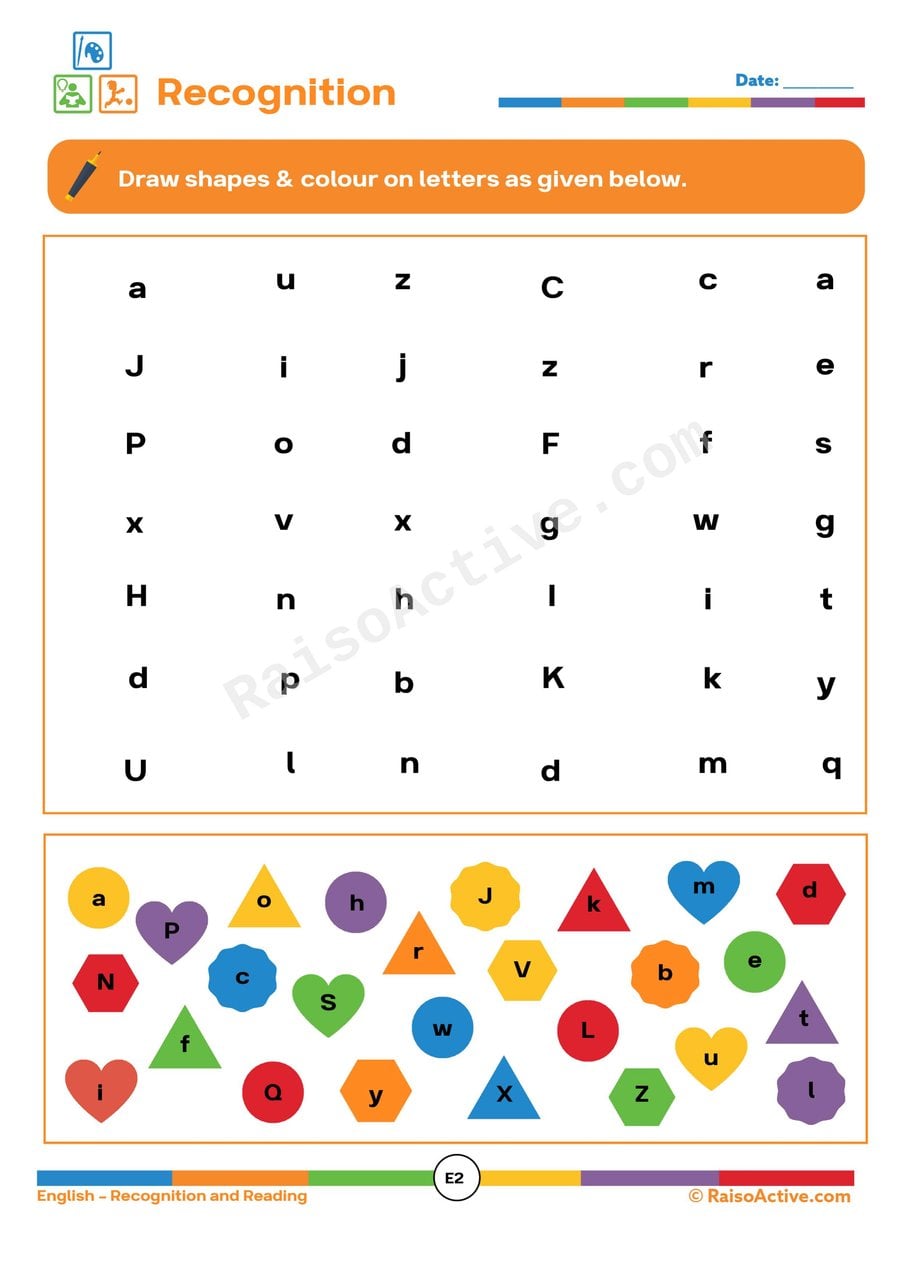
Letter Recognition Worksheet: Draw Shapes & Color!
Ages 3-5 · Preschool–Pre-KAges 3-5 · Nursery–ReceptionAges 3-5 · Nursery–LKGAges 3-5
Pairing letter recognition with drawing shapes gives children ages 3-5 practice on two skills at once: identifying printed letters by sight and following simple shape instructions with a pencil. Coloring the letters afterward reinforces the letter's visual form through repeated, focused attention rather than a quick glance, while the shape-drawing task builds the same pre-writing control needed for forming letters later. Combining these tasks keeps the page varied and engaging for a young attention span.

Fun Phonics Worksheet: Matching Uppercase and Lowercase Letters!
Ages 3-5 · Preschool–Pre-KAges 3-5 · Nursery–ReceptionAges 3-5 · Nursery–LKGAges 3-5
This matching worksheet teaches children ages 3-5 to recognize that uppercase and lowercase versions of the same letter — like S and s — represent one letter despite looking different, a concept that trips up many early readers. Drawing a line between the four matching pairs builds visual discrimination and letter-form memory, while the follow-up task of circling pictures that start with 'C' adds practice connecting a letter to its sound.

Match the Letters: Fun Vocabulary Worksheet for Preschoolers!
Ages 3-5 · Preschool–Pre-KAges 3-5 · Nursery–ReceptionAges 3-5 · Nursery–LKGAges 3-5
This worksheet helps children ages 3-5 connect familiar vocabulary pictures to their correct starting letters, reinforcing both letter recognition and the idea that written letters represent spoken sounds. Building vocabulary alongside letter knowledge gives children two ways into literacy at once — through meaning and through print — which supports children with different learning strengths.

Alphabet Games Worksheet: Match the Letters to the Games!
Ages 4-6 · Pre-K–KindergartenAges 4-6 · Reception–Year 1Ages 4-6 · LKG–UKGAges 4-6
This worksheet helps children ages 4-6 practice beginning-sound letter recognition by matching alphabet cards to pictures of games whose names start with that letter. Placing a letter card on its matching game picture, rather than simply circling an answer, adds a hands-on sorting element that keeps the activity active and physical rather than purely paper-based.

Small Letter a-h Matching Worksheet for Preschoolers
Ages 3-5 · Preschool–Pre-KAges 3-5 · Nursery–ReceptionAges 3-5 · Nursery–LKGAges 3-5
This worksheet builds lowercase letter recognition for a through h by having children match each letter to a picture whose name starts with that sound. For three- to five-year-olds, focusing on lowercase forms specifically matters because most of the text children encounter in books is written in lowercase, making this recognition more directly useful for early reading than uppercase alone.
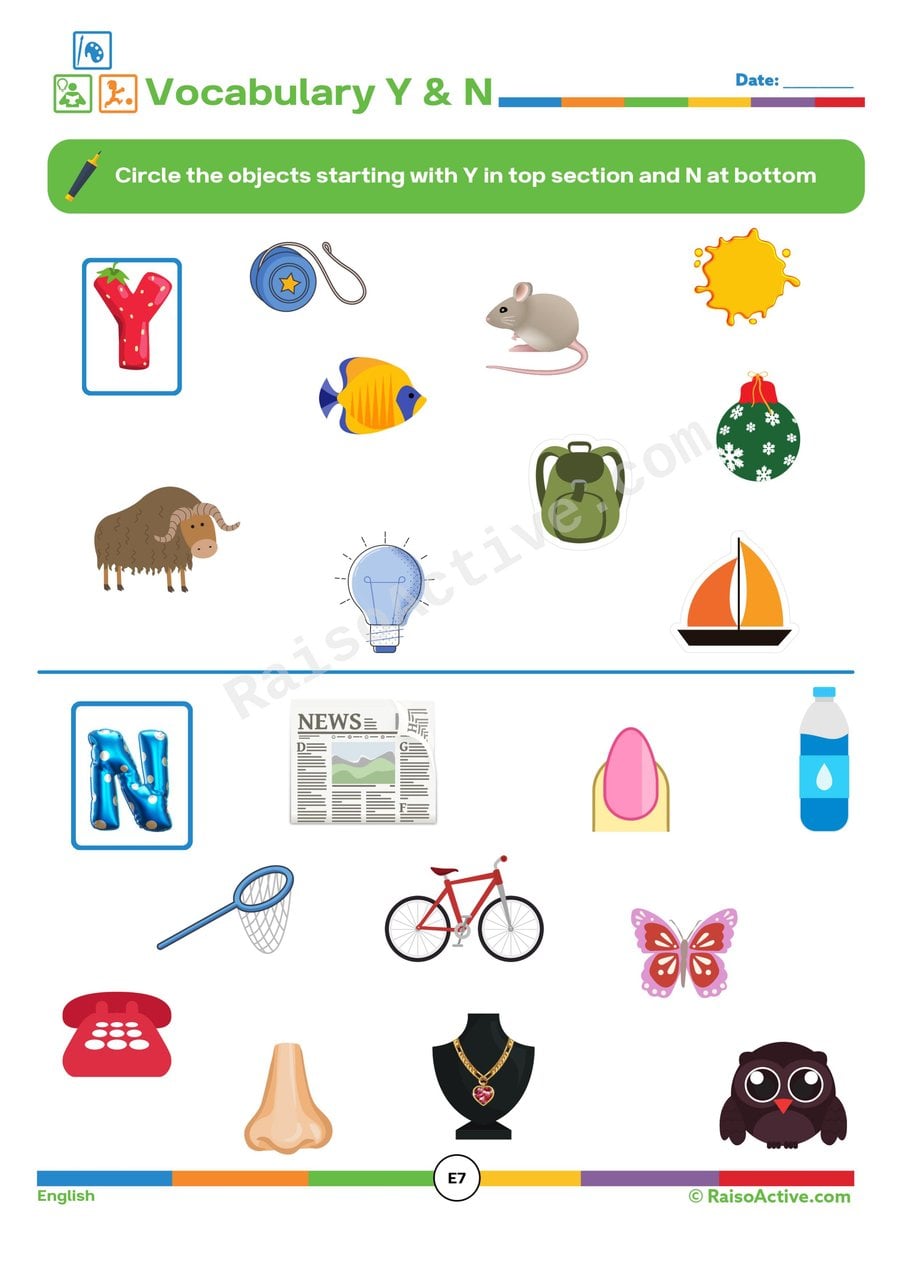
Y and N Vocabulary Worksheet: Circle the Objects!
Ages 3-5 · Preschool–Pre-KAges 3-5 · Nursery–ReceptionAges 3-5 · Nursery–LKGAges 3-5
Deciding whether a pictured object starts with Y or N helps children ages 3-5 practice initial sound discrimination between two distinct consonant sounds, building both vocabulary and listening skills. Circling in the correct top or bottom section adds a simple visual organization step that reinforces the category each object belongs to.

Coloring and Matching Fun: Heart, Fish, and Alphabet Worksheet
Ages 3-5 · Preschool–Pre-KAges 3-5 · Nursery–ReceptionAges 3-5 · Nursery–LKGAges 3-5
This multi-part worksheet asks children ages 3-5 to follow a specific coloring instruction and then match letters to objects, building both instruction-following skills and early letter-object association in a single activity. Coloring only the heart red, rather than coloring freely, practices listening comprehension and attention to detail, a skill children need for following classroom directions later on. The letter-matching portion reinforces that letters represent real objects and sounds, an important building block before formal phonics instruction takes over.
Guides for this topic

Best Worksheets for 3-Year-Olds: What Works and What to Avoid
What works on worksheets for 3-year-olds: short sessions, crayons, tracing lines, matching, cutting, a free weekly plan, and signs one is too advanced.
Documenting Learning Without Drowning in Data: A Practical Guide for Parents and Teachers
Learn practical ways to document your child's learning without overwhelm. Simple portfolios, observation tips, and printable trackers for ages 1-8.

When Should My Child Learn to Read? Is Kindergarten Too Early? A Complete Guide to Reading Readiness
Discover the research-backed optimal age for reading, key readiness signs, and why pushing too early can backfire. A complete guide for parents of children aged 3-8.
Reviews
Every worksheet for ages 4–5, no watermark
Members download the full library of 1,000+ worksheets and every activity pack without watermarks or daily limits. One year costs ₹999 in India or $20 elsewhere.
See membership plansOr download any worksheet free with a watermark (5 a day).