Free printable worksheets · United States
Thanksgiving Worksheets (Ages 3–7)
Thanksgiving worksheets are printable activity sheets for children aged 3 to 7 built around turkeys, harvest food and gratitude. They include counting turkey feathers, tracing pie and cornucopia outlines, sorting harvest foods by color, and writing one thing a child is thankful for, building counting, sorting, fine motor and early writing skills.
Thanksgiving falls on Thursday, November 26, 2026, in the middle of a school week that many US districts turn into a short holiday, which is when these worksheets get used most: in the classroom's harvest theme corner beforehand, and at home over the long weekend. A four-year-old counts turkey feathers one at a time; a seven-year-old writes a short sentence about something they are thankful for, using the sentence-writing skills 1st Grade already expects. Unlike a purely decorative harvest coloring sheet, these worksheets pair the season's imagery, turkeys, pies, corn and pilgrim hats, with the same counting, sorting and early writing goals a Preschool through 1st Grade classroom covers every November.
- 30 worksheets
- Free PDF download
- Print on A4 or Letter
Thanksgiving Worksheets to print
Browse all worksheets for ages 3–7
Clock Jigsaw: Cut a Clock into Pieces, Rebuild It and Write the Time
Ages 4-6 · Pre-K–KindergartenAges 4-6 · Reception–Year 1Ages 4-6 · LKG–UKGAges 4-6
Children colour two clocks, cut each along the dashes, mix the pieces up and rebuild them, then read the time they show in numbers and words. A small jigsaw can be given to a friend.

Thanksgiving Spot the Difference: Feast Table Picture Puzzle
Ages 5-6 · KindergartenAges 5-6 · Year 1Ages 5-6 · UKGAges 5-6
Children compare two feast tables and find six changes, such as a missing apple, a pie with a slice gone or a moved cup. Looking carefully trains attention to detail, memory and visual discrimination. They finish by drawing their favorite feast food.

Thanksgiving Place Cards and Napkin Rings: Cut and Fold Table Crafts
Ages 5-6 · KindergartenAges 5-6 · Year 1Ages 5-6 · UKGAges 5-6
Children make four fold-up name cards and two napkin rings for the feast table. They practice cutting on lines, folding along a crease and writing a name for each guest, and then get to see their own work on the table.

Thanksgiving Maze for Kids: Escape to the Leaf Pile and Picture Riddles
Ages 5-6 · KindergartenAges 5-6 · Year 1Ages 5-6 · UKGAges 5-6
Children trace a path through a leaf maze with a pencil, collect the letters they pass in order to read a secret word and then match three short riddles to pictures. It builds planning, patience and listening for clues.

Roll-a-Turkey Game: A Roll and Draw Game for 2 to 4 Players
Ages 5-6 · KindergartenAges 5-6 · Year 1Ages 5-6 · UKGAges 5-6
Children play a turn-taking dice game where each roll adds a turkey part. It builds counting, number recognition, fair play and the fun of drawing silly extras when a part has already been drawn.

Turkey in Disguise Worksheet: Draw a Costume for Turkey Tom
Ages 5-6 · KindergartenAges 5-6 · Year 1Ages 5-6 · UKGAges 5-6
Children invent a costume for a big outline turkey, give the costume and a secret name, then use clues like feet and tail feathers to find Tom hiding among four pumpkin-suited friends.

Thanksgiving Color by Sum: Mystery Feast Picture (Addition to 10)
Ages 5-6 · KindergartenAges 5-6 · Year 1Ages 5-6 · UKGAges 5-6
Children add two numbers that make 10 or less, match each answer to a color on the key and reveal a hidden picture of Turkey Tom. A second activity asks them to find the one sum that does not make 10, and to write a sum of their own.

I Love You To Pieces: Valentine's Day Cut and Paste Worksheet
Ages 3-5 · Preschool–Pre-KAges 3-5 · Nursery–ReceptionAges 3-5 · Nursery–LKGAges 3-5
This Valentine-themed cut-and-paste activity builds scissor control and hand-eye coordination in children ages 3-5 as they cut along lines to separate heart pieces, then strengthens spatial reasoning as they figure out how each piece fits back together into a whole picture. Reassembling something from parts is an early puzzle skill that also supports later understanding of how wholes are made of smaller parts, useful in both math and reading.

Harvests & New Years: One Harvest, Many Names Across India
Ages 4-8 · Pre-K–Grade 2Ages 4-8 · Reception–Year 3Ages 4-8 · LKG–Class 2Ages 4-8
Children learn that the same winter harvest is celebrated with different names across India, and that many states have their own New Year festival.

Thanksgiving Placemat Printable: Color Your Feast Placemat and Pumpkin Dot-to-Dot
Ages 5-8 · Kindergarten–Grade 2Ages 5-8 · Year 1–Year 3Ages 5-8 · UKG–Class 2Ages 5-8
Children color a leaf-and-pumpkin border, write their name and what they are thankful for in a banner, and draw their favorite feast food on a plate. A dot-to-dot from 1 to 20 reveals a pumpkin treat to color, which practices counting in order.

Meet Turkey Tom: Feast Table Tracker and Spot the Real Turkey
Ages 5-8 · Kindergarten–Grade 2Ages 5-8 · Year 1–Year 3Ages 5-8 · UKG–Class 2Ages 5-8
Children meet Turkey Tom and learn how the pack works: every finished page earns a dish to color on the feast table. They also compare small details to pick out the real Tom from four look-alikes by checking his scarf, feathers and feet.

Yogi's Silly Kitchen: Spot the Mistakes and Order the Pie Steps
Ages 6-7 · Grade 1Ages 6-7 · Year 2Ages 6-7 · Class 1Ages 6-7
Children look carefully at a busy kitchen to spot six things that do not belong, such as a fish in the fruit bowl or a carrot in the toaster. Then they number five cards to put the steps of baking a pie in a sensible order.

Who Sits Where? Thanksgiving Logic Puzzle with Seating Clues
Ages 6-7 · Grade 1Ages 6-7 · Year 2Ages 6-7 · Class 1Ages 6-7
Children use four picture clues to seat five guests, one letter per seat, and then fill in a three-by-three grid to work out which guest brought pie, corn or rolls. Exactly one answer fits, so it teaches careful reading, testing ideas and checking every clue.

Turkey Tom Headband: Printable Thanksgiving Turkey Hat Craft
Ages 5-8 · Kindergarten–Grade 2Ages 5-8 · Year 1–Year 3Ages 5-8 · UKG–Class 2Ages 5-8
Children color a Turkey Tom face, scarf and tail, cut out Tom and three band strips and glue the strips into a ring that fits their head. Wearing the finished hat to the feast gives them something to be proud of, and building it practices cutting, gluing and following four steps.

Thanksgiving Word Search and Picture Crossword for Kids
Ages 6-7 · Grade 1Ages 6-7 · Year 2Ages 6-7 · Class 1Ages 6-7
Children find six hidden feast words in a letter grid, searching across and down, and then solve a mini crossword where every clue is a picture. It builds spelling, reading and visual scanning.

Thankful Fortune Teller: Thanksgiving Paper Fortune Teller to Fold
Ages 6-7 · Grade 1Ages 6-7 · Year 2Ages 6-7 · Class 1Ages 6-7
Children cut out a square, fold it into a fortune teller, color the flaps and play with prompts such as naming three thankful things or saying something nice to a friend. Following six fold steps builds fine-motor skills and the prompts turn gratitude into a game.

Harvest Market Math: Prices, Totals and a $10 Shopping Trip
Ages 6-7 · Grade 1Ages 6-7 · Year 2Ages 6-7 · Class 1Ages 6-7
Children read price tags, find which item costs the most and the least, add two prices for each shopping list and then choose their own items to buy with $10. It builds mental addition, money sense and decision-making.

How to Catch Turkey Tom: Design a Tom Catcher and Write How It Works
Ages 5-8 · Kindergarten–Grade 2Ages 5-8 · Year 1–Year 3Ages 5-8 · UKG–Class 2Ages 5-8
Children invent a gentle catcher for Turkey Tom, draw it and name its softest and cleverest parts, choose a treat to tempt him and tell how it works in three steps: first, then, last. They finish by testing it with a toy. It builds planning, sequencing and kind problem solving.

Color the Feast: Thanksgiving Coloring Page and Draw Yourself
Ages 5-8 · Kindergarten–Grade 2Ages 5-8 · Year 1–Year 3Ages 5-8 · UKG–Class 2Ages 5-8
Children color a detailed feast table scene with pies, corn, rolls and Turkey Tom, then draw themselves and the people they love around the table and finish the sentence about what they are thankful for.

Fair Pie Shares Worksheet: Halves and Quarters for Kids
Ages 6-7 · Grade 1Ages 6-7 · Year 2Ages 6-7 · Class 1Ages 6-7
Children learn that a fair cut makes equal parts. They sort six pies into fair and not fair, draw a line to cut pies into two fair halves and work out how four friends can share two pies so everyone gets the same amount. It is a hands-on first step into fractions.

Thankful Turkey Tom: Stand-Up Turkey Craft with Six Thanks Feathers
Ages 5-8 · Kindergarten–Grade 2Ages 5-8 · Year 1–Year 3Ages 5-8 · UKG–Class 2Ages 5-8
Children color, cut out and assemble a turkey that stands up on its own, then write or draw one thing they are thankful for on each of six feathers. The finished Tom becomes a keepsake for the feast table. Cutting and gluing build hand strength and following steps in order.

Thankful Bunting: Cut-Out Thanksgiving Banner to Color and Write
Ages 7-8 · Grade 2Ages 7-8 · Year 3Ages 7-8 · Class 2Ages 7-8
Children cut out eight flags that spell THANKFUL, color the big letters and finish the sentence I am thankful for on each flag in words or a drawing. The finished bunting is a real decoration to hang at the feast.

If I Were a Turkey for a Day: Write and Draw a 4-Panel Comic
Ages 7-8 · Grade 2Ages 7-8 · Year 3Ages 7-8 · Class 2Ages 7-8
Children plan a four-panel comic, drawing what happens in each box and finishing a sentence starter in two lines. A word bank offers silly turkey words, and a title for the comic rounds off the story.

Secret Code Breaker: Thanksgiving Cipher Puzzle and Coded Thank-You
Ages 7-8 · Grade 2Ages 7-8 · Year 3Ages 7-8 · Class 2Ages 7-8
Children match 14 food pictures to letters, decode a joke symbol by symbol and write each letter in its box. Then they use the key to draw a coded thank-you note spelling THANK YOU for someone special.
What children learn through Thanksgiving worksheets
Thanksgiving worksheets use turkey feathers, pumpkins and corn as counting and sorting objects: a three- to five-year-old counts feathers or kernels up to 10, while a six- or seven-year-old sorts harvest foods by color or category or completes a simple addition sentence using pie slices or pumpkins. Gratitude sheets ask a child to draw or write one thing they are thankful for, an early, low-pressure writing task that suits Kindergarten and 1st Grade.
- Counting turkey feathers, pumpkins and corn kernels to 10
- Sorting harvest foods by color, shape or category
- Tracing pie, cornucopia and turkey outlines
- Drawing or writing one thing a child is thankful for
What to prepare a week before Thanksgiving
Print a mixed set of counting, sorting and gratitude sheets before the school week around November 26, since many classrooms send harvest-themed homework home in that window and a ready pack avoids a last search. Keep crayons or colored pencils on hand for the coloring and gratitude sheets, and set aside one gratitude sheet specifically for the day itself so a child has something ready before the family meal.
- Print 5–6 sheets across counting, sorting and gratitude writing
- Keep crayons or colored pencils with the printed pack
- Set aside one gratitude sheet for Thanksgiving Day itself
- Save a harder sorting or addition sheet for the long weekend
Frequently asked questions
What age are Thanksgiving worksheets for?
Thanksgiving worksheets on this page suit children aged 3 to 7, roughly Preschool through 1st Grade. Three- and four-year-olds do best with tracing and coloring sheets using large turkey and pumpkin outlines, while five- to seven-year-olds are ready for counting, sorting and short gratitude-writing sheets that match Kindergarten and 1st Grade skills.
What should a first grader be able to write for a Thanksgiving gratitude worksheet?
By 1st Grade, most six- and seven-year-olds can write a simple sentence with a capital letter and a full stop, such as "I am thankful for my dog." Thanksgiving gratitude worksheets that offer a sentence starter and a blank line are written for exactly this level, while younger children can draw a picture instead of writing.
Are Thanksgiving worksheets only about turkeys and food?
No. Alongside turkey and harvest-food counting sheets, this page includes gratitude writing or drawing sheets, sorting sheets for harvest foods by color or type, and fine motor tracing sheets using pie and cornucopia outlines, covering counting, sorting, early writing and pencil control rather than one single theme.
How many Thanksgiving worksheets should a preschooler do?
One sheet a day, or 10 to 15 minutes, in the week or two before November 26 is enough for a three- to five-year-old, since Thanksgiving worksheets are seasonal supplements rather than a full curriculum. A short counting or tracing sheet a few times a week fits easily around a school week already covering its own numeracy and literacy goals.
Are the Thanksgiving worksheets free to download?
Yes. Every Thanksgiving worksheet and printable pack can be downloaded free as a watermarked PDF after creating an account, with five downloads a day. An annual subscription removes the watermark and the daily limit across the Thanksgiving sheets, printable packs and the rest of the 1,000+ worksheet library.

Written by
Hemsweta Jain · Teacher Cheena
MBA and Early Childhood Educator, teaching since 2014 · Founder of RaisoActive, Mumbai
Written and reviewed by Hemsweta Jain (Teacher Cheena), who designs every RaisoActive worksheet.
Last reviewed
Printable packs for ages 3–7
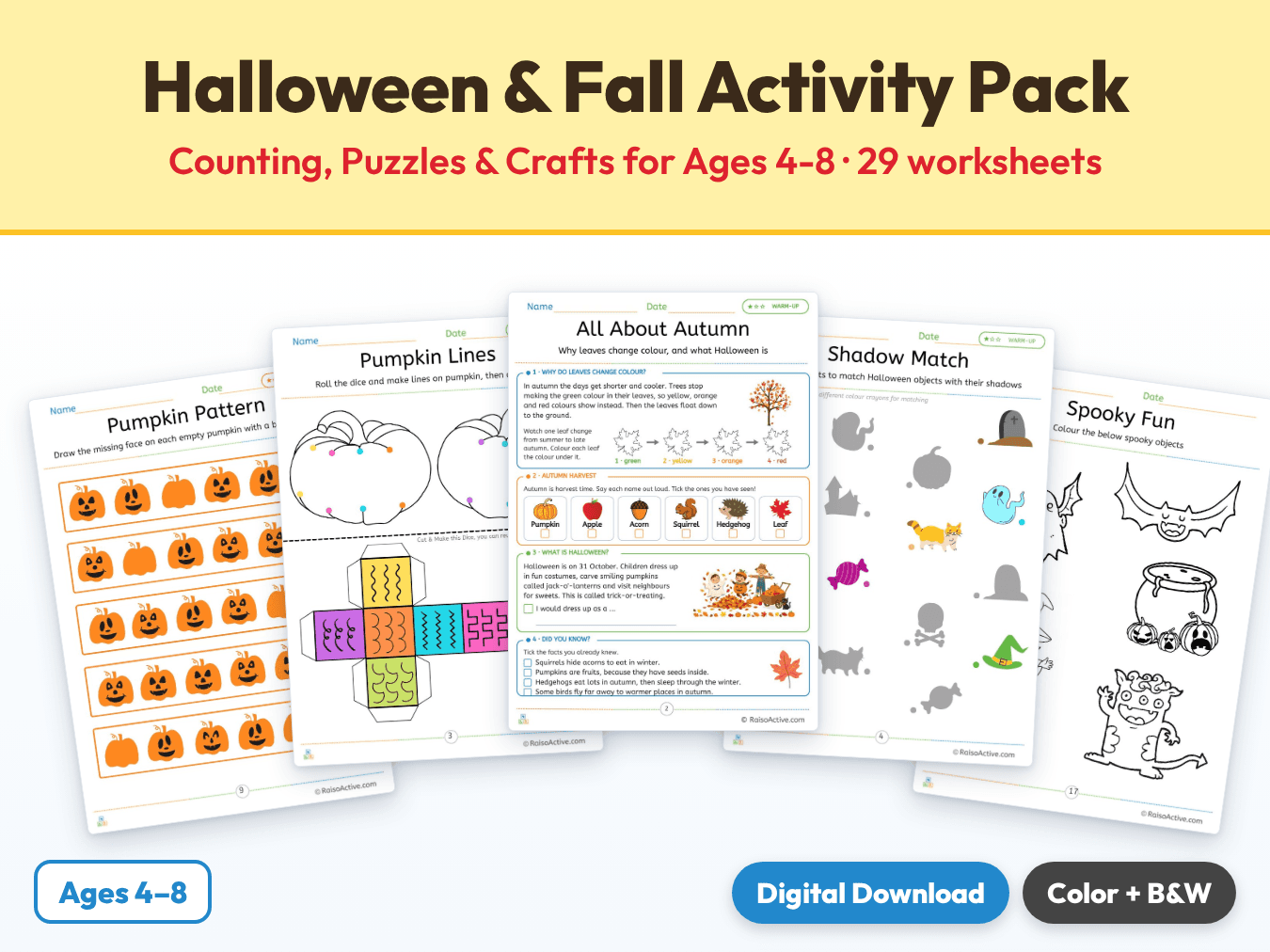

Halloween & Fall Activity Pack: Counting, Puzzles & Crafts for Ages 4-8
Ages 4-8 · Pre-K–Grade 2Ages 4-8 · Reception–Year 3Ages 4-8 · LKG–Class 2Ages 4-8 · 30 pages
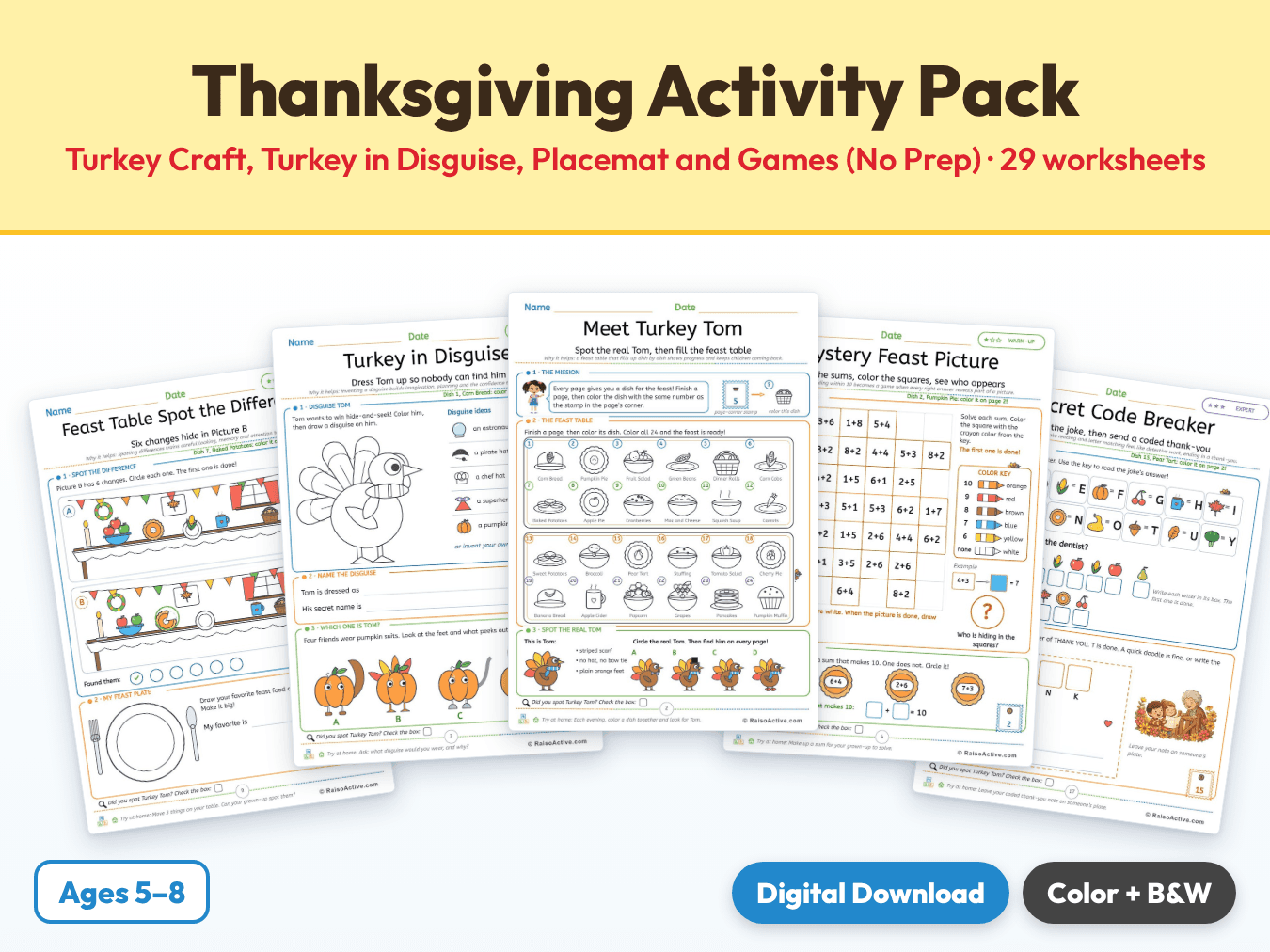
Thanksgiving Activity Pack: Turkey Craft, Turkey in Disguise, Placemat and Games (No Prep)
Ages 5-8 · Kindergarten–Grade 2Ages 5-8 · Year 1–Year 3Ages 5-8 · UKG–Class 2Ages 5-8 · 30 pages
Guides for parents and teachers
See all guides
Number Formation Rhymes 0–9 and How to Fix Reversals
Original number formation rhymes for 0–9, the correct stroke order for each digit, why 3, 5 and 7 get reversed most often, and multisensory fixes that work.

Best Worksheets for 3-Year-Olds: What Works and What to Avoid
What works on worksheets for 3-year-olds: short sessions, crayons, tracing lines, matching, cutting, a free weekly plan, and signs one is too advanced.
Portfolio Assessment with Young Children: A Comprehensive Guide to Meaningful Documentation
Learn how portfolio assessment captures your child's growth through meaningful documentation. Practical tips, templates, and age-appropriate strategies for ages 1-8.
Fostering Creativity in Structured Learning: The Perfect Balance for Young Minds
Learn how to blend creativity with structured learning for children ages 1-8. Practical strategies, activities, and printable worksheets for parents and teachers.
Preparing Your Child for a Rapidly Changing World: Essential Skills for Future Success
Discover the essential 21st century skills your child needs for future success. Practical tips on creativity, critical thinking, digital literacy & emotional intelligence for ages 1-8.
Celebrating Diversity: How to Incorporate Cultural Awareness in Learning Activities for Young Children
Practical cultural awareness activities for young children aged 2-8. Explore Indian festivals, world cultures, food, music, and crafts to teach diversity and inclusion.