Free printable worksheets · US · UK · India
Alphabet Worksheets (Ages 2–6)
Alphabet worksheets are printable sheets for children aged 2 to 6 that teach the 26 letters as names, shapes and sounds. They cover recognizing uppercase and lowercase letters, matching the two cases, finding a target letter among others, ordering letters A to Z, and linking each letter to a picture, across Preschool and Nursery to Kindergarten, Reception and UKG.
Knowing the alphabet means three separate things, and children learn them at different ages. Letter names come first, usually by singing, and a two- or three-year-old can chant A to Z long before recognizing a single letter on a page. Recognition follows: picking out the M in a word, telling b from d, matching a capital to its lowercase partner. Sounds and formation come last and are covered on the phonics and letter tracing hubs. This page is for the middle step, recognition, which is where most Preschool, Nursery and LKG work sits and which Kindergarten, Reception and UKG expect to be complete. A three-year-old finds the first letter of their name; a five-year-old names every letter in both cases out of order; by six the alphabet is a tool rather than a subject.
1053+ worksheets · free PDF download · print on A4 or Letter
Alphabet Worksheets to print
Browse all worksheets for ages 2–6
Clothing Pattern Match Worksheet for Preschoolers
This worksheet has children ages 3-5 study repeating patterns on clothing items — stripes, polka dots, or checks — and match each item to its identical twin, building visual discrimination and early pattern-sequencing skills. Distinguishing between similar-looking patterns also sharpens attention to detail, a skill that later supports letter and word recognition.

Weather Color by Number Worksheet for Preschoolers
This color-by-number activity has children ages 3-5 practice matching numerals to a color key while completing a weather-themed picture, combining number recognition with color recognition and the fine motor control needed for careful, contained coloring. Because each numbered section must be colored correctly for the picture to look right, children get immediate visual feedback on whether their number identification was accurate. The weather theme also gives a natural opportunity to talk about the picture's subject once it's revealed.

Trace and Write the Letter X Worksheet for Preschoolers
This worksheet has children ages 3-5 trace the uppercase letter X, practicing two diagonal lines that cross in the middle, a stroke pattern that requires more precise pencil control than straight or curved letters alone. Because relatively few common words start with X, this page also introduces the idea that a letter's position within a word, not just the beginning, matters for reading, since children may know X best from words like 'box' or 'fox.' Mastering this crossing stroke also supports other skills like drawing intersecting lines in later math and geometry work.

Pongal Pot Design and Coloring Worksheet for Kids
This worksheet helps children ages 3-5 practice instruction-following and creativity as they use a dice roll to determine random design elements for a Pongal pot, then color it in. Introducing an element of chance through dice-rolling adds a playful decision-making layer on top of the usual coloring practice, while still reinforcing fine motor control.

Christmas Fill-in-the-Blanks Worksheet for Preschoolers
Filling in missing letters of Christmas words like 'S_ _W' or 'TR_ _' helps children ages 3-5 connect letter sounds to their written form, an essential early step toward independent spelling. Using the accompanying picture as a clue also teaches them to cross-check visual and phonetic information — a strategy they'll rely on throughout early reading.

Color the Balloons with the Dolphin! A Fun Coloring Worksheet
This coloring worksheet helps children ages 3-5 practice color recognition and following visual instructions by matching colored dots on the balloons and dolphin to the correct crayon color. Reading a color-coded key and applying it accurately builds attention to detail and the ability to follow a multi-step visual instruction, a skill that transfers to many other early learning tasks. Coloring within the balloon and dolphin shapes also strengthens the hand control needed for later writing.

Number 1 Tracing Worksheet: Trace, Count, and Color!
This worksheet gives children ages 3-5 their very first structured practice tracing a numeral, using the simplest number shape, a single straight line, to build early pencil control before moving on to curvier numbers. Counting and coloring exactly one object reinforces that the numeral 1 represents a single item, an essential first step in connecting written symbols to real quantities. Because this is often a child's introduction to number writing, it sets the pattern for how they'll approach every number worksheet that follows.
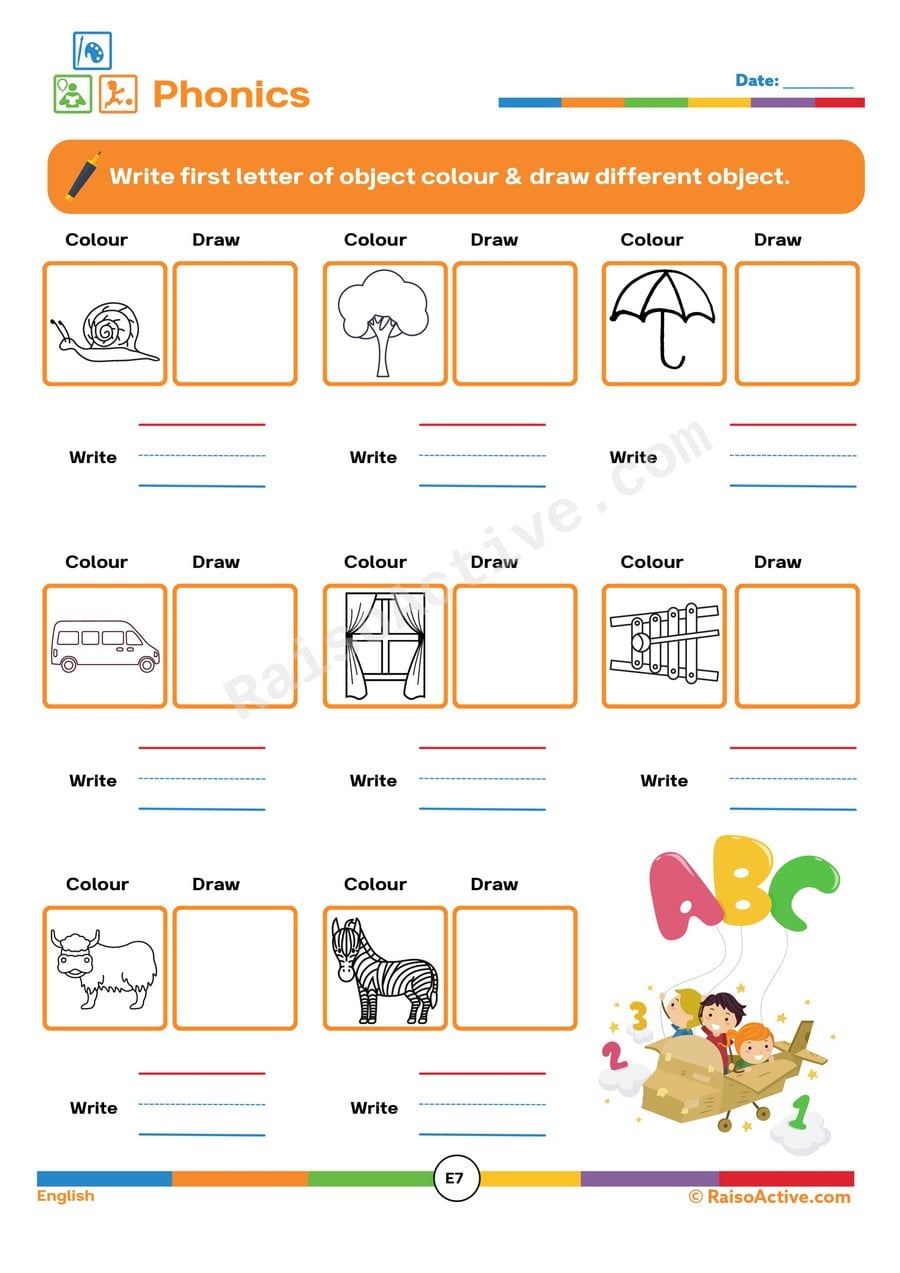
Phonics Fun: Color, Draw, and Write! (Ages 3-5)
Coloring a picture, drawing a related object, and writing its first letter combines three literacy-building tasks in one activity for children ages 3-5 — visual recognition, creative expression, and beginning-sound identification.

Merry Christmas Coloring Worksheet for Preschoolers
Filling in Christmas-themed pictures with crayons or colored pencils helps children ages 3-5 refine their pencil grip and hand control while practicing the concept of staying within a defined boundary. Because the pictures include multiple familiar holiday objects, this worksheet also gives children a chance to build vocabulary by naming each item as they color it. Repeated coloring practice at this age steadily improves the wrist and finger strength needed for later writing tasks.

Writing Numbers Worksheet: Counting and Tracing for Preschoolers
Counting a group of objects, writing the total, and then tracing that same number gives children ages 3-5 a complete loop of practice — recognizing a quantity, representing it with a written numeral, and reinforcing the numeral's shape through tracing. This combination targets both number sense and handwriting in a single page, which is more efficient and engaging than practicing each skill separately. Repeating this pattern across several different numbers also builds flexibility, since children must apply the process freshly to each new quantity rather than following a single fixed routine.

Letter O Tracing Worksheet for Preschoolers: Practice Uppercase and Lowercase!
O is a complete closed circle, distinct from the open curves of C and the single dip of U, giving 3-5 year olds practice with a stroke that must connect back to its own starting point. Tracing both uppercase O and lowercase o also reinforces that this is one of the few letters that looks essentially identical in both cases, just at different sizes.

Capacity Worksheet: Circle the Object with More Capacity!
Comparing pairs of containers teaches children ages 3-5 the early measurement concept of capacity — how much space is inside an object for holding something — which is distinct from simply judging an object's overall size. Making a choice and explaining it also builds early reasoning skills, since children must connect what they see to an invisible property, the amount something can hold.
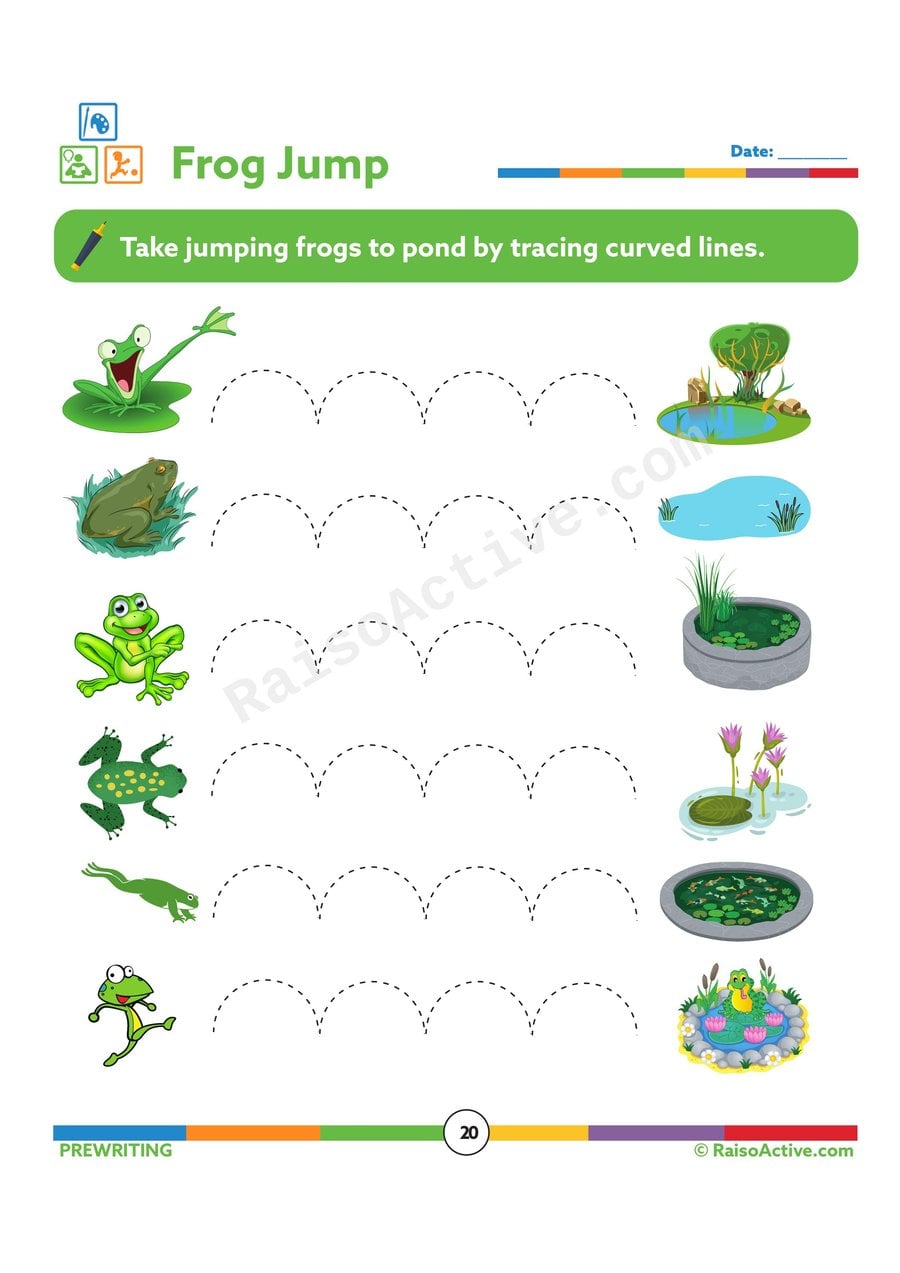
Frog Jump Tracing Worksheet for Preschoolers
Tracing the arc-shaped path of a frog's jump from one lily pad to the next gives children ages 3-5 practice with curved strokes tied to a real physical motion, a hop, which makes the abstract line feel grounded in something they've done themselves. Repeating this jump-shaped arc across several lily pads also builds consistency, helping a child produce similarly sized curves rather than arcs that vary widely from one to the next.

Housefly Life Cycle Flashcards Worksheet for Kids
These flashcards teach children ages 3-5 the four stages of a housefly's life cycle, egg, larva, pupa, and adult fly, giving them a concrete, sequential science concept using an insect they likely encounter often in daily life. Learning that a familiar insect goes through such distinct changes also builds curiosity and reduces the instinct to simply dismiss it.

Letter A Tracing Worksheet for Preschoolers: Learn to Write!
This worksheet focuses on the uppercase letter A alone, giving children a chance to build real confidence and precision with a single letter form — three connected strokes, two diagonals meeting at a point plus a crossbar — before adding the complexity of a second, differently-shaped lowercase version. Mastering capital A's three-stroke structure also lays groundwork for other 'peaked' letters like M.

Trace and Write the Letter S Worksheet for Preschoolers
Focusing only on the uppercase S lets children give undivided attention to its single continuous curve, without also managing the nearly identical but smaller lowercase form on the same page. At ages 3-5, this kind of concentrated single-case practice helps the smooth, flowing hand motion S requires become more automatic before it's tested with a second letter form.

Sunlight Worksheet: Learn About the Sun and Seasons!
This worksheet introduces children ages 3-5 to the idea that the sun's warmth and position change across the year, giving rise to the four seasons. By matching descriptions to pictures and completing sentences about the sun's daily movement, children build early scientific observation skills and the vocabulary needed to describe weather and time of day.

Letter G Tracing Worksheet: Learn to Write and Color!
Preschoolers ages 3-5 build handwriting readiness by tracing both the uppercase and lowercase letter G along dotted guide lines, developing the fine motor control and pencil grip needed for future writing. The distinct curved shape of the letter G, especially its small hook, offers valuable practice with controlled curved strokes. Coloring pictures that start with G connects the letter's shape to its beginning sound, reinforcing early phonics.

Easter Egg Match: Add and Find the Matching Designs!
This worksheet blends early addition with visual matching as children ages 3-5 combine two separate shape groups and then search for the Easter egg design that shows the same total. Because the 'answer' is a picture rather than a written number, children practice quantity comparison and pattern-matching without needing to know written numerals yet.

Letter K Tracing and Coloring Worksheet for Preschoolers
This worksheet builds recognition and formation of the letter K in both uppercase and lowercase forms through tracing, coloring, and identifying words that start with K, like 'kite' or 'kangaroo.' For three- to five-year-olds, working through both letter cases together, plus circling the letter among distractors, strengthens visual discrimination alongside handwriting practice.

Letter B Tracing and Identification Worksheet for Preschoolers
This worksheet helps children ages 3-5 practice tracing and writing the letter B, identifying B among other letters, and recognizing objects that start with the letter B. Circling the correct letter within a small group builds the visual scanning skill children need before they can read words fluently.

Slanting Lines Worksheet: Trace the Rain and Help the Flowers Bloom!
This worksheet gives children ages 3-5 focused practice tracing slanting lines, a pre-writing stroke that appears in letters like A, K, N, and X and in numbers like 4 and 7. Practicing diagonal strokes is typically harder than horizontal or vertical lines because it requires more precise wrist and finger control, making this a valuable stepping stone before formal letter writing begins. The rain-to-flowers storyline gives the repetitive tracing practice a clear, motivating purpose.

Trace and Write the Letter W Worksheet for Preschoolers
This worksheet has children ages 3-5 trace the uppercase letter W, made of four connected diagonal lines forming two Vs side by side, one of the more visually complex letters to trace accurately. Practicing W builds on the diagonal-stroke control introduced by simpler letters like V, while adding the extra challenge of maintaining even width and height across all four strokes. The page also reinforces the /w/ sound in words like 'water,' 'worm,' and 'window.'
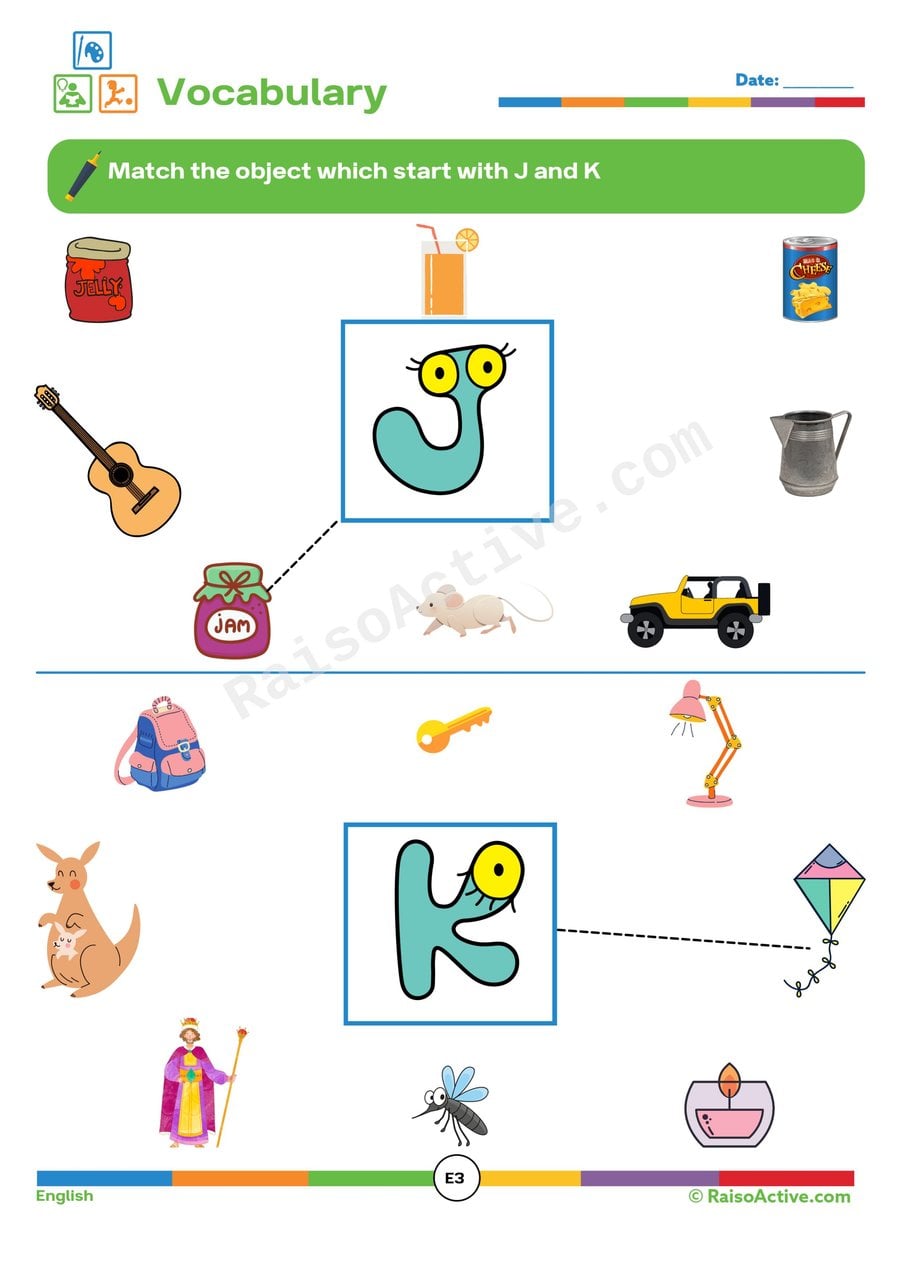
J and K Vocabulary Worksheet: Match the Objects!
This worksheet gives children ages 3-5 focused practice with the letters J and K, two consonants that don't come up as often in early vocabulary as letters like S or B, so dedicated practice like this helps round out full alphabet familiarity. Matching pictures to their correct beginning letter reinforces the sound-symbol connection while also building vocabulary for objects that start with these less common letters, like jars, jellyfish, kites, or kangaroos. This kind of targeted practice on less-frequent letters helps prevent gaps in alphabet knowledge that can otherwise show up later during reading.
Names, shapes and sounds are different skills
Naming a letter (that is a bee), recognizing its shape (find every B on this page), knowing its sound (b says buh) and forming it (write a B) are four separate skills that develop in roughly that order. A child who can sing the alphabet song may not recognize any letter; a child who recognizes letters may not know their sounds. Alphabet worksheets target recognition, and the sheets here are grouped so that each of the 26 letters gets the same set of tasks.
Start with the letters in the child's own name, because they are seen daily and matter to the child. Then add the most visually distinct letters (O, X, S, T) before the confusable ones (b, d, p, q; m, n, u; i, l). Uppercase is easier to recognize than lowercase, so most programs teach capitals for recognition first and add lowercase within the same year.
- Age 2–3: alphabet song, letters in own name, coloring large single letters
- Age 3–4: recognizing most uppercase letters, matching identical letters, first-letter pictures
- Age 4–5: recognizing lowercase, matching upper to lower, finding a letter in a row
- Age 5–6: alphabet order, missing-letter sequences, which letter comes before or after
How to use alphabet worksheets
Treat each sheet as a short game rather than a test. On a find-the-letter sheet, name the target letter, then let the child hunt and circle. On a matching sheet, say the letter name each time a pair is joined. Keep a set of flashcards from this page and shuffle a few into the sheet session so recognition is tested out of alphabetical order, since many children identify letters only by their place in the song. Ten minutes and one or two letters a day is enough.
Alphabet order and when it matters
Alphabetical order is useful for dictionaries and for the song, but it is not needed for reading, and a child who can only name a letter after reciting from A is not recognizing it. Order sheets (fill in the missing letter, what comes after K) belong at the end of the sequence, in Kindergarten, Reception or UKG, once every letter is known on its own. Before then, order practice is best kept to the song and an alphabet strip on the wall.
Frequently asked questions
At what age should a child know the alphabet?
Most children can sing the alphabet by 3, recognize about half the uppercase letters by 4, and name all 26 letters in both cases by the end of Kindergarten, Reception or UKG at 5 to 6. Common Core sets naming all upper- and lowercase letters as a Kindergarten goal (RF.K.1d). Children vary widely within this range, and knowing letters early does not by itself predict reading.
How many letters should a 4-year-old know?
By 4, at the end of Nursery or Preschool, a child typically recognizes 10 to 20 uppercase letters, reliably including those in their own name, and a few lowercase letters. By the end of Pre-K, Reception or LKG at 5, most uppercase letters and many lowercase ones are expected. Sounds for those letters usually lag recognition by a few months.
Should I teach uppercase or lowercase letters first?
For recognition, both can be introduced together, since a child meets both in print, but uppercase is easier to distinguish and is usually secure first. For writing, uppercase comes first because the strokes are simpler. Most Preschool and Nursery programs lead with capitals and add lowercase matching within the same year, and Kindergarten and Reception expect both cases by the end of the year.
What is the best order to teach the alphabet?
For recognition, start with the letters in the child's name, then letters with distinct shapes, and leave confusable pairs until the others are secure. For sounds, phonics programs use an order such as s, a, t, p, i, n that makes words quickly. For formation, group by stroke type. The A-to-Z order of the song is fine for singing but is the least useful order for actual teaching.
How do I teach the alphabet to a 2-year-old?
Sing it, point to letters in the child's name and on signs, and use large single-letter coloring pages. At 2, alphabet worksheets should involve no writing and no expectation of recognition; the aim is exposure and the association of letters with something the child cares about. Formal recognition work suits 3 and up, when the child can attend for a few minutes and point deliberately.
Are the alphabet worksheets free to download?
Yes. Every A to Z sheet downloads as a watermarked PDF without charge once you have an account, up to five downloads a day. An annual subscription of ₹1000 or $20 removes the watermark and daily limit across the library of more than 1,000 worksheets and all printable packs. All sheets are laid out for A4 and US Letter.

Written by
Hemsweta Jain · Teacher Cheena
MBA and Early Childhood Educator, teaching since 2014 · Founder of RaisoActive, Mumbai
Written and reviewed by Hemsweta Jain (Teacher Cheena), who designs every RaisoActive worksheet.
Last reviewed
Printable packs for ages 2–6
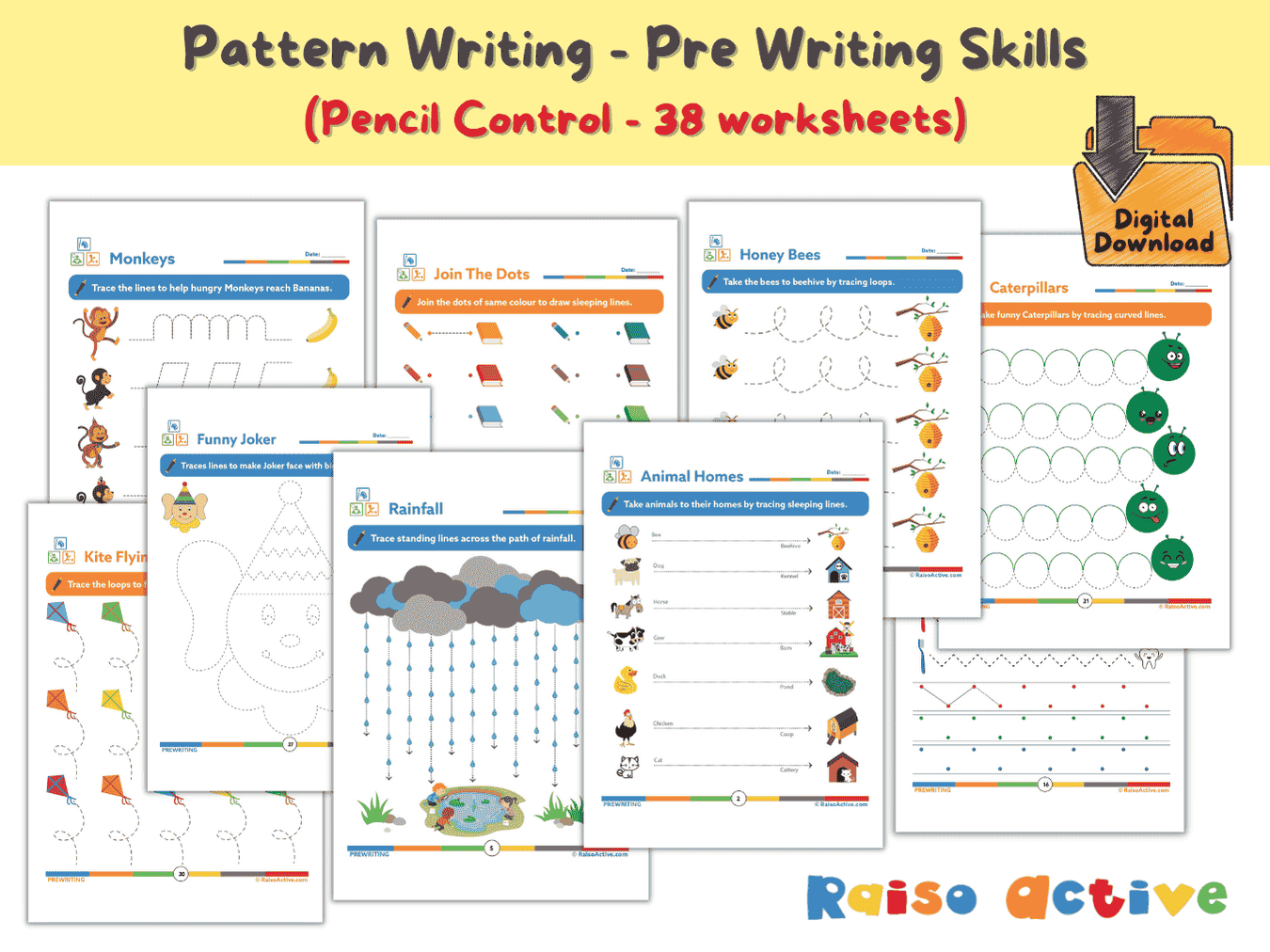
Pattern Writing Pre-writing Skills Activity Book for 3-4 Year Olds
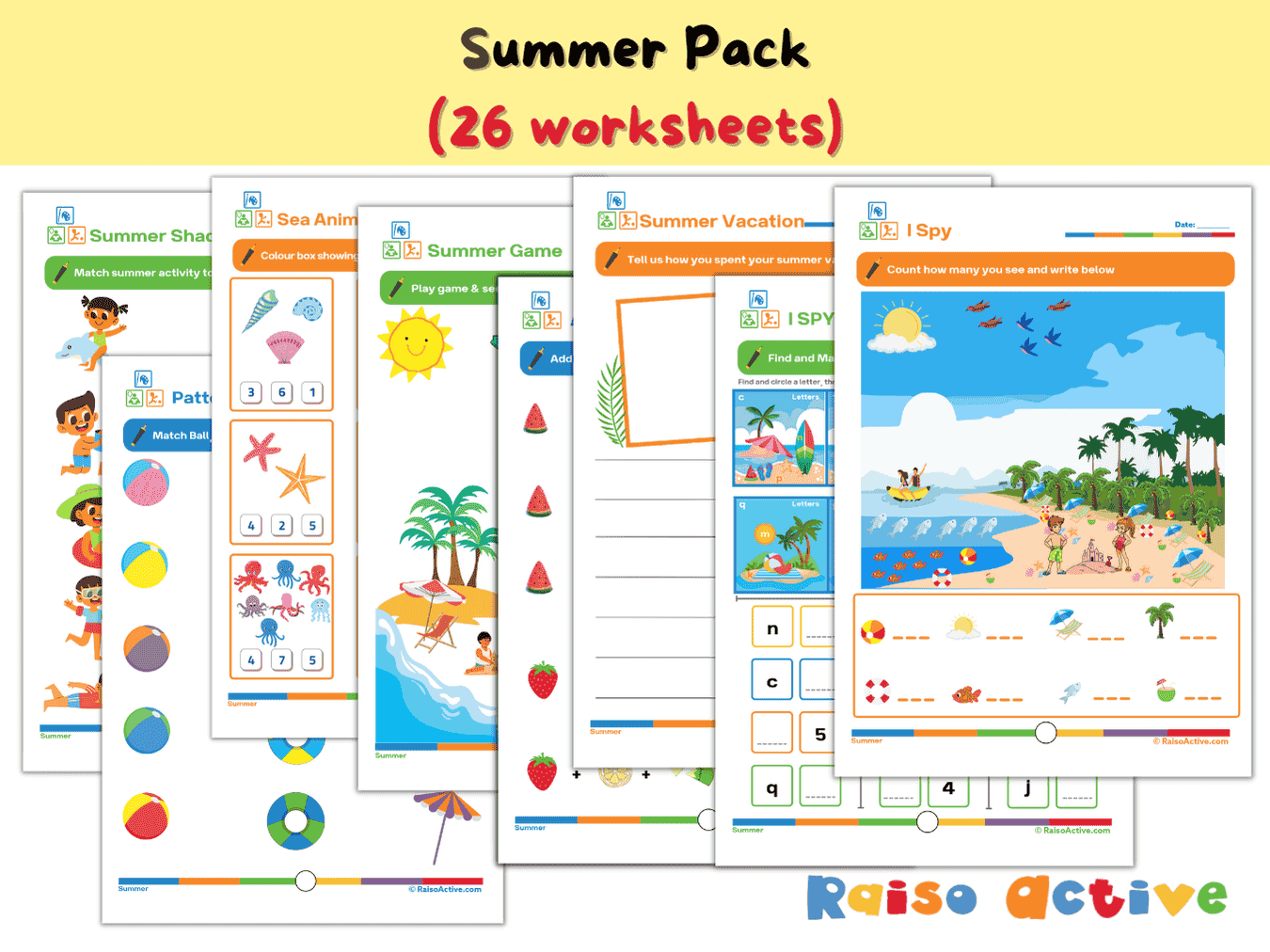
Summer Activity Pack: Math, Literacy, Puzzles & More for Preschool & Kindergarten
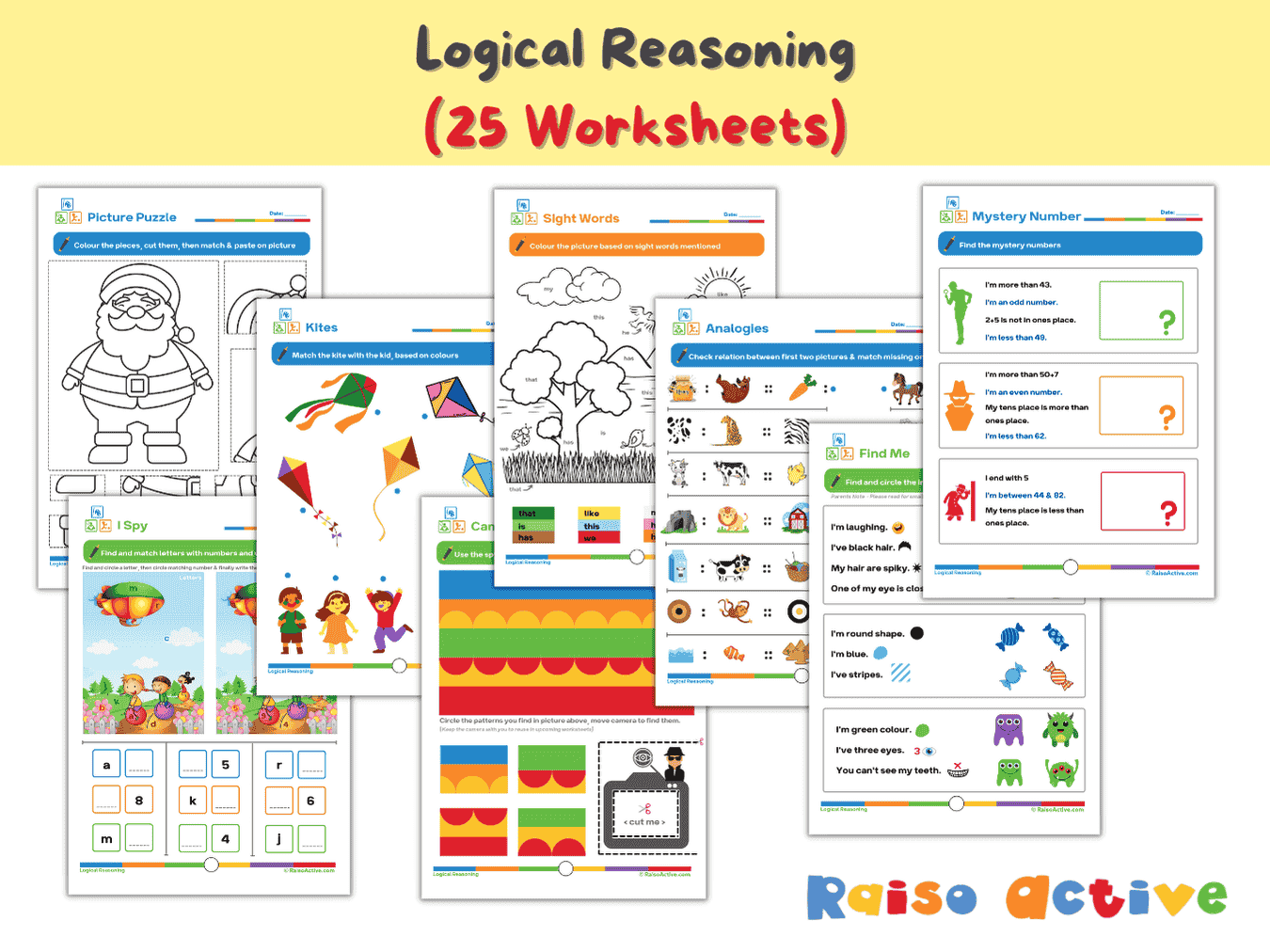
Logical Reasoning Activity Book for Preschool & Kindergarten | Patterns, Puzzles & Analogies
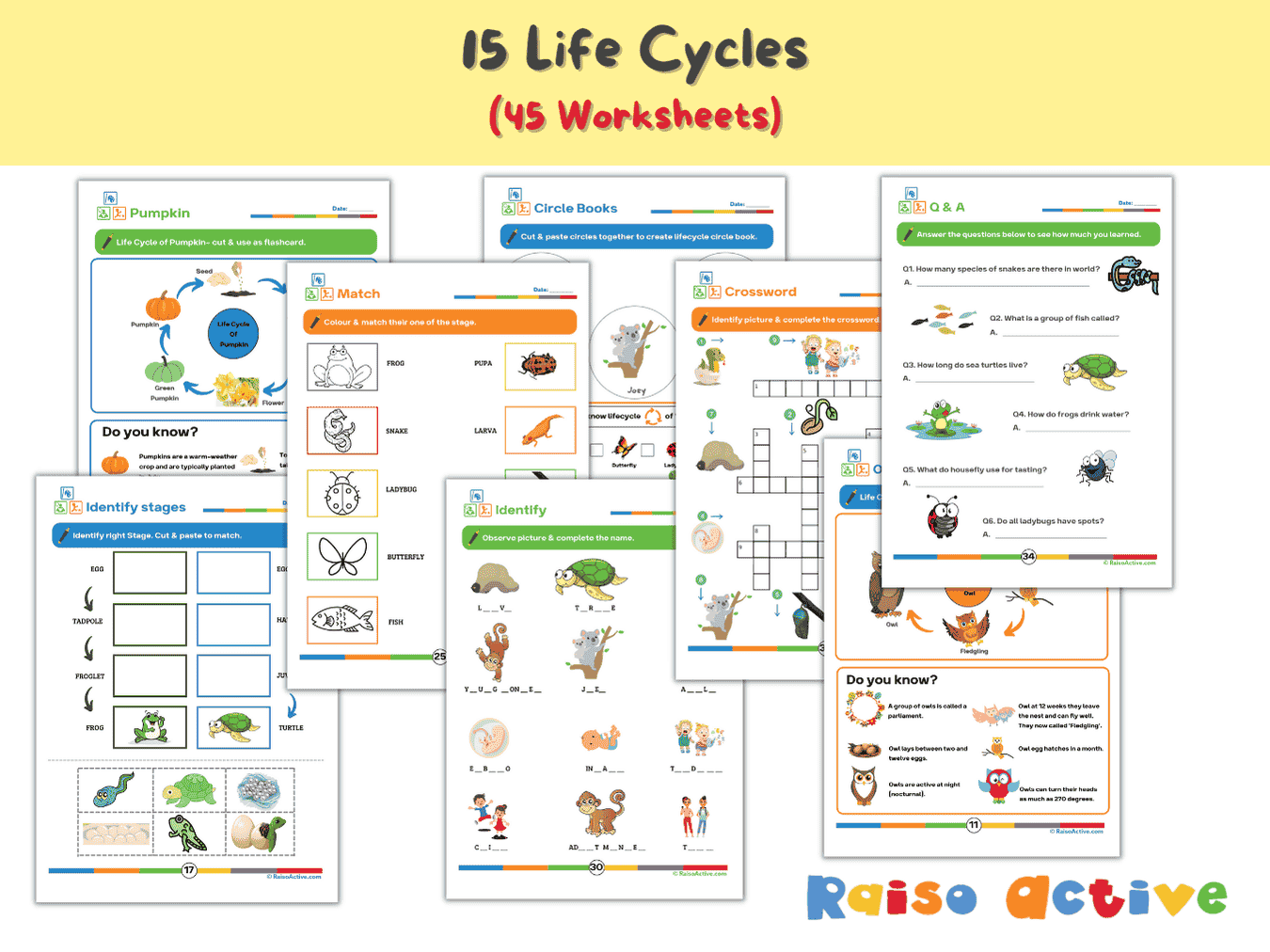
Lifecycles Activity Book & Flashcards for Preschool & Early Elementary
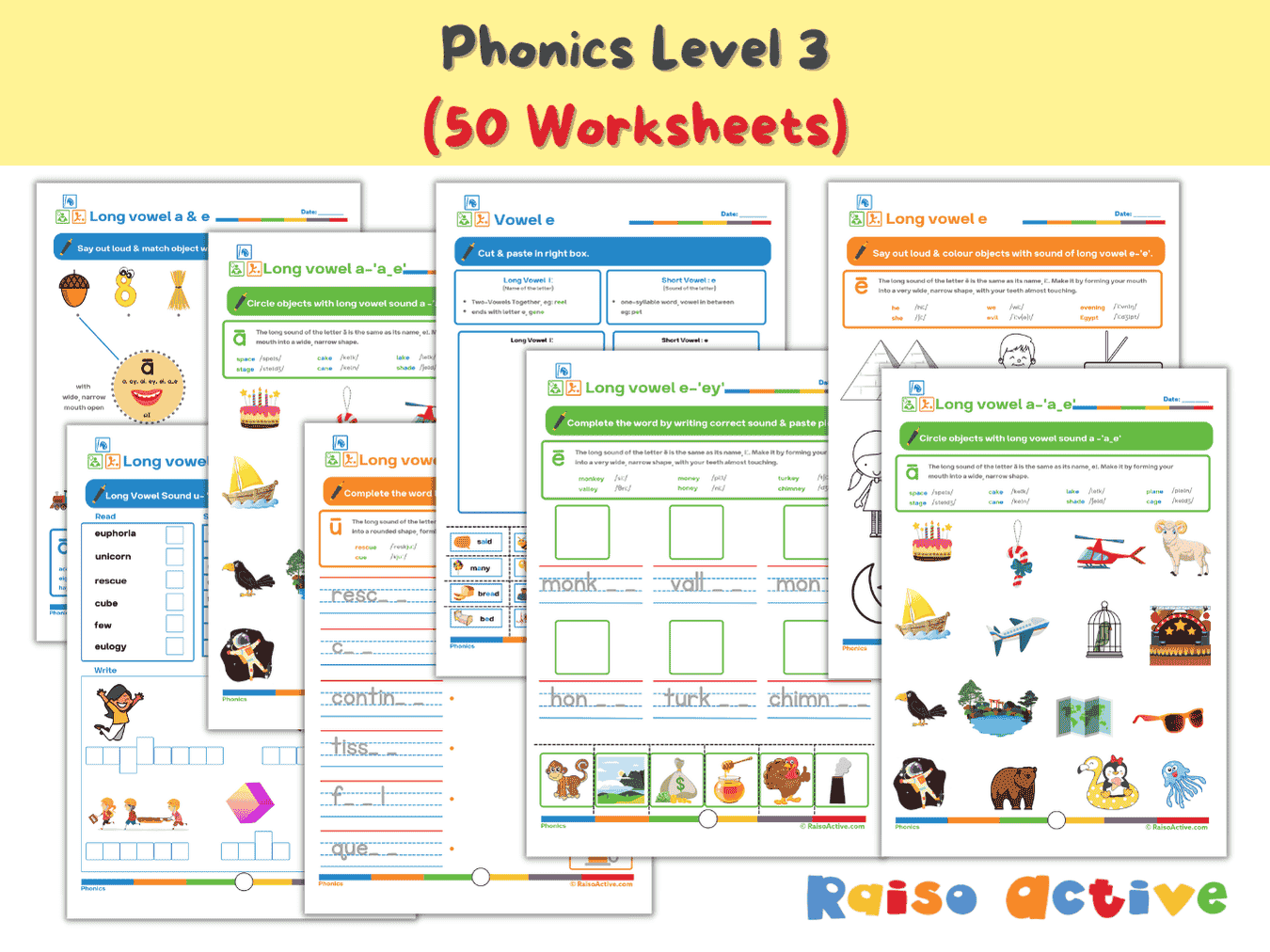
Phonics Level 3 Long Vowels Activity Book for Kindergarten & 1st Grade
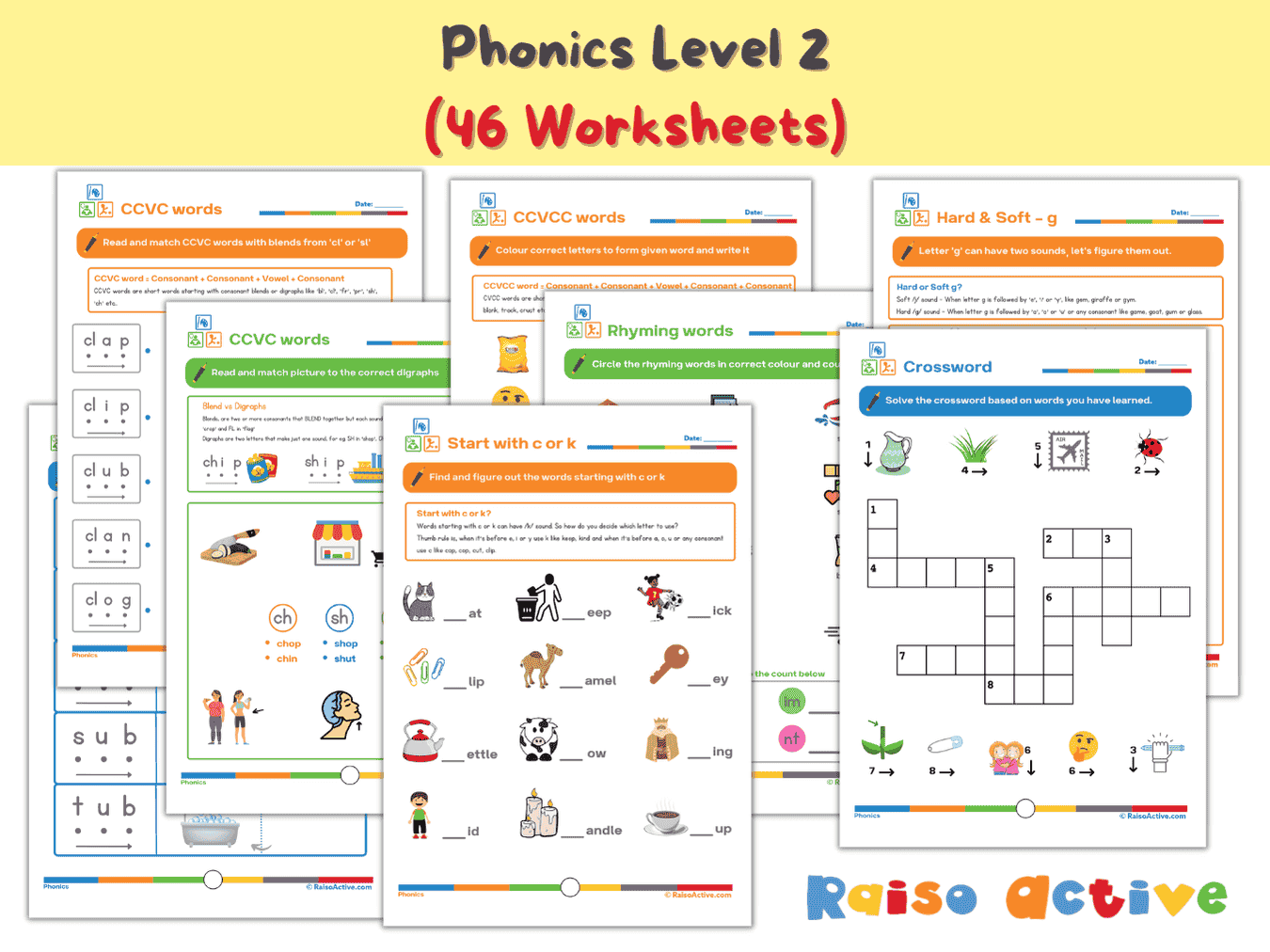
Phonics Level 2 Worksheets: CVC, CCVC, CVCC Word Families & Blends for Early Readers (Ages 4-7)
Guides for parents and teachers
See all guides →How to Teach CVC Blending: A Step-by-Step Method That Works in Two Weeks
A step-by-step method for teaching CVC blending, covering continuous sounds, word families, common errors, and a 14-day plan that most children finish reading CVC words.
Kindergarten Readiness Checklist: 25 Skills to Practice Before the First Day
A kindergarten readiness checklist of 25 literacy, math, motor, self-regulation and self-help skills, with an 8-week summer plan and notes on when not to worry.
Phase 2 Phonics at Home: Sound Order, Blending Games, Worksheets
Phase 2 phonics at home: the five sound sets in order, oral blending, tricky words, a two-week routine, common mistakes, and free worksheets.
Reception Year Explained: EYFS Learning and How to Help at Home
A teacher's plain-English guide to the Reception Year: the seven areas of learning, Early Learning Goals, Phase 2/3 phonics, the RBA and home routines.
UKG Syllabus Explained: English, Maths and EVS Month by Month
What UKG classes typically cover in English, maths and EVS, month by month, aligned to NEP 2020, with ways to support at home and signs your child is behind.
What Should a 4-Year-Old Know Before LKG? A Readiness Checklist
A calm, teacher-written LKG readiness checklist for 4-year-olds: language, pattern writing, numbers to 10, self-help and social skills, plus a 6-week plan.
Canonical: https://raisoactive.com/worksheets/alphabet