Letter K Tracing Worksheet: Learn to Write the Letter K!
This tracing worksheet helps children ages 3-5 practice the angled strokes of the letter K, which are more challenging than curved letters because they require precise diagonal lines meeting at a point. Repeated tracing builds the pencil control and hand strength needed for confident handwriting later on. Coloring K-word pictures reinforces the connection between the letter's shape and its beginning sound.
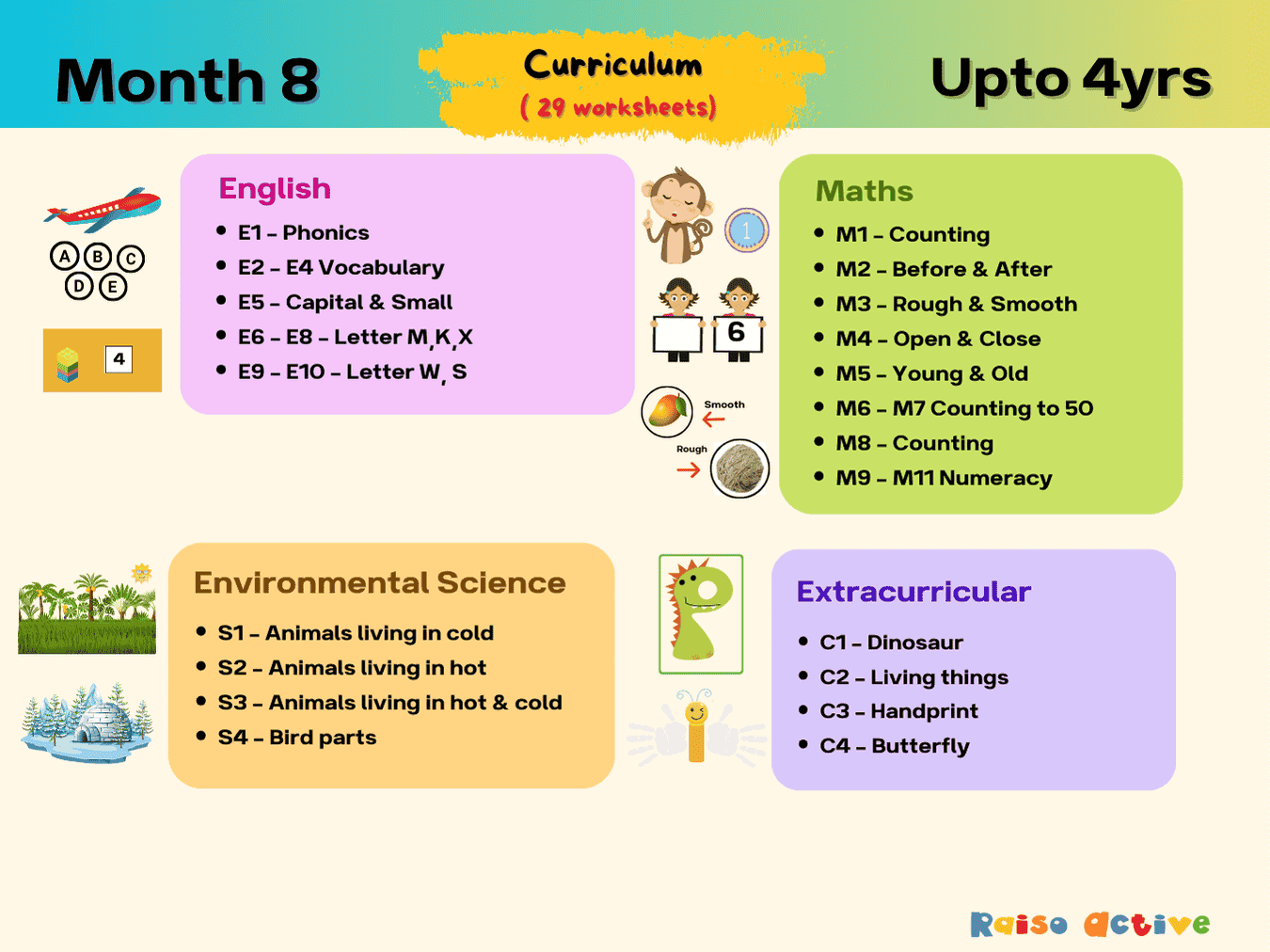
Part of the pack
Month 8: Phonics, Math, Science, Creativity | Ages Up to 4
This is page 10 of the pack. Ages 3-5 · Preschool–Pre-KAges 3-5 · Nursery–ReceptionAges 3-5 · Nursery–LKGAges 3-5
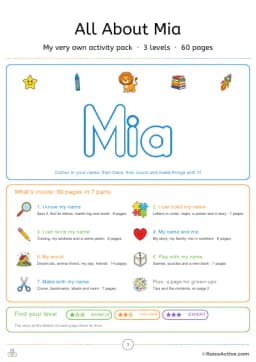
Made for your child
A whole activity pack made with their name
60 pages to spot, build, trace and write their own name, plus pages about their favourites, feelings and family. See a free preview with their name.
Make an All About Me packFree preview · free for members
Or start free: a name tracing sheet with their nameCurriculum
- Writing > Letter Tracing A-Z
How to use this worksheet
Have your child trace the dotted letter K first with a finger to feel the vertical line and two diagonal strokes, then switch to a pencil for the same path. Encourage them to pause where the diagonal lines meet the vertical line, since this junction is often the hardest part to get right. After tracing, move to the practice lines and have them write the letter K independently several times. Finish by naming the pictures on the page and coloring only the ones that start with the letter K.
Materials needed
- Pencil
- Crayons
Extension activities
- 1Find objects around the house starting with K, like keys, a kite, or a kettle.
- 2Practice forming the letter K using craft sticks or pipe cleaners to reinforce the straight-line shapes.
- 3Write the letter K in a tray of sand or shaving cream for a sensory, low-pressure writing experience.
- 4Fly a kite or draw one together while talking about the letter K sound.
- 5Play a simple game clapping once every time you hear a K word in a story read aloud.

Written by
Hemsweta Jain · Teacher Cheena
MBA and Early Childhood Educator, teaching since 2014 · Founder of RaisoActive, Mumbai
Every RaisoActive worksheet is designed and checked by the founder before publishing.
Published · Last reviewed
More from Month 8: Phonics, Math, Science, Creativity | Ages Up to 4

Phonics Fun: Match the Letter to the Object Worksheet
Ages 4-5 · Pre-KAges 4-5 · ReceptionAges 4-5 · LKGAges 4-5
This worksheet asks children to connect a printed letter to a picture whose name starts with that letter's sound, then reinforces the connection a second time through color-coded circles, a repetition that research on phonics instruction shows helps move sound-letter pairs from short-term recognition into lasting memory. For four and five year olds, this dual task also builds sustained attention across a slightly longer worksheet than a single matching exercise.
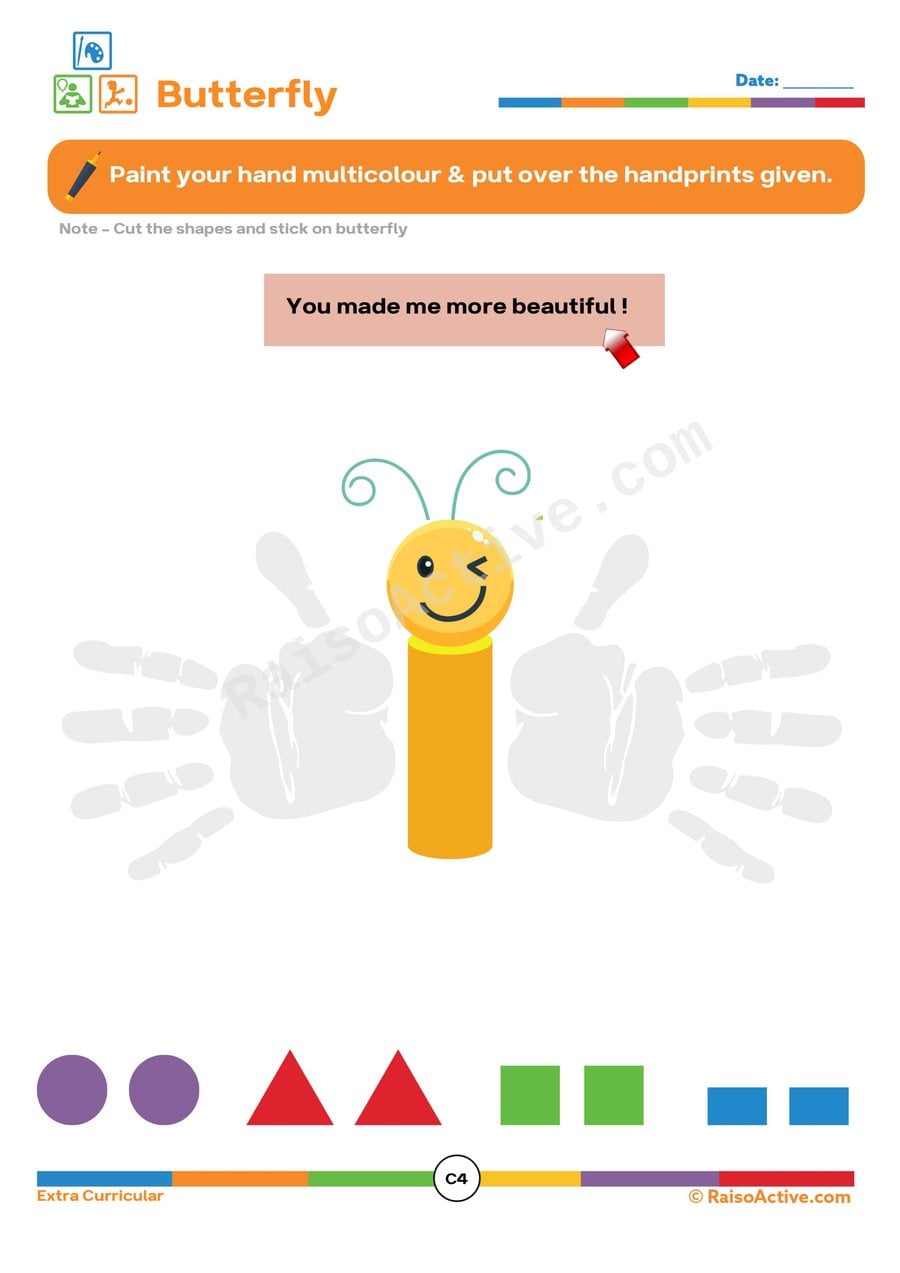
Butterfly Handprint Craft Worksheet for Kids
Ages 3-5 · Preschool–Pre-KAges 3-5 · Nursery–ReceptionAges 3-5 · Nursery–LKGAges 3-5
Painting a handprint to form butterfly wings and then adding cut-out details turns this craft into practice for both fine motor control and symmetry, since a butterfly's wings mirror each other, children begin to notice matching patterns on either side of a center line. The multi-step process of painting, waiting, cutting, and pasting also builds patience and sequencing skills appropriate for ages three to five.

Before and After Numbers Worksheet for Preschoolers
Ages 4-6 · Pre-K–KindergartenAges 4-6 · Reception–Year 1Ages 4-6 · LKG–UKGAges 4-6
Children ages 4-6 strengthen their understanding of number order by identifying which number comes immediately before and after a given number, a skill that builds number line reasoning beyond simple counting. Completing the cherry and lolly counting sections adds a real quantity-based check to the abstract number sequencing work. Together, these tasks deepen number sense and prepare children for addition and subtraction, which depend on knowing neighboring numbers.

Capital and Small Letter Matching Worksheet for Preschoolers
Ages 3-5 · Preschool–Pre-KAges 3-5 · Nursery–ReceptionAges 3-5 · Nursery–LKGAges 3-5
Children ages 3-5 build letter recognition fluency by matching each uppercase letter to its corresponding lowercase form, a skill essential for reading since text uses both cases interchangeably. Recognizing that 'B' and 'b' represent the same letter sound despite looking different is a genuinely tricky early literacy milestone. Circling words that begin with a capital letter adds an extra layer of practice noticing capitalization in real context.

Living Things: Color the Smiles! A Fun Sorting Worksheet
Ages 3-5 · Preschool–Pre-KAges 3-5 · Nursery–ReceptionAges 3-5 · Nursery–LKGAges 3-5
Preschoolers ages 3-5 build foundational science classification skills by distinguishing living things from non-living things, indicated by coloring a smiley face only on the items that are alive. This concept requires children to think beyond appearance and consider whether something grows, breathes, or needs food, an abstract but essential early science idea. The playful smiley-face format keeps a genuinely tricky classification concept approachable and fun.
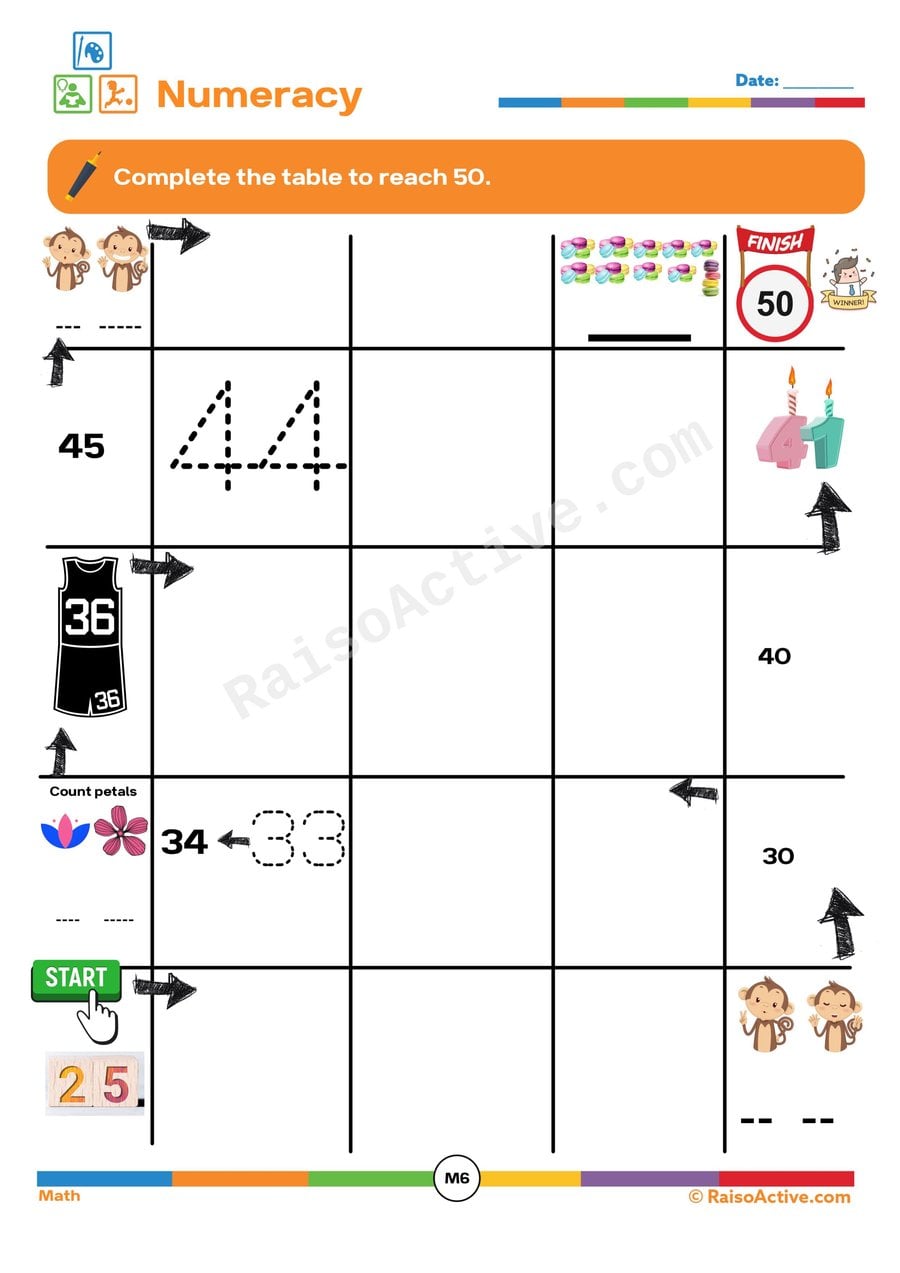
Reach 50! A Fun Numeracy Worksheet for Kids
Ages 4-5 · Pre-KAges 4-5 · ReceptionAges 4-5 · LKGAges 4-5
Filling in a number sequence toward a target like 50 gives children ages 4-5 practice with number order and pattern continuation over a longer stretch than they might attempt in casual counting, building stamina alongside numeracy. Starting partway through the sequence, at 25, also asks children to pick up counting from a non-zero starting point, which is a slightly more advanced skill than counting from one every time. Successfully completing the full path to 50 gives children a strong, visible sense of accomplishment tied to a meaningful numerical milestone.

Caterpillar Counting Adventure: Connect the Dots Worksheet
Ages 4-6 · Pre-K–KindergartenAges 4-6 · Reception–Year 1Ages 4-6 · LKG–UKGAges 4-6
Ages 4-6 practice counting in sequence up to 50 by connecting numbered dots that form a caterpillar shape, combining number recognition with fine motor line control. Counting this high in order builds confidence with larger numbers beyond the more common 1-20 range most preschool worksheets cover. The connect-the-dots format also rewards persistence, since the picture only fully forms once every number has been found correctly.

Animals in Hot Climate Cut and Paste Worksheet for Preschoolers
Ages 3-5 · Preschool–Pre-KAges 3-5 · Nursery–ReceptionAges 3-5 · Nursery–LKGAges 3-5
Preschoolers ages 3-5 learn which animals are adapted to live in hot climates, like camels or lions, by cutting them out and pasting them into a matching habitat scene. This activity builds early science understanding of how animals are suited to their environments, connecting a visual habitat cue to specific animal knowledge. The scissor and glue work also continues developing the fine motor precision needed for later handwriting tasks.
Related worksheets

Letter 'i' Tracing and Matching Worksheet for Preschoolers
Ages 3-5 · Preschool–Pre-KAges 3-5 · Nursery–ReceptionAges 3-5 · Nursery–LKGAges 3-5
This worksheet builds recognition of the letter 'i' for 3-5 year olds through tracing, picture matching, and a highlighting activity, giving repeated exposure to both the letter's shape and its sound in a single sitting. Matching objects that start with 'i' alongside the tracing practice connects the visual letter shape to real vocabulary, reinforcing that letters aren't abstract marks but stand for actual sounds your child hears in words they already know.
Letter F Worksheet: Trace, Color, and Learn!
Ages 3-5 · Preschool–Pre-KAges 3-5 · Nursery–ReceptionAges 3-5 · Nursery–LKGAges 3-5
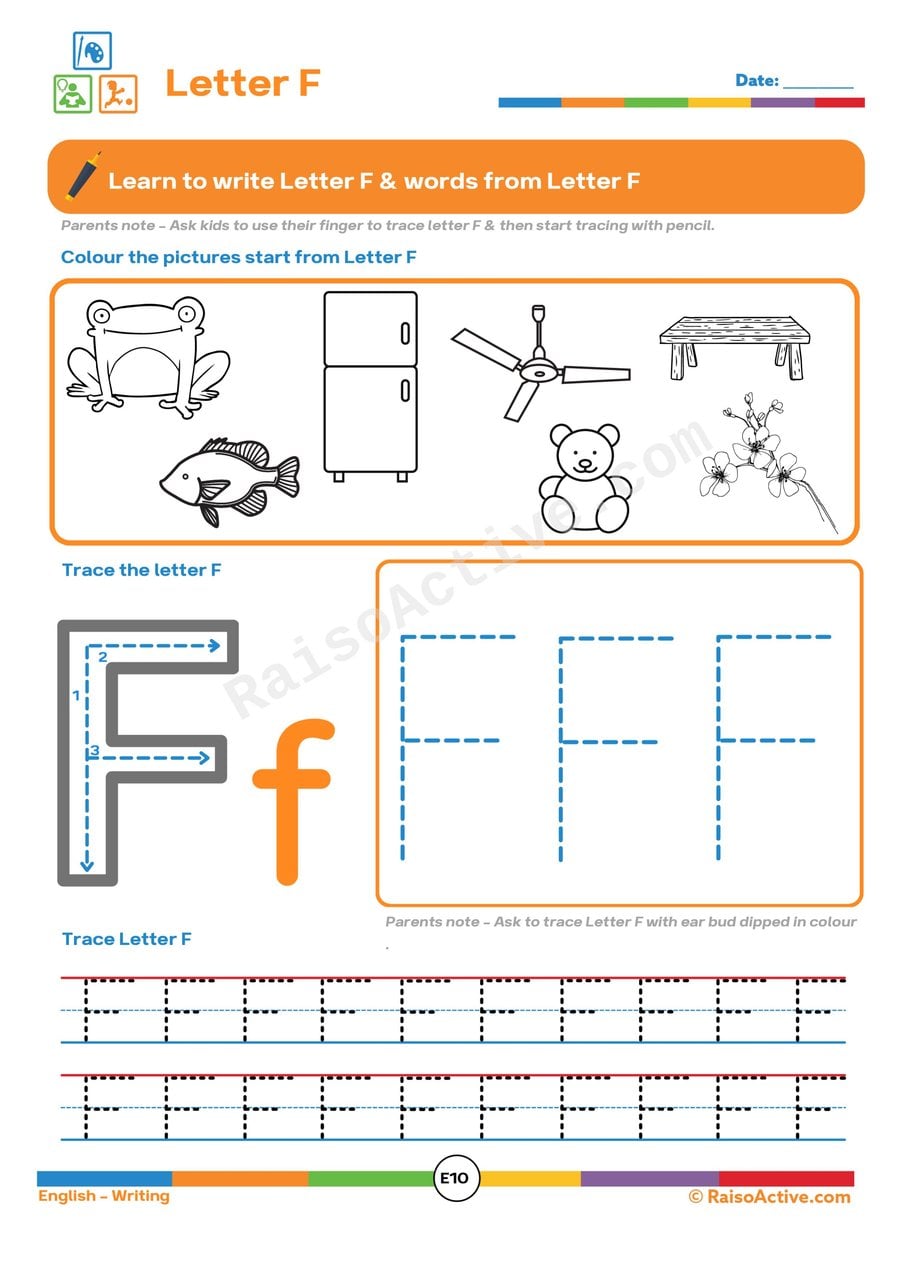
This worksheet builds children's ability to reproduce capital F — a vertical line with two horizontal branches — through repeated tracing, while the matching coloring activity trains them to connect the letter shape to its beginning sound in real words. For 3-5 year olds, this dual practice of motor formation plus sound recognition is exactly the combination that prepares a child to write and read independently.
Letter Ee Worksheet: Trace, Find, and Color!
Ages 3-5 · Preschool–Pre-KAges 3-5 · Nursery–ReceptionAges 3-5 · Nursery–LKGAges 3-5
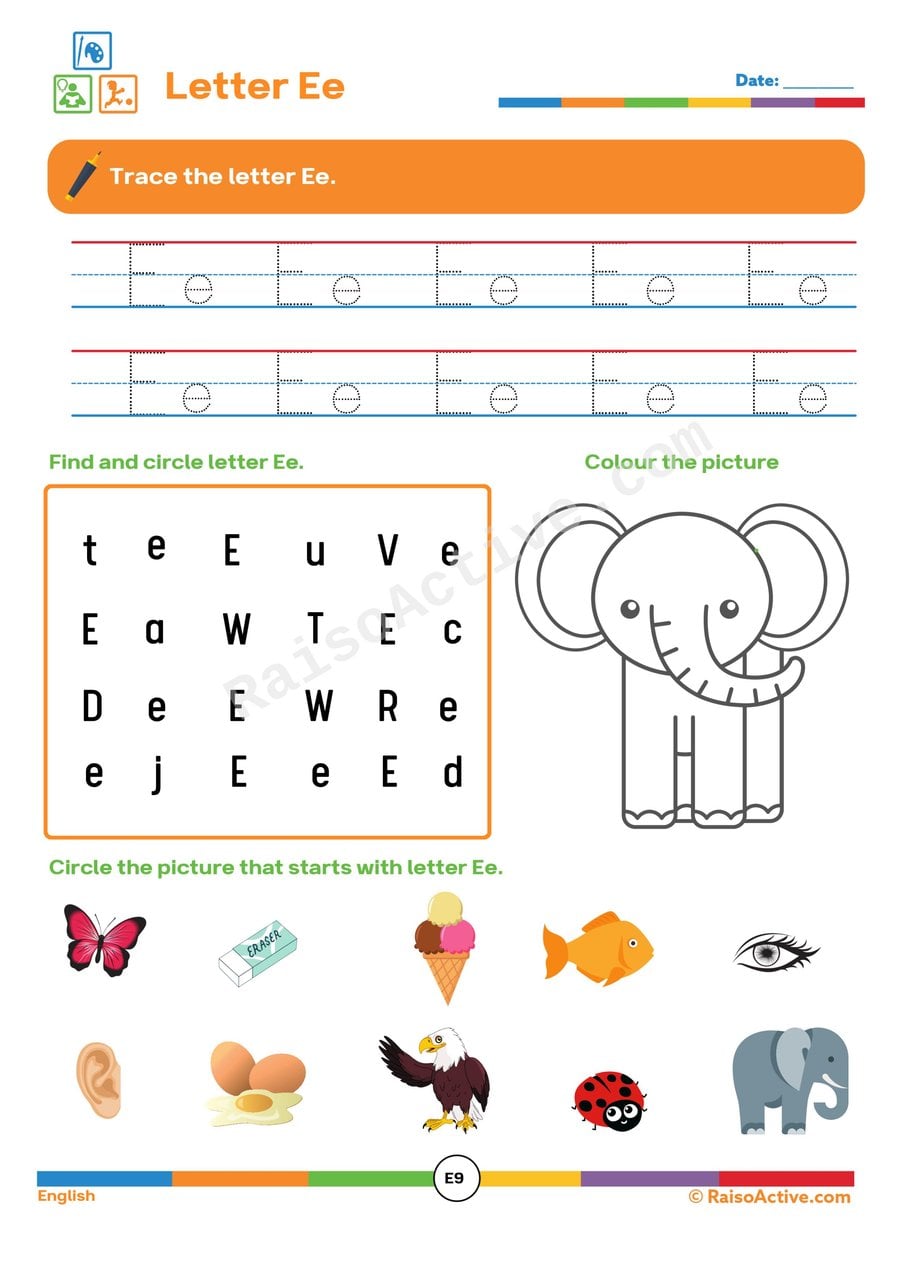
This worksheet gives children ages 3-5 layered practice with the letter Ee — tracing it, finding it inside a word search grid, and identifying an elephant along with other pictures that start with the same sound. Repeating the letter across a tracing task, a visual search, and a picture-matching task in one sitting builds stronger, faster recognition than any single activity could alone.
Letter 'w' Worksheet: Trace, Match, and Color!
Ages 3-5 · Preschool–Pre-KAges 3-5 · Nursery–ReceptionAges 3-5 · Nursery–LKGAges 3-5
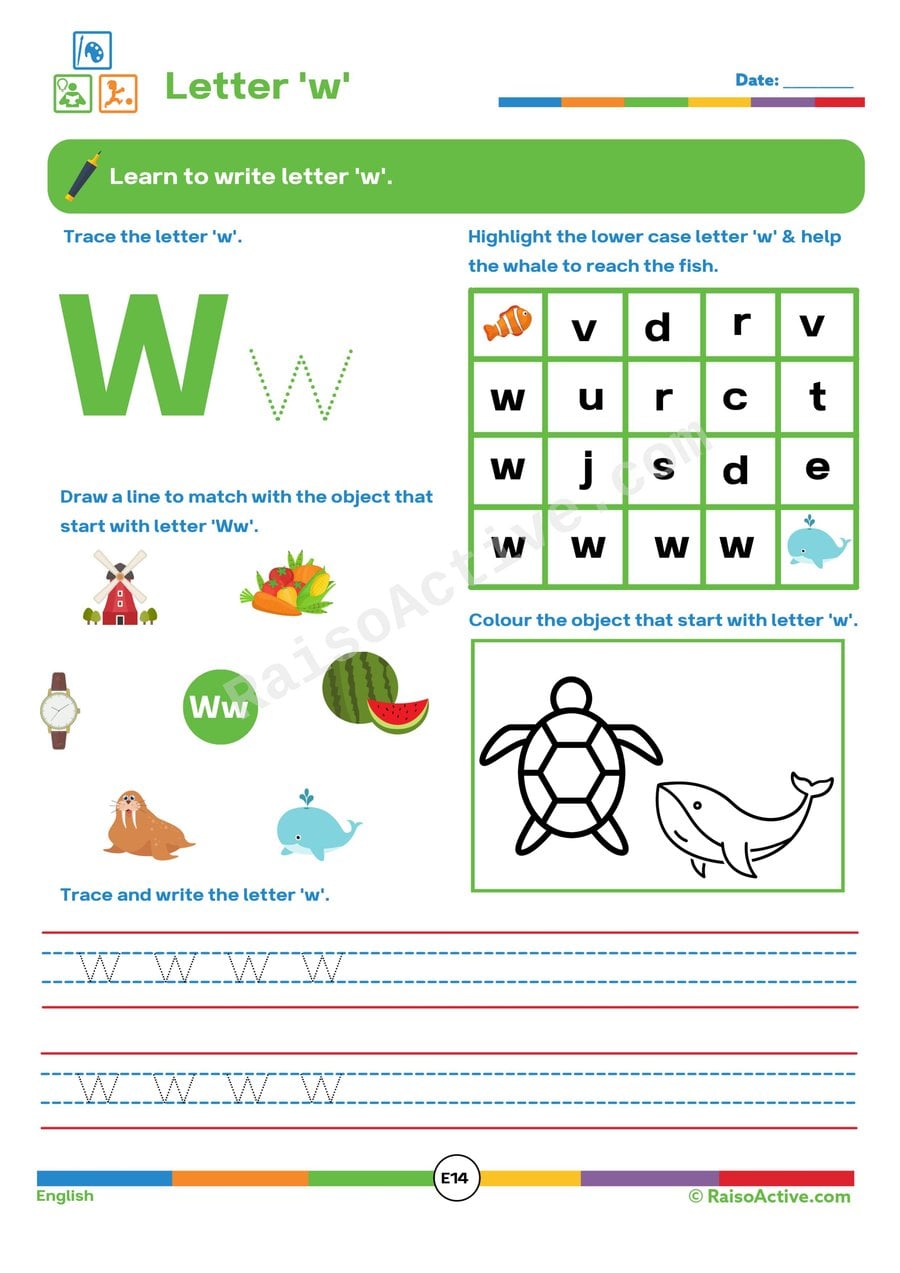
Tracing, matching, and highlighting the letter 'w' gives children ages 3-5 practice with one of the more visually complex lowercase letters, made up of four connected diagonal strokes rather than a single simple shape. Matching pictures that start with 'w' to the letter reinforces the /w/ sound-to-symbol link, while scanning a letter grid to highlight every 'w' builds visual search skills alongside letter recognition. This combination of tracing, matching, searching, and coloring keeps the practice varied enough to hold a young child's attention across the full page.

Learn the Letter 'n' Worksheet: Tracing, Matching, and Coloring Fun!
Ages 3-5 · Preschool–Pre-KAges 3-5 · Nursery–ReceptionAges 3-5 · Nursery–LKGAges 3-5
This worksheet builds letter 'n' recognition for 3-5 year olds through tracing, a highlighting search, matching to pictures, and coloring — four connected tasks that ask your child to hold onto the same letter across different formats and follow multi-step instructions in sequence. The letter 'n' is frequently confused with 'm' since both involve humps, so the repeated exposure here helps children start telling the two apart by sound and shape.

Learn the Letter N! Tracing and Coloring Worksheet for Preschoolers
Ages 3-5 · Preschool–Pre-KAges 3-5 · Nursery–ReceptionAges 3-5 · Nursery–LKGAges 3-5
This worksheet helps children ages 3-5 build the specific hand movements needed to form the letter N, tracing both its uppercase and lowercase shapes while also linking the letter to its sound through picture coloring. Repeated tracing strengthens the pencil grip and directional control that later support fluent handwriting.

Learn the Letter 'L': Tracing, Matching, and Coloring Worksheet for Preschoolers
Ages 3-5 · Preschool–Pre-KAges 3-5 · Nursery–ReceptionAges 3-5 · Nursery–LKGAges 3-5
This worksheet builds letter 'L' recognition through tracing, matching, a themed maze that highlights the letter while guiding a lion to its meat, and coloring — a four-part structure that keeps 3-5 year olds engaged across several formats while reinforcing the same letter each time. The maze section in particular adds a playful goal to what would otherwise be repetitive letter-spotting, motivating your child to scan carefully for every 'L' along the path.
Letter Z Worksheet: Trace, Write, and Color!
Ages 3-5 · Preschool–Pre-KAges 3-5 · Nursery–ReceptionAges 3-5 · Nursery–LKGAges 3-5
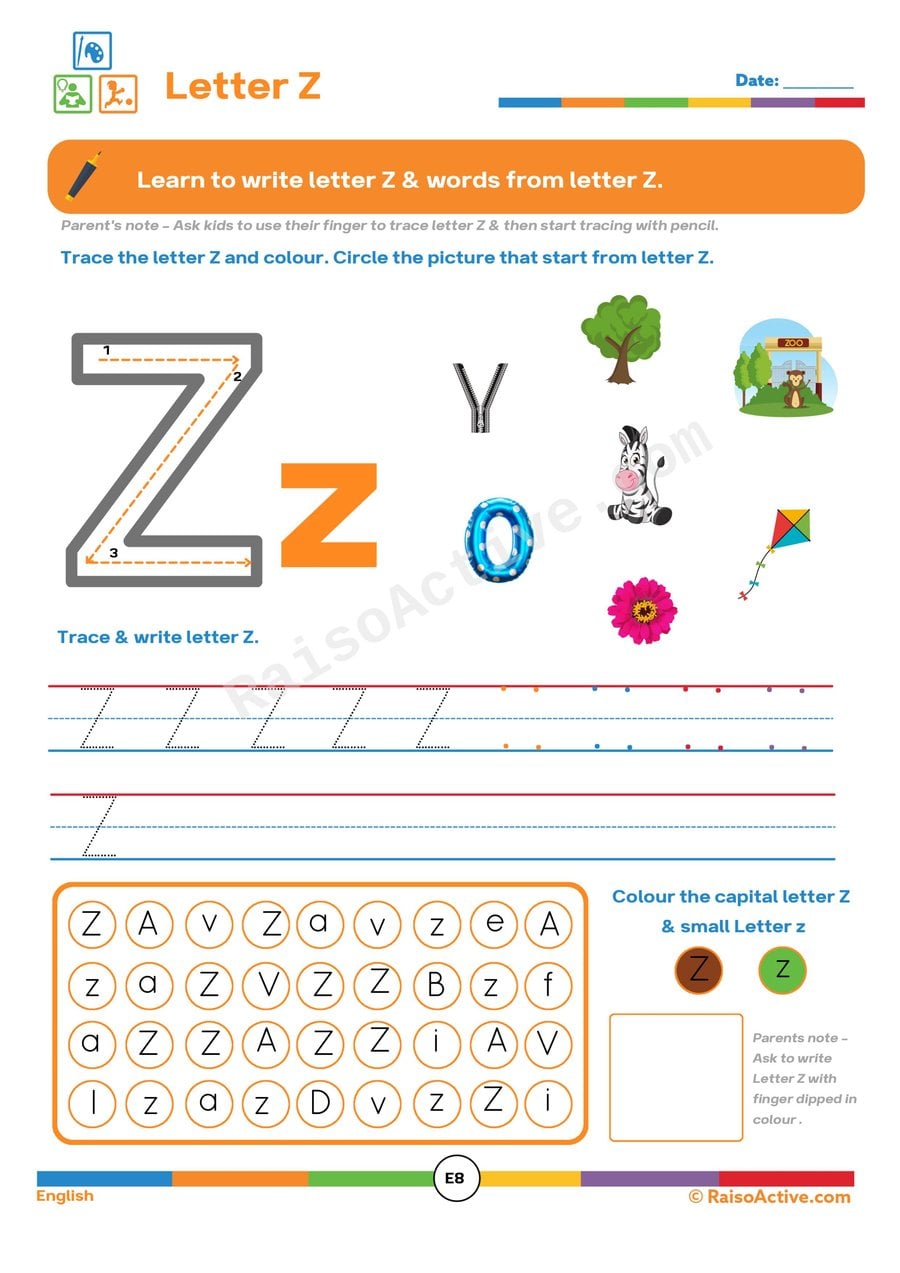
This worksheet helps children ages 3-5 learn to recognize and write the letter Z, both uppercase and lowercase, completing their practice of the full alphabet with one of its most visually distinct letters. Tracing Z's sharp diagonal stroke also gives practice with a different kind of pencil movement than the curves and loops used in many other letters.
Guides for this topic

Documenting Learning Without Drowning in Data: A Practical Guide for Parents and Teachers
Learn practical ways to document your child's learning without overwhelm. Simple portfolios, observation tips, and printable trackers for ages 1-8.

How to Help Your Child with Letter Reversals: A Complete Guide for Parents and Teachers
Letter reversals are normal until age 7-8. Learn the best multisensory strategies, anchor letter tricks, and activities to help children write b, d, p, and q correctly.

Activities That Help with Pencil Grip Development: A Complete Guide for Parents and Teachers
Discover fun, research-backed activities to develop pencil grip in young children. Age-wise exercises, play ideas, and expert tips for parents and teachers.
Reviews
Every worksheet for ages 3–5, no watermark
Members download the full library of 1,000+ worksheets and every activity pack without watermarks or daily limits. One year costs ₹999 in India or $20 elsewhere.
See membership plansOr download any worksheet free with a watermark (5 a day).