Free printable worksheets · United States
Pre-K Worksheets (Ages 4–5)
Pre-K worksheets are kindergarten-readiness practice sheets for children aged 4 to 5 in the year before kindergarten. They cover writing the child's first name, letter names and beginning sounds, rhyming, counting to 20, recognizing and writing numerals to 10, copying and extending patterns, and scissor and pencil skills, the areas most state pre-K standards address.
Pre-K is the bridge year. Every state publishes early learning standards or guidelines for four-year-olds, and programs funded through Head Start follow the Early Learning Outcomes Framework; together they describe a child who arrives at kindergarten able to write their name, name most letters and some sounds, hear rhymes, count to 20, and manage scissors and a pencil. The change from preschool is that four-year-olds can now sustain attention for ten minutes at a table, hold a pencil in a tripod grip, and hear the first sound in a word, which opens the door to real pre-reading and pre-math work. The worksheets on this page are sequenced toward kindergarten entry: name tracing first, then letters and sounds, then numbers to 20, patterns and cutting.
1952+ worksheets · free PDF download · print on A4 or Letter
Pre-K Worksheets to print
Browse all worksheets for ages 4–5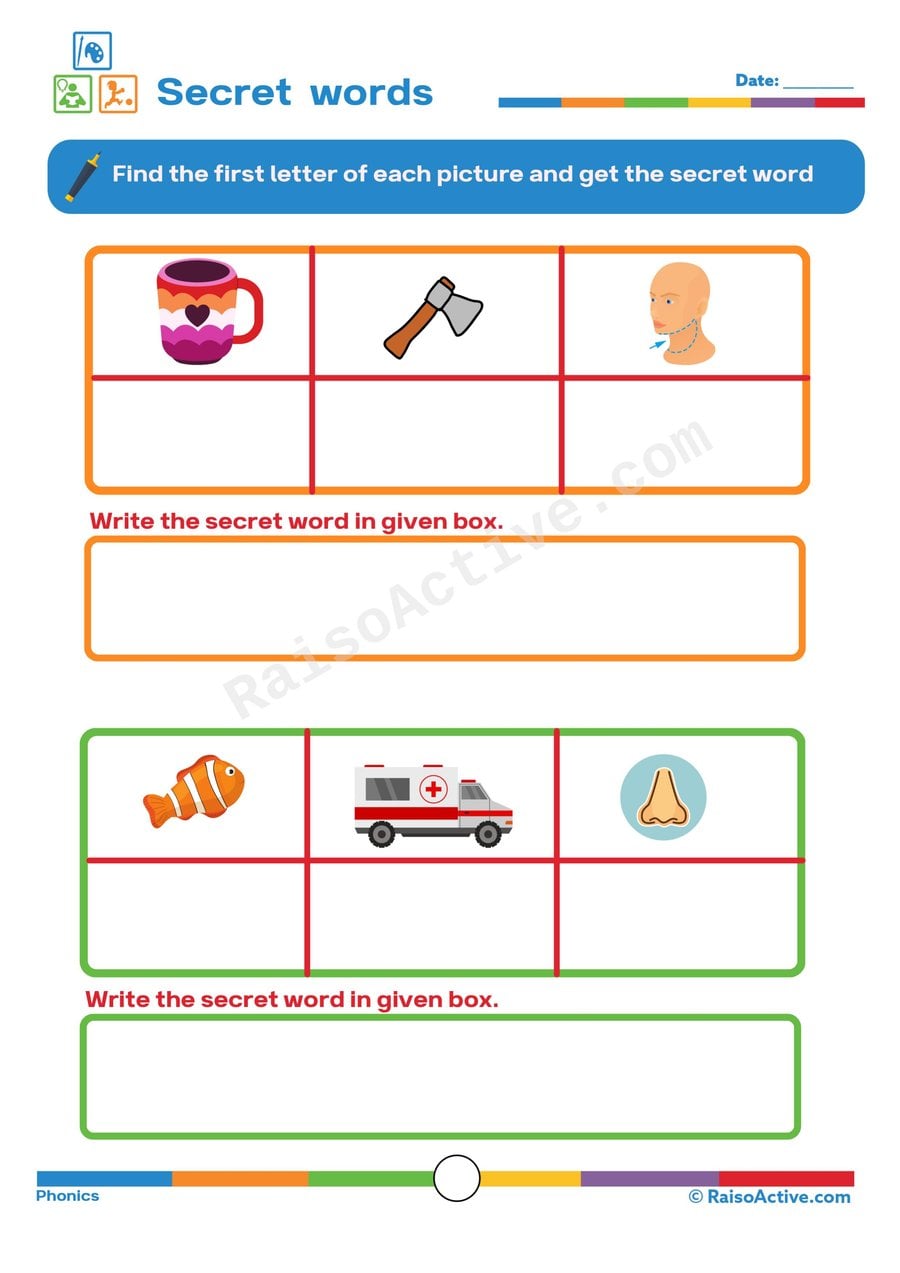
Secret Words Worksheet: Find the First Letter!
This beginning-sounds worksheet asks children ages 4-5 to listen closely to a series of pictures, name the very first sound in each word, and record the matching letter — a core phonemic awareness skill that precedes fluent reading. Because each correct letter contributes to spelling out a hidden 'secret word,' children get an immediate, motivating reason to focus on sound isolation rather than treating it as an abstract drill. This step also builds early spelling instincts, since children practice matching sound to symbol one letter at a time.

Alphabet Adventures: 'A' and 'B' Picture Sorting Worksheet
This worksheet strengthens phonemic awareness in children ages 4-5 by having them listen for and identify pictures whose names begin with the letters 'A' or 'B,' then sort them accordingly. Focusing on just two letters at a time, rather than the whole alphabet, gives children a manageable, focused way to practice isolating beginning sounds before tackling more letters.
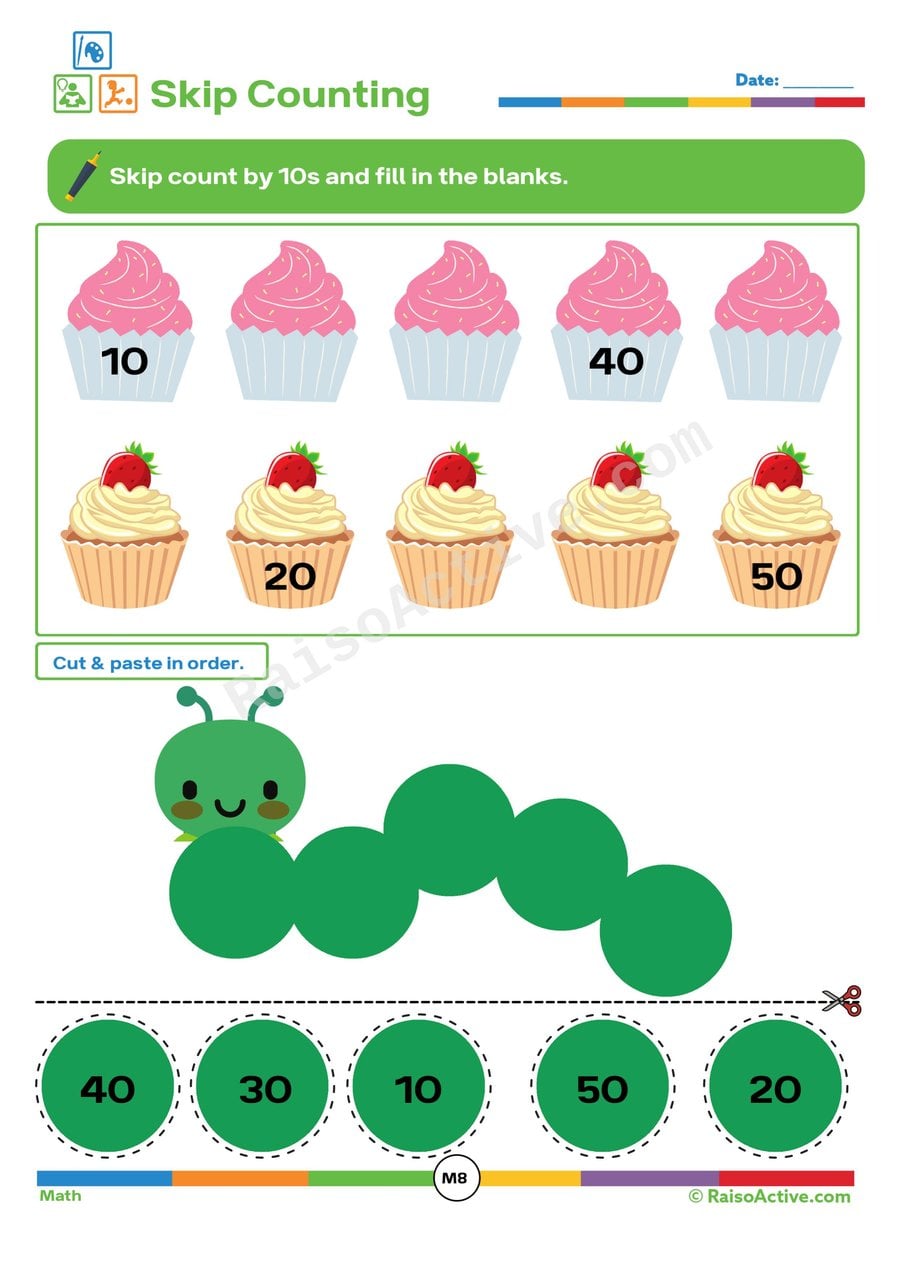
Skip Counting Cupcake Worksheet: Count by 10s!
This worksheet has children ages 4-5 fill in missing numbers while skip counting by tens, then cut and paste the numbers onto a caterpillar in the correct sequence. Skip counting by tens is a crucial stepping stone toward place value and mental math, since it helps children see numbers in efficient groups rather than counting one by one.
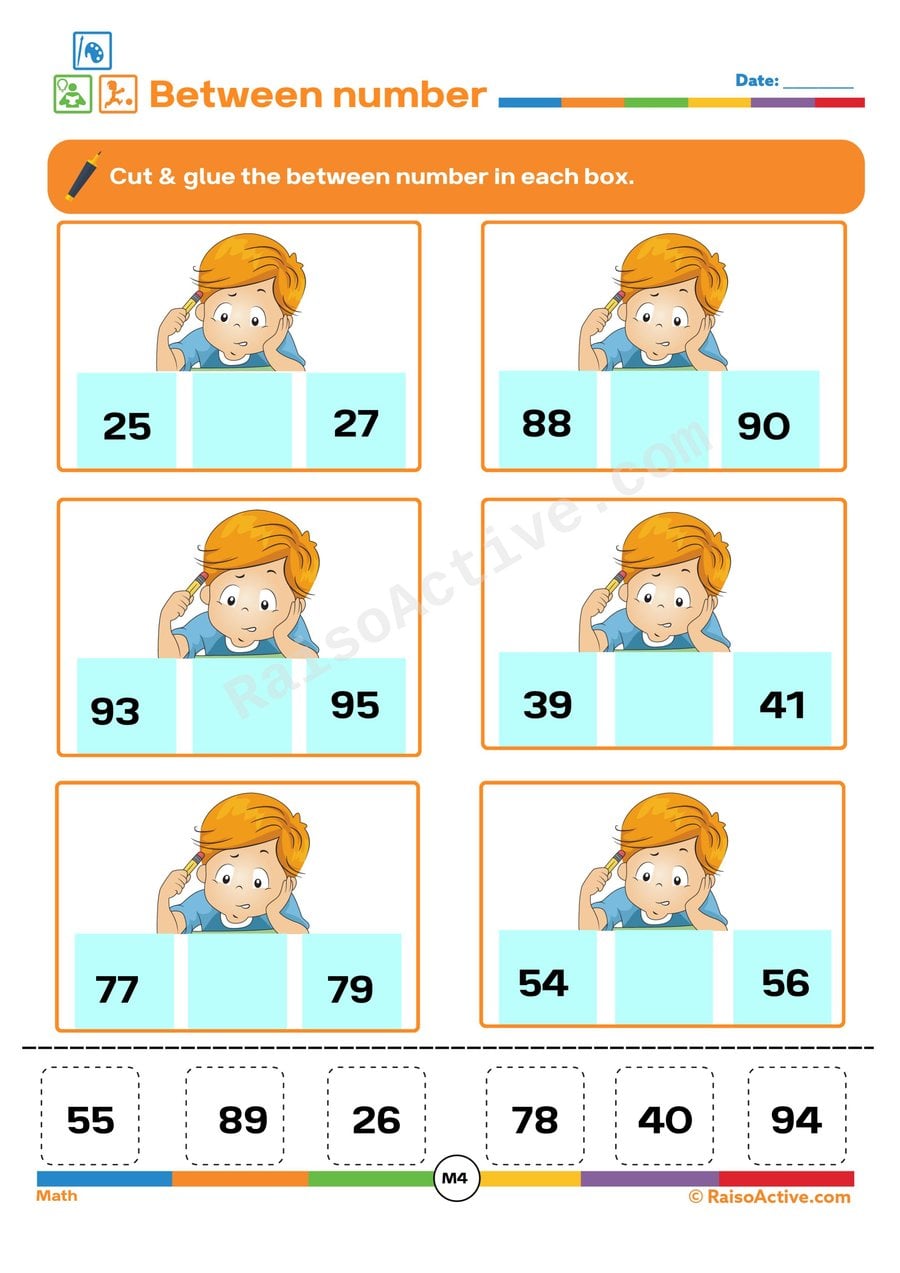
Find the Missing Number Worksheet for Kids
Children ages 4-5 strengthen number recognition and sequencing by figuring out which number is missing from a short sequence, then physically cutting and pasting the correct number into place. The cut-and-paste format adds a search-and-select step on top of the math, since children must locate the right numeral among several choices before placing it, reinforcing both number recognition and careful visual scanning.

Trace and Write Simple Sentences Worksheet for Preschoolers
Tracing and then writing simple sentences independently helps children ages 4-5 move beyond single-word and letter practice into connected writing, learning that words are separated by spaces and sentences follow a left-to-right flow. This step is an important bridge between early handwriting skills and functional written communication.
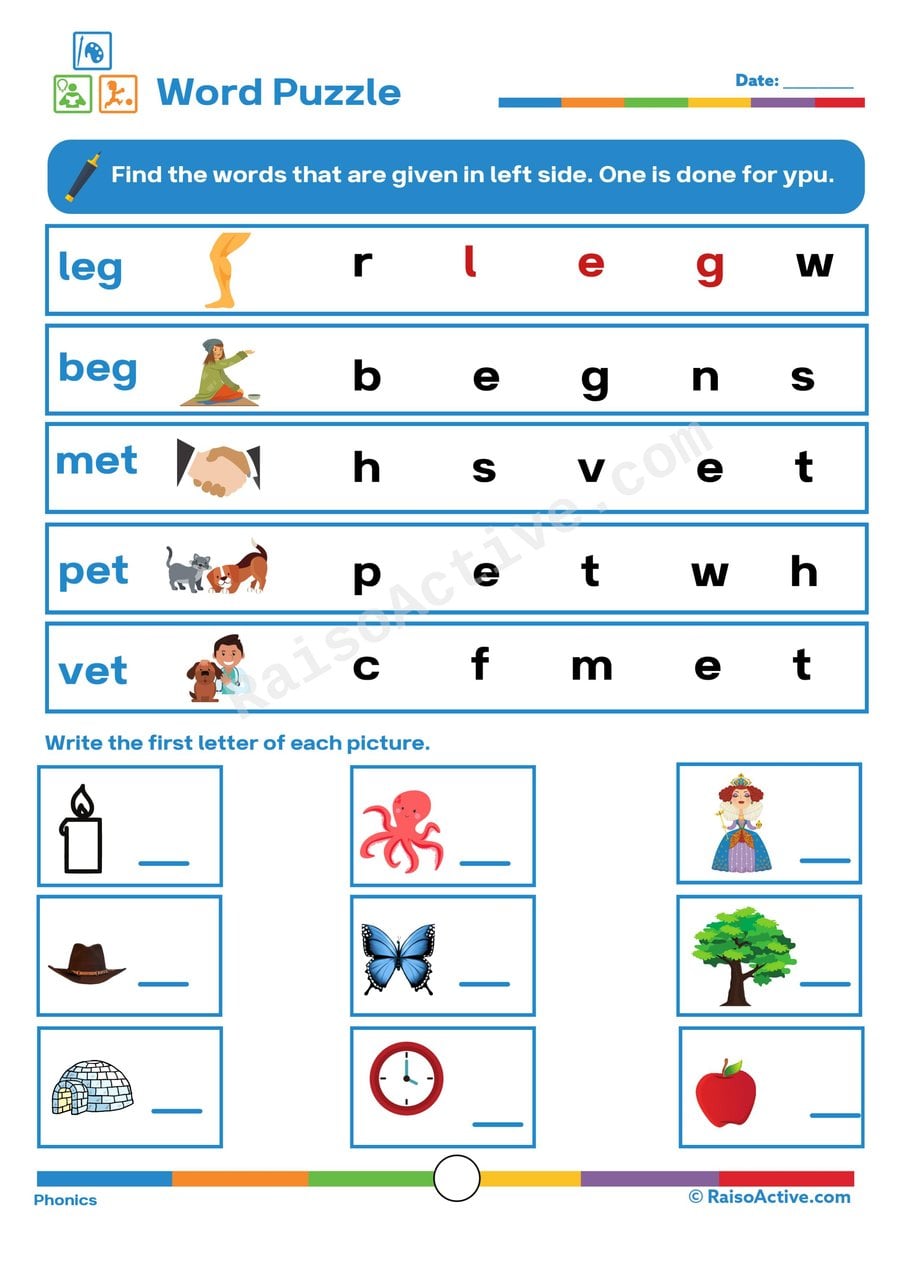
Word Puzzle Fun: Find and Write the First Letter!
This worksheet asks children ages 4-5 to locate hidden words in a picture puzzle and then identify and write the first letter of each corresponding picture, combining visual search skills with beginning-sound phonics. Searching a puzzle for target words builds visual scanning and attention, a skill that supports reading fluency later on, while writing the beginning letter reinforces the sound-to-symbol connection central to early spelling. Doing both together keeps young learners engaged while practicing two skills at once.
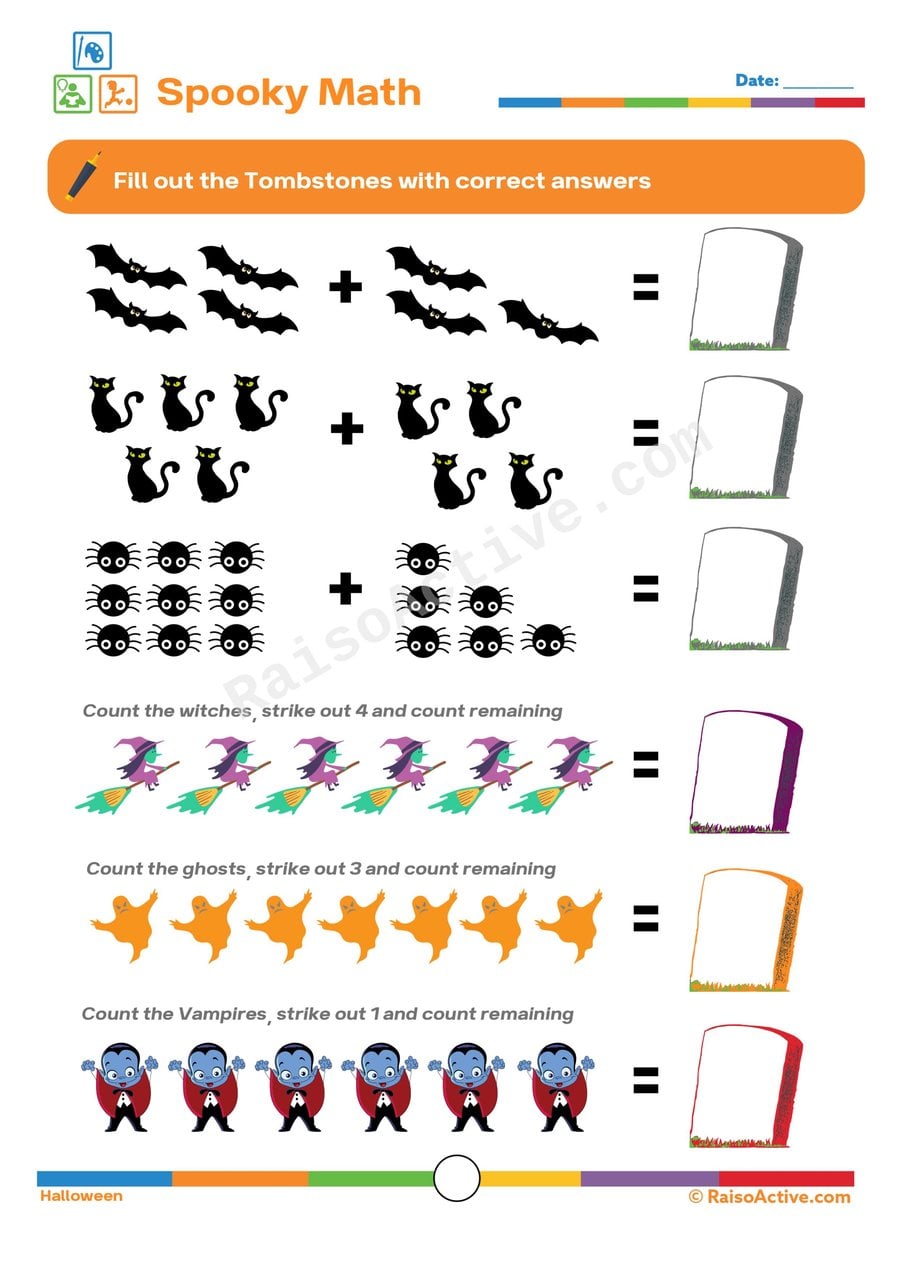
Spooky Math Worksheet: Halloween Counting Fun!
This Halloween math worksheet has children ages 4-5 count grouped pictures and then solve simple addition and subtraction problems, moving from concrete counting toward the more abstract skill of combining or taking away quantities. Writing each answer inside a tombstone shape keeps the seasonal theme playful while practicing genuine early arithmetic.

Learn the Sight Word 'Are' Worksheet for Preschoolers
Children ages 4-5 build instant recognition of the high-frequency sight word 'are', a word that doesn't sound out phonetically and must be memorized by sight to support reading fluency. This multi-step worksheet reinforces the word through five different modes — coloring, searching a grid, tracing, writing, and a watercolor technique — giving repeated exposure that strengthens memory. Practicing 'are' in context through fill-in-the-blank sentences also helps children see how the word functions within real sentences.

Number Sequence Worksheet: What Comes Before, After, and In Between!
Identifying numbers that come before, after, or in between a given number builds flexible number sequencing skills for children ages 4-5, going beyond simple forward counting to strengthen their overall sense of number order.

Trace and Count: Number 18 Worksheet for Preschoolers
This worksheet has children ages 4-5 trace the number 18 and then count and color a full set of eighteen hearts, continuing to build stamina for counting well into the teens range. Because eighteen is close to twenty, successfully counting this many objects without losing track shows real progress in sustained attention and one-to-one correspondence. Using hearts instead of a more neutral shape also adds a small, engaging visual theme to an otherwise repetitive counting task.
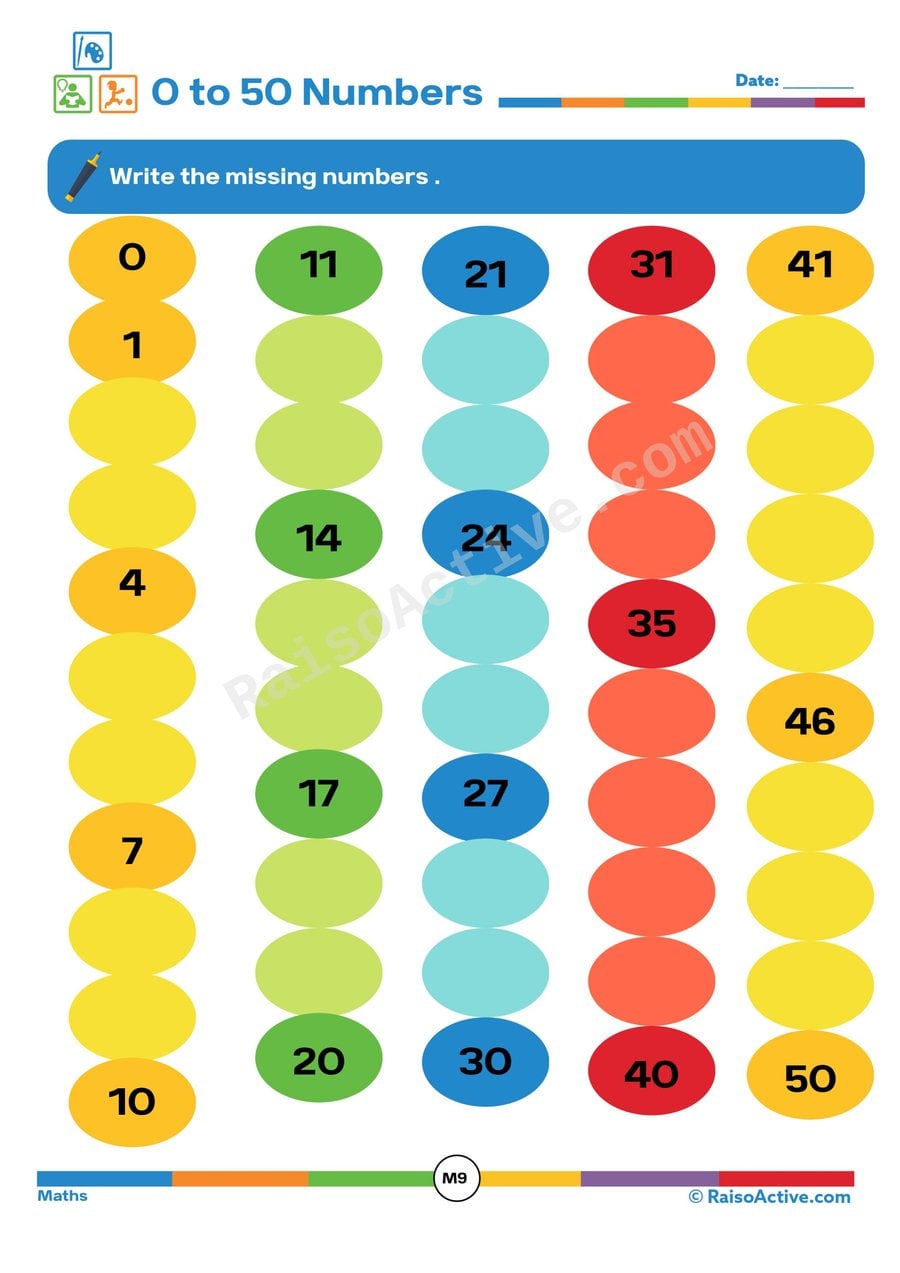
Missing Numbers Worksheet: 0 to 50
Filling in missing numbers across the 0-50 range asks children ages 4-5 to hold a much longer counting sequence in mind than typical 1-20 worksheets, strengthening both number recognition and the pattern sense needed to predict what comes next at any point in the range. This kind of extended practice also introduces children to the way numbers group into decades, like the 20s or 30s, which becomes important for later place-value understanding. Successfully completing a long sequence like this builds real counting stamina and confidence.
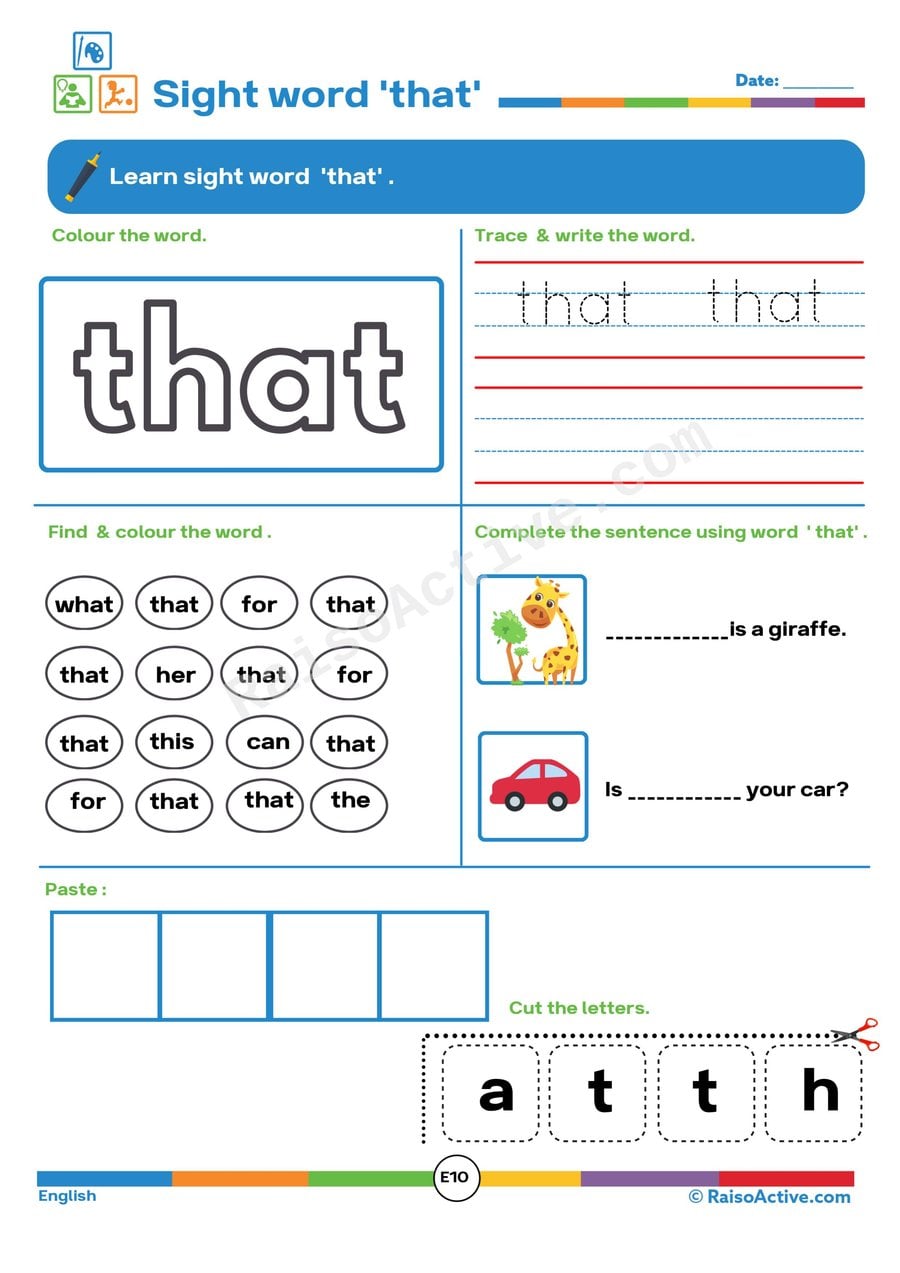
Sight Word 'That' Worksheet: Trace, Find, and Write!
As one of the most frequently used words in early reading texts, 'that' needs to be recognized instantly rather than sounded out letter by letter, and this worksheet gives children ages 4-5 several different ways to practice that recognition. Combining tracing, visual searching, sentence completion, and cutting letters to spell the word reinforces the same target through multiple senses and formats, which strengthens memory retention for tricky sight words.

Sight Word 'For' Worksheet: Learn to Read and Write!
The word 'for' appears constantly in early reading material but doesn't follow simple sound-it-out rules, so children ages 4-5 need repeated practice to recognize it instantly as a sight word. Working through tracing, a word search, and sentence completion in one sitting gives multiple angles of exposure, which research on early literacy shows helps cement tricky high-frequency words into memory.

Lowercase Letter Matching Worksheet for Preschoolers
This worksheet trains children ages 4-5 to connect an uppercase letter to its lowercase counterpart, a skill that's genuinely tricky since many lowercase letters look quite different from their capital form (like G and g, or Q and q). Matching cases correctly is essential groundwork for reading real books and sentences, which are written mostly in lowercase.

Number Tracing Worksheet: Trace and Count the Number 20!
This worksheet has children ages 4-5 trace the number 20, a milestone number that marks the top of the common preschool counting range, and then count and color a full set of twenty pentagons. Reaching and confidently counting to 20 shows that a child has built solid one-to-one correspondence across an extended set, a skill they'll rely on heavily once they begin adding and subtracting in early math. Counting pentagons instead of simpler shapes also gives a light introduction to five-sided shapes.

Trace and Count the Number 16 Worksheet for Preschoolers
This worksheet has children ages 4-5 trace the two-digit number 16 and then count and color a full set of sixteen squares, continuing to build counting stamina in the teens range that many children find more challenging than counting to 10. Because 16 combines a 1 and a 6, tracing it reinforces the same two-digit writing pattern practiced with numbers like 11 through 15, helping children generalize the pattern rather than treating each teen number as entirely new. Counting squares instead of round objects also quietly introduces basic shape vocabulary.

Superhero Grouping in Tens: A Fun Counting Worksheet for Preschoolers!
Using a superhero theme, this worksheet helps children ages 4-5 practice counting objects accurately and matching a counted group to its written number, an early step toward understanding place value through grouping in tens. Circling objects according to a given number afterward reinforces the connection between a numeral and the actual quantity it represents, rather than just reciting numbers in order.

Writing Number 6 Worksheet: Trace, Color, and Count!
This worksheet builds number 6 recognition for 4-5 year olds through tracing, coloring, and counting practice, connecting the written numeral to an actual quantity of objects your child counts aloud. Bringing formation, counting, and independent writing together in one page reinforces that '6' isn't just a shape to copy but represents a specific, countable amount, which is the real foundation of number sense.

Sight Word 'There' Worksheet for Preschoolers: Tracing, Coloring, and Sentence Building
Because 'there' can't be decoded using typical phonics rules and is easily confused with the similar-sounding 'their' and 'they're,' children ages 4-5 need repeated, varied exposure to memorize it as a sight word. Practicing it through coloring, tracing, searching, and sentence-building helps move the word from momentary recognition into automatic recall needed for fluent reading.

Small Letters Worksheet: Practice Writing Lowercase Letters!
Tracing and then independently writing lowercase letters helps children ages 4-5 move from guided hand motion to self-directed letter formation, a critical step toward legible, automatic handwriting. Pairing each letter with a picture also reinforces the letter-sound connection, so children are practicing both motor control and early phonics at the same time.
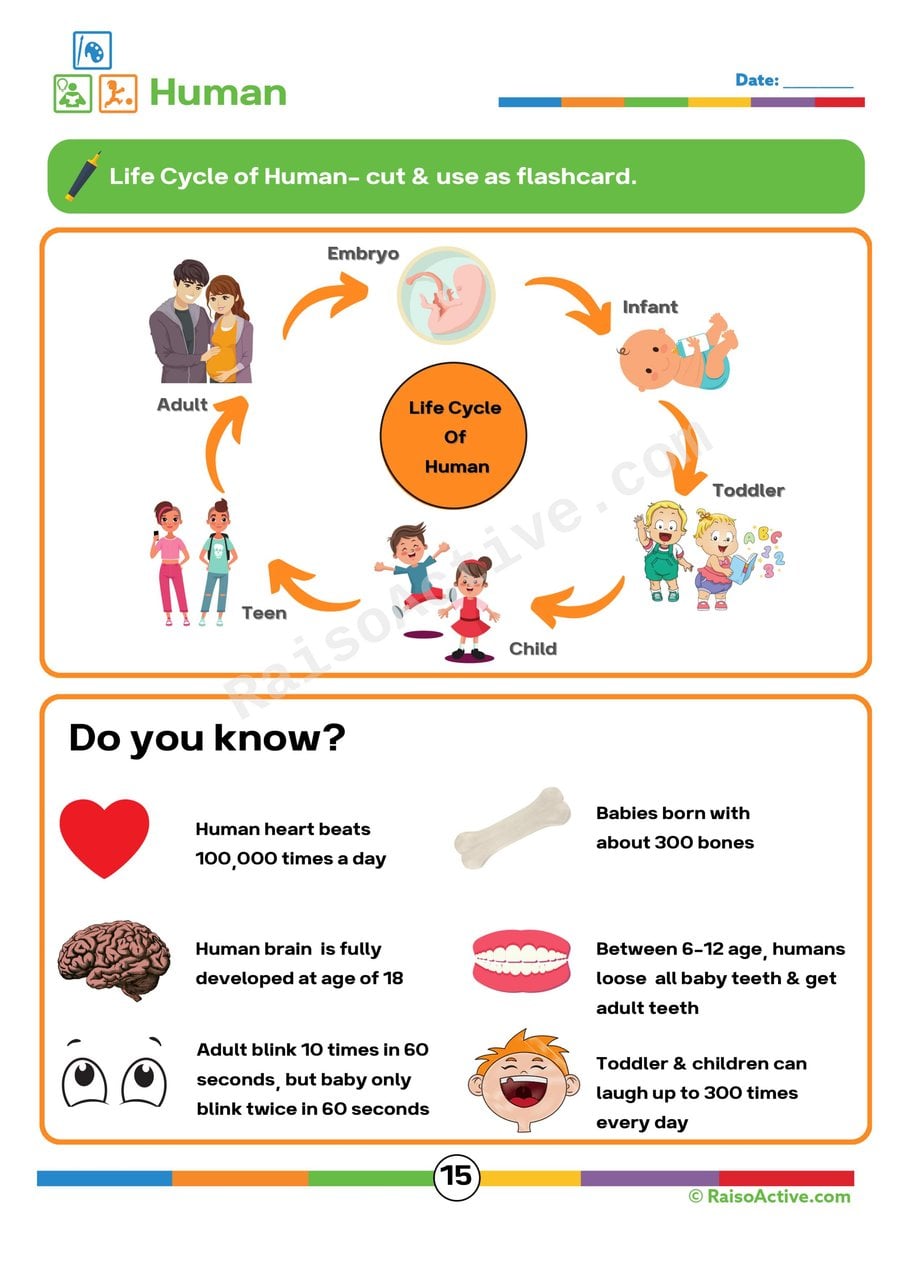
Human Life Cycle Flashcards for Kids
Children ages 3-6 explore the stages of human development — from embryo to infant, child, and adult — using flashcards that build both sequencing skills and personal understanding of growth. Because this topic relates directly to the child's own life, it offers a uniquely relatable entry point into the broader science concept of life cycles.
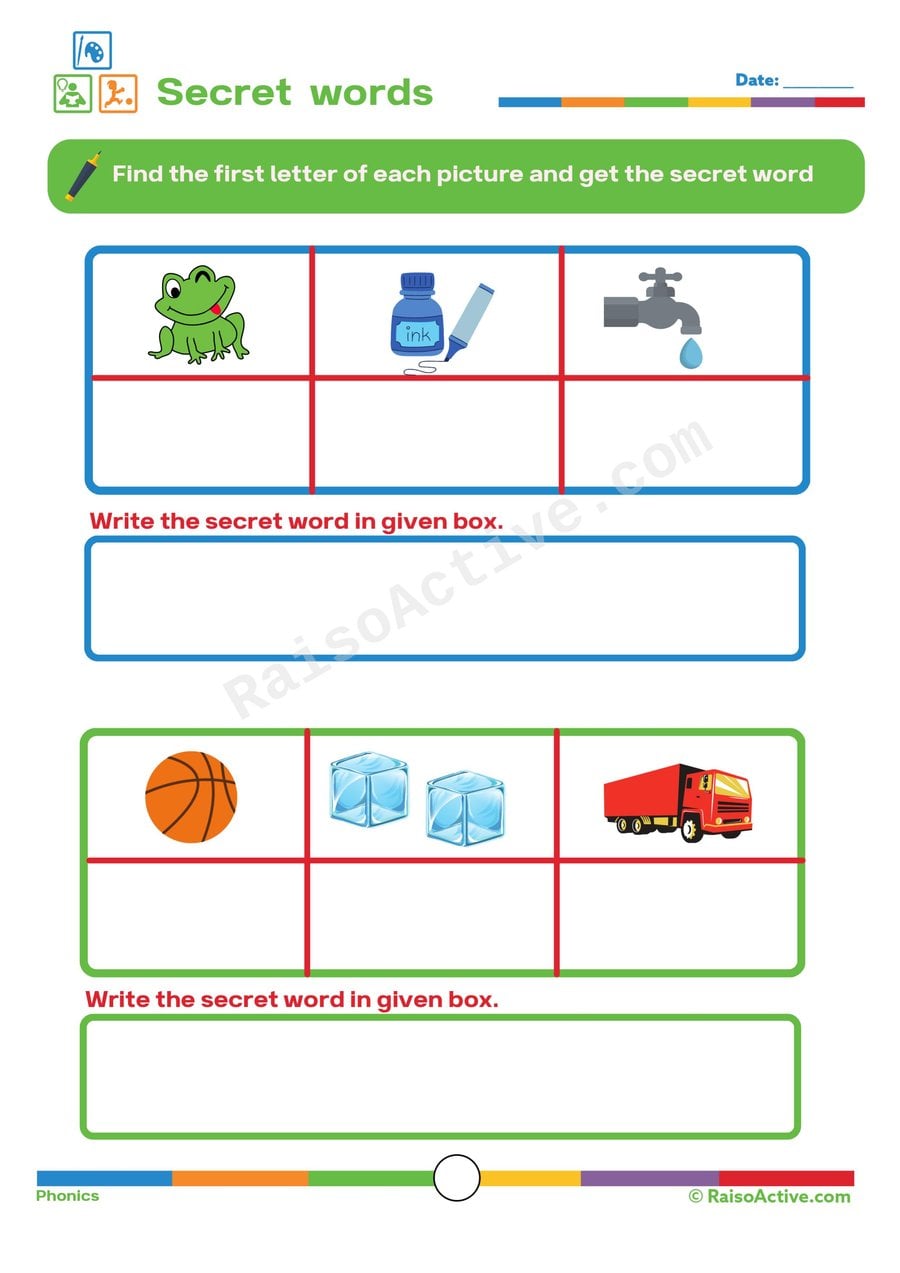
Secret Words Worksheet: Beginning Sounds Fun!
This version of the Secret Words activity challenges children ages 4-5 to identify the beginning sound of each picture and use that letter to help spell out a hidden word, reinforcing both phonemic awareness and early spelling skills. Because the task requires holding several letters in sequence before the full word appears, it also gently builds working memory alongside sound-symbol knowledge. This combination of skills is exactly what children need before they can spell simple words independently.
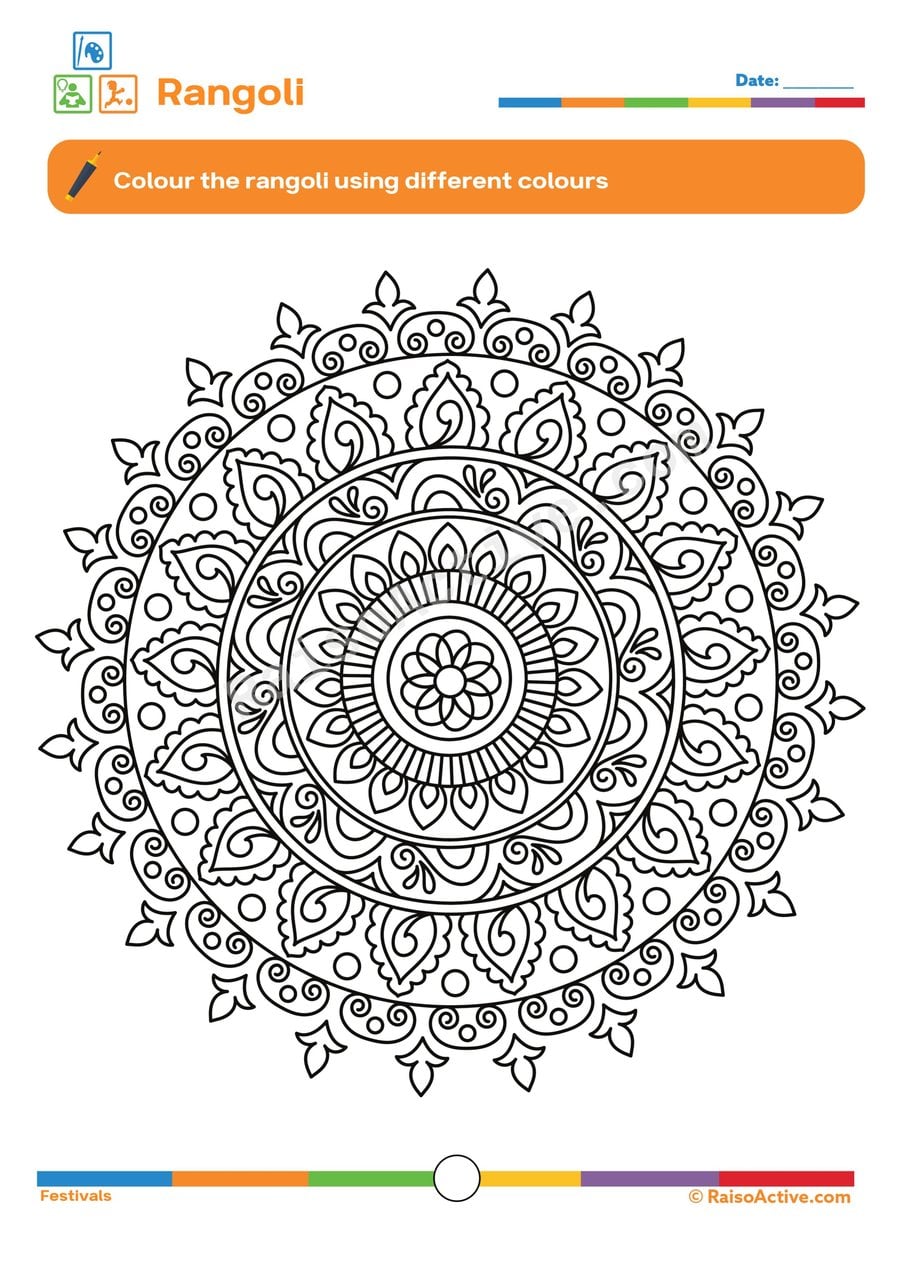
Rangoli Coloring Worksheet for Kids
Children ages 3-6 practice fine motor control and pattern following as they color a symmetrical rangoli design using multiple colors. Because rangoli patterns are built from repeating shapes, this activity also introduces early geometry and symmetry awareness in a hands-on, visual way.

CVC 'ig' Family Worksheet: Read and Reveal the Pictures!
This worksheet builds reading fluency for children ages 4-5 around the 'ig' word family, such as 'pig' and 'big', combining phonics practice with a self-checking cut-and-reveal format. Repeated exposure to the same word ending across several words trains children to recognize that chunk automatically, which is a key step toward reading words in whole units rather than sound by sound. The hidden picture reveal gives children a built-in way to confirm their own reading accuracy.
Kindergarten readiness skills
Kindergarten teachers consistently ask for the same things at entry, and they are not reading and arithmetic. They want children who can write their first name, recognize most uppercase and many lowercase letters, know some letter sounds, count to 20 and count out 10 objects, recognize numerals to 10, copy an AB pattern, use scissors, and follow a two-step direction. Pre-K worksheets target each of these.
- Literacy: name writing, uppercase and lowercase letter matching, beginning sounds, rhyming pairs
- Math: counting to 20, one-to-one counting to 10, numeral recognition and writing to 10, AB and ABC patterns, shapes
- Fine motor: tracing lines and curves, cutting on a line, gluing, dot-to-dot
- Thinking: sorting by attribute, same and different, what comes next, simple mazes
How to use Pre-K worksheets at home
Ten minutes a day is plenty, and consistency matters more than length. Start with name tracing, because a child who can write their name gains confidence quickly and uses it on every sheet after that. Say letter sounds as well as names when you trace, and count out loud, touching each object. Keep a pair of child scissors and a glue stick with the printouts so cutting practice happens weekly. Finished sheets on the fridge are a real motivator at four.
Common difficulties at four
Reversed letters and numbers, especially b, d, s, 3 and 5, are normal at this age and usually resolve by seven. A fist grip on the pencil is worth correcting gently with a short pencil or a triangular one. Children who skip numbers when counting past 12 (the teens are irregular in English) need more counting out loud, not more worksheets. Refusing to trace is often a sign the sheet is too small; try larger versions and shorter sessions.
Frequently asked questions
What should a child know before starting kindergarten?
Most kindergarten readiness checklists, and state pre-K standards, expect a child to write their first name, recognize most letters and some of their sounds, count to 20 and count 10 objects accurately, recognize numerals to 10, know basic shapes and colors, use scissors, hold a pencil correctly, follow two-step directions, and manage toileting and dressing. Reading is not expected at kindergarten entry.
What is the difference between Pre-K and preschool?
Preschool generally serves three-year-olds and focuses on routines, language, play and motor skills. Pre-K is the year before kindergarten, usually for four-year-olds, and follows state early learning standards that lead into the kindergarten curriculum: letter sounds, counting to 20, name writing and early pattern work. Many programs offer both, and public pre-K is free in a growing number of states and districts.
How many letters should a 4-year-old know?
By the end of Pre-K many children recognize most uppercase letters and a good number of lowercase ones, and know the sounds of several, but the range is wide and none of this is required for kindergarten entry. A reasonable goal is the letters in the child's own name plus a growing set learned one or two a week. Recognition, then sounds, then writing is the usual order.
Should a Pre-K child be able to write their name?
Writing their first name is the single most common expectation on kindergarten readiness lists, so it is worth practicing in Pre-K. Most four-year-olds can copy or trace their name with an uppercase first letter and lowercase letters after it, even if the letters are large and uneven. Start with tracing, move to copying under a model, then to writing from memory.
What is the Head Start Early Learning Outcomes Framework?
The Head Start Early Learning Outcomes Framework (ELOF) describes what children from birth to five are expected to know and do across five domains: approaches to learning, social and emotional development, language and literacy, cognition, and perceptual, motor and physical development. Head Start programs must use it, and many state pre-K standards are aligned to it. It is a set of goals, not a curriculum or a test.
Are Pre-K worksheets free to download?
Yes. Once you have a free account, every Pre-K worksheet downloads as a watermarked PDF, with a cap of five downloads a day. An annual subscription removes the watermark and the limit across the full library of over 1,000 worksheets and all printable activity packs. Sheets are formatted to print on US Letter or A4.

Written by
Hemsweta Jain · Teacher Cheena
MBA and Early Childhood Educator, teaching since 2014 · Founder of RaisoActive, Mumbai
Written and reviewed by Hemsweta Jain (Teacher Cheena), who designs every RaisoActive worksheet.
Last reviewed
Printable packs for ages 4–5
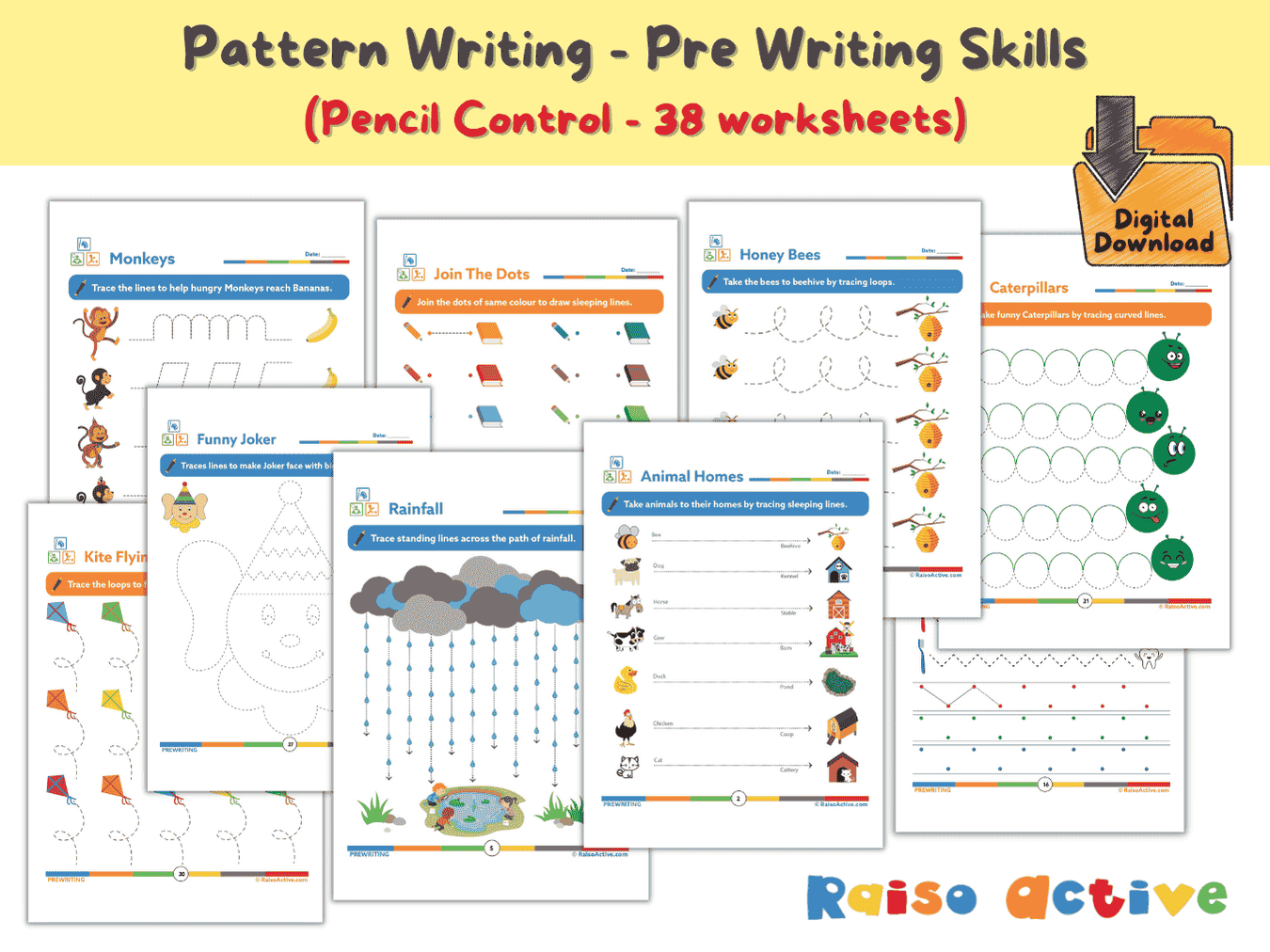
Pattern Writing Pre-writing Skills Activity Book for 3-4 Year Olds
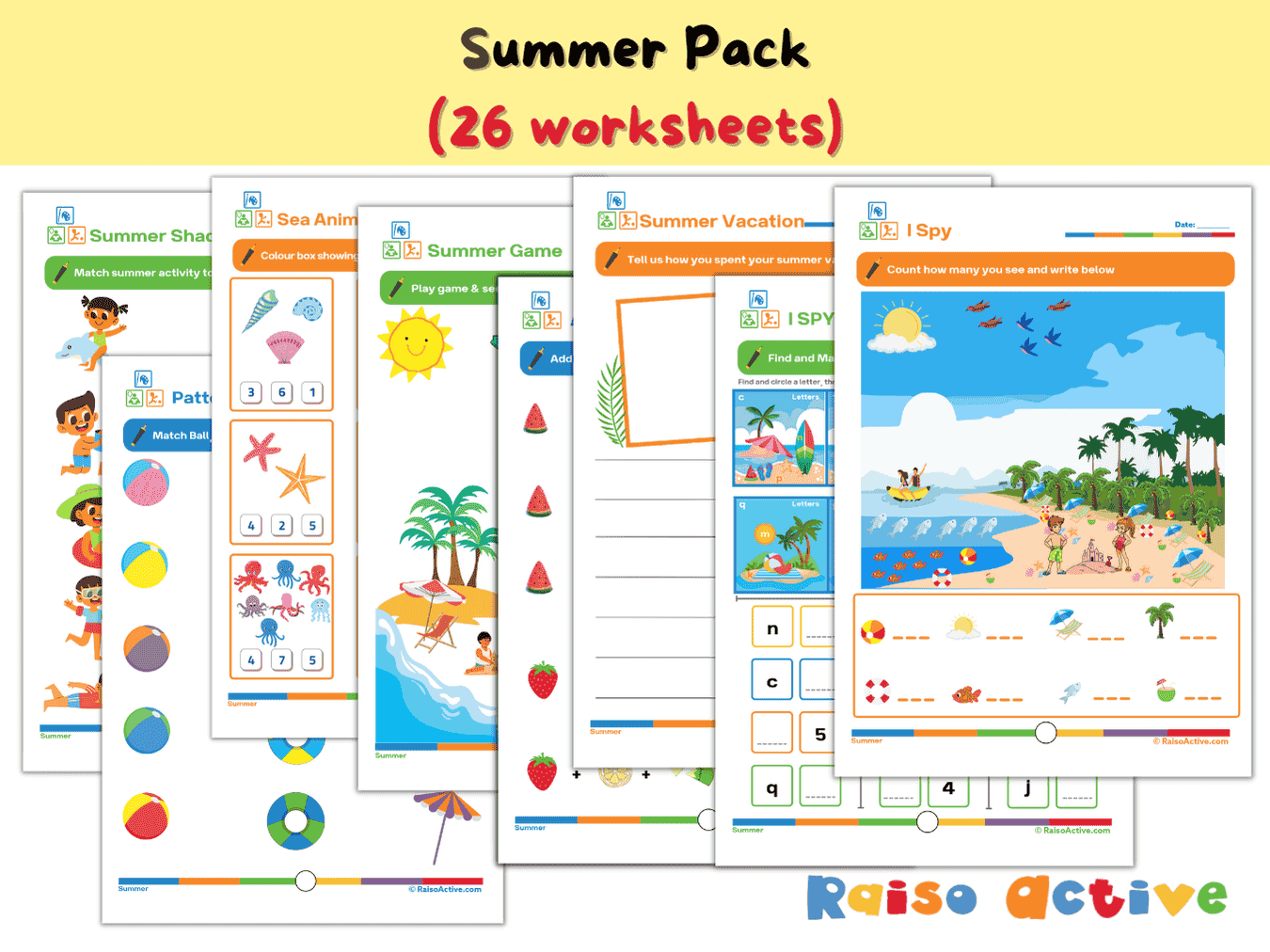
Summer Activity Pack: Math, Literacy, Puzzles & More for Preschool & Kindergarten
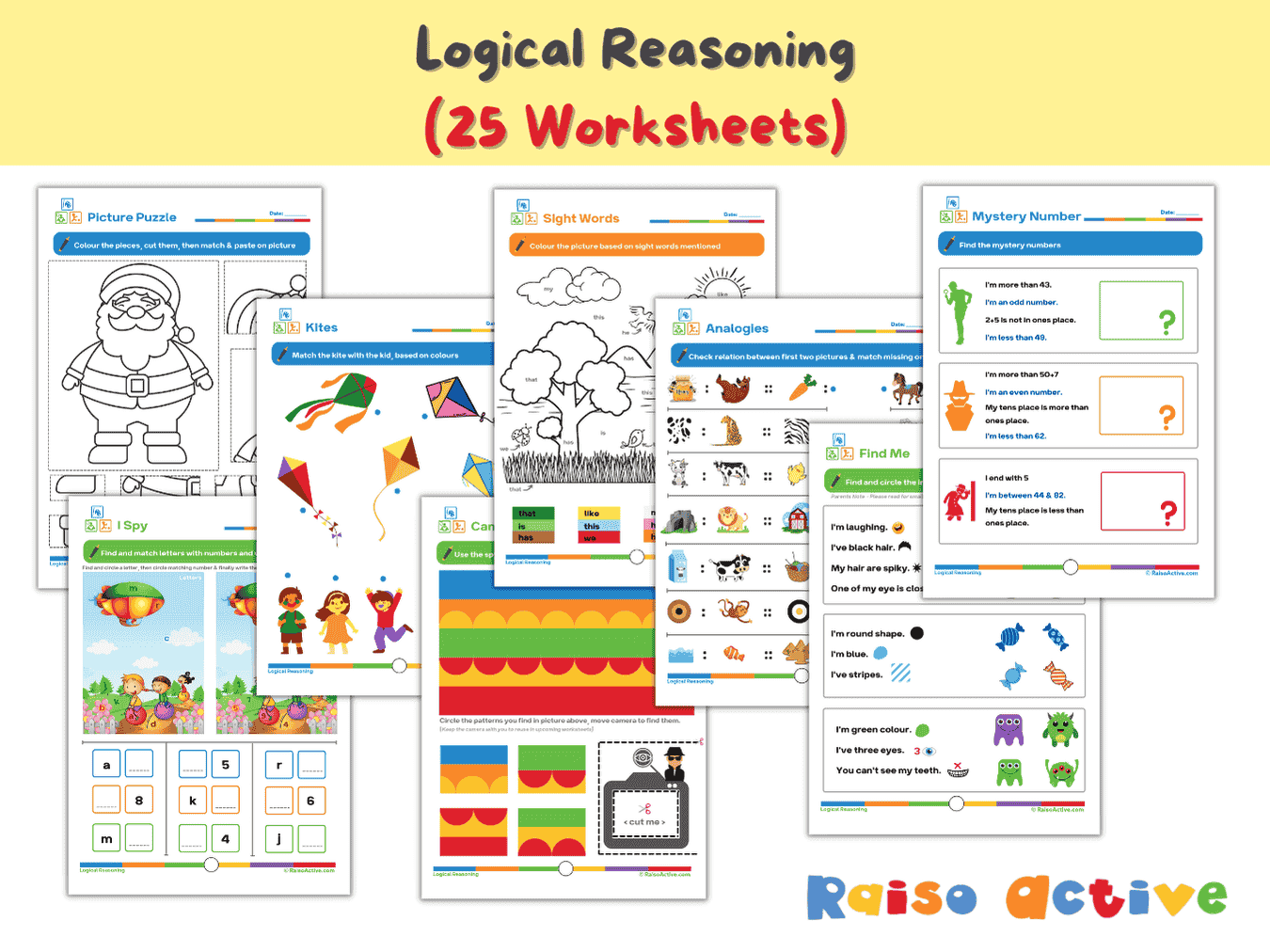
Logical Reasoning Activity Book for Preschool & Kindergarten | Patterns, Puzzles & Analogies
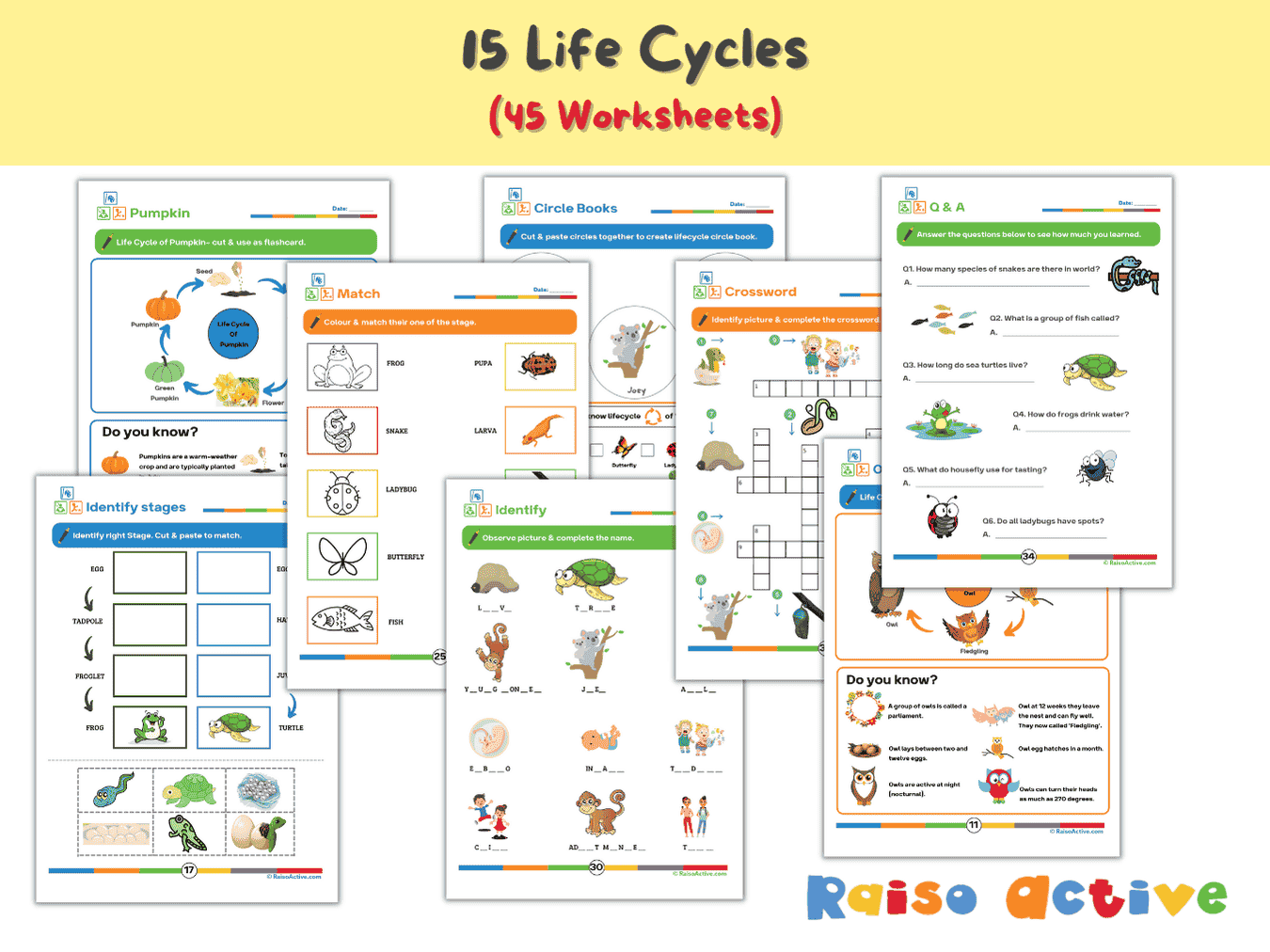
Lifecycles Activity Book & Flashcards for Preschool & Early Elementary
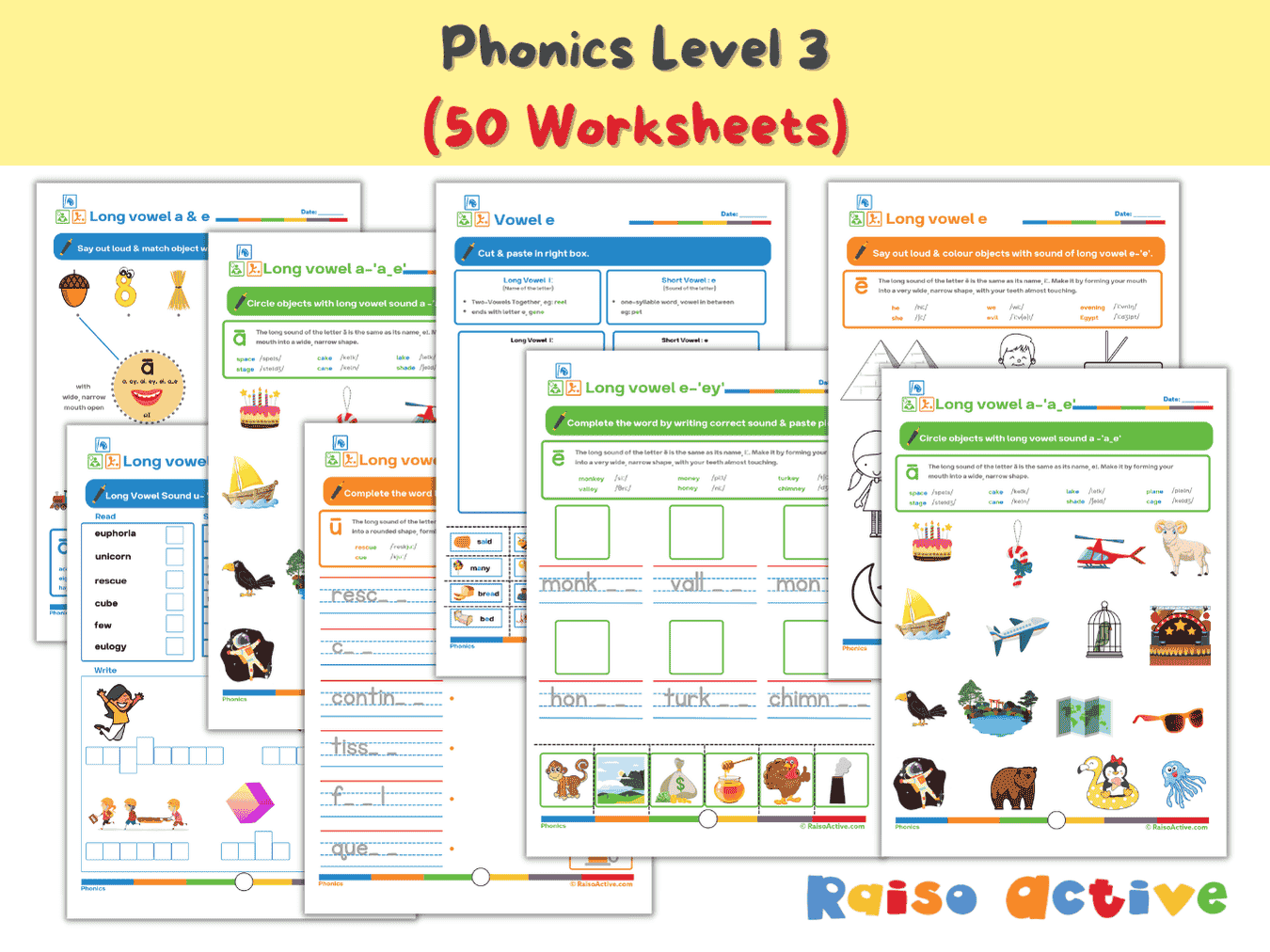
Phonics Level 3 Long Vowels Activity Book for Kindergarten & 1st Grade
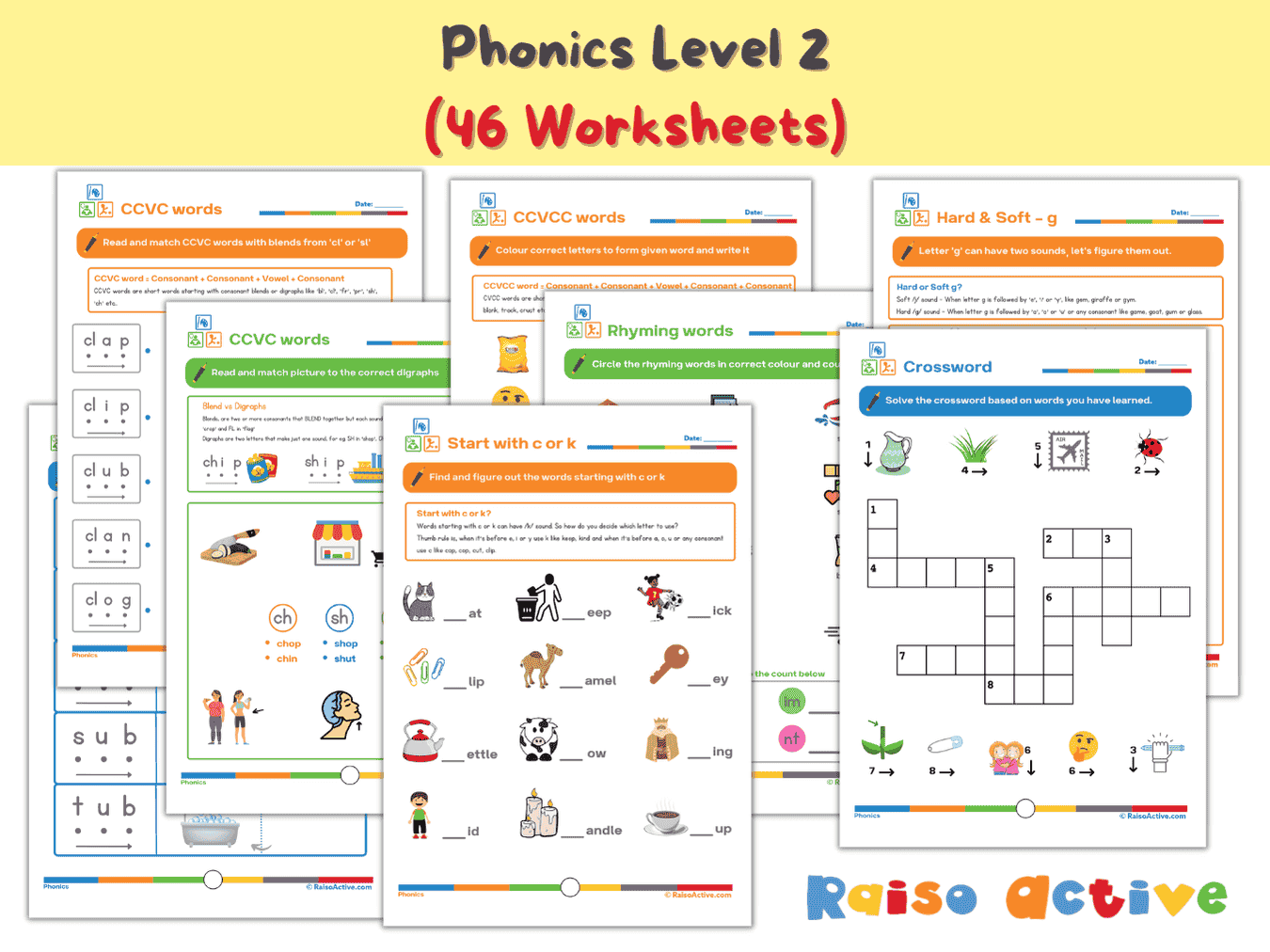
Phonics Level 2 Worksheets: CVC, CCVC, CVCC Word Families & Blends for Early Readers (Ages 4-7)
Guides for parents and teachers
See all guides →Sight Words by Age: The First 50 Words and How to Teach Them Without Flashcard Fatigue
Which sight words to teach first and why, the heart-word method, a read-trace-write-find routine, games, and a by-age table of typical sight-word progress.
Number Formation Rhymes 0–9 and How to Fix Reversals
Original number formation rhymes for 0–9, the correct stroke order for each digit, why 3, 5 and 7 get reversed most often, and multisensory fixes that work.
Pre-Writing Strokes in Order: From Standing Lines to Loops (With Printable Patterns)
The developmental order of pre-writing strokes, from vertical lines to loops, and why practicing them in sequence makes letter formation much easier to learn.
Kindergarten Readiness Checklist: 25 Skills to Practice Before the First Day
A kindergarten readiness checklist of 25 literacy, math, motor, self-regulation and self-help skills, with an 8-week summer plan and notes on when not to worry.
Best Worksheets for 3-Year-Olds: What Works and What to Avoid
What works on worksheets for 3-year-olds: short sessions, crayons, tracing lines, matching, cutting, a free weekly plan, and signs one is too advanced.
Phase 2 Phonics at Home: Sound Order, Blending Games, Worksheets
Phase 2 phonics at home: the five sound sets in order, oral blending, tricky words, a two-week routine, common mistakes, and free worksheets.
Canonical: https://raisoactive.com/worksheets/pre-k