Alphabet Adventures: 'A' and 'B' Picture Sorting Worksheet
This worksheet strengthens phonemic awareness in children ages 4-5 by having them listen for and identify pictures whose names begin with the letters 'A' or 'B,' then sort them accordingly. Focusing on just two letters at a time, rather than the whole alphabet, gives children a manageable, focused way to practice isolating beginning sounds before tackling more letters.
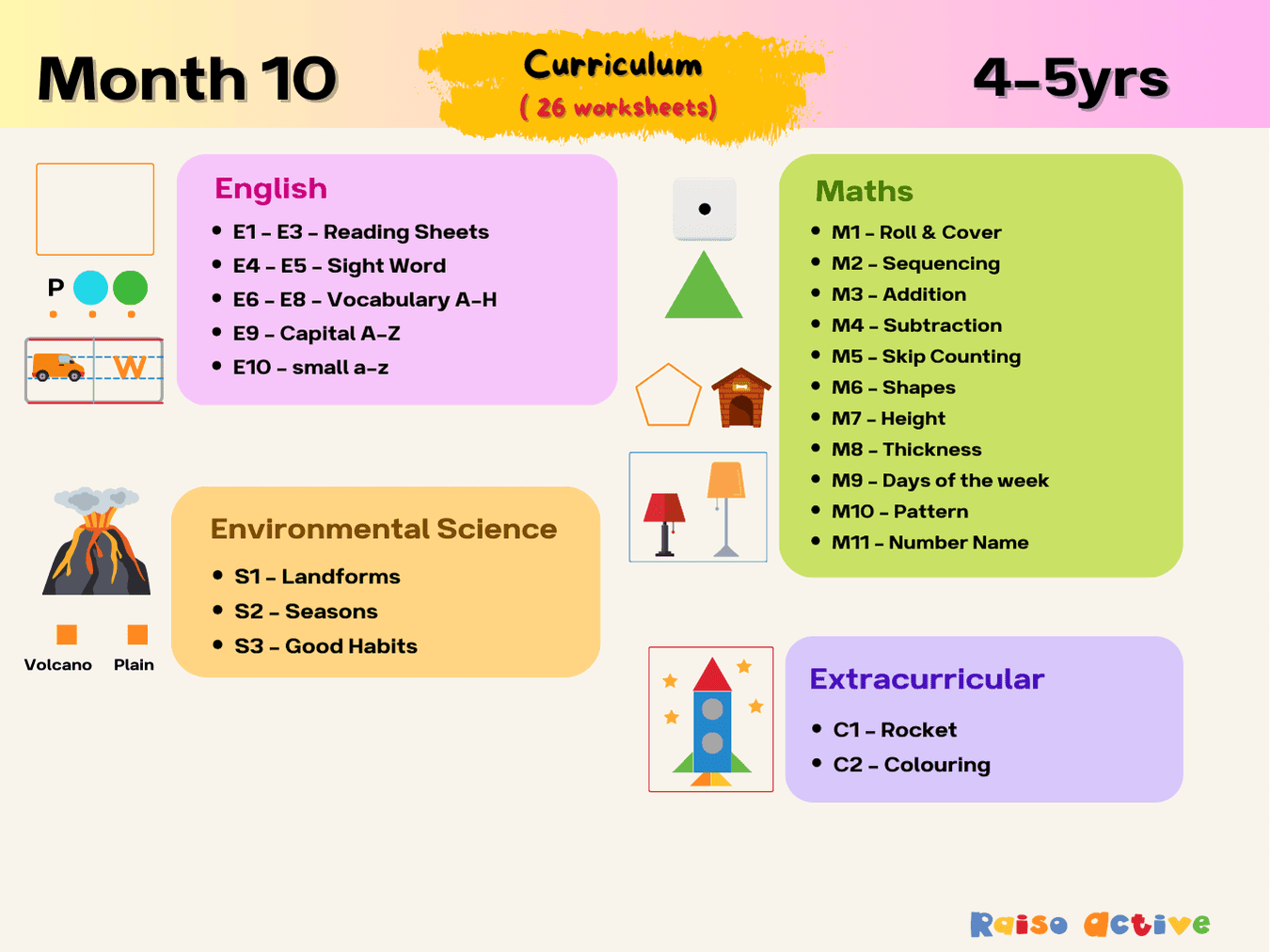
Part of the pack
Month 10: Learning & Development | Ages 4-5
This is page 9 of the pack. Ages 4-5 · Pre-KAges 4-5 · ReceptionAges 4-5 · LKGAges 4-5

Made for your child
Numbers to 20, made for your child
A maths pack with your child's name in it: pictures that explain, practice at three levels, puzzles and story sums about them. Print a new set whenever they finish.
Make a maths packFree preview · free for members
Curriculum
- Phonics - Letter Sounds > Beginning Sounds
How to use this worksheet
Look at the first section of pictures together and say each one's name slowly, listening for whether it starts with the 'Aa' sound. Have your child circle every picture that starts with 'A' before moving to the second section, where they'll do the same for pictures starting with 'Bb.' Encourage your child to say each word out loud before deciding, rather than guessing from the picture alone, and review their circled choices together at the end.
Materials needed
- Pencil
- Crayons
Extension activities
- 1Have the child name other words that start with 'A' and 'B' from around the house.
- 2Cut out the pictures and physically sort them into two piles labeled 'A' and 'B.'
- 3Play an 'A or B' guessing game, saying a word aloud and having your child decide which letter it starts with.
- 4Create a simple scrapbook page for each letter, adding new pictures that start with 'A' or 'B' throughout the week.

Written by
Hemsweta Jain · Teacher Cheena
MBA and Early Childhood Educator, teaching since 2014 · Founder of RaisoActive, Mumbai
Every RaisoActive worksheet is designed and checked by the founder before publishing.
Published · Last reviewed
More from Month 10: Learning & Development | Ages 4-5

Small Alphabet Writing Worksheet: Before, Between, and After
Ages 3-5 · Preschool–Pre-KAges 3-5 · Nursery–ReceptionAges 3-5 · Nursery–LKGAges 3-5
Children ages 3-5 practice recalling the fixed order of the alphabet by writing the small letter that comes before, between, or after given letters, a skill that goes beyond simply reciting the alphabet song and requires genuine understanding of letter sequence. This kind of targeted recall practice helps children build the alphabet knowledge needed for using dictionaries, alphabetized lists, and smooth handwriting flow later on.

Read and Circle: Matching Sentences to Pictures Worksheet
Ages 4-5 · Pre-KAges 4-5 · ReceptionAges 4-5 · LKGAges 4-5
Children ages 4-5 build reading comprehension by reading a short, simple sentence and then identifying which of several pictures actually matches its meaning, rather than just decoding words in isolation. This step — connecting written language back to a real scene — is what separates true reading comprehension from mechanical word-calling, making it an important milestone activity for early readers.
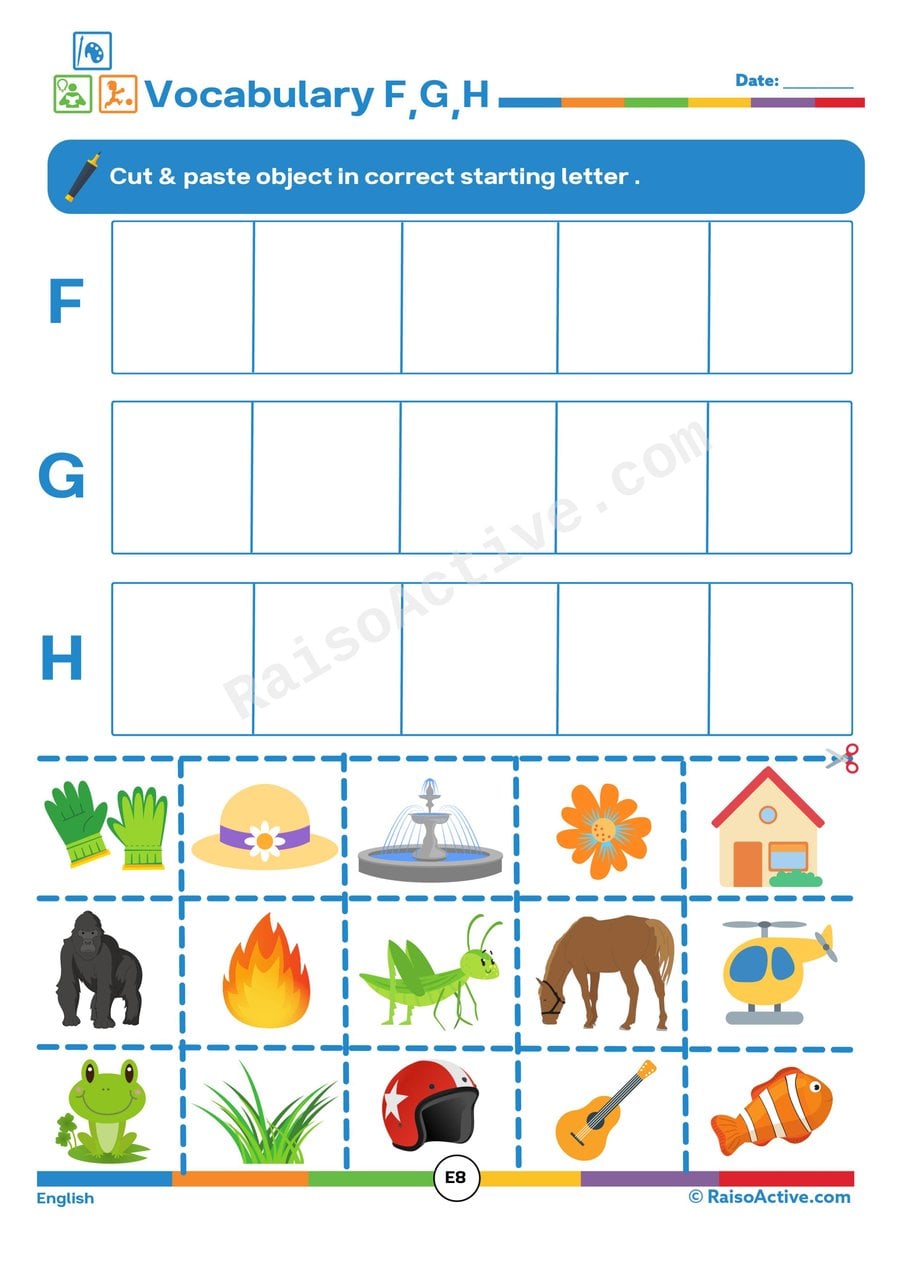
F, G, H Letter Sounds Cut and Paste Worksheet
Ages 4-5 · Pre-KAges 4-5 · ReceptionAges 4-5 · LKGAges 4-5
This worksheet builds phonemic awareness in children ages 4-5 by asking them to isolate the beginning sound of each picture and sort it under the correct letter — F, G, or H. Sorting across three letters at once, rather than just one, requires children to hold multiple sound-letter associations in mind and choose between them, which is a step up in difficulty from single-letter worksheets. This kind of comparative sound-sorting strengthens the phonics foundation needed for early reading.

Sight Words Coloring Worksheet: 'His', 'My', and 'Her' Fun!
Ages 3-5 · Preschool–Pre-KAges 3-5 · Nursery–ReceptionAges 3-5 · Nursery–LKGAges 3-5
This coloring activity helps children ages 3-5 recognize and internalize the common sight words 'his,' 'my,' and 'her' by following a color-coded key, an approach that builds sight word memory through repeated visual association rather than isolated flashcard drilling. Because sight words like these don't sound out easily using phonics rules, repeated exposure in a fun context like coloring is one of the most effective ways for young children to memorize them. The activity also reinforces fine motor control as children carefully color within the lines of each labeled section.
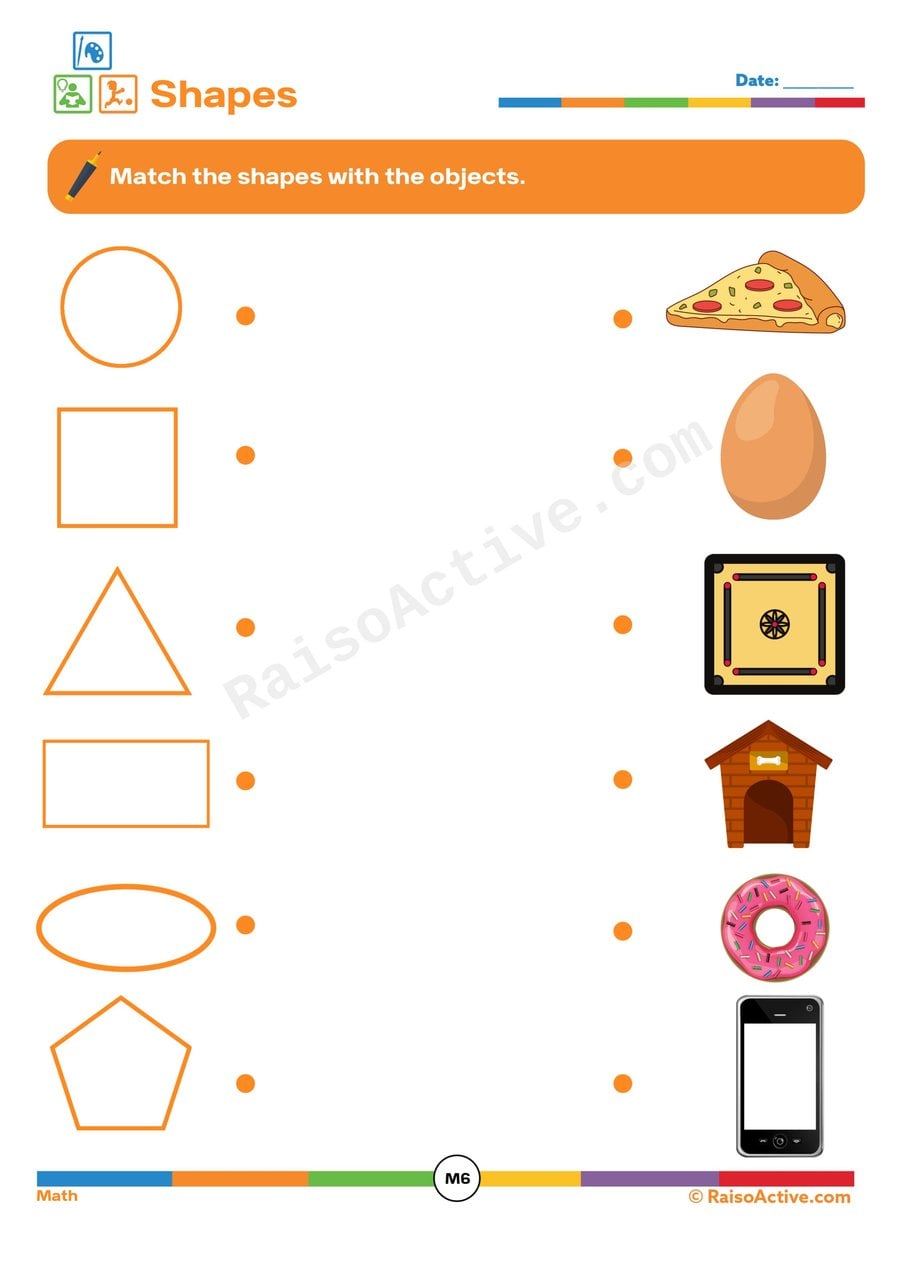
Shape Matching Worksheet for Preschoolers
Ages 3-5 · Preschool–Pre-KAges 3-5 · Nursery–ReceptionAges 3-5 · Nursery–LKGAges 3-5
This worksheet strengthens shape recognition for children ages 3-5 by asking them to connect abstract shape outlines to the real-world objects that share that same shape. Recognizing that a shape like a circle or rectangle can apply to very different objects, such as a clock and a door, helps children generalize shape concepts beyond a single example. Drawing the connecting line between matched pairs also reinforces visual tracking and pencil control.

Parent's Guide: Fun Activities for Early Learning
Ages 3-5 · Preschool–Pre-KAges 3-5 · Nursery–ReceptionAges 3-5 · Nursery–LKGAges 3-5
This parent guide equips caregivers of children ages 3-5 with structured activity ideas around three early-learning concepts: recognizing the days of the week, identifying patterns, and practicing skip counting. Each activity translates an abstract concept into a hands-on or playful format, since young children learn these ideas best through repetition embedded in daily routines rather than worksheets alone. Covering multiple concepts in one guide also gives caregivers flexibility to pick the activity that fits their child's current interest.

Addition Fun: Count and Add the Pictures Worksheet!
Ages 4-6 · Pre-K–KindergartenAges 4-6 · Reception–Year 1Ages 4-6 · LKG–UKGAges 4-6
Counting two separate groups of pictured objects and combining their totals introduces children ages 4-6 to the core concept of addition as joining quantities together, before they ever see an addition sign written out. Writing the final sum in the answer box connects this hands-on counting process to numeral writing, reinforcing that a math answer is a specific, countable quantity rather than an abstract symbol. This picture-based approach to addition builds a concrete foundation that supports later work with number-only equations.
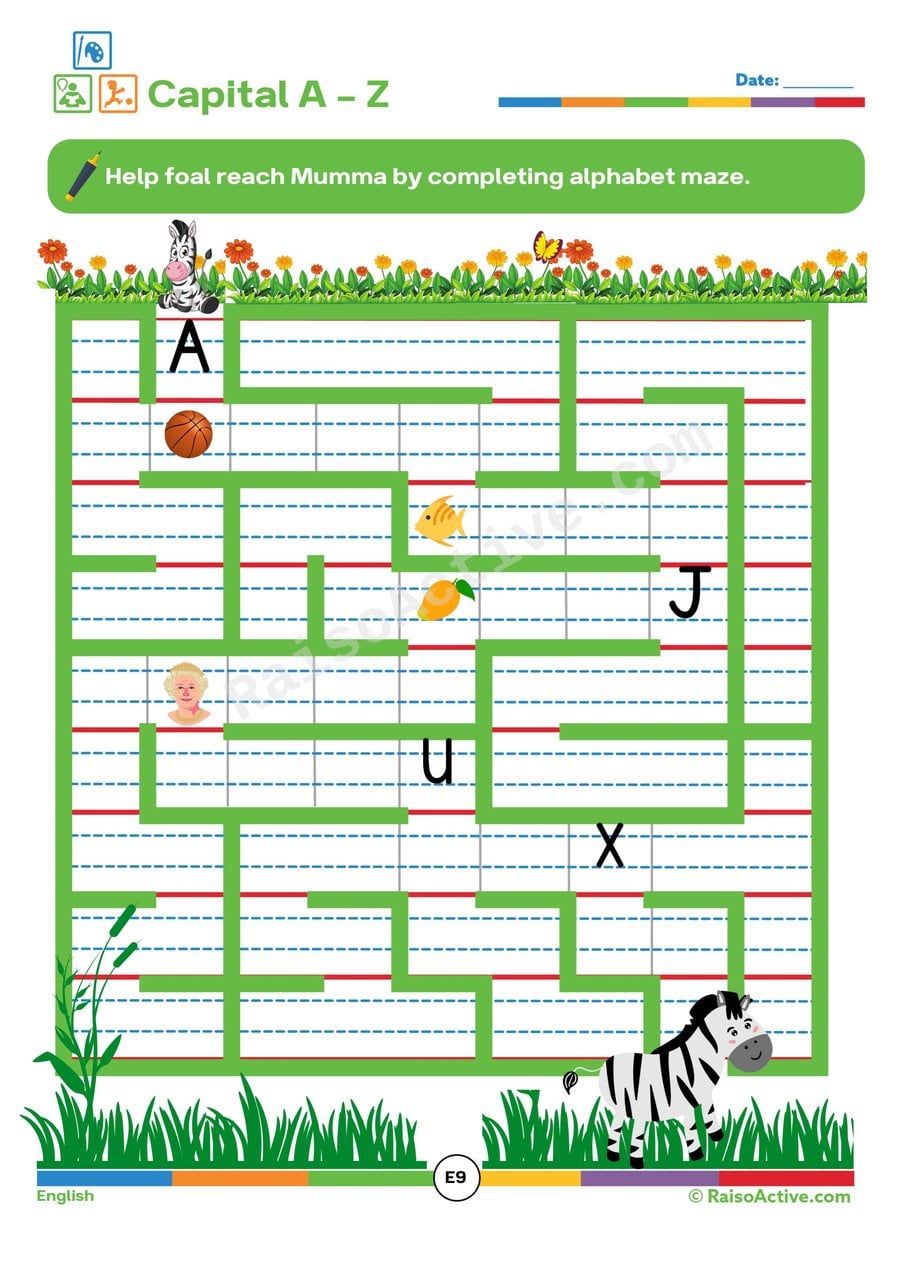
Capital Letter Maze: Help the Foal Find Mumma!
Ages 3-5 · Preschool–Pre-KAges 3-5 · Nursery–ReceptionAges 3-5 · Nursery–LKGAges 3-5
This maze worksheet combines fine motor tracing practice with capital letter recognition for children ages 3-5, as they navigate a path from letter to letter to reunite the foal with its mother. Following a maze path while simultaneously identifying letters along the way builds sustained visual attention and reinforces that letters appear in a meaningful, recognizable sequence. The storyline element also adds emotional motivation that keeps children engaged through a longer tracing task.
Related worksheets

First Letter Fun: Identify and Write the Beginning Sounds Worksheet
Ages 4-5 · Pre-KAges 4-5 · ReceptionAges 4-5 · LKGAges 4-5
Naming each pictured object and writing its first letter helps children ages 4-5 practice phonemic awareness, the skill of isolating the very first sound in a word, which is a key building block for spelling and early reading. This worksheet turns that listening skill into a writing task, reinforcing the connection between a spoken sound and its written letter.

First Letter Fun: Identify and Write! A Fun Vocabulary Worksheet for Kids
Ages 4-6 · Pre-K–KindergartenAges 4-6 · Reception–Year 1Ages 4-6 · LKG–UKGAges 4-6
This worksheet extends beginning-sound practice for children ages 4-6 slightly further than earlier versions, asking them to independently identify an object's name and write its first letter with less visual support. Isolating and writing initial sounds accurately is a strong predictor of later spelling and reading success, since it requires children to translate an auditory skill into a written one. Repeating this process across multiple pictures builds both vocabulary and growing independence in phonics reasoning.

M-R Phonic Beginning Sound Worksheet: Circle the Correct Letter!
Ages 4-6 · Pre-K–KindergartenAges 4-6 · Reception–Year 1Ages 4-6 · LKG–UKGAges 4-6
This phonics worksheet focuses children ages 4-6 on distinguishing between five similar beginning sounds — M, P, O, R, and N — by having them look at a picture, say its name, and circle the correct starting letter from those choices. Including several letters as answer options, rather than just one, makes this a meaningfully harder discrimination task than a single-letter worksheet, since children must rule out close-sounding alternatives.

Phonics Fun: Connect the Letters S-X with Starting Sounds Worksheet
Ages 4-6 · Pre-K–KindergartenAges 4-6 · Reception–Year 1Ages 4-6 · LKG–UKGAges 4-6
Connecting pictures to their correct beginning letter across the range S through X helps children ages 4-6 extend their phonics practice beyond the most common early letters, building broader letter-sound matching skills. This wider range also introduces children to less frequently practiced sounds, rounding out their overall phonemic awareness.

Alphabet Adventures: Circle the Objects! A Fun Letter Recognition Worksheet
Ages 3-5 · Preschool–Pre-KAges 3-5 · Nursery–ReceptionAges 3-5 · Nursery–LKGAges 3-5
This worksheet builds letter-sound correspondence by having children scan a group of pictures and circle only the ones that start with a specific letter. For three- to five-year-olds, this kind of visual search-and-sort task strengthens both phonics recognition and sustained visual attention, since children have to check each picture against the target sound rather than just glancing at the page.

Cut and Paste Objects Starting with Letters: Q, R, and S Worksheet
Ages 3-5 · Preschool–Pre-KAges 3-5 · Nursery–ReceptionAges 3-5 · Nursery–LKGAges 3-5
This cut-and-paste worksheet combines beginning-sound recognition with fine motor practice for children ages 3-5, focusing on the letters Q, R, and S — three consonants that appear less often in early vocabulary than letters like B or C, so extra practice helps cement them. Cutting out small object pictures and correctly pasting them beside the matching letter requires your child to first identify the beginning sound, then execute the physical control needed to cut along lines and place glue precisely. This blend of phonics and hands-on craft work builds both academic and physical skills in one sitting.
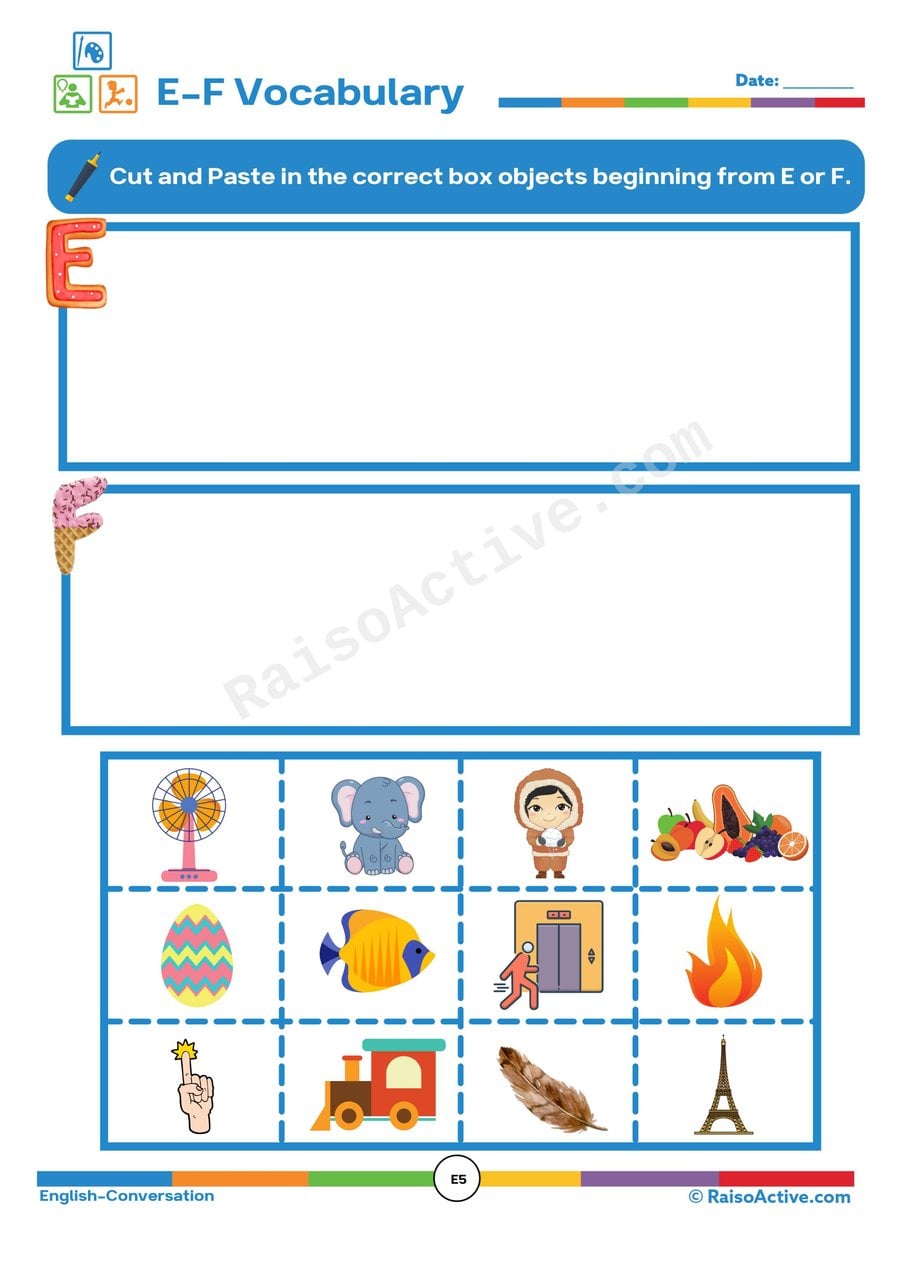
E-F Vocabulary Worksheet: Cut and Paste Fun!
Ages 3-5 · Preschool–Pre-KAges 3-5 · Nursery–ReceptionAges 3-5 · Nursery–LKGAges 3-5
This worksheet builds phonemic awareness and vocabulary as children ages 3-5 sort pictures by their beginning sound, deciding whether each object starts with the letter E or F. Practicing this kind of sound-sorting strengthens the auditory discrimination skills children need before they can reliably match letters to sounds in reading.

Small Alphabet Letter Practice: Write the First Letter - Worksheet for Kids
Ages 3-5 · Preschool–Pre-KAges 3-5 · Nursery–ReceptionAges 3-5 · Nursery–LKGAges 3-5
Writing lowercase letters correctly is a distinct skill from recognizing them, and this worksheet asks children ages 3-5 to identify a pictured object, isolate its beginning sound, and then physically form the matching lowercase letter from memory. Combining sound identification with independent letter formation — rather than tracing — pushes children a step further toward true early spelling. This is often one of the first times children write letters without a dotted guide to follow, which builds real handwriting confidence.
Guides for this topic

Kindergarten Readiness Checklist: 25 Skills to Practice Before the First Day
A kindergarten readiness checklist of 25 literacy, math, motor, self-regulation and self-help skills, with an 8-week summer plan and notes on when not to worry.

Phase 2 Phonics at Home: Sound Order, Blending Games, Worksheets
Phase 2 phonics at home: the five sound sets in order, oral blending, tricky words, a two-week routine, common mistakes, and free worksheets.
Reception Year Explained: EYFS Learning and How to Help at Home
A teacher's plain-English guide to the Reception Year: the seven areas of learning, Early Learning Goals, Phase 2/3 phonics, the RBA and home routines.
Reviews
Every worksheet for ages 4–5, no watermark
Members download the full library of 1,000+ worksheets and every activity pack without watermarks or daily limits. One year costs ₹999 in India or $20 elsewhere.
See membership plansOr download any worksheet free with a watermark (5 a day).