C, D, E Letter Sounds Worksheet: Circle and Count!
This activity gives children ages 3-5 focused practice recognizing the beginning sounds of the letters C, D, and E, asking them to circle matching pictures in different colors for each letter before counting the results. Combining phonics with counting means children practice two skills in one sitting: identifying initial letter sounds and recording a numeric total, both foundational for kindergarten readiness. Color-coding each letter also helps children visually organize the three sounds instead of mixing them together.
Part of the pack
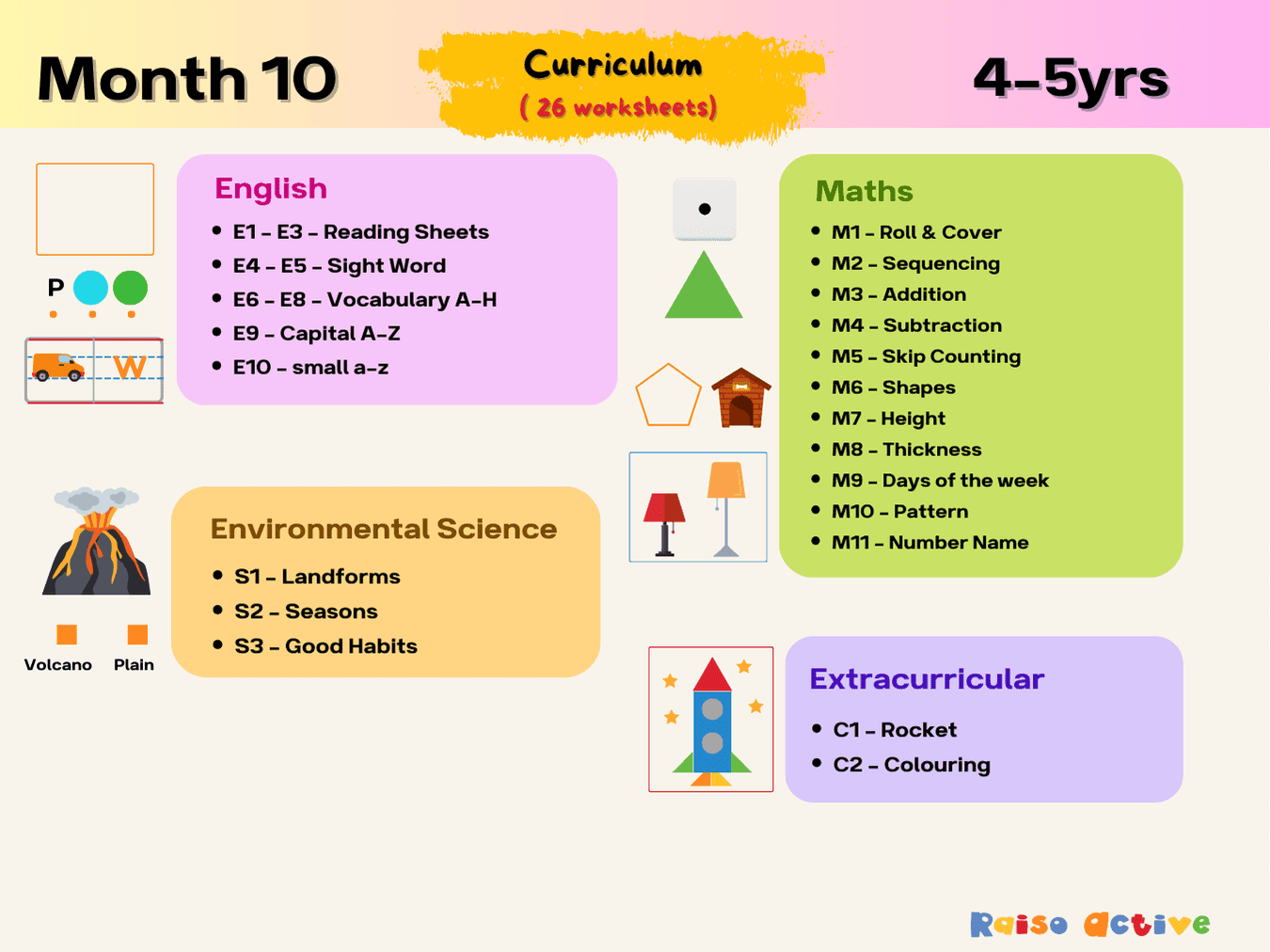
Month 10: Learning & Development | Ages 4-5
This is page 10 of the pack. Ages 4-5 · Pre-KAges 4-5 · ReceptionAges 4-5 · LKGAges 4-5
Made for your child
Counting to 10, made for your child
A maths pack with your child's name in it: pictures that explain, practice at three levels, puzzles and story sums about them. Print a new set whenever they finish.
Make a maths packFree preview · free for members
Curriculum
- Phonics - Letter Sounds > Beginning Sounds
How to use this worksheet
Look at each picture on the page and say its name out loud together, listening for the very first sound. Circle words that start with C in blue, D in red, and E in yellow, checking as you go that the color matches the correct letter. After circling, count how many objects were found for each letter and write that number in the box. Review all three groups together, saying each letter sound and its matching words aloud.
Materials needed
- Pencils
- Blue, Red, and Yellow Crayons or Markers
Extension activities
- 1Find other objects in the house that start with the letters C, D, and E.
- 2Draw pictures of objects that start with C, D, and E.
- 3Practice writing the letters C, D, and E in both uppercase and lowercase.
- 4Sort small toys or household items into three piles by their beginning sound.
- 5Make up a silly sentence using several words that all start with the same letter.

Written by
Hemsweta Jain · Teacher Cheena
MBA and Early Childhood Educator, teaching since 2014 · Founder of RaisoActive, Mumbai
Every RaisoActive worksheet is designed and checked by the founder before publishing.
Published · Last reviewed
More from Month 10: Learning & Development | Ages 4-5

Small Alphabet Writing Worksheet: Before, Between, and After
Ages 3-5 · Preschool–Pre-KAges 3-5 · Nursery–ReceptionAges 3-5 · Nursery–LKGAges 3-5
Children ages 3-5 practice recalling the fixed order of the alphabet by writing the small letter that comes before, between, or after given letters, a skill that goes beyond simply reciting the alphabet song and requires genuine understanding of letter sequence. This kind of targeted recall practice helps children build the alphabet knowledge needed for using dictionaries, alphabetized lists, and smooth handwriting flow later on.

Christmas Pattern Worksheet: Circle the Next Picture!
Ages 4-6 · Pre-K–KindergartenAges 4-6 · Reception–Year 1Ages 4-6 · LKG–UKGAges 4-6
This seasonal worksheet gives children ages 4-6 practice identifying a repeating pattern using Christmas-themed pictures and predicting which picture logically comes next. Pattern prediction requires children to notice a repeating rule and apply it forward, a skill that underlies later math concepts like skip counting and multiplication tables. The festive imagery adds seasonal excitement that can make repeated pattern practice feel like a holiday game.

Number Sequencing Worksheet: Practice Counting and Ordering Numbers!
Ages 4-5 · Pre-KAges 4-5 · ReceptionAges 4-5 · LKGAges 4-5
This worksheet gives children ages 4-5 focused practice writing numerals in order by filling in the missing numbers within several different counting sequences. Unlike simple counting aloud, writing each numeral by hand forces children to connect the spoken number word to its correct written symbol, reinforcing both number recognition and early handwriting control.

Skip Counting Adventure: Fill in the Blanks Worksheet for Numbers 2, 5, and 10!
Ages 4-6 · Pre-K–KindergartenAges 4-6 · Reception–Year 1Ages 4-6 · LKG–UKGAges 4-6
Filling in missing numbers in sequences that count by twos, fives, and tens teaches children ages 4-6 to recognize numerical patterns beyond counting one at a time, an important stepping stone toward multiplication later in school. Because each skip-counting sequence has a consistent gap between numbers, children must notice and apply that pattern rather than simply reciting a memorized list. This worksheet also builds flexible number sense, helping children see numbers as a system with predictable structure rather than an arbitrary list to memorize.

Subtraction Fun: Count and Subtract with Cute Animals!
Ages 4-6 · Pre-K–KindergartenAges 4-6 · Reception–Year 1Ages 4-6 · LKG–UKGAges 4-6
Counting a group of animal pictures and then crossing out or removing a specified number teaches children ages 4-6 the concept of subtraction as taking away from a starting quantity, which is easier to grasp visually than through numbers alone. Writing the remaining total after the take-away step reinforces that subtraction results in a smaller, specific number, connecting the physical act of removing objects to a written numeral. Using cute animal pictures as the countable objects keeps a potentially tricky math concept approachable and fun.

Alphabet Adventures: 'A' and 'B' Picture Sorting Worksheet
Ages 4-5 · Pre-KAges 4-5 · ReceptionAges 4-5 · LKGAges 4-5
This worksheet strengthens phonemic awareness in children ages 4-5 by having them listen for and identify pictures whose names begin with the letters 'A' or 'B,' then sort them accordingly. Focusing on just two letters at a time, rather than the whole alphabet, gives children a manageable, focused way to practice isolating beginning sounds before tackling more letters.

Number Names Matching Worksheet for Preschoolers
Ages 3-5 · Preschool–Pre-KAges 3-5 · Nursery–ReceptionAges 3-5 · Nursery–LKGAges 3-5
This worksheet helps children ages 3-5 connect written number names, like 'three' or 'seven,' to the numeral they represent, an important step beyond simply recognizing digits since it introduces reading actual number words. Decoding a color clue to figure out and write each number name first adds an extra layer of visual attention before the matching step even begins.

Days of the Week Cut and Paste Worksheet for Preschoolers
Ages 4-6 · Pre-K–KindergartenAges 4-6 · Reception–Year 1Ages 4-6 · LKG–UKGAges 4-6
Cutting out the seven day names and gluing them into the correct sequence teaches children ages 4-6 the fixed order of the days of the week, a foundational piece of time-concept knowledge they'll rely on for calendars, schedules, and daily routines. Because this activity requires both reading the day names and remembering their correct order, it strengthens sight-word recognition alongside sequencing skills. The hands-on cutting and pasting also gives fine motor practice within a literacy and time-concept task.
Related worksheets

Color the Animals! M, K, S Beginning Sounds Worksheet for Preschool
Ages 3-5 · Preschool–Pre-KAges 3-5 · Nursery–ReceptionAges 3-5 · Nursery–LKGAges 3-5
By coloring circles according to a color key tied to the beginning sound of each animal's name, this worksheet trains children to isolate the very first sound in a word, a skill called phoneme isolation that is one of the strongest early predictors of reading success. Working with the letters M, K, and S specifically gives practice distinguishing sounds that can be tricky to tell apart when spoken quickly.

Say My Sound: Beginning Sounds Worksheet for Preschoolers
Ages 3-5 · Preschool–Pre-KAges 3-5 · Nursery–ReceptionAges 3-5 · Nursery–LKGAges 3-5
This worksheet helps children ages 3-5 identify the beginning sounds of familiar words and match them to the correct letters, an essential early phonics skill for sounding out words later. Coloring each picture after identifying its sound keeps the activity playful while still requiring focused listening.

Vocabulary Worksheet: Circle the Objects That Start with Letters M, K, X, W, and S!
Ages 4-6 · Pre-K–KindergartenAges 4-6 · Reception–Year 1Ages 4-6 · LKG–UKGAges 4-6
This worksheet asks children ages 4-6 to identify pictured objects and circle the ones that begin with a specific target letter — cycling through M, K, X, W, and S — reinforcing beginning sound recognition across a wider range of letters than a single-letter worksheet would. Working across five different letters in one sitting also helps children practice quickly switching their sound-matching strategy from one letter to the next.

Phonics Fun: Connect the Letters S-X with Starting Sounds Worksheet
Ages 4-6 · Pre-K–KindergartenAges 4-6 · Reception–Year 1Ages 4-6 · LKG–UKGAges 4-6
Connecting pictures to their correct beginning letter across the range S through X helps children ages 4-6 extend their phonics practice beyond the most common early letters, building broader letter-sound matching skills. This wider range also introduces children to less frequently practiced sounds, rounding out their overall phonemic awareness.
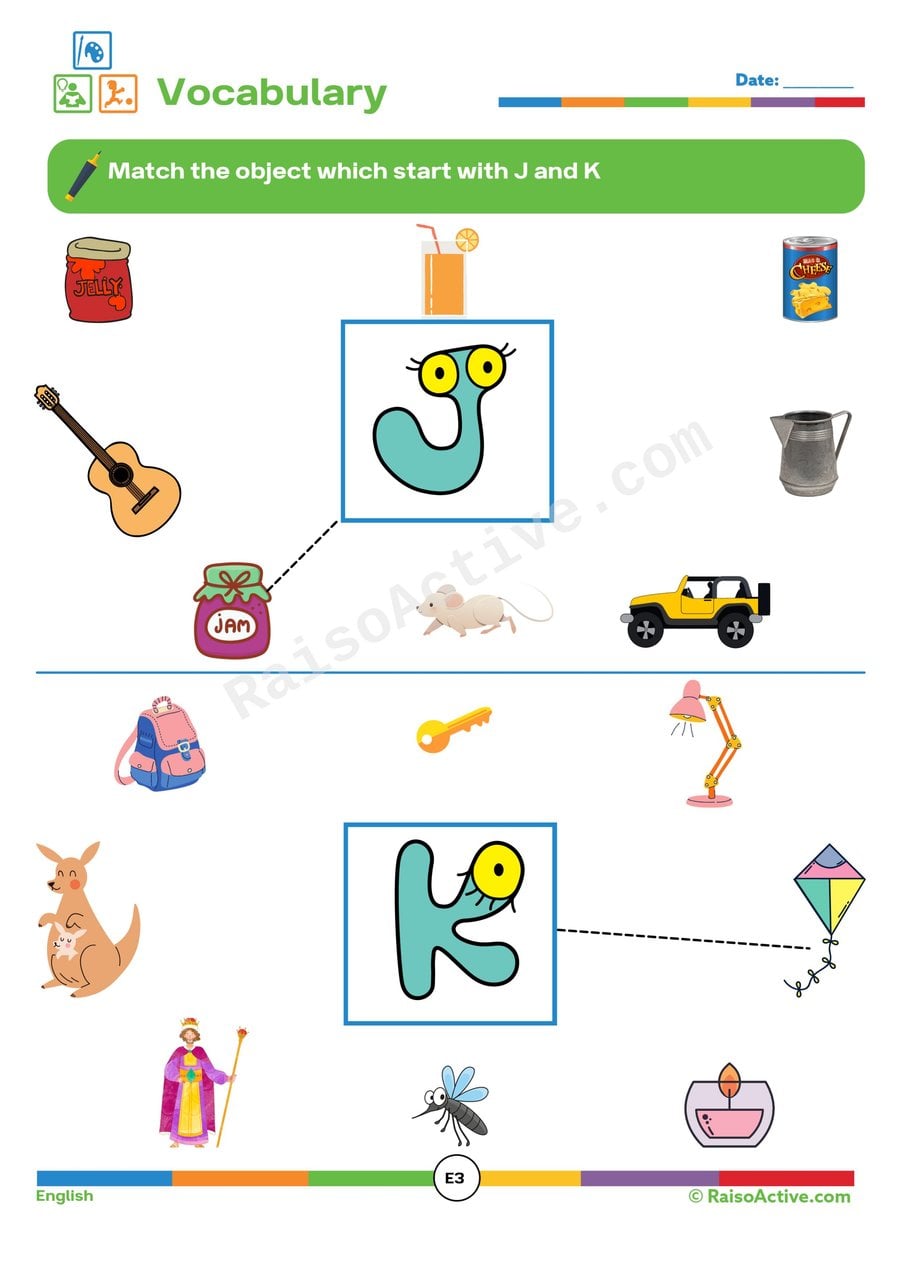
J and K Vocabulary Worksheet: Match the Objects!
Ages 3-5 · Preschool–Pre-KAges 3-5 · Nursery–ReceptionAges 3-5 · Nursery–LKGAges 3-5
This worksheet gives children ages 3-5 focused practice with the letters J and K, two consonants that don't come up as often in early vocabulary as letters like S or B, so dedicated practice like this helps round out full alphabet familiarity. Matching pictures to their correct beginning letter reinforces the sound-symbol connection while also building vocabulary for objects that start with these less common letters, like jars, jellyfish, kites, or kangaroos. This kind of targeted practice on less-frequent letters helps prevent gaps in alphabet knowledge that can otherwise show up later during reading.

Fun Phonics Activities: Letter S Worksheet for Preschoolers
Ages 3-5 · Preschool–Pre-KAges 3-5 · Nursery–ReceptionAges 3-5 · Nursery–LKGAges 3-5
This multi-part activity page immerses preschoolers in the sound and shape of the letter 'S' through drawing, speaking, and playful games rather than a single worksheet task, which research on early phonics shows helps the sound-letter connection stick faster than tracing alone. Ages three to five benefit especially from this variety, since moving between drawing, talking, and active games matches their short attention spans while reinforcing the same target sound from multiple directions.

Letter Sounds: Color the Letter Worksheet for Preschoolers
Ages 3-5 · Preschool–Pre-KAges 3-5 · Nursery–ReceptionAges 3-5 · Nursery–LKGAges 3-5
Matching a picture — a ball, a cat, a dog — to the letter it starts with asks a 3-5 year old to isolate the very first sound of a word, which is one of the core building blocks of phonemic awareness before formal reading begins. Coloring the matching letter circle adds a low-pressure, motor-skill layer to what's really a listening and sound-matching task.

Phonics Fun: Circle the Beginning Letter Worksheet for Kids
Ages 4-6 · Pre-K–KindergartenAges 4-6 · Reception–Year 1Ages 4-6 · LKG–UKGAges 4-6
This 'Circle the Beginning Letter' worksheet strengthens phoneme-grapheme correspondence for children ages 4-6, teaching them to connect the sound they hear at the start of a word to its written letter. Naming each picture aloud and choosing among several letter options builds auditory discrimination, a skill that predicts later decoding success. It also reinforces letter recognition by asking children to distinguish the target letter from visually similar distractors.
Guides for this topic

Number Formation Rhymes 0–9 and How to Fix Reversals
Original number formation rhymes for 0–9, the correct stroke order for each digit, why 3, 5 and 7 get reversed most often, and multisensory fixes that work.

How to Teach CVC Blending: A Step-by-Step Method That Works in Two Weeks
A step-by-step method for teaching CVC blending, covering continuous sounds, word families, common errors, and a 14-day plan that most children finish reading CVC words.
Phase 2 Phonics at Home: Sound Order, Blending Games, Worksheets
Phase 2 phonics at home: the five sound sets in order, oral blending, tricky words, a two-week routine, common mistakes, and free worksheets.
Reviews
Every worksheet for ages 3–5, no watermark
Members download the full library of 1,000+ worksheets and every activity pack without watermarks or daily limits. One year costs ₹999 in India or $20 elsewhere.
See membership plansOr download any worksheet free with a watermark (5 a day).