Letter Sounds: Color the Letter Worksheet for Preschoolers
Matching a picture — a ball, a cat, a dog — to the letter it starts with asks a 3-5 year old to isolate the very first sound of a word, which is one of the core building blocks of phonemic awareness before formal reading begins. Coloring the matching letter circle adds a low-pressure, motor-skill layer to what's really a listening and sound-matching task.
Part of the pack
Month 1: Learning & Development | Ages 4-5
This is page 5 of the pack. Ages 4-5 · Pre-KAges 4-5 · ReceptionAges 4-5 · LKGAges 4-5
Made for your child
A whole activity pack made with their name
60 pages to spot, build, trace and write their own name, plus pages about their favourites, feelings and family. See a free preview with their name.
Make an All About Me packFree preview · free for members
Or start free: a name tracing sheet with their nameCurriculum
- Phonics - Letter Sounds > Beginning Sounds
How to use this worksheet
Say each picture's name slowly and clearly first — 'b-b-ball' — stretching out the beginning sound so your child can hear it separately from the rest of the word. Ask them which letter makes that sound before they color anything, so the identification happens out loud rather than by guessing and checking against the coloring. Once they've named the correct letter, let them color that letter's circle in whatever color they like.
Materials needed
- Pencil
- Crayons
Extension activities
- 1Play 'I hear a sound': say a word aloud and have your child guess the starting letter without seeing a picture.
- 2Sort small toys or household objects into piles by their starting sound.
- 3Make up silly alliterative names together, like 'Bouncy Ball Bobby'.
- 4Read a picture book and pause on each page to name the starting sound of one object.
- 5Create a 'sound box' with 3-4 objects that all start with the same letter for your child to find and name.

Written by
Hemsweta Jain · Teacher Cheena
MBA and Early Childhood Educator, teaching since 2014 · Founder of RaisoActive, Mumbai
Every RaisoActive worksheet is designed and checked by the founder before publishing.
Published · Last reviewed
More from Month 1: Learning & Development | Ages 4-5
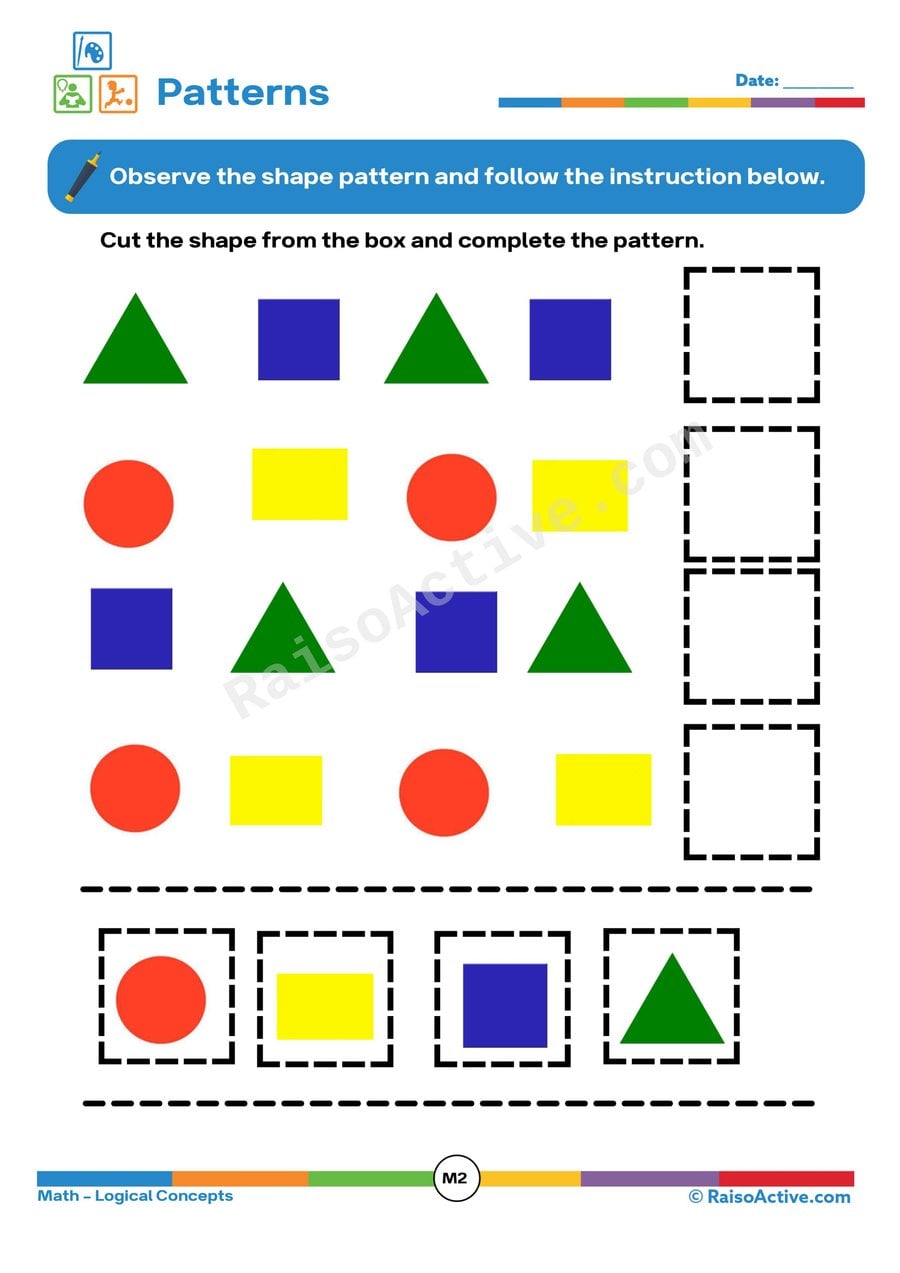
Shape Pattern Worksheet: Complete the Pattern!
Ages 3-5 · Preschool–Pre-KAges 3-5 · Nursery–ReceptionAges 3-5 · Nursery–LKGAges 3-5
Completing a repeating shape pattern asks children ages 3-5 to notice what comes next in a sequence and predict it correctly, an early form of the logical reasoning used in algebra much later on. Recognizing and continuing patterns also strengthens visual memory, since a child has to hold the beginning of the pattern in mind while figuring out what should come next.
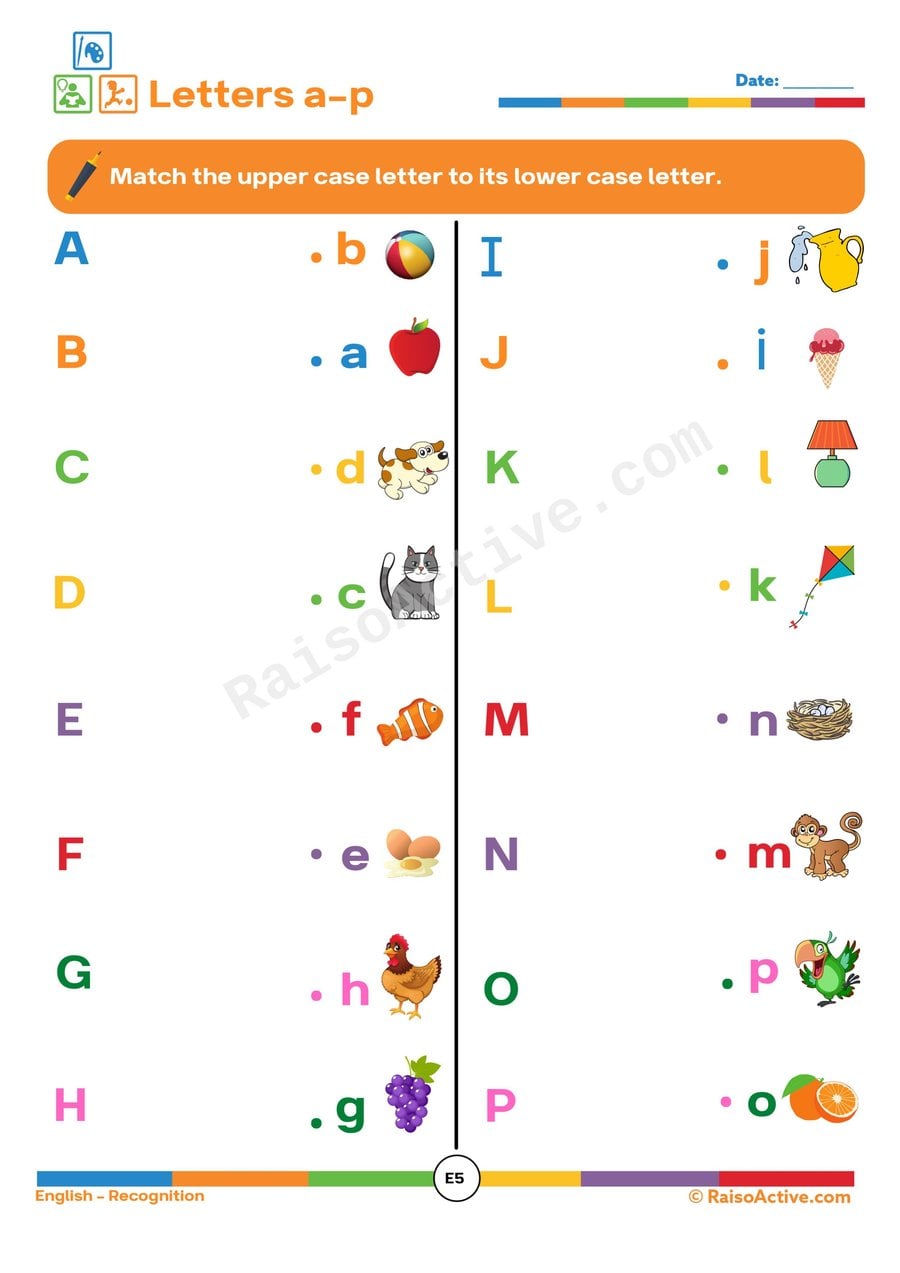
Match the Uppercase Letters: A-P Worksheet
Ages 4-5 · Pre-KAges 4-5 · ReceptionAges 4-5 · LKGAges 4-5
This worksheet strengthens your child's visual discrimination skills by focusing on uppercase letters from A to P. Children aged 4-5 years develop crucial pre-reading abilities as they learn to identify and pair identical letter forms. Mastering this matching task builds a strong foundation for future letter recognition and early literacy success.
Shape Sorting Worksheet: Cut and Paste Fun!
Ages 3-5 · Preschool–Pre-KAges 3-5 · Nursery–ReceptionAges 3-5 · Nursery–LKGAges 3-5
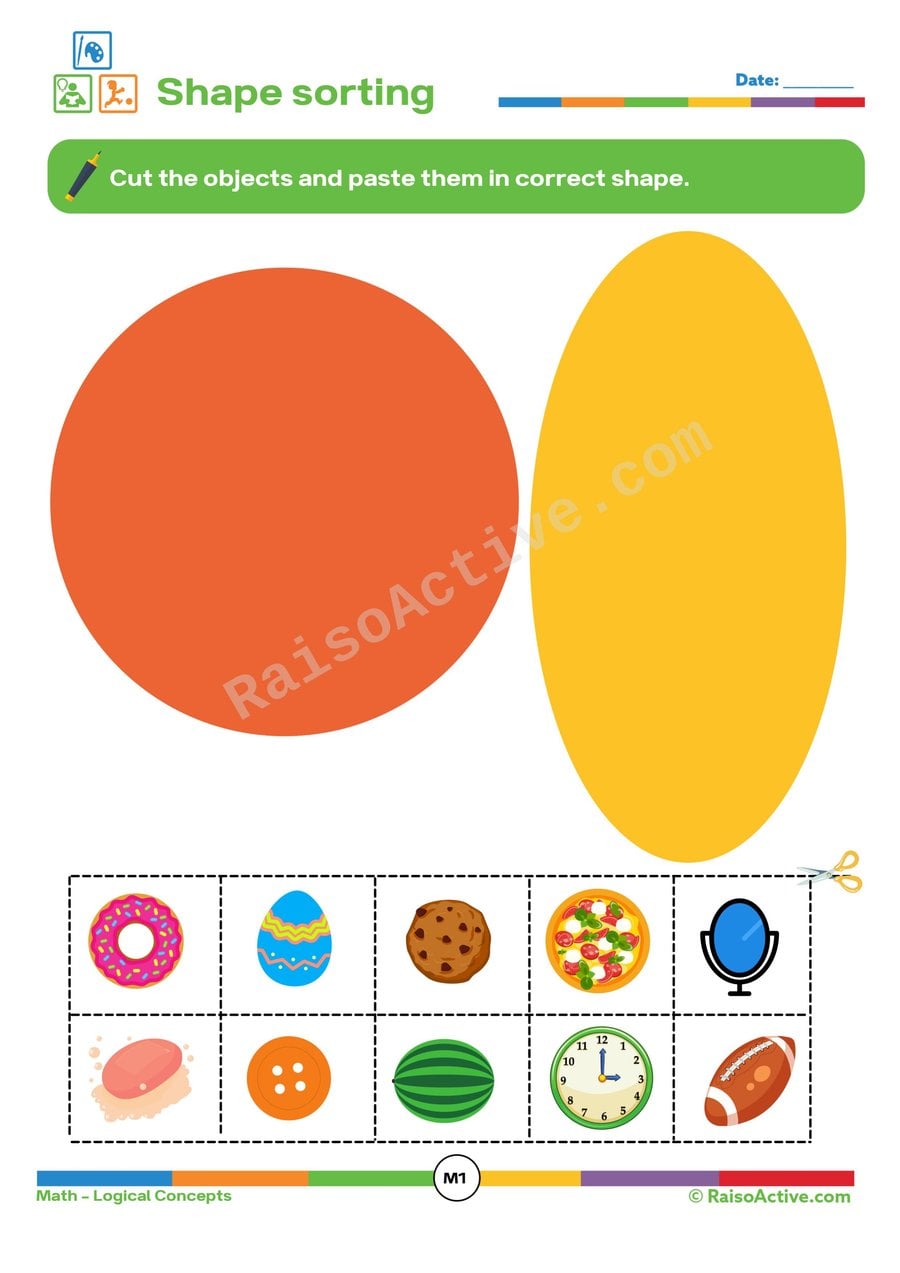
Sorting everyday objects — a plate, an egg, a clock — into 'circle' or 'oval' bins asks a 3-5 year old to look past what an object is and notice its geometric shape instead, an early step toward abstract categorization. Cutting along the outline of each picture and gluing it into the right column also builds the scissor control and hand-eye coordination that later supports handwriting.

My Body Parts Matching Worksheet for Preschoolers
Ages 3-5 · Preschool–Pre-KAges 3-5 · Nursery–ReceptionAges 3-5 · Nursery–LKGAges 3-5
Matching body part pictures to their names or functions helps children ages 3-5 build body awareness vocabulary, connecting a word like 'elbow' or 'knee' to the correct part of their own body. This kind of labeling activity also supports early self-care and safety skills, since children who can name body parts accurately can better communicate if something hurts or needs attention.

Parent's Guide: Fun Activities for Gross Motor Skills and More!
Ages 3-5 · Preschool–Pre-KAges 3-5 · Nursery–ReceptionAges 3-5 · Nursery–LKGAges 3-5
This parent's guide explains why gross motor skills, the large muscle movements involved in running, jumping, climbing, and balancing, need to develop before fine motor skills like pencil control fully mature in children ages 3-5. Understanding this progression helps a parent or teacher choose age-appropriate physical activities and recognize that time spent climbing, running, and balancing is directly building the strength and coordination needed for later table-top and handwriting tasks.

Mickey Mouse Number Sequence Worksheet: Counting and Matching
Ages 4-6 · Pre-K–KindergartenAges 4-6 · Reception–Year 1Ages 4-6 · LKG–UKGAges 4-6
Filling gaps in a number sequence — knowing that 4 comes after 3 and before 5 — is a different skill from simply counting a pile of objects; it asks a 4-6 year old to hold the whole order in mind rather than count from one each time. Cutting and pasting the missing numbers into place adds a fine-motor and precision layer on top of the counting itself.

Classroom Connections: Circle the Classroom Items!
Ages 4-6 · Pre-K–KindergartenAges 4-6 · Reception–Year 1Ages 4-6 · LKG–UKGAges 4-6
This observation worksheet asks children ages 4-6 to scan a mixed group of pictures and circle only the ones that belong in a classroom, building categorization skill, the ability to sort items by a shared context rather than by appearance alone. This kind of visual discrimination and category-based thinking is an early form of the reasoning children will use constantly in school, from sorting objects in science to grouping words by topic in reading.

Say My Sound: Beginning Letter Worksheet for Preschoolers
Ages 3-5 · Preschool–Pre-KAges 3-5 · Nursery–ReceptionAges 3-5 · Nursery–LKGAges 3-5
This is a companion beginning-sounds sheet with a new set of pictures, giving your child more practice isolating the first sound of a word — a skill that only really sticks with repeated exposure across different words, not a single worksheet. Circling instead of coloring the answer keeps the response quick and low-effort, so more of the session goes toward the listening task itself.
Related worksheets
E-F Vocabulary Worksheet: Cut and Paste Fun!
Ages 3-5 · Preschool–Pre-KAges 3-5 · Nursery–ReceptionAges 3-5 · Nursery–LKGAges 3-5
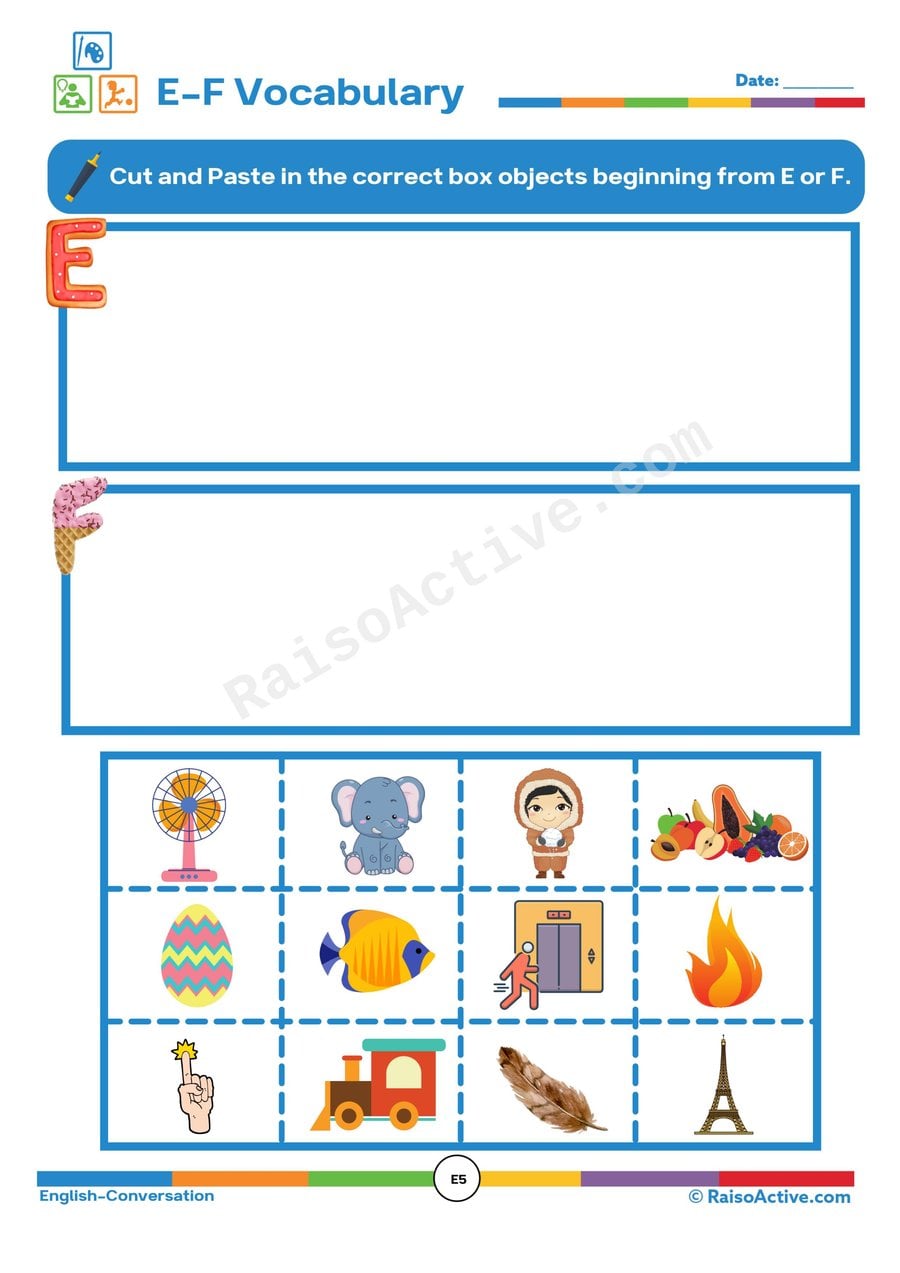
This worksheet builds phonemic awareness and vocabulary as children ages 3-5 sort pictures by their beginning sound, deciding whether each object starts with the letter E or F. Practicing this kind of sound-sorting strengthens the auditory discrimination skills children need before they can reliably match letters to sounds in reading.

Color the Beginning Sounds: G, D, and P Worksheet for Preschoolers
Ages 3-5 · Preschool–Pre-KAges 3-5 · Nursery–ReceptionAges 3-5 · Nursery–LKGAges 3-5
This worksheet strengthens phonemic awareness by asking children to distinguish between three different beginning sounds, G, D, and P, and color pictures according to which sound they start with. For ages 3-5, sorting by sound rather than simply circling reinforces both listening discrimination and the ability to hold multiple sound categories in mind at once.

Alphabet Adventures: Circle the Objects! A Fun Letter Recognition Worksheet
Ages 3-5 · Preschool–Pre-KAges 3-5 · Nursery–ReceptionAges 3-5 · Nursery–LKGAges 3-5
This worksheet builds letter-sound correspondence by having children scan a group of pictures and circle only the ones that start with a specific letter. For three- to five-year-olds, this kind of visual search-and-sort task strengthens both phonics recognition and sustained visual attention, since children have to check each picture against the target sound rather than just glancing at the page.

Phonics Fun: Write the First Letter and Draw! (Ages 3-5)
Ages 3-5 · Preschool–Pre-KAges 3-5 · Nursery–ReceptionAges 3-5 · Nursery–LKGAges 3-5
This worksheet asks children ages 3-5 to identify a picture's beginning sound and write the matching letter, then draw their own picture for extra practice, combining phonemic awareness with early letter formation. Writing the letter by hand, rather than just circling it, demands more fine motor control and reinforces the sound-symbol link more deeply than recognition alone. The open-ended drawing task also lets children apply the same beginning sound to a word of their own choosing.
F, G, H Letter Sounds Cut and Paste Worksheet
Ages 4-5 · Pre-KAges 4-5 · ReceptionAges 4-5 · LKGAges 4-5
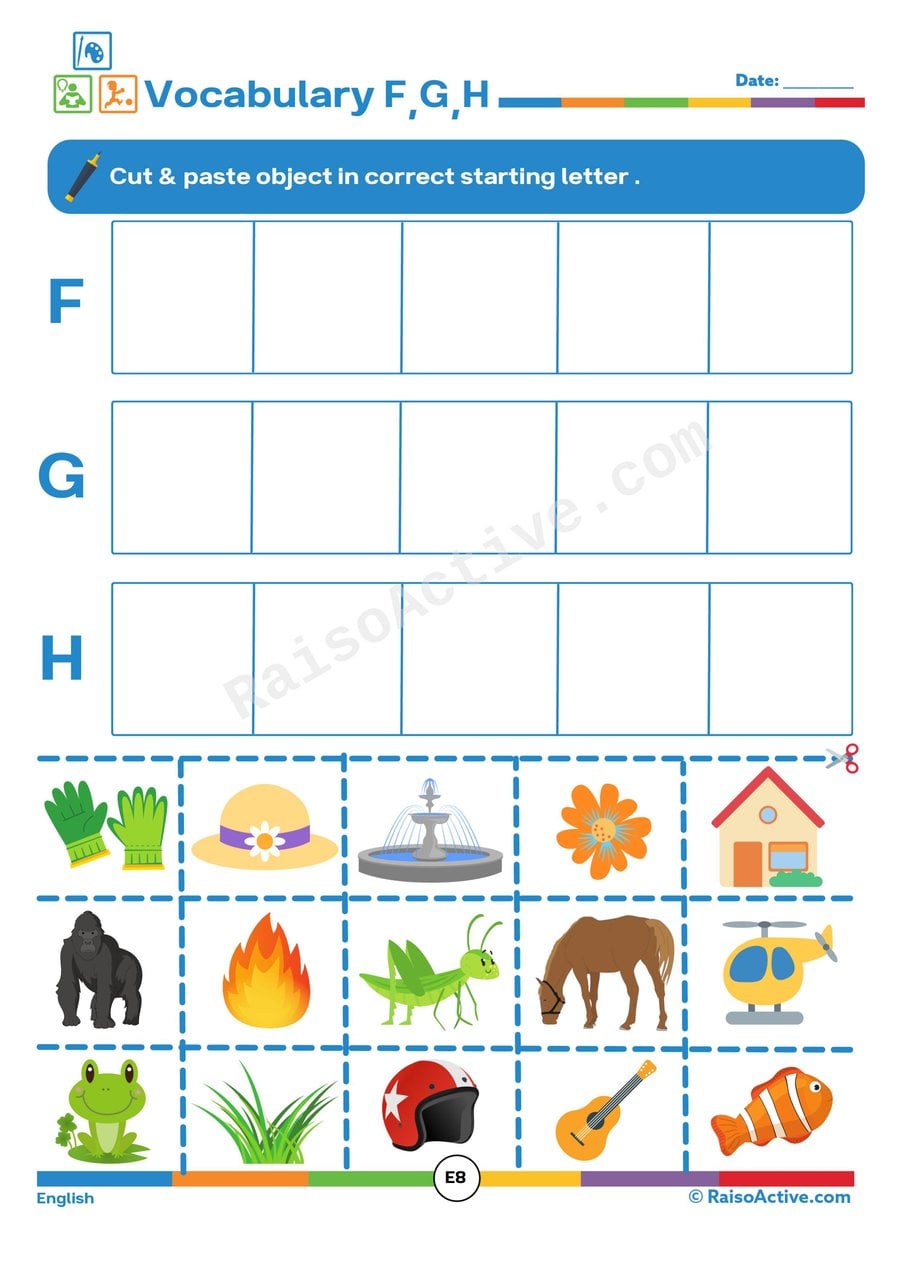
This worksheet builds phonemic awareness in children ages 4-5 by asking them to isolate the beginning sound of each picture and sort it under the correct letter — F, G, or H. Sorting across three letters at once, rather than just one, requires children to hold multiple sound-letter associations in mind and choose between them, which is a step up in difficulty from single-letter worksheets. This kind of comparative sound-sorting strengthens the phonics foundation needed for early reading.

Alphabet Adventures: 'A' and 'B' Picture Sorting Worksheet
Ages 4-5 · Pre-KAges 4-5 · ReceptionAges 4-5 · LKGAges 4-5
This worksheet strengthens phonemic awareness in children ages 4-5 by having them listen for and identify pictures whose names begin with the letters 'A' or 'B,' then sort them accordingly. Focusing on just two letters at a time, rather than the whole alphabet, gives children a manageable, focused way to practice isolating beginning sounds before tackling more letters.

Color the Animals! M, K, S Beginning Sounds Worksheet for Preschool
Ages 3-5 · Preschool–Pre-KAges 3-5 · Nursery–ReceptionAges 3-5 · Nursery–LKGAges 3-5
By coloring circles according to a color key tied to the beginning sound of each animal's name, this worksheet trains children to isolate the very first sound in a word, a skill called phoneme isolation that is one of the strongest early predictors of reading success. Working with the letters M, K, and S specifically gives practice distinguishing sounds that can be tricky to tell apart when spoken quickly.

First Letter Fun: Identify and Write! Vocabulary Worksheet
Ages 3-5 · Preschool–Pre-KAges 3-5 · Nursery–ReceptionAges 3-5 · Nursery–LKGAges 3-5
Naming everyday objects and writing their opening letter builds vocabulary alongside phonics for 3-5 year olds — each picture requires your child to first recall or recognize the object's name, then isolate just its first sound, and finally translate that sound into a written symbol. This vocabulary-first framing makes the worksheet especially useful for children who are still building the words for common objects, not just the letters that start them.
Guides for this topic

How to Teach CVC Blending: A Step-by-Step Method That Works in Two Weeks
A step-by-step method for teaching CVC blending, covering continuous sounds, word families, common errors, and a 14-day plan that most children finish reading CVC words.

Best Worksheets for 3-Year-Olds: What Works and What to Avoid
What works on worksheets for 3-year-olds: short sessions, crayons, tracing lines, matching, cutting, a free weekly plan, and signs one is too advanced.
Phase 2 Phonics at Home: Sound Order, Blending Games, Worksheets
Phase 2 phonics at home: the five sound sets in order, oral blending, tricky words, a two-week routine, common mistakes, and free worksheets.
Reviews
Every worksheet for ages 3–5, no watermark
Members download the full library of 1,000+ worksheets and every activity pack without watermarks or daily limits. One year costs ₹999 in India or $20 elsewhere.
See membership plansOr download any worksheet free with a watermark (5 a day).