Shape Pattern Worksheet: Complete the Pattern!
Completing a repeating shape pattern asks children ages 3-5 to notice what comes next in a sequence and predict it correctly, an early form of the logical reasoning used in algebra much later on. Recognizing and continuing patterns also strengthens visual memory, since a child has to hold the beginning of the pattern in mind while figuring out what should come next.
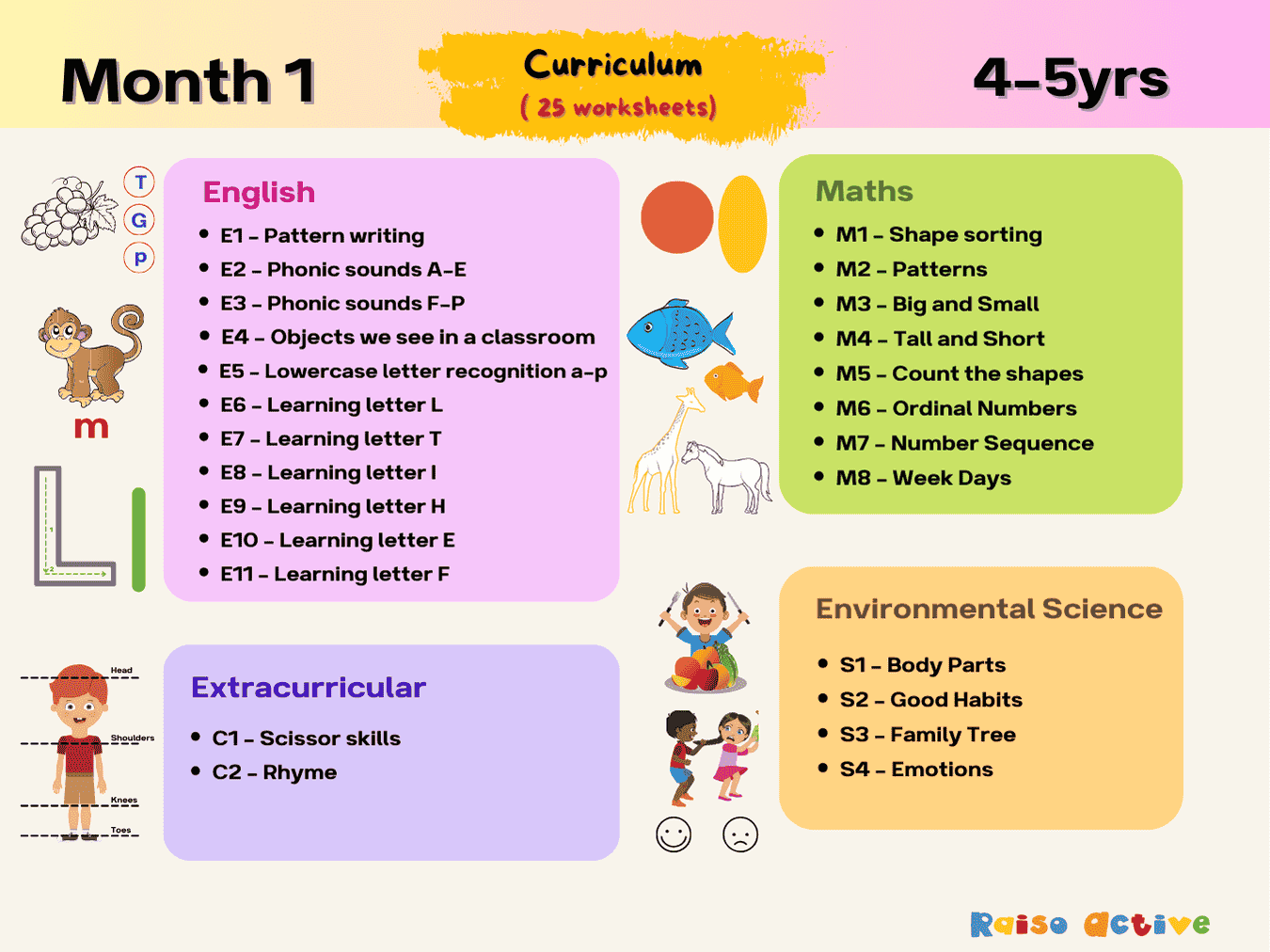
Part of the pack
Month 1: Learning & Development | Ages 4-5
This is page 16 of the pack. Ages 4-5 · Pre-KAges 4-5 · ReceptionAges 4-5 · LKGAges 4-5

Made for your child
Counting to 10, made for your child
A maths pack with your child's name in it: pictures that explain, practice at three levels, puzzles and story sums about them. Print a new set whenever they finish.
Make a maths packFree preview · free for members
Curriculum
- Patterns > Patterns
How to use this worksheet
Look at the pattern together and have your child say each shape out loud in order, like 'circle, square, circle, square.' Ask them what they think comes next before they draw, color, or circle the answer, so they commit to a prediction rather than guessing after the fact. Check their answer together and talk through why it's correct or, if not, what the actual pattern is. Move to the next pattern on the page and repeat the process.
Materials needed
- Pencil
- Scissors
- Glue
Extension activities
- 1Set up a repeating pattern with household objects, like fork-spoon-fork-spoon, and ask your child to continue it.
- 2Make a repeating movement pattern, like clap-stomp-clap-stomp, and have your child keep it going.
- 3String beads onto a lace in a repeating color or shape pattern.
- 4Look for repeating patterns in nature or around the house, like a striped shirt or a tiled floor.
- 5Build a repeating pattern with building blocks by color or shape and ask your child to add the next piece.

Written by
Hemsweta Jain · Teacher Cheena
MBA and Early Childhood Educator, teaching since 2014 · Founder of RaisoActive, Mumbai
Every RaisoActive worksheet is designed and checked by the founder before publishing.
Published · Last reviewed
More from Month 1: Learning & Development | Ages 4-5

Big and Small Fish Counting Worksheet for Preschoolers
Ages 3-5 · Preschool–Pre-KAges 3-5 · Nursery–ReceptionAges 3-5 · Nursery–LKGAges 3-5
This worksheet helps children aged 3-5 develop crucial early numeracy by practicing one-to-one correspondence as they count specific groups of fish. Children will also strengthen their observation skills by distinguishing between 'big' and 'small' fish, a foundational step in understanding comparative sizes and classification. This combination builds both number sense and pre-mathematical reasoning.

Animal Babies Tracing Worksheet: Help the Babies Find Their Mothers!
Ages 3-5 · Preschool–Pre-KAges 3-5 · Nursery–ReceptionAges 3-5 · Nursery–LKGAges 3-5
This tracing worksheet sharpens fine motor skills and hand-eye coordination as children carefully follow the dotted lines. It helps them develop the controlled pencil movements essential for pre-writing while reinforcing visual discrimination to match baby animals with their mothers. Children also expand their vocabulary by identifying different animal families and their offspring.

Parent's Guide: Fun Activities for Gross Motor Skills and More!
Ages 3-5 · Preschool–Pre-KAges 3-5 · Nursery–ReceptionAges 3-5 · Nursery–LKGAges 3-5
This parent's guide explains why gross motor skills, the large muscle movements involved in running, jumping, climbing, and balancing, need to develop before fine motor skills like pencil control fully mature in children ages 3-5. Understanding this progression helps a parent or teacher choose age-appropriate physical activities and recognize that time spent climbing, running, and balancing is directly building the strength and coordination needed for later table-top and handwriting tasks.
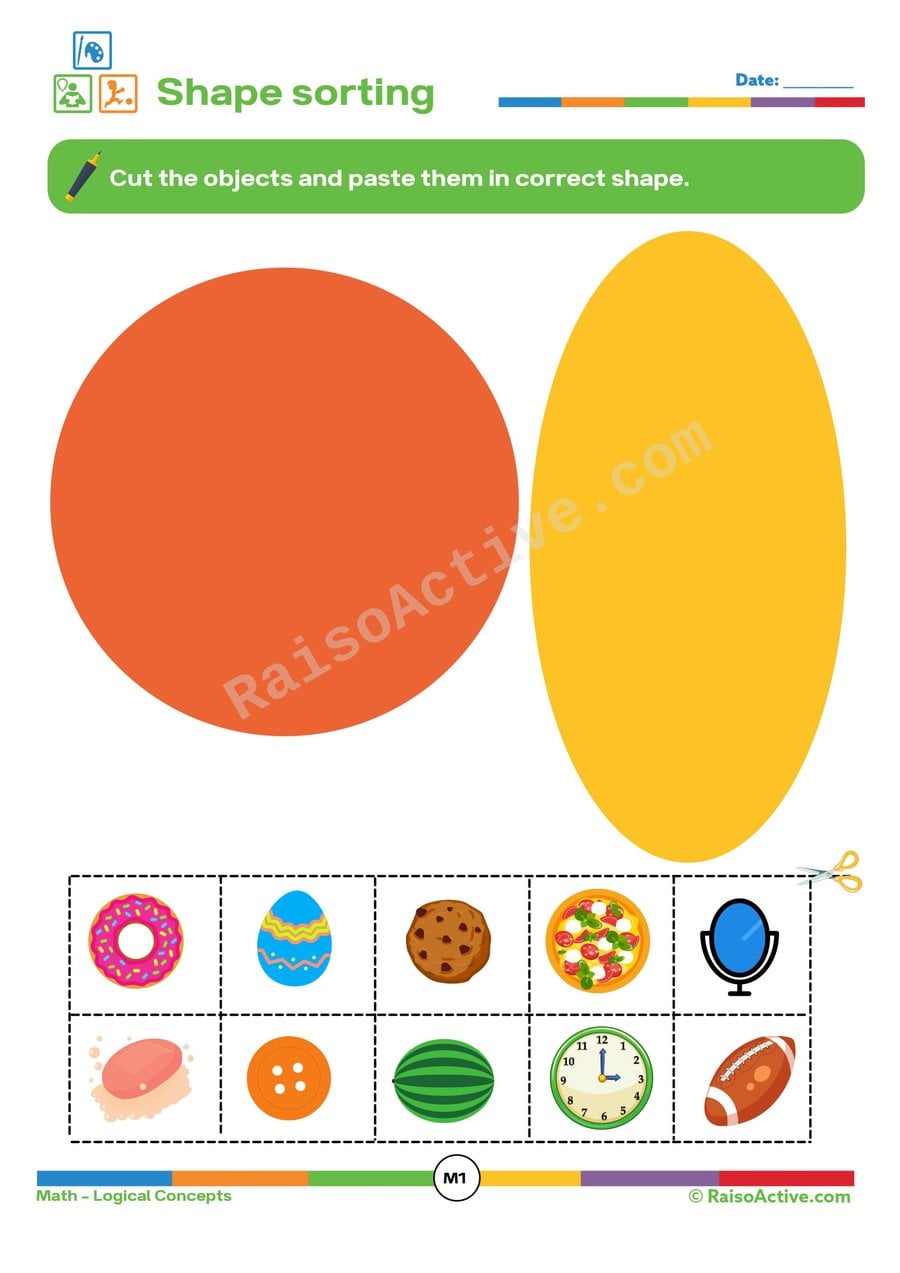
Shape Sorting Worksheet: Cut and Paste Fun!
Ages 3-5 · Preschool–Pre-KAges 3-5 · Nursery–ReceptionAges 3-5 · Nursery–LKGAges 3-5
Sorting everyday objects — a plate, an egg, a clock — into 'circle' or 'oval' bins asks a 3-5 year old to look past what an object is and notice its geometric shape instead, an early step toward abstract categorization. Cutting along the outline of each picture and gluing it into the right column also builds the scissor control and hand-eye coordination that later supports handwriting.
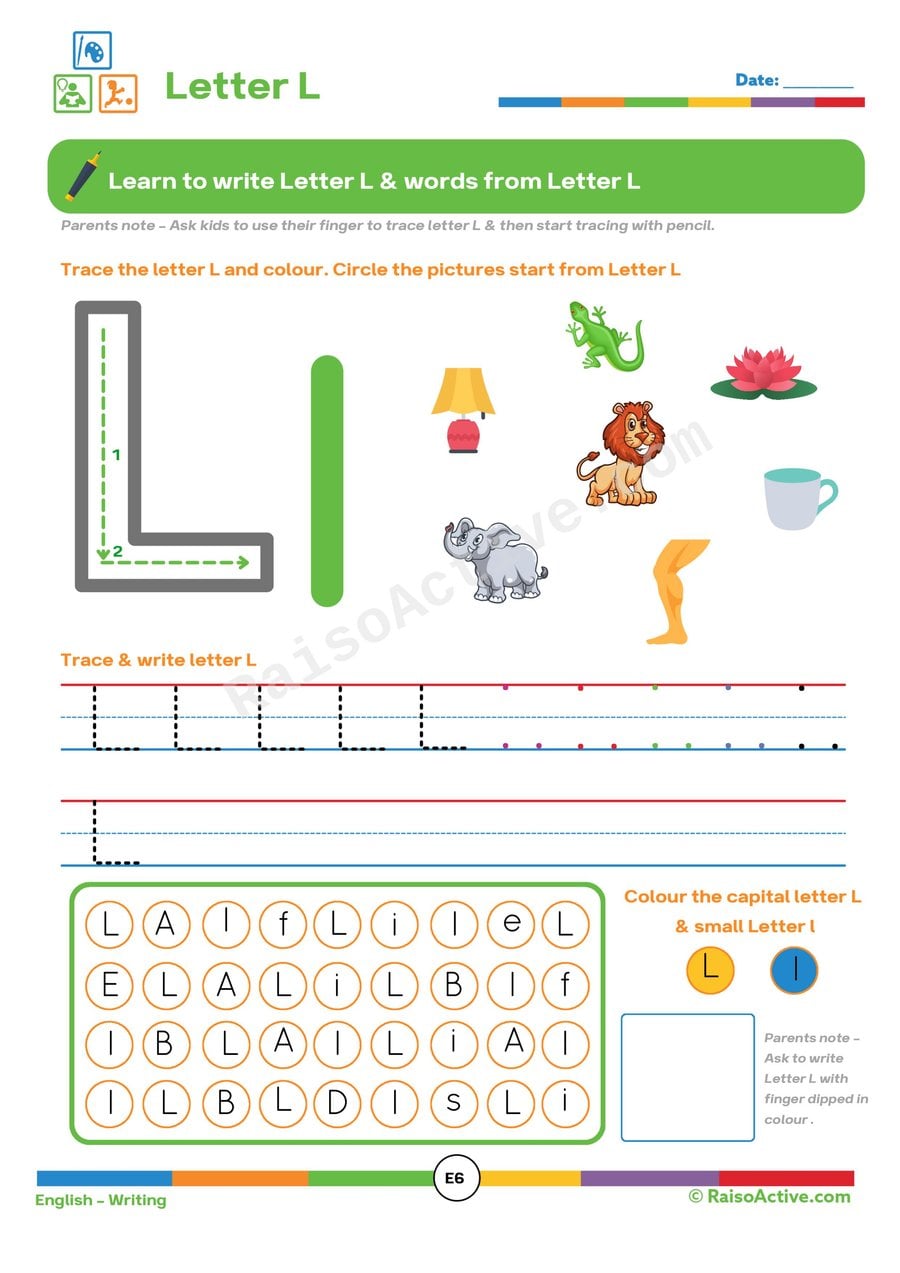
Letter L Worksheet: Trace, Color, and Learn!
Ages 3-5 · Preschool–Pre-KAges 3-5 · Nursery–ReceptionAges 3-5 · Nursery–LKGAges 3-5
Tracing the letter L builds the top-to-bottom, left-to-right pencil strokes that show up again in dozens of other letters, so this is one of the more transferable shapes a 3-5 year old can practice. Naming and coloring objects that start with L — a lion, a ladder, a leaf — ties the shape to its sound, which is exactly how early readers start linking print to speech.

My Family Tree Worksheet: Learn About Family Members!
Ages 3-5 · Preschool–Pre-KAges 3-5 · Nursery–ReceptionAges 3-5 · Nursery–LKGAges 3-5
Filling in a family tree helps children ages 3-5 practice family vocabulary, like mother, father, sibling, and grandparent, while also building an early sense of belonging and identity by seeing themselves as part of a larger family structure. Talking through each relationship as it's added also supports oral language development, since children have to describe who each person is and how that person relates to them.

Butterfly Cutting Practice Worksheet for Preschoolers
Ages 3-5 · Preschool–Pre-KAges 3-5 · Nursery–ReceptionAges 3-5 · Nursery–LKGAges 3-5
Cutting along a butterfly's wing outline gives children ages 3-5 focused scissor practice with a mix of straight and gently curved edges, building the specific hand strength and control needed for more advanced cutting tasks. Scissor skills like this directly support later pencil control too, since both rely on similar hand muscles and a steady, coordinated grip between two hands.
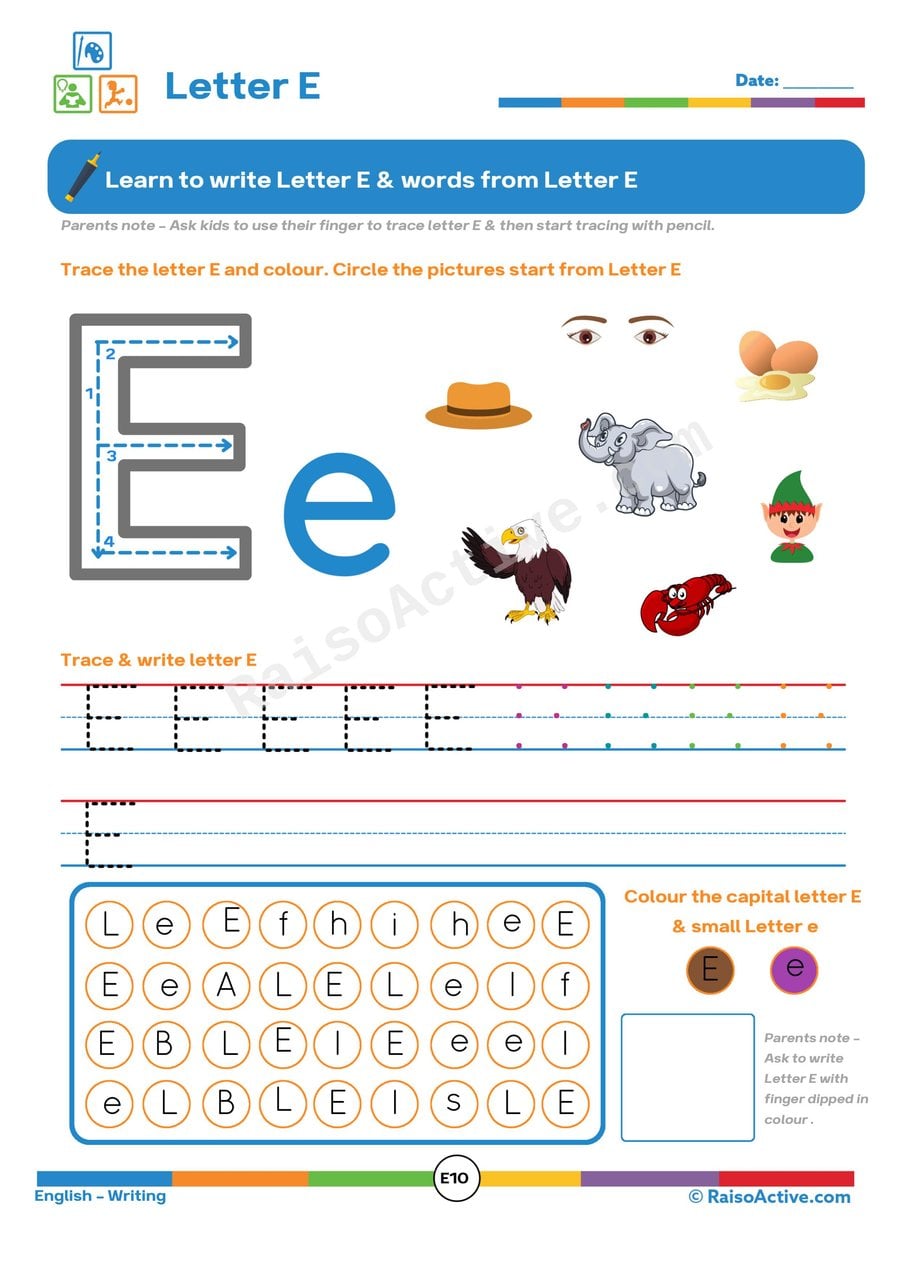
Letter E Fun: Trace, Color, and Learn!
Ages 3-5 · Preschool–Pre-KAges 3-5 · Nursery–ReceptionAges 3-5 · Nursery–LKGAges 3-5
Tracing and writing the letter E gives children ages 3-5 practice with one vertical stroke and three horizontal strokes, a slightly more complex letter shape than single-curve letters, which builds precision in stopping and starting a pencil at the right point. Alongside the physical writing practice, coloring and simple recognition activities reinforce that this shape and sound go together, an early step toward connecting letters with the words they start.
Related worksheets

Pattern Recognition Worksheet: Cut and Paste the Next Picture!
Ages 3-5 · Preschool–Pre-KAges 3-5 · Nursery–ReceptionAges 3-5 · Nursery–LKGAges 3-5
This worksheet builds pattern recognition for children ages 3-5 by having them identify a repeating sequence in each row and then cut out and glue the picture that correctly continues it. Because the correct piece must be found among several distractor options, this task sharpens visual discrimination alongside the logical thinking needed to predict what comes next in a sequence.

Camera Spy 2: Find the Patterns Worksheet for Preschoolers
Ages 4-7 · Pre-K–Grade 1Ages 4-7 · Reception–Year 2Ages 4-7 · LKG–Class 1Ages 4-7
This worksheet helps children identify and recognize repeating patterns in a visual format.

Camera Spy 3: Pattern Recognition Worksheet for Preschoolers
Ages 4-7 · Pre-K–Grade 1Ages 4-7 · Reception–Year 2Ages 4-7 · LKG–Class 1Ages 4-7
This worksheet helps children identify and match patterns by using a 'spy camera'.
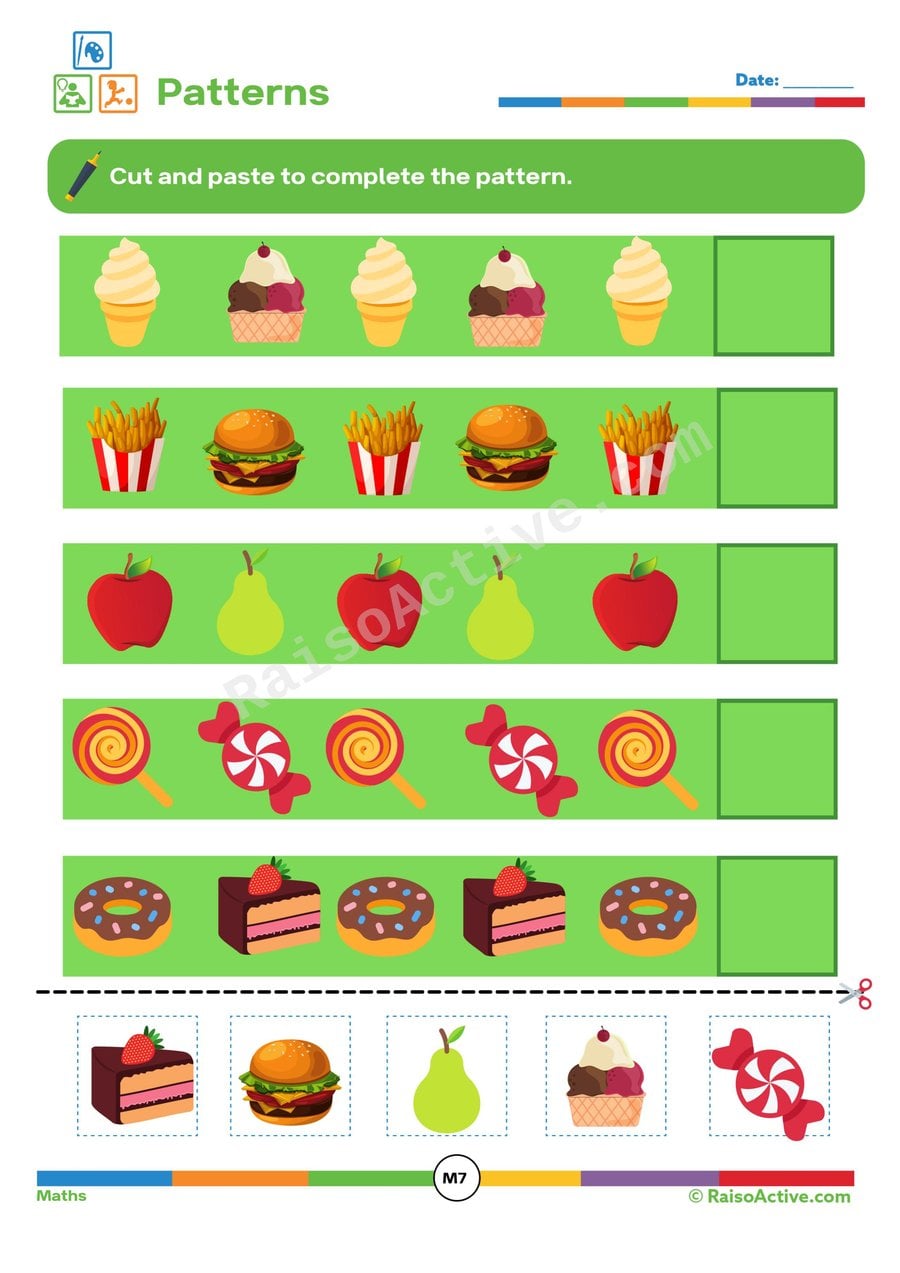
Yummy Food Patterns Worksheet for Preschoolers
Ages 3-5 · Preschool–Pre-KAges 3-5 · Nursery–ReceptionAges 3-5 · Nursery–LKGAges 3-5
This worksheet introduces pattern recognition — a core pre-math skill — by having children identify what food item comes next in a repeating sequence like apple-banana-apple-banana. Spotting and continuing patterns teaches children to predict what comes next based on a rule, an early form of the logical reasoning used later in math and science.

Christmas Pattern Worksheet: Circle the Next Picture!
Ages 4-6 · Pre-K–KindergartenAges 4-6 · Reception–Year 1Ages 4-6 · LKG–UKGAges 4-6
This seasonal worksheet gives children ages 4-6 practice identifying a repeating pattern using Christmas-themed pictures and predicting which picture logically comes next. Pattern prediction requires children to notice a repeating rule and apply it forward, a skill that underlies later math concepts like skip counting and multiplication tables. The festive imagery adds seasonal excitement that can make repeated pattern practice feel like a holiday game.

Shape Pattern Worksheet: Identify and Color the Next Shape!
Ages 3-5 · Preschool–Pre-KAges 3-5 · Nursery–ReceptionAges 3-5 · Nursery–LKGAges 3-5
This worksheet helps children ages 3-5 recognize and continue simple repeating shape patterns, an early form of the logical reasoning that later supports algebraic thinking. Coloring the shape that comes next also requires children to first identify each shape by name, reinforcing basic geometry vocabulary.

Shape Pattern Fun: Complete the Pattern Worksheet for Preschoolers
Ages 3-5 · Preschool–Pre-KAges 3-5 · Nursery–ReceptionAges 3-5 · Nursery–LKGAges 3-5
This worksheet introduces children ages 3-5 to pattern recognition using shapes, asking them to notice a repeating sequence and supply the missing piece. Continuing a pattern requires children to detect a rule and predict what comes next, an early form of the logical reasoning that later supports algebra and sequencing skills. Cutting and pasting the correct shape also reinforces shape recognition and fine motor precision.
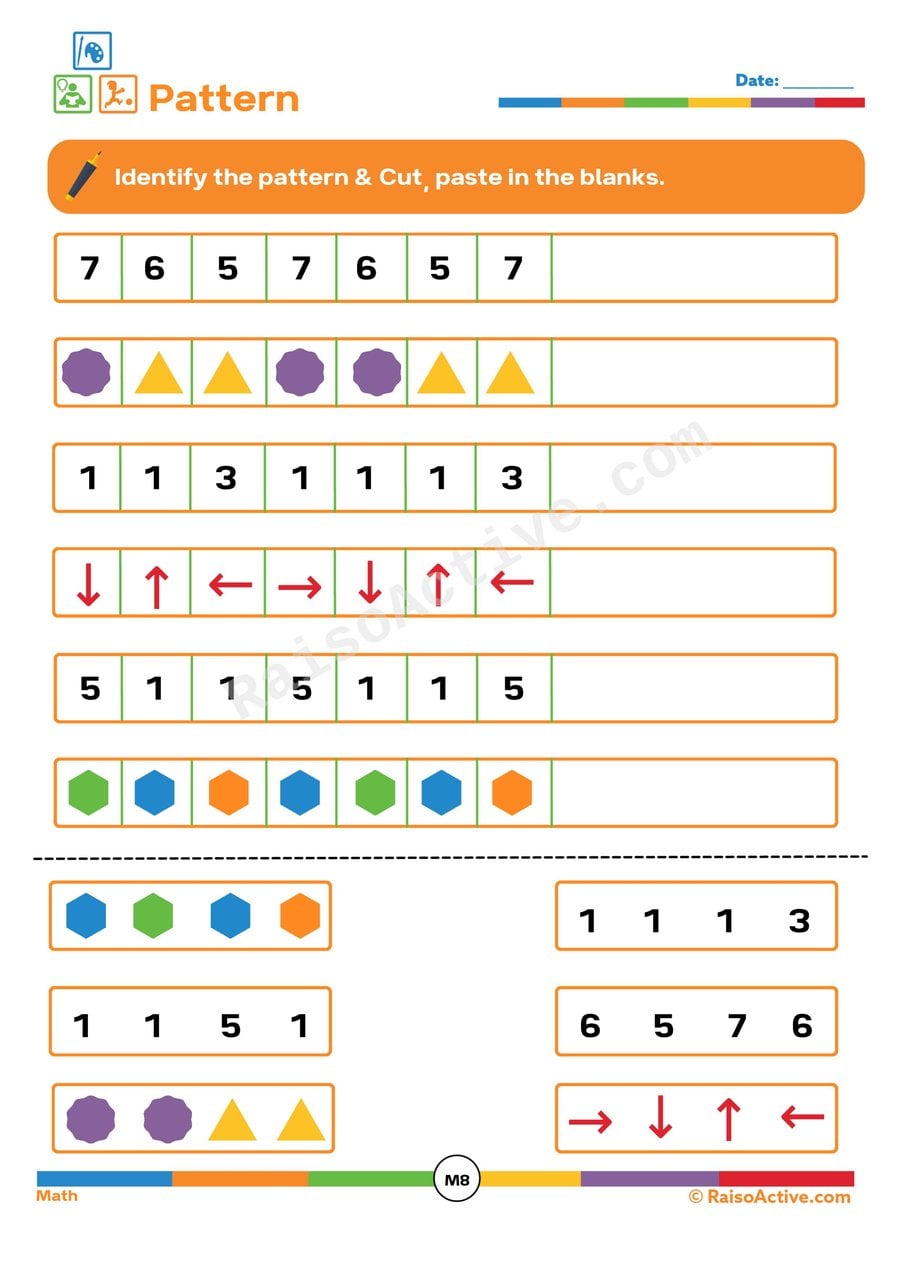
Pattern Fun: Identify and Complete the Sequences!
Ages 4-6 · Pre-K–KindergartenAges 4-6 · Reception–Year 1Ages 4-6 · LKG–UKGAges 4-6
This worksheet mixes numbers, shapes, and symbols across different pattern types, pushing children to apply the same pattern-recognition logic flexibly rather than to just one familiar format. For ages four to six, practicing across varied pattern types builds a more transferable understanding of sequences, which will support both math and reading skills that rely on recognizing regular structures.
Guides for this topic

Pre-Writing Strokes in Order: From Standing Lines to Loops (With Printable Patterns)
The developmental order of pre-writing strokes, from vertical lines to loops, and why practicing them in sequence makes letter formation much easier to learn.

Age-Appropriate Problem-Solving Activities: Building Critical Thinkers from the Ground Up
Discover fun, age-appropriate problem-solving activities for children ages 1-8. Build critical thinking, logic, and reasoning skills through play-based learning.

Fostering Creativity in Structured Learning: The Perfect Balance for Young Minds
Learn how to blend creativity with structured learning for children ages 1-8. Practical strategies, activities, and printable worksheets for parents and teachers.
Reviews
Every worksheet for ages 3–5, no watermark
Members download the full library of 1,000+ worksheets and every activity pack without watermarks or daily limits. One year costs ₹999 in India or $20 elsewhere.
See membership plansOr download any worksheet free with a watermark (5 a day).