Letter L Worksheet: Trace, Color, and Learn!
Tracing the letter L builds the top-to-bottom, left-to-right pencil strokes that show up again in dozens of other letters, so this is one of the more transferable shapes a 3-5 year old can practice. Naming and coloring objects that start with L — a lion, a ladder, a leaf — ties the shape to its sound, which is exactly how early readers start linking print to speech.
Part of the pack
Month 1: Learning & Development | Ages 4-5
This is page 9 of the pack. Ages 4-5 · Pre-KAges 4-5 · ReceptionAges 4-5 · LKGAges 4-5
Made for your child
A whole activity pack made with their name
60 pages to spot, build, trace and write their own name, plus pages about their favourites, feelings and family. See a free preview with their name.
Make an All About Me packFree preview · free for members
Or start free: a name tracing sheet with their nameCurriculum
- Writing > Letter Tracing A-Z
How to use this worksheet
Start by tracing the large model letter L with a finger before picking up a pencil, so your child feels the two straight strokes before drawing them. Move to tracing the dotted L with a pencil, then have them name each picture on the page and color only the ones that start with the L sound. Finish with the blank practice lines, where they write L on their own without the dotted guide.
Materials needed
- Pencil
- Crayons
Extension activities
- 1Build a letter L out of two straws or popsicle sticks glued at a right angle.
- 2Go on an 'L hunt' through a picture book, calling out every L word on the page.
- 3Trace a giant L on the floor with painter's tape and have your child walk it heel-to-toe.
- 4Pack a lunch of only L foods (lettuce, lemon, lentils) and name each one together.
- 5Practice writing L in a tray of rice or sand before moving back to paper.

Written by
Hemsweta Jain · Teacher Cheena
MBA and Early Childhood Educator, teaching since 2014 · Founder of RaisoActive, Mumbai
Every RaisoActive worksheet is designed and checked by the founder before publishing.
Published · Last reviewed
More from Month 1: Learning & Development | Ages 4-5

Diamond Shape Counting and Matching Worksheet for Preschoolers
Ages 3-5 · Preschool–Pre-KAges 3-5 · Nursery–ReceptionAges 3-5 · Nursery–LKGAges 3-5
This diamond-themed worksheet helps 3-5 year olds tell a diamond apart from squares, circles, and triangles by its four slanted sides and pointed top and bottom, a shape many preschoolers find trickier than rounder or more symmetrical ones. Counting the diamonds one at a time builds one-to-one correspondence, and matching same-sized diamonds strengthens visual discrimination, the skill of spotting small differences between similar-looking shapes.
Shape Sorting Worksheet: Cut and Paste Fun!
Ages 3-5 · Preschool–Pre-KAges 3-5 · Nursery–ReceptionAges 3-5 · Nursery–LKGAges 3-5
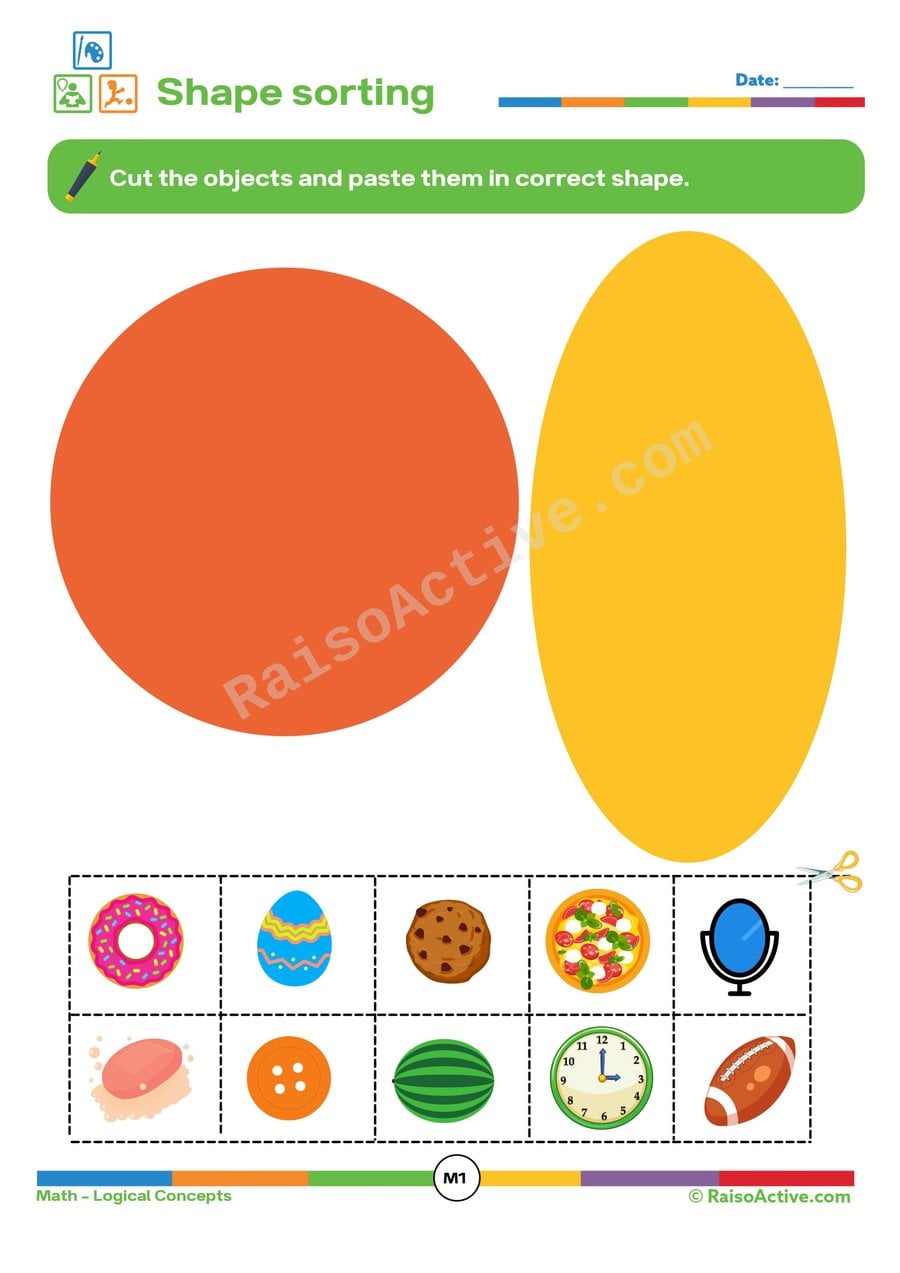
Sorting everyday objects — a plate, an egg, a clock — into 'circle' or 'oval' bins asks a 3-5 year old to look past what an object is and notice its geometric shape instead, an early step toward abstract categorization. Cutting along the outline of each picture and gluing it into the right column also builds the scissor control and hand-eye coordination that later supports handwriting.

The Hungry Ant: Fruit Matching Worksheet for Kids
Ages 3-5 · Preschool–Pre-KAges 3-5 · Nursery–ReceptionAges 3-5 · Nursery–LKGAges 3-5
Cutting out fruit pictures and matching them to an ant's trail builds scissor control in children ages 3-5 while also reinforcing counting and fruit vocabulary as they sort or count pieces before gluing. The hungry ant theme gives the matching task a simple narrative reason, finding food for the ant, which tends to hold young children's attention better than an unconnected matching exercise.

Trace and Color the Letter T Worksheet for Preschoolers
Ages 3-5 · Preschool–Pre-KAges 3-5 · Nursery–ReceptionAges 3-5 · Nursery–LKGAges 3-5
Tracing and writing the letter T gives children ages 3-5 practice with one simple vertical stroke crossed by one horizontal stroke, making it one of the more approachable uppercase letters to master, which builds confidence before moving on to more complex shapes. Coloring the finished letters afterward reinforces recognition of the letter's form independent of the writing motion itself.

Butterfly Cutting Practice Worksheet for Preschoolers
Ages 3-5 · Preschool–Pre-KAges 3-5 · Nursery–ReceptionAges 3-5 · Nursery–LKGAges 3-5
Cutting along a butterfly's wing outline gives children ages 3-5 focused scissor practice with a mix of straight and gently curved edges, building the specific hand strength and control needed for more advanced cutting tasks. Scissor skills like this directly support later pencil control too, since both rely on similar hand muscles and a steady, coordinated grip between two hands.

Fun with Letter F Worksheet: Tracing, Coloring, and Letter Recognition!
Ages 3-5 · Preschool–Pre-KAges 3-5 · Nursery–ReceptionAges 3-5 · Nursery–LKGAges 3-5
Tracing and writing the letter F gives children ages 3-5 practice with one vertical stroke and two horizontal strokes at different heights, building precision in starting and stopping a pencil at specific points along a line. Combined with coloring and recognition activities, this worksheet reinforces that the letter F represents a specific sound, an early step toward connecting written symbols with spoken language.
Find and Color Ordinal Numbers Worksheet
Ages 4-6 · Pre-K–KindergartenAges 4-6 · Reception–Year 1Ages 4-6 · LKG–UKGAges 4-6
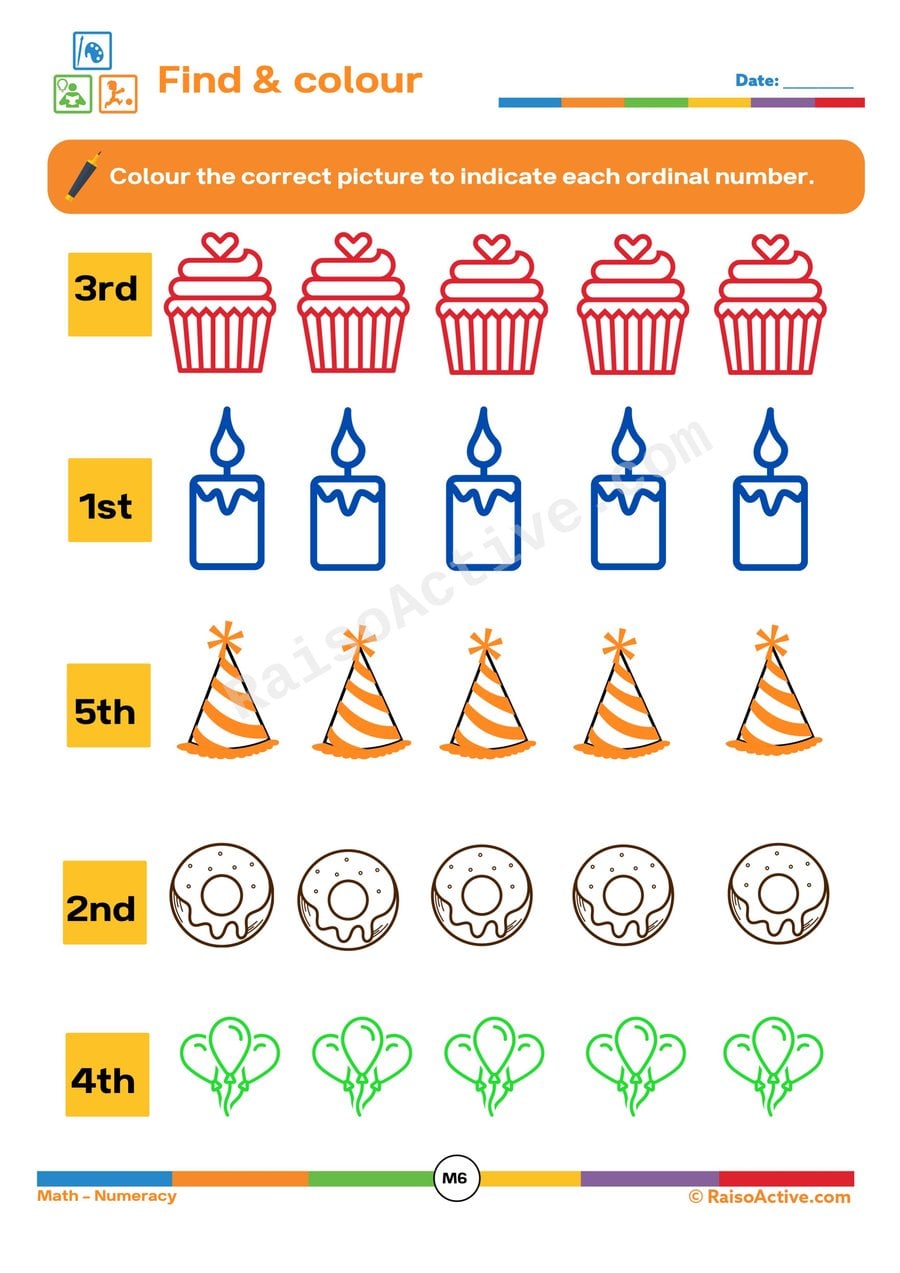
Finding and coloring items based on their ordinal position, like the third balloon or the first star, teaches children ages 4-6 a different kind of counting than they may be used to. Ordinal numbers describe position in a sequence, first, second, third, rather than quantity, and this distinction is a genuinely tricky concept that takes deliberate practice to master, forming an important foundation for later math concepts like sequencing steps.
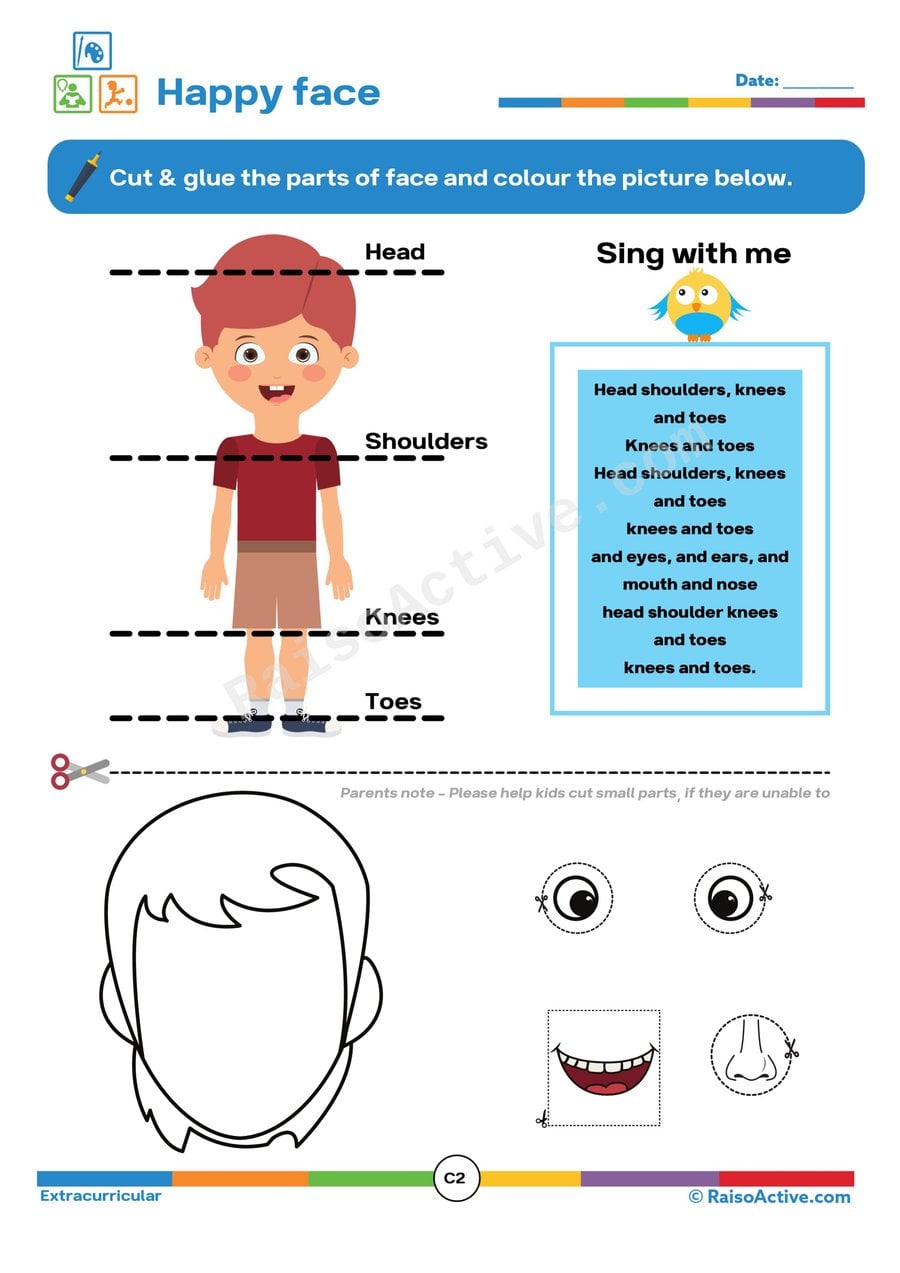
Happy Face Worksheet: Cut, Paste, and Sing!
Ages 3-5 · Preschool–Pre-KAges 3-5 · Nursery–ReceptionAges 3-5 · Nursery–LKGAges 3-5
Cutting out and placing facial features onto a face outline teaches children ages 3-5 the names and locations of basic face parts, like eyes, nose, and mouth, while building the same scissor and gluing skills practiced in other cut-and-paste activities. Pairing the craft with singing, as the title suggests, adds a rhythmic, repeated language element that helps body-part vocabulary stick.
Related worksheets

Trace and Identify the Letter 'G' Worksheet for Preschoolers
Ages 4-5 · Pre-KAges 4-5 · ReceptionAges 4-5 · LKGAges 4-5
This worksheet helps children ages 4-5 build the pencil control needed to form the letter G while also practicing visual search skills as they locate every G hidden among other letters. Coloring pictures that start with G ties the abstract letter shape to concrete, familiar words, strengthening the letter-sound connection.

Learn the Letter 'V': Tracing, Matching, and Coloring Worksheet
Ages 3-5 · Preschool–Pre-KAges 3-5 · Nursery–ReceptionAges 3-5 · Nursery–LKGAges 3-5
Tracing, matching, and coloring the letter 'V' gives children ages 3-5 focused repetition on a letter formed entirely from two diagonal strokes, a different motor pattern than the curves and verticals used in many other letters. Matching pictures like a violin or a van to the letter builds the sound-symbol connection for the /v/ sound, which can be tricky to distinguish from /f/ or /b/ for young learners. Highlighting the lowercase 'v' within a letter grid to help a character find an object adds a game-like search element that keeps attention on the task.

Learn the Letter 'n' Worksheet: Tracing, Matching, and Coloring Fun!
Ages 3-5 · Preschool–Pre-KAges 3-5 · Nursery–ReceptionAges 3-5 · Nursery–LKGAges 3-5
This worksheet builds letter 'n' recognition for 3-5 year olds through tracing, a highlighting search, matching to pictures, and coloring — four connected tasks that ask your child to hold onto the same letter across different formats and follow multi-step instructions in sequence. The letter 'n' is frequently confused with 'm' since both involve humps, so the repeated exposure here helps children start telling the two apart by sound and shape.
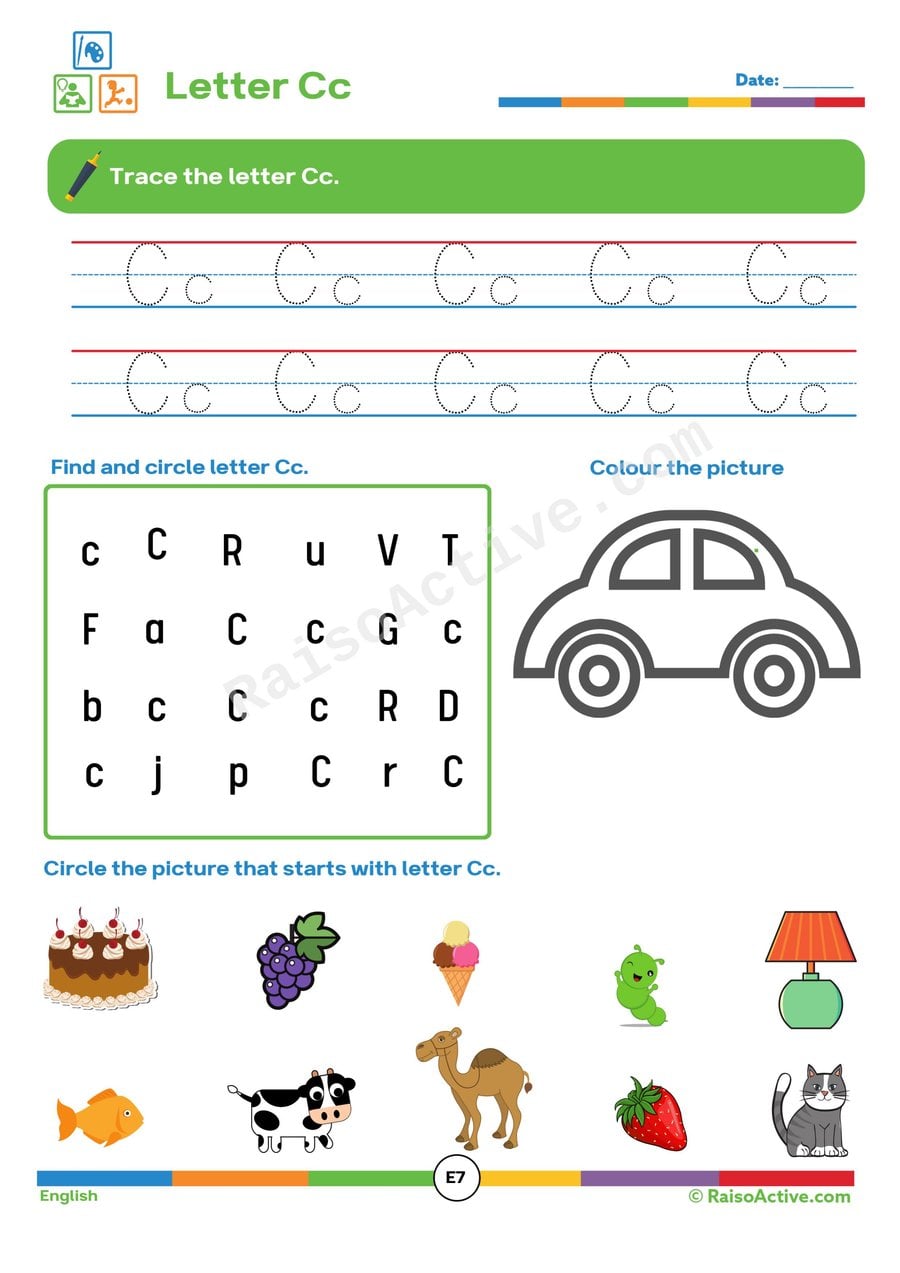
Letter Cc Worksheet: Trace, Find, and Color!
Ages 3-5 · Preschool–Pre-KAges 3-5 · Nursery–ReceptionAges 3-5 · Nursery–LKGAges 3-5
This worksheet has children ages 3-5 trace the letter Cc, search a grid to find and circle every instance of it, then color a picture of a car and identify other pictures that start with C. Layering tracing, visual search, and picture-sound matching in one worksheet gives repeated exposure to the same letter in several different formats, which builds stronger recognition than any single task alone.

Fun with Letter F: Tracing, Finding, and Coloring Worksheet
Ages 3-5 · Preschool–Pre-KAges 3-5 · Nursery–ReceptionAges 3-5 · Nursery–LKGAges 3-5
Children ages 3-5 reinforce letter recognition and pencil control as they trace the letter F, search for it among other letters, and identify a picture starting with the F sound. Working through the same letter in multiple formats — writing, spotting, and sound-matching — helps move the letter from simple recognition toward automatic recall, an important pre-reading skill.

Letter Hh Tracing and Matching Worksheet for Preschoolers
Ages 3-5 · Preschool–Pre-KAges 3-5 · Nursery–ReceptionAges 3-5 · Nursery–LKGAges 3-5
Children ages 3-5 build letter recognition and handwriting readiness as they trace uppercase and lowercase Hh, identify the letter among different fonts, and match it to pictures of objects that start with the Hh sound. Practicing the letter across tracing, spotting, and sound-matching formats helps cement both its shape and its 'huh' sound more thoroughly than repetition of just one activity.

Letter Y Tracing and Recognition Worksheet for Preschoolers
Ages 3-5 · Preschool–Pre-KAges 3-5 · Nursery–ReceptionAges 3-5 · Nursery–LKGAges 3-5
This worksheet builds recognition and formation of the letter Y through guided tracing practice and by identifying pictures of words that start with Y, like 'yarn' or 'yo-yo.' For three- to five-year-olds, tracing first with a finger and then with a pencil builds the motor memory needed before a child can form the letter confidently on their own.

Letter B Tracing and Identification Worksheet for Preschoolers
Ages 3-5 · Preschool–Pre-KAges 3-5 · Nursery–ReceptionAges 3-5 · Nursery–LKGAges 3-5
This worksheet helps children ages 3-5 practice tracing and writing the letter B, identifying B among other letters, and recognizing objects that start with the letter B. Circling the correct letter within a small group builds the visual scanning skill children need before they can read words fluently.
Guides for this topic

Best Worksheets for 3-Year-Olds: What Works and What to Avoid
What works on worksheets for 3-year-olds: short sessions, crayons, tracing lines, matching, cutting, a free weekly plan, and signs one is too advanced.
Fostering Creativity in Structured Learning: The Perfect Balance for Young Minds
Learn how to blend creativity with structured learning for children ages 1-8. Practical strategies, activities, and printable worksheets for parents and teachers.

How to Help Your Child with Letter Reversals: A Complete Guide for Parents and Teachers
Letter reversals are normal until age 7-8. Learn the best multisensory strategies, anchor letter tricks, and activities to help children write b, d, p, and q correctly.
Reviews
Every worksheet for ages 3–5, no watermark
Members download the full library of 1,000+ worksheets and every activity pack without watermarks or daily limits. One year costs ₹999 in India or $20 elsewhere.
See membership plansOr download any worksheet free with a watermark (5 a day).