Camera Spy - Pattern Recognition Worksheet for Preschoolers
This worksheet develops visual scanning and pattern-matching skills in children ages 3-5 as they use a 'spy camera' to find smaller patterns hidden within a larger image. Searching for a specific pattern among distractors builds sustained visual attention, a skill that supports later tasks like letter recognition and proofreading.
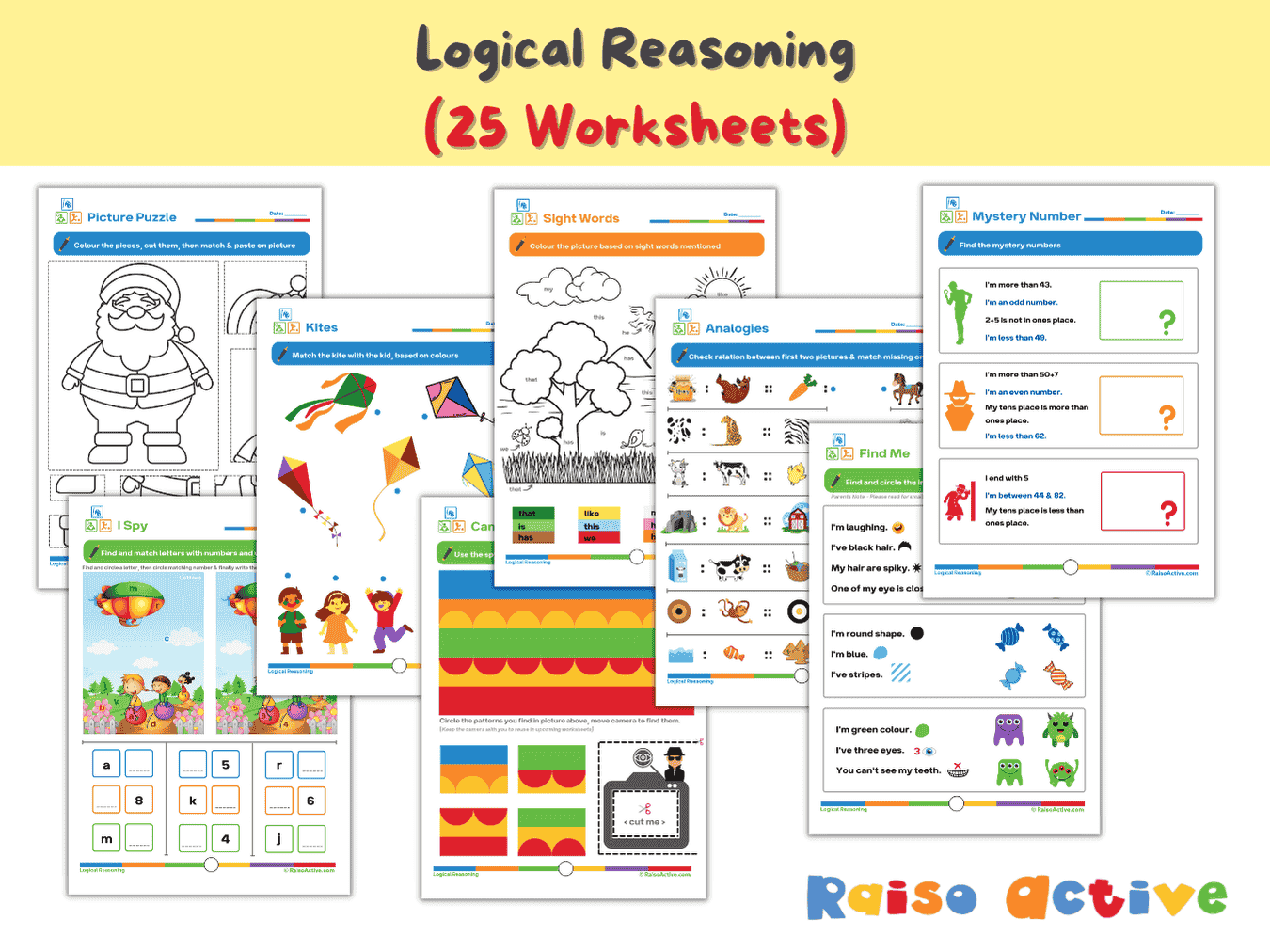
Part of the pack
Logical Reasoning Activity Book for Preschool & Kindergarten | Patterns, Puzzles & Analogies
This is page 20 of the pack. Ages 4-7 · Pre-K–Grade 1Ages 4-7 · Reception–Year 2Ages 4-7 · LKG–Class 1Ages 4-7
Curriculum
How to use this worksheet
Look at the main image together and help your child notice the specific pattern they need to search for. Have them scan the smaller images around the page, comparing each one carefully to the target pattern. When they spot a match, have them circle it with a pencil or crayon. Continue until all matching patterns have been found, then review the circled answers together.
Materials needed
- Pencil
- Crayons
Extension activities
- 1Create your own patterns using different colors and shapes for your child to search for.
- 2Go on a pattern hunt around the house, looking for repeating designs on fabric, tiles, or wallpaper.
- 3Play a 'spy' game where you describe a hidden object by its pattern and your child searches for it.
- 4Make a simple pattern using stickers and ask your child to find the matching sticker in a mixed pile.
- 5Time how long it takes to find all the matches, then try again to see if speed improves.

Written by
Hemsweta Jain · Teacher Cheena
MBA and Early Childhood Educator, teaching since 2014 · Founder of RaisoActive, Mumbai
Every RaisoActive worksheet is designed and checked by the founder before publishing.
Published · Last reviewed
More from Logical Reasoning Activity Book for Preschool & Kindergarten | Patterns, Puzzles & Analogies
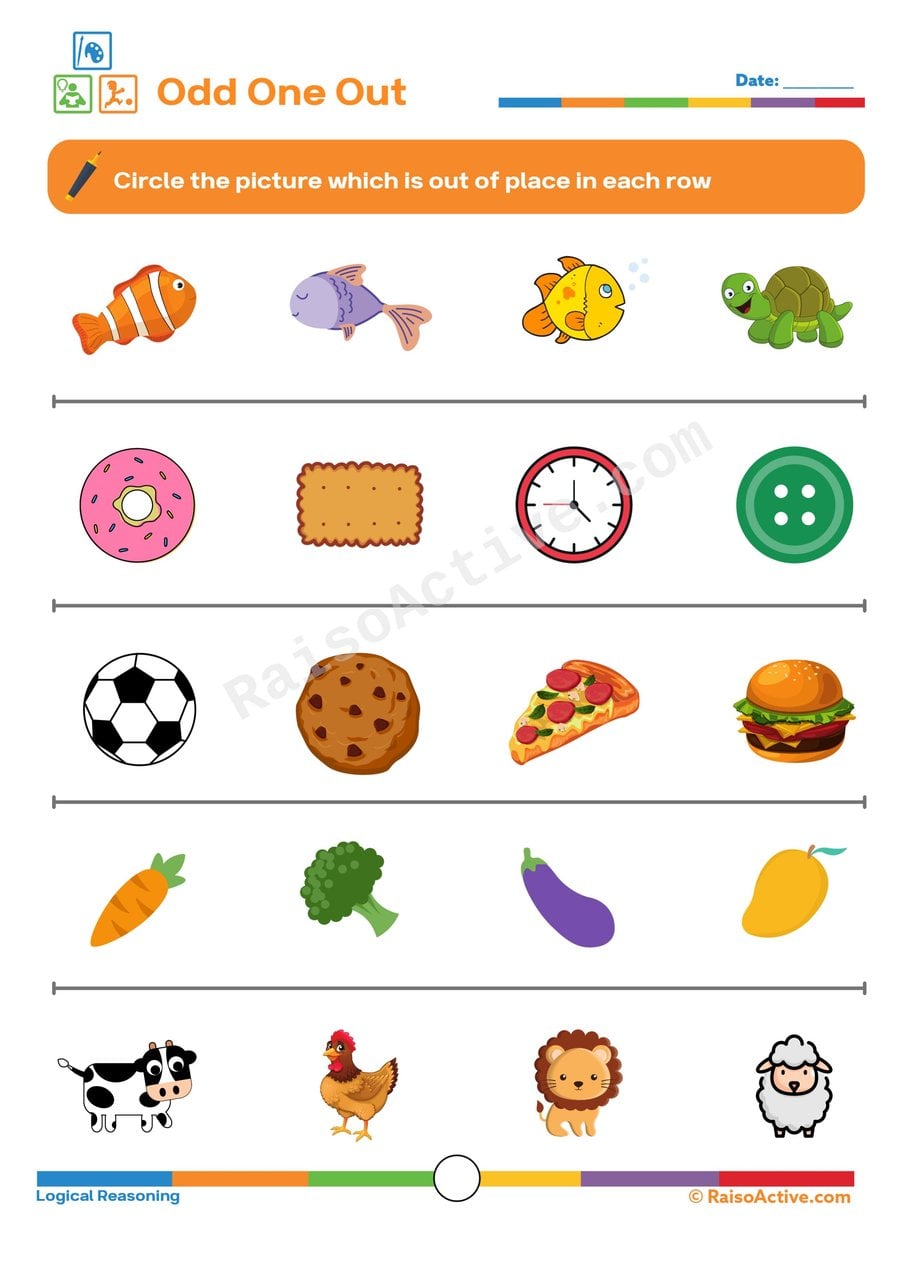
Odd One Out Worksheet: Spot the Differences!
Ages 4-6 · Pre-K–KindergartenAges 4-6 · Reception–Year 1Ages 4-6 · LKG–UKGAges 4-6
Identifying which picture in a row is different from the others builds visual discrimination and logical reasoning in children ages 4-6, requiring them to compare multiple objects at once and notice a distinguishing feature rather than just spotting an obvious mismatch. This skill directly supports later academic tasks like sorting, categorizing, and comparing, since children must articulate what makes an item different, not just recognize that it is. Explaining their reasoning out loud after choosing also builds early verbal reasoning and communication skills.
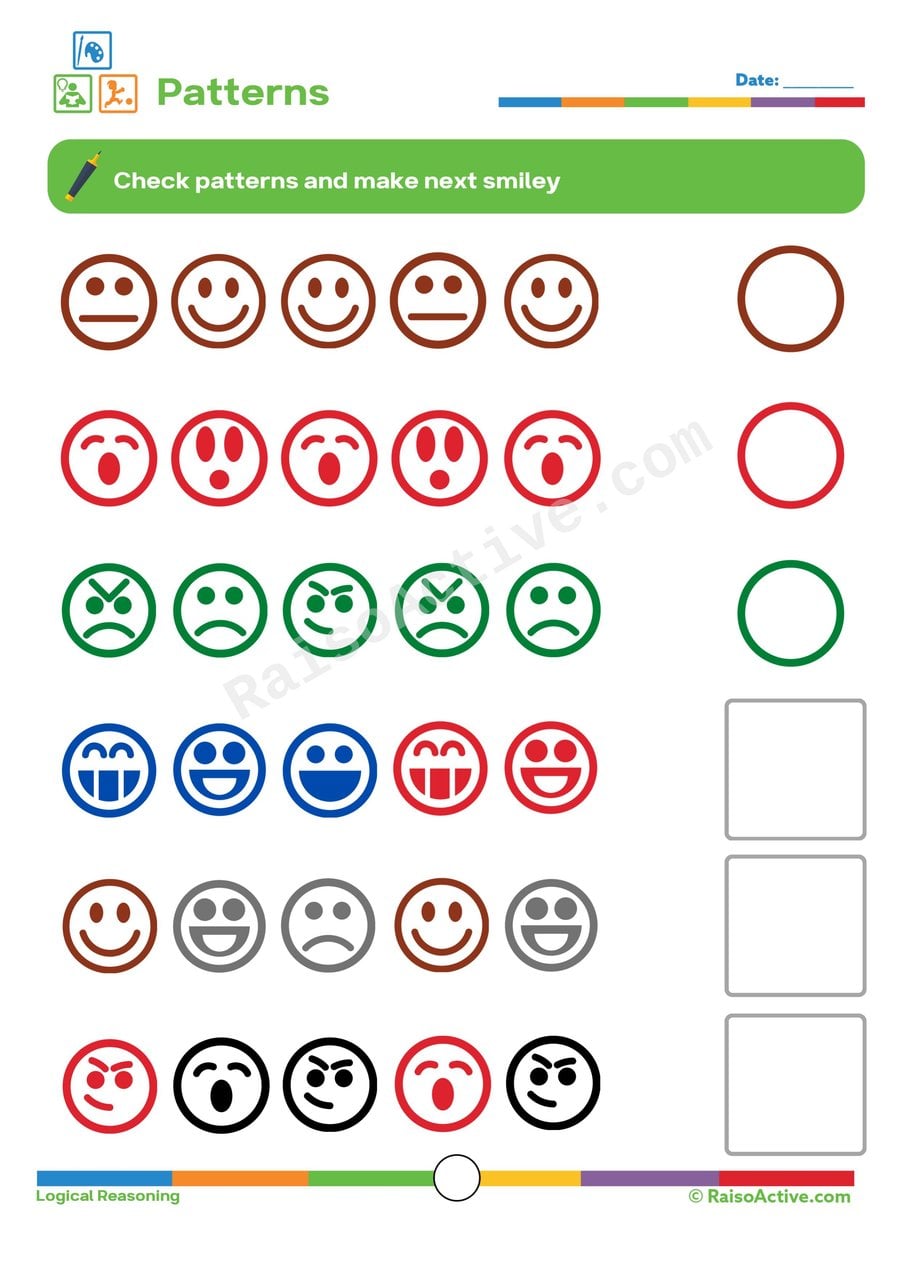
Smiley Face Patterns Worksheet for Preschoolers
Ages 3-5 · Preschool–Pre-KAges 3-5 · Nursery–ReceptionAges 3-5 · Nursery–LKGAges 3-5
This pattern worksheet has children ages 3-5 study a row of smiley faces with varying expressions or colors and determine what comes next in the repeating sequence, building foundational pattern recognition and logical reasoning skills. Recognizing and extending patterns is one of the earliest forms of mathematical thinking children encounter, laying groundwork for later work with number patterns, skip counting, and algebraic reasoning. Because the pattern uses a familiar, emotionally engaging image like a smiley face, children stay motivated through several rows of repeated practice.

Easter Egg Pattern Matching Worksheet for Preschoolers
Ages 3-5 · Preschool–Pre-KAges 3-5 · Nursery–ReceptionAges 3-5 · Nursery–LKGAges 3-5
This seasonal worksheet strengthens pattern-recognition and visual matching skills in children ages 3-5 by having them connect a decorative pattern to the Easter egg that displays the same design. Matching a pattern swatch to its corresponding decorated egg requires close visual comparison of colors, shapes, and repeating elements, sharpening the same attention-to-detail skills used in reading and early math. The seasonal egg theme adds festive motivation to the visual discrimination practice.

I Spy Letter and Number Matching Worksheet for Preschoolers
Ages 3-5 · Preschool–Pre-KAges 3-5 · Nursery–ReceptionAges 3-5 · Nursery–LKGAges 3-5
Finding and circling a target letter, then finding and circling its matching number before writing the letter in a blank space, gives children ages 3-5 combined practice in visual scanning, letter recognition, and number recognition within a single multi-step task. Because the activity moves between two different symbol systems, letters and numbers, children build flexible attention and the ability to switch between related but distinct types of thinking. Writing the letter as a final step also reinforces handwriting practice on top of the visual search components.
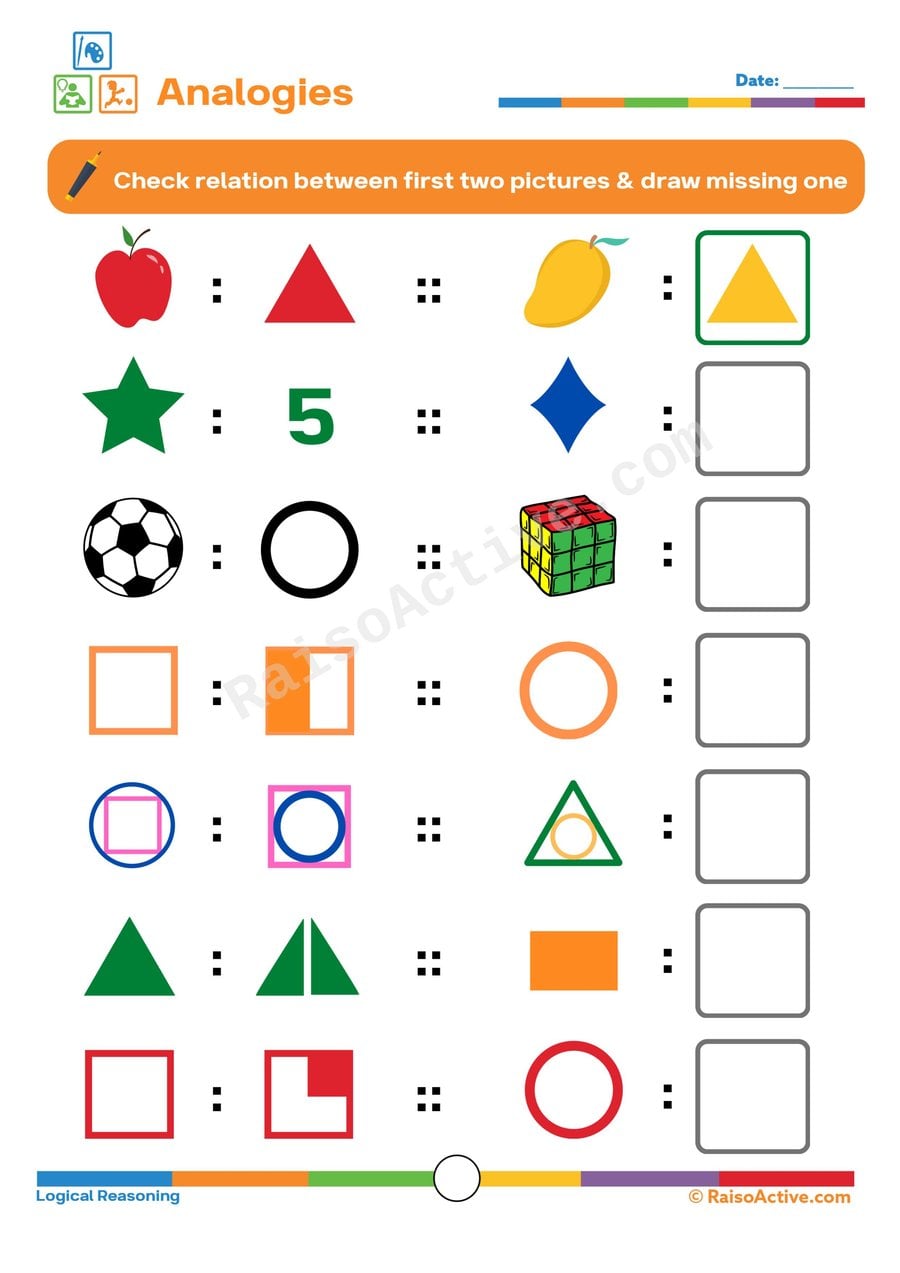
Shape Analogies Worksheet: Find the Pattern!
Ages 3-5 · Preschool–Pre-KAges 3-5 · Nursery–ReceptionAges 3-5 · Nursery–LKGAges 3-5
This shape analogy worksheet pushes children ages 3-5 beyond simple shape naming into relational reasoning, asking them to figure out how two shapes relate to each other and then apply that same relationship to a third shape. This 'this is to that as this is to what' thinking is an early form of the analogical reasoning used throughout later math and logic problems. Because the task requires holding two pieces of information in mind at once — the shape and the relationship — it offers meaningfully more challenge than basic shape matching.

Honeycomb Pattern Matching Worksheet for Preschoolers
Ages 3-5 · Preschool–Pre-KAges 3-5 · Nursery–ReceptionAges 3-5 · Nursery–LKGAges 3-5
Cutting out hexagon shapes and matching their patterns to complete an incomplete honeycomb teaches children ages 3-5 pattern recognition, requiring them to notice details like color, design, or line placement before deciding where a piece belongs. Because hexagons fit together in a specific interlocking way, this activity also introduces early tessellation and spatial reasoning, concepts that support later geometry learning. The cutting and gluing steps add fine motor practice on top of the visual pattern-matching task.

Find the Matching Image: A Fun Logical Reasoning Worksheet for Kids
Ages 3-5 · Preschool–Pre-KAges 3-5 · Nursery–ReceptionAges 3-5 · Nursery–LKGAges 3-5
Reading or listening to a short description and circling the image that matches it teaches children ages 3-5 to translate spoken or written language into a mental picture, then compare that picture against several visual options. This kind of description-to-image matching builds listening comprehension and logical reasoning, since children must hold multiple details in mind, like color, size, or action, before deciding which image fits all of them. It's a step up from simple visual matching because it requires connecting language to an image rather than comparing two pictures directly.

Santa Picture Puzzle Worksheet for Kids
Ages 3-5 · Preschool–Pre-KAges 3-5 · Nursery–ReceptionAges 3-5 · Nursery–LKGAges 3-5
This puzzle-style worksheet has children ages 3-5 color, cut, and reassemble Santa's picture from individual puzzle pieces, combining visual discrimination and problem-solving as they figure out where each colored piece belongs on the main image. Because the pieces must be matched by both shape and picture detail, children practice a more demanding form of visual comparison than a standard coloring page. Completing the full picture piece by piece also builds patience and persistence with a multi-step project.
Related worksheets

Clothing Pattern Matching Worksheet for Preschoolers
Ages 3-5 · Preschool–Pre-KAges 3-5 · Nursery–ReceptionAges 3-5 · Nursery–LKGAges 3-5
By comparing clothing items and connecting each one to its pattern match, children ages 3-5 build visual discrimination skills, learning to notice fine differences in stripes, dots, or repeated shapes. This close-looking practice supports the same attention-to-detail children will later need to tell similar-looking letters and numbers apart.
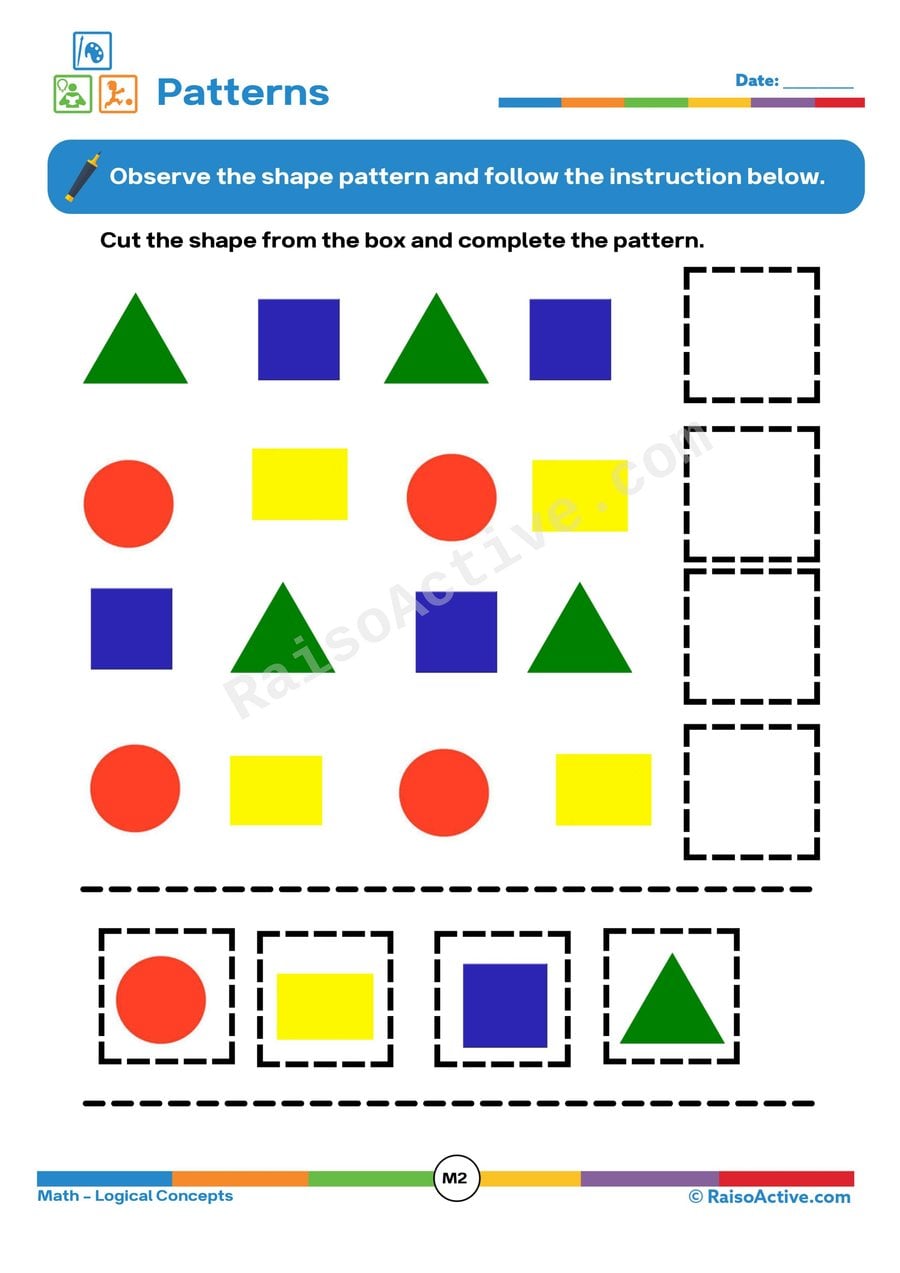
Shape Pattern Worksheet: Complete the Pattern!
Ages 3-5 · Preschool–Pre-KAges 3-5 · Nursery–ReceptionAges 3-5 · Nursery–LKGAges 3-5
Completing a repeating shape pattern asks children ages 3-5 to notice what comes next in a sequence and predict it correctly, an early form of the logical reasoning used in algebra much later on. Recognizing and continuing patterns also strengthens visual memory, since a child has to hold the beginning of the pattern in mind while figuring out what should come next.

Balloon Pattern Matching Worksheet for Preschoolers
Ages 3-5 · Preschool–Pre-KAges 3-5 · Nursery–ReceptionAges 3-5 · Nursery–LKGAges 3-5
Children ages 3-5 build early pattern-recognition skills on this worksheet by studying a sequence of colored balloons and finding the matching set to complete it. Recognizing and continuing a repeating sequence is a foundational pre-math skill that later supports understanding of number patterns, skip counting, and simple algebraic thinking.

What Comes Next? Pattern Worksheet for Preschoolers
Ages 3-5 · Preschool–Pre-KAges 3-5 · Nursery–ReceptionAges 3-5 · Nursery–LKGAges 3-5
Identifying a repeating sequence of pictures and circling the one that comes next builds pattern-recognition and visual discrimination skills for children ages 3-5, an early form of logical reasoning that connects to later math concepts like skip counting and multiplication.

Coding Shapes Worksheet for Preschoolers: Cut and Paste Patterns
Ages 3-5 · Preschool–Pre-KAges 3-5 · Nursery–ReceptionAges 3-5 · Nursery–LKGAges 3-5
This cut-and-paste activity has children ages 3-5 recreate shape sequences shown in sample boxes, combining shape recognition with the same ordered, step-by-step thinking used in beginner coding concepts. Cutting out individual shapes and arranging them in the correct sequence also builds fine motor precision and spatial planning.

Complete the Pattern Worksheet: Ladybugs, Snails, and More!
Ages 3-5 · Preschool–Pre-KAges 3-5 · Nursery–ReceptionAges 3-5 · Nursery–LKGAges 3-5
Continuing a visual pattern like 'ladybug, snail, ladybug' asks preschoolers to notice a repeating rule and predict what comes next, an early form of the logical reasoning that later supports algebra and sequencing in reading. Because the pictures here are garden creatures, this worksheet also builds vocabulary and observation skills as children study small differences between the pieces before choosing the correct one.

Fall Leaf Patterns Matching Worksheet for Preschoolers
Ages 3-5 · Preschool–Pre-KAges 3-5 · Nursery–ReceptionAges 3-5 · Nursery–LKGAges 3-5
Children ages 3-5 build pattern recognition and logical reasoning skills by matching colored fall leaves to complete repeating patterns in a grid. Recognizing and continuing a pattern is an early algebraic thinking skill, teaching children to notice what comes next based on a repeating sequence — a foundation for later math concepts.

Shape Pattern Fun: Complete the Pattern Worksheet for Preschoolers
Ages 3-5 · Preschool–Pre-KAges 3-5 · Nursery–ReceptionAges 3-5 · Nursery–LKGAges 3-5
This worksheet introduces children ages 3-5 to pattern recognition using shapes, asking them to notice a repeating sequence and supply the missing piece. Continuing a pattern requires children to detect a rule and predict what comes next, an early form of the logical reasoning that later supports algebra and sequencing skills. Cutting and pasting the correct shape also reinforces shape recognition and fine motor precision.
Guides for this topic

Pre-Writing Strokes in Order: From Standing Lines to Loops (With Printable Patterns)
The developmental order of pre-writing strokes, from vertical lines to loops, and why practicing them in sequence makes letter formation much easier to learn.

Age-Appropriate Problem-Solving Activities: Building Critical Thinkers from the Ground Up
Discover fun, age-appropriate problem-solving activities for children ages 1-8. Build critical thinking, logic, and reasoning skills through play-based learning.

Fostering Creativity in Structured Learning: The Perfect Balance for Young Minds
Learn how to blend creativity with structured learning for children ages 1-8. Practical strategies, activities, and printable worksheets for parents and teachers.
Reviews
Every worksheet for ages 3–5, no watermark
Members download the full library of 1,000+ worksheets and every activity pack without watermarks or daily limits. One year costs ₹999 in India or $20 elsewhere.
See membership plansOr download any worksheet free with a watermark (5 a day).