Clothing Pattern Matching Worksheet for Preschoolers
By comparing clothing items and connecting each one to its pattern match, children ages 3-5 build visual discrimination skills, learning to notice fine differences in stripes, dots, or repeated shapes. This close-looking practice supports the same attention-to-detail children will later need to tell similar-looking letters and numbers apart.
Part of the pack
Hands-On Early Learning Activity Book: Math, Science, Literacy & Emotions for Ages 3-6
This is page 15 of the pack. Ages 3-6 · Preschool–KindergartenAges 3-6 · Nursery–Year 1Ages 3-6 · Nursery–UKGAges 3-6

Made for your child
Counting to 10, made for your child
A maths pack with your child's name in it: pictures that explain, practice at three levels, puzzles and story sums about them. Print a new set whenever they finish.
Make a maths packFree preview · free for members
Curriculum
- Patterns > Patterns
How to use this worksheet
Look at each clothing item on the left and describe its pattern together, using words like 'striped' or 'spotted.' Have your child search the items on the right for the one with the identical pattern, color, and arrangement. Once found, let them draw a connecting line between the matching pair using a pencil. Continue through the page, and finish by coloring the matched clothing items with crayons.
Materials needed
- Pencil
- Crayons
Extension activities
- 1Sort actual clothes from a drawer or laundry pile into pattern groups — stripes, dots, plain, or plaid.
- 2Design an original patterned outfit on paper by repeating a simple shape or color sequence.
- 3Play a patterned-pairs memory game using cut-out clothing cards from an old magazine or catalog.
- 4Take a walk and count how many striped or spotted patterns you can spot on people's clothing.

Written by
Hemsweta Jain · Teacher Cheena
MBA and Early Childhood Educator, teaching since 2014 · Founder of RaisoActive, Mumbai
Every RaisoActive worksheet is designed and checked by the founder before publishing.
Published · Last reviewed
More from Hands-On Early Learning Activity Book: Math, Science, Literacy & Emotions for Ages 3-6

Balloon Pattern Matching Worksheet for Preschoolers
Ages 3-5 · Preschool–Pre-KAges 3-5 · Nursery–ReceptionAges 3-5 · Nursery–LKGAges 3-5
This worksheet strengthens pattern recognition in children ages 3-5 by having them study a repeating sequence of colored balloons and locate the matching arrangement elsewhere on the page. Recognizing and reproducing a pattern is an early pre-algebra skill, laying groundwork for later number patterns and logical sequencing.
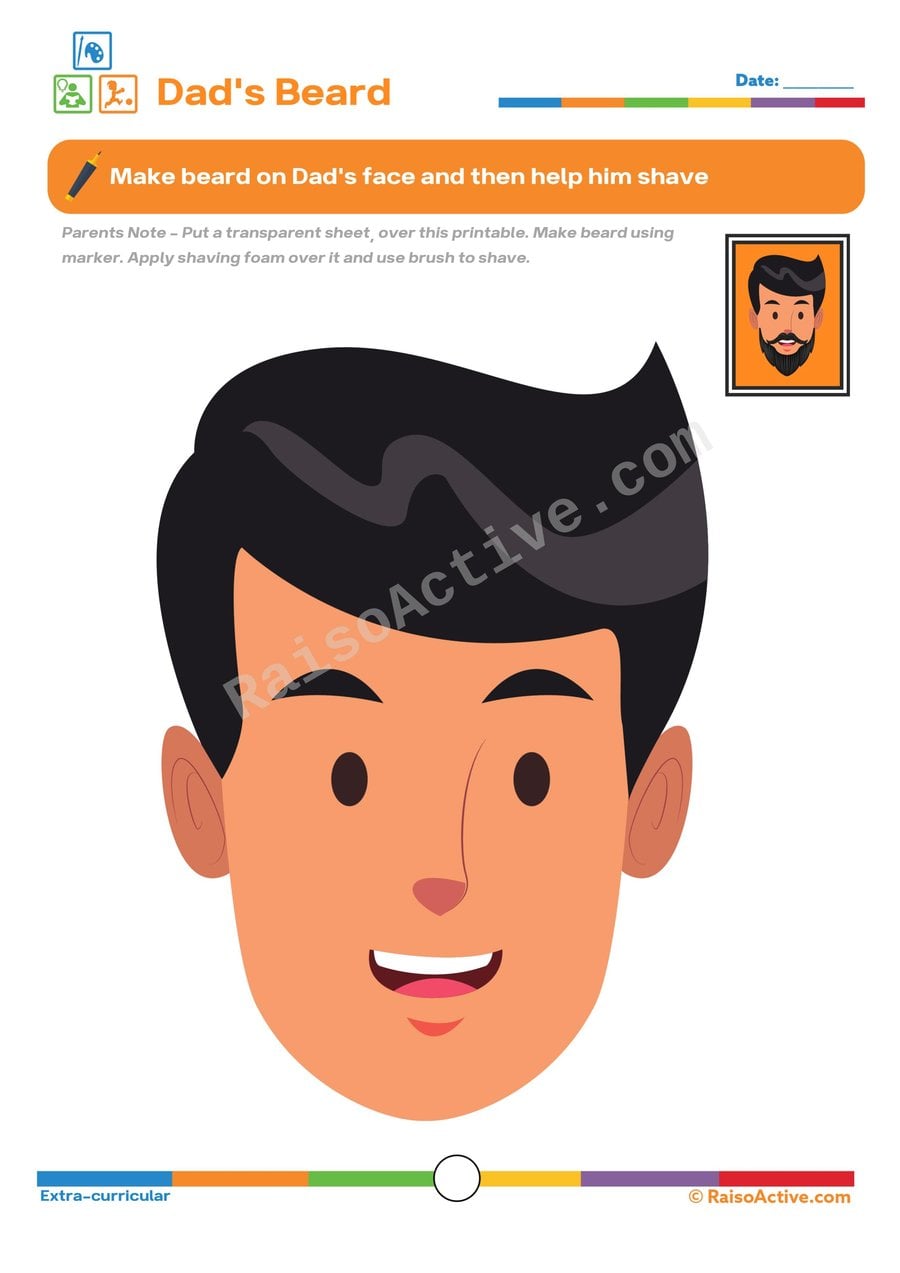
Dad's Beard: A Fun Shaving Activity for Kids!
Ages 3-5 · Preschool–Pre-KAges 3-5 · Nursery–ReceptionAges 3-5 · Nursery–LKGAges 3-5
This sensory pretend-shaving activity builds fine motor precision and hand control in children ages 3-5, as they draw a beard with a marker and then carefully brush away shaving foam in controlled strokes. Beyond motor skills, it gives children a playful, low-stakes way to imitate a grown-up grooming routine they've likely observed at home.
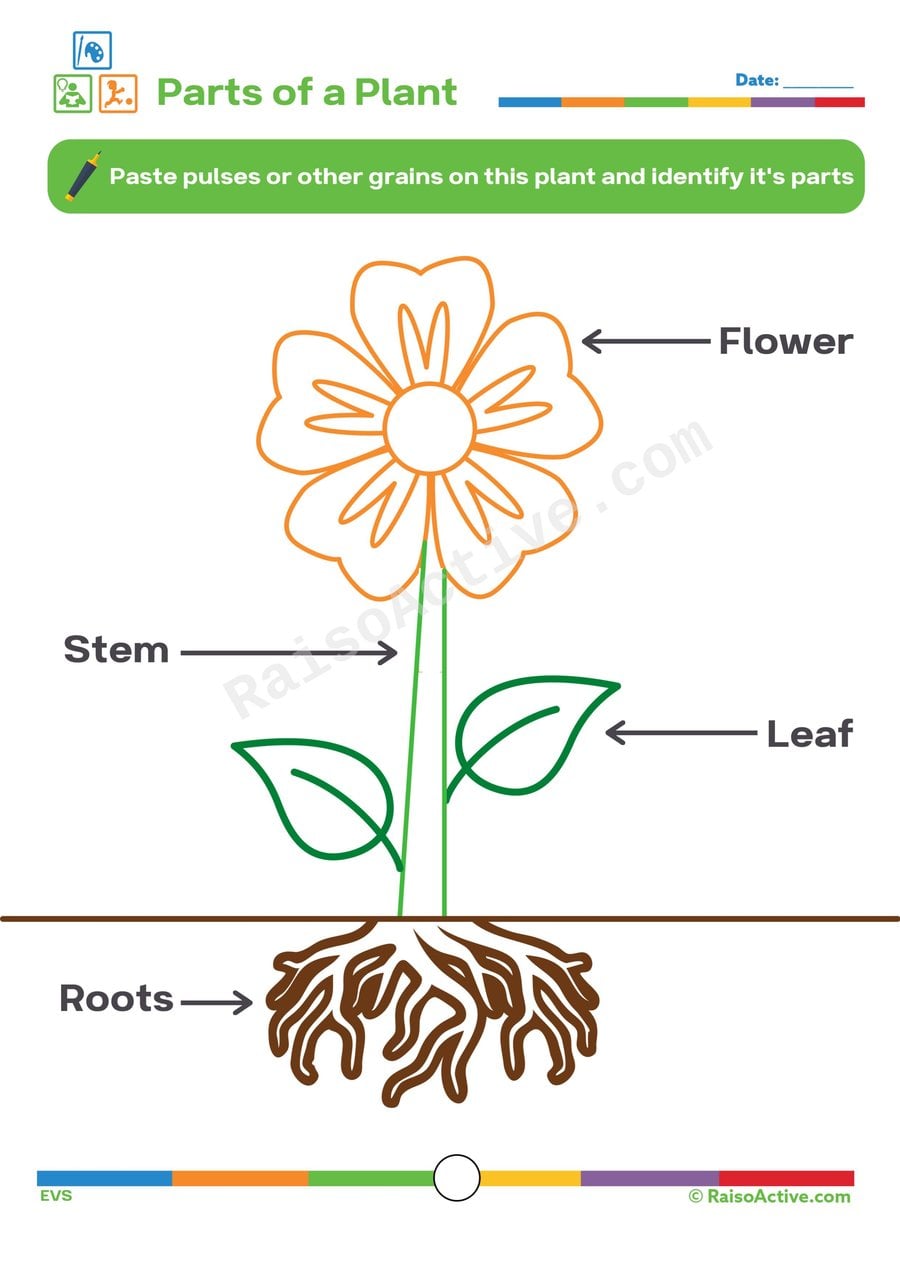
Parts of a Plant Worksheet: Identify and Label!
Ages 3-5 · Preschool–Pre-KAges 3-5 · Nursery–ReceptionAges 3-5 · Nursery–LKGAges 3-5
This activity teaches children ages 3-5 the basic parts of a plant — flower, stem, leaf, and roots — by having them label a diagram and add texture using real pulses or grains glued onto the plant shape. Combining a tactile material with each labeled part helps young children retain the vocabulary better than labeling alone, since touch and sight reinforce the same information.
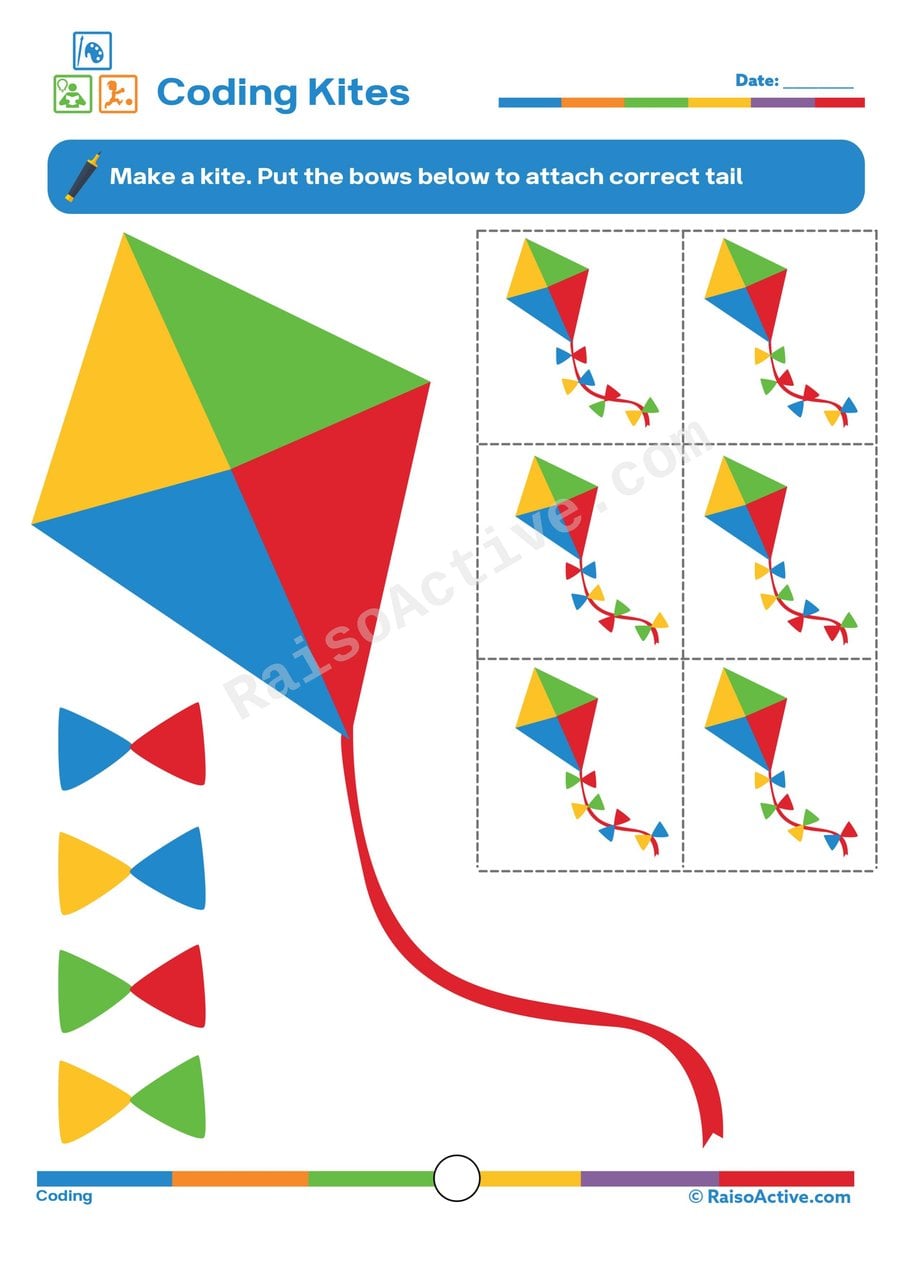
Coding Kites Worksheet: Match the Bows!
Ages 3-5 · Preschool–Pre-KAges 3-5 · Nursery–ReceptionAges 3-5 · Nursery–LKGAges 3-5
By matching each colorful bow to the kite sharing its color pattern, children ages 3-5 practice visual pattern recognition — an early form of the same logical sequencing used in beginner coding concepts. Cutting, matching, and gluing the correct bow also reinforces color-word vocabulary and precise hand-eye coordination.
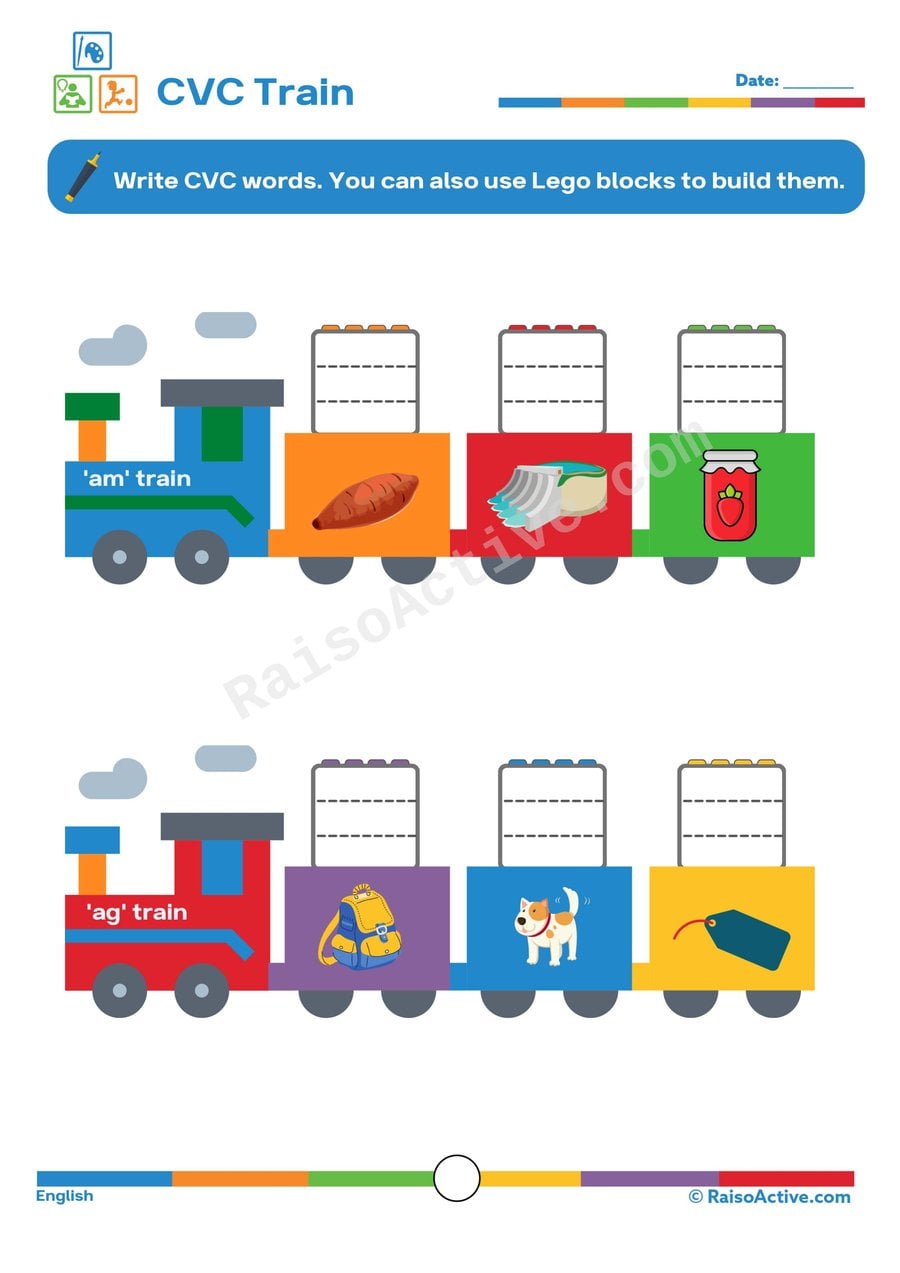
CVC Train Worksheet: Write CVC Words!
Ages 4-6 · Pre-K–KindergartenAges 4-6 · Reception–Year 1Ages 4-6 · LKG–UKGAges 4-6
Writing consonant-vowel-consonant words like 'cat,' 'sun,' or 'pig' under matching pictures gives children ages 4-6 direct practice with letter-sound blending, a core phonics skill that underpins independent reading. Because each train car pairs a picture clue with a blank space, children also practice translating a spoken word they can sound out into its correctly spelled written form.

3D Shapes Worksheet: Explore and Learn with Playdough!
Ages 4-6 · Pre-K–KindergartenAges 4-6 · Reception–Year 1Ages 4-6 · LKG–UKGAges 4-6
This worksheet teaches children ages 4-6 the basic components of 3D shapes — vertices, edges, and faces — by having them count each feature on shapes like cubes and cones, then build matching shapes out of playdough. Physically constructing a shape and counting its parts by hand builds a far deeper understanding of geometry than looking at flat pictures alone, since children can touch and rotate what they've made.

Soap & Pepper Science Experiment Worksheet for Preschoolers
Ages 3-5 · Preschool–Pre-KAges 3-5 · Nursery–ReceptionAges 3-5 · Nursery–LKGAges 3-5
This hands-on demonstration shows children ages 3-5 how soap disrupts water's surface tension, using floating pepper as a simple, visible indicator of the change. Because the reaction happens instantly and dramatically, it gives young children a strong, memorable first experience with predicting an outcome and then observing whether their prediction was right.

Coding Shapes Worksheet for Preschoolers: Cut and Paste Patterns
Ages 3-5 · Preschool–Pre-KAges 3-5 · Nursery–ReceptionAges 3-5 · Nursery–LKGAges 3-5
This cut-and-paste activity has children ages 3-5 recreate shape sequences shown in sample boxes, combining shape recognition with the same ordered, step-by-step thinking used in beginner coding concepts. Cutting out individual shapes and arranging them in the correct sequence also builds fine motor precision and spatial planning.
Related worksheets

Complete the Pattern: Cut and Paste Worksheet for Preschoolers
Ages 3-5 · Preschool–Pre-KAges 3-5 · Nursery–ReceptionAges 3-5 · Nursery–LKGAges 3-5
Completing a simple visual pattern by cutting and pasting the next correct picture asks children ages 3-5 to notice a repeating rule, such as circle-square-circle-square, and predict what logically comes next — an early and important building block of mathematical and logical thinking. This skill underlies later concepts in math, coding, and even music, all of which rely on recognizing and extending sequences. The cut-and-paste format adds a fine motor and decision-making layer, since children must select the correct piece from several options rather than simply pointing to an answer.
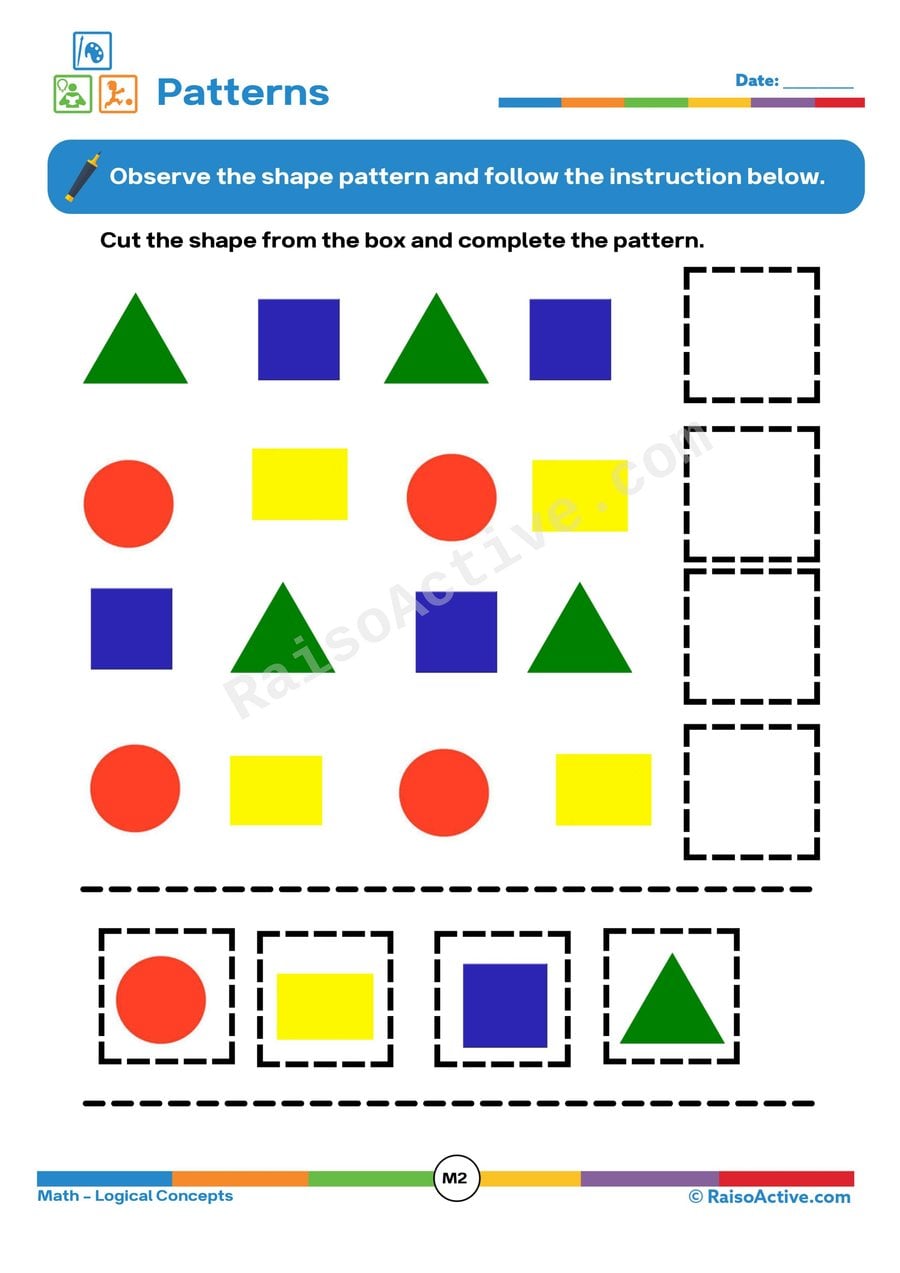
Shape Pattern Worksheet: Complete the Pattern!
Ages 3-5 · Preschool–Pre-KAges 3-5 · Nursery–ReceptionAges 3-5 · Nursery–LKGAges 3-5
Completing a repeating shape pattern asks children ages 3-5 to notice what comes next in a sequence and predict it correctly, an early form of the logical reasoning used in algebra much later on. Recognizing and continuing patterns also strengthens visual memory, since a child has to hold the beginning of the pattern in mind while figuring out what should come next.

Observe and Draw: Pattern Recognition Worksheet for Preschoolers
Ages 3-5 · Preschool–Pre-KAges 3-5 · Nursery–ReceptionAges 3-5 · Nursery–LKGAges 3-5
This worksheet challenges children ages 3-5 to identify decreasing patterns — sequences where shapes shrink or reduce in a predictable way — and draw the next shape in that sequence themselves. Decreasing patterns are more demanding than simple repeating patterns because children must track a changing rule, like shapes getting smaller, rather than a fixed repeating unit. Drawing the answer, rather than choosing from options, also requires stronger visual-motor planning to reproduce the shape accurately at the right size.
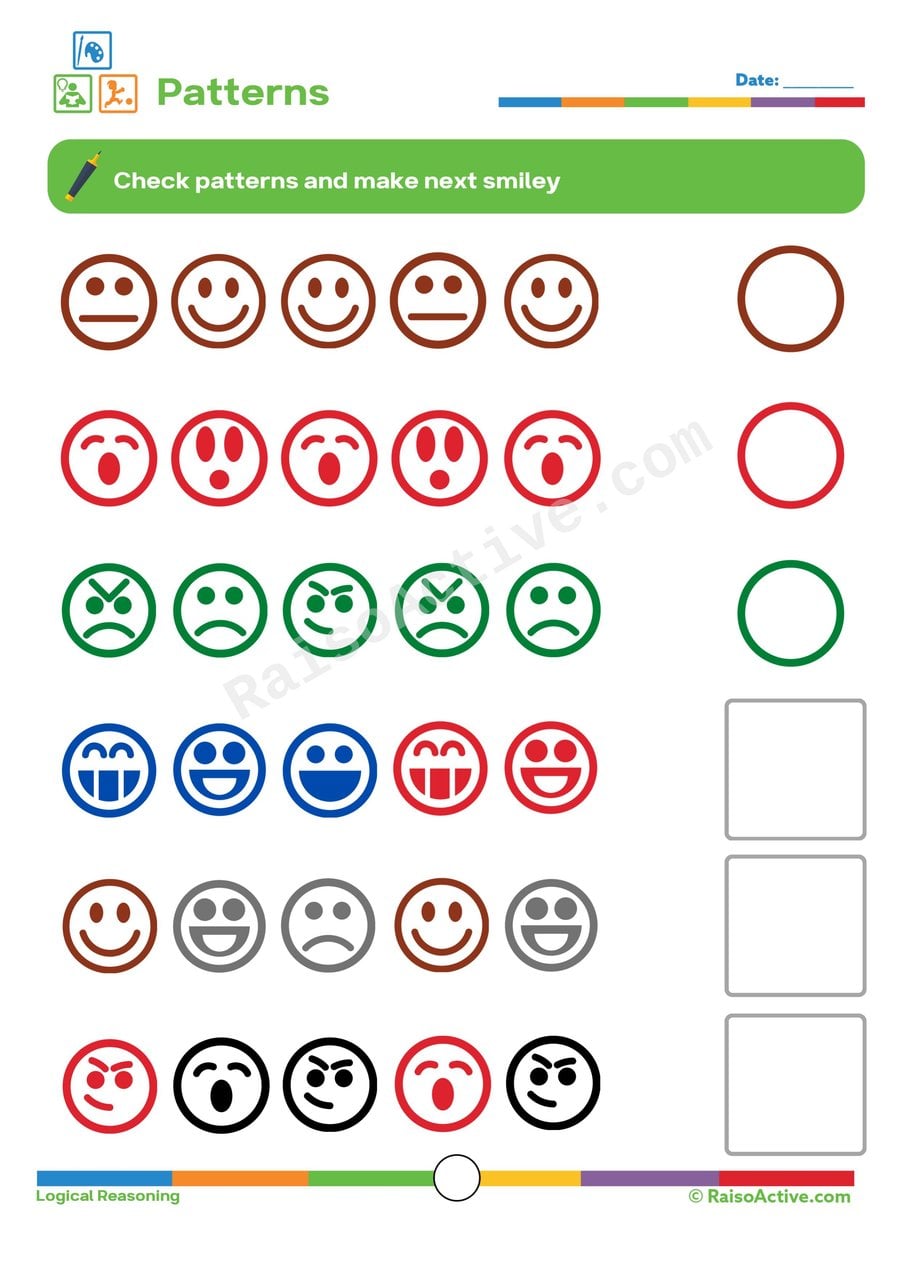
Smiley Face Patterns Worksheet for Preschoolers
Ages 3-5 · Preschool–Pre-KAges 3-5 · Nursery–ReceptionAges 3-5 · Nursery–LKGAges 3-5
This pattern worksheet has children ages 3-5 study a row of smiley faces with varying expressions or colors and determine what comes next in the repeating sequence, building foundational pattern recognition and logical reasoning skills. Recognizing and extending patterns is one of the earliest forms of mathematical thinking children encounter, laying groundwork for later work with number patterns, skip counting, and algebraic reasoning. Because the pattern uses a familiar, emotionally engaging image like a smiley face, children stay motivated through several rows of repeated practice.
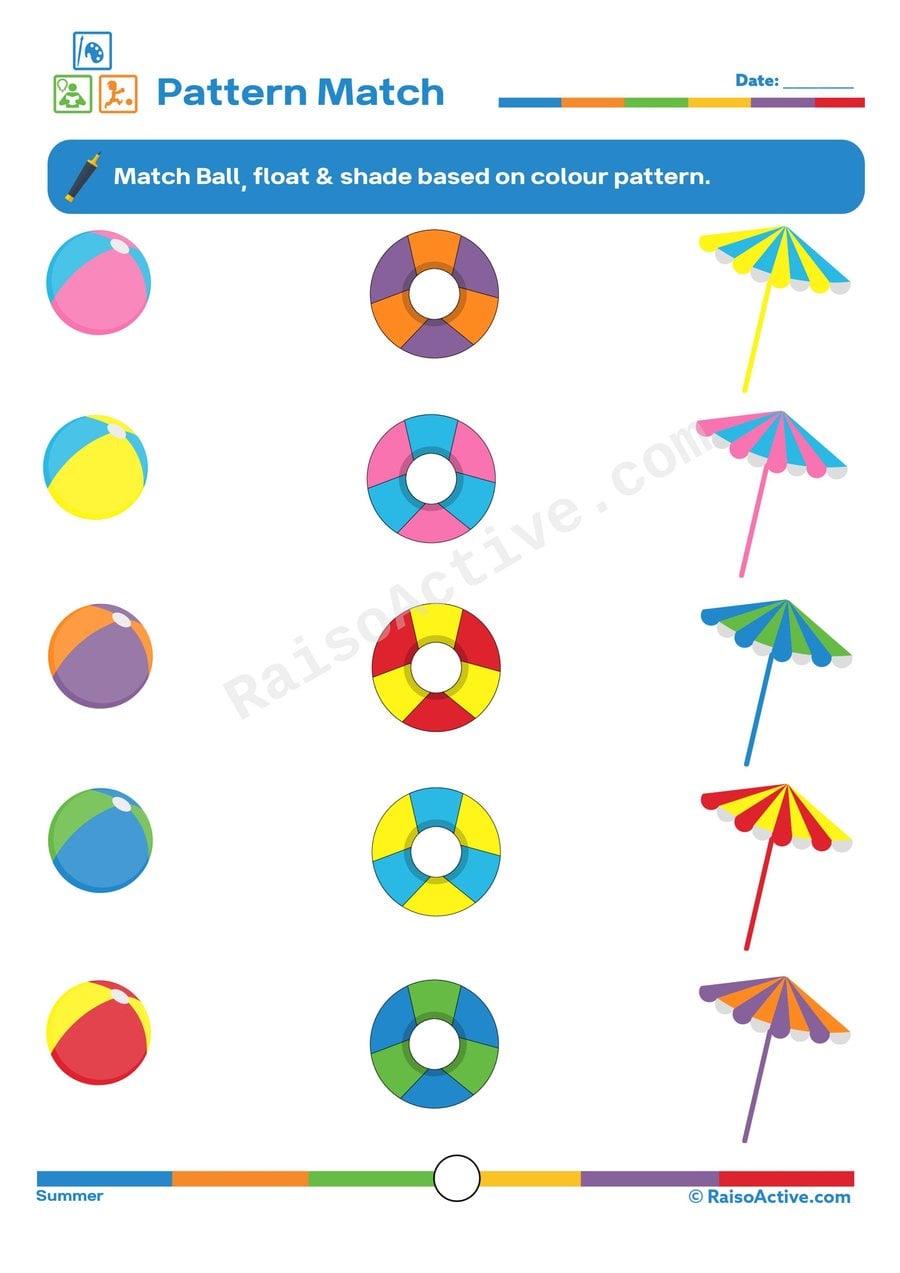
Summer Pattern Match Worksheet for Preschoolers
Ages 3-5 · Preschool–Pre-KAges 3-5 · Nursery–ReceptionAges 3-5 · Nursery–LKGAges 3-5
This worksheet asks children ages 3-5 to study the color pattern on a beach ball, pool float, and sun umbrella and match each item to its correctly patterned counterpart, building early pattern recognition, a foundational skill for later math concepts like sequencing and algebraic thinking. Because the match depends on noticing the order and repetition of colors rather than just matching a single color, children must compare details carefully rather than glance quickly. This strengthens visual attention alongside the pattern skill itself.
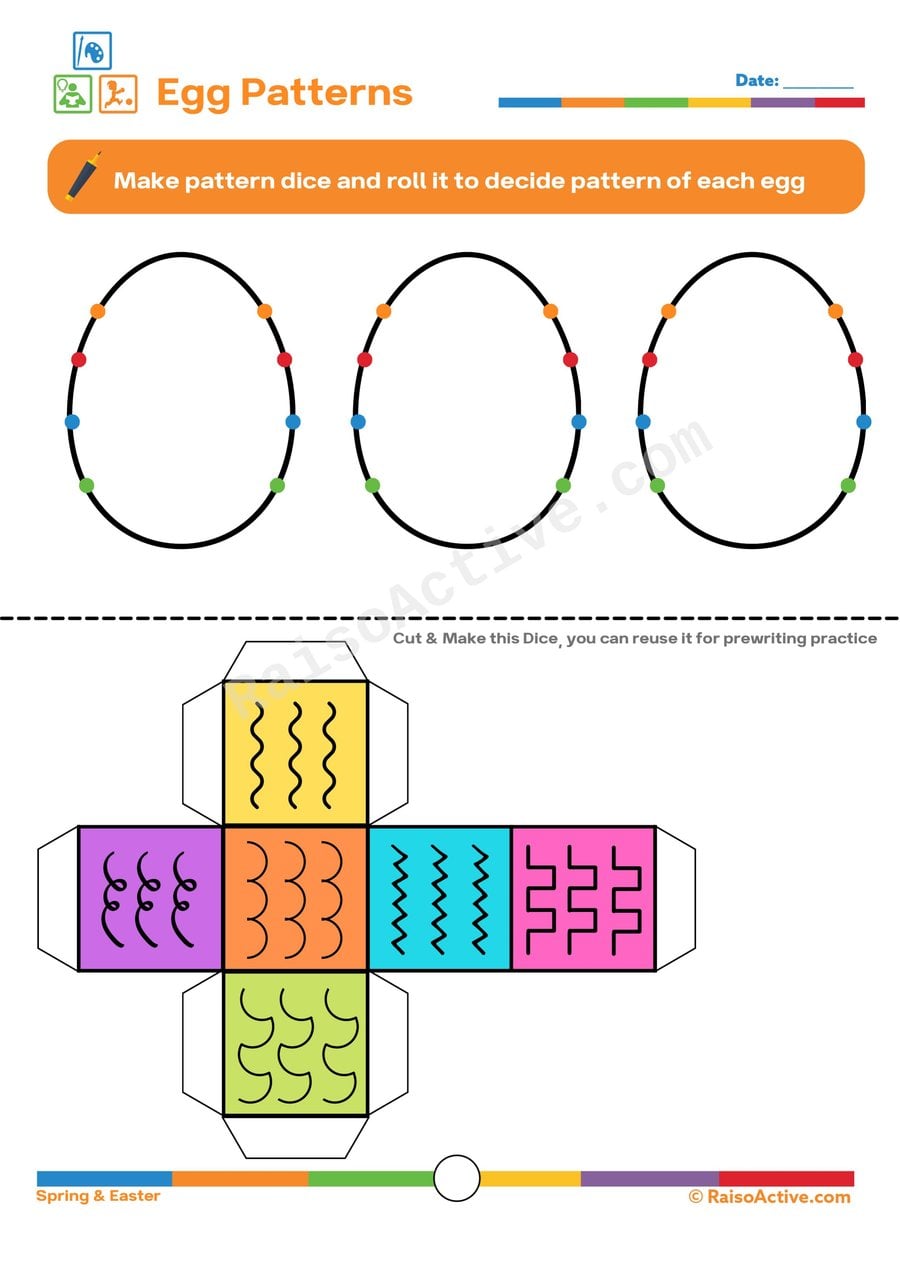
Egg Pattern Worksheet: Create and Match Patterns!
Ages 3-5 · Preschool–Pre-KAges 3-5 · Nursery–ReceptionAges 3-5 · Nursery–LKGAges 3-5
This egg-pattern activity has children ages 3-5 build a simple pattern dice and use it to generate and recreate repeating designs, developing pattern-recognition skills that underpin later math concepts like sequencing and multiplication. Rolling the dice and transferring the result onto each egg also connects a random outcome to a deliberate drawing action, strengthening cause-and-effect thinking.

Shape Pattern Worksheet: Identify and Color the Next Shape!
Ages 3-5 · Preschool–Pre-KAges 3-5 · Nursery–ReceptionAges 3-5 · Nursery–LKGAges 3-5
This worksheet helps children ages 3-5 recognize and continue simple repeating shape patterns, an early form of the logical reasoning that later supports algebraic thinking. Coloring the shape that comes next also requires children to first identify each shape by name, reinforcing basic geometry vocabulary.

Match the Patterns: Fun Worksheet for Preschoolers
Ages 3-5 · Preschool–Pre-KAges 3-5 · Nursery–ReceptionAges 3-5 · Nursery–LKGAges 3-5
By connecting each picture to its matching pattern, children ages 3-5 practice visual pattern recognition - the ability to notice a repeating sequence of colors, shapes, or objects - which is an early building block for both math reasoning and reading, since reading also relies on recognizing repeated letter patterns. The worksheet also builds fine motor control as children draw connecting lines with a pencil or crayon.
Guides for this topic

Pre-Writing Strokes in Order: From Standing Lines to Loops (With Printable Patterns)
The developmental order of pre-writing strokes, from vertical lines to loops, and why practicing them in sequence makes letter formation much easier to learn.

Best Worksheets for 3-Year-Olds: What Works and What to Avoid
What works on worksheets for 3-year-olds: short sessions, crayons, tracing lines, matching, cutting, a free weekly plan, and signs one is too advanced.

Age-Appropriate Problem-Solving Activities: Building Critical Thinkers from the Ground Up
Discover fun, age-appropriate problem-solving activities for children ages 1-8. Build critical thinking, logic, and reasoning skills through play-based learning.
Reviews
Every worksheet for ages 3–5, no watermark
Members download the full library of 1,000+ worksheets and every activity pack without watermarks or daily limits. One year costs ₹999 in India or $20 elsewhere.
See membership plansOr download any worksheet free with a watermark (5 a day).