Coding Kites Worksheet: Match the Bows!
By matching each colorful bow to the kite sharing its color pattern, children ages 3-5 practice visual pattern recognition — an early form of the same logical sequencing used in beginner coding concepts. Cutting, matching, and gluing the correct bow also reinforces color-word vocabulary and precise hand-eye coordination.
Part of the pack
Hands-On Early Learning Activity Book: Math, Science, Literacy & Emotions for Ages 3-6
This is page 5 of the pack. Ages 3-6 · Preschool–KindergartenAges 3-6 · Nursery–Year 1Ages 3-6 · Nursery–UKGAges 3-6
Made for your child
Counting to 10, made for your child
A maths pack with your child's name in it: pictures that explain, practice at three levels, puzzles and story sums about them. Print a new set whenever they finish.
Make a maths packFree preview · free for members
Curriculum
- Patterns > Patterns
How to use this worksheet
First, have your child cut out the bows along the dotted lines at the bottom of the page. Next, look at the color pattern on each kite together and find the bow whose colors repeat in the same order. Once a match is found, apply a small dot of glue to the back of the bow and press it onto the matching kite's tail. Repeat until every kite has its correct bow, then let your child color in the rest of each kite.
Materials needed
- Scissors
- Glue
- Pencil
Extension activities
- 1Create a simple three-color repeating pattern with beads or blocks and ask your child to continue it.
- 2Design a brand-new kite pattern on paper and challenge a sibling or friend to find its matching bow.
- 3Go outside and fly a real kite, if the weather allows, and talk about what makes kites stay in the air.
- 4Sort loose buttons or pom-poms by color to reinforce the color-matching skill from the worksheet.

Written by
Hemsweta Jain · Teacher Cheena
MBA and Early Childhood Educator, teaching since 2014 · Founder of RaisoActive, Mumbai
Every RaisoActive worksheet is designed and checked by the founder before publishing.
Published · Last reviewed
Related worksheets

Clothing Pattern Match Worksheet for Preschoolers
Ages 3-5 · Preschool–Pre-KAges 3-5 · Nursery–ReceptionAges 3-5 · Nursery–LKGAges 3-5
This worksheet has children ages 3-5 study repeating patterns on clothing items — stripes, polka dots, or checks — and match each item to its identical twin, building visual discrimination and early pattern-sequencing skills. Distinguishing between similar-looking patterns also sharpens attention to detail, a skill that later supports letter and word recognition.

Balloon Pattern Matching Worksheet for Preschoolers
Ages 3-5 · Preschool–Pre-KAges 3-5 · Nursery–ReceptionAges 3-5 · Nursery–LKGAges 3-5
Children ages 3-5 build early pattern-recognition skills on this worksheet by studying a sequence of colored balloons and finding the matching set to complete it. Recognizing and continuing a repeating sequence is a foundational pre-math skill that later supports understanding of number patterns, skip counting, and simple algebraic thinking.
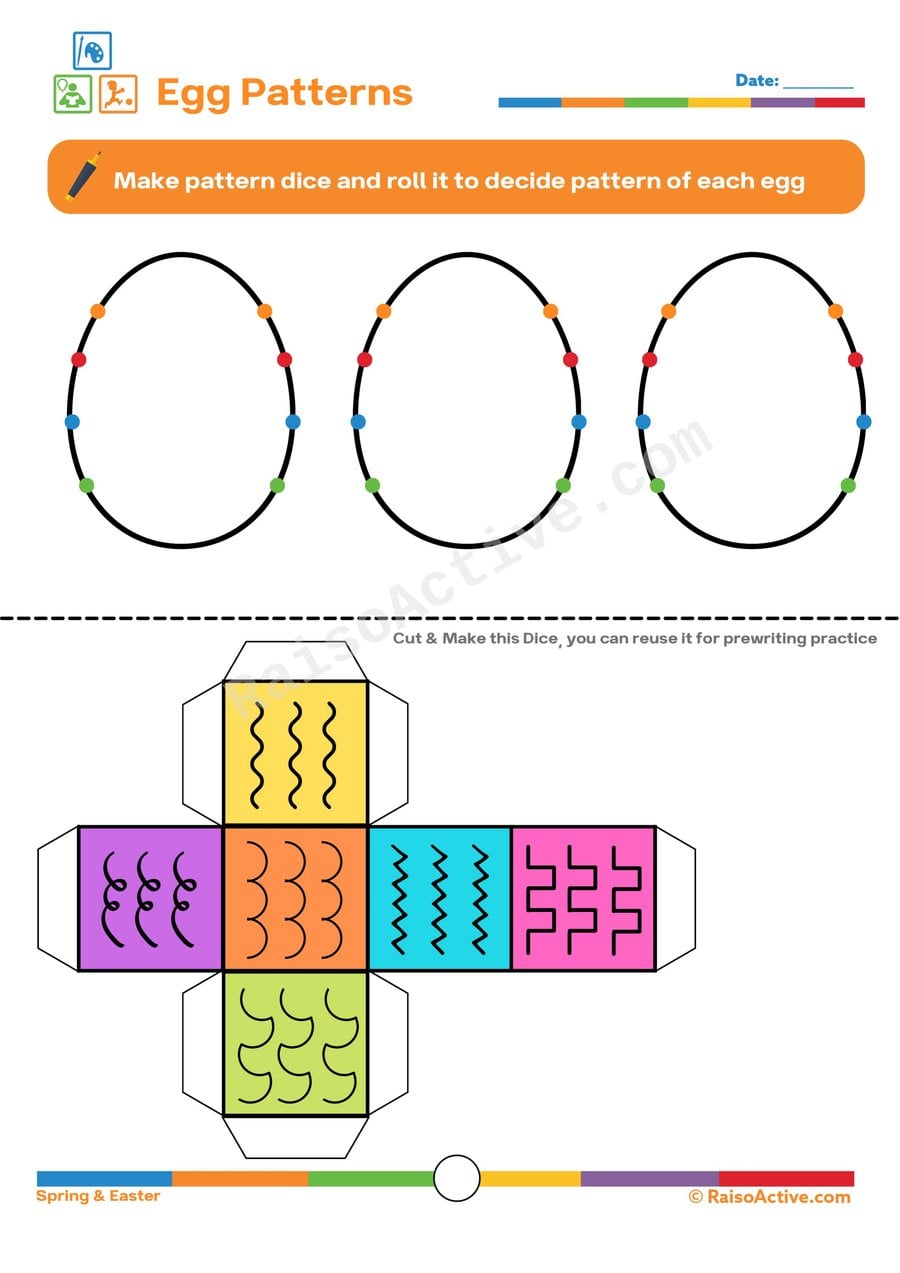
Egg Pattern Worksheet: Create and Match Patterns!
Ages 3-5 · Preschool–Pre-KAges 3-5 · Nursery–ReceptionAges 3-5 · Nursery–LKGAges 3-5
This egg-pattern activity has children ages 3-5 build a simple pattern dice and use it to generate and recreate repeating designs, developing pattern-recognition skills that underpin later math concepts like sequencing and multiplication. Rolling the dice and transferring the result onto each egg also connects a random outcome to a deliberate drawing action, strengthening cause-and-effect thinking.

Fall Leaf Patterns Matching Worksheet for Preschoolers
Ages 3-5 · Preschool–Pre-KAges 3-5 · Nursery–ReceptionAges 3-5 · Nursery–LKGAges 3-5
Children ages 3-5 build pattern recognition and logical reasoning skills by matching colored fall leaves to complete repeating patterns in a grid. Recognizing and continuing a pattern is an early algebraic thinking skill, teaching children to notice what comes next based on a repeating sequence — a foundation for later math concepts.

Easter Egg Pattern Matching Worksheet for Preschoolers
Ages 3-5 · Preschool–Pre-KAges 3-5 · Nursery–ReceptionAges 3-5 · Nursery–LKGAges 3-5
This seasonal worksheet strengthens pattern-recognition and visual matching skills in children ages 3-5 by having them connect a decorative pattern to the Easter egg that displays the same design. Matching a pattern swatch to its corresponding decorated egg requires close visual comparison of colors, shapes, and repeating elements, sharpening the same attention-to-detail skills used in reading and early math. The seasonal egg theme adds festive motivation to the visual discrimination practice.

Camera Spy - Pattern Recognition Worksheet for Preschoolers
Ages 3-5 · Preschool–Pre-KAges 3-5 · Nursery–ReceptionAges 3-5 · Nursery–LKGAges 3-5
This worksheet develops visual scanning and pattern-matching skills in children ages 3-5 as they use a 'spy camera' to find smaller patterns hidden within a larger image. Searching for a specific pattern among distractors builds sustained visual attention, a skill that supports later tasks like letter recognition and proofreading.

Camera Spy: Find the Patterns Worksheet for Preschoolers
Ages 3-5 · Preschool–Pre-KAges 3-5 · Nursery–ReceptionAges 3-5 · Nursery–LKGAges 3-5
This pattern-recognition worksheet has children ages 3-5 study a set pattern shown at the top of the page and then locate that same repeating sequence within smaller boxes below, training visual comparison and pattern-matching across separate parts of a page. Unlike simply continuing a pattern, this format asks children to recognize an identical pattern elsewhere, a subtly different and useful skill for later tasks like matching sets or comparing groups. Repeating this scan-and-match process across several boxes builds sustained visual attention.

Camera Spy: Find the Patterns Worksheet for Preschoolers
Ages 3-5 · Preschool–Pre-KAges 3-5 · Nursery–ReceptionAges 3-5 · Nursery–LKGAges 3-5
This 'camera spy' activity gives children ages 3-5 practice identifying repeating visual patterns within a busy scene, using a cut-out paper camera as a fun framing tool to focus their attention on one section at a time. Framing pattern-spotting as detective work keeps young children motivated through a task that otherwise requires sustained visual scanning. This early pattern recognition in a complex scene is more demanding than spotting patterns in a simple row, since children must first locate the pattern before they can identify it.
Guides for this topic

Pre-Writing Strokes in Order: From Standing Lines to Loops (With Printable Patterns)
The developmental order of pre-writing strokes, from vertical lines to loops, and why practicing them in sequence makes letter formation much easier to learn.

Best Worksheets for 3-Year-Olds: What Works and What to Avoid
What works on worksheets for 3-year-olds: short sessions, crayons, tracing lines, matching, cutting, a free weekly plan, and signs one is too advanced.

Age-Appropriate Problem-Solving Activities: Building Critical Thinkers from the Ground Up
Discover fun, age-appropriate problem-solving activities for children ages 1-8. Build critical thinking, logic, and reasoning skills through play-based learning.
Reviews
Every worksheet for ages 3–5, no watermark
Members download the full library of 1,000+ worksheets and every activity pack without watermarks or daily limits. One year costs ₹999 in India or $20 elsewhere.
See membership plansOr download any worksheet free with a watermark (5 a day).